Cloud Computing for Digital Libraries in
Universities
Dev Ras Pandey, Gauri Shanker Kushwaha
Research Scholars, MGCGV Chitrakoot, Satna(M.P.)
Abstract:In India libraries are building and managing their own data centers. Model that maintains more control on the applications and data centers that private information about us. The challenging point is provisioning and maintenance of infrastructure for digital library based on web applications. To outcome these challenges we have to apply e-learning system as a product of modern in sequence technology to implement education modernization. Through the cloud computing technology and features of e-learning technology teachers can involve in the e-learning process of students openly. Beginning of computer with sophisticated software has made it potential to explain many composite troubles quickly and at lower cost. Paper introduces the self of the current e-learning and then describes the architecture of cloud computing to building and managing libraries. Cloud computing offers a range of new opportunities for developing countries to do what they could not do in advance with computers and the Internet. Cloud computing infrastructure and applications are able to interact with users who have mobile phones, Tablet PCs, OLPC [one-laptop-per-child], and other mobile devices. Because the mobile phone and devices user market is too big to be ignored, cloud service providers, in collaboration, with mobile service providers have deployed hundreds of cloud-enabled applications and are continuing in their end to provide an endless range of products.
I. INTRODUCTION
The term cloud computing is completely new trend and technology which is known as third party revolution after computer and internet, in distributed computing, parallel computing, grid computing and in the case of distributed database improves the power of above in digital library. It provides distributed environment that makes easier to collect information from local computers, personal computers, remote computers, mobile phones or other equipments and also integrate that information to serving users. Digital library technology popularization provides resources sharing with difficulty from each in sequence with aggregate demand.
The beginning of the word cloud computing is undecided. Alternative illumination is that the old programs to draw network schematics surrounded the icons for servers with a circle, and a group of servers in a network diagram had several overlapping circles, which resembled a cloud. Cloud was used as a metaphor for the internet and a standardized cloud like shape to denote a network.
The cloud symbol was used to represent the Internet as early as 1994, in which servers were shown connected outside the cloud. Cloud computing in its modern sense appeared as early as 1996, with the earliest known mention in a Compaq internal document, more popularization of the term can be traced in 2006 when Amazon.com introduced the Elastic Compute Cloud.
In July 2010, Rack space Hosting and NASA jointly launched an open-source cloud-software project known as Open Stack. The Open Stack project proposed to help organizations offer cloud-computing services running on standard hardware. The early code came from NASA's Nebula platform as well as from Rack space's Cloud Files platform.
The National Institute of Standards and Technology (NIST) defines “cloud computing as a model that helps enable everywhere, convenient, on-demand network access to a shared pool of configurable computing recourses (networks, servers, storage, applications, and services) that can be rapidly provisioned and released with minimal management effort or service provider interaction”. [1]
Cloud Characteristics:
On-demand Self- Services: A Consumer can unilaterally obtain computing capabilities computer services such as email, applications, server time and network storage as needed automatically without requiring human interaction with each service provider.
Broad network access: Cloud capabilities are available over a network and can be accessed through standard mechanism that promotes use by (multiple) client platforms such as mobile phones, laptops, PDAs (Personal Digital Assistants).
Recourse pooling: one of the great strengths of cloud computing is that the provider is able to pool computing resources, such as storage, processing, memory, network, bandwidth, and virtual mechanics , to serve multiple consumers with different physical and virtual machines and email services dynamically assigned and reassigned according to the consumer demand. The subscriber generally has no control over or knowledge of the exact location of the provided resources.
Rapid elasticity: Cloud services can be rapidly and
elasticity provisioned, in some cases automatically to quickly scale out and rapidly released to quickly scale in to the consumer, the capabilities available for provisioning often appear to be boundless and can be purchased in any number at any time.
Measured services: Cloud systems use a metering
capability which enables to control and optimize recourses use by filtering services appropriately by its type. Resources use is measured, monitored, controlled and reported, providing transparency for both the provider and consumer of the utilized services.
segmentation, isolation, power, service levels, and chargeback/billing models for different consumer constituency. Clients might make the most of a public cloud provider’s service contributions or essentially be from the same organization, such as different business units somewhat separate organizational entity, but would still share infrastructure.
Service models
Infrastructure as a service (IaaS): Infrastructure as a service, allows the consumer to obtain basic services such as virtual servers, data storage, and databases into one platform for deploying and running our applications. The consumer does not manage or control the primary cloud infrastructure but controls operating systems, storage and deployed applications and may have limited control of select networking components. The two primary aspects that make IaaS special: Elasticity and virtualization.
Platform as a service (PaaS): PaaS allows developers to build and deploy web applications on a hosted infrastructure and allows them to leverage the apparently infinite compute resources of a cloud infrastructure. The consumer does not control the underlying cloud infrastructure, including network, servers, operating systems, or storage, but has control over the set up applications and possibly application hosting environment configurations.
Software as a service (SaaS): This model allows replacing the applications running on PC. If we are using SaaS service model of cloud computing then there is no need to install and run the special software on our computer. Applications can be accessed from various client devices through a thin client interface such as web – based email. The consumer do not manage or control underlying cloud infrastructure, including network, servers, operating systems, storage, or even individual application capabilities, with the feasible exception of limited user-specific application configuration settings.
Choosing an infrastructure
Private cloud: a model which is built for the limited use of one user, providing the maximum control over data, security, and quality of service. The user generally owns the infrastructure and has control over how applications are hosted on it. Private clouds may be deployed at the user’s data center, or at a common facility.
Public cloud: A model in which a service provider
provides resources such as applications and storage to everyone over the Internet. Public cloud services are usually offered on a pay – per – usage model. They are generally run by third parties, and various applications are likely to be interlaced together on the cloud’s servers. The infrastructure is made available to the general public or a large industry group and owned by an organization selling cloud services.
Community cloud: A model that typically refers to a
particular purpose cloud computing environment, shared and managed by a number of related entities participating in a common agenda. It can be managed internally or by a third-party and hosted internally or externally the
organizations or a third party and may exist on or off premises.
Hybrid cloud: A model which can be treated as a private cloud or as a public cloud. A hybrid cloud is a special environment in which the user provides and manages some resources in-house, and outsources the rest. [8]
II. PROBLEMS OF DIGITAL LIBRARY
Digital library for our study provides an appropriate, along with the increasing knowledge level, the requirement of digital library and increasing because of uneven economic development in different regions causes the digital library’s resources to be comparatively short, to university digital library as an example. Various colleges and universities while are raising the respective teaching level unceasingly, have established a digital library to purchase its own database resources, but because of the teaching focus and economic conditions, library resources between university's has the differences, meanwhile looked from the whole that the Digital library has certain flaw. Data resources between various universities are relatively independent, building redundant projects possibility was high, has created the manpower, the financial resource and the resources waste, or some colleges and universities to use only part of database resources, inadequate use of resources, and cannot play resources maximum utilization. Digital library representative one kind of new infrastructure and the environment, through the cloud computing, it may use resources more effective, and can solve the defects of digital library.
a) Cloud computing awareness
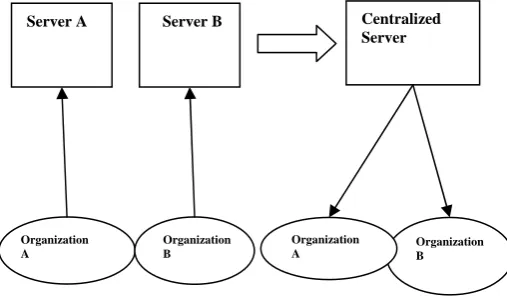
Based on cloud computing in the cost design, presentation, team collaboration and the returns of the physical location, because parallel the different application process has used the different mutually self-sufficient platform, each application procedure finalizes on own server. Using cloud computing we can share the server in many application procedures, appreciates the resource sharing, thus also reduced server's quantity, achieves the effect of reducing the cost, therefore utilizes cloud computing in the Digital library, will give our work, the life and the study inevitably gains a greater efficiency, see figure 1.
Server A Server B Centralized
Server
Organization A
Organization B
Organization B Organization A
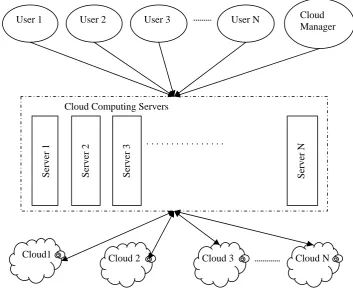
Every cloud computation's server may be the computation server, saves the server or the wide band resources and so on, in figure 2 every cloud signifies any university Digital library database resources, every two clouds or more clouds may compose a bigger cloud, may divide the cloud or the composition cloud by the different regions either the different rank university. SaaS, Software as a service, through the browser to the form of services on condition that to the applications, to users and suppliers to reduce costs. PaaS, Platform as a service, defined by the form of services provided to the developers application development and deployment platform, so that they can use this platform to develop, deploy and manage SaaS applications. The platform normally includes a database, middleware and development tools, all are in the form of services through the Internet. IaaS: infrastructure as a service, defined by the form of services to provide servers, storage and networking hardware. SDK Software Development Kit refers to supporting development of a certain type of software, certification, samples, and a group of tools. In spacious, SDK that the development of applications under the Windows platform.
b) Permissions recognition
Cloud administrator ought to is composed by university usual, government representative and service provider representative , its responsibility should be the organization daily operation, provides the high grade service and the high security, the creation treaty, the synchronized all quarters' benefit and brings on permission on the forbidden user and the contrary procedure. First, user requested to the Internet transmission, and between cloud platform and
Internet continuous revision key, in order to defend the platform. Concurrently the cloud platform describes an access rule to its user, the user transmits own status to the platform, the platform basis rule production user authorizations statement.
III. EXPLORATION OF CURRENT USER SERVICE MODEL
IN DIGITAL LIBRARIES OF UNIVERSITIES
University library, as a most significant hypothetical and scientific research base, charges for providing information services for its users. In the past, most libraries contended that their facility is based on their individual library resources so librarians hardly considered users demands. But today, modern libraries must change this viewpoint and librarians usually need to collect as more information as they can, rendering to users' wants then they will observe the information and sort out them. Finally, they will provide them for users in some certain technical systems. However, services in modern libraries will increasingly focus on users' stimulating in future and the ultimate goal of modern library is to offer suitable, inclusive and multi-level services for its users. At existing user service models are mainly WWW service model, FTP service model, BBS and E-mail service model, etc.
a) WWW Service Model
WWW (World Wide Web) is based on client server model. It presents all kinds of information browsing systems with the bases of HTML language and HTTP protocol. The exact division is: WWW Servers are in charge of linking web pages by hypertext links and WWW clients are responsible for showing information and sending requests Cloud Computing Servers
. . .
Server 1 Server 2 Server 3 Server N
User 1 User 2 User 3 Cloud Manager User N
Cloud1 Cloud 2 Cloud 3 Cloud N
to servers and the most important feature of WWW service is its high degree of integration. In other words, it can connect all kinds of information and services seamlessly and provide users with vivid graphical user interface finally. In general, WWW provides new means of searching and distribution information for people around the world. Meanwhile, it gradually becomes the best means of active multimedia communicating for people.
b) FTP Service Model
FTP (File Transfer Protocol) is a usually used communication protocol and it is comprised of various rules that support file transfer on the Internet as such rules can permit online users copy files from one host to another, it brings great suitability and benefits to users just as other Internet service, FTP is also based on client-server model, temporarily, it's easy to learn to use FTP service. First, you only need to start the FTP consumer package to join with remote host, then you should issue file transfer command to remote host and after remote host received the command, it will give respond and implement the correct operation. Launching FTP service in university library network classification is a good type which brings great accessibility for users and library as well. By using FTP service in university library, users can make their own password, such as using their Email address, and this can let librarians obtain users visiting records simply. Additionally, according to users' visiting records, librarians can offer consistent services for them and improved users' agreement.
c) BBS and E-mail Service Model
BBS (Bulletin Board Service) is a kind of electronic information service system on the Internet. It is just like a public blank board on the internet; all users can write their thoughts or announcement information on this board and E-mail is just another kind of information service on the Internet. In a word, E-mail provides a very quick, simple and economical way of communication for the Internet users in the whole world. Through BBS system, library users can ask and consult librarians at any time. Generally they can get their response in a very short period of time. Meanwhile, librarians can communicate with more users at a time through BBS. What's more, university libraries can open lectures, release announcements and provide online help for users by BBS system and through E-mail system, users can obtain their desirable information and knowledge resources more quickly and economically as they don't need to visit libraries personally.
In the new information environment, several IT technologies updated appropriate so current user service models are already out of date at some extent. Although they brought suitable services for users and saved their time indeed, they cannot keep up with the development of libraries. Facing the problems of shortage of funds, manpower and other material resources, existing user service models cannot deal well with them effectively. What's worse, they may cause waste of resources and affect the quality of library services. BBSes were usually text – based, rather than GUI – based and early BBSes conversed using the simple ASCII character set. However, some home computer manufacturers extended the ASCII character set
to take advantage of the innovative color and graphics capabilities of their systems.
IV. ENHANCEMENT OF USER SERVICE MODEL IN
UNIVERSITY LIBRARIES
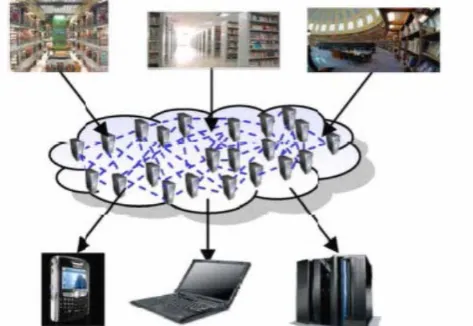
With the rapid development of various IT technologies, users' information requirements are progressively adapted and now more and more libraries sponsored user-centered services. So librarians should mine and study users' information desires frequently and only in this way, they can master the basic demands of their users and furthermore, library can develop itself according to such information and improve users' fulfillment. University library, as we all know, is well-known for its hypothetical and teaching influences. And IT technology has been the driving force of library development. What's more, librarians can keep using new technology to develop library and enhance library services. With the growth of Cloud Computing request, this paper anticipated to apply Cloud Computing in libraries. By establishing a pubic cloud among many university libraries, it not only can conserve library resources but also can improve its user satisfaction, and it can be illustrated in figure 3.
Figure 3 Use of Cloud Computing in University Library
a) Unified Search Service Model
Though there are OPAC (Online Public Access Catalog) and ILL (Inter – library loan) facilities already, library users still cannot access to the shared resources through a uniform access platform. However, with the implementation of Cloud Computing in university library, the integrated library resources support dispersed uniform access interface. At the same time, the unchanging access platform can promote library resources, guide and answer users' questions by using high – quality navigation. As a result, users can grip more information recovery methods and make better use of library principals.
b) Integrated Consulting Services Model
resources, specialists and services of university libraries. Also, it will develop QI A smart joint service system, and this will bring great services for library users.
c) Real-time Access Services Model
In the era of digital libraries, library workers remunerated more attention to electronic journals, electronic databases and so on. This is certainly a big challenge for university libraries but by introducing Cloud Computing, university libraries can create a shared public cloud equally. As shared cloud can have unlimited storage capacity and computing power hypothetically. It can bring noticeable benefits to libraries, on one hand, associated libraries no longer consider the hardware cost; on the other hand, it can help reduce the obtaining of electronic database resources frequently among allied libraries. Meanwhile, users can visit the shared resources by any station equipment, such as PC, 30 mobile phones or PDA only if you can access to the Internet.
d) Knowledge Service Model
In the context of the knowledge economy, knowledge resource has become the main resource affecting efficiency development and university libraries are the main departments of storing, processing and spreading knowledge. So how to offer users with well – organized transmission of information and knowledge services became urgent task for librarians today T91. However, the Emergence of Cloud Computing accelerated library's development and the establishment of shared public cloud can save manpower and material resources greatly among university libraries. Therefore, with the aid of Cloud Computing, librarians won't have to maintain their own equipment or deal with discussions personally and librarians will have more time and energy to offer users with their needed knowledge-based services but not only information.
e) All – oriented Service Model
Comparing with foreign university libraries, we can find that foreign libraries are intended to provide services for all the people. In addition the professors, teachers or students, all the people of that country can access to the library resources. Besides, they also permit users access to many libraries' resources by handling related certificate of that library and fortunately, domestic libraries can also do this in the cloud environment. Anybody who can through the legal network identity verification has the right to visit the joint resources of university libraries on the Internet. In other words, university libraries will offer services for all the people with the benefit of Cloud Computing.
V. CONCLUSION
We all know that library is not only a knowledge ocean; its crucial purpose is to offer acceptable services for all the people. So in the new age, library should advance itself constantly by adopting many new IT technologies. As well as in this paper, we tried to make progress current user service model in university library by using Cloud Computing. Even though study of Cloud Computing is still in the initial stage now, impacts carried by Cloud Computing are obvious. With the overview of Cloud Computing to university library, services of libraries will have a new leap in the near future. Services provided by libraries will become more user – centric, more professional and more effective, etc. And we all believe that libraries will create more knowledge benefits for our country with the help of Cloud Computing. Cloud environment is a highly developed network environment; it appears to the users of high – quality service and high security. The Cloud computing techniques and methods applied to digital libraries, not only can advance the employment rate of resources to address the imbalance in development between regions, but also can make more broad use of cloud computing to our work life.
REFERENCES:
1. Michael Miller, Cloud computing: Web-based Applications That
Change the Way You Work and Collaborate Online [M]. Que Publishing, 2008.
2. Mladen A. Vouk, Cloud Computing – Issues, Research and
Implementations, Journal of Computing and Information Technology – CIT, 4, 235–246, September, 2008.
3. Rupesh Sanchati, Gaurav kulkarni, Cloud Computing in Digital and University Libraries, Global Journal of Computer Science and Technology, Volume 11, Issue 12, Version 1.0, July 2011.
4. Sam Goundar, Cloud computing: Opportunities and issues for
developing countries, Diplo Foundation with the financial assistance of the European Union, 2011.
5. D Kishore Kumar, Dr.YSSR Murthy, D. Ramakrishna, A. V. Rohit, Application of Cloud Technology in Digital Library, IJCSI, International Journal of Computer Science Issues, Vol. 9, Issue 3, No 1, May 2012.
6. Prof. Vaishnavi. J. Deshmukh, Prof. Sapna. S. Kaushik, Prof. Amit. M. Tayade, Cloud Computing System for E-Learning: A Design and Development Approach, International Journal of Advanced Research in Computer Science and Software Engineering, ISSN: 2277 128X, Volume 3, Issue 5, May 2013.
7. http://securesoftwaredev.com/cloud-computing/on-demand-self-service/
8. Chunye Gong, Jie Liu, Qiang Zhang, Haitao Chen and Zhenghu