VICTORIA ~ UNIVERSITY
•
·' ~0
-0
0
..
DEPARTMENT OF COMPUTER AND
MATHEMATICAL SCIENCES
Distributed Intelligent Power System Protection
Using Case Based and Object Oriented Paradigms
S. K. Wong and A. K. Kalam
(59 COMP 20)
June, 1995
(AMS
:
68T01)
TECHNICAL REPORT
VICTORIA UNIVERSITY OF TECHNOLOGY
(P
0
BOX 14428) MELBOURNE MAIL CENTRE
MELBOURNE, VICTORIA, 3000
AUSTRALIA
TELEPHONE (03) 9688 4249
I
4492
ABSTRACT
Distributed Intelligent Power System Protection
Using Case Based and Object Oriented Paradigms
*S.K Wong **A.K. Kalam
*Department of Computer and Mathematical Sciences **Department of Electrical and Electronic Engineering
Victoria University of Technology, AUSTRALIA.
1.0 INTRODUCTION
The expert system paradigm has increasingly been used in the development of power system applications. The areas of interest include power system management, system restoration, forecasting, protectiOJ?-, communication, distribution, transmission, scheduling, monitoring, security, control and many more. However, the number of research projects in intelligent power system protection is relatively small. These include application and simulation systems developed for setting calculations for distance protection in zones 2 and 3, load forecasting, distance relaying, alarm processing, fault analysis and transformer protection [I, 5, 8, 10, 11].
However, it is worth noting that: (i) most of the applications are expert system applications which basically employ production rules with backward and/or forward chaining processes; (ii) applications concentrate mainly on the analysis of power systems eg. alarm processing, fault calculations and relaying. It follows that comparatively few knowledge based or decision support systems have been developed and very few applications actually involve the design and analysis of the performance of protection systems.
Expert systems have been successfully applied to well defined problems. Major difficulties arise however, when dealing with problems which are ill defined and, at the same time, are highly diversified. The difficulties are due to [2]:
(i) Building and maintaining the consistency of a complex rule based system;
(ii) Integrating the various knowledge representations and reasoning strategies used by different systems;
(iii) Restricting the problem domain of an expert to a specific area.
Some of the expert systems developed in the protection area are discussed in [4, 9]. Most of these systems involve a large number of formal expert rules. To maintain such knowledge bases which may involve frequent or numerous updates would be very difficult if not impossible task.
An example of an application system which uses relations to represent domain knowledge for power system is called CAPE [3]. CAPE is a productivity tool developed on InterBase - a commercial relational database management system -consisting of a large number of tables. However, the process of updating and querying such tables could be slow whilst maintaining consistency and integrity of the database could prove cumbersome. In general, there are small number of applications [7, I 0, 15] that focus on assisting engineers in the design and assessment of protection schemes. Both [7, 10] are relatively small systems that focus on transformer protection and utilise production rules. However, such applications may be expanded to include verification of protection systems, calculation of relay settings and display of relay information.
communication and as an integration platform for posting and coordinating partial solutions. The proposed system called ISPP (Intelligent System for Power Protection) is intended to assist engineers in the design, selection and analysis of protection schemes. It could also be used as a training or learning tool for new graduates and inexperienced engineers in the protection area.
2.0 PROTECTION OF POWER SYSTEMS
Protection for power system is basically viewed as integrated and coordinated protection for all parts of power system. There are varieties of protection schemes available and each scheme depends on factors such as location and importance of the power system, the components to be protected, economic constraints, availability of resources, budget allocation, utility policies and cost of implementation.
The design of protection scheme for power system is not a simple task. It represents tedious work that requires a great . deal of expertise and experience on the part of the engineer. In addition, the decisions regarding protection are at most times subjective and follow 'rules of thumb'. The protection schemes for power system elements must be designed so that the system meets the reliability requirements, speed and selectivity as set by the system operating constraints [15].
The possible implications of an incorrect protection operation or even delayed fault clearance can be disastrous. Such events will progressively multiply and their likely consequences and effects will continuously increase. Fault conditions are usually not simple events and may have a multiplicative effect on other parts of the system. Therefore, it is imperative that proper and adequate protection to all parts of the power system must be provided.
Given the brief account of the responsibilities of a ·protection engineer and the protection requirements for a power system, the approach proposed in this paper advocates integration of various methodologies when developing ISPP.
3.0 Ov,erview of ISPP
The system's architecture consists of a group of loosely coupled and decentralised problem solving agents. The system is a distributed knowledge based system where agents have to cooperate and combine their know ledge. The agents are organised in a hierarchical structure and employ multi paradigm reasoning strategy to solve their individual tasks. The system incorporates a blackboard as an integration platform to facilitate problem solving ie. the coordination and integration of partial solutions into a single coherent design solution.
and maintenance of the knowledge is simplified, reusability is encouraged, acqms1t1on and modifications to any part of the knowledge can be achieved independently without any side effects on the other part of knowledge. The organisation of the system's agents is shown in Figure 1.
; - - - -- -- - - --
-1 - - • , USERINTERFACE/EXTl!RNALSYSTEM '4--- - - I ' -.- - - ' I
, I ,
INIT!.l.11>R AGENT
wk dca>mposilion
CASE AGENT CASE !GENT
- - - + - - - ! SHARED DOMAIN K N O W L E D G E I - - - ' mib-solution
sub-.solution BIACKBO!RD Jtub-soluli.on
coordinate."
CON1l!DL AGENT
I USER INTERFACE I
Figure 1. Organisation of the system's agents
The Initiator agent interacts with the user or an external program. The user may specify the type of problem to be solved or alternatively, an external program could provide the system with the parameters of a power system. Using the input, a problem case is constructed. A problem case represents the specification and features of the power system for which the protection scheme has to be designed. The Initiator agent initiates the problem solving task by decomposing the problem and assigning the various tasks to the appropriate Case agents. At the same time, the identity of the Case agents are also posted onto the blackboard.
The Case agent may represent an expert system in busbars, lines, generators or any part of the power system requiring protection. It attempts to solve a problem by first applying its previous experiences. This is accomplished by retrieving similar cases from the case library. The case library forms part of the distributed knowledge which stores historical cases. All new cases that are different from the existing cases in the case library will be automatically stored in the library. When no similar cases are retrieved, problem solving begins from scratch. Consider for example the situation where the user wants to design a protection system for a busbar. Given· the information on the current transformers (CTs), requirements for back-up protection and so on, the Busbar agent will search its case library for similar cases. If found, the solutions of the retrieved cases will be applied and adapted to the given busbar configurations and presented to the user as the possible design solutions. If the
Busbar agent has no experience in solving the busbar problem at hand, it turns to its domain knowledge
to derive the design solution from first principles. In this instance, the Busbar agent will interact with the user directly and ask for more information. In addition to the built-in knowledge, the Busbar agent
The Control agent is responsible for coordinating all the cases that are posted to the blackboard.
In
coordinating the cases, the Control agent may need to modify or adapt the cases. However, the modifications would not be carried out if they have an adverse effect on other cases. In this instance, the case is returned to the originating Case agent for rebuilding. Once a solution is built, the user may request an explanation of how a particular scheme was derived.
3.1 Agent Architecture
Object oriented processing provides support for data abstraction, knowledge encapsulation, inheritance, reusability, extensibility and modularity. The message passing capability of object oriented processing allows the system to keep knowledge about the domain separate from the knowledge about r,easoning. Using this model, agents can be structured using classes. Figure 2 shows the architecture of the Initiator and Control agents in the system.
USER INTERFACE
i
l
CantTol
to 1---+ Work Area Case agents
and Domain
- - Inference - - - - Blackboard Knowledge
- - Knowledge -
-Figure 2. Initiator and Control Agents Architecture
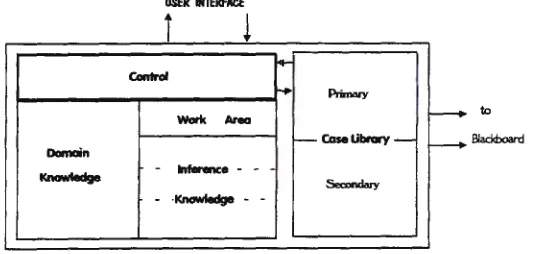
The domain knowledge represents the agent knowledge and expertise in a specific area. The inference knowledge is the knowledge applied to task management and decision making. The work area is similar to the human short term memory where temporary data are registered. Whereas the control is akin to the human mind. It schedules the agent activities. It is responsible for calling the appropriate reasoning strategy (in the inference knowledge) and applies the domain knowledge to solve problems. Figure 3 shows the architecture of the Case agent.
I+-Control
,... Primary
Work Area
1 - -Cose Ubrary - Blackboard Domoin
- Inference -
-Kl.-ledge Secoodaiy
- -~ -
The Case agent has an additional feature, which differs from the Initiator and Control agents, consisting of historical cases in its memory. This memory (ie. case library) similar to the human long term memory and represents the agent acquired and accumulated experiences. The case library is divided into two memory sections: primary and secondary. The primary memory stores the latest and frequently retrieved cases, whereas the secondary stores old cases that have not been used for a defined period of time. Retrieval is carried out from the primary memory only. In situations where there is no similar cases found, retrieval is then performed on the secondary memory. This organisation and memory management will provide a more efficient and faster retrieval process.
3.2 Agent functions
The agents in the system have special responsibilities and each of them has been designed to perform certain functions. To enable the agent to execute its functions, the inference knowledge of the agent is organised into a number of distinct layers. In fact, each inference layer represents a different reasoning strategy. A detailed discussion of the multi reasoning strategies will be presented in a separate paper.
The Initiator agent mainly employs rules to carry out its functions. Its main responsibilities include problem decomposition, distribution of tasks to the Case agents and writing the identity of the Case agents onto the blackboard. If data is to be input by a human operator, the Initiator agent will direct the operator to interact with the appropriate Case agent.
The Case agent is responsible for generating a solution to a specific task. It uses case based reasoning to retrieve similar cases from the case library and tries to adapt the solutions. Whenever the number of retrieved cases exceeds a number specified by the system, it automatically sieves through them in order to reduce the number of potential candidate solutions. As a consequence, a predefined number of cases that best match the current problem will be chosen. This improves the efficiency of the problem solving. If no similar cases are found, the Case agent will construct a new case from first principles.
The Control agent also employs multi paradigm reasoning strategy. Its responsibilities include coordinating the cases in the blackboard to produce a coherent integrated solution but may need to modify some of the cases to achieve coordination. The Control agent is also capable of providing an explanation of how the solution has been derived.
3.3 Operation of the system
case. This index is used as the basis for retrieving similar cases from the case library. Similar cases found are presented to the user for consideration. However, this step can be automated so that the user approval will not be necessary. The potential solutions represented by the retrieved cases are modified to suit the current problem. If no similar cases are found or the retrieved cases are not acceptable, a new case is build from scratch. This requires more detailed information which can include load, voltage, CTs characteristics, backup protection if any and so on. This new or the adapted busbar case is posted to the blackboard. The Busbar agent updates the blackboard to indicate that it has finished its task. A similar process is carried out by the Line agent to generate a new or adapted line case.
When the Line agent has completed its task, the Control agent then attempts to coordinate both the bus and the line cases to build one single coherent solution.
In
doing so, the Control agent may need to modify one of the cases. For example, the settings of the bus protection which provides the necessary backup to the line may be operating too fast. The Control agent would adjust the settings within the acceptable limits. If the proposed design is not acceptable (ie. could not be coordinated), the Control agent would instruct the Case agent to rebuild a new case.4.0 ADV ANT AGES OF THE AGENT BASED ARCHITECTURE
Due to the nature of the distributed system, each agent contains only partial domain knowledge and hence, the agent can be kept separate and independent. This means changes to the agent architecture can be made independently without affecting other agents. The distributed paradigm allows complex problems to be decomposed into manageable tasks.
In
addition, the best suited paradigm for solving specific tasks can be encapsulated within an agent. The problem solving capability is further enhanced by integrating the domain knowledge with past experiences, ie. using case based paradigm.Applying case based reasoning technique enables the Case agents to dynamically increase their knowledge and experiences. This new experiences can then be used to solve a wider range of problems. Furthermore, case based systems can handle incomplete information or missing data quite well [13]; that is, the features of the missing values will not be used in the retrieval process. If the solution or outcome of the retrieved case(s) is acceptable, then the missing value is proved to be unimportant. Otherwise, a new solution can be derived using some other reasoning technique.
The decomposition of the problem into domain specific tasks increases the efficiency of problem solving [14]. This approach is far more superior than the conventional approach which involves the construction of a single large expert system which has to perform all the tasks of problem solving. However, it is even more effective when implemented in a parallel processing environment.
In general, other advantages offered by distributed architectures include reduction in the complexity of control and execution of problem task, increased modularity, speed, reliability and reusability. Furthermore, knowledge acquisition becomes simpler, that is, it is easier to find experts in narrow and specialised domain and if the system fails, the degradation of the system performance would be graceful (soft crash rather than hard crash).
5.0 EVALUATION OF THE ISPP SYSTEM
The approach outlined in this paper has been discussed with a number of protection engineers. It appears that the case based methodology closely resembles the approach employed by the engineers
when designing protection schemes.
A prototype has been developed on Unix platform using an object oriented database management system, called 02. The prototype represents a part of the power system which includes the busbar and the line components only. The following agents have been implemented - Initiator, Busbar, Line and the Control agents. The prototype implemented so far has been tested and is still undergoing refinement. The protection schemes designed by the system have been critically examined and evaluated by the protection experts. However, more tests still need to be carried out before the prototype is fully implemented.
In view of the promising results obtained so far, it has been decided to develop a DOS version of the system. The DOS version would be more user friendly, portable, affordable and requiring less computing knowledge on the part of the protection engineers.
6.0 CONCLUSION
This paper presented an integrated case based and object oriented approach in the development of a distributed intelligent protection system. One of the main advantages of this architecture is the increased modularity due to distributed control and the integrated approach, which makes the system more manageable and easier to maintain. The employment of different agents to carry out domain specific tasks enables complex problems to be solved more effectively and efficiently. The approach shows how distributed knowledge base can be integrated and how the multi paradigm reasoning strategy can be employed. Moreover, the application of multiple and distributed expert systems offers more flexibility, integrity, robustness and many other advantages over and above the conventional approach which involves one single large expert system.
The object oriented technique has assisted in the modelling and development of the system. The system can be readily implemented with the mechanisms offered by object orientation such as software reusability, inheritance, encapsulation and modularity. Furthermore, the system can be easily modified or expanded. The employment of multi paradigm reasoning strategies allows the system not only to choose the appropriate strategy but also to switch between the reasoning paradigms, thus
mimicking the behaviour of a human expert.
ACKNOWLEDGEMENT
The authors would like to thank Ted Alwast for his invaluable comments and help in editing the paper, Clement Leung and John Horwood for their comments, all from the Computer and Mathematical
REFERENCES
[1] APSCOM 91, IEE International Conference on Advances in Power System Control,
Operation and Management, November 1991, Hong Kong, pp.152-157.
[2] Chi T., Kiang Y., Turban E., Distributed Intelligent Agents in Decentralised Organisations, 1993.
[3] Enns M.K., McGuire P.F., Ramaswami R., Arbor A., CAPE: The Computer-Aided Protection
Engineering System, Proceedings of the American Power Conference, 13-15 Mac 92, vol.2, pp.1084-1089.
[4] Fauquembergue P., Maizener A., Parant J.M., Perrot L., Bertrand H., Monitoring of Protection
System Behaviour Using An Expert System Which Analyses Substations Sequential Events
Recording Field Experience At Electricite De France, DPSP 93, pp.42-45.
[5] Gora S., Kacejko P., Application of expert system for determination of protective devices'
settings, Proceedings 2nd Symposium Expert System Applications to Power Systems
(ESAPS), Seattle, WA., USA, 1989, Electric Power Research Institute, Palo Alto, CA., pp 251-256.
[6] Huang J, Jennings N.R, Fox J, An Agent Architecture for Distributed Medical Care, London,
Technical Report 1994.
[7] Kalam A., Klebanowski A., Poloni D., Knowledge Based System for Transformer Protection,
Proceedings on IEE International Conference on Advances in Power System Control, Operation and Management 1991, pp.443-448.
[8] Kalam A., Negnevitsky M., Knowledge Based Approach To Clearing Overloads On The
Power System Plant, Proceedings of Second International Conference on Modelling and
Simulation, Victoria University of Technology, Melbourne, Australia, July 12-14 93, pp. 355-363.
[9] Kawahara K., Sasaki H., Kubokawa J., Sugihara H., Kitagawa M., An Expert System for
Supporting Protective Relay Setting for Transmission Lines, DPSP 93, pp.203-206.
[10] Liu L., Gao Z., Yang Q., Tong W., Construction of Expert System for Designing Protection of
Power Transformer, ICPST 94, pp.1380-1384.
[11] Lee S.J., Yoon S.H., Moon M.C., Yang J.K., An Expert System for Protective Relay setting of
transmission systems, Proceedings PICA Conference, Seattle, WA., USA, 1989, IEEE, New
York, pp. 296-302.
[12] Marin M.A., Banerjee S.N., An Approach to a Knowledge-Based Diagnostic System for
[13] Stottler R.H, CBR for cost and sales prediction, Al Expert August 1994, pp.25-32.
[14] Smith R.G, Davis R, Frameworks for Cooperation in Distributed Problem Solving,
Transactions on Systems, Man and Cybernetics vol.SMC-11 (1) January 1981.
[15] Wong S.K., Kalam A., Klebanowski A., A Decision Support System Using Case-Based