Template Attacks Based On Priori Knowledge
Guangjun Fan1, Yongbin Zhou2, Hailong Zhang2, Dengguo Feng1 1
State Key Laboratory of Computer Science, Institute of Software, Chinese Academy of Sciences, Beijing, China
[email protected],[email protected]
2 State Key Laboratory of Information Security, Institute of Information Engineering
Chinese Academy of Sciences, Beijing, China
[email protected],[email protected]
Abstract. Template attacks are widely accepted as thestrongest
side-channel attacks from the information theoretic point of view, and they can be used as a verypowerful tool to evaluate the physical security of cryptographic devices. Template attacks consist of two stages, the pro-filing stage and the extraction stage. In the propro-filing stage, the attacker is assumed to have a large number of power traces measured from the reference device, using which he can accurately characterize signals and noises in different points. However, in practice, the number of profiling power traces may not be sufficient. In this case, signals and noises are not accurately characterized, and the key-recovery efficiency of template attacks is significantly influenced. We show that, the attacker can still make template attacks powerfully enough in practice as long as the pri-ori knowledge about the reference device be obtained. We note that, the priori knowledge is just a prior distribution of the signal component of the instantaneous power consumption, which the attacker can easily ob-tain from his previous experience of conducting template attacks, from Internet and many other possible ways. Evaluation results show that, the priori knowledge, even if not accurate, can still help increase the power of template attacks, which poses a serious threat to the physical security of cryptographic devices.
Keywords: Side-Channel Attacks, Power Analysis Attacks, Template
Attacks, Priori Knowledge.
1
Introduction
interesting points. However, in practice, the number of profiling traces may be limited. For example, a common countermeasure is to limit the operation times of the reference device, or the key used by the reference device will be refreshed after being used several times. In these scenarios, the attacker can only obtain a limited number of power traces in the profiling stage, and signals and noises are not accurately characterized, which significantly influences the key-recovery efficiency of template attacks.
1.1 Motivations
A natural question is whether or not it is possible to further increase the power of template attacks even if the number of profiling traces is limited? We anticipate that using the priori knowledge about the reference device may be a possible way. The priori knowledge is just a kind of prior distribution of the actual value of the signal component in the instantaneous power consumption. There are many ways that the attacker can obtain the priori knowledge in practice. We show three typical examples here.
Example 1: Assume that the attacker has characterized the power leakages of some cryptographic devices whose leakage characterizations are similar to the reference device. Then, he may obtain the priori knowledge about the reference device. For example, noises in different interesting points are usually assumed to follow the normal distribution. If the attacker can estimate the mean value and the variance of the normal distribution using power traces measured from previous cryptographic devices, then the priori knowledge about the reference device can be obtained.
Example 2:From Internet (e.g. [18,19]), the attacker may obtain some power traces or other potential useful information (e.g. Signal-to-Noise Ratio) of dif-ferent devices which are similar to the reference device, using which he can infer the priori knowledge of the reference device (similarly to Example 1).
Example 3: For a sophisticated attacker, after obtaining power traces from the reference device in the profiling stage, he can use the power traces to obtain an interval estimation of the actual value of the signal component and roughly infer the prior distribution is a kind of distribution (e.g. normal distribution or uniform distribution) over the interval.
Of course, one may ask such question: Why not the attacker exploits the power traces obtained from the similar devices (from his previous experience of conducting template attacks or from Internet) together with the power traces obtained from the reference device to build the templates to make template attacks more powerful? In fact, if one directly exploits power traces from the similar devices and the reference device to build the templates, the classifica-tion performance of template attacks will be decreased [21]. The reason is that the acquisition campaigns about the devices are different1 even if the leakage
distributions of the similar devices and the reference device are similar [21]. If we can give positive answers to the above two important questions, then in order to make template attacks more powerful in the above scenarios, the attacker can first extract the priori knowledge from the power traces obtained from the different but similar devices and then conduct template attacks with the priori knowledge as well as the limited power traces obtained from the reference device. From this point of view, these two questions are worth researching.
1.2 Contributions
Main contributions of our work are two-folds. Firstly, based on the method of Bayes estimation [13], we give a theoretically correct and practically feasible way of exploiting the priori knowledge when the attacker conducts template attacks with limited power traces obtained from the reference device in the profiling stage.
Secondly, we verify our way of exploiting the priori knowledge using both simulated and practical experiments. Evaluation results show that, template attacks will be more powerful if the attacker can possess accurate priori knowl-edge. Additionally, the more accurate the priori knowledge is, the more powerful template attacks will be. Therefore, with the priori knowledge we can further increase the power of template attacks.
1.3 Related Work
Answers to some practical issues of template attacks were provided by [2], such as how to choose interesting points in an efficient way and how to preprocess noisy data. Choudary et al. proposed efficient methods to avoid possible numerical obstacles when implementing template attacks in [4]. In [10], Hanley et al. pre-sented a variant of template attacks which can be applied to block ciphers when the plaintext and ciphertext are unknown. In [7], template attacks were used to attack a masked implementation. Recently, a simple pre-processing technique of template attacks, normalizing the sample values using the means and variances was evaluated [6]. Standaert et al. [20] showed how to best evaluate profiling and extraction of profiled attacks by using the information theoretic metric and the security metric. Principal Component Analysis (PCA)-based template at-tacks were investigated in [3]. However, this kind of template atat-tacks may not
1
improve the classification performance [6]. Therefore, PCA-based template at-tacks are not widely used in practice. Linear Discriminant Analysis (LDA)-based template attacks were introduced in [8] and depend on the condition of equal covariances [4], which does not hold in most settings. Therefore, it is not a better choice compared with PCA-based template attacks [4]. Up to now, no previous work considered our important questions.
1.4 Organization of This Paper
The rest of this paper is organized as follows. In Section 2, we review the concept of template attacks and Bayes estimation. In Section 3, we give a reasonable way of exploiting the priori knowledge to make template attacks more powerful. In Section 4, we verify the way of exploiting the priori knowledge by both simulated and practical experiments. In Section 5, we conclude the whole paper.
2
Preliminaries
Template attacks mainly include: classical template attacks [1] and reduced tem-plate attacks (pp. 108 in [9]). In this section, we briefly review these two kinds of template attacks and the method of Bayes estimation.
2.1 Classical Template Attacks
We will introduce the two stages of classical template attacks: the profiling stage and the extraction stage.
2.1.1 The Profiling Stage Assume that there exist K different (sub)keys keyi, i = 0,1, . . . , K−1 which need to be classified. Also, there exist K dif-ferent key-dependent operations Oi, i = 0,1, . . . , K−1. Usually, one will gen-erate K templates, one for each key-dependent operation Oi. One can exploit some methods to chooseN interesting points (P0, P1, . . . , PN−1). The
interest-ing points are those time samples that contain the most information about the characterized key-dependent operations. Each template is composed of a mean vector and a covariance matrix. The mean vector is used to estimate the signal component of side-channel leakages. It is the average signal vector
Mi = (Mi[P0], . . . , Mi[PN−1]) for each one of the key-dependent operations.
The covariance matrix is used to estimate the probability density of the noise component at different interesting points. It is assumed that noises at differen-t indifferen-teresdifferen-ting poindifferen-ts approximadifferen-tely follow differen-the muldifferen-tivariadifferen-te normal disdifferen-tribudifferen-tion. A N dimensional noise vector ni(S) is extracted from each actual power trace
S = (S[P0], . . . , S[PN−1]) representing the template’s key dependency Oi as
ni(S) = (S[P0]−Mi[P0], . . . , S[PN−1]−Mi[PN−1]). One computes the (N×N)
noises occurring under key-dependent operationOiis given by theN dimension-al multivariate Gaussian distributionpi(·), where the probability of observing a noise vectorni(S) is:
pi(ni(S)) = √ 1
(2π)N|Ci|exp
(
−1 2ni(S)C
−1
i ni(S)
T) ni(S)∈RN. (1)
In equation (1), the symbol |Ci|denotes the determinant ofCi and the symbol
C−i1 denotes its inverse.
2.1.2 The Extraction Stage Assume that one obtains t power traces (de-noted byS1,S2, . . . ,St) from the target device in the extraction stage. When the
power traces are statistically independent, one will apply maximum likelihood approach on the product of conditional probabilities (pp. 156 in [9]), i.e.
keyck:=argmaxkeyi
{∏t
j=1
Pr(Sj|keyi), i= 0,1, . . . , K−1
}
,
where Pr(Sj|keyi) = pf(Sj,keyi)(nf(Sj,keyi)(Sj)). The keyck is considered to be
the correct (sub)key. The output of the function f(Sj, keyi) is the index of a key-dependent operation.
2.2 Reduced Template Attacks
In order to avoid numerical obstacles with the inversion of the covariance matrix
Ci, one can set the covariance matrix equal to the identity matrix. This essen-tially means that one does not take the covariances between different interesting points into consideration. A template that only consists of a mean vector is called a reduced template (pp. 108 in [9]). Correspondingly, template attacks based on reduced templates are called as reduced template attacks. In reduced template attacks, the probability density of the noises occurring under key-dependent op-erationOi is given by the distributionp′i(·), where the probability of observing a noise vectorni(S) is:
p′i(ni(S)) = √ 1 (2π)Nexp
(
−1
2ni(S)ni(S)
T) ni(S)∈RN.
2.3 Bayes Estimation
In the following, we briefly introduce the method of Bayes estimation [13]. We firstly introduce the definition of Bayes estimators. Then, we introduce how to compute a Bayes estimator.
L(θ, δ(X))≥0 for allθandδ(X),
and L[θ, g(θ)] = 0 for all θ, so that the loss is zero when the correct value is estimated. The accuracy, or rather inaccuracy, of an estimatorδis then measured by therisk function
R(θ, δ) =Eθ{L[θ, δ(X)]},
the long-term average loss resulting from the use of δ(X). This defines the risk function as a function ofδ(X). An estimatorδ(X) minimizing
r(Λ, δ) =
∫
R(θ, δ)dΛ(θ)
is called a Bayes estimator with respect to the prior distributionΛ. Note that, the prior distributionΛis a probability distribution of the parameterθ, that is,
∫
dΛ(θ) = 1.
Now, we will introduce how to compute a Bayes estimator of an unknown parameterθ. Letλ(θ) denote the prior probability density of the parameterθ. The prior probability density of the population (or discrete probability func-tion) is denoted byf(X;θ). If one extractsnsamples (X1, X2, . . . , Xn) from the
population, then the probability density of this group of samples is f(X1;θ)f(X2;θ)· · ·f(Xn;θ).
Thereby, we can compute the marginal density
p(X1, X2, . . . , Xn) =
∫
λ(θ)f(X1;θ)f(X2;θ)· · ·f(Xn;θ)dθ.
Then, the following posterior probability density is computed:
λ(θ|X1, . . . , Xn) =λ(θ)f(X1;θ)· · ·f(Xn;θ)/p(X1, X2, . . . , Xn). (2)
In general, the Bayes estimator of the parameterθ is set to be the mean value ofλ(θ|X1, . . . , Xn).
3
Using Priori Knowledge to Improve Template Attacks
In this section, we introduce how to use the priori knowledge about the reference device for template attacks. The usage of the priori knowledge for template attacks is the same for both classical template attacks and reduced template attacks.
It is well known that the instantaneous power consumption P Ctotal can be modeled as the sum of an operation-dependent component P Cop, a data-dependent component P Cdata, the electronic noise P Cel.noise, and a constant component P Cconst(pp. 62-65 in [9]), i.e.
The value P Cop+P Cdata (or P Cop+P Cdata+P Cconst) can be viewed as the signal component and the value P Cel.noise can be viewed as the noise component. Usually, for each pointPj in an actual power trace, when the oper-ation and the data are all fixed, its power consumptionP Ctotal follows a normal distributionN(µj, σ2
j) and the electronic noiseP Cel.noisefollows the normal dis-tribution N(0, σ2j) (pp. 62-65 in [9]). For fixed operation on fixed data, due to V ar(P Cop) = V ar(P Cdata) = V ar(P Cconst) = 0, we have P Cop+P Cdata+ P Cconst=µj. The priori knowledge is a kind of prior distribution of the actual value of the signal componentµj. Due to the existence of the electronic noise, we can reasonably assume the prior distribution of the actual value ofµj obtained by the attacker is a normal distribution.
There are many ways that the attacker can obtain the prior distribution and we just give out a specific one of them. Considering Example 1 in Section 1, for the same position about the target intermediate value, the attacker obtains n samples (For convenience, the samples are denoted byX1, . . . , Xn.) from power traces obtained from his previous experience of conducting template attacks against different devices which are similar to the reference device. Then, by computing
θ1=
1 n·
n
∑
i=1
Xi, θ22=
1 n−1 ·
n
∑
i=1
(Xi−θ1)2,
the attacker can easily obtain the prior distribution which is the normal dis-tribution N(θ1, θ22). Because the leakage distributions of the devices are very
similar to that of the reference device, the prior distribution can be used for the interesting points correspond to the same position about the target intermediate value for the reference device. We note that, compared with traditional template attacks, the computational price of obtaining the priori knowledge about the ref-erence device is very small. This implies that the attacker can obtain the prior distribution easily in practice.
The more accurate the signal component (the value ofµj) is estimated, the more accurate the noise component (the valueP Ctotal−µj) will be estimated. For an interesting point, if the signal component and the noise component are accurately estimated, accurate templates (reduced templates) will be built and template attacks (both classical template attacks and reduced template attacks) will be more powerful. In the classical way of building templates (reduced tem-plates), for an interesting point, the attacker computes the mean value of the samples to estimate the actual value of the signal component µj. Specifically, for the key-dependent operationOi, the pointPj is an interesting point and the attacker obtainsnpower traces (S1,S2, . . . ,Sn) from the reference device in the
profiling stage. Therefore, the attacker obtains nvalues of the power consump-tion of the point Pj, one from each power trace. The n values are denoted by S1[Pj], S2[Pj], . . . , Sn[Pj]. The actual value of µj is estimated byµ′j:
µ′j =Mi[Pj] = n
∑
k=1
However, in our scenario, the attacker not only hasnpower traces (The power traces are obtained from the reference device. However, the number of the power traces is limited.), but also possesses the priori knowledge about the reference device which can be used to estimate the actual value ofµjmore accurately. Let’s consider the most common case. Assume that the attacker knows that the actual value ofµj follows the normal distributionN(θ1, θ22) from priori knowledge1but
does not know what the actual value of µj accurately is. The attacker can use the method of Bayes estimation to estimate the actual value ofµjwith the priori knowledgeN(θ1, θ22) in the profiling stage as follows: The attacker computes the
probability density of the actual value of the signal component µj from priori knowledge as
λ(µj) = (√2πθ2)−1exp
[
− 1
2θ2 2
(µj−θ1)2
]
.
Moreover, the power consumption of the pointPjsatisfies the following prob-ability density function:
f(x;µj, σj) = ( √
2πσj)−1exp
[
− 1
2σj2(x−µj)
2].
From equation (2), the attacker computes the posterior probability density:
λ(µj|S1[Pj], . . . , Sn[Pj]) =C1exp
[
− 1
2θ2 2
(µj−θ1)2−
1 2σ2 j n ∑ k=1
(Sk[Pj]−µj)2
]
,
the constant C1 only has relation with θ1, θ2, σj, S1[Pj], . . . , Sn[Pj] and has no
relation withµj. It has that
− 1
2θ2 2
(µj−θ1)2−
1 2σ2 j n ∑ k=1
(Sk[Pj]−µj)2=− 1
2A2(µj−B)
2+C
2,
whereA2=σ2
jθ22/(σj2+nθ22), B= (nMi[Pj] +σj2θ1/θ22)/(n+σj2/θ22),andC2has
no relation withµj. Furthermore, the attacker can obtain
λ(µj|S1[Pj], . . . , Sn[Pj]) =C3exp
[
− 1
2A2(µj−B) 2],
whereC3=C1eC2. Because it has that
∫ +∞
−∞
λ(µj|S1[Pj], . . . , Sn[Pj])dµj= 1,
henceC3 = (
√
2πA)−1. Up to now, the attacker obtains the Bayes estimator of the actual value ofµj as
µ′′j = n n+σ2
j/θ22
(∑n
k=1Sk[Pj] n
)
+ σ
2
j/θ22
n+σ2
j/θ22
θ1. (3)
1
Note that, the normal distributionN(θ1, θ22) itself may not be very accurate.
The equation (3) shows that if the attacker does not have the priori knowl-edge (i.e. the prior distribution N(θ1, θ22)), he can only use
∑n
k=1Sk[Pj]/n to estimate the actual value of µj. If the attacker does not have power traces ob-tained from the reference device, he can only use the priori knowledge (i.e. the value θ1) to estimate the actual value of µj. If the attacker has power traces
obtained from the reference device as well as the priori knowledge, by equation (3), he will use the weighted average of ∑nk=1Sk[Pj]/n andθ1 to estimate the
actual value of µj under the ratio n : σ2
j/θ22 in the profiling stage. This ratio
is reasonable and the relevant reasons are as follows. On one hand, when more power traces are obtained from the reference device by the attacker, the propor-tion of ∑nk=1Sk[Pj]/n should be larger. On the other hand, when the value θ22
is smaller (This implies that the prior distribution of the actual value of µj is more accurate.), the proportion of θ1 should be larger. Although the attacker
may not know the actual value ofσ2
j in practice, the Bayes estimator about the actual value of µj can still be computed. The reason is that the attacker can reasonably assume that the actual value of σ2
j equals to a constant value. Of course, when the attacker knows the actual value of σ2
j, more accurate Bayes estimation aboutµj can be obtained.
Other details of building templates (reduced templates) remain unchanged. Our way only exploits the priori knowledge to estimate the actual value of the signal component more accurately. We note that, due to the computational price of obtaining and exploiting the priori knowledge is very small, the priori knowl-edge can easily be used by practical attackers.
4
Experimental Evaluations
For the implementation of a cryptographic algorithm with countermeasures, one usually tries his best to use some approaches to delete the countermeasures from power traces at first. If the countermeasures can be deleted, then one tries to recover the correct (sub)key using some attacks against unprotected implemen-tation. For example, if one has power traces with random delays [11], he may first use the approach proposed in [12] to remove the random delays from power traces and then uses some attacks to recover the correct (sub)key. The approach-es of deleting countermeasurapproach-es from power tracapproach-es are beyond the scope of this paper. Moreover, considering power traces without any countermeasures shows the upper bound of the physical security of the target cryptographic device. Therefore, we take unprotected AES-128 implementation as an example.
We verified both classical template attacks and reduced template attacks by conducting simulated and practical experiments. In both simulated and practical experiments, we tried to attack the outputs of the S-boxes in the 1st round of AES-128. Before introducing the specific experiment details, we first introduce how to get the prior distribution of the actual value of the signal component for every interesting point for both simulated and practical experiments.
in the profiling stage is limited. Therefore, we mainly exploit reduced template attacks to exhibit our discoveries (Note that, our method can be used for both classical template attacks and reduced template attacks.).
For simplicity, for both simulated and practical experiments, letnp denote the number of traces used in the profiling stage and let ne denote the number of traces used in the extraction stage. In this paper, we use the typical metric Guessing Entropy [5] as the metric about the classification performance of tem-plate attacks (Many other papers also used Guessing Entropy (e.g. [4, 14, 15]).).
4.1 How to Get The Priori Knowledge
In order to get the priori knowledge, we simulated the cases that the attacker can obtain the priori knowledge from his previous experience of conducting template attacks against a device similar to the reference device.
For both simulated and practical experiments, we get the prior distribution of the actual value of the signal component for every interesting point using the traces which were generated in the same way as those were used in the two stages of template attacks. In this way, we can clearly give out an upper bound of how powerful template attacks will become by exploiting the priori knowledge.
In both simulated and practical experiments, for each key-dependent opera-tionOiand each interesting pointPj, we considered the prior distribution under four different levels of accuracy and assumed the prior distribution is a normal distributionN(θ1, θ22) (For different interesting points, the corresponding prior
distributions are different.).
For each key-dependent operation Oi, we generated 400 traces (simulated traces or actual power traces). The 400 traces were used to estimate the prior distributions for every interesting point as follows. We repeated the following process 300 times. Every time, we chosemtraces (denoted byS1, . . . , Sm) from the 400 traces uniformly at random and computed∑mk=1Sk[Pj]/m. Therefore, there were 300 different values about∑mk=1Sk[Pj]/m. The mean value of the 300 different values was set to beθ1 and the variance of the 300 different values was
set to beθ2
2. In this way, the prior distributionN(θ1, θ22) was got. Note that, in
practice, the attacker has many ways to get the prior distributionN(θ1, θ22). Our
method which were used in this paper is just one of them. We respectively letm= 16, 32,64, 128 and obtained four different estimation of the prior distribution. Clearly, when the valuemis larger, the estimation ofθ1andθ22is more accurate.
Therefore, we obtained four different prior distributions under different levels of accuracy, which represent the priori knowledge that the attacker can possess in practical attack scenarios.
attacks without any priori knowledge. The symbol “RTA-16” denotes reduced template attacks based on priori knowledge which is obtained when the val-ue mequals to 16. Similarly, we define the symbols “RTA-32”, “RTA-64”, and “RTA-128” to denote the cases that the valuemequals to 32, 64, and 128.
4.2 Simulated Experiments
In simulated experiments, we chose 4 interesting points and the typical Hamming-Weight power model (pp. 40-41 in [9]) was adopted to describe the power con-sumption. The standard deviation of simulated Gaussian noise is denoted by σ. We employed three different noise levels to test the influence of noises on the classification performance of template attacks. The standard deviations of simulated Gaussian noise for the three noise levels were 2, 3, and 4.
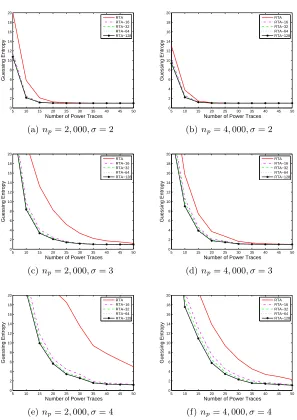
For each noise level, we respectively used 2,000 and 4,000 simulated traces to build the 256 reduced templates in the profiling stage for the five kinds of reduced template attacks (RTA, RTA-16, RTA-32, RTA-64, and RTA-128). This means that the attacker respectively obtained 2,000 and 4,000 traces from the reference device in the profiling stage. The simulated traces used in the profil-ing stage were generated with a fixed subkey and random plaintext inputs. We generated additional 100,000 simulated traces with another fixed subkey and random plaintext inputs under each noise level. The 100,000 simulated traces were used in the extraction stage. For fixed np and σ, we tested the Guessing Entropy of the five kinds of reduced template attacks when the attacker could use ne simulated traces in the extraction stage as follows. We respectively re-peated the five kinds of reduced template attacks 1,000 times. For each time, we chose ne simulated traces from the 100,000 simulated traces uniformly at random and the five kinds of reduced template attacks were conducted with the same ne simulated traces. We respectively computed the Guessing Entropy of the five kinds of reduced template attacks with the results of the 1,000 times attacks. The Guessing Entropy of the five kinds of reduced template attacks for different values ofnp andσis shown in Figure 1.
Table 1.The simulated experiment results for the casenp= 2,000, ne= 20, σ= 4
RTA RTA-16 RTA-32 RTA-64 RTA-128
21.22 6.66 5.97 5.68 5.61
5 10 15 20 25 30 35 40 45 50 0 2 4 6 8 10 12 14 16 18 20
Number of Power Traces
Guessing Entropy RTA RTA−16 RTA−32 RTA−64 RTA−128
(a)np= 2,000, σ= 2
5 10 15 20 25 30 35 40 45 50 0 2 4 6 8 10 12 14 16 18 20
Number of Power Traces
Guessing Entropy RTA RTA−16 RTA−32 RTA−64 RTA−128
(b) np= 4,000, σ= 2
5 10 15 20 25 30 35 40 45 50 0 2 4 6 8 10 12 14 16 18 20
Number of Power Traces
Guessing Entropy RTA RTA−16 RTA−32 RTA−64 RTA−128
(c)np= 2,000, σ= 3
5 10 15 20 25 30 35 40 45 50 0 2 4 6 8 10 12 14 16 18 20
Number of Power Traces
Guessing Entropy RTA RTA−16 RTA−32 RTA−64 RTA−128
(d) np= 4,000, σ= 3
5 10 15 20 25 30 35 40 45 50 0 2 4 6 8 10 12 14 16 18 20
Number of Power Traces
Guessing Entropy RTA RTA−16 RTA−32 RTA−64 RTA−128
(e)np= 2,000, σ= 4
5 10 15 20 25 30 35 40 45 50 0 2 4 6 8 10 12 14 16 18 20
Number of Power Traces
Guessing Entropy RTA RTA−16 RTA−32 RTA−64 RTA−128
(f)np= 4,000, σ= 4
of reduced template attacks with priori knowledge will be better. For example, in Table 1, the Guessing Entropy of RTA-16 equals to 6.66, while the Guessing Entropy of RTA-128 obviously reduces to 5.61.
Table 2.The simulated experiment results for different levels of noises
np= 2,000, ne= 20 σ= 2 σ= 3 σ= 4
RTA 1.27 8.23 21.22
RTA-128 1.03 2.11 5.61
Table 2 shows the Guessing Entropy of RTA and RTA-128 for different levels of noises when np is fixed to 2,000 and ne is fixed to 20. From Figure 1 and Table 2, we further find that, when the noise level is higher, reduced template attacks with priori knowledge will achieve larger advantage over reduced tem-plate attacks without priori knowledge. For example, in Table 2, the Guessing Entropy of RTA and RTA-128 is almost equal when σ equals to 2 (1.27 and 1.03). However, whenσequals to 4, the Guessing Entropy of RTA-128 (5.61) is much lower than that of RTA (21.22).
When more simulated traces can be obtained from the reference device (e.g. np = 4,000) in the profiling stage, the advantages of reduced template attacks with priori knowledge over template attacks without priori knowledge will be smaller. For classical template attacks, we computed the Guessing Entropy of the five kinds of classical template attacks (CTA, CTA-16, CTA-32, CTA-64, and CTA-128) similarly. The simulated experiment results show that classical template attacks with accurate priori knowledge have advantages over classical template attacks without priori knowledge.
4.3 Practical Experiments
We tried to attack the outputs of all the S-boxes in the 1st round of an un-protected AES-128 software implementation on an typical 8-bit microcontroller STC89C58RD+ whose operating frequency is 11MHz. The actual power traces were acquired with a sampling rate of 50MS/s. The average number of actu-al power traces during the sampling process was 10 times. For our device, the condition of equal covariances [4] does not hold.
caused by the priori knowledge. For each S-box of the unprotected AES-128 software implementation, we chose 4 interesting points in 4 continual clock cycles, one in each clock cycle1. Both classical template attacks and reduced template
attacks were conducted based on the same 4 interesting points. We only show the practical experiment results of the 1st and the 2nd S-box in this paper. For other S-boxes in the 1st round, similar evaluation results were obtained by us. In all practical experiments, we reasonably assumed that the actual value ofσ2
j equals to a constant value for each interesting point and each target intermediate value.
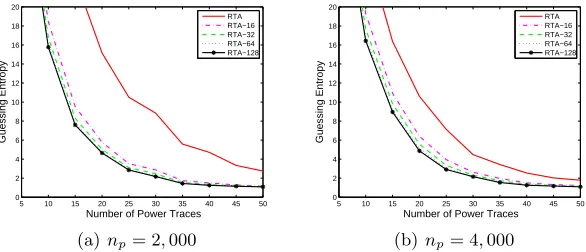
For reduced template attacks, we respectively chose 2,000 and 4,000 different power traces from Set A to build the 256 templates for the five kinds of reduced template attacks (RTA, RTA-16, RTA-32, RTA-64, and RTA-128). The 100,000 power traces of Set B were used in the extraction stage for the five kinds of reduced template attacks. For fixednp, we tested the Guessing Entropy of the five kinds of reduced template attacks when one uses ne power traces in the extraction stage similarly to that of the simulated experiments but used actual power traces. The Guessing Entropy of the five kinds of reduced template attacks for the 1stS-box are shown in Figure 2. The Guessing Entropy of the five kinds of reduced template attacks for the 1st S-box whenn
p is fixed to 2,000 andne is fixed to 20 is shown in Table 3.
5 10 15 20 25 30 35 40 45 50 0
2 4 6 8 10 12 14 16 18 20
Number of Power Traces
Guessing Entropy
RTA RTA−16 RTA−32 RTA−64 RTA−128
(a)np= 2,000
5 10 15 20 25 30 35 40 45 50 0
2 4 6 8 10 12 14 16 18 20
Number of Power Traces
Guessing Entropy
RTA RTA−16 RTA−32 RTA−64 RTA−128
(b) np= 4,000
Fig. 2.The experiment results of reduced template attacks for the 1stS-box
From Figure 2 and Table 3, we find that the classification performance of reduced template attacks with accurate priori knowledge will be obvious better than that of reduced template attacks without priori knowledge. For example, in Table 3, the Guessing Entropy of RTA equals to 15.16, while the Guessing Entropy of RTA-16 reduces to 5.78.
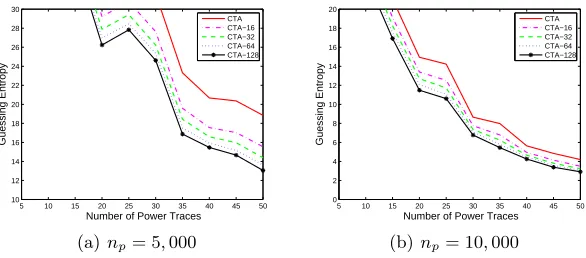
For classical template attacks, in order to avoid numerical obstacles with the inversion of the covariance matrix, we respectively chose 5,000 and 10,000
1
Table 3.The experiment results of reduced template attacks for the 1stS-box
np= 2,000 RTA RTA-16 RTA-32 RTA-64 RTA-128
ne= 20 15.16 5.78 5.03 4.73 4.65
different power traces from Set A to build the 256 templates for the five kinds of classical template attacks (CTA, CTA-16, CTA-32, CTA-64, and CTA-128). Moreover, using power traces from Set B, we computed the Guessing Entropy of the five kinds of classical template attacks when one usesnepower traces in the extraction stage similarly. The Guessing Entropy of the five kinds of classical template attacks for the 1st S-box are shown in Figure 3 in Appendix A.
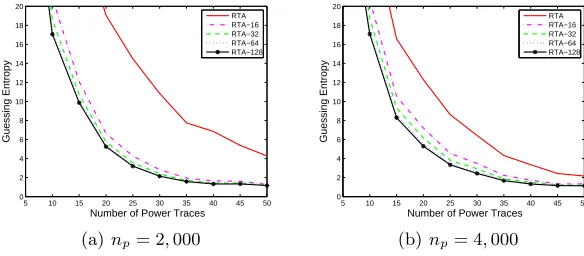
For the 2ndS-box, we also used the actual power traces in Set A and Set B to compute the Guessing Entropy of the five kinds of reduced template attacks and the five kinds of classical template attacks similarly. The practical experiment results for the 2ndS-box which can also verify our discoveries are shown in Figure 4, Figure 5, and Table 4 in Appendix B.
The practical experiment results show that, for both reduced template at-tacks and classical template atat-tacks, if the priori knowledge is more accurate, the classification performance will be better. For example, in Table 3, the Guess-ing Entropy of RTA-16 equals to 5.78, while the GuessGuess-ing Entropy of RTA-128 reduces to 4.65. When more power traces can be obtained from the reference device, the advantages of template attacks with priori knowledge over template attacks without priori knowledge will be smaller.
5
Conclusion and Future Work
In this paper, we show that leaking the priori knowledge about the reference device poses serious threat to the physical security of cryptographic devices. Therefore, we suggest that the designers of a cryptographic device should take the priori knowledge into consideration when he uses template attacks to eval-uate the physical security of the cryptographic device. The future work is as follows. First, our discoveries show that the approach to infer (estimate) the pri-ori knowledge as accurately as possible is crucial and is worth being researched from the attacker’s point of view. Second, it would be interesting to research how to prevent the attacker to obtain the priori knowledge (Using countermeasures such as the random delays [11] may be a good choice.). We should also concern on how to exploit the priori knowledge to make other profiled side-channel at-tacks (such as stochastic model based atat-tacks [16], PCA-based template atat-tacks etc.) become more powerful in a reasonable way. It is also necessary to further verify our discoveries in other devices such as ASIC and FPGA.
References
1. Chari, S., Rao, J.R., Rohatgi, P.: Template Attacks. CHES2002, LNCS 2523, pp. 13-28, 2003.
2. Rechberger, C., Oswald, E.: Practical Template Attacks. WISA2004, LNCS 3325, pp. 440-456, 2004.
3. Archambeau, C., Peeters, E., Standaert, F.-X., Quisquater, J.-J.: Template Attacks in Principal Subspaces. CHES2006, LNCS 4249, pp. 1-14, 2006.
4. Choudary, O., Kuhn, M.G.: Efficient Template Attacks. CARDIS2013, LNCS 8419, pp. 253-270, 2013.
5. Standaert, F.-X., Malkin, T.G., Yung, M.: A Unified Framework for the Analysis of Side-Channel Key Recovery Attacks. EUROCRYPT2009, LNCS 5479, pp. 443-461, 2009.
6. Montminy, D.P., Baldwin, R.O., Temple, M.A., Laspe, E.D.: Improving cross-device attacks using zero-mean unit-variance mormalization. Journal of Crypto-graphic Engineering, Volume 3, Issue 2, pp. 99-110, June 2013.
7. Oswald, E., Mangard, S.: Template Attacks on Masking—Resistance Is Futile. CT-RSA2007, LNCS 4377, pp. 243-256, 2007.
8. Standaert, F.-X., Archambeau, C.: Using Subspace-Based Template Attack-s to Compare and Combine Power and Electromagnetic Information LeakageAttack-s. CHES2008, LNCS 5154, pp. 411-425, 2008.
9. Mangard, S., Oswald, E., Popp, T.: Power Analysis Attacks: Revealing the Secrets of Smart Cards. Springer 2007.
10. Hanley, N., Tunstall, M., Marnane, W.P.: Unknown Plaintext Template Attacks. WISA2009, LNCS 5932, pp. 148-162, 2009.
11. Coron, J.-S., Kizhvatov, I.: Analysis and Improvement of the Random Delay Coun-termeasure of CHES 2009. CHES2010, LNCS 6225, pp. 95-109, 2010.
12. Durvaux, F., Renauld, M., Standaert, F.-X. et al.: Efficient Removal of Random Delays from Embedded Software Implementations Using Hidden Markov Models. CARDIS2012, LNCS 7771, pp. 123-140, 2013.
13. Lehmann, E. L., Casella, G.: Theory of Point Estimation (2nd ed.). Springer. ISBN 0-387-98502-6.
14. Standaert, F.-X., Gierlichs, B., Verbauwhede, I.: Partition vs. Comparison Side-Channel Distinguishers: An Empirical Evaluation of Statistical Tests for Univariate Side-Channel Attacks against Two Unprotected CMOS Devices. ICISC2008, LNC-S5461, pp. 253-267, 2009.
15. Medwed, M., Standaert, F.-X., Joux. A.: Towards Super-Exponential Side-Channel Security with Efficient Leakage-Resilient PRFs. CHES2012, LNCS 7428, pp. 193-212, 2012.
16. Schindler, W., Lemke, K., Paar, C.: A Stochastic Model for Differential Side Chan-nel Cryptanalysis. CHES2005, LNCS 3659, pp. 30-46, 2005.
17. Ye, X., Eisenbarth, T.: Wide Collisions in Practice. ACNS2012, LNCS 7341, pp. 329-343, 2012.
18. The DPA Contest: http://www.dpacontest.org/home/
19. Power Analysis Attacks-Revealing the Secrets of Smartcards: http://dpabook.org/ 20. Standaert, F.-X., Koeune, F., Schindler, W.: How to Compare Profiled
Side-Channel Attacks? ACNS2009, LNCS 5536, pp. 485-498, 2009.
Appendix A: Practical Experiments for The 1
stS-box
5 10 15 20 25 30 35 40 45 50 10 12 14 16 18 20 22 24 26 28 30
Number of Power Traces
Guessing Entropy CTA CTA−16 CTA−32 CTA−64 CTA−128
(a)np= 5,000
5 10 15 20 25 30 35 40 45 50 0 2 4 6 8 10 12 14 16 18 20
Number of Power Traces
Guessing Entropy CTA CTA−16 CTA−32 CTA−64 CTA−128
(b)np= 10,000
Fig. 3.The experiment results of classical template attacks for the 1stS-box
Appendix B: Practical Experiments for The 2
ndS-box
5 10 15 20 25 30 35 40 45 50 0 2 4 6 8 10 12 14 16 18 20
Number of Power Traces
Guessing Entropy RTA RTA−16 RTA−32 RTA−64 RTA−128
(a)np= 2,000
5 10 15 20 25 30 35 40 45 50 0 2 4 6 8 10 12 14 16 18 20
Number of Power Traces
Guessing Entropy RTA RTA−16 RTA−32 RTA−64 RTA−128
(b) np= 4,000
5 10 15 20 25 30 35 40 45 50 10
12 14 16 18 20 22 24 26 28 30
Number of Power Traces
Guessing Entropy
CTA CTA−16 CTA−32 CTA−64 CTA−128
(a)np= 5,000
5 10 15 20 25 30 35 40 45 50 0
2 4 6 8 10 12 14 16 18 20
Number of Power Traces
Guessing Entropy
CTA CTA−16 CTA−32 CTA−64 CTA−128
(b)np= 10,000
Fig. 5.The experiment results of classical template attacks for the 2ndS-box
Table 4.The experiment results of reduced template attacks for the 2ndS-box
np= 2,000 RTA RTA-16 RTA-32 RTA-64 RTA-128