Local vs. Distributed - An experimental
comparative analysis of divergent overload control
methods in SIP Server
Abdullah Akbar#1, S. Mahaboob Basha*2, Syed Abdul Sattar$3 #Department of Computer Science Engineering, JNTUH
Hyderabad, Telangana, India
*Al Habeeb College of Engineering and Technology Chevella, R.R. District, Telangana, India $Royal Institute of Technology and Science
Chevella, R.R. District, Telangana, India
Abstract— The advent of Internet telephony has unleashed the
new era in unlimited multimedia and voice calls between globally spread users of Voice over Internet Protocol. Session Initiation Protocol is playing predominant role for signalling and controlling multimedia communication sessions. SIP can facilitate the sessions for audio, video conferencing, interactive gaming and call forwarding in IP Networks. SIP servers are configured with a specific overload control configuration. When the SIP messages are loaded on servers more than its capacity, overload will be experienced by the servers. The overload control methods are widely developed by many research scholars to withstand against the overloaded messages on SIP servers. The proposed paper examines the predominant Overload Control Methods suggested by different research scholars are compared here and distinguishes the most powerful method among them. In this experimental results comparison, the overload control methods suggested by Luca De Cicco, Member, IEEE, Giuseppe Cofano, and Saverio Mascolo, Senior Member, IEEE, Masataka Ohta and Abdullah Akbar et.al have been compared and distinguished the most effective and powerful method among them. In this paper Cooperative Overload Control Algorithm for SIP overload control method has been proved conclusively to be better than other methodologies.
Keywords— SIP Servers, Multimedia Communication
Sessions, Overload Control Methods.
I. INTRODUCTION
Session Initiation Protocol is used to terminate various types of real-time sessions between VoIP communication endpoints of the network. The predominant utility of SIP is establishing, modifying and terminating the communication sessions as an application layer control signalling protocol. A receiver and sender are exchanging messages through intermediate SIP servers. RFC 3261 is the standard of SIP server communication processing different kinds of SIP messages. RFC 3261 compliant SIP servers are regarded as most popular used for VoIP call centres to process effectively the voice, text, video and other multimedia messages transmission. When the communication transmission from different agents is more than the capacity of the RFC 3261 SIP server, then overload will be experienced. To control the overload of SIP servers several research works have initiated several algorithms. These
algorithms in turn have initiated several methods to control the overload of SIP Servers. The present paper is focusing on the best and comparatively better algorithms from the available overload control methods.
SIP sessions are transported over UDP protocol. This is the best transport protocol albeit without congestion control and retransmission of packets. This mechanism enables the SIP servers to recover the lost packets. When overload is experienced by RFC 3261 SIP servers, UDP protocol initiate the retransmissions. This retransmission enriches the load on SIP server and decrease the sustainability with the messages from network. This situation leads to collapse of SIP servers. At this juncture the prevention of uncontrolled messages retransmission should be rejected. The rejection of messages to the originated user agent should be incorporated with a rejection message “503 Service Unavailable”. The receipt of this error message will deactivate the user agent to retransmit the failed messages. This is a simple mechanism to avoid the overload in SIP servers. Though there is a simple internal mechanism in built in SIP servers, the overload and Server Collapse is still experienced by RFC 3261 SIP servers.
The research works have given fruitful results to overcome the overload problems in SIP Servers with overload control algorithms. These algorithms have been developed on the basis of three fundamental concepts. These are namely Local overload control, hop-by-hop and end-to-end processes. Based on these concepts the algorithms have been developed by research scholars to facilitate the SIP overload control.
The present paper is focusing on four different algorithms to perform overload control for SIP signalling network. These works are protecting the SIP servers from overload messages with the help of two thresholds in a queue with the detection of congestion. The mechanism in the algorithms initiates the restriction to make calls from User Agents. The mechanism is demonstrated in a network simulator tool NS-2, SIPp a SIP message generator tool and the results are displayed.
paper comparing the results extracted from the solutions for the over load problems in SIP servers developed by Luca De Cicco, Masataka Ohta and Abdullah Akbar.
Predominantly the works suggested by Luca De Cicco and Masataka Ohta are regarded as Local overload control methods whereas the Abdullah Akbar et.al has suggested local and distributed overload control methods. The methods are suggested by Masataka Ohta are quite old and the overload control methods suggested by Luca De Cicco are next generation level of overload control methods. The latest overload control methods suggested by Abdullah Akbar et.al have proved to be good and compared with the previous overload control methods.
II. MASATAKA OHTA ALGORITHM
Masataka Ohta has suggested the over load control methods with two proxy servers with two thresholds to detect congestion. Masataka Ohta has demonstrated the overload control methods with the help of NS2 a simulation tool. In this model the overload control is incorporated in a traffic model.
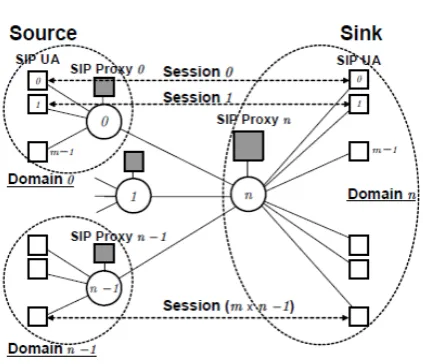
In this model two SIP Proxy servers have been taken into account. The sessions generated from SIP Proxy servers are simulated in NS2 simulation tools and recorded the results. The messages have been generated from source server have transmitted to Sink servers. The source servers are two proxy servers and transmitting different messages to sink server. The end destination nodes are receiving the messages generated from source servers.
Masataka Ohta has suggested the traffic model with an assumption of inter arrival time of calls is T1 sec and a source message came from User Agent makes another call in T1. User Agent finishes a call A sink User Agent is assumed to answer the call in TA seconds.
Tcall = T1 + TA + TS [1]
Figure 1 Network Traffic overload control model The duration of session is assumed as TS. SIP messages are arriving to a SIP proxy server are served to complete a call. The following figures 1 and 2 illustrate the mechanism of transmission diagram for overload control. Ohta’s overload controlling model is supported by Ohta’s algorithm is a simple developed on queue based bang-bang
controller. This is meant for differentiate the states of server in normal and congestion. This model allowed the servers to forward all of the received messages during normal state. If the queue length is exceeded a high watermark value automatically the server rejects all the requests made by the user agents. The servers will obtain the normal state as soon as the current value reaches less than the watermark value.
Figure 2 Transmission diagram for overload control
III. LUCA DE CICCO’S EXTREMUM SEEKING ALGORITHM
The overload control design suggested by Luca De Cicco is developed on the basis of local open source extremum seeking algorithm. The implementation of algorithm has incorporated the SIP overload controller has counteracts overload situations and facilitated a goodput. These algorithms have established delays and retransmission rations. The implementation of the overload controller is done on SIP server Kamailio.
The system proposed by De Cicco has been implemented on open source Kamailio SIP proxy server to optimize the controller using the Extremum Seeking Algorithm. The following equations reveal the Extremum Seeking Algorithm how iteratively modifies the controller parameters ø to minimize a cost function J(ø).
ζ(k)= −hζ(k − 1)+J (θ(k−1))
θi(k + 1)=kaw (sat (θi(k), 0)−θi(k)))+ˆθi(k)
−γi(αi cos(ωik) (J (θ(k))−(1+h)ζ(k))
θi(k + 1)= ˆθi(k + 1)+αi cos (ωi ・ (k + 1)) Where the saturation function sat (θi, 0) is given by sat(θi, 0) = { 0 if θi < 0, , θi otherwise. [2]
The algorithm and overload control model developed by De Cicco is evaluated with cost functions. The cost functions have been developed with the following equations.
[1]
The following table describes the optimal parameters for different conditions of signals received by the User Agent.
[3] Finally CIAEi is the integral absolute measured CPU value. This value has increased the performance of the CPU to withstand the message traffic from User Agents of the network. The algorithm suggested by De Cicco has followed the local model to increase the performance of the CPU to withstand the traffic of SIP servers as described in Figure 3.
Figure 3 De Cicco SIP Overload Control
IV.ABDULLAH AKBAR ET.AL COOPERATIVE OVERLOAD
CONTROL METHOD [3]
Abdullah Akbar et.al have suggested a newer and faster distributed overload control method for SIP Servers. This method is incorporated with the modified open source Kamailio SIP proxy server. The method is enriched with standard standalone overload control algorithms to demonstrate the outstanding performance for SIP servers in terms of throughput and response time. The experimental results have proved to be the best method among the previous methods to improve the status of SIP servers when overload is experienced.
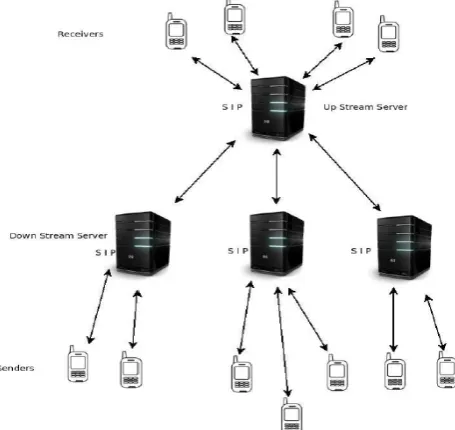
Abdullah Akbar et.al have developed the overload control method on the basis of server-to-server overload transmission as shown in figure 4. The previous research works have developed local overload control methods enable the monitor and actuator on the same server. This facility initiates the server to monitor the current resource usage and reject the messages which are beyond the capacity of the server. The server capacity is earmarked with watermark and is observed by the overload control mechanism. When the number of messages is reaching the watermark level of the SIP server capacity the local overload control mechanism will reject the messages.
Once the server rejects the messages, the rejected messages are again reprocessed and re generated from the user agent to process the request. The local mechanism for overload control is abstracted the collapse of SIP servers.
The cooperative overload control mechanism is established in different SIP servers. This mechanism
initiates the servers to handle effectively to maintain and monitor the messages beyond the capacity of the servers. The cooperative overload control method is rich with congestion control algorithms are specially developed for SIP servers to monitor the requests and responses. The algorithm regulates the excess traffic in end-to-end points of SIP Servers and hop to hop networks to take the feedback from downstream server and regulate the excess traffic.
Figure 4 Cooperative overload control method
Cooperative overload control mechanism is incorporated at the SIP servers to monitor the processor of the server and memory resources to detect the overload control. In fact stand-alone overload control algorithms are easy to implement and can be deployed independently on the servers without relying on other SIP server component. The specialty of Cooperative overload control algorithm is lying in decision making mechanism on information received from neighbour-hood servers to monitor the traffic to upstream server. The predominant mechanism regulates the neighbouring servers to send the new calls up to the limit of SIP servers. The cooperative overload control algorithm monitor all the servers connected to the Kamailio server in the network and regulate SIP messages and new calls beyond the capacity. The monitoring of messages and new calls between two servers will be performed on Google congestion control method.
V. ABDULLAH AKBAR ET.AL RATE BASED OVERLOAD CONTROL METHOD
REGISTER and BYE requests and database look up. To build the concept end-to-end overload control algorithms have been incorporated as depicted in Figure 5.
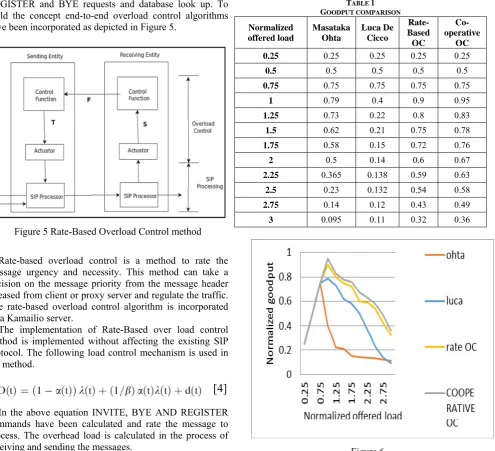
Figure 5 Rate-Based Overload Control method
Rate-based overload control is a method to rate the message urgency and necessity. This method can take a decision on the message priority from the message header released from client or proxy server and regulate the traffic. The rate-based overload control algorithm is incorporated on a Kamailio server.
The implementation of Rate-Based over load control method is implemented without affecting the existing SIP protocol. The following load control mechanism is used in the method.
[4]
In the above equation INVITE, BYE AND REGISTER commands have been calculated and rate the message to process. The overhead load is calculated in the process of receiving and sending the messages.
A. The experimental comparative results
The comparative analysis has been done between the local overload control algorithms and the distributed overload control algorithms. Masataka Ohta and Luca De Cicco suggested methods of local overload control are compared with Abdullah Akbar et.al Distributed over load control methods i.e. Cooperative and Rate-based overload control methods in terms of call performance.
B. Throughput comparison
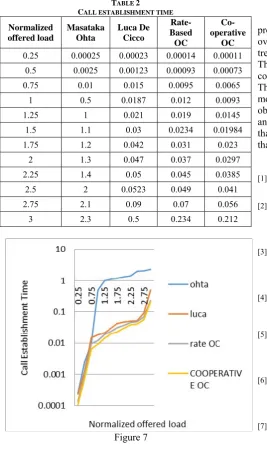
The comparative results have taken into account in terms of calculating the good throughput. The test results obtained in this comparative results are depicted in table 1 and have proved that the Distributed Overload Control methods are the better than Local overload Control methods. Figure 6 shows the data in a graphical representation as well.
TABLE 1 GOODPUT COMPARISON
Normalized offered load
Masataka Ohta
Luca De Cicco
Rate- Based OC
Co-operative
OC 0.25 0.25 0.25 0.25 0.25 0.5 0.5 0.5 0.5 0.5 0.75 0.75 0.75 0.75 0.75
1 0.79 0.4 0.9 0.95
1.25 0.73 0.22 0.8 0.83
1.5 0.62 0.21 0.75 0.78
1.75 0.58 0.15 0.72 0.76
2 0.5 0.14 0.6 0.67
2.25 0.365 0.138 0.59 0.63 2.5 0.23 0.132 0.54 0.58 2.75 0.14 0.12 0.43 0.49
3 0.095 0.11 0.32 0.36
Figure 6
Luca is the author of the algorithm of the target comparison paper - "Local SIP Overload Control: Controller Design and Optimization by Extremum Seeking". Ohta algorithm is from the target comparison paper - M. Ohta, “Overload control in a sip signalling network". The other two algorithms are proposed by Abdullah Akbar et.al.
C. Call Establishment Time
TABLE 2 CALL ESTABLISHMENT TIME
Normalized offered load
Masataka Ohta
Luca De Cicco
Rate- Based OC
Co-operative
OC
0.25 0.00025 0.00023 0.00014 0.00011 0.5 0.0025 0.00123 0.00093 0.00073 0.75 0.01 0.015 0.0095 0.0065
1 0.5 0.0187 0.012 0.0093
1.25 1 0.021 0.019 0.0145
1.5 1.1 0.03 0.0234 0.01984 1.75 1.2 0.042 0.031 0.023
2 1.3 0.047 0.037 0.0297
2.25 1.4 0.05 0.045 0.0385
2.5 2 0.0523 0.049 0.041
2.75 2.1 0.09 0.07 0.056
3 2.3 0.5 0.234 0.212
Figure 7
The above results have demonstrated the call establishment time taken for different overload control methods. The lowest time has been recorded for distributed methods than other local methods.
D. Calculating Normalized Offered Load r (t) = p (t) / p(m) where
r (t) - normalized offered load
p (t) - no. of INVITE messages
p(m) - maximum offered load
The above equation is used to calculate the normalized offer load to extract the results from different models.
VI.CONCLUSIONS
SIP servers are frequently experiencing the overload problem which leads to the unwanted collapse. The overload control methods have been developed and tremendous research has been done with different methods. The present paper has successfully compared the overload control methods developed in local and distributed models. The local models have been described and distributed models are illustrated. The comparative results have been obtained for both models in terms of normalized goodput and call establishment time. The comparative results proved that the Cooperative model for overload control is better than the other overload control models.
REFERENCES
[1] Masataka Ohta (2009) "Overload Control in a SIP Signaling Network" published in International Journal of Electrical and Electronics Engineering 3:2 2009
[2] Luca De Cicco, Member, IEEE, Giuseppe Cofano, and Saverio Mascolo, Senior Member, IEEE (2015) Local SIP Overload Control: Controller Design and Optimization by Extremum Seeking published in IEEE TRANSACTIONS ON CONTROL OF NETWORK SYSTEMS, VOL. 2, NO. 3, SEPTEMBER 2015 [3] Abdullah Akbar, S. Mahaboob Basha and Syed Abdul Sattar
(2015)A Novel Rate Based Overload Control Method for SIP Servers published in © Springer India 2016 N.R. Shetty et al. (eds.), Emerging Research in Computing, Information, Communication and Applications, DOI 10.1007/978-81-322-2553-9_14
[4] Abdullah Akbar, S. Mahaboob Basha, and Syed Abdul Sattar(2015 A Cooperative Overload Control Method for SIP Servers published in International Conference on Communication and Signal Processing, April 2-4, 2015, India
[5] Ahmad Reza Montazerolghaem, Mohammad Hossein Yaghmaee (2013) SIP OVERLOAD CONTROL TESTBED: DESIGN,BUILDING AND EVALUATION published in International Journal of Ambient Systems and Applications (IJASA) Vol.1, No.2, June 2013
[6] Kiran Kumar Guduru & Dr. Usha J (2014)Overload Detection and Controlling Techniques in SIP Servers - A Survey published in IRACST – International Journal of Computer Networks and Wireless Communications (IJCNWC), ISSN: 2250-3501 Vol.4, No3, June 2014
[7] Homayouni, M.; Sch. of Comput. Eng., Iran Univ. of Sci. & Technol., Tehran, Iran ; Jahanbakhsh, M. ; Azhari, V. ; Akbari, A. (2015) Overload control in SIP servers: Evaluation and improvement published in Telecommunications (ICT), 2010 IEEE 17th International Conference on
[8] Halina Tarasiuk and Jan Rogowski (2014) On performance evaluation of loss-based overload control mechanism in signaling system with SIP protocol This work is partially funded by Polish Ministry of Science and Higher Education, under contract number N N517 385838 “Modelling and analysis of signalling in QoS Internet”
[9] Bell Labs., Alcatel-Lucent, Holmdel, NJ (2008) Controlling overload in networks of SIP servers published in DOI: 10.1109/ICNP.2008.4697027 Conference: Network Protocols, 2008. ICNP 2008. IEEE International Conference on Source: IEEE Xplore [10] E. Noel, P. Williams (2015) Session Initiation Protocol (SIP) Rate Control published by Internet Engineering Task Force (IETF) ISSN: 2070-1721 Standards Track