1
Effects of OsCDPK1 on the Structure and Physicochemical
Properties of Starch in Developing Rice Seeds
Jian-Zhi Jiang1, Chun-Hsiang Kuo1, Bo-Hong Chen1, Mao-Kei Chen1, Choun-Sea Lin2,
Shin-Lon Ho1*
1Department of Agronomy, National Chiayi University, Chiayi, Taiwan, Republic of China 2Agricultural Biotechnology Research Center, Academia Sinica, Taipei, Taiwan, Republic of
China
*Author for correspondence, Tel.: +886-5-2717388, fax: +886-5-2717386, E-mail: [email protected]
2
Abstract
Overexpression of a constitutively active truncated form of OsCDPK1 (OEtr) in rice produced smaller seeds, but a double-stranded RNA gene-silenced form of OsCDPK1 (Ri) yielded large seeds, suggesting that OsCDPK1 plays a functional role in rice seed development. In the study presented here, we propose a model in which OsCDPK1 plays key roles in negatively controlling the grain size, amylose content, and endosperm appearance, and also affects the physicochemical properties of the starch. The dehulled transgenic OEtr grains were smaller than the dehulled wild-type grains, and the OEtr endosperm was opaque and had a low amylose content and numerous small loosely packed polyhedral starch granules. However, the OEtr grain sizes and endosperm appearances were not affected by the temperature being either optimal (25 °C ) or low (22 °C) or high (31 °C) during the grain-filling phase. In contrast, the transgenic Ri grains were larger, had higher amylose contents, and had more transparent endosperms filled with tightly packed polyhedral starch granules. This demonstrates that OsCDPK1 plays a novel functional role in starch biosynthesis during seed development and affects the transparent appearance of the endosperm. These results improve our understanding of the molecular mechanisms through which the grain filling process occurs in rice.
Keywords: rice; OsCDPK1; grain size; amylose content; endosperm appearance
1. Introduction
The quality of rice (Oryza sativa L.) grain is defined in terms of several main factors, including (i) the eating and cooking qualities and (ii) the milling qualities and appearance [1]. The eating and cooking qualities are determined by the amylose content, amylopectin structure, gelatinization temperature, and pasting viscosity [2], and the milling qualities and appearance correlate strongly with the transparency, flouriness, and chalkiness of the endosperm [3]. The filling and accumulation of starch granules in developing rice endosperm can accelerate at high temperatures, causing the starch in the endosperm cells to be packed loosely and the kernel to be chalky. Such grains crack easily during milling, giving poor eating and cooking qualities [4-6].
3
4
SSIIIa strongly affects the chain-length distribution of amylopectin biosynthesized in developing rice grains [20]. The floury endosperm mutant flo6 had a completely floury white endosperm, but the flo7 endosperm was floury and white only at the peripheries but not in the interior [21,22]. Map-based cloning demonstrated that flo6 was an insertion mutation in the unknown function gene Os03g0686900 [21] and that flo7 was a deletion mutation in the unknown function gene Os10g0463800 [22], suggesting that these genes may play vital roles in starch biosynthesis and granule formation in the endosperm during the grain-filling process.
Calcium ions (Ca2+) are secondary messengers in plant cells, and are used when various
environmental and developmental stimuli are sensed through temporal and spatial fluctuations or when the cytosolic Ca2+ concentration increases [23,24]. Calcium-dependent protein kinases
(CDPKs) are a major family of calcium sensors that have been characterized in various plant species. CDPKs are Ser/Thr protein kinases that are encoded by multigene families [25,26]. CDPKs have four functional domains, an N-terminal variable domain, a catalytic kinase domain, an autoinhibitory domain, and a calcium-binding EF-hands regulatory domain [27]. It has been shown in many studies that CDPKs play important physiological roles in response to various environmental stresses and developmental processes [23,24,28-30]. Only in a few studies have CDPKs been shown to play a role in starch biosynthesis during the grain-filling process in rice. The rice CDPK called SPK (which shared 79% of its amino acid sequence with OsCDPK1) has been found to encode a sucrose synthase kinase. Expression of antisense SPK in transgenic rice produced watery grains because large amounts of sucrose had accumulated in the endosperm due to low sucrose synthase activity, resulting in inefficient sucrose degradation [31]. This indicates that SPK may be a regulator in the starch biosynthesis pathway.
In previous studies, we demonstrated that overexpression of a constitutively active truncated form of OsCDPK1 (OEtr-1) in rice gave smaller seeds whereas RNA interference gene knockdown (Ri-1) mutants gave larger seeds [32]. In the study presented here, OsCDPK1 was found to play pivotal roles in rice-seed development, in the physicochemical properties of the starch produced, and in the appearance of the endosperm.
5
2. Results
2.1. Ectopic Overexpression and Silencing of OsCDPK1 in Transgenic Rice Plants Gave Opaque and Ttransparent Endosperms,Respectively
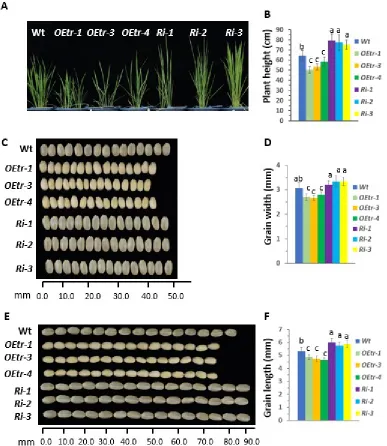
We examined the 55-day-old plant phenotypes in the T4 transgenic lines further, and the results were consistent with our previous studies [32]. The Ri-1, -2 and -3 plants were higher (mean value is 76.66.18 cm) and the OEtr-1, -3 and -4 plants were shorter (52.43.58 cm) than WT plants (63.34.63 cm) (Figure 1A,B). At the grain filling stage, the WT and transgenic plants were transferred to the growth room under optimal temperature of a cycle of 25℃ for 16 h light and 20°C for 8 h dark. Fifteen seeds randomly selected from each individual lines and then dehulled. We found that the dehulled Ri-1 grains were longer and that the OEtr-1 grains were shorter than the WT grains (Figure 1E,F). We also found that the dehulled OEtr-1 grains were all of the floury-kernel phenotype (Figure 1C,E).
Table 1
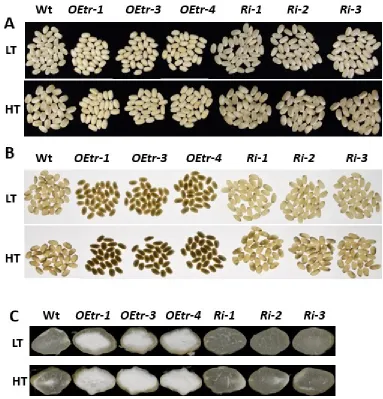
The ratios of chalky grains in wild type (TNG67), OEtr-1 and Ri-1 lines growth under lower temperature (LT) (22 °C for 16 h light, 20 °C for 8 h dark) or higher temperature (HT) (31 °C for 16 h light, 28 °C for 8 h dark) during rice grain filling process.
The ratios of chalky grains in LT (%) 16.2 2.19 100 100 100 6.0 0.61 6.7 0.56 7.1 0. 61
Wild type OEtr-1 OEtr-3 OEtr-4 Ri-1 Ri-2 Ri-3
Mean values calculated from 100 independent seeds. All data are presented as mean SE. Statistical significant is determined by t-test.
6
Figure 1. Plant heights and grain morphologies in the WT, and the OEtr-1, -3 and -4 (OEtrs), and the Ri-1, -2 and -3 (Ris) plants. After 5 d of flowering, rice plants were transferred to a growth chamber and grown at an optimal temperature (25 °C for 16 h light, 20 °C for 8 h dark). (A) Plant heights of the 55-day-old of the WT, OEtrs, and Ris plants. (B) Quantification of the plant heights. Each error bar is the standard error for 15 individual plants. (C) Endosperm appearances and grain widths for the WT, OEtrs, and Ris plants. Fifteen grains per line were positioned in a row and measured. (D) Quantification of the grain widths. Each error bar is the standard error for 50 individual grains. (E) Endosperm appearances and grain lengths for the WT, Preprints (www.preprints.org) | NOT PEER-REVIEWED | Posted: 3 September 2018 doi:10.20944/preprints201809.0042.v1
7
OEtrs, and Ris plants. Fifteen grains per line were positioned in a row and measured. (F) Quantification of the grain lengths. Each error bar is the standard deviation (n = 50). Different letters above the bars indicate significant differences, identified by performing ANOVAs (P < 0.01).
8
Figure 2. Effects of temperature on the appearances of the WT, OEtrs, and Ris endosperm. After 5 d of flowering, rice plants were transferred to a growth chamber and grown at a lower temperature (22 °C for 16 h light, 20 °C for 8 h dark) or a higher temperature (31 °C for 16 h light, 28 °C for 8 h dark). (A) and (B) Seeds harvested from the plants grown at the lower and higher temperatures, respectively, illuminated using (A) normal lighting and (B) backlighting. (C) Cross-sections of the endosperms of the seeds from plants grown at either lower or higher temperature. LT: lower temperature; HT: higher temperature.
9
2.2. Effect of OsCDPK1 on Starch Granule Morphology in Rice Endosperm
10
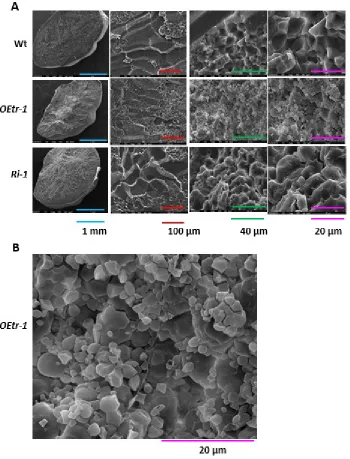
Figure 3. Scanning electron microscopy images of the structures of the starch granules in the rice endosperms. (A) The central areas of the cross-sections of mature endosperms from the WT plants (top panel), OEtr-1 plants (middle panel), and Ri-1 plants (bottom panel) were acquired using a scanning electron microscope. (B) The zoom in image from the 20 m photo in OEtr-1. Scale bar colors: blue as 1 mm, red as 100 m, green as 40 m, purple as 20 m.
11
2.3. Effects of OsCDPK1 on Starch Properties and Gelatinization in the Endosperm
We examined the apparent amylose content in the endosperm by reacting 20 mg of each rice endosperm powder sample with 1 N NaOH to gelatinize the starch. The amylose content was measured using a colorimetric method using an I2/KI solution [12,33]. The OEtr-1 samples had
less affinity than the other samples for iodine and were light purple, whereas the Ri-1 and WT sampler were dark blue and light blue, respectively (Figures 4A and S2). We examined the absorption spectra of the I2/KI stained solutions and found strong absorbance between 480 and
12
Figure 4. Iodine-staining and gelatinization properties of the starch in the rice endosperms. A 20 mg aliquot of endosperm powder was treated with 1 N NaOH as described in the materials and methods section. (A) Supernatants of the iodine-stained WT, OEtr-1, and Ri-1 samples. (B) Starch–iodine absorbance spectra of the supernatants. (C) Effects of using 3.0 and 4.0 M urea solutions on the gelatinization characteristics of the WT, OEtr-1, and Ri-1 endosperm starch. A 20 mg aliquot of rice powder was mixed in an Eppendorf tube with 1 mL of urea solution and the mixture was shaken for 24 h at 25 °C. The mixture was centrifuged and the volume of the gelatinized starch sediment was measured. (D) Quantification of the gelatinization volume. Different letters above the bars indicate
13
significant differences, identified by performing ANOVAs (P < 0.05). Each value is the mean ± the standard deviation of three independent measurements.
2.4. OsCDPK1 Expression Profiles in Developing Rice Seeds
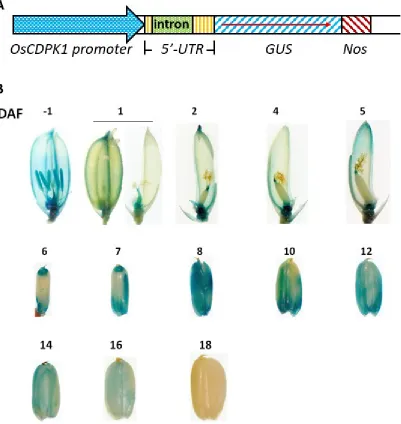
Our results have demonstrated that OsCDPK1 affects rice seed development. It is necessary to track changes in OsCDPK1 gene expression during rice seed development. The OsCDPK1::GUS transgenic line was generated using a GUS reporter gene controlled by the OsCDPK1 promoter (−1706 to +301 bp, i.e., a total of 2007 bp upstream of the translational start site) containing the first intron (607 bp, in the 5ʹ-untranslated region) (Figure 5A). As shown in Figure 5B, strong GUS staining was observed in the ovaries and anthers before flowering but weaker staining was observed in the styles and lemma. At 1 DAF, strong GUS activity was found only in the ovaries and styles, weaker activity was found in the lemma, and no GUS activity was found in the anthers and stigma. Between 2 and 5 DAF, concentrated GUS staining was found in the rachilla and both ends of the developing seeds and weak staining was found in the lemma. The blue color gradually expanded from both ends toward the central parts of the developing seeds between 6 and 7 DAF, and at 8 DAF the entire seeds were thoroughly stained blue. Staining gradually decreased afterwards, but remained strong between 10 and 14 DAF, then decreased quickly after 14 DAF and had completely gone by 18 DAF. These results suggest that OsCDPK1 was
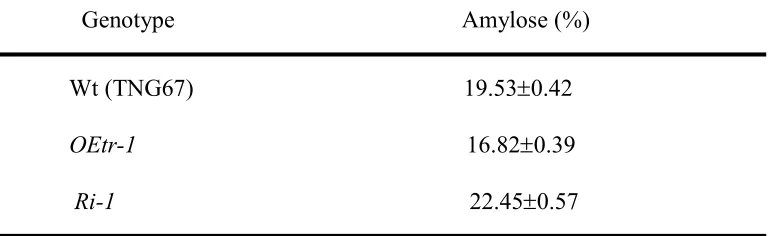
Table 2 Comparison of apparent amylose content in endosperm among Wt, OEtr-1 and Ri-1.
Genotype Amylose (%)
Wt (TNG67) 19.530.42
OEtr-1 16.820.39
Ri-1 22.450.57
14
expressed in a particular temporal and spatial way, predominantly in the middle stage of rice seed development.
Figure 5. Histochemical GUS (β-glucuronidase) activity staining in flowers and developing rice seeds. (A) Map of the OsCDPK1::GUS expression construct. (B) Rice spikelets were collected before flowering and 1–18 days after flowering (DAF). The lemma and palea were partially or completed removed from each spikelet or developing seed before staining. The stained spikelets or immature grains were preserved in 70% ethanol and photographed. −1 DAF means before flowering.
15
2.5. Effects of OsCDPK1 on the Levels of Starch-Biosynthesis-Related Genes in Developing Rice Seeds
16
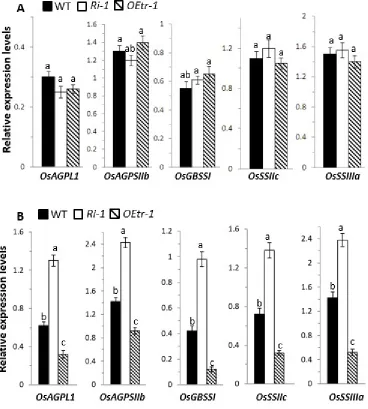
Figure 6. Expression of starch-biosynthesis-related genes during seed development in the WT, Ri-1, and OEtr-1 plants. Total RNA was isolated from developing endosperms 5 and 12 days after flowering (DAF) from the WT, Ri-1, and OEtr-1 plants and subjected to RT-PCR analysis. The relative expression levels of each gene were normalized to the expression level of the internal control OsActin. Different letters above the bars indicate significant differences, identified by performing ANOVAs (P < 0.01). Each value is the mean ± the standard deviation of three independent measurements. OsAGPLI: ADP-glucosepyrophosphorylase large subunit I; OsAGPSIIb: ADP-glucosepyrophosphorylase small subunit IIb; OsGBSSI: granule-bound starch synthase I; OsSSIIc: starch synthase IIc; OsSSIIIa: starch synthase IIIa. Primer sets and gene accession numbers are listed in Supplementary Table S1.
17
3. Discussion
The amylose content of endosperm is an important parameter determining the eating quality of rice, which is negatively related with stickiness but positively related to rice grain hardness [34,35]. However, the upstream signaling regulators that control the amylose content of the endosperm are still largely unidentified. Our results indicate for the first time that the protein kinase OsCDPK1 is functionally negatively correlated with the amylose content, endosperm transparency, and seed size in developing rice seed.
18
Several mutations of rice genes involved in starch biosynthesis have been found to alter the structures and properties of the starch produced. For example, the SSIIIa mutation (flo5) was found to increase the amylose content, alter the amylopectin structure, and cause the endosperm to have a white core. The waxy mutant (a mutation in GBSSI) produced an amylose-free, floury endosperm. The amylose-extender mutation in BEIIb altered the fine structure of amylopectin and gave a floury endosperm. A mutation in BEI (starch-branching enzyme I) caused the amylopectin fine structure to change but did not appear to affect the endosperm appearance. Our data show that the expression of some starch-biosynthesis-related genes was affected by OsCDPK1, similar to the results of previous studies. During the middle phase (12 DAF) of endosperm development, examples of genes affected were OsAGPLI, OsAGPSIIb, OsGBSSI, OsSSIIc, and OsSSIIIa, which were significantly up-regulated in the Ri-1 and down-regulated in OEtr-1 (Figure 6). Changes in the expression of these genes caused the OEtr-1 endosperm to have a low amylose content and a floury appearance, whereas the Ri-1 endosperm had a high amylose content and was more transparent (Figures 1, 2 and 4 and Tables 1 and 2). These results support the idea that OsCDPK1 acts as an upstream regulator that is closely associated with starch biosynthesis. Some regulators have been found to regulate the expression of genes encoding key starch-biosynthesis enzymes, and null mutations in these regulators usually alter the amylopectin fine structure, the starch composition, the starch granule morphology and size, and the endosperm appearance. For instance, some starch-biosynthesis-related genes were found to be affected in five independent mutants, flo2 (a tetratricopeptide repeat motif protein) [17], flo4 (pyruvate orthophosphate dikinase B) [19], flo7 (an unknown protein) [22], osbzip58 (a bZIP transcription factor) [37], and osbt1 (an ADP-glucose transporter) [38]. All these effects decreased the amylose content and changed the amylopectin composition. The endosperm appearance was affected differently in different parts, e.g., flo2 had endosperm with a floury kernel, flo4 and osbzip58 and osbt1 gave white-core phenotypes, and chalkiness was only found in the peripheral endosperm of flo7. Similarly, the low amylose content of the OEtr-1 endosperm was expressed in a floury morphology (Figures 1 and 4). The results of previous studies and this study together indicate that a low-amylose content of rice endosperm gives a chalky or floury phenotype, suggesting that the amount of amylose present is an important factor affecting the quality and appearance of the starchy endosperm. This raises the question of whether rice can be
19
engineered to have an endosperm with a high amylose content and therefore a transparent appearance. Here, we have provided direct evidence that silencing OsCDPK1 (Ri-1) increases the amylose content of the endosperm, making the starchy grain more transparent (Figures 1 and 4 and Tables 1 and 2). These results will be useful in developing rice-breeding strategies aimed at maintaining (or even improving) grain quality in rice to cope with global warming. The transgenic lines OEtrs and Ris could also be ideal materials for investigating the mechanisms controlling rice seed size and starch biosynthesis.
The temperature also strongly affects amylose synthesis during rice grain development. In previous studies, a lower temperature increased the expression of the Waxy gene and protein and increased the amylose content in developing rice endosperm [39] but a higher temperature had the opposite effects [39,40]. Moreover, during the rice grain-filling process, a temperature higher than the optimum usually causes impaired starch accumulation, resulting in loosely packed starch granules and small air spaces between them, giving high proportions of opaque chalky/floury grains. These effects decrease the market value because the rice will have poor milling qualities (being easily broken), poor cooking and eating qualities, and a poor appearance [41,42]. It has recently been found that a high temperature (33 °C for 12 h light, 28 °C for 12 h dark) also induced the expression of three -amylase genes, Amy1A, Amy3C, and Amy3D, in developing endosperm, causing the grains to be chalky, probably because of starch degradation and the accumulation of soluble sugars in the endosperm [43]. In contrast, we found that the Ri-1 endosperm was more transparent at both a low temperature (22 °C for 16 h light, 20 °C for 8 h dark) and a high temperature (31°C for 16 h light, 28 °C for 8 h dark) than that of the WT during the grain-filling process (Figure 2 and Table 1). Our results will be useful in developing rice-breeding strategies aimed at maintaining (or even improving) grain quality in rice selected to cope with global warming. Our results also improve our understanding of the molecular mechanisms involved in amylose biosynthesis.
20
in the WT and Ri-1 endosperm) rather than small and round as in most chalky/floury mutants (Figure 3B). It is therefore likely that OsCDPK1 plays a role in starch biosynthesis and negatively affects the sizes but not the shapes of the starch granules.
We previously found that OsCDPK1 plays a role that feedback inhibition of GA biosynthesis through down-regulating GA3ox2 and GA20ox1 [32]. In this study, we put forward a model in which OsCDPK1 plays key roles in negatively controlling the grain size, amylose content, and endosperm appearance, and also affects the physicochemical properties of the starch (Figure 7). Milled OsCDPK1-gene-silenced Ri-1 grains were larger than WT grains, and there were numerous densely packed polyhedral starch granules accompanied by a high amylose content and a transparent endosperm. In contrast, the OEtr-1 grains were smaller and contained loosely packed small but still polyhedral starch granules. The OEtr-1 grains had lower amylose contents and opaque white-cored endosperms. Notably, the phenotypes of the grain size and the floury endosperm in OEtr-1, -2 and -3 were consistent and were unaffected by the temperature during the grain-filling process (Figures 1 and 2). OsCDPK1 therefore plays pleiotropic roles in rice reproductive developmental processes, in a negative sense. Our results indicate that Ri-1 and OEtr-1 could be ideal materials for investigating the mechanisms controlling rice seed size and starch biosynthesis, and could also be valuable reference samples for rice breeding aimed at simultaneously improving grain yield and quality.
Figure 7. Proposed roles of OsCDPK1 in the interconnecting GA biosynthesis and signaling pathways and endosperm developmental processes. The dashed arrow indicates the predicted
21
pathway. The solid arrows and lines indicate the pathway directly supported by our previous studies and this study. The model is described in detail in the text.
4. Materials and Methods
4.1. Plant Materials
In our previous studies [32], eight independent T1 transgenic lines that carried single transgene in rice was subjected to ectopic overexpression of a constitutively active truncated form of OsCDPK1 (OEtr) in rice seedlings, which all gave a semi-dwarf phenotype that produced small seeds. By contrast, five independent T1 transgenic plants exhibited single copy of transgene was subject to OsCDPK1 gene silencing (Ri) by RNA interference, which all gave a slender-like phenotype during seedling development and subsequently produced large seeds. Due to the consistency of the phenotypic traits in the eight independent lines of OEtrs ( lines OEtr-1, -3,- 4, -6, -7, -8, -9 and -15), and in the five independent transgenic lines of Ris (lines Ri-1 - -5) [32]. According to these results, in this study, the T4 transgenic plants from OEtr-1, OEtr-3 and OEtr-4, and Ri-1, Ri-2 and Ri-3, whose carrying homozygous transgenes were selected to explore the roles of OsCDPK1 in rice grain development.
4.2. Callus Induction
22 4.3. Primers
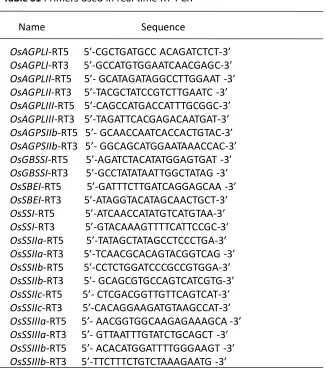
The nucleotide sequences of all the primers used in the real-time polymerase chain reaction (qRT-PCR) amplification are shown in Supplementary Table S1.
4.4. Construction of OsCDPK1::GUS Expression Vectors
The OsCDPK1::GUS expression vector was constructed by amplifying a 2,007 bp DNA fragment containing the OsCDPK1 promoter and its 5′-untranslated region (which contained a 607 bp intron) (Figure 1A) by PCR using the forward primer OsCDPK1-5P (5’-ATACTGCAGTGGTCTTATT AGGTAAGGCC-3’) and the reverse primer OsCDPK1-3B (5’-ATAGGATCC TCCAAGAACTCCTTATGCAA-3’). The DNA fragment was cleaved using PstI and BamHI, and then cloned into vector pBX-2 as described previously [45]. The OsCDPK1::GUS construct was linearized by digesting it with PstI, then inserted into the PstI site of the pSMY1H binary vector [45], then it was subjected to Agrobacterium-mediated gene transformation.
4.5. Plant Transformation
Recombinant binary plasmids were introduced into Agrobacterium tumefaciens strain EHA101 by electroporation, and rice calli were transformed as described previously [45].
4.6. Histochemical Staining of GUS Activity in Developing Rice Grains
Rice spikelets collected before flowering and 1–18 day after flowering (DAF) were subjected to GUS activity staining to assess OsCDPK1 gene expression profiles in developing rice grains. The lemma and palea were partially or completely removed from each spikelet (developing seed) before the staining process, then the spikelets were incubated in a 1 mM 5-bromo-4-chloro-3-indolyl -D-glucuronide solution (in 100 mM sodium phosphate containing 10 mM EDTA, 0.5 mM potassium ferrocyanide, 0.5 mM potassium ferricyanide, and 0.1% Triton X-100, at pH 7.0)
23
at 37 °C in the dark for 4 h. The stained spikelets or immature grains were then preserved in 70% ethanol and rinsed with water before being photographed.
4.7. Quantitative RT-PCR
Developing seeds were collected from wild-type (WT), Ri-1, and OEtr-1 at 5 and 12 DAF, respectively. Total RNA was isolated from developing endosperms by using TRIzol reagent (Invitrogen, Carlsbad, California, USA) and then DNA contamination was removed using a TURBO DNA-free kit (Ambion, Foster, USA). A 5 µg aliquot of the total RNA was used to synthesize first strand cDNA using M-MuLV reverse transcriptase (New England Biolabs) and oligo (dT) primer. Quantitative RT-PCR was performed using an Eco Real-Time PCR System (Illumina, San Diego, CA, USA) following the manufacturer’s instructions. Gene-specific primer sets (Table S1) localized at the 3’-untranslated regions for each gene examined were selected to allow assessment of the extent to which the starch-biosynthesis-related genes in WT, OEtr-1, and Ri-1 were expressed. The relative expression levels were normalized to expression in the internal control, OsActin 1. All reactions were performed in triplicate.
4.8. Analysis of the Gelatinization Properties of the Starch
A 20 mg aliquot of rice endosperm powder derived from de-embryonic seeds was mixed with 1 mL of urea solution at a concentration of between 0 and 9 M, and the mixture was shaken vigorously for 24 h at room temperature. The mixture was then centrifuged, and the volume of the gelatinized starch sediment was measured.
4.9. Apparent Amylose Content Analysis
A 20 mg aliquot of rice endosperm powder was gelatinized by adding 2 mL of 1 N NaOH and incubating the mixture at 25 °C for 24 h. Then, 4 mL of 1 N CH3COOH was added, the mixture
was mixed well, and 4 mL H2O was added. A 0.8 mL aliquot of the solution was mixed with 0.2
24
using the colorimetric method described by [33]. Absorbance at 620 nm was measured, and the apparent amylose content was determined by comparing the absorbance to a calibration curve prepared using potato amylose standards.
4.10. Scanning Electron Microscopy
Dehusked rice grains were cut transversely and analyzed using a scanning electron microscope (Quanta 200; FEI, Hillsboro, OR, USA) following the manufacturer’s instructions.
5. Conclusions
Our results demonstrated that OsCDPK1 plays key roles in negatively controlling the grain size, amylose content, and endosperm appearance, and also affects the physicochemical properties of the starch. Milled OsCDPK1-gene-silenced Ri-1 grains were larger than WT grains, and there were numerous densely packed polyhedral starch granules accompanied by a high amylose content and a transparent endosperm. In contrast, the OEtr-1 grains were smaller and contained loosely packed small but still polyhedral starch granules. The OEtr-1 grains had lower amylose contents and opaque white-cored endosperms. Moreover, the grain phenotypes in OEtrs were unaffected by the temperature during the grain-filling process. OsCDPK1 therefore plays pleiotropic roles in rice reproductive developmental processes, in a negative sense. Our results indicate that Ri-1 and OEtr-1 could be ideal materials for investigating the mechanisms controlling rice seed size and starch biosynthesis, and for rice breeding to improve grain yield and quality.
Author Contributions
Conceptualization, Shin-Lon Ho; Data curation, Jian-Zhi Jiang and Shin-Lon Ho; Investigation, Jian-Zhi Jiang, Chun-Hsiang Kuo, Bo-Hong Chen and Mao-Kei Chen; Methodology, Choun-Sea Lin; Supervision, Shin-Lon Ho; Writing – original draft, Shin-Lon Ho.
Acknowledgments
This work was supported by grants from the Ministry of Science and Technology of the Republic
25
of China (grant no. MOST 105-2313-B-415-009-, MOST 106-2313-B-415-006- and MOST 107-2313-B-415-006-).
Conflicts of Interest
The authors declare no conflict of interest
References
1. Rabiei B.; Valizadeh M.; Ghareyazie B.; Moghaddam M.; Ali A.J. Identification of QTLs for rice grain size and shape of Iranian cultivars using SSR markers. Euphytica 2004, 137, 325-332.
2. Bao J.; Jin L.; Xiao P.; Shen S.; Sun M.; Corke H. Starch physicochemical properties and their associations with microsatellite alleles of starch synthesizing genes in a rice RIL population. J. Agric. Food Chem.2008, 56, 1589-1594.
3. Fitzgerald M.A.; Lisle A.J.; Martin M. Chalky and translucent rice grains differ in starch composition and structure and cooking properties. Cereal Chem.2000, 77, 627-632. 4. Jiang H.; Dian W.; Wu P. Effect of high temperature on fine structure of amylopectin in
rice endosperm by reducing the activity of the starch branching enzyme. Phytochemistry
2003, 63, 53-59.
5. Morita S.; Shiratsuchi H.; Takanashi J.; Fujita K. Effect of high temperature on grain ripening in rice plants: analysis of the effects of high night and high day temperatures applied to the panicle and other parts of the plant. Jpn. J. Crop Sci.2004, 73, 77-83. 6. Counce P.A.; Bryant R.J.; Bergman C.J.; Bautista R.C.; Wang Y.J.; Siebenmorgen T.J.;
Moldenhauer K.A.; Meullenet J.F.C. Rice milling quality, grain dimensions, and starch branching as affected by high night temperatures. Cereal Chem. 2005, 82, 645-648. 7. Patindol J.; Wang Y.J. Fine structures and physicochemical properties of starches from
chalky and translucent rice kernels. J. Agric. Food Chem. 2003, 51, 2777-2784.
26
9. Fu F.F.; Xue H.W. Coexpression analysis identifies rice starch regulator1, a rice AP2/EREBP family transcription factor, as a novel rice starch biosynthesis regulator. Plant Physiol.2010, 154, 927-938.
10. Mizuno K.; Kimura K.; Arai Y.; Kawasaki T.; Shimada H.; Baba T. Starch branching enzymes from immature rice seeds. J. Biochem.1992, 112, 643-651.
11. Smith A.M.; Denyer K.; Martin C. The synthesis of the starch granule. Annu. Rev. Plant Physiol. Plant Mol. Biol.1997, 48, 67-87.
12. Nishi A.; Nakamura Y.; Tanaka N.; Satoh H. Biochemical and genetic analysis of the effects of amylose-extender mutation in rice endosperm. Plant Physiol. 2001, 127, 459-472.
13. Singh B.K.; Preiss J. Starch branching enzymes from maize. Plant Physiol.1985, 79, 34-40.
14. Nakamura Y.; Takeichi T.; Kawaguchi K.; Yamanouchi H. Purification of two forms of starch branching enzyme (Q-enzyme) from developing rice endosperm. Physiol. Plant.
1992, 84, 329-335.
15. Satoh H.; Omura T. New endosperm mutations induced by chemical mutagens in rice, Oryza sativa L. Jpn. J. Breed.1981, 31, 316-326.
16. Kaushik R.P.; Khush G.S. Genetic analysis of endosperm mutants in rice Oryza sativa L. Theor. Appl. Genet. 1991, 83, 146-152
17. She K.C.; Kusano H.; Koizumi K.; Yamakawa H.; Hakatae M. et al. A novel factor FLOURY ENDOSPERM 2 is involved in regulation of rice grain size and starch quality. Plant Cell2010, 22, 3280-3294.
18. Nishio T.; Iida S. (1993) Mutant having a low content of 16-kDa allergenic protein in rice (Oryza sativa L.). Theor. Appl. Genet.1993, 86, 317-321.
19. Kang H.G.; Park S.; Matsuoka M.; An G. White-core endosperm floury endosperm-4 in rice is generated by knockout mutations in the C4-type pyruvate orthophosphate dikinase
gene (OsPPDKB). Plant J.2005, 42, 901-911.
20. Ryoo N.; Yu C.; Park C.S.; Baik M.Y.; Park I.M.; Cho M.H.; Bhoo S.H.; An G.; Hahn T.R.; Jeon J.S. Knockout of a starch synthase gene OsSSIIIa/Flo5 causes white-core floury endosperm in rice (Oryza sativa L.). Plant Cell Rep.2007, 26, 1083-1095
27
21. Peng C.; Wang Y.H.; Liu F.; Ren Y.L.; Zhou K.N.; Lv J.; Zheng M.; Zhao S.L.; Zhang L.; Wang C.M.; Jiang L.; Zhang X.; Guo X.P.; Bao Y.Q.; Wan J.M. FLOURY ENDOSPERM6 encodes a CBM48 domain-containing protein involved in compound granule formation and starch synthesis in rice endosperm. Plant J.2014, 77, 917-930. 22. Zhang L.; Ren Y.L.; Lu B.Y.; Yang C.Y.; Feng Z.M.; Liu Z. et.al. FLOURY
ENDOSPERM7 encodes a regulator of starch synthesis and amyloplast development essential for peripheral endosperm development in rice. J. Exp. Bot. 2016, 67, 633-647. 23. Sanders D.; Pelloux J.; Brownlee C.; Harper J.F. Calcium at the crossroads of signaling.
Plant Cell2002, 14, S401-S417.
24. Harper J.F.; Breton G.; Harmon A. Decoding Ca2+ signals through plant protein kinases.
Annu. Rev. Plant Biol.2004, 55, 263-288.
25. Mori I.C.; Murata Y.; Yang Y.; Munemasa S.; Wang Y.F.; Andreoli S.; et.al. CDPKs CPK6 and CPK3 function in ABA regulation of guard cell S-type anion- and Ca2+
-permeable channels and stomatal closure. PLoS Biol. 2006, 4, e327.
26. Ray S.; Agarwal P.; Arora R.; Kapoor S.; Tyagi A.K. Expression analysis of calcium-dependent protein kinase gene family during reproductive development and abiotic stress conditions in rice (Oryza sativa L. ssp. indica). Mol. Genet. Genomics 2007, 278, 493-450.
27. Ludwig A.A.; Romeis T.; Jones J.D. CDPK-mediated signalling pathways: specificity and cross-talk. J. Exp. Bot. 2004, 55, 181-188.
28. Romeis T.; Ludwig A.A.; Martin R.; Jones J.D.G. (2001) Calcium-dependent protein kinases play an essential role in a plant defence response. EMBO J.2001, 20, 5556-5567. 29. Abbasi F.; Onodera H.; Toki S.; Tanaka H.; Komatsu S. OsCDPK13, a calcium-dependent
protein kinase gene from rice, is induced by cold and gibberellin in rice leaf sheath. Plant Mol. Biol.2004, 55, 541-552.
30. Wan B.; Lin Y.; Mou T. Expression of rice Ca(2+)-dependent protein kinases (CDPKs) genes under different environmental stresses. FEBS Lett.2007, 581, 1179-1189.
28
accumulation during seed development: phosphorylation of sucrose synthase is a possible factor. Plant Cell2002, 14, 619-628.
32. Ho S.L.; Huang L.F.; Lu C.A.; He S.L.; Wang C.C.; Yu S.P.; Chen J.; Yu S.M. Sugar starvation- and GA-inducible calcium-dependent protein kinase 1 feedback regulates GA biosynthesis and activates a 14-3-3 protein to confer drought tolerance in rice seedlings. Plant Mol. Biol. 2013, 81, 347-361.
33. Juliano B.O. A simplified assay for milled-rice amylose. Cereal Sci. Today1971, 16, 334-340.
34. Cameron D.K.; Wang Y.J. A better understanding of factors that affect the hardness and stickiness of long-grain rice. Cereal Chem. 2005, 82, 113-119.
35. Li H.; Prakash S.; Nicholson T.M.; Fitzgerald M.A.; Gilbert R.G. The importance of amylose and amylopectin fine structure for textural properties of cooked rice grains. Food Chem. 2016, 196, 702-711.
36. Ohdan T.; Francisco Jr P.B.; Sawada T.; Hirose T.; Terao T.; Satoh H.; Nakamura Y. Expression profiling of genes involved in starch synthesis in sink and source organs of rice. J. Exp. Bot. 2005, 56, 3229-3244.
37. Wang J.C.; Xu H.; Zhu Y.; Liu Q.Q.; Ca X.L. OsbZIP58, a basic leucine zipper transcription factor, regulates starch biosynthesis in rice endosperm. J. Exp. Bot. 2013, 64, 3453-3466. doi:10.1093/jxb/ert187
38. Li S.; Wei X.; Ren Y.; Qiu J.; Jiao G.; Guo X.; Tang S.; Wan J.; Hu P. OsBT1 encodes an ADP-glucose transporter involved in starch synthesis and compound granule formation in rice endosperm. Sci. Rep. 2017, 7, 40124. doi:10.1038/srep40124
39. Sano Y.; Maekawa M.; Kikuchi H. Temperature effects on the Wx protein level and amylose content in the endosperm of rice. J. Hered. 1985, 6, 221-222
40. Asaoka M.; Okuno K.; Sugimoto Y.; Kawakami J.; Fuwa H. Effect of environmental temperature during development of rice plants on some properties of endosperm starch. Starch – Stärke1984, 36, 189-193.
41. Lyman N.B.; Jagadish S.V.K.; Nalley L.L.; Dixon B.L.; Siebenmorgen T. Neglecting rice milling yield and quality underestimates economic losses from high-temperature stress. PLoS ONE2013, 8, e72157.
29
42. Shi W.; Yin X.; Struik P.C.; Solis C.; Xie F.; Schmidt R.C.; Huang M.; Zou Y.; Ye C.; Jagadish S.V.K. High day- and night-time temperatures affect grain growth dynamics in contrasting rice genotypes. J. Exp. Bot. 2017, 68, 5233-5245. doi:10.1093/jxb/erx344 43. Nakata M.; Fukamatsu Y.; Miyashita T.; Hakata M.; Kimura R.; Nakata Y.; Kuroda M.;
Yamaguchi T.; Yamakawa H. High temperature-induced expression of rice α-amylases in developing endosperm produces chalky grains. Front. Plant Sci. 2017, 8, 2089. doi: 10.3389/fpls.2017.02089
44. Chu C.C.; Wang C.C.; Sun C.S.; Hsu C.; Yin K.C.; Chu C.Y.; Bi F.Y. Establishment of an efficient medium for anther culture of rice through comparative experiments on the nitrogen sources. Sci. Sin. 1975, 5, 659–668.
30
Supplementary information
Table S1 Primers used in real time RT-PCR
Name Sequence
Gene accession number:
OsAGPLI: ADP-glucose pyrophosphorylase large subunit I (D50317)
OsAGPLII: ADP-glucose pyrophosphorylase large subunit II (U66041)
OsAGPLIII: ADP-glucose pyrophosphorylase large subunit III (AK069296)
OsAGPSIIb: ADP-glucose pyrophosphorylase small subunit IIb (XM_015756738)
OsGBSSI: granule-bound starch synthase I (X62134)
OsSBEI: Starch branching enzyme I (AF136268) OsSSI: starch synthase I (D16202)
OsSSIIa: Starch synthase IIa(AF419099) OsSSIIb: Starch synthase IIb(AF395537) OsSSIIc: starch synthase IIc (AF383878)
OsSSIIIa:starch synthase IIIa (AY100469)
OsSSIIIb: Starch synthase IIIb(AF432915)
OsAGPLI-RT5 5’-CGCTGATGCC ACAGATCTCT-3’
OsAGPLI-RT3 5’-GCCATGTGGAATCAACGAGC-3’
OsAGPLII-RT5 5’- GCATAGATAGGCCTTGGAAT -3’
OsAGPLII-RT3 5’-TACGCTATCCGTCTTGAATC -3’
OsAGPLIII-RT5 5’-CAGCCATGACCATTTGCGGC-3’
OsAGPLIII-RT3 5’-TAGATTCACGAGACAATGAT-3’
OsAGPSIIb-RT5 5’- GCAACCAATCACCACTGTAC-3’
OsAGPSIIb-RT3 5’- GGCAGCATGGAATAAACCAC-3’
OsGBSSI-RT5 5’-AGATCTACATATGGAGTGAT -3’
OsGBSSI-RT3 5’-GCCTATATAATTGGCTATAG -3’
OsSBEI-RT5 5’-GATTTCTTGATCAGGAGCAA -3’
OsSBEI-RT3 5’-ATAGGTACATAGCAACTGCT-3’
OsSSI-RT5 5’-ATCAACCATATGTCATGTAA-3’
OsSSI-RT3 5’-GTACAAAGTTTTCATTCCGC-3’
OsSSIIa-RT5 5’-TATAGCTATAGCCTCCCTGA-3’
OsSSIIa-RT3 5’-TCAACGCACAGTACGGTCAG -3’
OsSSIIb-RT5 5’-CCTCTGGATCCCGCCGTGGA-3’
OsSSIIb-RT3 5’- GCAGCGTGCCAGTCATCGTG-3’
OsSSIIc-RT5 5’- CTCGACGGTTGTTCAGTCAT-3’
OsSSIIc-RT3 5’-CACAGGAAGATGTAAGCCAT-3’
OsSSIIIa-RT5 5’- AACGGTGGCAAGAGAAAGCA -3’
OsSSIIIa-RT3 5’- GTTAATTTGTATCTGCAGCT -3’
OsSSIIIb-RT5 5’- ACACATGGATTTTGGGAAGT -3’
OsSSIIIb-RT3 5’-TTCTTTCTGTCTAAAGAATG -3’
31
Figure S1
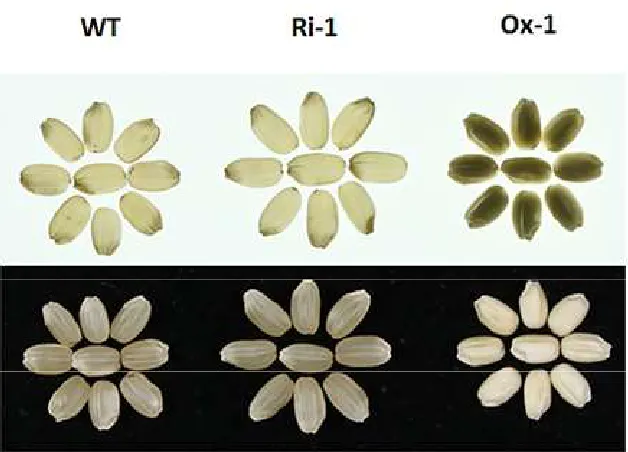
. Comparison of the transparent appearance of endosperm
between Wt,
OEtr-1
and
Ri-1
grains. Rice grains are illuminated
32
Figure S2
. Iodine-staining of endosperm starch in Wt,
OEtr-1
and
Ri-1.
Twenty milligrams of endosperm powder were
treated with 1N NaOH as described in materials and methods.
Supernatants of the starch samples was mixed with (A) 0.1
mL or (B) 0.2 mL
I
2/KI solution.
Wt
Ri-1 OEtr-1
Wt
Ri-1 OEtr-1
A
B
I
2/KI 0.1 mL 0.3 mL
33
Wt Ri-1 OEtr-1 Wt Ri-1 OEtr-1 Wt Ri-1 OEtr-1 Wt Ri-1 OEtr-1 Wt Ri-1 OEtr-1
Figure S3. Effect of various concentration of urea on the gelatinization
properties of endosperm starch in Wt,
OEtr-1
and
Ri-1
.
34 DAF
12 14
Figure S4. Histochemical GUS (β-glucuronidase) activity
staining in cross and longitudinal section developing rice seeds. Immature rice seeds were collected at 12 and 14 DAF,
respectively. The lemma and palea was completed removed carefully from the immature seeds. The cross section (A) and longitudinal section (B) of the seeds were cutted with a knife. The cutted of immature grains were stained and preserved in 70% ethanol and photographed. DAF: days after flowering.