On-Board Camera Based on Pedestrian
Detection system
Dr. Y.PadmaSai
1,
V. Naveen Kumar
2, N. Mohan Krishna
3Professor & Head of the Department, Dept. of ECE, VNRVJIET, Hyderabad, Telangana, India 1
Project Engineer at Research and Consultancy Center, VNRVJIET, Hyderabad, Telangana, India 2
PG Student [ES], Dept. of ECE, VNRVJIET, Hyderabad, Telangana, India 3
ABSTRACT: Situational awareness for industrial vehicles is crucial to ensure safety of personnel and equipment. While human drivers and onboard sensors are able to detect obstacles and pedestrians within line-of-sight, in complex environments, initially occluded or obscured dynamic objects can unpredictably enter the path of a vehicle. Right now the driver will continuously observe the pedestrian present while driving. If the driver is in drowsiness may leads to accidents. The main disadvantage in the existing method is driver will continuously observe the pedestrian through manually and the sensors will not give accurate information. The project aims at designing a system which automatically detects the presence of any pedestrians near to the vehicles and controls the vehicle motors and also alerts the pedestrians through buzzer alarm and also using ARM Cortex-A8 Beagle Bone Black processor with USB camera interfaced. We propose a system that integrates a vision-based off board pedestrian tracking subsystem with an onboard localization and navigation subsystem.
KEYWORDS: Beagle bone Black Processor, Pedestrian Detection, web camera.
I.INTRODUCTION
front of the vehicle. Once the pedestrian is detected, automatically the vehicle gets stopped. The system gives alert through buzzer alarm whenever it detects pedestrians in front of the vehicle. To perform this task, Beagle Bone Black processor is programming using in embedded Linux. The project which captures the image of pedestrian and it will gives alert to the driver using buzzer alarm and the vehicle automatically get stopped.
II
.
RELATED WORKPreviously work on pedestrian detection has taken a learning-based approach, bypassing a pose recovery step altogether and describing human face in terms of simple low-level features from a region of interest. Research has also been done on people and car detection from a moving vehicle through an urban area, using a stereo camera configuration as well as from a fixed camera observing areas like a pedestrian crossing. Given the depth information, many false positives can be filtered out however, additional computational power is needed to obtain a depth map and stereo camera hardware costs significantly more compared to monocular cameras. Results have shown that occlusions are common with 70% of pedestrians being occluded in at least one frame and a solution using motion estimation of the person is not effective when the camera is mounted on the moving vehicle. Detection rates varied from 70% when the pedestrian is in close proximity to the vehicle to only 20% successat a medium distance, pointing out a major drawbackeven with the most advanced people detection algorithms currently available.
III. PROPOSED SYSTEM
This project makes use of an onboard camera, which is commonly termed as Beagle Bone Black processor. This onboard camera can efficiently communicate with the output and input modules. The project aims at designing a system which automatically detects the presence of any pedestrians near to the vehicles and controls the vehicle motors and alerts the pedestrians through buzzer alarm and also using ARM Cortex-A8 Beagle Bone Black processor with USB camera interfaced.
Web Camera
Camera is a video camera that feeds its images in real time to a computer or computer network. An camera a wired USB camera is generally connected by a USB cable, similar cable. Cameras are known for their low manufacturing cost and flexibility.
DC motor
DC motor uses electrical energy to produce mechanical energy, very typically through the interaction of magnetic fields and current-carrying conductors. In any electric motor, operation is based on simple electromagnetism. A current carrying conductor generates a magnetic field
Buzzer
IV. HARDWARE IMPLEMENTATION
Fig: 1 Block diagram of pedestrian Safety using Beagle bone
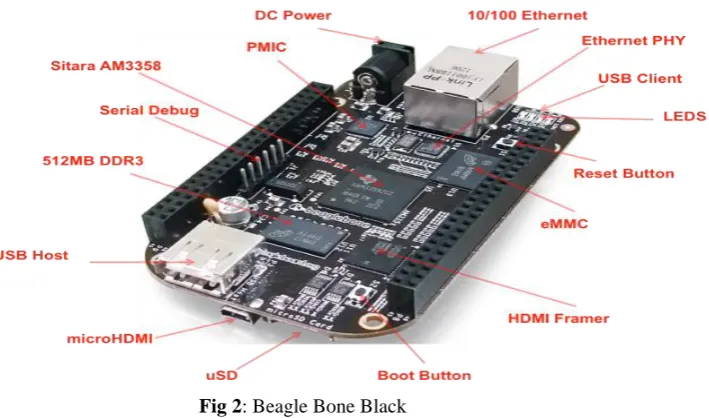
4.1 Beagle Bone Black
Fig 2: Beagle Bone Black
4.2 Web Camera
V. ALOGORITHM
Haar-like features are digital image features used in object recognition. They owe their name to their intuitive similarity with Haar wavelets and were used in the first real-time face detector
.
The advantage of a Haar-like feature over most other features is its calculation speed. Due to the use of integral images, a Haar-like feature of any size can be calculated in constant time. Here we will work with face detection. Initially, the algorithm needs a lot of positive images (images of faces) and negative images (images without faces) to train the classifier. Then we need to extract features from it. For this, Haar features shown in below image are used. They are just like our convolution kernel. Each feature is a single value obtained by subtracting sum of pixels under white rectangle from sum of pixels under black rectangle.Fig 4
:
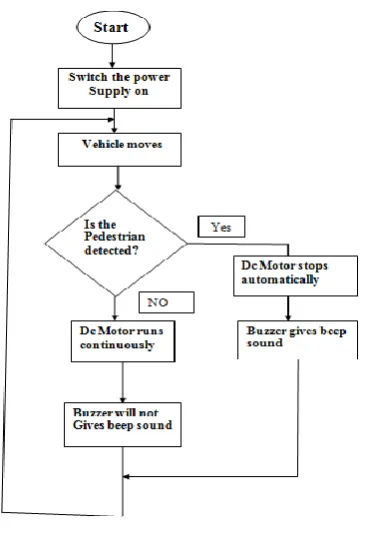
Flow ChartVI. EXPERIMENTAL RESULTS
Fig 5
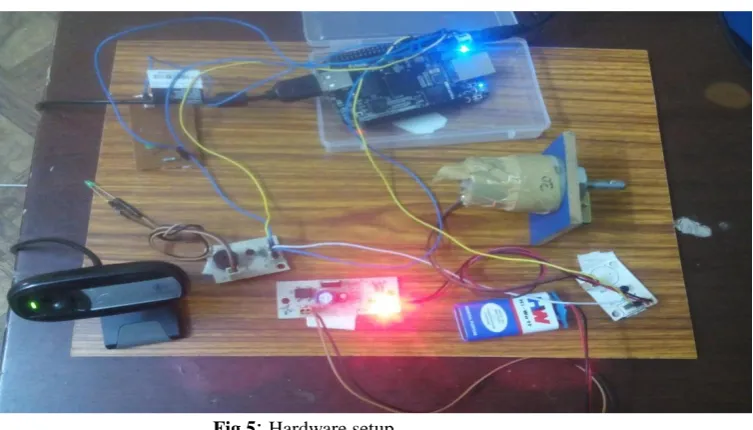
:
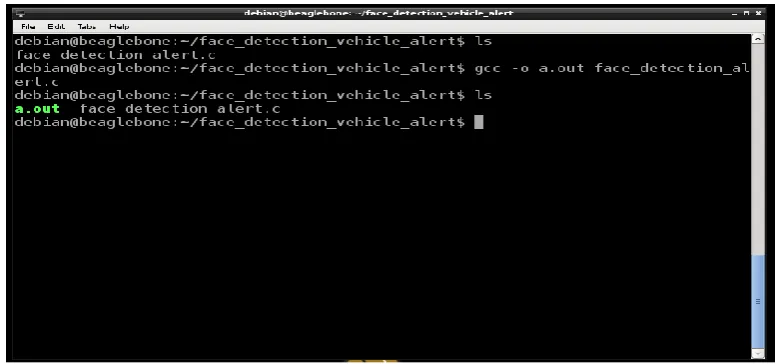
Hardware setupShow the command is given GCC Complier for the output
Fig 6: face_detection_alert_3 shows the command to compile c file using gcc compiler.
Fig 7: face_detection_alert_4 shows the compilation output file generation "a. out
VI.CONCLUSION& FUTURE SCOPE
Integrating features of all the hardware components used have been developed in it. Presence of every module has been reasoned out and placed carefully, thus contributing to the best working of the unit. Secondly, using highly advanced IC’s with the help of growing technology, the project has been successfully implemented. Thus the project has been successfully designed and tested. This project is mainly intended to design a system which captures the images of pedestrian using Beagle Bone Black processor and the system also alert through camera using buzzer alarm system. The project was designed such that the system captures the images of pedestrians and gives the buzzer indication to driver using Beagle bone black processor. When the USB camera detects the pedestrian in front of the vehicle, the vehicle automatically get stopped.
The system can be extended by interfacing wireless technologies like Bluetooth, WI-Fi, GSM etc. By interfacing Bluetooth or wireless Wi-Fi the human presence can be displayed on mobile phone along with location using GPS module If pedestrian arrivals towards the vehicle suddenly. So using this system, it prevents the accidents and it will secure human lives.
REFERENCES
[1] A. Gandhi and M. Trivedi, “Pedestrian protection systems: Issues, survey,and challenges,” IEEE Trans. Intell. Transp. Syst., vol. 8, no. 3, pp. 413–430, Sep. 2007.
[2] A. Ran, I. Weiss, Q. Zheng, and L. S. Davis, “Pedestrian detection via periodic motion analysis,” Int. J. Comput. Vis., vol. 71, no. 2, pp. 143–160, Feb. 2007.
[3] D. Senior, A. Hampapur, Y. L. Tian, L. Brown, S. Pankanti, and R. Bolle,“Appearance models for occlusion handling,” Image Vis. Comput., vol. 24,no. 1, pp. 1233–1243, Nov. 2006.
[4] D. Comaniciu and P.Meer, “Mean shift: A robust approach toward feature space analysis,” IEEE Trans. Pattern Anal. Mach. Intell., vol. 24, no. 5, pp. 603–619, May 2002.
[5] E. Johnsen and A. Tews, “Real-time object tracking and classification using a static camera,” in Proc. Workshop Pedestrian Detect. Track, IEEE Int. Conf. Robot. Autom., 2009.
[6] E.Dalal and B. Triggs, “Histograms of oriented gradients for human detection,” in Proc. IEEE Int. Conf. Comput. Vis. Pattern Recognit., 2005, [7] N.Wang, K. Ma, G. Ng, andW. Grimson, “Trajectory analysis and semantic region modeling using nonparametric hierarchical bayesian models,”Int. J. Comput. Vis., vol. 95, no. 3, pp. 287–312, Dec. 201.
BIOGRAPHY
Dr. Y Padma Sai, works as Lecturer in the Department of ECE in Deccan College of Engineering and Tech, Hyderabad and Later joined as an Assistant Professor in ECE at VNRVJIET in July 1999.Atpresent she is Professor and Head of the department of ECE .Her main objective is to impart quality education and learn New technologies and the scope is to fill gap between industry and academics.
V. Naveen Kumar is working as Project Engineer at Research and Consultancy Center (RCC) in VNR Vignana Jyothi College of Engineering & Technology, Hyderabad, Telangana. He Completed M. Tech in Embedded systems from VNRVJIET and B. Tech in Electronic & Communication Engineering from AZCET, JNTU Hyderabad. He has five years of research experience. His interests include Wireless sensor networks, Embedded Systems, RFID, Microprocessors & controllers, signal processing. He has two patents in wireless stream and five international papers.