
MHDE Algorithm for Hydrothermal
Scheduling
1
T.Saravanan, 2 V.Srinivasan, 3.G.Saritha 1
Professor, Dept of ETC, Bharath University, Chennai, India
2
Assistant Professor, Dept of ETC, Bharath University, Chennai, India
3
Assistant Professor, Sairam Institute of Technology, Chennai, India
ABSTRACT: This paper presents a modified hybrid differential evolution (MHDE) algorithm, for short-term scheduling of fixed head hydrothermal systems. Hydrothermal scheduling involves the optimization of a nonlinear objective function with a set of operational and physical constraints. The performance of the proposed approach is validated by illustration with two test systems. From the numerical results it is found that the MHDE based approach is able to provide better solution at a relatively lesser computational effort.
KEYWORDS: Differential evolution; evolutionary algorithms; genetic algorithm; hydrothermalscheduling;
1. INTRODUCTION
Hydrothermal scheduling is an important aspect for the optimal utilization of the available hydro resources in order to achieve maximum economy and has attracted increasing attention of researchers in recent years. Several optimization techniques have been developed for solving the hydrothermal scheduling problems [1-3]. In hydrothermal scheduling, complicated constraints such as limited water discharge rate, hydraulic continuity and final reservoir volume restrictions are present. For hydrothermal scheduling dynamic programming is widely used as it provides accurate modeling of the majority of hydroelectric plant characteristics . The major disadvantage of the DP method is the growth of computational and dimensional requirements with increasing system size and planning horizon [4-5]. Lagrangian relaxation methods have also been prevalently applied, due to its flexibility in dealing with different types of constraints . The generation and load balance constraints are the coupling constraints that are relaxed using multipliers onto the cost to form lagrangian function. The conventional optimization techniques have been found to be inefficient in handling the hydrothermal scheduling problems. Recently evolutionary algorithms have been employed for the hydrothermal scheduling problems. They do not place any restrictions on the shape of the cost curves and other non-linearities in model representation. Genetic algorithm [5-8] and Evolutionary programming have been employed successfully for the scheduling of hydrothermal systems. Differential evolution (DE) is a numerical optimization approach that is simple, robust and significantly faster [9]. Modified differential evolution has been successfully employed for hydrothermal scheduling problems. In DE, a large population has to be employed to avoid premature convergence. Hybrid Differential Evolution (HDE) has overcome the usage of large population, which results in lesser computation time [10,11]. The modifications are incorporated in the HDE algorithm as the DE algorithm exhibits difficulties
in handling the equality constraints, especially the reservoir end-volume constraints. The proposed algorithm has been implemented using VC++ on PIV-2.6 GHz 512MB RAM PC and the algorithm is illustrated on standard test systems.
II. HYDROTHERMAL SCHEDULING PROBLEM
The objective of the hydrothermal scheduling is to provide optimal utilization of hydro resources in order to minimize the thermal cost over a scheduling period T, as expressed by
TNs
t =1i=1
where Ns is number of thermal units and Ps represents thermal generation in MW. It is
subjected to a set of linear, non-linear and dynamic constraints. The load balance constraint is expressed as
N
s
N
h
(i, t )= PD(t )+ PL(t )
∑
P
s (i, t)+∑ Ph (2)
i= 1
i
=1
where Nh is the number of hydro units, Ph is the generation of hydro units in MW and PD is
the power demand in MW. PL is the total transmission loss in MW, as given by
PL
=
(Ns+ Nh) (Ns+Nh)
∑ ∑ Pi BijPj (3)
i=1 j=1
where Bij represents the loss formula coefficients. The hydro generator power output is expressed as a function of water
discharge rate, Qh in m3 and storage volume, Vh in m3.
Ph(i, t)= f (Qh(i, t), Vh(i, t)) (4)
The generator capacity constraints are expressed as
Ps(i)min ≤ Ps(i, t )≤ Ps(i)maxand Ph(i)min ≤ Ph(i, t )≤ Ph(i)max (5)
The continuity equation for the hydro reservoirs neglecting spillage and physical limitations on reservoir storage volumes and water discharge rate limits are given by is given by
Vh(i, t +1)= Vh(i, t)+ I h(i, t )− Qh(i, t )
( 6
)
V (i,t)min≤ V (i,t)≤ V (i,t)max and Q
h
(i,t)min≤ Q h
(i,t)≤ Q
h
(i,t)max
( 7
)
h h h
V
(i,
t) t =0 =V (i)begin and V (i,t)
t
=
T = V (i)end
( 8 )
h h h h
III. MHDE ALGORITHM FOR HYDROTHERMAL SCHEDULING
In MHDE based approach, modifications are incorporated in the initialization and mutation steps of the HDE algorithm to efficiently deal with the final reservoir storage volume constraints [1-5].
3.1 Initialization
The following steps are carried out in the initialization process:
1. The initial population of Np individuals is randomly selected based on uniform probability distribution for all variables to cover the entire search space uniformly. The discharge of ith plant at time t is expressed as
Qh (i, t) = Qh (i)min+ ρ(Qh (i)max− Qh (i)min) (9)
where ρ ∈ [0,1] is uniformly distributed random number. The initial population excluding the dependent hydro discharge is expressed as
Z0k=[Q(i,1),Q(i,2) ,KQ(i,d−1) , Q(i,d+1) ,KQ(i,T)], k = 1,2, …, Np, i = 1,2,…,Nh. (10)
2. A random element is chosen and the dependent hydro discharge Qh (i, d) is computed using
Q (i, d) = V
T T R u T
(m, t − τ)(11) h
(i)begin− V (i)end−∑ Q
h
(i, t) +∑ I
h
(i, t) + ∑ ∑ Q h
h h
t =1 m =1 t =1 t =1
t≠ d
3. The above steps are repeated until the element representing the dependent variable doesn’t violate the constraints.
3.2 Mutation
In mutation, a perturbed individual is generated on the basis of the parent individual by
ˆ G
+1 G G G
) (12)
Z
i
=
Zp + F ×(Z j
−
Zk
where F is a scaling factor and j and k are randomly selected. The scaling factor F ∈ [0,1.2] ensures the fastest possible convergence. In order that the perturbed individuals satisfy final reservoir storage constraints the following steps are carried out for all the Np individuals:
1. A random element of the perturbed individual is chosen. Let l = 1.
2. The dependent hydro discharge is computed using (11). If the computed hydro discharge doesn’t violate the constraints then go to step 6; otherwise go to the next step.
3. The dependent discharge is fixed either to its maximum or minimum limit according to its limit violation, a new random element is chosen and l = l + 1.
4. If l < = T, then go to Step 2; otherwise go to next step.
6. The mutation process is terminated.
The new set of Np perturbed individuals thus obtained by the modification process will satisfy the final storage volume. While generating the random element it is ensured that it is not repeatedly selected [6-10].
3.3 Crossover
The gene of an individual at the next generation is produced from the perturbed individual and the present individual, where the crossover factor CR ∈ [0,1.0] is assigned by user.
ˆ G
+1
⎧ G
, if a random number > C R
⎪Z
ji
i = 1, …, Np, j = 1, …, n (13)
Zi
=
⎨
ˆ G
+1
, otherwise
⎪
Z j i
⎩
3.4 Evaluation and Selection
The two steps involved are one-to-one competition and selection of best individual in the population as expressed by G
+
1 G
ˆ G
+1
)}, i =1,…NP (14)
Zi
= arg min {
ψ(Zi ), ψ(Zi ˆ G
+1
G
+1
) , i = 1,…N P} (15)
Z
b = arg min {ψ(Zi
3.5 Acceleration Operation
The acceleration phase with a step size α ∈ [0,1] is represented as
⎧ ˆ G
+
1
,
ˆ G
+1 ˆ G
)
ZG
+1
⎪Z
b
if
ψ(Z b
)< ψ(
Z
b
=
⎨
ˆ
(16)
b G
+
1
− α ∇ψ, otherwise
⎪Z b
3.6 Migration Operation
Migration phase regenerates a newly diverse population of individuals and the hth gene of the ith individual is regenerated as
⎧
G
+ 1
+ δ
hi (Z h min
G
+
1
)
, ~
G + 1
−Z
h min
Z
hb G
+
1 ⎪ Z hb − Z hb
if δ
hi < (17)
Z
h max
Z
hi
=
⎨
+ δ
hi (Z h max − Z G+1),
−Z
h min
⎪ otherwi
se i = 1, … , Np, h = 1, … , n
⎪Z G + 1
⎩ hb hb ~
where δ and δ denote uniformly distributed random numbers. The migration operation is performed only if
⎧ ⎫
⎪ N
p ⎛ n ⎞
⎪
⎜ ⎟
⎨ ∑
⎜
∑η
Z
⎟⎬
⎪i=1 ⎝ h=1
⎠ ⎪
⎪ ⎪
ρ =
⎩i≠
b ⎭ <
ε
n(Np− 1)
1
⎧ Z
hi - Zhb
wher e
⎪1 ,
i
f > ε2
(18)
Z
hb
η
Z =⎨
⎪
otherwise
⎩0
Parameter e2 expresses the gene diversity with respect to the best individual. ηZ is the scale index. With the members
of the next generation thus selected, the cycle repeats until there is no improvement in the best individual. In this study, DE with random vector perturbation and binominal crossover is employed [11-15].
IV. SIMULATION RESULTS
4.1 Test System I
The first test system consists of two hydro and four thermal plants, as given in ref. [10]. The quadratic fuel cost function including the effect of valve point loading is expressed as
N
s m
i n − Psi
)}
2
+ (19)
F=∑a
si +bsiPsi +csiPsi d si sin{esi (Psi i=1
where as, bs cs represent the cost coefficients and ds, es represent the coefficients corresponding to valve point
loading. The water discharge constraint of the hydro plant is
∑
T
12(ah (i) +bh (i)Ph (t, i) +ch (i)Ph
2
(t, i))−Wh (i) = 0 i∈Nh (20)
t
=
1
where ah, bh and ch represent the hydro coefficients and Wh represents the allowable volumes of water for the
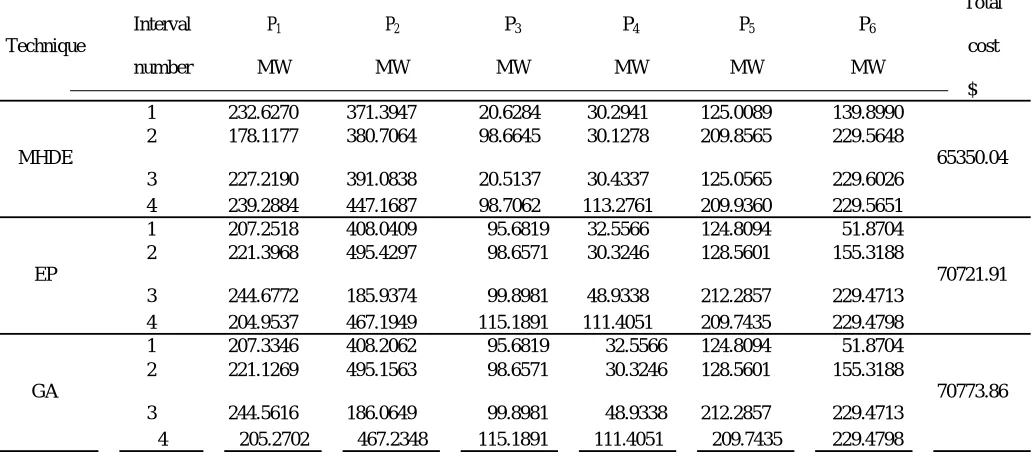
scheduling horizon [16-20]. Table 1 provides the comparison with EP and GA. The control parameters Np, F and CR
are 16, 1.0 and 0.9 respectively and MHDE converges in 0.63s.
4.2 Test System II
The second system consists of two thermal and two hydro plants [11]. The water discharge as a segmented piecewise linear function of output power of each hydro unit is given by
T ⎛ L ⎞
∑12⎜⎜ Qh(Ph
min)+∑δ
hjPhj(i,t)⎟ ⎟−
Wh= 0 (21)
i
=
1 ⎝ j=1 ⎠
Table 2 compares results of the proposed approach with those of EP and GA. The control parameters Np, F and CR
Table 1: Comparison of schedules of MHDE with EP and GA for test system I
Interval P1 P2 P3 P4 P5 P6
Total
Technique cost
number MW MW MW MW MW MW
$
1 232.6270 371.3947 20.6284 30.2941 125.0089 139.8990
MHDE
2 178.1177 380.7064 98.6645 30.1278 209.8565 229.5648
65350.04
3 227.2190 391.0838 20.5137 30.4337 125.0565 229.6026
4 239.2884 447.1687 98.7062 113.2761 209.9360 229.5651
1 207.2518 408.0409 95.6819 32.5566 124.8094 51.8704
EP
2 221.3968 495.4297 98.6571 30.3246 128.5601 155.3188
70721.91
3 244.6772 185.9374 99.8981 48.9338 212.2857 229.4713
4 204.9537 467.1949 115.1891 111.4051 209.7435 229.4798
1 207.3346 408.2062 95.6819 32.5566 124.8094 51.8704
GA
2 221.1269 495.1563 98.6571 30.3246 128.5601 155.3188
70773.86
3 244.5616 186.0649 99.8981 48.9338 212.2857 229.4713
4 205.2702 467.2348 115.1891 111.4051 209.7435 229.4798
Table 2: Comparison of schedules of MHDE with EP and GA for test system II
Method
Interval P1 P2 P3 P4
Total
cost
number MW MW MW MW $
1 354.0986 288.0500 199.9991 390.0646
MHDE
2 565.5165 384.6651 200.1617 399.9983
372625.50
3 493.8455 349.8964 200.0007 400.0016
4 661.4623 426.1222 277.0639 399.9998
EP
1 360.2849 258.8861 200.1733 400.0024
2 448.9986 463.8880 227.4372 390.2221
373369.88
3 294.8204 529.6531 199.6915 399.0026
4 449.9879 637.3414 249.8646 400.5992
1 350.6644 268.2802 200.0472 400.1263
GA
2 449.7204 464.3986 228.7785 387.7219
374153.91
3 279.9608 543.5551 199.4901 399.8788
4 443.2979 643.8198 248.8126 401.6378
V. CONCLUSION
VI. ACKNOWLEDGEMENT
The authors acknowledge with gratitude the support and facilities provided by the authorities of Annamalai University, Annamalainagar, India to carry out this research work.
REFERENCES
[1] Zaghlool M.F., Trutt F.C., 1988, “Efficient methods for optimal scheduling of fixed head hydrothermal power systems”, IEEE Trans. Power Systs., 3,24-30.
[2] Kumaravel, A., Meetei, O.N., "An application of non-uniform cellular automata for efficient cryptography", Indian Journal of Science and Technology, ISSN : 0974-6846, 6(S5) (2013) pp.4560-4566.
[3] Chang S.C., Chen C.H., Fong I.K., Luh P.B., 1990, “Hydroelectric generation scheduling with an effective differential dynamic programming”, IEEE Trans. Power Systs., 5, 737-742.
[4] Gorenstin G., Campodonico N.M., Costa J.P., Pereira M.V.F., 1992, “Stochastic optimization of a hydrothermal system including network constraints”, IEEE Trans. Power Systs, 7, 791-797.
[5] Kumaravel, A., Pradeepa, R., "Efficient molecule reduction for drug design by intelligent search methods", International Journal of Pharma and Bio Sciences, ISSN : 0975-6299, 4(2) (2013) pp.B1023-B1029.
[6] Salam M.S., Nor K.M., Hamdan A.R., 1998, “Hydrothermal scheduling based lagrangian relaxation approach to hydrothermal coordination”, IEEE Trans. Power Systs, 13, 226-234.
[7] Gil E., Bustos J., Rudnick H., 2003, “Short-term hydrothermal generation scheduling model using a genetic algorithm”, IEEE Trans. Power Systs., 18, 1256 – 1263.
[8] Hota P.K., Chakrabarti R., Chattopadhyay P.K., 1999, “Short-term hydrothermal scheduling through evolutionary programming technique”, Elect. Power Syst. Res., 52, 189-196.
[9] Kumaravel, A., Pradeepa, R., "Layered approach for predicting protein subcellular localization in yeast microarray data", Indian Journal of Science and Technology, ISSN : 0974-6846, 6(S5) (2013) pp.4567-4571.
[10] Storn R., Price K.V., 1997, “Differential evolution – A simple and efficient heuristic for global optimization over continuous spaces”, Journal of Global Opt., 11, 341–359.
[11] Lakshminarasimman L., Subramanian S., 2006, “Short-term scheduling of hydrothermal power system with cascaded reservoirs by using modified differential evolution”, IEE Proc. on Gen.Trans. and Dist., 153, 693-700.
[12] Chiou J.P., Chang C.F., Su C.T., 2004, “Ant direction hybrid differential evolution for solving large capacitor placement problems”, IEEE Trans. on Power Systs., 19, 1794–1800.
[13] Basu M., 2004, “Multiobjective Generation Scheduling of Fixed Head Hydrothermal Power Systems through an Interactive Fuzzy Satisfying Method and Evolutionary Programming Technique”, Elect. Power Comp. Systs., 32, 1287-1299.
[14] Basu M., 2003, “Hopefield Neural Networks for Optimal Scheduling of Fixed Head Hydrothermal Power Systems”, Electric Power Systs. Res., 64,11-15.
[15] K. Gopalakrishnan, Prem Jeya Kumar M, J. Sundeep Aanand, R. Udayakumar, 2013, Thermal Properties of Doped Azopolyester and its Application, Indian Journal of Science and Technology, ISSN: 0974-6846, 6(6), pp.4722-4725
[16] Kumaravel, A., Udhayakumarapandian, D.,"Consruction of meta classifiers for apple scab infections", International Journal of Pharma and Bio Sciences, ISSN : 0975-6299, 4(4) (2013) pp.B1207-B1213.
[17] K. Gopalkrishnan, J. Sundeep Aanad and R. Udayakumar, 2013, Structural Properties Doped azopolyester and its characteristics, Middle-East Journal of Scientific Research, ISSN:1990-9233, 15(12), pp.1773-1778
[18] K. Gopalkrishnan, J. Sundeep Aanad and R. Udayakumar, 2013, Synthesis of Doped azopolyester using solution casting technique, Middle-East Journal of Scientific Research, ISSN:1990-9233, 15(12), pp.1813-1816
[19] Lydia Caroline M., Vasudevan S., "Growth and characterization of pure and doped bis thiourea zinc acetate: Semiorganic nonlinear optical single crystals", Current Applied Physics, ISSN : 1567-1739, 9(5) (2009) pp. 1054-1061.
[20] R. Udayakumar, V.Khanna, Saravanan T, G.saritha, 2013, Retinal Image Analysis Using Curvelet Transform and Multistructure Elements Morphology by Reconstruction, Middle-East Journal of Scientific Research, ISSN:1990-9233, 16(12), pp.1798-1800
[21] R. Udayakumar, V.Khanna, Saravanan T, G.saritha, 2013, Cross Layer Optimization For Wireless Network (Wimax), Middle-East Journal of Scientific Research, ISSN:1990-9233, 16(12), pp.1786-1789
![Bis{2 [1 (8 hydroxy 2 quinolylmethyl) 1H benzimidazol 2 yl]quinolin 8 ol} toluene solvate](data:image/gif;base64,R0lGODlhAQABAIAAAP///wAAACH5BAEAAAAALAAAAAABAAEAAAICRAEAOw==)