DETERMINANTSOFGENDEREARNINGS
DIFFERNTIALS IN THE INFORMAL SET UP
••
Paul Mwangi Gachanja, Department of Economics, Kenyatta University
The rapid and comprehensive economic reforms that Kenya has undertaken have led to changes in the employment situation, with respect to increased participation of women in the labour force and the rise of unemployment, especially among the youth. The increased participation of women in the labour force is mainly due to the opening up of opportunities occasioned by the improved access of women to education. This has seen participation rates rise for urban women from 30 percent in the early eighties to over56percent currently.
However, womenS employment is still characterised by low productivity, low pay and long hours of work. This situation is even worse in the rural set up where the rural women still spend a disproportionate amount of their time on unpaid work, limiting their access to income earning opportunities. They also have a limited role in formal employment, while off-farm work oftencompromises their traditional roles. In addition, women are disproportion-ately represented in the informal sector. The major factors fronted for this situation include imbalances in training and access; retrogressive cultural practices which bar women from taking up positions in certain spheres of employ-ment and lack of a supportive legal framework. Attempts to raise the level of quality participation of women in the labour force have been unsuccessful due to inadequate skills and other social cultural factors (Republic of Kenya, 2002). The upshot is that average earnings for women are less than half those of men. (Republic of Kenya, 1997). This suggests that men are favoured by all these factors above, guaranteeing them higher earnings than women. This paper will therefore seek to identify the major hindrances to women
s
participation in labour force in the informal rural set up and more so, the extent to which training, culture and the current legal framework have contributed to dismal participation of women in the gainfulemployment thereby dismal earnings. This will be achieved through collection of the available secondary data to be supplemented with information primarily ob-tained from the relevant sources. Simple descriptive statistics will be used to analyze the data. The paper proposes remedies that will enhance women participation so as to step up their earnings.Introduction
The rapid and comprehensive economic reforms that Kenya has undertaken have led to changes in the employment situation, with respect to increased participation of women in the labour force and the rise of employment, espe-cially among the youth. The increased participation of women in the labour force is mainly due to the opening up of opportunities occasioned by the improved access of women to education. This conforms to the sentiments of (Moser and Holland, 1997) that the level of education determines women's earnings in both the formal and informal sectors. Access to education has led to the rise of participation rates for urban women from 30% in the early eighties to over 56 percent currently.
.-The following table gives an analysis of gender occupation discrepancies;
Table 1: Gender Occupation Discrepancies
OCCUPATION WOMEN ('000) MEN ('000) TOTAL ('000)
Unpaid Family workers 1,919l.54 856.83 2,776.37
Commercial Farmer 122.03 142.18 264.21
Subsistence Farmer 2,895.74 1,760.73 4,656.47
Unskilled Private Worker 437.34 800.47 1,232.81
Business Person 454.28 480.69 934.97
Source: Welfare Monitoring Survey, 1994
As table 1 shows,rural women in unpaid family worker were more than double the figure of men.In this case, 69%
of women were classified as unpaid family workers and 62% in subsistence farming which is largely non-income
generating. However, men incommercial farming were more than the number of women, another case of
dispro-portionate representation of women in income earning opportunities. In addition, more men were in business than
the number of women.
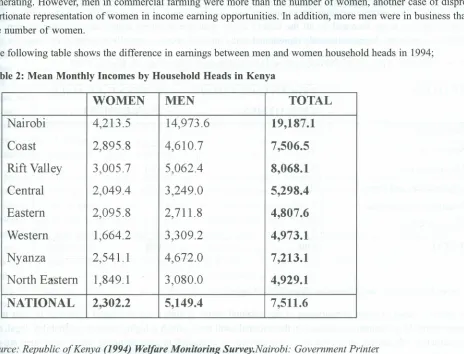
The following table shows the difference in earnings between men and women household heads in 1994;
Table 2: Mean Monthly Incomes by Household Heads in Kenya
WOMEN
MEN
TOTAL
Na
i
robi
4,213.5 14,973.6 19,187.1Coast
2,895.8 4,610.7 7,506.5Rift Valle
y
3,005.7 5,062.4 8,068.1Central
2,049.4 3,249.0 5,298.4Eastern
2,095.8 2,711.8 4,807.6Western
1,664.2 3,309.2 4,973.1Nyanza
2,541.1 4,672.0 7,213.1North Eastern
1,849.1 3,080.0 4,929.1NATIONAL
2,302.2 5,149.4 7,511.6Source: Republic of Kenya (1994) Welfare Monitoring Survey.Nairobi: Government Printer
As shown by table 2, men earnhigher average incomes than women in all the provinces in Kenya and on the National
level.This shows that across the whole nation, on average, women earn less than their male counterparts. Accord-ing to Republic of Kenya, (2002b), men have more skills than women, both in private and public enterprises explaining why the modem sector employment for men have been slightly higher than that of women. On the
--Women also have a limited role in formal employment, while off-farm work oftencompromises their traditional roles. In the rural areas, women spend more time in off farm wage employment than men do (Ongile, 1994). This situation is compounded by the traditional and cultural practices governing land and livestock ownership, access and control over resources and benefits accruing from agricultural production, which severely limit their capacity for increasing agricultural production. Traditional and social practices deny women the right to own property, which limits their capability to access credit agricultural inputs, marketing outlets and opportunities arising from membership of co-operatives. This is inspite of the fact that women head 38% of agricultural operations in Kenya, which is an improvement from 29.5% in 2000 (Republic of Kenya, 2001; Republic of Kenya, 2002 andCenter for gender Studies, 2003). Even in situations where women participate in income generating activities like growing of cash crops, the proceeds accrue to the family heads and women have no control over such proceeds (Kibwana,
1996).
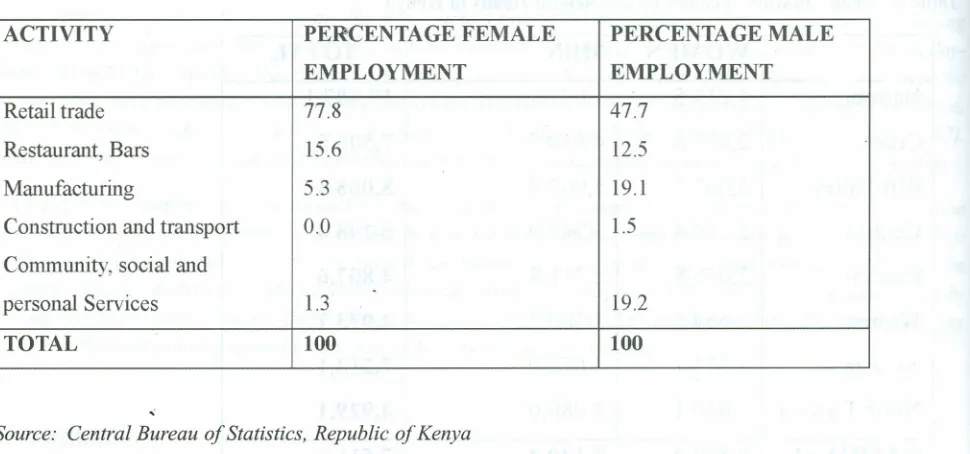
The major factors fronted for the dismal participation of women includes imbalances in training and access; retro-gressive cultural practices which bar women from taking up positions in certain spheres of employment and lack of a supportive legal framework. Attempts to raise the level of quality participation of women in the labour force have been relatively unsuccessful due to inadequate skills and other socio-cultural practices, Republic of Kenya (2002a). The upshot is that average earnings for women are less than half those of men, Republic of Kenya (1997). This suggests that men are favoured by all the factors above, guaranteeing them higher earnings than women. In addition, women are disproportionately represented in the informal sector, especially in terms of earnings.
Table 3: Gender Analysis of Participants in Informal Sector Enterprises in Kenya, 1999
ACTIVITY PERCENTAGE FEMALE PERCENTAGE MALE
EMPLOYMENT EMPLOYMENT
Retail trade 77.8 47.7
Restaurant, Bars 15.6 12.5
Manufacturing 5.3 19.1
Construction and transport 0.0 1.5
Community, social and
personal Services 1.3 19.2
TOTAL 100 100
Source: Central Bureau of Statistics, Republic of Kenya
As table 3 shows, women participation in the informal sector is highly disadvantaged compared to their male counterparts. More women are engaged in the informal retail trade,which is highly prone to profitability, legal,and infrastructural challenges which threaten their survival as compared to manufacturing where more men are en-gaged. Furthermore, more women than men are engaged in indecent trades such as bar operations, which further jeopardize their position in terms of their well being. Men have also dominated in the provision of community, social
and personal services as income generating activities where women are expected to play traditional roles freely.
Table 4: Structure of the Labour Force, 1999
ACTIVITY WOMEN MEN TOTAL
AgricuIture 4,173,071 3,503,515 7,676,586
Industries 143,069 703,362 846,431
Trade 539,586 613,645 1,153,231
Services 2,000,045 1,165,213 3,165,358
TOTAL 6,855,871 5,985,735 12,841,606
Source: National MSE Baseline Survey, 1999
As table 4 shows, more women than men were in majority of the Medium and Small scale Enterprises (MSEs), This is especially in agriculture and services sub-sectors. This has implications in the earnings of the women in the MSEs because agriculture based MSEs do not earn as much as industrial based ones. In this case, there is a case of dismal earnings even in the informal sector, relative to the earnings of men.
It is estimated that 80% of women live in rural areas and that majority of them are engaged in farming of food and cash crops.A substantial percent of the women labour force is concentrated in the rural smallholder agriculture and
urban informal sectors. In addition, 96% of the women from rural households is used up on small holder agricul
-ture. The agricultural sector has not been performing satisfactorily so as to absorb the labour force in the rural
areas,hence dismal earnings by the rural labour force (lLO, 1995). Sessional Paper No.2 of 1986 onRenewed
Economic Growth for Sustainable Development underscores the commitment by thegovemment in promoting the informal sector so as to create jobs in the informal sector.This is as a realisation that micro and small enterprises were avenues of job creation and for raisingincomes. This was to be achieved through provision of the necessary infrastructure required to enhance theproliferation of theJuaKali sector.
67 percent of the rural households depend on the informal sector enterprises for their household income.
Men-owned Enterprises are significantly larger (2.6 workers) compared to women Men-owned ones (1.6 workers) (Republic
of Kenya, 1999). In addition, workers in women led enterprises generally have less level of training and that the
businesses are less likely to have security of tenure, therefore the incentive to have their businesses located in their homes. Women also engage in businesses considered illegitimate by the government under the local authorities Act, for example vegetable/ food selling and are mostly unlicensed. Furthermore, they have no specific location, which puts them in trouble with the local authorities. Such enterprises also provide a lower share of income compared to men-owned ones. Women tend to concentrate on activities within the centers which generates low incomes (ILO, 1991). All these factors contribute to the dismal performance ofMSEs owned or managed by women. This is as presented by the following table;
Table 5: Average Monthly Earnings of MSE Entrepreneurs (Kshs)
ACTIVITY ISDn-SECTOR WOlVIEN MEN
AVERAGE
Manufacturing 3,634 5,507 4,869
Trade 3,455 5,519 4,370
--
-
---
-_.__._---_.__..__...._---As shown by table 5, there is a substantial difference in the earnings of MSEs operated by men in comparison to those managed by women. The discrepancy is largest in the service sub-sector, which is unfortunate because (as shown in table 4) there are over 2 million women, compared to only 1.17 million men.This shows that women's increased participation in the informal sector is still not matched by increase in their earnings, not only in the formal, but also in the informal sector.
Education
Education may not be a major factor when it comes to the participation of women in income earning opportunities. This is so because of increased access to education and training opportunities. However,although school enrollment at primary level for girls and boys are at par,disparities have been increasing at secondary and higher educational levels due to female dropout rates attributed to social-cultural and economic factors.As shown by table 6, admission of women to various institutions is almost the same as that of women:
Table 6: School Enrolment Learning Institutions by Gender
INSTITUTION YEAR MALES FEMALES TOTAL
PRIMARY 1995 2,802,305 2,734,091 5,536,396
1996 2,843,355 2,754,301 5,597,656
1997 2,933,982 2,830,873 5,764,855
1998 2,994,554 2,925,167 5,919,721
SECONDARY 1997 363,845 323,625 687,473
1998 373,440 327,098 700,538
1999 194,821 198,908 393,729
2000 350,317 310,598 660,915
TEACHER 1996 10,226 9,673 19,899
TRAINING 1997 10,226 9,673 19,899
COLLEGES 1998 5,392 4,997 10,389
1999 7,230 7,689 14,919
2000 7,789 7,857 15,646
2001 8,861 7,7l8 16,979
Source: Ministry of Education, Science and Technology
Legal Framework and Regulatory Framework
The law is the principle instrument that the government can use to implement reforms, such asthe empowerment of women. There are certain sections of the constitution of Kenya that tend to disfavour women in terms of property ownership/ rights. Examples of such include;
- The registered Land Act which discriminates against women who work and buy land, registering it in their spouse's name.This implies that the land absolutely belongs to the spouse and thewomen may not use the land to access credit;
- Employment Act (l997) restricts employment of women between 6.30 p.m. and 6.30a.m. in industries and underground work in a mine;
--- --- ---
--Interventions
by
the government and other stakeholders
As a show of commitment by the government to the promotion of women's well being, Kenya isa member of a
number of international conventions. They include the 1984 Convention on the Elimination of allforms of
Discrimi-nationAgainst Women(CEDAW), Nairobi Forward Looking Strategies (NFLS) for the advancement ofwomen and
the 1995,Beijing Declaration and the Platform for Action (Republic of Kenya, 2002b).
The government also established a Women's Bureau in the Ministry of Culture and Social Services in 1976 soasto
cater for the advancement of Women's affairs in Kenya (Republic of Kenya, 1993). This is aimed at facilitating
improvement of efficiency in resource allocation and utilization so as to empower women. The newly elected NARC
government hasalso established a Ministry of Gender, Sports and Culture, which is charged with the responsibility
of gender issues among others.
There are also local and international Non-governmental Organisations (NGOs) involved in the empowerment of
women in Kenya.They include FIDA-Kenya, KWPC,AAWORDand Oxfam among others(Kibwana, 1996).Some
NGOs are involved in leadership, income generating and entrepreneurial skills training among women, for example,
CARE-Kenya. In addition, CARE-Kenya offers credit and business management skills to women groups in Kenya
under a revolving fund scheme. Follow up is also done by the staff so as to offer technical assistance and monitor
-ing of the loan scheme (CARE-Kenya, 1991).Kenya Women Finance Trust (KWFT) also provides credit towomen
groups and offerstraining to small-scale women entrepreneurs in small business management.According to Macharia
(2003),credit enhances the performance of women-operated MSEs to compete favourably with those operated by
men.
Hindrances to the Performance of the informal sector
There are various hindrances to women's participation in the labour force in the informal rural set up. Further,
training, culture and the current legal framework have contributed to dismal participation of women in gainful
employment, thereby dismal earnings. According to Ongile (1994), women inthe informal sector enterprises are
faced with various problems in their attempts to earn a living. Such constraints include:
- Lack of access to resources;
- Poor investment patterns;
- Time and mobility constraints related to domestic responsibilities;
- Less involvement in diversified activities;
- Illiteracy; ,
- Lack:of numeracy and time saving technologies;
- Poor management; and
- By-laws, Employment Act and Succession Act which are not conducive to women's empowerment.
According to Aleke-Dondo (1994), credit related constraints could be attributed to the financial market infras
truc-ture problems and inconsistencies. They include:
- Inconsistencies in government policies where political considerations supercedes the acceptance of the info
r-mal sector as an avenue of income and output generation;
- Sustainability of lending programmes where most MFIs are dependent on donor funding or the government;
.- Low commercial banks participation and responsibilities whereby very few of them are involved or show the
interest of working with the informal sector which is evident in the conditions put on loans' acquisition;
- Performance of the NGO sector where they are tom between provision of social welfare and micro financing of SMEs, goals which are irreconcilable; and
- Lack of extension! training services among the rural folk.
Women and Women Groups
There are several women groups in the country, formed to forge for the social and economic advancement of
.women. Mostly, a number of women organize themselves, form a group, which becomes or operates like one
person. In many cases, group-run businesses by women often end up collapsing. This is attributed to the fact that it is difficult for a group to become cohesive enough to successfully run an enterprise. This occurs due to diversion of interest in the process of running the enterprise; after its inception. Some members of the group develop enthu-siasm. This is later on mistaken and misinterpreted by some of the members in the group. The enthusiasm fades, with some members dissociating themselves from the entrepreneurship leading to the business becoming nobody's business. This becomes the beginning of the end of the business.
Solidarity in the group, which is very important to the success of the enterprise lacks, and eventually, collapses.
This is because the characteristics of an entrepreneur lack in the group. There is resistance to discussions and new
ideas, lack of commitment to solve problems, maintenance of socio-cultural beliefs and traditions, discussions dominated by one member or a small group and lack of clear objectives. Educational and status differences within the members of the group become significant, and are eventually, a factor that works to the downfall of the group.
Moreover, age, skills, technology and information become hurdles to the success of the group. Contributing factors
to the downfall of the group include:
- Lack of finance
- Lack of leadership skills - Lack of access to resources
- Lack of market due to poor infrastructure
Conclusion
Although the contribution of various segments of the population in social and economic development of our country is recognized, there exists various gender disparities especially where women are concerned. Low levels of educa-tion attainment by women, coupled with retrogressive social-cultural practices have resulted in low participaeduca-tion
and representation of women in decision-makingpositions and lack of access to economic opportunities. Women
are also exposed to some forms of exploitation, discrimination, violence and harassment. Furthermore, women face
harmful cultural practices such as genital mutilation, forced and early marriages and food taboos among others.The
traditional gender roles over-burden the girl child thus limiting her opportunities for social and economic develop-ment.
Policy Recommendations
The elimination of the gender imbalances especially in the economic well being is not only a government's burden but should be a collective responsibility of all stakeholders to include the victims and the society as a whole.
The government's roles would be to;
- ensure the elimination of gender imbalances in all levels of education as a key priority in addressing gender biases throughout the society,
--- ensure operationalization of the National Policy on Gender and Development which seeks to offer both men and women the right placements in all spheres oflife (Economically, socially and politically),
- initiate and strengthen the existing gender interventions with an explicit focus on poverty,
- ensure a strong and conducive legal framework that seeks to recognise women especially in terms of property ownership and other rights of the girl child that the traditions have completely over-shadowed,
- offer gender training for key actors at all levels to enhance systematic gender mainstreaming in development policies, programmes and budgeting and
- Enhance women's accessibility to finance or credit sources so as to enhance the performance of their busi-nesses through relaxation of the existing rules and regulations regarding banks and development finance institu-tions.
Women on the other hand have several roles to play, such as;
- Seek formal training in the management of groups to eliminate management related problems for it is through such women groups that would give them legal ownership of property,
- Try and relax their embracing of retrogressive cultural practices and instead, adopt civilized societal norms and practices.
Other stakeholders also have roles to play,which include;
- Activist groups and Non -Governmental Organisations should sensitize women on their rights to help them overcome the traditional rigidities that have been responsible for the women's poor performance and
men should recognise women's efforts and match them with the relevant rewards in regard to their role in family income earning capacities.
Reference
Aleke-Dondo, 1994, "Policies on Credit and Savings for Women in the Rural and Informal Sectors" in ILO, 1994.
Productive Employment and Equity in the Rural and Informal Sectors in Kenya. ILO, Geneva
Ang'awa, M.1994, "Legal and Regulatory Framework for Women's Employment" in ILO, 1994.Productive
Em-ployment and Equity in the Rural and Informal Sectors in Kenya. ILO,Geneva.
Center for Gender Studies, 2003. The Kenya National Gender and Development Policy.Government Printer,Nairobi.
Kibwana,K.ed.1996, Women and Autonomy in Kenya; Policy and Legal Framework, AAWORD, Nairobi.
Macharia, lK. 2003, Performance of Micro and Small Enterprises in Kitale Town under K-REP Loans. Forthcom-ing.
Makoffu, M.1994, Organization of the Self-employed" in ILO, 1994.Productive Employment and Equity in the
Rural and Informal Sectors in Kenya. ILO, Geneva
Miranda, D. ed. 1994, Women and Violence,Zed Books Limited, London.
4
--Republic of Kenya, 2000. A Gender Analysis of Agriculture Kenya. Women's Bureau!DANIDA Project. Ministry of
Home Affairs, Heritage and Sports, Nairobi.
Republic of Kenya, 2000.Women and Men in Kenya: Facts and Figures 2000.Women's Bureau!
DANIDAproject-Minstry of Home Affairs, Heritage and Sports, Nairobi.
Republic of Kenya, 2001,Economic Survey, Ministry of Finance and Planning, Government Printer,Nairobi.
Republic of Kenya, 2002a, National Development Plan, 2002-2008 ..Nairobi: Government Printer,
Republic of Kenya, 2002b, National Policy: Gender and Development. Nairobi.:Government Printer,