Western University Western University
Scholarship@Western
Scholarship@Western
Electronic Thesis and Dissertation Repository
5-25-2012 12:00 AM
Explanation in Science
Explanation in Science
James A. Overton
The University of Western Ontario
Supervisor
Robert W. Batterman
The University of Western Ontario Graduate Program in Philosophy
A thesis submitted in partial fulfillment of the requirements for the degree in Doctor of Philosophy
© James A. Overton 2012
Follow this and additional works at: https://ir.lib.uwo.ca/etd
Part of the Philosophy of Science Commons
Recommended Citation Recommended Citation
Overton, James A., "Explanation in Science" (2012). Electronic Thesis and Dissertation Repository. 594.
https://ir.lib.uwo.ca/etd/594
This Dissertation/Thesis is brought to you for free and open access by Scholarship@Western. It has been accepted for inclusion in Electronic Thesis and Dissertation Repository by an authorized administrator of
EXPLANATION IN SCIENCE
Monograph
by
James Alexander Overton
Graduate Program in Philosophy
A thesis submitted in partial fulfillment of the requirements for the degree of
Doctor of Philosophy
The School of Graduate and Postdoctoral Studies The University of Western Ontario
London, Ontario, Canada
THE UNIVERSITY OF WESTERN ONTARIO School of Graduate and Postdoctoral Studies
CERTIFICATE OF EXAMINATION
Supervisor Examiners
Robert W. Batterman Paul Humphreys
Christopher Smeenk
Gillian Barker
Steven Kerfoot
The thesis by
James Alexander Overton
entitled:
Explanation in Science
is accepted in partial fulfillment of the requirements for the degree of
Doctor of Philosophy
Date
Abstract
Scientific explanation is an important goal of scientific practise. Philosophers have proposed a striking diversity of seemingly incompatible accounts of explanation, from deductive-nomological to statistical relevance, unification, pragmatic, causal-mechanical, mechanistic, causal intervention, asymptotic, and model-based accounts. In this dissertation I apply two novel methods to reexamine our evidence about sci-entific explanation in practise and thereby address the fragmentation of philosophical accounts.
I start by collecting a data set of 781 articles from one year of the journal Science. Using automated text mining techniques I measure the frequency and distribution of several groups of philosophically interesting words, such as “explain”, “cause”, “evidence”, “theory”, “law”, “mechanism”, and “model”. I show that “explain” words are much more common in scientific writing than in other genres, occurring in roughly half of all articles, and that their use is very often qualified or negated. These results about the use of words complement traditional conceptual analysis.
Next I use random samples from the data set to develop a large number of small case studies across a wide range of scientific disciplines. I use a sample of “explain” sentences to develop and defend a new general philosophical account of scientific explanation, and then test my account against a larger set of randomly sampled sentences and abstracts. Five coarse categories can classify the explanans and ex-plananda of my cases: data, entities, kinds, models, and theories. The pair of the categories of the explanans and explanandum indicates the “form” of an explana-tion. The explain-relation supports counterfactual reasoning about the dependence of qualities of the explanandum on qualities of the explanans. But for each form there is a different “core relation” between explanans and explanandum that sup-ports the explain-relation. Causation, modelling, and argument are the core relations for different forms of scientific explanation between different categories of explanans and explananda. This flexibility allows me to resolve some of the fragmentation in the philosophical literature. I provide empirical evidence to show that my general philosophical account successfully describes a wide range of scientific practise across a large number of scientific disciplines.
To Bob, for helping me find my own path.
To Judy, for helping me follow it.
Acknowledgements
My doctoral research was made possible by a Canada Graduate Scholarships Doc-toral Fellowship from the Social Sciences and Humanities Research Council of Canada. I gratefully acknowledge funding from Prof. Robert Batterman, the Joseph L. Rotman Institute of Philosophy, the London Health Sciences Centre Department of Medical Imaging, and the Canadian Institutes for Health Research Team in Image-Guided Prostate Cancer Management. I would like to thank the University of Pittsburgh for hosting me for two semesters, in 2009 and 2011, with the support of a CGS Michael Smith Foreign Study Supplement from SSHRC. I would also like to thank the Tilburg Center for Logic and Philosophy of Science for a very pleasant and productive visiting fellowship in 2011.
Contents
Certificate of Examination ii
Abstract iii
Dedication iv
Acknowledgements v
1 Explanation 1
1.1 Explanation in Science . . . 1
1.2 Philosophy of Science . . . 2
1.2.1 Background . . . 2
1.2.2 Philosophical Accounts of Scientific Explanation . . . 5
1.2.3 Too Many Explanations . . . 8
1.3 Evidence Base . . . 9
1.4 Analysis . . . 12
1.5 A General Philosophical Account of Scientific Explanation . . . 14
1.6 Limitations . . . 18
1.7 Overview . . . 19
2 Words 21 2.1 Text Mining . . . 21
2.2 Importance of Explanation . . . 23
2.3 Generality of Explanation . . . 31
2.4 Explanation as a Goal . . . 36
2.5 Evidence for Philosophical Accounts . . . 38
3 Analysis 40
3.1 The Case Study Method . . . 41
3.2 Selecting Cases . . . 41
3.3 Sample A – Cases of “Explain” . . . 42
3.3.1 Case A12 . . . 43
3.3.2 Case A14 . . . 43
3.3.3 Case A4 . . . 44
3.3.4 Case A10 . . . 44
3.3.5 Phrases . . . 45
3.3.6 Preliminary Glosses . . . 46
3.3.7 Normal Form . . . 47
3.3.8 Patterns of Explanation . . . 49
3.3.9 Categories and Forms . . . 51
3.3.10 The Structure of an Explanation . . . 53
3.3.11 Revised Glosses . . . 56
3.3.12 Preliminary Evidence for the Account . . . 58
3.4 A General Philosophical Account of Scientific Explanation . . . 60
3.4.1 Connections to Other Accounts . . . 61
3.5 Sample B – Beyond “Explain” . . . 62
3.5.1 Case B1 . . . 64
3.5.2 Evidence and Explanation . . . 65
3.5.3 The Importance of Explanation . . . 66
3.6 Sample C – Aiming to Explain . . . 67
3.6.1 Case C4 . . . 67
3.6.2 Explanation as a Goal . . . 68
3.7 Evidence for This Account . . . 69
3.7.1 The Generality of Explanation . . . 69
3.7.2 Forms of Explanation . . . 71
3.7.3 Evidence for Other Accounts . . . 73
3.8 Summary . . . 76
4 Data 78 4.1 Examples . . . 78
4.2 Discussion . . . 79
4.3 Data in Science . . . 81
4.4.1 Secondary: Data-Data . . . 84
5 Entities 86 5.1 Examples . . . 86
5.2 Discussion . . . 87
5.3 Entities inScience . . . 92
5.4 Forms of Explanation . . . 93
5.4.1 Primary: Entity-Data . . . 94
5.4.2 Secondary: Entity-Entity . . . 95
6 Kinds 97 6.1 Examples . . . 97
6.2 Discussion . . . 98
6.3 Kinds in Science . . . 102
6.4 Forms of Explanation . . . 103
6.4.1 Primary: Kind-Entity . . . 103
6.4.2 Secondary: Kind-Kind . . . 104
7 Models 106 7.1 Examples . . . 106
7.2 Discussion . . . 107
7.3 Models in Science . . . 114
7.4 Forms of Explanation . . . 115
7.4.1 Primary: Model-Kind . . . 116
7.4.2 Secondary: Model-Model . . . 116
8 Theories 118 8.1 Examples . . . 118
8.2 Discussion . . . 120
8.3 Theories in Science . . . 123
8.4 Forms of Explanation . . . 124
8.4.1 Primary: Theory-Model . . . 125
8.4.2 Secondary: Theory-Theory . . . 125
A.2 Sample A . . . 132
A.3 Sample B . . . 153
A.4 Sample C . . . 212
B Appendix B: Code Listings 235 B.1 Articles . . . 235
B.2 Keywords . . . 239
B.3 Terms . . . 241
B.4 Frequencies . . . 243
B.5 Genres . . . 244
B.6 N-Grams . . . 246
B.7 Positions . . . 248
B.8 Samples . . . 249
B.9 Cases . . . 251
B.10 Analysis . . . 257
Bibliography 262
List of Tables
2.1 For each word group we make four measurements: the number of arti-cles containing at least one word in that group; the percentage of such articles among the 781 in the data set; the number of tokens matched from that group; and the number of tokens from that group averaged over all of the articles in the data set. . . 25 2.2 The number of tokens per million words for each word group in each
of the three corpora. . . 28 2.3 The four lists show the ten most common “n-grams” – two-word,
three-word, four-three-word, and five-word phrases – that include either “explain” or “be explained”. For each phrase the number of occurrences is listed as well as its percentage among the 471 total occurrences of “explain” and “be explained” in the data set. . . 30 2.4 The two lists show the most common phrases from the list generated
by a systematic combination of a modal [“may”, “can”, “could”] with a base [“explain”, “be explained”, “show”] and negations. For each phrase the number of occurrences is listed, as well as its percentage among the total occurrences of the base phrase(s) in the data set. . . 30
3.1 Normalized structure of the explanation in case A4. . . 51 3.2 The number of cases in sample A for each of the 25 forms of
3.3 Summary of results by sample and in total, showing: 1. the number of cases sampled; 2. the number of cases for which at least one expla-nation on my account was found; 3. the number of cases for which at least one evidential claim on my account was found; 4. the number of cases for which at least one explanation or evidential claim on my account was found; 5. the percentage of cases containing at least one explanation on my account; 6. the percentage of cases containing at least one evidential claim on my account; 7. the percentage of cases containing at least one explanationor evidential claim on my account; 8. the number of explanations on my account found across all cases; 9. the number of evidential claims on my account found across all cases; 10. the sum of the number of explanations and evidential claims on my account found across all cases. . . 70 3.4 Breakdown of results by article keyword, showing: 1. the number
of articles with that keyword; 2. the percentage of articles with that keyword among all the articles; 3. the number of articles from which at least one case was sampled; 4. the percentage of the articles with that keyword from which at least one case was sampled; 5. the number of cases sampled from articles with that keyword; 6. the number of cases sampled from articles with that keyword that include at least one explanation on my account; 7. the number of cases sampled from articles with that keyword that include at least one evidence claim on my account; 8. the number of cases sampled from articles with that keyword that include at least one explanationorevidence claim on my account; 9. the percentage (if any) of cases sampled from articles with that keyword that include at least one explanation or evidence claim on my account. . . 72 3.5 The number of explanations and evidence claims on my account among
List of Figures
1.1 A plot of the number of articles in the data set by keyword. . . 12 1.2 The five categories, four primary relations, and examples of five
sec-ondary relations. . . 17 1.3 General structure of a theory-data explanation. . . 17
2.1 Plot of the percentage of articles that contain one or more tokens from each word group. . . 26 2.2 Plot of the number of tokens from each word group. . . 26 2.3 Plot of the number of tokens from each word group for the three corpora. 29 2.4 Plot of the percentage of articles that include at least one token from
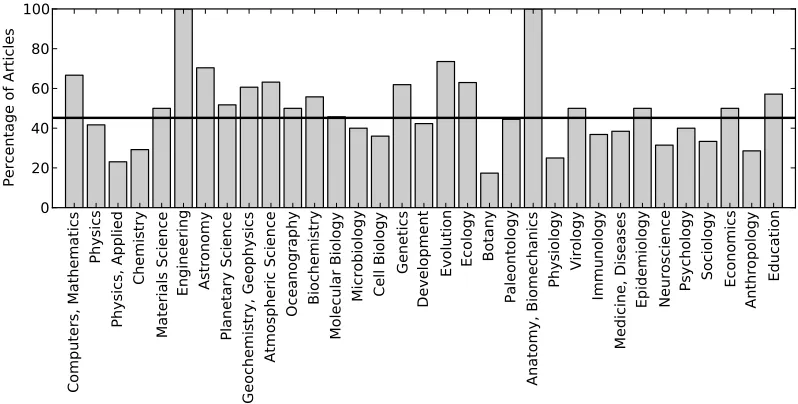
the “explain” word group, broken down by keyword, with a line indi-cating the overall percentage. . . 32 2.5 Plot of the percentage of articles that include at least one token of
“because”, broken down by keyword, with a line indicating the overall percentage. . . 32 2.6 Plot of the percentage of articles that include at least one token from
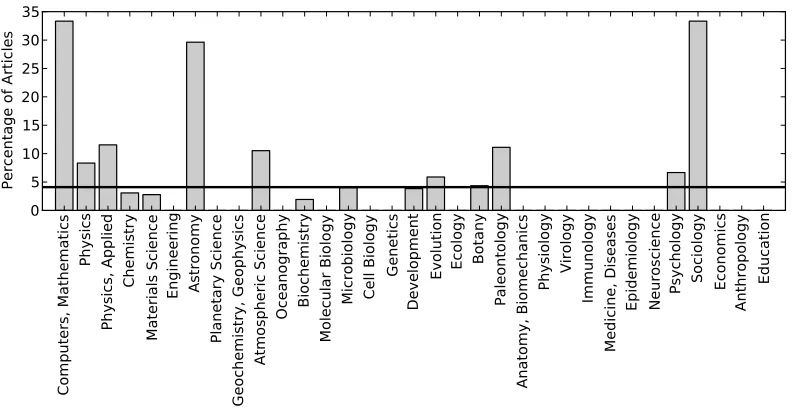
the “show” word group, broken down by keyword, with a line indicating the overall percentage. . . 33 2.7 Plot of the percentage of articles that include at least one token from
the “law” word group, broken down by keyword, with a line indicating the overall percentage. . . 33 2.8 Plot of the percentage of articles that include at least one token from
the “theory” word group, broken down by keyword, with a line indi-cating the overall percentage. . . 34 2.9 Plot of the percentage of articles that include at least one token from
2.10 Plot of the percentage of articles that include at least one token from the “mechanism” word group, broken down by keyword, with a line indicating the overall percentage. . . 35 2.11 Plot of the percentage of articles that include at least one token from
the “model” word group, broken down by keyword, with a line indi-cating the overall percentage. . . 35 2.12 Histogram of the relative positions at which tokens of words in the
“explain” group occur in articles. . . 36 2.13 Histogram of the relative positions at which tokens of words in the
“understand” group occur in articles. . . 37 2.14 Histogram of the relative positions at which tokens of “because” occur
in articles. . . 37 2.15 Histogram of the relative positions at which tokens of words in the
“cause” group occur in articles. . . 38
Chapter 1
Explanation
1.1
Explanation in Science
One of the goals of science is explanation. Scientists explain to other scientists how a particular gene regulates a phenotype, how patterns in the luminance of a particular star indicate the presence of planets, how the sizes of the populations of two particular linked species vary with environmental changes. Scientists explain to their students how genes are transcribed and code for proteins, how planets orbit and occlude stars, how the sizes of populations of organisms change and correlate. And scientists explain to the public and to policy makers how genes affect health and disease, the place of our planet and sun among the stars, and the effects of ecology on our lives and livelihoods. Explanation is a practise that cuts across scientific disciplines and extends far beyond the sciences. We offer explanations to each other and to ourselves in our daily lives and in our various specialized fields. But the importance of science and the differences between scientific practises and other practises have led many to consider scientific explanation as a topic of study in its own right. By understanding scientific explanation we may shed light on other forms of explanation, or on the distinction between science and non-science. These goals are important, but the primary goal here is to understand what scientific explanation is. This is valuable to the extent that it leads to better scientific explanations and thus to better science.
But scientific explanation is not well understood. Scientists themselves seem to find the concept slippery. Textbook discussions of scientific method often tangle to-gether hypothesis, prediction, and explanation without elucidating the latter.1 Great
1For instance see
scientists, famous for giving excellent explanations, are often unreflective or at best unclear about what makes a good explanation.2 Psychologists have looked into what
makes a proposed explanation satisfying – the “ah-ha!” moment – but there are too many examples where such a feeling is misleading (Trout 2007). Artificial intelligence researchers have built systems that can discover explanations of a sort, but only in a narrow range of highly restricted cases (J. R. Josephson and S. G. Josephson 1996). And all too often popular articles on scientific topics demonstrate confusion about what scientists have explained and have not explained. While scientific explanation is important, its nature and role are not as clear as they should be.
In this dissertation I take a philosophical approach toward scientific explanation. Philosophers have written extensively on the topic for 60 years, building on a tradition with ancient roots (Woodward 2011). Like most philosophers, I set aside questions of the psychology of explanation and the discovery of explanations, and ask instead what a scientific explanationis. I approach explanation as a topic in thegeneralphilosophy of science, cutting across scientific disciplines. And I combine traditional analysis and case studies with some new methods designed to keep the focus on scientific practise while covering a representative sample of cases. The result is a general account of scientific explanation that applies to a broad range of scientific practise, and that incorporates a number of insights from the philosophy of science literature. In this chapter I lay out my project and present an overview of my account.
1.2
Philosophy of Science
1.2.1
Background
Philosophy of science has roots in ancient philosophy. Pre-Socratic philosophers of-fered cosmological explanations of the nature of the world, its origins, its elements, and the order beneath its apparent diversity (Hankinson 2001). In this way they were precursors to modern scientists of many stripes. Aristotle not only took steps for-ward in science and scientific method but also in the philosophy of science and the understanding of explanation. His four causes are perhaps best understood as four forms of explanation, where his efficient causes are the best fit with the modern use of “cause”. Aristotle also elucidated natural kinds and developed a logic for reasoning
2Richard Feynman’s autobiographicalSurely You’re Joking, Mr. Feynmanis reflective but
about them, both of which have an important role in explanation.
Between Aristotle and the 20th century, science and the philosophy of science both matured. Some philosophical topics discussed over this long period that remain important include causation, laws of nature, deduction and induction, and questions of realism and empiricism, among others. But explanation itself was not a central topic for philosophers concerned with science.
In the 20th century both science and philosophy of science became increasingly specialized. Philosophy of science as its own field of philosophy developed out of the Vienna Circle and strands of American pragmatism in the first half of the century (Woodward 2011; Reisch 2005; Richardson 2002). Carl Hempel made explanation an important topic in the emerging field (Woodward 2011; Hempel and Oppenheim 1948; Hempel 1965b). His empiricist commitments made him skeptical of appeals to causa-tion, and his deductive-nomological (D-N) account of scientific explanation relies in-stead on deduction from natural laws and initial conditions. D-N was very influential on subsequent accounts of explanation, of which there are many, including: inductive-statistical (Hempel 1965a); inductive-statistical relevance (Salmon 1971); unification (Friedman 1974; Kitcher 1989); pragmatic (van Fraassen 1980); causal mechanical (Salmon 1984; Dowe 2000); mechanistic (Machamer, Darden, and Craver 2000; Bechtel and Abra-hamsen 2005); causal intervention (Woodward 2003); asymptotic (Batterman 2002); model-based (Bokulich 2009); and more.
This narrow focus began to change with the increasing scope and power of the sci-ence of biology. The discovery of DNA was one triumph in a cascade of advances. A new generation of philosophers of biology began to examine thorny conceptual issues in genetics and evolution. On the subject of explanation they found that the existing accounts fell far short. Laws of biology may exist but they are few and far between, and do not play the central role given to them in physics. Rather than mathemat-ical equations, biologmathemat-ical explanations are often narrative or focus on systems that are stable by degrees. Biologists and physicists use “mechanism” to mean quite dif-ferent things. And it is difficult to resist assigning purposes to biological organs and organisms because their behaviour appears so purposeful. Biologists appeal to causes, functions, models, and mechanisms in their explanations, and so philosophers of biology have appealed to these concepts to elucidate biological explanation.
The philosophy of physics and the philosophy of biology are the most prominent among a growing number of philosophies of specific sciences. Philosophy of cognitive science and philosophy of neuroscience are increasingly important and independent. In much of cognitive science the nature of the mind is explained in terms of functional modules. Those functional explanations build on the concept of biological function, but also on a computational sense of function. Mechanistic accounts of explanation for neuroscience build on biological mechanisms, but also on analogies to electronic circuits. So here too we see different approaches of explanation growing out of the specialized concerns of emerging philosophies of specific sciences.
As a final example, philosophies of the various social sciences have their own concerns that have implications for explanation. The social sciences must deal with individuals acting with intentions, who are communicating or concealing those inten-tions. Their explanations are sometimes singular and historical, sometimes general and probabilistic. Philosophers of science working in anthropology, archaeology, eco-nomics, and other fields must grapple with these differences. I only mention that there is growing interest in philosophy of chemistry, climatology, medicine, and more, as demonstrated by the proceedings of recent conferences.
No doubt there is great diversity among the sciences. And no doubt it was a na¨ıve vision that earlier philosophers of science had of physics as the model science to which all others would conform. But the failure of that vision need not lead us to accept its antithesis: that there is no common core to scientific explanation. I argue that there is a shared structure among the various forms of explanation. But before I put forward my argument we had best briefly survey some of the accounts of scientific explanation that philosophers have offered.
1.2.2
Philosophical Accounts of Scientific Explanation
Most histories of philosophical engagement with scientific explanation, including Wood-ward 2011, begin with Carl Hempel’s D-N account. Here I do the same, and give short synopses of several other prominent accounts in rough chronological order.
Deductive-Nomological A D-N explanation is a sound argument in first-order predicate logic that essentially includes at least one natural law as a premise, and for which the explanandum (the statement of the thing being explained) is the conclusion (Hempel and Oppenheim 1948). If the natural laws are removed the deduction must fail. The other premises will often include boundary con-ditions and initial concon-ditions. D-N explanations are usually taken to explain particular events, making predictions about the state of a system. However Hempel also intended D-N to apply to the deduction of special laws from more general ones.
D-N has been a very influential account. However it faces a large number of challenges and standard counterexamples (Salmon 1989,§2.3). Many subsequent accounts were designed specifically to addresses problems with D-N.
Unification This approach to explanation takes theoretical unification to be a con-dition for successful explanation. Michael Friedman presented an account based on this intuitive notion (Friedman 1974), and Philip Kitcher criticized (Kitcher 1976) and extended it (Kitcher 1989). On Kitcher’s version we have an explana-tory store of schemata for explaining the phenomena we observe, and the goal is to expand the scope of our explanations while reducing the size of the store. We do this by discovering increasingly powerful but stringent schemata. The intuitive appeal of this account is undermined by some of its consequences, such as its inability to distinguish between explanatory unifications and cases where the same formalism happens to apply in multiple cases, and its inability to allow for a shallow explanation to count as explanatory when a deeper explanation is available.
Pragmatic Bas van Fraassen argues that an explanation is simply an answer to a why-question (van Fraassen 1977). What answer should be accepted is a mat-ter of pragmatics. Every question presupposes a contrast class of acceptable answers, and to answer the question is to pick out a member of that class. Alternatively, one can reject the question and its presuppositions. Depending on the context, almost anything one can think of could be an answer to some question, and so there is little more to say about the nature of a well-formed explanation. A consequence of van Fraassen’s view is that there is no distinct category of scientific explanation – science does not explain, but merely pro-vides facts and principles that are employed in our answers to why-questions (van Fraassen 1977, p. 149).
Causal-Mechanical After rejecting statistical relevance Salmon turned to an ac-count of singular causal explanation. His concern was an analysis of causation compatible with our knowledge of physics, such that a “mark” can be transmit-ted by the causal interaction. Philip Dowe developed a relatransmit-ted account (Dowe 2000). Both are suspicious of appeals to counterfactual conditions to spell out causation. Christopher Hitchcock has raised the criticism that causally relevant aspects of mark-transmission often pull apart from the explanatorily relevant aspects that Salmon was trying to distinguish (Hitchcock 1996). While perhaps successful as an account of explanation for photons in the void, it is difficult to see how the account can apply to the tangled causal webs studied in the special sciences.
are several accounts of “mechanisms”. I will focus on Machamer, Darden, and Craver’s (MDC) account (Machamer, Darden, and Craver 2000). An MDC mechanism is a system of entities and activities organized to be productive of changes from start conditions to termination conditions. To explain an event is to describe the mechanisms that generated it. Their use of “mechanism”, as in much of contemporary scientific practise, goes far beyond mechanisms as machines and the science of mechanics (Craver and Darden 2005). Along with mechanisms they describe mechanism schemata and mechanism sketches to fill epistemic roles in their account. The MDC mechanism approach has been applied to a wide range of special science cases.
Causal Intervention James Woodward has developed a general account of causal explanation based in part on the structural equations literature (Woodward 2003). Woodward tries to capture very general features of causal explanation explicitly in terms of counterfactual dependencies. An explanation should an-swer “what if things had been different” questions about the explanans and the explanandum. The truth of the explanation depends upon truths about what would have been different if we had intervened at some point in the relevant causal chain. As with mechanisms, this approach is well suited to explanation in the special sciences.
Asymptotic Robert Batterman’s account of asymptotic explanations handles an important set of cases in statistical mechanics and solid state physics where all other accounts fall short (Batterman 2002). Physicists’ explanations in these examples revolve around the behaviour of a system in the limit as some quantity approaches infinity. In some cases the infinite quantity is the number of particles in the system, while in other cases it is the inverse of a wavelength. In each case the idealization contradicts our knowledge that the system is finite in the relevant respect, but the idealization cannot be relaxed or eliminated without abandoning the explanation. The idealization, which we know to be false, is essential to our best scientific explanation of the phenomenon.
1.2.3
Too Many Explanations
The first thing to note about these philosophical accounts of explanation is their variety. Explanations are variously logical arguments, collections of statistical infor-mation, argument schemata, answers to why-questions, descriptions of mechanisms, descriptions of causal relations, mathematical arguments, or models. If we look at these accounts as each proposing an explain-relation, then the relata of the various explain-relations are quite different: laws of nature, predictions, theories, statements of probabilities, particular events, models, questions, sets of possible answers, etc.
Most of these accounts apply (or apply best) to a subset of the sciences. The D-N, statistical relevance, unification, and causal mechanical accounts apply best to fundamental physics. All of them rely on laws of nature, but it is far from clear that laws of nature play the same central role in biology that they do in physics (Smart 1959; Beatty 1995). The singular causal chains of the causal mechanical account are a poor fit for the complicated causal tangles present in a cell or organism. On the other hand, the mechanistic and causal intervention accounts apply very well in certain special sciences, but can be a poor fit for quantum mechanics or space-time theories. Their reliance on causation prevents them from capturing mathematical explanation, where acausal numbers and mathematical functions play an essential role. The asymptotic explanation account works very well for a set of cases where all the previous accounts fail. It provides wide-ranging lessons about idealization, but it is not general in scope.
On the other hand, Bokulich’s model account is general and can probably be applied to cases in any science, if not to every case of scientific explanation. The pragmatic account of explanation is very general – it is designed to account for all forms of explanation.
atom and cites a number of model explanations in the literature. I think that this shift in the evidence given as support is representative of a larger shift away from toy examples and toward detailed cases in the philosophy of science.
None of these accounts is universally accepted. The case studies provide evidence that scientists do in fact offer mechanistic explanations, causal intervention expla-nations, asymptotic explaexpla-nations, and model explanations. Even this diversity is striking. Is scientific explanation really so heterogeneous, covering so many different relata? And if so, is it then fragmented by discipline or topic? Is there a general account of scientific explanation to be had amid this diversity?
To settle these questions I think we must reconsider our evidence about the prac-tise of scientific explanation. How do scientists, in various disciplines, explain?
1.3
Evidence Base
While there are many sources of evidence about scientific practise, some are easier to make use of than others. I have chosen to consider scientific articles recently published in the journal Science. Several factors played a role in this decision.
First, the publication of an article is one of the main goals of most scientific research. This gives scientific articles a special status. Publication in Science is especially prestigious – these articles are held up as ideals toward which scientists should strive. This introduces a normative factor into my discussions of scientific explanation. If I can correctly describe the use of scientific explanation in these articles then I will have described some norms for scientific practise. In this way my project has both a descriptive and a normative aspect.
On a practical basis, published articles are easy to access and easy to collect in large numbers. It is a virtue of an evidence base that all sides in the debate have ready access to the data. It is also easy to draw a range of inferences about scientific practise from sets of published articles, given the right methods.
I also believe that, for the overwhelming majority of hypothesis-driven scientific articles, their central claim is some sort of explanation or the rejection of some ex-planation. If I am correct then scientific articles are an excellent source of evidence about scientific explanation. One of the goals of my analysis is to test whether this is in fact the case.
In choosing to apply novel methods to a large set of published articles fromScience
many ways.
Scientific publications present only a fraction of scientific knowledge and practise. Years of painstaking work in the lab and in the field are neatly glossed in a few thousand words. Traditionally, philosophers of science have focused on the public face of science and ignored the myriad private details of scientific practise. But sociologists and historians have applied their own methods to the inner workings of science, and philosophers are increasingly engaged with such research.
I believe that the methods I develop in this dissertation could be successfully adapted and applied to, for instance, transcripts from laboratories and other ethno-graphic records. Without denying that there are many differences between public and private practise, I also believe that my general philosophical account of scientific ex-planation applies just as well to informal conversation as it does to the printed page. It would be fascinating to test these beliefs against an evidence base that reflects the private practise of science.
However, such a study would itself be limited without a supporting analysis of public practise. In order to sufficiently address my three questions about importance, generality, and goals, my methods also require a very large and diverse evidence base. Ethnographic research is laborious, and ethnographic records are relatively rare, but publications are plentiful and easy to collect in large numbers. In short, I think that an analysis of publications is the right place to start, and I hope that in the future this work will be extended to encompass a wider range of evidence.
The choice of publications from the journalSciencealso requires some justification.
Science is an outstanding journal in several senses. Not only it is prestigious, it is especially competitive, and its mission is to publish highly influential papers. Such papers can also be high-risk, and more prone to retraction than those published in other journals. Sciencearticles are especially short, compared to other journals, which may have a significant effect on the use of language. In short, by choosingScience as the source of my evidence I may be introducing bias into my analysis.
My methods can easily be adapted to publications in other scientific journals. The same methods could be applied to the top journals in various scientific disciplines (e.g.
Cell, or more specifically Annual Review of Immunology), and the results compared toScience. However, an analysis of one or a few specialized journals would not allow me to sufficiently address my three main questions about importance, generality, and goals. The evidence base I have chosen is the right starting point, but by no means the end of the road.
other possible biases. Doubtless there are trends in the use of language by scientists, some of which may be significant to this analysis. My analysis will also be blind to changes in the nature of scientific explanation over time. A temporal analysis might be able to show trends in philosophy or philosophy of science reflected in science. I have thought it best to start with a snapshot contemporary science before trying to describe changes over time. I leave these interesting questions to future work.
My evidence base for this dissertation consists of 781 scientific articles from the journalScience. It includes all 72 of the long-form “research articles” and all 709 of the shorter-form “reports” published in regular issues between September 24, 2010 and September 23, 2011. I consider the abstracts and bodies of these articles, excluding their bibliographies and supplementary materials, for a total of approximately 1.6 million words and 11 million characters.
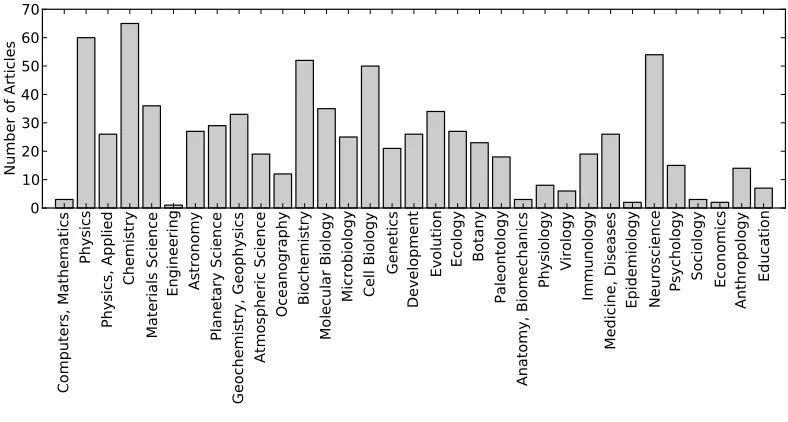
The set of articles covers a wide range of scientific disciplines, as shown in the fol-lowing list. The number of articles marked with that keyword is given in parentheses. Figure 1.1 shows a plot of the number of articles by keyword. I have organized the keywords in order to draw out potential similarities between physical sciences, life sciences, and social sciences. I freely admit the shortcomings of this ordering but I believe it is slightly more informative than an alphabetical listing.
• (3) Computers, Mathe-matics
• (60) Physics
• (26) Physics, Applied • (65) Chemistry
• (36) Materials Science • (1) Engineering • (27) Astronomy • (29) Planetary Science • (33) Geochemistry,
Geo-physics
• (19) Atmospheric Sci-ence
• (12) Oceanography • (52) Biochemistry • (35) Molecular Biology • (25) Microbiology • (50) Cell Biology • (21) Genetics • (26) Development • (34) Evolution • (27) Ecology • (23) Botany • (18) Paleontology • (3) Anatomy,
Morphol-ogy, Biomechanics
• (8) Physiology • (6) Virology • (19) Immunology • (26) Medicine, Diseases
• (2) Epidemiology • (54) Neuroscience • (15) Psychology • (3) Sociology • (2) Economics
Computers, Mathematics
Physics
Physics, Applied
Chemistry
Materials Science
Engineering Astronomy
Planetary Science
Geochemistry, Geophysics
Atmospheric Science
Oceanography Biochemistry
Molecular Biology
Microbiology Cell Biology
Genetics
Development
Evolution Ecology Botany
Paleontology
Anatomy, Biomechanics
Physiology Virology Immunology
Medicine, Diseases
Epidemiology Neuroscience Psychology Sociology Economics Anthropology Education
0 10 20 30 40 50 60 70
Number of Articles
Figure 1.1: A plot of the number of articles in the data set by keyword.
1.4
Analysis
To address this broad and rich set of data I take two distinct approaches. The first is to use automated text mining techniques to search for words of interest such as “explain” and “cause”. Second, and more important, I take random samples from the data set and use them to develop a large number of small case studies across a wide range of scientific disciplines. From these cases I develop and test a general philosophical account of scientific explanation.
The first approach is a novel one in philosophy. Using computer programs I search through the millions of words in the data set for patterns in their usage. I measure the frequency and distribution of these words, look for the most common phrases that they occur in, and consider the positions at which they occur in the articles. The evidence I collect is no substitute for a conceptual analysis of the words of interest, but it provides some valuable new information.
There are three questions driving my analysis using these two different approaches. The first is whether scientific explanation is important for science. The second is whether scientific explanation is general, occurring across a wide range of scientific disciplines. The third is whether explanation is a goal of science. My ultimate conclusions are all affirmative: that explanation is important, that it is general with a general account to describe it, and that it is a goal toward which scientists strive. The general account I propose addresses the problem of fragmentation, and its broad applicability reaffirms the importance of scientific explanation for the philosophy of science.
To address these three questions I begin with the usage of “explain” words in Sci-ence. I use text mining to show that “explain” is a common word but not ubiquitous. It has strong connotations and so scientists tend to qualify their use of the word. I take a random sample of sentences that include “explain” and use them as the basis of case studies. I use these clear cases of scientific explanation to develop my account. To address the question of the importance of scientific explanation I compare the use of “explain” words to other words of interest to philosophers such as “cause”, “evidence”, “theory”, “model”, and “law”. “Explain” is about as common as “cause” and “evidence”, more common than “theory” and “law”, and less common than “model”. But scientists explain without using the word “explain”. Using a large random sample from the set of all the sentences in the 781Sciencearticles, I show that the account of scientific explanation I propose applies to at least a quarter of all the sentences. I also show that, if we include claims of inference to the best explanation, we can account for another quarter of the sentences. In sum, approximately half of all the sentences in the Science data set make some sort of explanatory or abductive claim on my general account of scientific explanation. A large portion of the Science
data set cannot be understood without an account of scientific explanation.
To address the question whether explanation is a goal, I consider where“explain” words occur in scientific articles. They occur more frequently in the introduction and toward the end of the articles, suggesting that these words are used for setting and assessing the goals of the articles. But stronger evidence comes from a random sample of the abstracts from the Science data set. I consider the main claims being made in these abstracts and show that all of them have either explanatory or inference-to-the-best-explanation form on my account of scientific explanation.
each of those disciplines, with a small number of exceptions that are most likely due to inadequate sample sizes.
1.5
A General Philosophical Account of Scientific
Explanation
The two approaches I take to the data set are intended to provide empirical support for the general philosophical account of scientific explanation I develop here. But even without the support of text mining evidence and a broad range of cases, my account is intended to stand alone as a plausible philosophical account.
An explanation consists of an explain-relation, an explanans, and an explanandum. There is an ambiguity in the usage of “explanation”, allowing the word to refer to a statement of the explanation, but I try to distinguish between the explanation itself and the statement of the explanation. Unlike Hempel, I do not restrict the explanans and explanandum to propositions, and I believe that my broader use of the terms is not unusual among philosophers of science.
The explain-relation holds between a quality of the explanans and a quality of the explanandum. In other words, it is always something about the explanans that explains something about the explanandum. While the explanandum quality always depends on the explanans quality, the basis for that dependence can take many forms. In every case the explain-relation between the qualities must be supported by a second relation that holds between the explanans and the explanandum themselves. I call this the “core relation” for the explanation. In some cases the core relation issingular causation: the explanandum quality depends on the explanans quality because the explanans causes the explanandum. In other cases the core relation ismodelling: the explanandum quality depends on the explanans quality because the explanans is a model of the explanandum. While the explain-relation is essentially the same across a wide variety of scientific explanations, the core relation can differ widely.
kinds and their qualities. Theories are the principles and systems of inference that are used to build models. Each category is widely recognized by philosophers, although the details of my usage sometimes differ from what is standard. In each case there are philosophical problems and disagreements over the nature and role of that category of thing in scientific explanations. I cannot address and resolve all of these issues, but I do locate my position for each category within the wider philosophical literature.
I call the pair of the category of the explanans and the category of the explanan-dum the “form” of the explanation. Given the five categories there are 25 possible forms of explanation. Differences in the form of explanation indicate differences in the core relation. Among these 25 forms there are four that I call “primary forms”, because they are especially important for understanding explanation: theory-model, model-kind, kind-entity, and entity-data. Each of the four primary forms involves a shift from a more general explanans to a more specific explanandum. The four core relations for the four primary forms are justification, modelling, instantiation, and measurement, respectively. In a model-kind explanation it is something about the model (the explanans) that explains something about the kind (the explanandum), and the core relation that supports the explanation ismodelling. The explanation will hold if and only if as the model is a model of the kind. This includes both the actual circumstances and the counterfactual ones that the core relation supports. Figure 1.2 shows the five categories, the four primary forms of explanation, and examples of the five “secondary forms” of explanation for which the explanans and explanandum fall into the same category. I call the other 16 “tertiary forms” of explanation because I consider them to be composites of the primary and secondary forms. Accordingly I focus my attention on the four primary and five secondary forms.
What makes these 25 forms count as forms of explanation? In what sense do the various core relations support a single explain-relation? The fragmentation of the philosophical literature on scientific explanation has meant a diversity of proposed conditions on what makes for an explanation. Despite the fragmentation, there are two proposed necessary conditions that philosophers have been widely accepted. The first is that explanations answer why-questions. The second is that explanations answer “what if things had been different” questions. These are, of course, closely related: I believe that the second condition is a more accurate expression of the key insight in the first condition.
relation that supports counterfactual reasoning, and thus allow us to answer “what if things had been different” questions. Those answers, given in counterfactual terms, are answers to the scientific why-questions that philosophers have been interested in. This condition that all of the 25 forms of explanation meet is a broad one. There may well be other necessary conditions, or even sufficient conditions, to be found. Although broad, the condition is not toothless. It allows us to distinguish explanations from statements of fact, from descriptions, and from predictions. Each of the core relations articulates some more specific sort of of counterfactual relation, but all of them have at least this much in common.
The most complex form of explanation on my account is theory-data explanation because it spans the five categories from most general to most specific. Figure 1.3 shows the general structure for such a case. At the top are the explanans quality and the explanandum quality. At the bottom is the “base” of the explanation, which is shared between the explanans and explanandum. In the middle are the “cores” of the explanans and explanandum.
While this model was developed to capture the structure of explanatory claims, it also captures the structure of inferences to the best explanation. In these “evidential” cases the direction is reversed, and it is something about the more specific “explanan-dum” that gives evidence for something about the more general “explanans”. Figure 1.3 shows the “explain” and “evidence for” arrows pointing in opposite directions.
For each of the randomly sampled sentences or abstracts I develop a small case study and try to apply this structure. Often part of the structure is not apparent on the surface of the quotation, and so I take it to be implicit. Appendix A includes my analysis of all of the sampled cases. I distinguish clearly between the implicit and explicit items in each case analysis.
This general account addresses the problem of fragmentation in the philosophical literature that I raised above. Philosophers of science have often focused on one or a few of the many forms of explanation that scientists use. In giving detailed accounts of those forms for those sorts of explanantia and explananda they overlook the many other forms. There is room for a diversity of specific philosophical accounts because the practises of scientific explanation are in fact quite diverse.
Theories Models Kinds Entities Data
justifies models instantiated by measured by
unifies submodel of subkind of causes correlates with
Figure 1.2: The five categories, four primary relations, and examples of five secondary relations.
top
core
base
quality A
theory
model
kindX kindX
entity data quality B
b
ears
b
ears
justifies
mo
dels
identity instan
tiated
b
y
measured
b
y
explains
evidence for
core relation
entities. D-N explanations are an interesting case, since they can span the full range from theory to data. My general account of the various forms of scientific explanation allows us to pull apart what D-N explanations run together.
This account may appear overly complex on first glance. Instead of one explain-relation we have both an explain-explain-relation and a core explain-relation to support it. Instead of one form of explanation there are 25 possibilities, each with a different core relation. But both of these complexities reflect the reality of scientific practise. Scientists use the word “explain” to express dependence relations between qualities in many different situations, but to understand the dependence in a particular case we must look to the relation that holds between the bearers of the qualities. While some of the forms of explanation are much more common than others, all 25 are used at least once in my sampled cases. By distinguishing the core relation from the explain-relation, and recognizing the variety among core relations, we gain a flexible and truly general account that can capture a wide range of cases of explanation across many sciences. The flexibility and generality are required in order to address the problem of fragmentation. On balance, the added complexity is a small price to pay.
1.6
Limitations
Scientific explanation is an important topic. I consider it to be central to the phi-losophy of science. Explanation touches on many other important topics, including causation, measurement, natural laws, natural kinds, modelling, idealization, confir-mation, and theory change. By better understanding scientific explanation we gain insights into these other important areas.
But this comes at a cost. In order to fully understand scientific explanation we must be able to give accounts of causation, measurement, natural laws, natural kinds, modelling, idealization, confirmation, theory changes, etc. A complete account of this topic requires at least partial accounts of these others. And like scientific explanation itself, each of these other topics has its share of philosophical problems.
Faced with such a challenge, one response is specialization. By narrowing the scope to one branch of science we may be able to find questions that can be answered in full. This is often a good response, but it cannot be the only one. The general philosophical account of scientific explanation that I offer, and the novel methods that I use to support it, address important questions and provide useful answers, even if some of those answers are not complete.
explanation touches upon, I have tried to limit the scope of this work to the question:
what is a scientific explanation? When I discuss data, entities, kinds, models, and theories, I try give an adequate characterization of each and to locate my position in the larger philosophical literature.
There are two questions in particular that are very close to my focus but re-main outside the scope of this dissertation. The first is what makes a good scientific explanation? The second iswhat is the nature and role of inferences to the best expla-nation? Regarding the first, in analyzing the explanations in my sample cases I have not tried to evaluate whether they are good or bad ones. The main normative claim I make here is that these explanations are held up as exemplars by being published in
Science, and I have given an account of their structure. Regarding the second, many of the cases I have sampled appear to be inferences to the best explanation. They have the same structure as explanations except that the direction of the inference is reversed. For some of the cases, if I merely substituted “suggests” with “might be explained by” the reader would not notice any tampering, because switching the direction of the inference makes no other difference to the structure. In my analysis I mark these cases as distinct, but I analyze them in the same way as the other expla-nations. A full analysis of inference to the best explanation on my general account is an important goal that I must leave to future work.
Despite the many connections between scientific explanation and other important philosophical topics, in this dissertation I aim to answer the questionwhat is a scien-tific explanation? in such a way that I can resolve some of the fragmentation in the philosophical literature and show that scientific explanation is an important general goal of science.
1.7
Overview
This dissertation consists of nine chapters and two appendices. Following this intro-duction is the chapter on my text mining methods. I address the three questions about the nature and role of scientific explanation by means of various measurements of the frequency and distribution of words of interest in the Science data set. The results of this chapter provide insights into the use of “explain” words in science, and help to focus the analysis that follows.
“explains”, or “explained”. I use these cases to develop and discuss my general philosophical account of scientific explanation. Then I test the account against sample B, with 100 random sentences, and sample C, with 25 random abstracts. I close the chapter with a discussion of the evidence I have gathered from these samples and how it addresses the three questions about scientific explanation.
The following five chapters are each short. I present the five categories in turn: data, entities, kinds, models, and theories. The structure of each chapter is the same. I begin with some examples drawn from samples A, B, and C. I then provide a general philosophical discussion and characterization of the category. I describe each of the examples in this light. And I close with a discussion of the forms of explanation for which the explanans is in that category.
Chapter 2
Words
My goal is a philosophical answer to the questionwhat is a scientific explanation? In pursuit of that goal I apply philosophical methods such as conceptual analysis and case studies. Because the claims I want to make are general, I need to appeal to a wide base of evidence. But I cannot analyze all 781 Science articles. Instead I apply some novel methods that allow me to draw inferences about practises of explanation across the large data set. In this chapter I discuss my text mining methods and apply them to several questions about the practise of scientific explanation.
2.1
Text Mining
Text mining is the analysis of large sets of textual data using automated methods. These methods usually involve some sort of natural language processing of the data. My uses of these techniques are humble, amounting to different forms of comprehen-sive search. The important thing for the current purpose is not the sophistication of the text processing but the inferences that we can draw about the data set. By using automated techniques we can consider much larger data sets, and with larger data sets we can ensure that we are representing the diversity of scientific practise more accurately.
In broad strokes what I have done is collect electronic copies of the text of the
Sciencearticles and used a set of computer programs to find patterns in that text. The programs are built using the Natural Language Tool Kit (NLTK, http://nltk. org), an open-source library of software tools for natural language processing. Code listings of the programs I have written are provided in appendix B.
The sequences “explain”, “Explain”, and “ex-plain” are distinct, although they are all tokens of the same word. A computer needs to be told that “explain”, “explains”, “explained”, and “explaining” are grammatical inflections of the same word. Even dividing sequences of characters into token words can be difficult. Although words are usually separated by spaces or line-breaks, there are also periods, commas, colons, hyphens, quotation marks, apostrophes, and other characters that sometimes separate words but are sometimes part of a word. For instance, periods terminate sentences, but they are also included in acronyms and abbreviations, making it difficult to automatically break a text into sentences.
Natural Language Processing (NLP) is the wider field that encompasses text min-ing techniques. NLP researchers have developed heuristics and algorithms for break-ing sequences of characters into their lexicographical parts. These include methods for tokenizing (distinguishing word tokens from their surroundings), stemming (dis-tinguishing the root of a word from its affixes), and lemmatising (grouping inflections of the same stem together). These tools are supported by enhanced dictionaries such as WordNet (http://wordnet.princeton.edu) that describe networks of relations between words.
Philosophers use language carefully and pay close attention to small variations in the usage of words. Dictionary definitions are often too crude to be helpful for philosophical analysis. But philosophers usually pay less attention to syntactic varia-tions, and these are of primary importance for text mining. To perform an automated search for explanations in scientific literature we would need to build a list of all the syntactic representations of explanations that we want to match.
The relationship between sequences of characters and words is complex, but the relationship between words and concepts is even more so. Philosophers are interested in the concepts being expressed rather than the words that express them. When it comes to explanation, philosophers are not primarily interested in the words “explain” or “explanation”, but in explanations regardless of the details of the phrasing. I accept that concepts and not words are the proper targets of philosophical analysis.
one form. The task is then to transform public facts about language use into evidence about concept use.
In the following sections I make three main claims about the practise of scientific explanation and then use text mining methods to test them. While the focus is on the use of words, the goal is to learn about the concept of explanation.
2.2
Importance of Explanation
I have claimed several times already that explanation is an important scientific prac-tise. Is there evidence to support this claim?
One of the simplest ways to assess the importance of a concept in a body of text is to measure the frequency with which associated words are used. If those words are used frequently then we have some reason to believe that the concept is important in that corpus. Conversely, if those words are used infrequently then we have some reason to believe that the concept is unimportant in that corpus. Relative frequencies can be more informative than absolute frequencies. If one set of words occurs more frequently than another then we have some reason to believe that the concept associated with the first set is more important for that corpus than the concept associated with the second set. However we must also be aware of word ambiguity. If one word can be associated with more than one of the concepts we are trying to investigate then this will undermine our inferences about importance based on frequency.
To measure the frequency of the words associated with a concept we must make a list of the strings of characters we are interested in. (Our tools can be designed to ignore certain differences, such as letter-case.) Here I have listed some words of interest, grouped by concept. Our primary target is the “explain” concept by means of variations on the word “explain”. I have included groups for several concepts related to explanation, such as “because” and “understand”. And I have included other important terms from the general philosophy of science such as “cause”, “evidence”, “theory”, “law”, “mechanism”, and “model”.
explain explain, explains, explained, explaining, explainable, explanation, explana-tions, unexplained, unexplainable, explicate, explicates, explicated, explicable, inexplicable
because because
reason reason, reasons, reasoning
account account, accounts, accounted, accounting
evidence evidence, evident, evidential show show, shows, showed, shown, showing
discover discover, discovers, discovered, discovering, discovery, discoveries reveal reveal, reveals, revealed, revealing
suggest suggest, suggests, suggested, suggesting
implication imply, implies, implied, implying, implication, implications indicate indicate, indicates, indicated, indicating
confirm confirm, confirms, confirmed, confirming
establish establish, establishes, established, establishing cause cause, causes, caused, causing, causal, causation theory theory, theories, theoretical
law law, laws, lawful
mechanism mechanism, mechanisms model model, models, modelled, modelling phenomena phenomena, phenomenon effect effect, effects
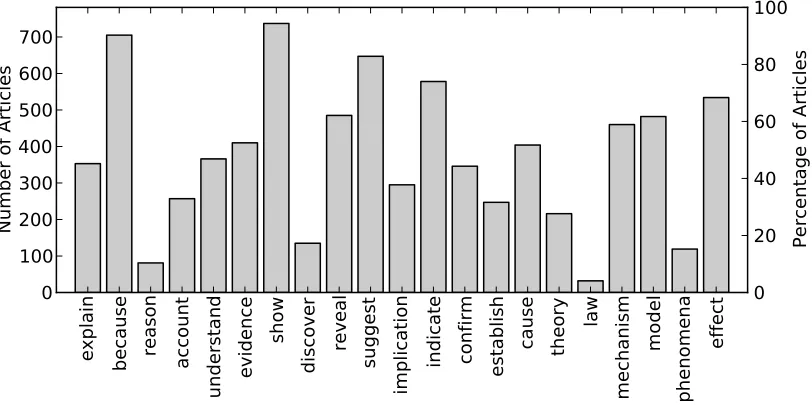
The next step is to write a program to determine the word frequencies. NLTK provides a library of tools for this purpose. I have written a short program (see appendix B.4) that uses the NLTK tokenizers and frequency distribution tools to count the number of occurrences of words from each group in two different ways. First, we are interested in the number of articles in which the concepts of interest are deployed, so I have measured the number of articles for which at least one word in the group occurs. Second, we are interested in the number of times the concepts are deployed, so I have measured the total number of occurrences of words in each group. Table 2.1 shows the results. Figure 2.1 plots the percentage of articles that include at least one token from each word group. Figure 2.2 plots the number of tokens for each word group.
#
Articles
%
Articles
T
ok
ens
T
ok
ens
p
er
Article
explain 353 45.2 747 0.96 because 705 90.3 2516 3.22 reason 81 10.4 132 0.17 account 257 32.9 434 0.56 understand 366 46.9 620 0.79 evidence 410 52.5 843 1.08 show 737 94.4 4075 5.22 discover 135 17.3 226 0.29 reveal 485 62.1 1101 1.41 suggest 647 82.8 2497 3.20 implication 295 37.8 512 0.66 indicate 578 74.0 1636 2.09 confirm 346 44.3 654 0.84 establish 247 31.6 391 0.50 cause 404 51.7 938 1.20 theory 216 27.7 608 0.78 law 32 4.1 66 0.08 mechanism 460 58.9 1368 1.75 model 482 61.7 2084 2.67 phenomena 119 15.2 173 0.22 effect 534 68.4 2278 2.92
explain because reason account
understand
evidence
show
discover
reveal
suggest
implication
indicate confirm establish
cause theory
law
mechanism
model
phenomena
effect
0
100
200
300
400
500
600
700
Number of Articles
0
20
40
60
80
100
Percentage of Articles
Figure 2.1: Plot of the percentage of articles that contain one or more tokens from each word group.
explain because reason account
understand
evidence
show
discover
reveal
suggest
implication
indicate confirm establish
cause theory
law
mechanism
model
phenomena
effect
0
500
1000
1500
2000
2500
3000
3500
4000
4500
Number of Tokens
in science, then it also suggests that we are wrong about understanding, causation, theories, mechanisms, and models being important.
The word group that is used most frequently in the data set is “show”. Unfor-tunately “show” is ambiguous between an evidential sense that interests us and uses such as “figure 3 shows a decline” that are more difficult to connect to explanation. Just behind “show” is “because”, which is also used in multiple ways that may not all indicate explanations. The “suggest” group is almost as ubiquitous, and plays an important role in claims about evidence. The “indicate” group occurs in almost as many articles as “suggest” but has far fewer tokens.
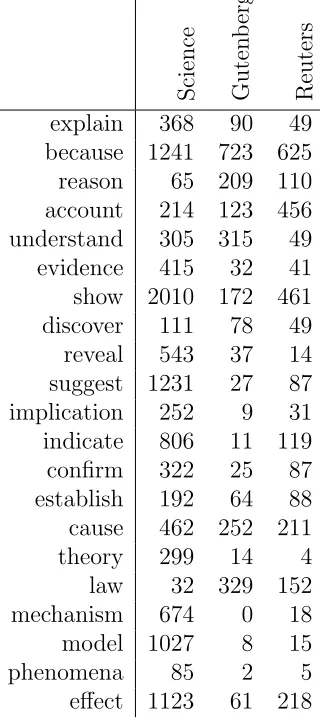
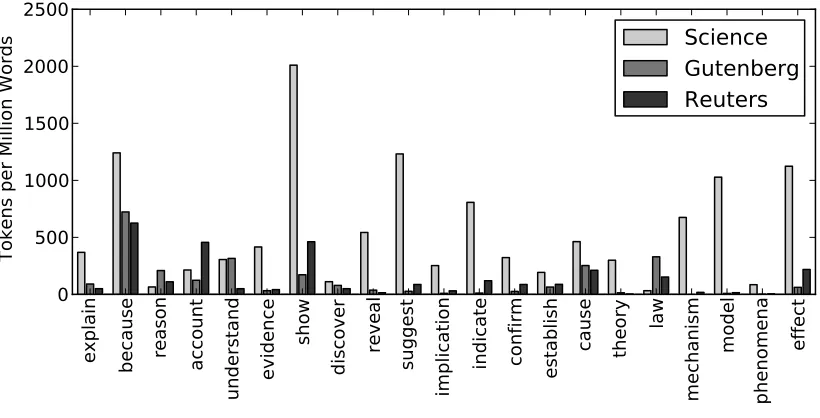
The high frequency of these words suggests that they are more important in scientific writing than they are in other genres and thus that explanatory concepts are relatively more important in science. I have tested this hypothesis by comparing the frequency of the the words of interest in theSciencedata set to their frequency in two other genres, using bodies of text provided by NLTK. The first comparison corpus contains 18 long-form works of English literature selected from Project Gutenberg.1
The second is the Reuters Corpus, containing 10 788 news articles. I used NLTK to count the number of occurrences of the word groups in the two comparison corpora and then compared the number of tokens per million words for each group. Table 2.2 and figure 2.3 show the results.
Here we see that for many of the words of interest the frequency in the Science
corpus is significantly greater than in the comparison corpora. “Explain” words are used four times as often in Science as in the Gutenberg corpus and almost eight times as often as in the Reuters corpus. The results for “evidence”, “show”, “reveal”, “suggest”, and “indicate” are similarly dramatic, while “because” is used roughly twice as often in the science genre than the other genres. I take this to show that explanation, and related concepts for dealing with evidence, are more important in science than in fiction and news reporting.
Given that explanation is more important in science than in some other areas, why does “explain” only occur in less than half of all articles while “because” and “show” are ubiquitous? I propose that scientists think of “explain” as a strong word. While they may frequently be explaining, they only use the word “explain” and its
1Seehttp://www.gutenberg.org/. The works are: Jane Austen’sEmma, Persuasion, and
Science Guten
b
erg
Reuters
explain 368 90 49 because 1241 723 625 reason 65 209 110 account 214 123 456 understand 305 315 49 evidence 415 32 41 show 2010 172 461 discover 111 78 49 reveal 543 37 14 suggest 1231 27 87 implication 252 9 31 indicate 806 11 119 confirm 322 25 87 establish 192 64 88 cause 462 252 211 theory 299 14 4 law 32 329 152 mechanism 674 0 18 model 1027 8 15 phenomena 85 2 5 effect 1123 61 218
explain
because reason
account
understand
evidence
show
discover
reveal
suggest
implication
indicate
confirm
establish
cause
theory
law
mechanism
model
phenomena
effect
0
500
1000
1500
2000
2500
Tokens per Million Words
Science
Gutenberg
Reuters
Figure 2.3: Plot of the number of tokens from each word group for the three corpora.
variants when they present or refute strong explanatory claims.
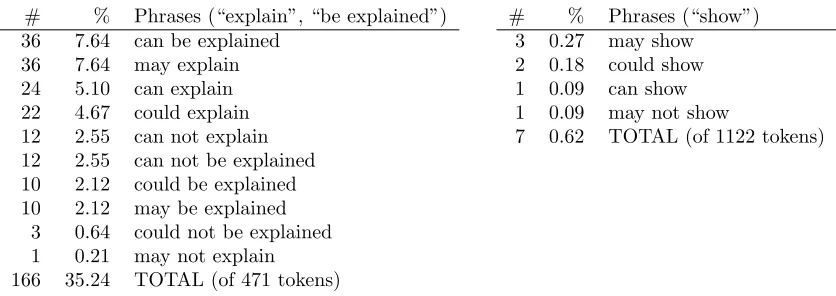
To test this hypothesis I have compiled a list of the phrases that the words “ex-plain” and “be explained” occur in. Table 2.3 lists the most frequent short phrases. What is notable about these lists is how many of the phrases qualify or negate the word “explain” or “be explained”. This provides some evidence that scientists treat “explain” as a strong word.
I then generated a list of qualified and negated phrases. The first part of each phrase is either “may”, “can”, or “could”. The last part of the phrase is either “explain”, “explained”, or “show”. I also added negations for each of these phrases (note that the contraction “cannot” is automatically separated into “can” and “not” by the NLTK word tokenizer). Then I counted the number of occurrences of these qualified phrases in the data set and calculated the percentage of qualified phrases among all the occurrences of “explain”, “explained”, and “show”.
Table 2.4 lists the results. The differences are striking. More than a third of all uses of “explain” and “explained” are simple qualifications or negations. Of course, other uses may be qualified in more complicated ways not measured here. By comparison, only a handful of uses of “show” were so qualified.
# % Top 2-Grams 144 30.57 explain the 114 24.20 to explain
98 20.81 explained by 94 19.96 be explained 36 7.64 may explain 34 7.22 explain why 24 5.10 can explain 22 4.67 could explain 21 4.46 not explain 20 4.25 explained in
# % Top 3-Grams
66 14.01 be explained by 58 12.31 to explain the 36 7.64 can be explained 34 7.22 explained by the 16 3.40 not be explained 15 3.18 explain the observed 13 2.76 may explain the 12 2.55 can explain the 12 2.55 can not explain 12 2.55 may explain why
# % Top 4-Grams
25 5.31 be explained by the 25 5.31 can be explained by 12 2.55 can not be explained 10 2.12 explained in terms of 10 2.12 not be explained by
9 1.91 be explained in terms 9 1.91 may be explained by 8 1.70 can not explain the 8 1.70 proposed to explain the 8 1.70 to explain the observed
# % Top 5-Grams
9 1.91 be explained in terms of 9 1.91 can be explained by the 7 1.49 can not be explained by 6 1.27 been proposed to explain the 6 1.27 can be explained in terms 6 1.27 have been proposed to explain 4 0.85 ) , which may explain
4 0.85 can only be explained by 4 0.85 may be explained by the 3 0.64 could not be explained by
Table 2.3: The four lists show the ten most common “n-grams” – two-word, three-word, four-three-word, and five-word phrases – that include either “explain” or “be ex-plained”. For each phrase the number of occurrences is listed as well as its percentage among the 471 total occurrences of “explain” and “be explained” in the data set.
# % Phrases (“explain”, “be explained”) 36 7.64 can be explained
36 7.64 may explain 24 5.10 can explain 22 4.67 could explain 12 2.55 can not explain 12 2.55 can not be explained 10 2.12 could be explained 10 2.12 may be explained
3 0.64 could not be explained 1 0.21 may not explain 166 35.24 TOTAL (of 471 tokens)
# % Phrases (“show”) 3 0.27 may show 2 0.18 could show 1 0.09 can show 1 0.09 may not show
7 0.62 TOTAL (of 1122 tokens)