Scholarship@Western
Scholarship@Western
Electronic Thesis and Dissertation Repository
2-14-2012 12:00 AM
Keeping Up with the Virtual Joneses: The Practices, Meanings,
Keeping Up with the Virtual Joneses: The Practices, Meanings,
and Consequences of Consumption in Second Life
and Consequences of Consumption in Second Life
Jennifer M. Martin
The University of Western Ontario Supervisor
Dr. Nick Dyer-Witheford
The University of Western Ontario Graduate Program in Media Studies
A thesis submitted in partial fulfillment of the requirements for the degree in Doctor of Philosophy
© Jennifer M. Martin 2012
Follow this and additional works at: https://ir.lib.uwo.ca/etd Part of the Other Film and Media Studies Commons
Recommended Citation Recommended Citation
Martin, Jennifer M., "Keeping Up with the Virtual Joneses: The Practices, Meanings, and Consequences of Consumption in Second Life" (2012). Electronic Thesis and Dissertation Repository. 386.
https://ir.lib.uwo.ca/etd/386
This Dissertation/Thesis is brought to you for free and open access by Scholarship@Western. It has been accepted for inclusion in Electronic Thesis and Dissertation Repository by an authorized administrator of
(Spine title: Keeping Up with the Virtual Joneses)
(Thesis format: Monograph)
by
Jennifer M. Martin
Graduate Program in Media Studies
A thesis submitted in partial fulfillment of the requirements for the degree of
Doctor of Philosophy
The School of Graduate and Postdoctoral Studies The University of Western Ontario
London, Ontario, Canada
ii
THE UNIVERSITY OF WESTERN ONTARIO School of Graduate and Postdoctoral Studies
CERTIFICATE OF EXAMINATION
Supervisor
______________________________ Dr. Nick Dyer-Witheford
Supervisory Committee
______________________________ Dr. Daniel Robinson
Examiners
______________________________ Dr. Carole Farber
______________________________ Dr. Sandra Smeltzer
______________________________ Dr. Mark McDayter
______________________________ Dr. Andrew Herman
The thesis by
Jennifer Meaghan Martin
entitled:
Keeping Up with the Virtual Joneses: The Practices, Meanings, and
Consequences of Consumption in Second Life
is accepted in partial fulfillment of the requirements for the degree of
Doctor of Philosophy
______________________ _______________________________
iii
Abstract
Every day, thousands of people log into the virtual world of Second Life and collectively pay hundreds of thousands of dollars to purchase virtual goods. With an in-world economic system that is linked to offline economies and a wealth of user-generated content, the virtual world has a wide variety of goods available for consumption. These commodities, which include everything from clothes and cars to fantastical pets and flying airships, are computer code visually rendered on a screen, and cannot exist apart from the servers on which they are housed. Although they are virtual, goods in Second Life are widely bought, sold, and traded.
Through participant observation, surveys, interviews, and content analysis, this dissertation investigates the practices, meanings, and effects associated with the consumption of virtual goods. It considers the extensive consumption practices found in the world’s market and freebie economies, the degree to which Second Life residents consume virtual goods, and their consumption preferences. It also investigates the meanings associated with these practices, and examines the ways in which consumption is implicated in individuality, belonging, resistance, social status, and social and cultural capital. Finally, it argues that although there is significant consumption inequality within the world, the effects and perceptions of this inequality are moderated by factors including the virtual nature of the world, free and inexpensive virtual goods, a lack of stigmas, user-generated content, and resident attitudes. Although consumption is a practice that bears important meanings for residents and is heavily engaged, often in unequal ways, the moderating effects of the world make Second Life what can be termed a utopia of inequality.
Keywords
iv
Acknowledgments
First and foremost, my thanks go to Dr. Nick Dyer-Witheford, my dissertation supervisor. His assistance and encouragement along the way have been invaluable in not only completing this work, but also in improving and refining it. Additional thanks go to Dr. Daniel Robinson, whose assistance as a second reader provided further clarity and support. Finally, many thanks go to Dr. Carole Farber, whose knowledge of Second Life, in-world connections, and remarkable kindness in sharing both set the tone for this work early on and helped it get off the ground.
Within the Faculty of Information and Media Studies (FIMS) community are numerous individuals who also deserve thanks. For their help in the many stages of this process I owe debts of gratitude to Dr. Pamela McKenzie, Dr. Jacquie Burkell, Cindy Morrison, and Shelley Long. Beyond FIMS, I would also like to extend my thanks to Dr. Mark McDayter, Dr. James Davies, and Dr. Nanda Dmitrov.
Outside of the Western community, huge thanks go to my family for their vast reserves of patience and love. Although my husband, Josh, completed the very important tasks of building my research website and survey engine, his love, support, and dedication made the biggest difference throughout the process. My parents, Marian and Ian Martin, always expressed their faith in my abilities, but also balanced that faith with “rare eastern academic mole” jokes, Oxford comma debates, and reminders to take the occasional break. My mother-in-law, Leah Scherer, also extended the same faith and encouragement, which was always appreciated, even across the miles.
v
vi
Table of Contents
CERTIFICATE OF EXAMINATION ... ii
Abstract ... iii
Acknowledgments ... iv
Table of Contents ... vi
List of Figures ... x
List of Appendices ... xi
Chapter 1 ... 1
1 Introduction ... 1
1.1 Living a Second Life ... 1
1.2 Second Life in Context ... 2
1.3 Second Life as a Virtual World ... 5
1.4 Consumption and Virtual Consumption ... 6
1.5 Consumption in Second Life ... 11
1.6 Research Contributions ... 14
Chapter 2 ... 17
2 Review of the Literature ... 17
2.1 Virtual Communities ... 17
2.2 Benefits of and Issues with Virtual Community ... 19
2.3 Video Game Consumption ... 23
2.4 Social Media Consumption ... 31
2.5 Second Life Consumption ... 34
Chapter 3 ... 40
3 Theoretical Perspectives ... 40
vii
3.2 Sign-Value ... 43
3.3 Conspicuous Consumption and Taste ... 46
3.4 The Consumer Society ... 47
3.5 Consumption Inequality ... 49
3.6 Theoretical Frameworks ... 50
Chapter 4 ... 53
4 Methodology ... 53
4.1 Methods... 53
4.2 Why Second Life? ... 54
4.3 Methods Explanation ... 56
4.4 Participant Observation Approaches and Issues ... 58
4.5 Survey Approaches and Issues ... 61
4.6 Content Analysis Approaches and Issues ... 64
4.7 Interview Approaches and Issues ... 66
4.8 Research Ethics ... 67
4.9 Additional Research Considerations ... 68
4.10 Methodological Summary ... 70
Chapter 5 ... 72
5 Consumption Practices ... 72
5.1 Consumption Possibilities ... 73
5.2 Virtual Currency and Consumption ... 76
5.3 Production ... 79
5.4 What is Consumed ... 83
5.5 Virtual Good Sales and Acquisitions ... 87
5.6 Second Life Economies ... 89
viii
5.6.2 Consumption in the Dollarbie Economy ... 93
5.6.3 Consumption in the Market Economy ... 95
5.7 Virtual Property ... 97
5.8 Conclusions ... 98
Chapter 6 ... 100
6 Sign-Value, Conspicuous Consumption, and Virtual Taste ... 100
6.1 Virtual Use-Value, Exchange-Value, and Sign-Value ... 100
6.2 Consumption and Customization ... 103
6.3 Consumption and Attractiveness ... 109
6.4 Consumption and Individuality ... 113
6.5 Consumption, Conspicuousness, and Status ... 117
6.6 Virtual Taste ... 120
6.7 Conclusions ... 122
Chapter 7 ... 124
7 Subcultural Consumption and Resistance ... 124
7.1 Consumption and Belonging... 124
7.2 Consumption and Social and Cultural Capital ... 134
7.3 Consumption, Visibility, and Recognition... 138
7.4 Criticisms of Consumption ... 141
7.5 Consumption and Resistance ... 146
7.6 Anti-Consumerist Resistance ... 150
7.7 Conclusions ... 152
Chapter 8 ... 153
8 Inequality and Consumption ... 153
ix
8.2 Economic, Income, and Consumption Inequality ... 154
8.3 Perceptions of Inequality ... 158
8.4 Consequences of Inequality ... 161
8.5 General Factors Moderating Inequality ... 166
8.6 Economic Factors Moderating Inequality ... 169
8.7 Meanings Moderating Inequality ... 174
8.8 Conclusions ... 177
Chapter 9 ... 179
9 Conclusions ... 179
9.1 Research Objectives ... 179
9.2 Consumption in Second Life ... 180
9.3 From Offline to Online Consumption ... 183
9.4 Second Life’s Utopia of Inequality ... 187
9.5 Second Life’s Potential ... 192
9.6 Consumption Beyond Second Life and Future Research ... 197
Works Cited ... 201
Appendices ... 225
x
List of Figures
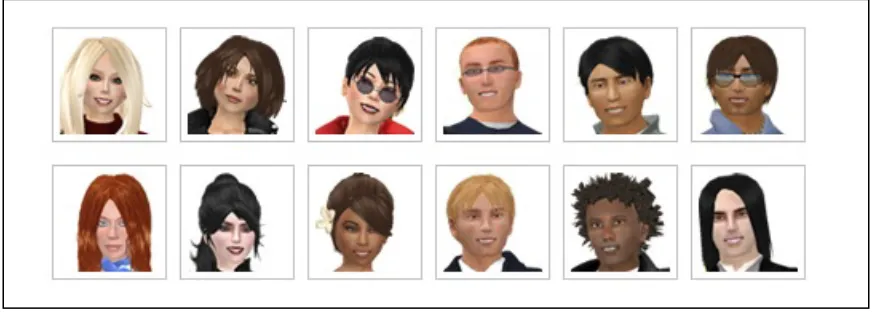
Figure 6.1: The available default avatars for Second Life as of July 26, 2010. ... 104
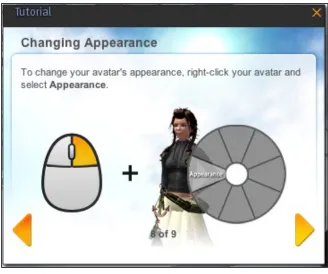
Figure 6.2: Tutorial showing residents how to change their avatar’s appearance. ... 105
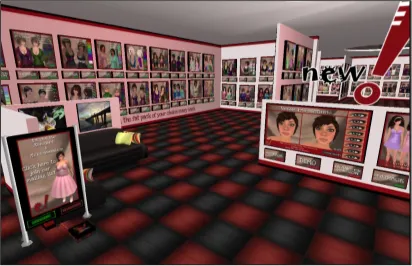
Figure 6.3: A sign offering new residents teleports away from Welcome Island... 106
Figure 6.4: One of the first stores to which new avatars are teleported... 107
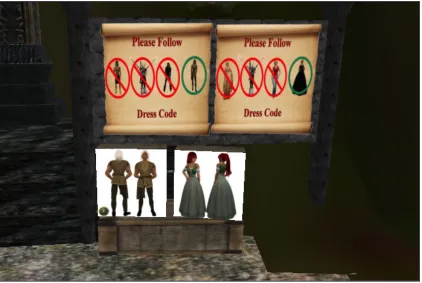
Figure 7.1: A sign detailing the dress code for Avilion, an elven-themed sim... 129
Figure 7.2: Virtual postcard from SLSecret showcasing resident sentiments about those who are too focused on developing their avatars... 145
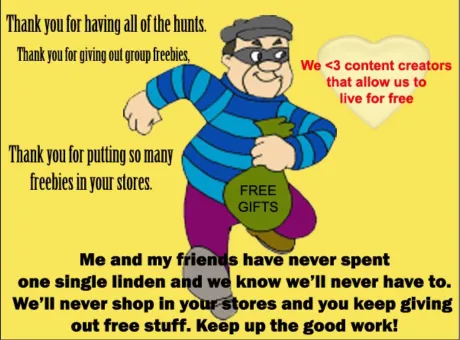
Figure 8.1: Virtual postcard from SLSecret showing (possibly somewhat snide or sarcastic) appreciation for freebie content in-world. ... 170
Figure 8.2: Virtual postcard from SLSecret detailing an expensive wedding dress purchase that is highly valued by the resident for personal reasons. ... 173
xi
List of Appendices
1
Introduction
Every day, thousands of people spend hundreds of thousands of dollars in a world that exists only as digital computer code, on goods that are equally ephemeral and
immaterial. This world, called Second Life ("Second Life," 2003-2011), is an online social environment filled with participants – usually referred to as residents – who virtually interact with each other using virtual bodies of their choosing and can engage in a variety of activities within the world. One of these activities is consumption, with residents purchasing – often with “real” money – virtual goods that cannot exist apart from the online world and the servers on which it is housed. The prevalence of consumption and the ways in which it is engaged raise three questions. What is consumed in Second Life, what meanings do consumption practices hold for residents, and what are the effects of visible consumption on the experience of using and engaging with the virtual world?
1.1
Living a Second Life
In recent years there has been increasing development of graphically rendered online social environments (Taylor, 2006). Following in the footsteps of online games, these social worlds provide an environment where individuals create a visual
representation of themselves – usually referred to as an avatar – and, using their virtual body, interact with the world and other individuals. Created by Linden Lab, Second Life is a virtual world that focuses on social interaction. The environment was made public in October of 2003, and as of September 25, 2011 housed 25 452 560 residents, with
anywhere between 300 000 and 600 000 logging in over the course of a week ("Second Life Economic Metrics Repository," 2011). Over the eight years of its existence, Second Life has developed a solid base of residents and commerce.
name. Then, users choose a premade avatar from ten defaults and provide basic personal information. Once the account is created, users can download the viewer and log into the virtual world using a computer and Internet connection. Logged in, residents are guided through a series of basic tutorials before they head out to explore the world and interact with other users.
Second Life has gained celebrity within an extensive range of other virtual social environments. It is a complex virtual world and community, and despite its reliance on the Internet, is distinct from online games, social networking, and many other digital pursuits. It also supports a large registered population. This can be attributed to its position as an early leader and the fact that it allows residents multiple accounts and avatars. However, it is still only one of many virtual communities within a long
progression of online social worlds and other sites designed to bring people together. As with most other social environments, Second Life borrows heavily from previous
iterations of online community ranging from text-based communities to online video games. As a result, it is both linked to and distinct from these other communities.
1.2
Second Life in Context
Although it is graphical, Second Life draws heavily on earlier forms of text-based social environments, such as multi-user domains (MUDs) and multi-user domains-object oriented (MOOs) (Castronova, 2005). Based on text, MUDs and MOOs allow users to interact with other participants through chat, but also by describing things and actions within the virtual space. Although originally started in the mid-1970s on systems like ARPAnet, a precursor to the Internet, environments such as TinyMUD, AberMUD, AlphaMOO, and LambdaMOO became popular in the late 1980s and early 1990s thanks to the increasing accessibility of the Internet. While some MUDs and MOOs are based on tabletop role-playing games, others are focused more on social interactions. In both cases, the potential for many participants to interact with each other in a virtual world serves as an early precursor to graphical worlds like Second Life.
avatars within virtual communities, technology has not always been able to allow for heavy interactive graphics use. With increasingly sophisticated technology, computers and servers are better able to handle the high amount of data necessary to render the visual elements of the world onscreen. As a result, there are currently a wide variety of graphical social worlds, including Second Life, Habbo Hotel, Club Penguin, There, and Active Worlds.
Despite its prominence, Second Life is not the first virtual social world to rely on a graphical interface or on user-generated content to develop and expand the world.
Graphical social environments can be traced back as early as 1994 when WebWorld – the 2.5D predecessor to Active Worlds – was released (Stevens, 2007). This release was followed by a range of lesser-known environments, such as TalkWorld, released in 1997. Along with graphical worlds came the development of user-generated content, which allowed users to build and expand on the world and its content. Despite the limitations placed on user-generated content in games (for reasons discussed in chapter 2), many early social environments allowed users to create usable content within the world, with some also allowing them to give away and acquire the creations of others as a form of trade or virtual consumption.
In addition to social interaction, social worlds like Second Life can also be linked to the development of video games in terms of consumption. As early as 1985, the online role-playing game Habitat offered vending machines from which players could buy virtual goods with their earned in-game currency (Lehdonvirta, 2009a). The use of buyable and tradable in-game items became a feature of many multi-player games, such as 1996’s Diablo. With the development of progressively larger MMOs like Lineage, EverQuest, and Asheron’s Call, and later the 12 million player strong World of Warcraft (Blizzard Entertainment, "World of Warcraft® Subscriber Base Reaches 12 Million Worldwide," 2010) virtual economies formed, with complex systems of buying, selling, and trading between players and vendors. It is also out of many of these games that players started linking offline money with virtual goods, selling currency and items to other players.
1.3
Second Life as a Virtual World
Given its rise in the information age and the heyday of Web 2.0, Second Life also exists within a vast matrix of online sites and communities from blogs and social media to forums and personal webpages. As with earlier virtual worlds, it is the combination of a graphical capabilities, user-generated content, and consumption that facilitate the creation and development of the three main features of the virtual world that make Second Life, as the term “virtual world” implies, a world. These features are avatars, environments, and activities.
While avatars can be a regular feature of any form of online community, and can be static images or interactive virtual selves, virtual worlds allow for interactive and highly customizable avatars. Because the world is graphical, avatars are visible to their users and to other residents, making appearance an important element of virtual life. Within Second Life, avatars are almost infinitely customizable. Sliding scales allow individuals to adjust the appearance of their avatar down to the angle of the nose and the size of feet. A huge selection of clothing, accessories, and facial features that can be acquired allow avatar appearances to be changed at will. The application of “skins” allows for a wide variety of overall appearances that can range from highly photorealistic humans to animals, and from robots to fish. Combined with the fact that they can engage with the world and other residents, Second Life offers participants a more customizable and interactive experience through their avatar than is usually afforded by more
conventional virtual communities like chat rooms, blogs, or social networking.
Although avatars are appealing on their own, virtual worlds also offer residents environments in which they can use their avatars to interact with the world and with each other. Although they vary between and even within worlds, graphical environments support features such as land, water, trees, deserts, forests, buildings, and cities.
Furthermore, when residents have the power to create and are charged with building and expanding the environment, there are few limits on what is possible in terms of
Gardens of Apollo. While other forms of community – such as chat rooms or social media sites – may offer avatars, virtual worlds offer an opportunity to create entire environments and settings that can be explored and interacted with by avatars.
Finally, by supporting both avatars and an environment for them to inhabit, Second Life also makes possible virtual activities. Activities range from the mundane – like shopping, chatting, or simply wandering around – through to the extraordinary – such as flying, visiting lost wonders of the world, or skydiving without a parachute. Many of these activities are facilitated by the effort and creations of other residents. Collectively, they offer a wide variety of options that avatars can engage with to develop a virtual life based on their own interests.
With avatars, environment, and activities combined in one online program, it is possible to create a virtual world that, in many ways, both mimics and expands upon offline experience. Because virtual worlds have these capabilities, they offer an
environment that is amenable to features that are not always apparent in or supported by other forms of virtual community, such as creation, production, consumption, and the emergence of complex economies.
1.4
Consumption and Virtual Consumption
While there is relatively little research into the consumption that happens within virtual worlds, there is a great deal of research into consumption in general, including its practices, meanings, and effects. Consumption practices have been widely studied within a variety of disciplines. Different fields offer analyses of the practices and effects of production and consumption, both in general and as they relate to virtual spaces. In economics, production is viewed as the process of creating goods or services that meet needs (Kotler, Armstrong, Brown, & Adam, 2006). Consumption also serves needs, but does so through the purchase and use of goods and services (Gough, 1994; Princen, 2001).
Qualitative and quantitative research both point to the lived experience and social effects of production and consumption. Economic sociology, for instance, considers the causes and effects of economic phenomena while taking into account how economic relations function within already existing social relations (Granovetter, 1985). Production is examined in terms of how its processes are affected by social forces (Zafirovski, 2002), while consumption is seen most recently through a lens that includes the ways in which cultural products can be adapted to the needs of consumers (Campbell, 1995). Both practices can be read in a similar way through the optic of economic anthropology. This approach explores human behaviour as it relates to economic practices, and considers how humans meet needs through both consumption for personal use and consumption for exchange (Polyani, 1944). Production and consumption are considered in terms of their role in social life, with goods understood as a means of fulfilling social obligations (Douglas & Isherwood, 1996 (1979)). In this social role, consumption is also a means of including and excluding people from a group (Bauman, 2007; Veblen, 1979 (1899)).
Consumption in everyday life is also engaged through cultural studies research. Theories of the consumer society, for instance, explore the idea that consumption has supplanted production in the formation of identity and social status (Baudrillard, 1998; Bauman, 2007). In related work, scholars also explore the degree to which production and consumption have become linked in advanced capitalism. The idea of the prosumer, for instance, acknowledges individuals who both produce and consume (Ritzer &
Jurgenson, 2010). Given the current focus on the role of prosumers in digital culture and new media, this body of work has also focused on virtual worlds with (Bruns, 2009; Herman, Coombe, & Kaye, 2006; Jones, 2008; Kücklich, 2005) an eye to the ways that users are increasingly both generators and consumers of digital content.
more generally, economic inequality. When individuals consume, they have different resources at their disposal (Attanasio, Berloffa, Blundell, & Preston, 2002; Blundell & Preston, 1998). Different resources can cause unequal levels of consumption (Attanasio et al., 2002; Garner, 1993; Schor, 1998; Veblen, 1979 (1899)).
Over time, consumption has taken on different definitions as its meanings have shifted in response to changes in society and economics. Raymond Williams explores some early definitions of consumption, tracking the progression of meanings and connotations. Williams writes that early definitions of consumption were almost exclusively negative and focused on destruction, exhaustion, or the using up of things (1976), a perspective that is reiterated in the updated version of William’s work (Warde, 2005). These meanings imply that consumption is making use of something to the point where it is no longer usable, or no longer exists.
Research into consumption still invokes the idea of consumption as a form of using things up. This perspective is apparent in work on planned obsolescence, where goods are designed to wear out or fail within a set period of time, necessitating new purchases (Iizuka, 2007). Such perspectives are especially prominent in work that deals with the negative impacts of consumption. Research into the relationship between issues such as environmental degradation (Shove & Warde, 2002), consumer spending and debt (Cohen, 2007), and the upkeep of status (Schor, 1998) suggest a shifting vision of “using up” where items are no longer necessarily worn out, but instead no longer meet their purposes and are discarded in favour of something newer or better. In these cases, items are still used up in the sense that they fulfill a purpose, but the definition of use becomes more symbolic than utilitarian.
Despite these early and ongoing connotations of destruction, not all definitions of consumption are negative. Williams notes that the meaning of consumption became more neutral around the mid eighteenth century. Production and consumption became
concerns of political economy, with consumption seen as, “the act of using goods and services” (Williams, 1976, p. 78). Eventually consumption was seen as, “acts of
and aggregate financial consequences” (Warde, 2005, p. 57). This definition not only invokes the use of commodities, but also spending, which is seen in the focus on
purchases and financial consequences, and which highlights the centrality of the market in an emerging capitalist economy.
It is not, however, until the mid twentieth century that the term consumption entered into more widespread use (Warde, 2005). This growth is marked by an increased focus on the consumer, who is seen as both someone for producers to attract as well as well as someone who is in need of protection and promotion (Ibid). This is also the point at which society takes the form of a consumer society, with consumption more focused on signs than on actual use-value (Baudrillard, 1998). Here, although acquisition, spending, and use remain elements of consumption, the focus is largely on its underlying meanings and the elements that drive it.
Virtual consumption is a growing element of social life; not just within Second Life, but also in other virtual environments (Castronova, 2002; Lehdonvirta, Wilska, & Johnson, 2009; Liszkiewicz, 2010; Molesworth & Denegri-Knott, 2007b). Given this, it is important to consider how existing definitions of consumption apply, or fail to apply, in virtual contexts and the ways in which these definitions can be expanded to better represent the realities of consumption in the digital age in general, and in virtual worlds in particular.
Early definitions that deal with consumption in terms of destruction or using up (Warde, 2005; Williams, 1999) do not address forms of consumption in which wear or destruction is not possible. However, even in accounting for virtual consumption, Lehdonvirta, Wilska, and Johnson suggest that there are exceptions to this idea even within offline consumption, including goods like antiques and jewelry that are not used up or exhausted (2009). Since virtual goods cannot be worn out, they are closer to more modern but still negative definitions of consumption. These perspectives take using up to mean outliving a purpose rather than truly being destroyed, and hence can take into account that virtual goods cannot be worn out and can be discarded or replaced without being used up in the more traditional sense.
Considerations of consumption that move beyond associations with using up and spending begin to move towards a definition that is applicable to virtual consumption. Williams addresses these ideas in a general claim that consumption is about making use of goods and services (1976). This approach is amplified in modern definitions that move away from specific considerations of materiality and spending and address the varied consumption options and practices made possible within advanced capital. Acquisition as the primary feature of consumption is acknowledged by work on the present state of consumption and within what has been termed “the consumer society” (Baudrillard, 1998; Bauman, 2007). Virtual consumption exists within a system of advanced capital in which consumption is pervasive and acquisition is necessary not just for survival, but also for status (Shipman, 2004), identity (Bauman, 2007), and the continuing reproduction of the capitalist system (Debord, 2004 (1967)). While
materiality and spending still exist, the focus is on the underlying meanings and effects of acquisition.
Jean Baudrillard writes that, “There is all around us today a kind of fantastic conspicuousness of consumption and abundance, constituted by the multiplication of objects, services and material goods” (1998, p. 25). Within this system, the focus is on the acquisition of goods. Although not explicitly stated, the consumption of virtual goods is now as much a part of this system of abundance as material goods. Second Life
game players (Castronova, 2002), and participants in other virtual social worlds (Kafai, Fields, & Cook, 2010; Lehdonvirta et al., 2009). While the breadth of virtual
consumption is testament to the availability and pervasiveness of consumption, it is also indicative of the need for a definition of consumption broad enough to include the virtual.
Since Second Life opens new options for making and acquiring goods in a virtual setting, many conventional definitions of consumption are too limited or focused to fully account for virtual consumption. Given these possibilities, virtual consumption needs to be defined within the context of a capitalist system in which consumption is expanded to almost every element of life, including the virtual (Poster, 2004). Although virtual goods may not have the same costs or materiality associated with offline goods, they bear many of the same meanings and serve many of the same purposes. Within Second Life,
consumption is the acquisition of virtual goods, either for free or in a system of paid exchange. Even when residents seek out and acquire goods that do not have the same physicality or costs as offline goods, they are consuming based on intention, the
acquisition of something made from code, and the expectation that what they acquire will be used.
1.5
Consumption in Second Life
Because of this freedom, Second Life offers a wider variety of goods than is available in many other virtual environments, such as games and social media that are dependent on developer input. The wide range of consumption available to residents is an important element of this research. Rather than being limited to what is offered by developers, Second Life residents have a large selection of virtual goods available to them, both in terms of quantity and the ease of accessing them through in-world and web-based markets.
In addition to the practical elements of consumption, the ways in which virtual goods are acquired raises concerns about the visibility of consumption and the ways in which it can be interpreted and understood. Given that virtual goods are created by thousands of residents rather than a development team, they can be associated with their designers. Recognizable brands, designer items, high and low quality goods, and distinctive and custom items are all options within Second Life in ways that are not usually possible within other virtual environments. Furthermore, these items are also capable of indicating characteristics such as rarity and even social connections based on who they are made by and how they were acquired.
Second Life has an in-world system that facilitates the exchange of virtual goods between residents. Not only can residents make their own virtual goods, but they can share them with others; the thousands of free items made available to residents
demonstrate the importance of sharing. Beyond sharing, residents can also sell what they make and set their own prices for the goods that they offer. Within this system, it is also important to note that residents retain intellectual property rights over their virtual goods (Herman et al., 2006), a feature that is not common in other virtual environments.
Finally, in order to purchase goods, residents must have money. Linden Dollars – usually referred to as Lindens – are Second Life’s in-world currency. Lindens can be exchanged for offline currencies, such as the United States dollar, and then used to purchase virtual goods. In turn, the currency can also be cashed out again, making it possible to convert in-world wealth to offline money. For those not willing or able to spend money,
Games, social media, and many virtual worlds also have in-world economic systems that facilitate the exchange of virtual goods, although they are different from that which exists in Second Life. An economic system that is linked to offline economies is relatively rare within games, where paid content makes play unfair and virtual goods and the currency necessary to buy them must often be earned. It is more common in social media, where the exchange of gifts and the range of free-to-play games makes paying for virtual goods with offline money an increasingly common occurrence (Lin & Sun, 2011). In social media, however, it is extremely rare that currency can be cashed out, eliminating the opportunity for users to profit.
Second Life’s virtual consumption differs from other forms in three main ways. First, beyond building wealth that is only useful in the virtual environment, residents are able to sell their virtual goods to others, potentially for profits if they cash out their Lindens. Second, instead of having to work in order to afford what they want, residents can easily purchase Lindens using “real”, offline money. This facilitates consumption by making it easy to obtain in-world currency. Finally, the monetary value of goods can be apparent in Second Life. It is possible to see how much another resident has spent on consumption based on the purchases they have made. These assessments can be
somewhat obscured by gifts, prizes, or self-made goods, on which residents are unlikely to have spent Lindens. However, they still offer a sense of the value of the virtual goods owned by other residents.
inequality is a feature of the world and whether there are associated consequences. Although in-world consumption can be relatively inexpensive for some residents, the use of an economic system that is strongly linked to offline economies makes it possible to consume at different levels, potentially creating problems around monetary versus free virtual consumption.
This consumption is linked to the profitability of the world’s developers. Linden Lab is the creator of Second Life. The company was started in 1999 and was founded by Philip Rosedale, who was also its original CEO (Au, 2008c). The company is known to be non-hierarchical, with a large amount of freedom and self-direction for its employees (Malaby, 2009). Over time, Linden Lab has acquired companies such as
LittleTextPeople (Constine, 2012)and Windward Mark Interactive (Bray, 2007) and programs including XStreetSL, OnRez, and Avatars United (Au, 2009c; Nino, 2010). However, in 2010 it underwent a restructuring that necessitated laying off 30 percent of its workforce as the company’s focused shifted ("Linden Lab Restructures to Generate Efficiencies and Support Investment in New Platforms," 2010). Although not explicitly linked to the global recession, it is possible that this economic situation contributed towards this significant corporate restructuring in order to maintain profitability.
Linden Lab is a privately held company and, as such, a great deal of information about their revenue model and profitability is not publicly available. Some revenue does come from paid accounts, which are each between USD$6 and $10 per month
1.6
Research Contributions
In speaking about the Whole Earth ‘Lectronic Link (WELL) bulletin board system (BBS), Howard Rheingold suggests that, “There is no such thing as a single, monolithic, online subculture; it's more like an ecosystem of subcultures, some frivolous, others serious” (Rheingold, 1993). The same thing can be said today not only about all of the available communities within cyberspace, but also of Second Life itself. Despite the focus on consumption in this research, it is of the utmost importance to note that life and interactions within Second Life can no more be defined strictly by consumption than could offline life. While consumption is an integral part of Second Life, it is caught within a web of other interests, interactions, and activities that prevent it from being completely isolated from many other facets of virtual life, and in many cases make it important for if not integral to these pursuits. Just as with offline life, consumption is inextricably linked to other practices surrounding communities, activities, social networks, and almost any other engagement that is possible.
To reduce Second Life to its consumption practices would therefore be to render a thriving, meaningful virtual world flat and de-contextualized. However, by the same token, consumption is important to study in order to better understand Second Life’s manifold virtual culture. To date, much of the literature on consumption in virtual worlds has focused on the economics of the practice within games with little focus on how these observations might transfer – if they transfer at all – to social spaces. Although there is recognition of the importance of studying virtual economies in general, there is relatively little work to be found on consumption practices as they exist within more socially oriented worlds, or on the effects that such practices generate for participants in these virtual communities.
not only in terms of what they choose to consume and how often, but also how they present themselves within the world. Because residents are able to make these choices, their consumption practices provide information about their in-world identity,
preferences, interests, and what they wish to convey about themselves. However, consumption does not happen in a vacuum, and the items that residents choose to consume may convey different meanings or impressions than intended. Given the potential for consumption to be interpreted in a variety of different ways, this research will also consider how residents feel about and respond to the consumption of others.
Third, given the importance of consumption and its different meanings, this research will consider its consequences, especially with regards to the links between consumption and different forms of inequality. When consumption is visible it can also become conspicuous, both in terms of its visibility and through its association with money. Along with these associations comes the potential for consumption practices to be linked with in-world status and inequality. Virtual consumption will therefore be considered in terms of its impacts and influence effects on residents, and whether they feel that consumption – or perhaps a lack thereof – has had an impact on their experience of the virtual world and their interactions within it.
2
Review of the Literature
This study is focused on consumption in virtual worlds. While there is a body of literature surrounding virtual worlds and communities, literature on consumption
comprises only a small part of this research. Since there is relatively little work on this area, it is necessary to consider literature on virtual worlds and on consumption
independently of each other. Examining both areas provides a clearer perspective of the topics at hand, as well as highlighting the associated features. Given the importance of community to online interaction in general, and to virtual consumption more specifically, this review will first consider virtual communities, including their benefits and issues. It will then focus on virtual consumption by looking at broad considerations of the subject and more focused research into consumption in video and computer games and social media in addition to the available literature on consumption within Second Life. Theories of consumption “in general”—that is, not as specifically related to virtual worlds-- will be dealt with in the following chapter.
2.1
Virtual Communities
Despite its differences from other media, Second Life remains one of many current and past manifestations of online and virtual community. Community is important on its own, but is also implicated in the economics, production, and
consumption of virtual worlds. Furthermore, it also plays a role in consumption-related phenomena such as conspicuous consumption and the acquisition of social status. Second Life needs to be studied within the matrix of other virtual arenas to understand both the nature of virtual community in general, and those features of the world that makes it different from many of its predecessors and contemporaries.
affinity that are applicable to discussions of virtual community (Wellman, 1997; Wellman & Gulia, 1999).
Researchers suggest that communities are built around the shared interests of participants (Usoro, Sharratt, Tsui, & Shekhar, 2007). In some instances, these interests may be very focused, with communities formed around particular subcultures or areas of interest (Broderick, MacLaran, & Ma, 2003). Shared interest also informs the idea of “imagined community” (Anderson, 1991 (1983)). For Benedict Anderson, “the members of even the smallest nation will never know most of their fellow-members, meet them, or even hear of them, yet in the minds of each lives the image of their communion” (1991 (1983)). By interacting with others who are also interested in the virtual space and its offerings, participants have a shared interest through which community can be
established.
Historically – or, at least, as historically as is possible with a media that is perhaps only 50 years old – sites that support virtual communities have focused on social
interaction. Communities that exist virtually can take a wide variety of forms. Social media facilitate social networks (boyd & Ellison, 2007). Blogs and websites with a body of involved readers and commenters can create community (Nardi, Schiano, Bumbrecht, & Schwartz, 2004). Listservs and newsgroups provide opportunities for shared
engagement (Kavanaugh, 1999). Video and computer games generate community around and through play (Steinkuehler & Williams, 2006).
Some online communities are created around individuals who already have offline connections (Ellison, Steinfield, & Lampe, 2007; Zhao, Grasmuck, & Martin, 2008). In others, bonds are developed within the virtual space. In many cases, this social
I was in the Parenting conference on the WELL, participating in an informational and emotional support group for a friend who just learned his son was diagnosed with leukemia. I was in MicroMUSE, a role-playing fantasy game of the twenty-fourth century (and science education medium in disguise), interacting with students and professors who know me only as "Pollenator." I was in TWICS, a bicultural community in Tokyo; CIX, a community in London; CalvaCom, a community in Paris; and Usenet, a collection of hundreds of different discussions that travel around the world via electronic mail to millions of participants in dozens of countries (1993).
In addition to interests, communities are also based on shared aims or goals. Some communities, for instance, are based on information sharing or mutual support
(Bakardjieva, 2007), while others are created to explore rhetorical practices (Vrooman, 2002).
Despite a focus on smaller interest- and task-based groups, one feature that has come to mark many virtual communities is a sense that members may share some not only common interests, but also a concern for the community. This type of bond is seen in Rheingold’s account of how members raised money for a new server to maintain the community (1993). Yet, Rheingold’s account is not the only one that elucidates the idea of a general sense of community that goes beyond smaller interest groups. In Julian Dibbell’s writings on “A Rape in Cyberspace” the sense of community at large emerges when the question of what should be done with a virtual rapist is considered (1993). This shared concern for the good of the world and the people within it can also be seen within Second Life, especially in situations where changes to the virtual world such as pricing structures are protested by residents (Rymaszewski et al., 2008).
2.2
Benefits of and Issues with Virtual Community
affect their participants, whether these affects exist in Second Life, and how they relate to virtual consumption.
Anonymity is a term that is frequently raised within discussions of online interaction. While it does have positive effects, it is also associated with the possibility of deception, since there are few ways to verify what other people are saying and who they claim to be (Donath, 1998). The anonymity associated with virtual communities does not necessarily lessen the need to conform to social norms within the context of a group (Willson, 2000). It does, however, reduce consequences and can increase negative behaviours (Christopherson, 2007). As a result, individuals can experience harm in virtual environments (Wolfendale, 2007).
The idea of virtual harm is contentious. It has been argued that no real harm can take place in such situations, given the fact that the offline body is not immediately affected (Powers, 2003). However, many people experience a sense of identification with and attachment to their virtual self (Blinka, 2008; Turkle, 1995). Being subjected to negative actions such as teasing, ostracism, or rape can therefore lead to feelings of harm or violation (Dibbell, 1993; Jordan, 2005; Powers, 2003; Wolfendale, 2007). Although virtual harm is acknowledged, there are few ways of dealing with such transgressions in many virtual communities (Dibbell, 1993; Jamerson, 2008).
Linked to the notion of virtual harm is the fact that even the egalitarian nature of virtual community can become problematic. While virtual communities may be
One of the biggest criticisms leveled against virtual communities is that the social interaction that they provide is not as deep as offline interaction (Steinkuehler &
Williams, 2006). While they may help to foster relationships quickly (Bargh, McKenna, & Fitzsimons, 2002) and with many people (Steinkuehler & Williams, 2006), they do not necessarily lend themselves to meaningful, deep interaction seen in bonding relationships (ibid). Consequently, they may be unfulfilling and can even distract from offline
relationships that could help to fill these needs (Wellman, Quan-Haase, Witte, & Hampton, 2001).
Despite these criticisms, not all accounts of virtual worlds focus on their negative features. Challenging many of the less-than-positive evaluations, Constance Steinkuehler and Dmitri Williams deal directly with the issue of depth of community in online spaces, as well as indirectly addressing other issues around such virtual practices. The authors suggest that video games and the virtual communities that they support have also become “third places”, or sites that encourage casual sociability and community (2006). Third places are set up in contrast to first places, which are the home, and second places, which are workplaces. Both first and second places are associated with obligations, while third places provide sites of interaction and are a cornerstone of community life (Oldenburg, 1999). Rather than assuming that online interactions are the same as those available to individuals in their offline lives, Steinkuehler and Williams suggest that virtual
communities should be examined in terms of their own benefits, especially in terms of the diverse range of people to whom members can be exposed through their engagement with a virtual community. Although virtual community is different than it would be offline, it remains no less valid and even offers its own benefits to members.
According to Sherry Turkle, interacting in online communities also allows for two additional benefits (1995). First, online interaction enables participants to work through personal issues. Turkle asserts that by taking on different roles, people can work through difficult situations and relationship in a relatively safe yet productive way. She also suggests that online interaction can lead to increased tolerance through the experience of Otherness. By taking on a different identity, people are able to experience what it is to be something other than themselves. This is especially apparent in her account of how gender swapping caused individuals to develop a greater understanding of some of the difficulties and benefits experienced by others.
Finally, and most significant to this particular research, virtual communities have been considered in terms of their potential to offer interaction that is largely free from hierarchies based on markers of identity and status, such as gender, age, race, or wealth. Although she also addresses their limitations, Anne Balsamo makes note of these hopes, stating that, “One of the most often repeated claims about virtual-reality is that it provides the technological means to construct personal realities free from the determination of body-based (‘real’) identities” (1996). Were these markers removed, it is more likely – although not assured – that individuals will be judged based on their contributions rather than personal characteristics.
Virtual worlds research has pointed to places where hierarchies based on characteristics like knowledge and skill can carry more weight than these more
increase their standing within the group. Because anyone can build themselves up, this form of hierarchy is more easily overcome than one based on characteristics that cannot be changed.
2.3
Video Game Consumption
There are some studies that broadly address the trend towards virtual
consumption. Examinations of the attributes that drive virtual good sales suggests that purchases are made based on “functional, hedonic and social attributes” (Lehdonvirta, 2009b). Research also indicates that virtual consumption fulfills consumer desires that would otherwise not be possible or practical (Molesworth & Denegri-Knott, 2007a, 2007b). Much of the remaining literature on virtual consumption can, however, be divided according to whether it deals with video and computer games, or social media.
Video games and social worlds like Second Life appear similar. Both are digitally constructed environments, rendered in a semi-realistic way, that run through the interplay of computers, consoles, servers, and Internet connections. Both support populations of individuals interacting together and engaging in activities. In many cases, both also support consumption practices and economic systems. Despite superficial similarities, however, there are differences in structure and control between the two, especially around virtual consumption.
In the early days of virtual worlds, games were the spaces in which consumption played a significant role, even when they were text-based. Given that swords are needed for the slaying of dragons and food is needed to reestablish health after a battle, games allowed for consumption in the form of food, weapons, armor, gear, and other goods focused on sustenance and, occasionally, novelty. Items could be picked up as “loot” from monsters that were killed, traded with other players, or bought from vendors. This feature has continued with graphical games, where similar forms of consumption are still common.
even central component of games. The Sims, for example, mimics middle-class life and provides players a virtual life, “in which commodity consumption is the raison d'être” (Kline, Dyer-Witheford, & de Peuter, 2003, p. 276). With consumption as such an important element of gameplay, economic systems are now a consistent feature of online games. Those goods that a player is not able to find or create for themselves can be bought from non-player characters (NPCs) or, in the case of massively-multiplayer games, from another player (Castronova, 2002). In games where consumption is important, economies are a shared way to ensure that players have the things that they need for their play.
The role of consumption and economic systems has also increased with the graphical sophistication of games and a consequent focus on aesthetics. As the ability to see and appreciate in-game goods increases, so too does the desirability of those items. Despite their virtual nature, there are indications of the importance of graphical goods in games. In the game World of Warcraft, for example, the best armor in the game is also the largest, brightest, most visually distinct and therefore the most visible to other
players. These items are attractive not only because of the tangible benefits they offer the character in terms of in-game abilities, but also because they are attractive and easily seen by others (Fron, Fullerton, Ford Morie, & Pearce, 2007). This appeal was apparent when players successfully petitioned for a “dressing room” function that would allow them to see what armor would look like on their character before making a purchase ("Dressing Room," 2008). While the consumption practices surrounding aesthetics are somewhat under-studied, a similar concern for aesthetics can also be seen within virtual social environments like Second Life (Bardzell, 2006, 2007).
With recent games, and especially those with many players, currency can be used not only for purchases from vendors, but also other players. As a result, the consumption that happens within multiplayer games forms the in-world economies seen in video and computer games like World of Warcraft, EverQuest, and Lineage.
To ensure player enjoyment, game developers rely on a series of goals and tasks to maintain interaction (King & Krzywinska, 2006). Consumption and economic activity are included in games as an element that encourages this engagement, as players are challenged to acquire better virtual goods or increase their personal wealth. In-game consumption, however, can also serve other purposes. Players can fulfill fantasies that are unattainable in offline life (Molesworth & Denegri-Knott, 2007a). They can collect special items and show them off to other players (Dibbell, 2003). In doing so,
consumption moves away from the practical and more into the realm of fantasy, desire, status, and fulfillment.
Because consumption is such a significant element of virtual life, it is important for game developers to maintain control over the virtual world. To maintain a level playing field, inequality between players in video games is limited (Salen & Zimmerman, 2006): games are worlds of formal, though not substantive, equality. Economist Edward Castronova speaks to this requirement, stating, “everyone’s status at the start of the game must be equal…so long as everyone starts out with the same opportunities, the
inequalities that choices create acquire the character of fun” (2005). This need for control has effects on different elements of gameplay. For the purposes of this research, the most significant effects are those on in-game consumption, especially as a point from which to contrast consumption in social environments.
In video and computer games, developers have usually intentionally included everything that exists within the game world. While exchanges of goods and money may happen between different players, or between players and vendors, the items and
was carrying. These drops are determined by a drop rate, or the percentage of the time that an item will drop when something is killed. Other items and money may come from selling goods, or from completing quests and missions. This control also extends to in-game creation. Players can often make their own armor, potions, bandages, and tools, but they can only do so because the possibility for creation is coded into the world.
Therefore, player’s consumption choices are limited to what is allowed within the world by developers not only in terms of pre-made items, but also in terms of what they are able create.
There is, however, a caveat. While players have no control over whether
something is available within the world, they do have a level of control over how much of something is. Because drop rates are percentage based, the more something is killed, the greater the number of items it drops will be in the world. For trade skills, a similar process is in effect with spawn times. When something that players need to collect – for instance, herbs that are gathered or ores that are mined – appears in-game, it is said to have “spawned”. Players can collect as many of these items as they want, and the faster they pick, the faster new ones spawn. The more players who collect these items, the more of these items will be available. Although developers limit consumption options, the quantity of available items is somewhat dependent on players.
To ensure that players do not gain advantages or abuse the system, developers eliminate game features that could be exploited by players (Consalvo, 2007). One technique is closing a game to most external influences (King & Krzywinska, 2006). In addition to general gameplay, these restrictions are important with regards to currency, economics, and consumption. In-world consumption is one way that players can gain an advantage, especially by acquiring better virtual goods. To limit this possibility,
The more people that play and the longer the game is in existence, the more currency will accumulate within the world. This steady influx of currency can unsettle the economy through in-world inflation, which gradually devalues game currencies (Castronova et al., 2007; Nitsche, 2009). This is where economic control becomes important, as illustrated by the fact that the developers of the game Eve Online hired an economist to ensure that changes made to the game’s economy would be carefully controlled (Nitsche, 2009).
Gathering currency over time means that long-term players can have an arguably unfair advantage (Consalvo, 2007). This is especially apparent when comparing long-term players with those who are new. Long-long-term players with enough money can afford almost anything they want within in the game, increasing their abilities. Some players also create new characters that they outfit to perform better using their extensive resources, a practice referred to as “twinking” (Glas, 2007). It is therefore possible for new players to compete against the “alt” of a well-established player who is better geared and better skilled thanks to their ability to consume.
There are two recognized ways for developers to control the economy. First, they can limit how much money is released into the game (Nitsche, 2009). While there are direct ways that this can be done, there are also more subtle means. Second, they can find ways to take money out of circulation when needed (Heeks, 2008). This approach requires care, since even virtual currency cannot simply be taken away from players after it is earned.
With their ability to shape and tweak the game world, developers have a few choices to limit the influx of currency, including reducing the rates at which money and items appear for players. They can also reduce the amount of money and items entering into circulation by fixing the prices of items traded to NPCs for currency, or by reducing how often loot drops (Rettberg, 2008). While players can continue to earn currency and consume, this approach can reduce the amount of currency available for consumption.
developers usually have to offer something in return, since taking money is likely to be met with resistance (Terdiman, 2008). One way of removing currency is to include items or activities that require a regular outlay of money. In World of Warcraft, for example, armor is damaged in battle, necessitating regular repairs that increase in cost with higher-level armor. In many games, players buy consumable items that offer temporary benefits and must be regularly renewed. These features require a regular output of virtual
currency.
To reduce in-world currency, developers can also use “money sinks” (Terdiman, 2008). Money sinks are items or skills that are expensive and attractive enough to take a large amount of virtual currency out of circulation. In World of Warcraft money sinks have included special skills, mounts, vehicles, pets, and extra storage. Other games rely on different tactics. Ultima Online and RuneScape, for example, have included player housing, and Kingdom of Loathing offers rare collectibles. These money sinks cause players to consume in expensive ways, removing some of their amassed wealth from the economy.
These practices around consumption are also linked to some of the negative effects explored in video game literature. One growing concern is the merging of work and play. For Dibbell, this process is termed ludocapitalism, or play that is used in the creation of wealth (2007). For Julian Kücklich, these practices are termed “playbour”, a hybrid of play and labour (2005). Due to the goal and reward structures of games, both in general and in relation to consumption, players are driven to repetitive play that is often marked by obligation, and come to see play as work (Yee, 2006). Given these characteristics, Yee asserts that games are essential platforms that are designed to force players to become better workers under capital (ibid).
Players can also pay companies that specialize in providing in-game items, currency, and services (Dibbell, 2006; 2007a). For those who want to have access to particular items without the work of acquisition or earning currency, offline currency can be used to pay for wanted or needed in-game items. Usually referred to as real money trading (RMT), these practices violate the Terms of Service (ToS) and End User License Agreement (EULA) of many games, but offer a way of consuming by outsourcing the difficult elements of gameplay to others (ibid).
In recent years, some game developers have allowed for links to be made between in-game consumption and offline currency, albeit largely on their own terms. Seeing the profitability in specialty virtual goods, Blizzard Entertainment, for instance, has released specialty pets and mounts in World of Warcraft. These items are available for purchase only in the online store, and cannot be acquired through in-game activities or for in-game currency. In order to not offer advantages to some players over others, sales are usually limited to “vanity” items, goods that look nice, but that do not confer any additional bonuses. They do however, allow particular readings of the players who own them (Moberly, 2010); in this case, they indicate a willingness and ability to pay for virtual items with offline currency.
retain ownership of their items within the context of games, which allows them to be protected from the theft, loss, or accidental destruction of their items within the world. However, many games do not extend ownership rights and privileges beyond the scope of the virtual world (Kayser, 2006-2007). This means that while a player can own virtual goods within the world, those goods ultimately belong to the developer, who reserves the right to limit their use or to take them away at any time.
These limits have two implications. First, without claim to their virtual items or character, players are at risk of losing their virtual goods, as well as time and effort spent developing and acquiring characters and goods, if anything happened to the world (Horowitz, 2006-2007). Second, the restriction of ownership means that players usually have no right, according to the ToS and EULA, to sell their virtual goods to other players outside of the virtual world or for offline money (Volanis, 2007). Although there are exceptions to this rule – most notably, Sony Online Entertainment’s (SOE) Station Exchange, an online auction site where players of SOE games can sell their virtual goods to other players – many games limit ownership to prevent players from using offline money to increase their in-world consumption power and better their characters in ways that would disadvantage other players.
Video game economies provide much of the research currently available on virtual consumption. This work is important for several reasons. First, it highlights the economic potential of virtual worlds. In Castronova’s work, for instance, the value of in-game currency is calculated, and found to have value comparable to offline currencies (2001). This recognition makes it possible to value in-game work, currencies, and virtual goods in reasonably concrete ways. Second, it showcases the importance of virtual economies to in-game experience, which has value for players in terms of identity (Turkle, 1995) and community (Steinkuehler & Williams, 2006). Finally, in a few
Much of this work is not directly applicable to Second Life (for reasons that will be discussed in greater detail in section 2.6). It does, however, offer a starting point from which to consider economies and consumption within virtual environments.
Understanding the role of the consumption in games, how it is facilitated by virtual economies, and some of the concerns that arise from its presence in the virtual world offer examples of virtual world consumption that inform and contrast with other virtual environments. Furthermore, understanding the broad reasons why consumption is important within virtual worlds, both from practical and more desire-based perspectives, highlights the many roles and meanings of consumption.
2.4
Social Media Consumption
Social media can be defined as, “a group of Internet-based applications that build on the ideological and technological foundations of Web 2.0, and that allow the creation and exchange of User Generated Content” (Kaplan & Haenlein, 2010). These
applications include social networks, video sharing, blogs, news aggregators, and wikis. Because they are one-dimensional pages rather than three-dimensional spaces, social media do have virtual consumption, but do not support internal economies in the same way as virtual worlds.
While some virtual consumption has been directly created through social media sites themselves, the popularity of social media has also led to the rise of third-party applications that are run on existing platforms and enable consumption. Much of the consumption in social media sites falls into two categories: games and gifts. The former facilitates consumption largely as a necessity of game play, while both rely on the importance of social standing inherent in social networks.
Game consumption in social media works similarly to that found in online multi-player and multi-user spaces. A variety of simple but popular games have been
players earn in-game currency by playing the game. This currency, in turn, can be used to buy game components. With FarmVille, for instance, players earn farm coins and can buy goods like seeds, trees, animals, and buildings for their farm. These goods can then be given to or traded with other players.
Because players earn farm coins, anyone can play the game and gather the currency necessary for consumption. If players need more goods, however, they may need to buy extra currency. Unlike most multi-player games, social media games allow and even encourage players to buy additional currency because it is profitable. To this end, many games make two kinds of currency available. With FarmVille, players earn farm coins by playing, but they can also buy extra coins or what is known as farm cash. Farm cash is used for the same purchases as farm coins, but can also be used to buy special game items, such as flamingos and garden gnomes. These items are not available to those who only have farm coins. As a result, particular forms of consumption within social media games require specialized consumption that is only available by spending offline currency. In order to further facilitate this kind consumption, Facebook has also introduced its own credits that can be applied to different games.
Social media games are somewhat underrepresented within academic literature, especially with respect to consumption. Work that has examined this area has focused largely on identity and sociality. With their focus on customizing characters and settings, Facebook games help to establish identity (LeBlanc, 2011). Given the fact that they are public and embedded in social networks, they are also seen as points of comparison between people, and as a way to show off (Liszkiewicz, 2010). Other players can visit the simulations and see updates, making consumption highly visible. Because
consumption is so embedded in these games, so too is its use in the establishment of identity and status within social networks.
Consumption is also seen in social media in the form of gifts. Gifts are
this form of consumption, many games offer ways for players to advertise that they need help, enabling others to easily see and respond to their requests. In this way,
consumption becomes not only an activity that an individual engages in for their own gameplay, but also a social practice through which players can establish and maintain social networks.
Just as individuals can play games for free, consumption as it relates to giving can also be free. Rather than focusing on the purchase of goods with offline currency, people can give gifts without having to pay for them. For Christmas 2010, for example,
FarmVille players could send free gifts to their “neighbours.” These gifts could only be opened on Christmas, and contained gifts that were not available for purchase. Players were able to give and receive these gifts at no cost. Because players could only send gifts to neighbours and not to themselves, social networks came heavily into play in enabling free consumption. Consequently, this practice has been linked to reciprocity, where the giving of a gift creates the expectation of a gift in return (Ines, Abdelkader, & Laur, 2010)
Social media gifts are also not limited to games, and Facebook users can send their friends a wide variety of virtual gifts. Initially made available through Facebook, usually for a dollar each, gifts later became the focus of applications developed
specifically for giving. Although Facebook’s gift store closed August 1, 2010, it sold an estimated USD$75 million in virtual goods in 2009 alone (Carlson, 2009). Current applications like Pieces of Flair continue to allow for consumption based on the giving of gifts.
This form of consumption is highly reliant on the social element of social