Single-Inductor Dual-Output Buck-Boost
Power Factor Correction Converter
Niruban. C1, Jayasudha. K2
P.G. Student, Department of EEE, J.J. College of Engineering and Technology, Trichy, Tamilnadu, India1
Assistant Professor, Department of EEE, J.J. College of Engineering and Technology, Trichy, Tamilnadu, India2
ABSTRACT: In this paper a single-inductor dual-output (SIDO) buck-boost PFC converter operating in critical conduction mode (CRM) is proposed. By multiplexing a single inductor, each output of SIDO buck-boost converter can be regulated independently. Compared with conventional two-stage multiple output converter, SIDO buck-boost PFC converter benefits from significant overall cost saving, small size and light weight. Moreover, the efficiency of SIDO buck-boost PFC converter can be improved due to single-stage power conversion. Control strategy and characteristics of the proposed converter are analyzed. The efficiency, power factor, total harmonic distortion (THD) and output accuracy are verified experimental results.
KEYWORDS: Critical conduction mode (CRM), Power factor correction (PFC), Single stage, Single-inductor dual-output (SIDO), Time multiplexing (TM).
I. INTRODUCTION
Multiple outputs ac/dc power converter has been becoming popular with fast development of consumer electronics and LED lighting[1]-[3], such as multi-level voltage supply system, current balancing for multiple LED string driving, RGB LED lighting, etc. IEC61000-3-2 Class C for lighting equipment establishes a strict requirement for input current harmonic content of power converter [4]. Power factor correction (PFC) is usually used to provide sinusoidal input current. Hence, research of multiple outputs ac/dc power converter with low cost and high power factor is important. In order to achieve high power factor (PF) and to accurately regulate output voltages or currents of multiple output ac/dc converter, conventional multiple output ac/dc power converter consisting of two-stage power conversion is utilized, as shown in Fig.1, where PFC pre-regulator provides dc bus voltage vbus, and parallel connected dc-to-dc regulators are used to regulate output voltage or output current from vbus [5]. The circuit configuration of multiple output ac/dc converter shown in Fig.1 is complex and suffers from high cost, with multiple inductors and controllers are required [6],[7]. Moreover, the two-stage power conversion with PFC pre regulator and dc-to-dc converters suffer from lower efficiency and higher volume and cost. However, single-stage PFC converter can achieve high PF and output current or voltage regulation at the same time [8], [9]. Hence, it has drawn more and more attention in recent years. Flyback PFC converter with multiple secondary windings is a typical single-stage multiple outputs converter, with only one output can be well regulated. Multiple secondary windings in the transformer leads to cross-regulation due to leakage inductance, forward voltage drop of diodes, and series resistance of the windings [10].
ISSN (Print) : 2320 – 3765 ISSN (Online): 2278 – 8875
I
nternational
J
ournal of
A
dvanced
R
esearch in
E
lectrical,
E
lectronics and
I
nstrumentation
E
ngineering
(An ISO 3297: 2007 Certified Organization)
Vol. 5, Issue 6, June 2016
factor.
Fig.1. Block diagrams of a conventional multiple output ac/dc power converters with high power factor.
Moreover, only voltage output regulation can be achieved, while multiple current outputs are hard to regulate independently. In order to achieve high accurate regulation of multiple output converter, magnetic amplifier post-regulator approach is applied in [11], [12], but it still requires multiple inductors and windings.
Single-inductor multiple-output (SIMO) converter with only one inductor benefits from significant overall cost saving, small size and light weight, which make it as one of the most suitable and cost-effective solutions for multiple output power supplies. SIMO dc/dc converters in mobile application have been studied in recent years [13]-[17]. In some offline applications, such as LED lighting, single stage PFC converters are preferred. Single-stage buck-boost PFC converter has the advantage of low cost and high power factor, which make it widely applied in single-output non-isolated general lighting application [18]. In this paper, a novel single inductor dual-single-output (SIDO) buck-boost PFC converter operating in critical conduction mode (CRM) is proposed. Its control strategy and corresponding characteristics are analyzed. Independent regulation of each output can be achieved in this converter by multiplexing a single inductor. Compared with conventional two-stage multiple output converter, the proposed converter benefits with significant overall cost saving, small size, light weight and high power conversion efficiency due to single stage power conversion. The proposed converter can also be easily extended to realize SIMO buck boost PFC converter to fulfil different system requirements. This paper is organized as follows. In Section II, SIDO buck-boost PFC converter is proposed and analyzed. The design considerations and analysis are described in Section III. The experimental results including efficiency, power factor, total harmonic distortion (THD) and output regulation accuracy are given in Section IV, and Section V summarizes the conclusions drawn from the study.
II. PROPOSED SIDO BUCK-BOOST PFC CONVERTER
As shown in Fig.2 (a), the power stage of SIDO buck-boost PFC converter consists of a diode bridge Dbridge, a input filter consists of Lf and Cf, three switch networks consists of Q1, Q2 and Q3 and their corresponding sense resistors Rs1, Rs2 and Rs3, two freewheeling diodes D1 and D2, a time-multiplexing inductor L and two output filter capacitors C1 and C2. Q2 and Q3 are the time-multiplexing control switches of each output. When Q2 is turned on and
Q3 is turned off, converter transfer power to output A, and when Q2 is turned off and Q3 is turned on, converter transfer power to output B.
As shown in Fig.2 (a), the power stage of SIDO buck-boost PFC converter consists of a diode bridge Dbridge, a input filter consists of Lf and Cf, three switch networks consists of Q1, Q2 and Q3 and their corresponding sense resistors Rs1, Rs2 and Rs3, two freewheeling diodes D1 and D2, a time-multiplexing inductor L and two output filter capacitors C1 and C2. Q2 and Q3 are the time-multiplexing control switches of each output. When Q2 is turned on and
Fig.2. The proposed SIDO buck-boost PFC converter. Power stage
When Q2 is turned on and Q3 is turned off, converter transfer power to output A, and when Q2 is turned off and Q3 is turned on, converter transfer power to output B.
III. DESIGN CONSIDERATIONS AND ANALYSIS
In this section, the SIDO buck-boost PFC converter operating CRM is analyzed under the following assumptions.
1) All the components as shown in Fig.2 are ideal. 2) The switching frequency fsw is much higher than the line frequency 2fL, i.e. fsw>>2fL, input voltage can thus be considered as constant in a switching cycle. 3) The input voltage is a full-wave rectified sine wave, i.e., vin, rec(t) = |vin(t)|=Vp|sin(_Lt)|, where Vp is the amplitude and _L = 2_fL is the angular frequency of AC input voltage. 4) The output voltage voa and vob are constant, i.e., they have a negligible ac ripple in steady state. 5) As the bandwidth of the control loop of PFC converter is usually much lower than the rectified line frequency (2fL), the error voltage of each output ve[i] (i=1, 2) are constant within each half of a line cycle, i.e., constant on time control can be achieved by controller.
IV. SIMULATION AND EXPERIMENTAL VERIFICATION
ISSN (Print) : 2320 – 3765 ISSN (Online): 2278 – 8875
I
nternational
J
ournal of
A
dvanced
R
esearch in
E
lectrical,
E
lectronics and
I
nstrumentation
E
ngineering
(An ISO 3297: 2007 Certified Organization)
Vol. 5, Issue 6, June 2016
TABLE
CIRCUIT PARAMETERS OF SIDO BUCK-BOOST PFC CONVERTER
Variable Definition Value
Vin Input voltage 100~240Vac
Ra Rated load resistor of output A 300Ω
Ioa Current of output A 0.2A
Rb Rated load resistor of output B 300Ω
Iob Current of output B 0.25A
L Inductor/Bobbin 180uH/RM8
Q1 Power MOSFET 7N65
Q2, Q3 Multiplexing MOSFET IRFR13N15D
D1, D2 Freewheeling diode ES2J
Lf Input filter inductor 1mH
Cf Input filter capacitor 220nF
C1,C2 Output filter capacitor 220uF
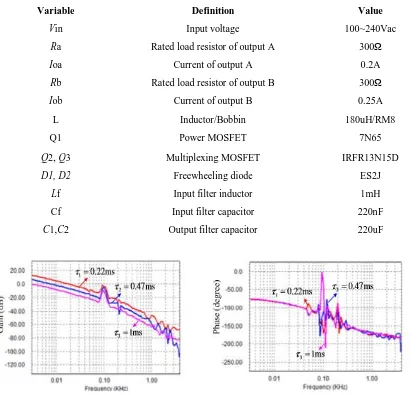
Fig.10. Loop gain simulation results of the sub-converter A with _=Re3Ce3.
According to Fig.2, low pass filter, Re1 and Ce1, Re2 and Ce2 are used to filter inductor freewheeling current sense signal on Rs1 and Rs2. Due to low frequency (2fL) ripple on Rs1 and Rs2, the time constant of these low pass filters should be lower than 1/2fL. The capacitance and resistance of these two filters are designed as 100nF and 120k_ in this prototype. Two compensators (Op1, Re3, Ce3, Op2, Re4 and Ce4) are applied to achieve sufficient phase margin and low bandwidth for power factor correction. Fig.10 shows the loop gain of Psim simulation results at 100Vac for sub-converter A with different compensation parameters (_1, _2 and _3) by using the circuit parameters shown in Table I. It can be observed that when time constant _ =Re3Ce3 is lower than 0.22ms, the phase margin is approximately 90 degree when the compensator is applied. The bandwidth will be lower than 20Hz, which can ensure acceptable power factor correction requirement, but
Fig.11 vin and iin waveforms of SIDO buck-boost PFC Converter at 110Vac input Fig.12 vin and iin waveforms of SIDO buck-boost PFC Converter at 220Vac input
This fluctuation is due to the combined effects of 100Hz switching at the bridge rectifier and the 100Hz ripple in the output voltage. In order to make the design simple, the same compensation parameters are applied in two compensation network and the compensation parameters are designed as Re3=Re4=10k_, Ce3=Ce4=47nF considering high PF and acceptable transient performance, i.e., _=0.47ms. The steady-state input current waveforms of CRM SIDO buck-boost PFC converter at rated output power are shown in Fig.11 and Fig.12. From Fig.11 and Fig.12, it can be known that input current iin is in phase with input voltage vin. The power factor correction function is achieved.
V. SIMULINK
AC Input
D is cre te , T s = 1e -006 s .
v + -v + -v + -A B + -< < 55 Ref Volt. 70 Ref Volt Pulse B Pulse A
P OWER FACT OR
PI(s) PI(s) V I Out1 PF-Measurement Output B Output A g D S g D S g D S i+ -i + -i +
ISSN (Print) : 2320 – 3765 ISSN (Online): 2278 – 8875
I
nternational
J
ournal of
A
dvanced
R
esearch in
E
lectrical,
E
lectronics and
I
nstrumentation
E
ngineering
(An ISO 3297: 2007 Certified Organization)
Vol. 5, Issue 6, June 2016
Experimental results
a) Proposed the hardware structure Wave Form A
b) Output voltage and current 1 c)
Wave Form B
C) output voltage and current 2
The above diagram discussed about the wave form difference between current and voltage. the voltage and current waveforms differs only by varying the value in reference voltage.
V. CONCLUSION
A single-inductor dual-output buck-boost PFC converter operating CRM is proposed in this paper. Detailed control strategy analysis and design considerations are presented. Each output can be regulated independently in this converter by multiplexing a single inductor. Compared with conventional two-stage multiple output ac/dc converters, the proposed single-stage multiple output ac/dc converter benefits from significant overall cost saving, small size and light weight of device. Experimental results are presented to verify the analysis results, and demonstrate the advantage of the proposed converter. Although only dual-output converter is discussed in detailed in this paper, the proposed converter can be easily extended to realize SIMO PFC converters with different topology to fulfil different system requirements.
REFERENCES
[1]. Jae-Kuk Kim, Seong-Wook Choi, Chong-Eun Kim, and Gun-WooMoon, “A new standby structure using multi-output full-bridge converter
integrating flyback converter, ” IEEE Trans.Ind. Electron., vol.58, no.10, pp. 4762-4767, Oct. 2011.
[2]. Qu Xiaohui, Siu-Chung Wong, and Chi-K.Tse, “Noncascading structure for electronic ballast design for multiple LED lamps with independent
brightness control,” IEEE Trans.Power Electron., vol.25, no.2, pp. 331- 340, Feb. 2010.
[3]. Jesús Cardesín , Javier Ribas, Emilio López corominas, and Marco Antonio Dalla Costa, “LED permanent emergency lighting system Based on
a single magnetic component,” IEEE Trans.Power Electron., vol.24, no.5, pp. 1409-1416, May. 2009.
[4]. Electromagnetic Compatibility (EMC), Part 3-2: Limits–limits for harmonic current emissions (equipment current _ 16 A per phase), International Standard IEC 61000-3-2, 2009.
[5]. Manuel Arias, Diego G. Lamar, Francisco F. Linera, Didier Balocco, Almadidi Aguissa Diallo, and Javier Sebastián, “Design of a softswitching
asymmetrical half-bridge converter as second stage of an LED driver for street lighting application,” IEEE Trans.Power Electron., vol.27, no.3,
pp. 1608-1621, Mar. 2012.
[6]. Huang-Jen Chiu, and Shih-Jen Cheng, “LED backlight driving system for large-scale LCD panels,” IEEE Trans.Ind. Electron., vol.54, no.5, pp.
2751-2760, Oct. 2007.
[7]. Quanming Luo, Shubo Zhi, Can Zou, Weiguo Lu, and Luowei Zhou, “A LED driver with dynamic high frequency sinusoidal bus voltage
regulation for multi-string applications,” IEEE Trans.Power Electron., vol.29, no.1, pp. 491-500, Jan. 2014.
[8]. Chi K. Tse, Martin H. L. Chow, and Martin K. H. Cheung, “A family of PFC voltage regulator configurations with reduced redundant power
processing,” IEEE Trans.Power Electron., vol.16, no.6, pp. 794-802, Nov. 2001.
[9]. Beibei Wang, Xinbo Yuan, Kai Yao, and Ming Xu, “A method of reducing the peak-to-average ratio of LED current for electrolytic