ISSN 2348 – 7968
Wolkite Smart City
Community Cloud Computing with Cyber Security
PVL Narayana Rao
Information System Department, Wolkite University, Wolkite, Ethiopia
Pothireddy Siva Abhilash
Electronic Data Processing Department, ICICI Bank Ltd., Hyderabad, India
P.Siva Pavan Kumar
Computer Science and Engineering Department, Vijayawada, India
ABSTRACT
—
Cloud Computing is development fast, with its data centers evolving at an extraordinary rate. However, this has come with worries over privacy, efficiency at the expense of flexibility, and environmental sustainability, because of the dependence on Cloud vendors such as Google, Amazon and Microsoft. Our answer is an alternative model for the Cloud conceptualization, providing a model for Clouds in the community, utilizing networked personal computers for liberation from the centralized vendor model. Community Cloud Computing (C3) offers an alternative architecture, created by combing the Cloud with models from Grid Computing, principles from Digital Ecosystems, and sustainability from Green Computing, while remaining true to the original vision of the Internet. It is more technically challenging than Cloud Computing, having to deal with distributed computing issues, including varied nodes, varying quality of service, and additional security constraints. However, these are not incredible challenges, and with the need to recall control over our digital lives and the potential environmental significances, it is a challenge we must follow.Key Words
—
Cloud Computing, Community
Cloud Computing, Grid Computing, Green
Computing, Sustainability
.
I.INTRODUCTION
The recent development of Cloud Computing provides a certain value proposal for organisations to outsource their Information and Communications Technology (ICT) infrastructure [1]. However, there are growing concerns over the control surrendered to large Cloud vendors [2], especially the lack of information privacy [3]. Also, the data centers required for Cloud Computing are growing
exponentially [4], creating an ever-increasing carbon footprint and therefore raising environmental concerns [5], [6]. The distributed resource delivery from Grid Compu-tting, distributed control from Digital Ecosystems, and sustainability from Green Computing, can remedy these worries.
II. SMART CITY
A smart city (also wired city) uses digital technologies to progress performance and comfort, to reduce costs and resource consumption, and to engage more efficiently and actively with its citizens. Key 'smart' sectors include transport, energy, health care, water and waste. A smart city should be able to respond faster to city and global challenges. Interest in smart cities is motivated by major
challenges, including climate change, economic
rearrangement, and the move to online retail and entertainment, ageing populations, and pressures on public finances. 'Smart' cities comprise Chicago, Boston, Barcelona and Stockholm in USA.
ISSN 2348 – 7968
A. Smart City Services 1. Smart City Networks
Smart City Networks is the nation’s leading benefactor of quality, advanced technology and telecommunication services to the settlement, trade show and event industry. 2. Smart City Telecom
Smart City Telecom services for all of residences, theme parks, hotels, restaurants, retail stores and extensive office and support facilities located throughout the Certificate Area. . And other smart city services are Broad band connectivity, Internet of Everything, Smart Personal Devices, Cloud Computing, and Big Data Analysis.
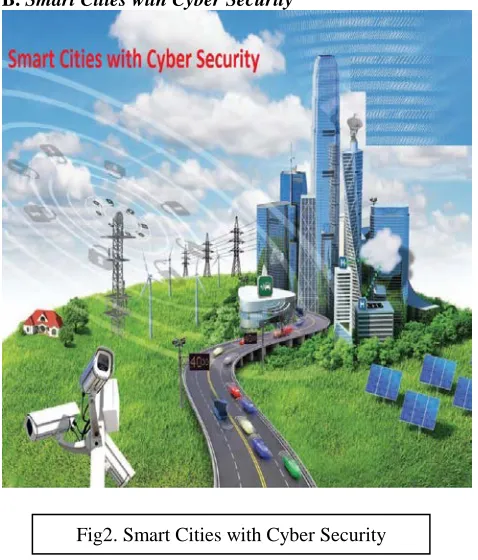
B. Smart Cities with Cyber Security
However, over the last few years, with worms and malware like Stuxnet coming into the front position, the possibility of reel life going real seems hazardously close. Stuxnet marked a watershed in virtual warfare by infecting critical infrastructure and sending even heavily-guarded machinery spinning wildly out of control. Now this potential seems to have grown more complex with the newer cyberspionage attacks employed by groups like Dragonfly that hit more than 1,000 firms, crippling critical infrastructure in many countries. While the main resolve of these ‘infections’ was to gain a base in the networks of battered companies,
the attacks also exposed that the Dragonfly group now had the competence to strike vital infrastructure if it chose to.
III. CLOUD COMPU TING
Cloud Computing is the use of Internet-based technologies for the provision of services [1], originating from the cloud as a symbol for the Internet, based on representations in computer network diagrams to abstract the complex infrastructure it conceals [8]. Figure 4 shows the typical configuration of Cloud Computing at run-time when consumers visit an application served by the central Cloud, which is housed in one or more data centers1. Green symbolises resource consumption, and yellow resource provision. The role of coordinator for resource provision is designated by red and is centrally controlled.
1
A data center is a facility, with the necessary security devices and environmental systems (e.g. air conditioning and fire suppression), for housing a server farm, a collection of computer servers that can accomplish server needs far beyond the capability of one machine.
Figure 4. Cloud Computing: Typical configuration when consumers visit an application served by the central Cloud, which is housed in one or more data centers. Green symbolizes resource consumption, and yellow resource provision. The role of coordinator for resource provision is designated by red, and is centrally controlled
Fig2. Smart Cities with Cyber Security
Fig3. Cloud Computing
ISSN 2348 – 7968
Resources, and in their efforts to scale their primary businesses have gained considerable expertise and hardware. For them, Cloud Computing is a way to resell these as a new product while expanding into a new market. Consumers include everyday users, Small and Medium
A. Layers of Abstraction
While there is a significant call around Cloud Computing, There is little clearness over which offerings qualify or their interrelation.
1) Infrastructure-as-a-Service (IaaS): At the most basic level of Cloud Computing offerings, there are providers such as Amazon ] and Mosso, who provide machine cases to developers..
2) Platform-as-a-Service (PaaS): One level of abstraction above, services like Google App Engine provides a programming environment that abstracts machine illustrations and other technical details from developers. The programs are executed over data centers, not concerning the developers with matters of allocation. 3) Software-as-a-Service (SaaS): At the consumer-fronting level are the most popular examples of Cloud Computing, with well-defined applications influence to a distributed storage system for structured data that focuses on scalability, at the expense of the other benefits of relational databases, e.g. Google’s BigTable and Amazon’s SimpleDB.
B. Concerns
The Cloud Computing model is not without concerns, as others have noted [3], and we reflect the following as primary:
1) Failure of Monocultures: The uptime of Cloud Computing based solutions is an advantage, when compared to businesses running their own infrastructure, but often ignored is the co-occurrence of downtime in vendor-driven monocultures.
2) Environmental Impact: The other major anxiety is the ever-increasing carbon footprint from the exponential growth [4] of the data centers required for Cloud Computing. With the industry expected to exceed the airline industry by 2020 [6], raising sustainability concerns [5].
IV. GRID COMPUTING: DISTRIBUTING
PROVISION
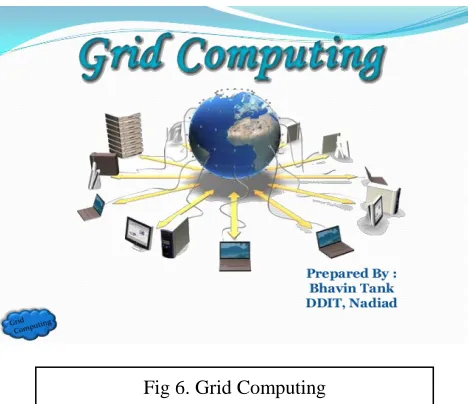
Grid Computing is a form of distributed computing in which a virtual super computer is composed from a cluster Virtualization is the creation of a virtual version of a resource,
Figure 5. Abstractions of Cloud Computing: While there is a significant call around Cloud computing, there is little clarity over which offerings qualify or their interrelation. The key to deciding this confusion is the realisation that the various offerings fall into different levels of abstraction, aimed at different market segments.
Figure 7. Grid Computing: Typical configuration in which resource provision is managed by a group of distributed nodes. Green symbolises resource consumption, and yellow resource provision. The role of coordinator for resource provision is designated by red, and is centrally controlled.
ISSN 2348 – 7968
It has been applied to computationally rigorous scientific, mathematical, and academic problems through volunteer computing, and used in commercial enterprise for such diverse applications as drug discovery, economic forecasting, seismic analysis, and back-office processing to support e-commerce and web services.
V. DIGITAL ECOSYSTEMS: DISTRIBUTING
CONTROL
Digital Ecosystems are distributed adaptive open sociotechnical systems, with properties of self-organisation, scalability and sustainability, inspired by natural ecosystems. Developing as a novel approach to the catalysis of sustainable regional development driven by Small Enterprises. Digital Ecosystems research is yet to consider accessible resource provision, and therefore risks being subsumed into vendor Clouds at the infrastructure level, while striving for decentralisation at the service level.
VI. GREEN COMPUTING: GROWING
SUSTAINABLY
Green Computing is the efficient use of computing resources, with the primary objective being to account for the triple bottom line, an expanded spectrum of values and standards for measuring organisational (and societal) success. Given computing systems existed before concern over their environmental impact, it has generally been implemented retroactively, but is now being considered at the development phase [11].
.
VII. COMMUNITY CLOUD
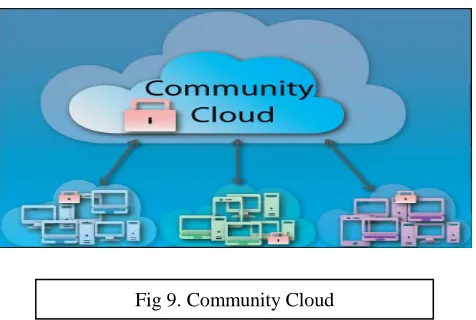
The Community Cloud seeks to combine distributed resource delivery from Grid Computing, distributed control from Digital Ecosystems and sustainability from Green Computing, with the use cases of Cloud Computing, while making greater use of self-management advances from Autonomic Computing. Replacing vendor Clouds by shaping the underutilised resources of user machines to form a Community Cloud, with nodes possibly fulfilling all roles, consumer, producer, and most importantly coordinator, as shown in Figure 4.
A. Conceptualisation
The conceptualisation of the Community Cloud draws upon Cloud Computing, Grid Computing [9], Digital
Ecosystems], Green Computing and Autonomic
Computing [12]. A model for Cloud Computing in the community, without need on Cloud vendors, such as Google, Amazon, or Microsoft.
1) Openness: Removing dependence on vendors makes the Community Cloud the open equivalent to vendor Clouds, and therefore identifies a new dimension in the open versus branded struggle that has emerged in code, standards and data, but has yet to be expressed in the realm of hosted services[10].
2) Community: The Community Cloud is as much a social structure as a technology model, because of the community ownership of the organization. Carrying with it a degree of economic scalability, without which there would be
Figure 10. Community Cloud: Created from shaping the underutilized resources of user machines, with nodes potentially fulfilling all roles, consumer, producer, and most importantly coordinator. Green symbolizes resource consumption, yellow resource provision, and red resource coordination.
Fig.8 Green Computing
Fig 9. Community Cloud
ISSN 2348 – 7968
reduced competition and potential roasting of innovation as risked in vendor Clouds[7].
B. Architecture
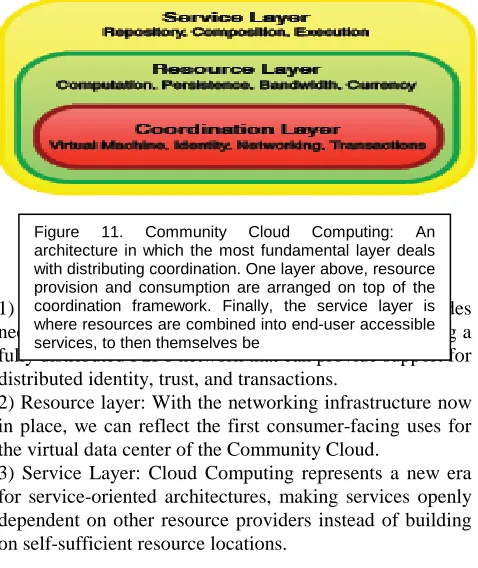
1) Coordination Layer: To achieve coordination, the nodes need to be deployed as remote virtual machines, forming a fully distributed P2P6 network that can provide support for distributed identity, trust, and transactions.
2) Resource layer: With the networking infrastructure now in place, we can reflect the first consumer-facing uses for the virtual data center of the Community Cloud.
3) Service Layer: Cloud Computing represents a new era for service-oriented architectures, making services openly dependent on other resource providers instead of building on self-sufficient resource locations.
VIII. IN THE COMMUNITY CLOUD
While we have covered the fundamental incentives and architecture of the Community Cloud, its practical application may still be unclear.
A. Wikipedia
Wikipedia suffers from an ever-increasing demand for resources and bandwidth, without a steady supporting revenue source. Their current funding model requires continuous monetary donations for the maintenance and expansion of their infrastructure. The alternative being contentious advertising revenues, which caused a long-standing conflict within their community. While it would provide a more accessible funding model, some fear it would compromise the content and/or the public trust in the content.
B. YouTube
YouTube requires a significant bandwidth for satisfied distribution, significant computational resources for video transcoding, and is yet to settle on a profitable business model. In the Community Cloud, websites like YouTube would also have a self-sustaining accessible resource
provision model, which would significantly reduce the income required for them to turn a profit.
VIII. CONCLUSION
We have offered the Community Cloud as an alternative to Cloud Computing, created from combination its usage scenarios with models from Grid Computing, principles from Digital Ecosystems, self-management from Autonomic Computing, and sustainability from Green Computing. So, C3 utilises the spare resources of networked personal computers to provide the facilities of data centers, such that the community provides the computing power for the Cloud they wish to use. A socio-technical conceptualization for supportable distributed computing. While the Open Cloud Manifesto is well intentioned, its promotion of open standards for vendor Cloud interoperability has proved difficult. We believe it will continue to prove difficult until a feasible alternative, such as C3, is developed. Furthermore, we hope that the Community Cloud will encourage innovation in vendor Clouds, forming an association analogous to the creative tension between open source and proprietary software. .
IX.ACKNOWLEDGEMENTS
We would like to acknowledge for the comments and cooperative discussions Paulo Siqueira of the Instituto de Pesquisasem Tecnologia e Inovacao, Eva Tallaksen and Alexander Deriziotis.
X.REFERENCES
[1] M. Haynie, “Enterprise cloud services: Deriving business value from Cloud Computing,” Micro Focus, Tech. Rep., 2009.
[2] R. L. Peter Lucas, Joseph Ballay, “The wrong cloud,” MAYA Design, Inc, Tech. Rep., 2009. [Online]. Available: http://www. maya.com/file download/126/The%20Wrong%20Cloud.pdf [3] M. Armbrust, A. Fox, R. Griffith, A. Joseph, R.
Katz, A. Konwinski, G. Lee, D. Patterson, A. Rabkin, I. Stoica, and M. Zaharia, “Above the Clouds: A Berkeley view of Cloud Computing,” University of California, Berkeley, 2009. [Online].
Available: http://d1smfj0g31qzek.cloudfront.net/
abovetheclouds.pdf
[4] J. Hayes, “Cred - or croak?” IET Knowledge Network, Tech. Rep., 2008. [Online]. Available: http://kn.theiet.org/magazine/issues/0820/cred-croak-0820.cfm?SaveToPDF
Figure 11. Community Cloud Computing: An architecture in which the most fundamental layer deals with distributing coordination. One layer above, resource provision and consumption are arranged on top of the coordination framework. Finally, the service layer is where resources are combined into end-user accessible services, to then themselves be
ISSN 2348 – 7968
[5] P. Mckenna, “Can we stop the internet destroying our planet?” New Scientist, vol. 197, no. 2637, pp. 20–21, 2008.
[6] J. Kaplan,W. Forrest, and N. Kindler,
“Revolutionizing data center energy efficiency,” McKinsey & Company, Tech. Rep., 2008.
[Online]. Available: http://www.mckinsey.com/clientservice/bto/
pointofview/pdf/Revolutionizing Data Center Efficiency.pdf
[7] B. Leiner, V. Cerf, D. Clark, R. Kahn, L.
Kleinrock, D. Lynch, J. Postel, L. Roberts, and S. Wolff, “A brief history of the internet,” Institute for Information Systems and Computer Media, Tech. Rep., 2001. [Online]. Available: http://www.iicm.tugraz. at/thesis/cguetl diss/literatur/Kapitel02/References/Leiner et al. 2000/brief.html?timestamp=1197467969844 [8] J. Scanlon and B. Wieners, “The internet cloud,”
The Industry Standard, Tech. Rep., 1999. [Online]. Available: http://www.thestandard.com/article/0,1902,5466, 00.html
[9] I. Foster, Y. Zhao, I. Raicu, and S. Lu, “Cloud Computing and Grid Computing 360-degree compared,” in Grid Computing Environments Workshop, 2008, pp. 1–10.
[10]T. Foremski, “Sun services CTO says utility computing acceptance is slow going,” ZDNet, CBS Interactive, Tech. Rep., 2006. [Online]. Available:
http://blogs.zdnet.com/Foremski/?p=33
[11] A. Orlowski, “The Cell chip - how will MS and Intel face the music?” The Register, Tech. Rep., 2005. [Online]. Available: http://www.theregister.co.uk/2005/02/03/cell analysis part two/
[12] J. Kephart, D. Chess, I. Center, and N.
Hawthorne, “The vision of autonomic
computing,” Computer, vol. 36, no. 1, pp. 41–50, 2003.
X1. AUTHORS PROFILE
POTHIREDDY .V.L. NARAYANA RAO
Was born in Vijayawada, Krishna District, Andhra Pradesh, India. He completed M.Tech. in Information Technology from Sam Higginbottom Institute of Agriculture, Technology and Sciences Deemed University, Allahabad, Uttar Pradesh, India and PhD in Computer Science Engineering from Lingaya’s University, NCR, New Delhi [Faridabad, Haryana State], India. He has 8 years of Teaching and Research experience in reputed Indian Post Graduation Engineering Colleges, 14 years of Teaching and Research experience in different Universities of Foreign Country ETHIOPIA, East Africa and 4 years Industrial Experience in India as a System Analyst, Systems Developer and Networks Administrator. He is presently working as Professor (CSE), Wolkite University, SNNPR, Wolkite, Ethiopia, and East Africa. He is a member of various professional bodies like WASET, USA, IAEng, Hong Kong and EDAS, New York, USA, CSE, Ethiopia. He has various publications in the reputed National and International Journals, Conference Proceedings. His email id is [email protected] and alternative email ids are: [email protected],
ISSN 2348 – 7968
POTHIREDDY SIVA ABHILASH
Was born in Vijayawada, Krishna District, Andhra Pradesh, India. He completed B.Tech. in Electronics and Communication Engineering from Nimra College of Engineering and Technology [Vijayawada] affiliated to Jawaharlal Nehru Technological University, Kakinada, Andhra Pradesh, India and M.S. degree in Tele Communication Engineering from Staffordshire University, Staffordshire, United Kingdom. He is working as Web Server Logic Administrator in ICICI Bank Ltd., Hyderabad, Telangana State, India and also he is having Research Experience too. He has various publications in the International Journals. His email id
POTHIREDDY SIVA PAVAN KUMAR
Was born in Vijayawada, Krisna District, Andhra Pradesh, India. He is a Final Year Student of B.Tech. in Computer Science and Engineering from Sri Paladugu Parvathidevi College of Engineering and Technology [Vijayawada] affiliated to Jawaharlal Nehru Technological University, Kakinada, Andhra Pradesh, India. He has Research Experience also. His email id