Papers presented in NCIICT-2017 Conference can be accessed from
Raspberry PI based Keen Museum Environment
K Sornalatha
1, V R Kavitha
21
ME Student,
2HOD
1 , 2
Department of Computer Science and Engineering, Prathyusha Engineering College,
Aranvoyal kuppam, Thiruvallur – 602025
A bstract: In these days everything is getting to be distinctly s marter through the improvement of heterogeneous advances. To coordinate these smart things, our environment needs to end up distinctly s marter through an innovation that is we called IoT. People are more intrigued to take after our old culture and the future eras additionally need to take after our s ocial legacy. Exhibition hall/museum is one of the spots through which we can think about our antiquated societies, how it was and how to tail it. Subsequently to get the consideration of guest in historical center it is proposed IoT based Smart Museum Environment which will give the data about work of art consequently with no client communication. IoT construct s hrewd historical center depends with respect to a wearable device (Raspberry PI) that will catch the client's moves, does the background s ubtraction calculation to perform Image processing and it gets the location information from Bluetooth Low Energy (BLE) which is introduced in the gallery. Es pecially, this wearable gadget will build the execution of the entire framework by sending just coordinated casing to cloud handling center. Besides, an overseer of the historical center cooperates with cloud to store all the work of art and related multimedia content. At long last, based upon their age everybody can get information about art profile and history through advanced s mart devices like mobile by utilizing portable application.
Keywords— IoT , Raspberry PI, Bluetooth Low Energy, Smart Museum Environment.
Introduction
The adaptation of Future Internet (FI) innovation, and specifically of its most testing parts like the Internet of Things (IoT) and IoS, can constitute the essential building squares to advance towards unified platform for an assortment of utilizations
utilizing confinement data. Besides, we have conveyed and tried, in an indoor domain, the establishment of a few sensors that, utilizing Wi-Fi innovation, permit the clients versatile gadgets to identify the nearest fine art. The wearable device fulfills two basic assignments: it unendingly tracks the client by utilizing a Bluetooth low Energy (BLE) framework and perceives the fine art before the client by utilizing restriction data. The outcome of this twofold are sent to the cloud's handling center and that is in control to give each one of the segments of the system.
Related Work
To better comprehend inspirations driving our work, it is imperative to dissect the sort of connection that exists between the exhibition and the guests of a exhibition hall: the purpose of the guest is to see and take in more and not to expressly utilize the technology. Thus and to better assess and advance the museum heritage, it ought to be desirable over give show objects the capacity of recounting their story, as opposed to hold up that clients require in first individual (through interactive media guides) more data about an object. In expansion, it ought to be valuable for a client to get an arrangement of proposals, unequivocally in view of his inclinations, for exploring the physical space as far as perusing exercises. The social environment offers, by a Wi-Fi association, an electronic access to a multimedia gathering containing: computerized multiplications and other minor craftsmen, instructive recordings, sound aides, literary and hypermedia archives with depiction of creators and figures. So as to make the client's experience all the more fascinating and fortifying, the entrance to data ought to be naturally conveyed and redone in view of the specific profile of a guest. In [1] authors proposed the structure normally bargains with the home condition basing on customers portrayed rules and on individual's advancements. It licenses to adequately depicting the home contraptions and also the organizations and UIs. Regardless, inconsistence among the guidelines may happen in this outline. A lightweight IoT device organization structure [2] gives consistent correspondence to sharp home organizations. The smart electronic guide [3] for chronicled focus using AVR microcontroller and RFID advancement which has the capacity giving vocal information to the visitors of display as for each dissent in the presentation corridor. This guide gives simply solid information to the customers. In [4] author proposed a mishandling a couple territory based organizations what's more, headways
remembering the ultimate objective to get it a sharp multi-media coordinate system. It makes expressive arts prepared to tweet and talk using GPS and Wi-Fi in the midst of customers visit. Region estimation [5] is used to address and manage the talent inside social spaces. To deal with the issue of indoor spread and to get the high accuracy, interesting finger impression technique and illustration planning estimation [6] were used. RFID per client and tag, and MAC Address strategy [7] are used to interface a presentation corridor's classical specific sight and sound records on the framework to sharp contraptions. In [8] author proposes a got hail quality sign (RSSI) based Bluetooth Localizatio n methodology. We can similarly use this BLE specifically splendid condition to find challenge's positions. Finally, A Location-Aware Access Control tradition [9] is used for getting to locales of different get to centres.
Proposed Work
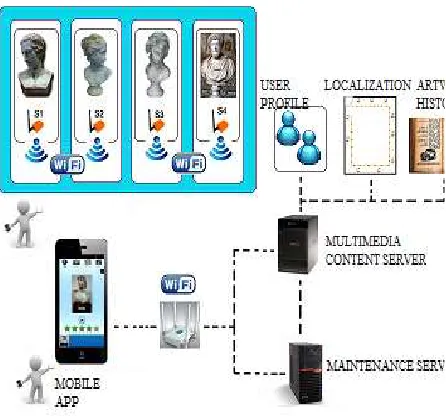
The smart museum environment is supported mainly by Wi-Fi connection, Localization from BLE and smart mobile application whole structure is presented in Fig 1 and containing following specific parts:
Wi-Fi infrastructure, covering the entire show/historical center region. Every work of art is secured to its own sensor and is empowered to produce a system flag. Every fine art sensor creates a Wi-Fi arrange flag that will be distinguished by clients cell phones, outfitted with the SmART application and with a two stage indoor limitation calculation, intended to keep running in the SmART application Environment.
Papers presented in NCIICT-2017 Conference can be accessed from
Fig 1:- Detailed d iagram o f Co mmunication b etween User and Artwork.
The Multimedia Content Server (MCS) acknowledges a demand for substance from the MS, deals with a multimedia vault, assembles a sight and sound story abusing client inclinations and a fitting proposal technique, what's more, finally conveys all the data to the related client versatile App.
SmART guide application, at present created to keep running over the Android platform, with the accompanying components: (i) running the localization algorithm to set up the nearest work of art to every client; (ii) empowering the triumphant fine art related sight and sound substance recovery and introduction, misusing correspondence with the MS and the MCS modules. A survey is preliminarily submitted to clients, with a specific end goal to catch his/her profile and the gadget highlights.
The overall architecture of the proposed work is given below which consists of two main fold 1) Localization and 2) Image Recognition.
Fig 2:- Th e o v erall A rch itectu re Diag ram
A) Localization: Location of visitors and gadgets is perceived as one of the primary building pieces of setting context based applications. In a exhibition hall, localization of users gadgets is utilized to choose when and which sort of fulfilmen t is more reasonable for the user. Numerous and very much evaluated are the ways to deal with indoor situating as in WSN space. In our system, we embrace a run of the mill range based localizatio n exploding the Received Signal Strength Indicator (RSSI) and making utilization of Wi-Fi correspondence advancements, exploits a topology worked with an arrangement of fixed sensors put on every fine arts, communicating with portable sensors that are spoken to by guests gadgets. Points of interest of this progression are portrayed as takes after and it is made out of two sections: (1) Wi-Fi Systems Discovery and (2) Winning Wi-Fi Network Declaration.
1) W i-Fi Networks Dis covery: It is performed by a product module composed of an arrangement of daemon procedures running on clients' gadget that deals with a periodical examinin g process intended to look for all the Wi-Fi systems detected from client’s area. Museum Wi-Fi environment was examined picking an appropriate testing time, got as the after effect of a tuning movement estimations. Yield created by this progression of the confinement calculation is a rundown of dynamic detected Wi-Fi organizes in vicinity of clients’ gadget.
be the victor, speaks to the centre of the restriction algorithm. It takes as contribution, from the Network Discovery module, the rundown of detected Wi-Fi Networks identifiers, relating to the rundown of works of art recognized in proximity of a guest. At that point, it begins the figuring procedure of RSSI qualities measured in correspondence of each system in the rundown, to evaluate the winning one. Since our intend to get the guests viewpoint and conduct and not his punctual position, the embraced criteria sets up that the triumphant system is that one related to the base RSSI esteem. Such least esteem is evaluated processing a weighted normal by method for three succeeding measures of RSSI. Weights were processed by running an alignment calculation expected to tune and refine the system framework configuration.
B) Image Recognition: Before observing a work of art, steady pre processing steps must be made. Background Subtraction algorithm used for image recognition and image processing. Frame contrast is the least difficult type of foundation subtraction. The present casing is basically subtracted from the past casing, and if the distinction in pixel values for a given pixel is more noteworthy than a limit Th at that point the pixel is considered
some portion of the foreground
|𝑓𝑟𝑎𝑚𝑒
𝑖− 𝑓𝑟𝑎𝑚𝑒
𝑖−1| > 𝑇
ℎ(1)
The estimated background is just the previous frame and it is very sensitive to the threshold
𝑇
ℎ.Results and Discussion
The yield acquired by the picture preparing calculation, i.e., the interesting identifier of the observed work of art, speaks to the key data for getting to the craved social substance. The wearable gadget sends this data to the handling focus through the nearby Wi-Fi arrange. There, a particular administration is in charge of getting all solicitations originating from clients and breaking down them to begin the best possible method. More in detail, the understanding of the work of art identifier can prompt to two conceivable comes about:
1) Sound depiction of the work of art on the client's wearable gadget.
2) Mixed media social substance on intelligent dividers of the historical center.
Wi-Fi sensors have been sent by utilizing the Beagle Bone Black board 3, however right now we have not ended yet the arrangement of the sensors
within Museum. The MS segment has been actualized by a few JAVA libraries misusing multi-threading techniques. Moreover, correspondence logs have been put away into an appropriate vault oversaw by the Nosql DBMS Cassandra. The MCS segment misuses impromptu JAVA libraries to manufacture the interactive media stories of the sight and sound gathering oversaw by Postgre SQL DBMS. At long last, the engineering uncovered in the Cloud another helpful benefit that gives factual data about the heftiness of the exhibition hall. To be sure, by misusing the restriction data, this administration dependably knows what numbers of guests are moving in the exhibition hall and where they are. Accordingly, this administration can be utilized by outside clients to know ahead of time the length of lines in particular regions of the exhibitio n hall or which the most respected works of art are. Additionally, the data gave by this administration could likewise be misused by the exhibition hall managers to plan fractional upkeep works or to revamp the interior spaces. One of the principle assignments of the administrations running on the exhibition hall is to adjust the status of the earth concurring to the data originating from the localization information. More in detail, abusing IoT-mindful advancements, the earth could be changed progressively with a specific end goal to give the client with a genuine intuitive affair. For instance, envision that the exhibition hall has an uncommon room where a verifiable war is spoken to by a mechanical activity oversaw by a few IoT actuators. To amplify the effect of this movement, the framework could choose to enact it just when the number of guests in the room is higher than a predefined limit. Similarly, lighting, temperature, and other physical attributes of a room could be controlled to naturally perform embellishments average of a 4-D silver screen. Clearly, the IoT innovations ready to give these elements could be amazingly heterogeneous since they are frequently agreeable to various principles and conventions.
Conclusion
Papers presented in NCIICT-2017 Conference can be accessed from
by a framework of BLE transmitters. Experimen tal comes about demonstrated that our approach is very encouraging, both in wording of fine arts confinement and as far as substance personalization conveying and along these lines energizes additionally inquire about. The s tructure gets the Cloud to store intelligent media substance made by the client. At long last, Users can get the data in an appealing configuration in light of their age.
References
[1] Mainetti, V. Mighali, and L. Patrono, “A location-aware architecture for heterogeneous building automation
systems,” in IFIP/IEEE International Symposium on
Integrated Network Management (IM), May 11–15, 2015. [2] T hinagaran perumal,Soumya Kanti Dat ta and Christian Bonnet, “IoT Device Management Framework for Smart
Home Scenarios” in IEEE 4th Global Conference on
Oct.2015.
[3] Majed Rostamian , Maryam Parsa and Voicu Groza
“Design and fabrication of a smart electronic guide for
museums” in IEEE Transaction on Applied Computational
Intelligence and Informatics (SACI), 30 July 2012. [4] Angelo Chianese , Fiammetta Marulli , Vincenzo Moscato
and Francesco Piccialli “SmARTweet: A Location-Based
Smart Application for Exhibits and Museums” in IEEE
T ransaction on Signal-Image Technology & Internet-Based Systems (SIT IS), 30 January 2014.
[5] Angelo Chianese and Francesco Piccialli,”Designing a
Smart Museum: When Cultural Heritage Joins IoT” in IEEE
T ransaction on mobile Apps, 15 December 2014. [6] Sisongkham Phimmasean and Somphone Kanthavong
“Smart tracking system applied for Lao's museum using
RFID technology based on fingerprint technique” in IEEE
T ransaction, September 2016.
[7] Ashish Mody , Muneeb Akram, Kamruzzaman Rony , Muhammad Sajjad Aman and Ridha Kamoua
“Enhancing user experience at museums using smart
phones with RFID” in IEEE T ransaction, May 2009.
[8] Zhu Jianyong, Luo Haiyong, Chen Zili and Li Zhaohui
“RSSI based Bluetooth low energy indoor positioning” in
IEEE International Conference on Indoor positioning and Navigation, 28 September 2015.
[9] YounSun Cho, Lichun Bao and Michael T . Goodrich
“LAAC: A Location-Aware Access Control Protocol” in
IEEE T ransaction on Mobile and Ubiquitous Systems. [10] Deivid A. T esch , Everton L. Berz and Fabiano P. Hessel,
“RFID indoor localization based on Doppler effect” in
IEEE T ransaction on Quality Electronic Design, 16 April 2015.
[11] A. Chianese, F. Marulli, V. Moscato, F. Piccialli: A Novel Challenge into Multimedia Cultural Heritage: An Integrated
Approach to Support Cultural Information Enrichment In:
Proc. of the Intern. Conference on Signal-Image T echnology & Internet-Based Systems (SIT IS), pp.217-224, 2013.
[12] A. Chianese, F. Marulli, V. Moscato, F. Piccialli: A smart multimedia guide forindoor contextual navigation in
Cultural Heritage applications, In: Proceedings of 4th IPIN
international conference, 2013.
[13] M. Albanese, A. dAcierno, V. Moscato, F. Persia, A. Picariello: A Multimedia Semantic Recommender System
for Cultural Heritage Applications, Proc. of IEEE