R E S E A R C H
Open Access
On the use of the channel second-order
statistics in MMSE receivers for time- and
frequency-selective MIMO transmission
systems
Manuel A. Vázquez
1,3*and Joaquín Míguez
2,3Abstract
Equalization of unknown frequency- and time-selective multiple input multiple output (MIMO) channels is often carried out by means of decision feedback receivers. These consist of a channel estimator and a linear filter (for the estimation of the transmitted symbols), interconnected by a feedback loop through a symbol-wise threshold detector. The linear filter is often a minimum mean square error (MMSE) filter, and its mathematical expression involves second-order statistics (SOS) of the channel, which are usually ignored by simply assuming that the channel is a known (deterministic) parameter given by an estimate thereof. This appears to be suboptimal and in this work we investigate the kind of performance gains that can be expected when the MMSE equalizer is obtained using SOS of the channel process. As a result, we demonstrate that improvements of several dBs in the signal-to-noise ratio needed to achieve a prescribed symbol error rate are possible.
Keywords: MIMO, MMSE, Joint channel and data estimation, Second-order statistics
1 Introduction
The main appeal in using a multiple input multiple output (MIMO) wireless communication system stems from the fact that the channel capacity increases linearly with the minimum between the number of transmitting antennas and that of receiving antennas [1]. Unfortunately, the com-plexity of optimal MIMO detectors (which minimize the probability of either symbol or sequence detection errors) grows exponentially with the number of input streams and the order of the channel, if the latter is frequency-selective [2]. Therefore, suboptimal equalization algorithms that avoid this computational burden are needed in order to take advantage, in a practical setup, of the increase in capacity that a MIMO channel can offer. Additionally, in most real-world scenarios, the channel is unknown and must be estimated prior to data detection. A decision
*Correspondence: [email protected]
1Departamento de Teoría de la Señal y Comunicaciones, Universidad Carlos III de Madrid, Avenida de la Universidad 30, Leganés, Spain
3Gregorio Marañón Health Research Institute, Calle del Dr. Esquerdo, 46, 28007 Madrid, Spain
Full list of author information is available at the end of the article
feedback equalizer (DFE) type of receiver [3–7] is then an appealing choice due to its ease of implementation and the good trade-off between computational complexity and performance that it achieves.
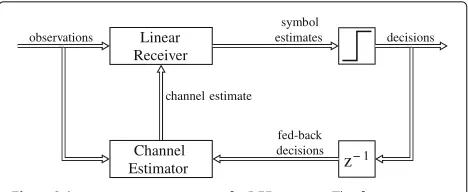
Figure 1 shows a simple DFE scheme. The main blocks are an adaptive channel estimation algorithm and a linear filter. The latter takes a channel estimate and the observa-tions at the receiver front-end to produce linear estimates of the transmitted symbols. These estimates are either real or complex numbers, depending on the modulation format. A threshold detector is used to convert them into hard symbol decisions, i.e., discrete estimates chosen from the symbol alphabet based on a minimum distance rule. We assume that the detector operates symbol-wise in order to keep the computational effort limited. The decisions at the output of the detector are fed back to the channel estimation block, so that they can be used to improve the subsequent channel estimates. Usually, the detected symbols are also employed to cancel inter-symbol interference (see, e.g., [8] and Section 3 in this article), but this is omitted in the figure for simplicity. We
observations Linear Receiver
symbol
estimates decisions
channel estimate
Channel Estimator
fed-back decisions
z− 1
Fig. 1Schematic representation of a DFE receiver. The figure illustrates the working a simple DFE receiver. The blockz−1 represents a delay of one symbol period
remark that the receiver is nonlinear, due to the threshold-ing operation, yet its computational complexity is similar to that of a linear receiver combined with an adaptive channel estimation algorithm [9], ([7] Chapter 16).
Any linear filter is amenable to be used in a DFE struc-ture. However, the use of the minimum mean square error (MMSE) filter has become widespread because it offers an attractive trade-off between noise amplification and inter-ference cancelation [10]. Many joint data detection and channel estimation algorithms (see, e.g., [11–14]) rely on the linear MMSE filter to carry out the equalization of an unknown MIMO channel. In every case, and to the best of our knowledge, the point estimatesof the chan-nel impulse response (CIR) provided by the corresponding estimator are used by the MMSE filter as if they were the trueCIR. However, the estimates are actually statistics of the true channel and, as such, have a mean and a covari-ance matrix, the latter measuring the uncertainty we have about their accuracy. When the Kalman filter (KF) [15, 16] is used to estimate the channel, both statistics, the mean and the covariance matrix of the channel become avail-able, but even then the usual approach (e.g., in [11, 17]) consists in taking the mean of the estimate as if it were the true channel and ignore the information provided by the covariance matrix. In this paper, we argue that significant performance gains can be expected by taking advantage of the second-order statistics (SOS) of the channel, with a low impact on the computational complexity of the receiver. To be specific, we show that reductions of several dBs in the signal-to-noise ratio (SNR) needed to attain a prescribed symbol error rate (SER) can be achieved using the proposed scheme. The main contributions of this work are the design and implementation of the new linear MMSE equalizer that exploits the second-order statistics of the channel, as well as extensive computer simulations showing the gains that can be expected from the proposed method as compared to the conventional one.
The remaining of this paper is organized as follows. In Section 2, the discrete-time baseband equivalent signal model of a MIMO transmission system with frequency-and time-selective channel is described. The stfrequency-andard
linear MMSE equalizer is briefly reviewed in Section 3. Our extension thereof using the channel SOS is intro-duced in Section 4. Section 5 outlines the DFE schemes resulting from the investigated equalizers. In Section 6, we show and discuss the results of extensive computer sim-ulations to compare the performance of the conventional DFE MMSE receiver (that ignores the channel SOS) and the proposed DFE SOS-MMSE scheme. Finally, Section 7 is devoted to the conclusions.
1.1 Summary of notation
Given a time-indexed sequence of (column) vectors,
xa,xa+1,· · ·,xb, we denote byxab the column vector con-structed by stacking, in order, all the vectors betweenxa andxb(including both), i.e.,
xa b =
xa xa+1 · · · xb
.
An identity matrix of orderkis denoted byIk, whereas
0N,Mis anN×Mall-zeros matrix. IfN =M, we simply write0N. For a vectorx, x(i)represents itsith element, and given a matrixA,a(i)refers toith column.
2 Signal model
2.1 Time- and frequency-selective MIMO channel
We consider a MIMO communication system with Nt
transmitting antennas and Nr receiving antennas sepa-rated by a time- and frequency-selective (MIMO) channel. The discrete-time baseband-equivalent model describing the transmission can be written as (see, e.g., [18])
yt= m−1
i=0
Ht(i)st−i+gt, (1)
whereytis aNr×1 vector containing the observations col-lected at timet,mis the number of taps (usually referred to as the order) of the frequency-selective MIMO channel,
Ht(i)is the (time-varying)Nr×Ntchannel matrix associ-ated with theith tap,stis a vector of sizeNt×1 comprising the symbols transmitted at timet, andgtis anNr×1 vector of independent additive white Gaussian noise (AWGN) components with zero mean and varianceσg2.
Grouping the matrices associated with the different taps of the channel,Ht(i),i =0,. . .,m−1, in a singleoverall channel matrix,
Ht=[Ht(m−1) Ht(m−2) · · · Ht(0)] , (2)
of sizeNr ×Ntm, allows Eq. (1) to be written in a more compact form as
yt=Htst−m+1
t +gt, (3)
wherest−m+1
t is aNtm×1 vector that stacks all the symbol
vectors involved in thetth observation,
st−m+1
t =
st−m+1 st−m+2 · · · st
While non-standard, the notation in (4) shows explicitly that vectorst−m+1
t is constructed by stacking simpler
vec-tors in order and indicates the time indexes of the first (t−m+1 in this case) and last (there) elements to be stacked. These features should ease the understanding of some formulas in the sequel.
The evolution of the channel is modeled by means of an autoregressive (AR) process driven by white Gaussian noise1[11]. For the sake of generality, we consider an AR process of orderR, whose analytical description is given by
Ht= tically distributed (i.i.d.) Gaussian random variables (r.v.) with zero mean and varianceσv2.
Equations (3) and (5) can be seen, respectively, as the observation and state equations of a random dynamic system in state-space form. Since both equations are lin-ear and the corresponding noise processes are Gaussian, the Kalman filter (KF) can be applied to exactly compute the posterior probability distribution of the time-varying MIMO channel when the symbols are available.
In order to do so while using the standard KF equations, we first need to gather the whole state of the system (here, the channel at the last Rtime instants) in a single vec-tor and rewrite the state and observation equations in terms of it. MatrixHt can be represented as a vector in a straightforward manner by, e.g., stacking all its columns one upon another. In particular, if we letht(j)denote the jth column of matrixHt, then theNrNtm×1 vector
contains the same coefficients as matrix Ht. Using this vectorial notation and taking into account that, according to Eq. (5), the channel at a certain time instant depends on the channel at theRprevious time instants, the state of the system at timetcan be represented by the vector
ht−R+1
The state equation of the system can then be written in terms of thisaugmentedchannel vector as
ht−R+1
t =Qhtt−−R1 +vt, (8) wherevtis aNrNtmR×1 vector with i.i.d. Gaussian r.v.’s of zero mean and varianceσv2in the lastNrNtmpositions and zeros in the rest, and the state transition matrix,Q, is defined as
The observation (Eq. (3)) can also be easily rewritten in terms of the augmented channel vector,ht−R+1
t , as
We use the dynamic system in state-space form speci-fied by Eqs. (10) and (8) (which is equivalent to that given by Eqs. (3) and (5)) to track the unknown time-varying MIMO channel by means of a KF.
2.2 Stacked model
When a channel is time dispersive, a reliable detection of the transmitted symbols usually requires smoothing. It entails taking into account the observationsyt:t+d(the
parameter d ≥ 1 being the smoothing lag) in order to
detect the vectorstcontaining the symbols transmitted at timet. In such case, it is useful to consider an equation that relates a tall vector of stacked observations with the transmitted symbols, namely, which, at timet, have already been detected. It is conve-nient to identify their contribution to the stacked obser-vations vector,yt
t+d. Let us decompose the overall channel
where the submatricesH‡t,d andHt,d encompass, respec-tively, the first Nt(m− 1) and last Nt(d + 1) columns ofHt,d. Then, the vector of stacked observations can be rewritten as
yt t+d =
H‡t,d Ht,d
st−m+1
t−1
st t+d
+gt
t+d
=H‡t,dst−m+1
t−1 +Ht,ds
t t+d+g
t t+d,
(15)
where the termH‡t,dst−m+1
t−1 contains the contribution of the symbols transmitted up to timet−1, and can be treated as causal inter-symbol interference.
2.3 Kalman filtering
The KF [15] provides the optimal solution to the problem of estimating the state of a dynamic system in state-space form when its state and observation equations are linear and their corresponding noises are Gaussian.
In the problem at hand, the state of the system at time t is given by the augmented channel vector, ht−R+1
t , and
Eqs. (8) and (10) can be seen as, respectively, the state and observation equations of a dynamic system in state-space form. Since the above constraints of linearity and Gaussianity are met, the KF can be used to compute the probability density function of the state conditional on the available observations, p(ht−R+1
t |y0,· · ·,yt).
How-ever, the observation equation involves knowing, at time t, matrix St, which includes all the symbols transmitted between time instantst−m+1 andt. In practice, only
estimates of the symbols transmitted up to time t − 1
are available at time t, and hence we aim at the (pre-dictive) distribution of the state conditional on all the past observations and previously detected symbols, i.e., p(ht−R+1
t |y0,· · ·,yt−1,s˜0,· · ·,s˜t−1) with ˜st denoting the
vector containing the hard estimates of the symbols inst. Every expectation in the remaining of the paper is also (implicitly) conditional on the same information, and we denote it asEt−1[·]. For example, the posterior mean of the CIR at timet+k(k≥ 0) conditional ony0,· · ·,yt−1 ands˜0,· · ·,s˜t−1is written asEt−1[ht+k] and the poste-rior cross-covariance betweenht+kandht+k,k,k≥0, is denotedEt−1[ht+khHt+k].
Notice that here the KF only yields an approximate solution insofar as it depends on the goodness of the previously detected symbols fed to it.
3 Linear MMSE smoothing
In order to detect the symbols transmitted at timetover a frequency-selective channel, it is usually a good approach to first remove the contribution of the already detected symbols from the observations vector [8]. At the sight of
Eq. (15), we can obtain causal-interference-free observa-tions as
zt
t+d:=ytt+d−H
‡
t,dstt−−m1+1 (16)
=Ht,dst
t+d+gtt+d. (17)
Computingzt
t+dfromy t
t+dentails knowing vectorstt−−m1+1, which encompasses symbol vectors st−m+1,· · ·,st−1. These are unknown but previous estimates thereof are available at timetand can be used as a surrogate. Hence, in practice, the stacked symbols vectorst−m+1
t−1 in Eq. (16) is replaced with vector,˜st−m+1
t−1 that contains hard estimates of the same symbols. This is a common approximation for the design of DFEs, and it usually makes sense under the assumption that the receiver is operating with a suf-ficiently low symbol error probability. Throughout the paper, we rely on this approximation, which amounts to taking the previously detected symbols as if they were the truly transmitted symbols, i.e.,
˜
st−m+1
t−1 =stt−−m1+1. (18) Assuming the causal interference is properly canceled, the linear MMSE estimation of the symbols transmitted at timetconsidering the observations up to timet+dcan be easily derived from Eq. (17) (see, e.g., [19]). In partic-ular, let theNr(d+1)×Nt(d+1) matrixFt represent the response of a linear system. Then, estimates of the transmitted symbols are computed as2
ˆ
st t+d=F
H t zt
t+d, (19)
and, in order to minimize the mean square error of these estimates, the response matrix can be computed by solv-ing the optimization problem
Ft=arg min Ft Et−1
FHt zt
t+d−s t t+d
2
. (20)
Since the ultimate aim is to estimatestbut we are using observations up to timet+d, we refer to the linear
sys-tem whose response is given byFt in (20) as an MMSE
smoother.
Equation (20) poses a quadratic optimization problem and it is straightforward to obtain the closed-form solu-tion (see, e.g., [2])
FHt =Et−1
st
t+dz
H
t
t+d Et−1
zt
t+dz
H
t t+d
−1
. (21)
observations, so that these are given by Eq. (17), then the expectations on the right-hand side of Eq. (21) can be shown to be
s denotes the variance of the symbols and it has been taken into account that the noise at timetis white and independent of the channel process and the symbols
transmitted up to t − 1, and that the channel and the
symbols are a priori independent.
The expectation on the right-hand side of Eq. (23) is usually approximated, to the best of our knowledge, by dealing with the channel matrixHt,das if it were a known given (deterministic) parameter, and hence
Et−1
Substituting (24) into Eq. (23) yields
Et−1
and combining Eqs. (22) and (25) in Eq. (21) yields the final expression for the response of the conventional linear MMSE smoother,
So far, we have assumed the channel is a known (deter-ministic) parameter. However, this is not usually the case in practice, and the common approach to tackle this prob-lem consists in replacing, whenever necessary, the (true) channel matrix with its expectation. Notice that here this entails a twofold approximation. On one hand, even when
assuming that the symbols up to timet −1 have been
detected exactly, at best one can only obtainapproximate causal-interference-free observations as On the other hand, taking the true channel matrix in Eq. (26) to be equal to its expectation results in the following approximation for the linear MMSE filter
FHt ≈σs2Et−1
At the sight of Eqs. (13) and (14), in order to obtain Et−1
on the right-hand side of
Eqs. (27) and (28), respectively, we need the expecta-tions of the matrices Ht,Ht+1,. . .,Ht+d. At time t, the expectation of the channel matrixHtis given by the pre-dictive distribution of the KF, which takes into account the observations and symbols vectors up to timet−1. How-ever, the expectations of the matricesHt+1,. . .,Ht+dhave to be computed as well. In order to do so, we simply use Eq. (5) (the state equation of the system) to expand the expected channel matrix at timet, i.e.,
Et−1
4 MMSE smoothing using the channel SOS
The proposed MMSE detector treats the channel as an unknown (multidimensional) random variable (as opposed to a deterministic known parameter), and takes advantage of its second-order statistics rather than just its expectation. Additionally, it avoids performingexplicit interference cancelation, since this cannot be performed exactly. In order to do so, it aims to detect the transmitted symbols by solving the optimization problem
Ft=arg min
which is exactly the same as that posed by Eq. (20) replac-ingzt
Through straightforward algebraic manipulation, one can show
because the expectations are conditional on the previously detected symbols and we are assuming these match the truly transmitted ones (see Eq. (18) and the surrounding discussion).
4.1 The observation autocorrelation matrix
From Eq. (33), computing Et−1
amounts to the calculation ofEt−1
Et−1
. Regarding the first
expecta-tion, if we letht,d(j)denote thejth column of matrixHt,d andst
t+d(j)denote thejth element within vectors t t+d, then
the expectationEt−1
where the third equality follows because the symbols from timet onwards are a priori independent of the channel at timetand subsequent time instants, while the fourth equality holds because of the (also a priori) independence between different symbols, (assumed known), we have
Et−1
where, once again, we have used that the expectation is conditional on all the previously detected symbols and
hence, assuming these were exactly detected, vectorst−m+1
t−1 is known.
4.2 Channel cross-correlation matrices
Equations (34) and (36) involve computing the cross-correlation between different columns of matrices Ht,d andH‡t,d, respectively. These are submatrices ofHt,d(see Eq. (14)), and hence their columns are ultimately columns from Ht,d. In particular, if we let ht,d(j) denote the jth
and every required cross-correlation is ultimately between columns ofHt,d. The structure of a column from the latter can be inferred from Eq. (13). Specifically, thejth column ofHt,dis given by
We compute the cross-correlation between any pair of columns in Ht,d, by way of their means and cross-the expectation of cross-the entire matrix, Ht,d, which can be obtained in a straightforward manner as explained at the end of Section 3. As for the cross-covarianceh
whereh˘ script are the same, this yields the (self-)covariance matrix h˘t+k(i),h˘t+k(i)=h˘t+k(i).
Recall from Eq. (40) thath˘t+k(i)fork = 0,· · ·,d, and i = 1,· · ·,Nr(d + 1), is either an all-zeros (column) vector or a column from matrixHt+k. Thus, when com-puting the cross-covariance between vectorsh˘t+k(i)and
˘
the cross-covariance between columnsnandqof matrix
Ht+k and can be obtained from the KF. Indeed, we can make the KF evolve from timetup to timet+kwhen no new information is available by takingkpredictive steps. This yields predictive statistics forht+k (a vectorial rep-resentation of Ht+k), and from its covariance matrix it is straightforward to obtain the cross-covariance matrix, ht+k(n),ht+k(q) between any pair of columnsht+k(n)and Appendix 7 for details) that, fork<l,
ht+k(n),ht+l(q)=
R
r=1
arht+k(n),ht+l−r(q), (45)
which allows for the recursive computation of the cross-covariance between any given two (different) columns in matricesHt,Ht+1,. . .,Ht+d. Notice that whenk > l, we can still use the above formula since
ht+k(n),ht+l(q)=
Since a KF estimating the augmented channel vector defined in Eq. (7) yields, at time t, the cross-covariance matrices hk(i),hl(j) with k,l = t − R + 1,. . .,t and
i,j = 1,. . .,Ntm, Eq. (45) allows the recursive com-putation of all the cross-covariance matrices needed to obtain, according to Eq. (42), the cross-covariance
matrixh
t,d(i),ht,d(j), for any pair of columns in Ht,d. To
summarize,
• Equations (45), (42), and (41) together yield the channel cross-correlation matrices observation autocorrelation matrixEt−1
4.3 The SOS-MMSE smoother
Having computed the stacked observations autocorrela-tion matrix given by Eq. (33), it is straightforward to plug it into Eq. (31), along with right-hand side of (32), to obtain the final expression for the proposed MMSE smoother that exploits the channel SOS explicitly,
FHt =σs2Et−1HHt,d
Notice that, at the sight of the right-hand side of Eq. (47), the proposed MMSE detector takes advantage of the pre-viously detected symbols. Hence, causal-interference can-celation is still being performed, although in an implicit manner (as opposed to the explicit causal-interference cancelation carried out by the conventional MMSE detector).
In order to ease the implementation of the proposed scheme, Pseudocode 1 gives an overview of the
neces-sary steps to obtain the MMSE smoother at timetwhen
the order of the AR process used to model the channel
dynamics is R = 1. The extension to higher order AR
processes is straightforward (the procedure is essentially the same), though some care is needed to build up the involved cross-covariance matrices in an adequate order.
Pseudocode 1Proposed SOS-MMSE smoother at timetwhenR=1 1: fork=1,· · ·,ddo
2: use KF equations over the dynamic system described by (10) and (8) withSt=0Nr×Ntmandyt=0Nr×1to get the predictive
mean,Hˆt+k := Et−1Ht+k, and covariance matrix,hˆt+k, ofHt+kgiven observations,y0,· · ·,yt−1, and the previously
detected symbols,s˜0,· · ·,˜st−1.
3: useHˆt,Hˆt+1,· · ·,Hˆt+dto build an estimate,Hˆt,d, ofHt,dusing (13) //computation ofEt−1
Ht,dst t+ds
H
t t+d
HHt,d
4: setS←0
5: fori=1,· · ·,Nt(d+1)do
6: from Eq. (37) obtain the index,i, of the column within matrixHt,dsuch thatht,d(i)=ht,d(i) 7: initialize the covariance matrix for thei-th column of matrixHt,d:hˆt,d(i),hˆt,d(i)←0Nr(d+1)
8: fork=0,· · ·,ddo
9: from Eq. (40) obtain the indexnsuch thath˘t+k(i)=ht+k(n) 10: forl=k+1,· · ·,ddo
11: from Eq. (40) obtain the indexqsuch thath˘t+l(i)=ht+l(q) 12: ifh˘t+k(i)orh˘t+l(i)is0Nr×1then
13: continue to the next iteration of loop starting in line 10 14: obtainhˆ
t+k(n),hˆt+k(q), the cross-covariance matrix between columnsnandqofHˆt+k by selecting the appropriate
coefficients fromhˆt+k
15: compute, according to Eq. (46),hˆt+k(n),hˆt+l(q)=a
l−k
1 hˆt+k(n),hˆt+k(q)
16: seth˘
t+k(i),h˘t+l(i)←hˆt+k(n),hˆt+l(q)
17: inserth˘t+k(i),h˘t+l(i)(and its transpose ifk=l) into the adequate position of matrixhˆt,d(i),hˆt,d(i)according to (42)
18: obtainEt−1
ht,d(i)
as thei-th column ofHˆt,d
19: fromhˆ
t,d(i),hˆt,d(i)andEt−1
ht,d(i)
computeEt−1
ht,d(i)h H t,d(i)
according to (41)
20: setS←S+Et−1
ht,d(i)h H t,d(i)
//computation ofEt−1
H‡t,dst−m+1
t−1 s H
t−m+1
t−1
H‡Ht,d
21: setS‡←0
22: fori=1,· · ·,Nt(m−1)do 23: forj=1,· · ·,Nt(m−1)do
24: initialize the cross-covariance matrix between thei-th andj-th columns of matrixHt,d:hˆt,d(i),hˆt,d(j)←0Nr(d+1)
25: fork=0,· · ·,ddo
26: from Eq. (40) obtain the indexnsuch thath˘t+k(i)=ht+k(n) 27: forl=0,· · ·,ddo
28: from Eq. (40) obtain the indexqsuch thath˘t+l(j)=ht+l(q) 29: ifh˘t+k(i)orh˘t+l(j)is0Nr×1then
30: continue to the next iteration of loop starting in line 27 31: ifk≤lthen
32: obtainhˆ
t+k(n),hˆt+k(q), the cross-covariance matrix between columnsnandqofHˆt+kby selecting the appropriate
coefficients fromhˆ
t+k
33: else
34: obtainhˆ
t+k(n),hˆt+k(q)as the transpose ofhˆt+l(q),hˆt+l(n), the cross-covariance matrix between columnsqandnof
ˆ
Ht+lby selecting the appropriate coefficients fromhˆt+l
35: compute, according to Eq. (46),hˆ
t+k(n),hˆt+l(q)=a
|l−k|
1 hˆt+k(n),hˆt+k(q)
36: seth˘
t+k(i),h˘t+l(j)←hˆt+k(n),hˆt+l(q)
37: inserth˘
t+k(i),h˘t+l(j)into the adequate position of matrixhˆt,d(i),hˆt,d(j)
38: obtainEt−1
ht,d(i)
andEt−1
ht,d(j)
as, respectively, thei-th andj-th columns ofHˆt,d
39: fromhˆ
t,d(i),hˆt,d(j),Et−1
ht,d(i)
andEt−1
ht,d(j)
computeEt−1
ht,d(i)h H t,d(j)
according to (41)
40: setS‡←S‡+st−m+1
t−1 (i)stt−−1m+1(j) ∗E
t−1
ht,d(i)h H t,d(j)
41: return FH
t =σs2Hˆt,d
σ2
sS+S‡+σg2INr(d+1)
ultimately the complexity of runningmKFs, each one esti-mating a state vector of lengthNrNtm(see lines 1–2 of Pseudocode 1). Therefore, the computational complexi-ties of the SOS-MMSE smoother and the conventional MMSE smoother of Section 3 are of the same order.
5 DFE schemes
The two MMSE smoothers described in Sections 3 and 4 can be readily used in a DFE scheme that relies on a Kalman filter for the channel tracking. In particular, we aim at comparing the performance of
• a conventional MMSE DFE that neglects the SOS generated by the KF, termed “MMSE + KF” in the sequel, and
• the proposed SOS-based MMSE DFE, termed “SOS-MMSE + KF”.
Figure 2 illustrates schematically the fundamental dif-ferences between the MMSE + KF- and SOS-MMSE + KF-based receivers. The KF yields the mean and the
interference
cancellation
channel mean
KF
MMSE
channel covariance matrix
z
− 1·
·
channel mean
KF
SOS-MMSE
channel covariance matrix
z
− 1·
·
(b)
(a)
Fig. 2Data exchange between the KF and theaMMSE + KF andb SOS-MMSE+KF receivers. The figure stresses the fundamental difference between the conventional MMSE and the one proposed. Notice how the channel matrix covariance given by the KF is fed to the smoother in thelowerfigure, whereas it is discarded in theupperone
covariance matrix of the channel impulse response, and both receivers make use of the former (along with the observations) to obtain estimates of the symbols transmit-ted. However, the proposed SOS-MMSE filter also takes advantage of the covariance matrix whereas the conven-tional MMSE neglects the information contained within this statistic. Also notice that the proposed receiver does not perform explicit interference cancelation (since this cannot be carried out exactly), as opposed to the conven-tional MMSE.
6 Simulation results
In order to assess the performance of the proposed algo-rithm, we have carried out computer simulations
con-sidering a system with Nt = 4 transmitting antennas
and Nr = 7 receiving antennas. The modulation
for-mat is BPSK and transmission is carried out in frames
of K = 300 symbol vectors (i.e., 1200 binary symbols
overall), including a training sequence of length T =
30 comprising symbols known to the receiver. This last parameter has been selected empirically, after observing that an increase thereof does not yield any noticeably per-formance improvement while decreasing it has indeed a negative impact. The training sequence is used at the beginning of each data frame to obtain a rough estimate of the channel impulse response. However, extending the method to use pilot symbols instead of, or in addition to, a training preamble is straightforward.
A flat power profile is assumed for the channel, and every coefficient is initially (and independently) drawn from a Gaussian distribution with zero mean and unit variance. As for the channel model, an AR process of order 1 has been considered, i.e.,R = 1. The coefficient of the AR process isa1=1−10−5, and we evaluate the perfor-mance of the MMSE + KF and SOS-MMSE + KF receivers in terms of the symbol error rate (SER) considering two different values for the variance of the channel noise,σv2, each one studied in a section of its own4. Furthermore, dif-ferent values for the channel order are explored in every case.
In all the simulations, each data frame is generated inde-pendently of all others (including the transmitted data, the MIMO channel realization and the noise terms), and the lag for the MMSE smoothers is set tod=m−1. The latter condition guarantees that every symbol is detected using all the related observations, and values of the smoothing lag abovem−1 do not seem to yield a noticeable per-formance gain. The results are averaged over 60, 000 data frames.
6.1 Slow fading channel (σv2=5×10⁻³)
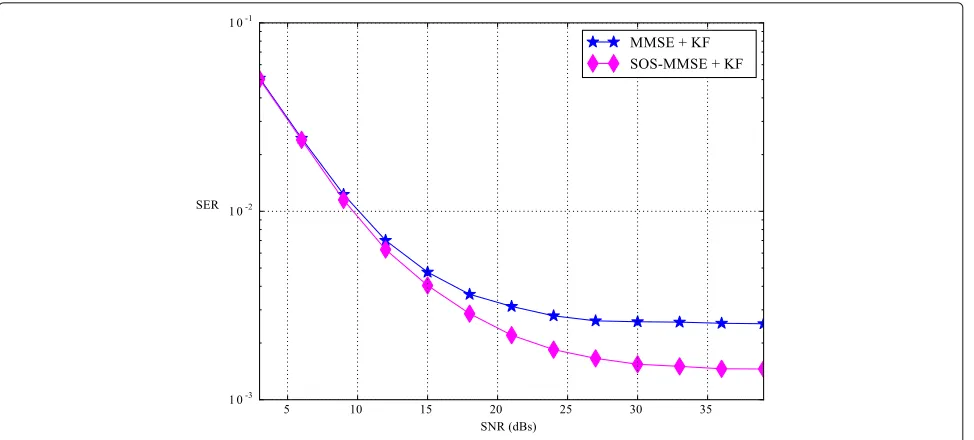
Fig. 3SER for several values of the SNR (dB) withσ2
v =0.005 andm=1
Figure 3 compares the SER achieved by the algorithms MMSE + KF and SOS-MMSE + KF for different values
of the SNR when the channel is flat (m = 1). In order
to reach a SER of 10−2, the method using the proposed MMSE DFE requires roughly 0.4 dBs less SNR than the method using the conventional MMSE DFE. This gap largely widens as the SNR increases: for a SER of 5×10⁻³, the curve for the MMSE + KF is more than 1 dB away from that of the SOS-MMSE + KF. Notice that both methods exhibit an error floor, but the one associated with the DFE scheme introduced in this paper is lower.
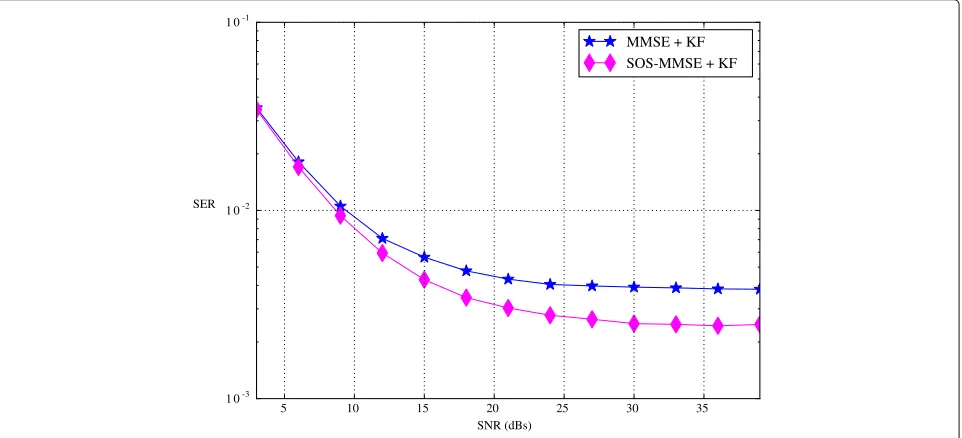
When the channel is flat, only the presentstate of the channel is needed (along with the observations) in order to detect the symbols transmitted. On the other hand, when the channel is dispersive, i.e., m > 1, not only does the number of channel coefficients to be estimated increase, but predictions offuturechannel states are also necessary in order to perform both causal-interference cancelation and smoothing. Overall, this results in less reliable channel estimates being employed, and hence accounting for their uncertainty becomes important. This is illustrated in Fig. 4 that shows the performance of the
5 10 15 20 25 30 35
SNR (dBs) 1 0-3
1 0-2 1 0-1
SER
MMSE + KF SOS-MMSE + KF
Fig. 4SER for several values of the SNR (dB) withσ2
5 10 15 20 25 30 35 SNR (dBs)
1 0-4 1 0-3
1 0-2 1 0-1
1 00
SER
MMSE + KF SOS-MMSE + KF
Fig. 5SER for several values of the SNR (dB) withσ2
v =0.005 andm=5
algorithms whenm = 3. When comparing these results
to those obtained form = 1, the SER achieved by the
MMSE + KF degrades over the whole range of SNRs on account of this algorithm neglecting the channel SOS. On the other hand, the SOS-MMSE + KF is able to success-fully cope with the uncertainty in the channel estimates and even sees a performance boost due to the increase in diversity given by a higher channel order. As a conse-quence, the proposed receiver now exhibits a more clear advantage over the conventional one. Indeed, in order to attain a SER of 10−2, the latter requires around 2.4 dBs more SNR than the former. Figure 5 shows that when
the channel order ism = 5, the gap between the curves of the SOS-MMSE + KF and MMSE + KF algorithms widens even more. Moreover, the performance of the SOS-based MMSE DFE improves slightly whereas that of the conventional MMSE DFE further deteriorates.
6.2 Fast fading channel (σv2=0.01)
Increasing the variance of the channel noise has a twofold effect. On one side, since the channel now changes more rapidly and hence it is harder to track, the performance of any receiver is expected to worsen. On the other side, the channel evolving faster means that predictions about
5 10 15 20 25 30 35
SNR (dBs) 1 0-3
1 0-2 1 0-1
SER
MMSE + KF SOS-MMSE + KF
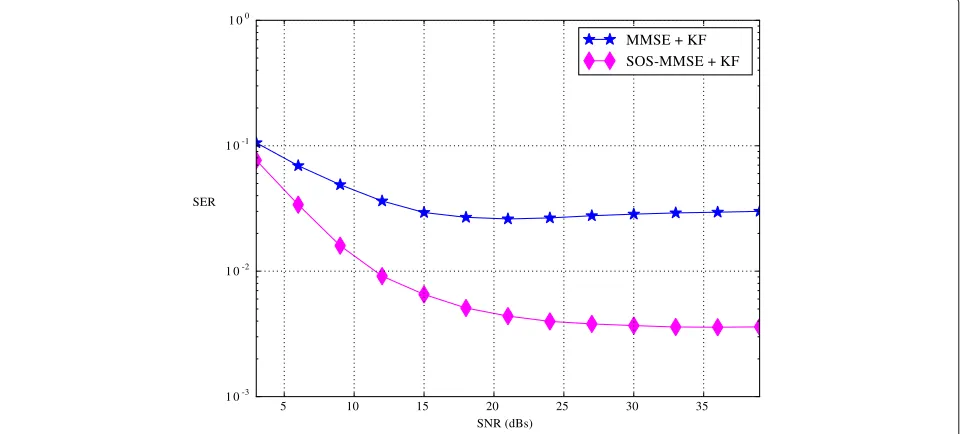
Fig. 6SER for several values of the SNR (dB) withσ2
5 10 15 20 25 30 35 SNR (dBs)
1 0-3 1 0-2 1 0-1
SER
MMSE + KF SOS-MMSE + KF
Fig. 7SER for several values of the SNR (dB) withσ2
v =0.01 andm=3
its future state are less reliable, and hence accounting for their uncertainty is even more important (which should benefit the SOS-based MMSE DFE). From a mathemat-ical point of view, if the predicted channel estimates are not accurate, then the elements in the covariance matrices that enter Eq. (41) are non-negligible and so is their con-tribution to the computation of the proposed MMSE DFE in Eq. (47).
Figure 6 shows the performance of the algorithms in a
flat channel (m = 1). The SER of both DFEs degrades
in the medium-high SNR region, as compared to the pre-vious scenario, but this penalty is larger in the case of
the MMSE + KF. Thus, the proposed MMSE DFE now exhibits a more pronounced advantage over the conven-tional MMSE (about 0.65 dBs for a SER of 10−2and more than 3 dBs for a SNR of 5×10⁻³).
Increasing the channel order in a fast fading channel has a negligible effect on the performance of the
SOS-MMSE + KF5 but seriously harms that of the MMSE +
KF. In Fig. 7, it can be seen that, when the channel
order is m = 3, a SER of 10−2 requires ≈ 8.3 dBs
less SNR in the former than in the latter (recall that in the previous scenario this gap was approximately 2.4 dBs).
5 10 15 20 25 30 35
SNR (dBs) 1 0-3
1 0-2 1 0-1 1 00
SER
MMSE + KF SOS-MMSE + KF
Fig. 8SER for several values of the SNR (dB) withσ2
Results for the case in whichm=5 are shown in Fig. 8. Again, the advantage of the proposed method over the conventional one is much more clear as the channel order increases.
7 Conclusions
In this work, we have introduced an enhanced version of the conventional MMSE equalizer for time-selective MIMO channels that takes advantage of the posterior second-order statistics of the channel provided by the KF. Computer simulations show that the proposed SOS-MMSE DFE yields significant performance gains (in terms of SER) over the conventional MMSE in the medium-high SNR region. In medium-highly dispersive channels, the SNR required for the proposed SOS-MMSE receiver to achieve a certain SER can be several dBs lower than that required by the conventional MMSE. This is especially true for fast-varying channels, in which the uncertainty about the channel estimates becomes important. Indeed, a mea-sure of this uncertainty is given by the second-order statistics of the channel, which are dismissed by the con-ventional MMSE, but handled by the one introduced in this paper.
It is important to point out that the application of the SOS-aided MMSE filter introduced in this work is not restricted to DFE receivers. On the contrary, the key idea is very general and can be integrated into any MMSE-based scheme as long as SOS of an unknown random variable that is relevant for the filter (here, the channel) are available.
One last remark is that the computational complexity of the proposed SOS-MMSE DFE is of the same order as that of the conventional scheme that neglects the channel SOS.
Endnotes
1For all practical purposes, any model that is linear and
affected by Gaussian noise is amenable to be used here. 2Notice that (for the sake of mathematical convenience)
estimates of the symbol vectors st+1,st+2,· · ·,st+d are obtained at timet(using observations up to timet+d) since they are also included in st
t+d. However, they are
dismissed at that time and the actual estimates of the symbols in st+i are computed at time t + i using the observations up to timet+i+d.
3This is a reasonable hypothesis since the smoothing lag
should be selected to account for, at least, the observa-tions containing all the energy of the symbols transmitted at timet. This obviously depends on the length of the CIR, m, and it is common to set the smoothing lag tod=m−1. This is also the case in the experiments whose results are presented in Section 6.
4Notice that the higher the variance of the channel
noise, the more rapidly the channel coefficients fluctu-ate. A faster varying channel can also be obtained by decreasing the coefficient of the AR process,a1, which determines the correlation between a channel coefficient and itself at a different time instant.
5Here, the increase in diversity due to a higher channel
order is not enough to compensate for the rapid variation of the channel coefficients.
Appendix
Computation of the cross-covarianceht+k(n),ht+l(q) withk<l
Theqth column in matrixHt+l,ht+l(q), can be expressed, according to Eq. (5), as
ht+l(q)= ables (r.v.) with zero mean and varianceσv2. Its expectation is then given by
Et−1
Notice that this last equation is just Eq. (29) restated column-wise.
Substituting Eqs. (48) and (49) into (43), we obtain
ht+k(n),ht+l(q)=Et−1
Since we are assuming k < l, it is clear from
since Et−1
ht+k(n)
is a constant. Therefore, Eq. (50) becomes
(and through straightforward algebraic manipulation)
=
Since all the terms in the second summation of (51) are zero, only the first summation is left and the equation can be rewritten as
where Eq. (44) has been used in the last step of the derivation.
Abbreviations
AWGN: Additive white Gaussian noise; AR: Autoregressive; BPSK: Binary phase-shift keying; CIR: Channel impulse response; DFE: Decision feedback equalizer; i.i.d.: Independent and identically distributed; KF: Kalman filter; MIMO: Multiple input multiple output; MMSE: Minimum mean square error; r.v.: Random variable; SOS: Second-order statistics; SER: Symbol error rate
Acknowledgements
This work was supported byMinisterio de Economía y Competitividadof Spain (project COMPREHENSION TEC2012-38883-C02-01),Comunidad de Madrid (project CASI-CAM-CM S2013/ICE-2845), and the Office of Naval Research Global (award no. N62909- 15-1-2011).
Competing interests
The authors declare that they have no competing interests.
Author details
1Departamento de Teoría de la Señal y Comunicaciones, Universidad Carlos III de Madrid, Avenida de la Universidad 30, Leganés, Spain.2School of Mathematical Sciences, Queen Mary University of London, Mile End Road, E1 4NS, London, UK.3Gregorio Marañón Health Research Institute, Calle del Dr. Esquerdo, 46, 28007 Madrid, Spain.
Received: 26 April 2016 Accepted: 8 November 2016
References
1. E Telatar, Capacity of multi-antenna Gaussian channels. Eur. Trans. Telecommun.10, 585–595 (1999)
2. S Verdú,Multiuser Detection. (Cambdridge University Press, Cambridge, 1998)
3. TS Rappaport,Wireless Communications: Principles and Practice, (2nd Edition). (Prentice-Hall, Upper Saddle River, 2001)
4. C Tidestav, A Ahlen, M Sternad, Realizable MIMO decision feedback equalizers: structure and design. IEEE Trans. Signal Process.49(1), 121–133 (2001)
5. CA Belfiore, JH Park Jr., Decision feedback equalization. Proc. IEEE.67(8), 1143–1156 (1979)
6. AH Sayed,Adaptive Filters. (Wiley-IEEE Press, Hoboken, 2008) 7. AF Molisch,Wireless Communications, vol. 15. (John Wiley & Sons, West
Sussex, 2010)
8. JG Andrews, Interference cancellation for cellular systems: a contemporary overview. Wireless Commun. IEEE.12(2), 19–29 (2005) 9. AM Chan, GW Wornell, A new class of efficient block-iterative interference
cancellation techniques for digital communication receivers. J. VLSI Signal Process. Syst. Signal Image Video Technol.30(1-3), 197–215 (2002) 10. E Biglieri, AR Calderbank, AG Constantinides, A Goldsmith, A Paulraj,
MIMO Wireless Communications. (Cambridge University Press, Cambridge, 2010), p. 1323
11. C Komnikakis, C Fragouli, AH Sayed, RD Wesel, Multi-input multi-output fading channel tracking and equalization using Kalman estimation. IEEE Trans. Signal Process.50(5), 1065–1076 (2002)
12. J Choi, Equalization and semi-blind channel estimation for space-time block coded signals over a frequency-selective fading channel. IEEE Trans. Signal Process.52(3), 774–785 (2004)
13. MA Vázquez, MF Bugallo, J Míguez, Sequential Monte Carlo methods for complexity-constrained MAP equalization of dispersive MIMO channels. Signal Process.88, 1017–1034 (2008)
14. G Yanfei, H Zishu, inCommunications, Circuits and Systems, 2005. Proceedings. 2005 International Conference On. MIMO channel tracking based on Kalman filter and MMSE-DFE, vol. 1 (IEEE, 2005), pp. 223–226 15. RE Kalman, A new approach to linear filtering and prediction problems.
J. Basic Eng.82, 35–45 (1960)
16. BDO Anderson, JB Moore,Optimal filtering. (Englewood Cliffs, New Jersey, 1979)
17. N Al-Dhahir, AH Sayed, The finite-length multi-input multi-output MMSE-DFE. Signal Process. IEEE Trans.48(10), 2921–2936 (2000) 18. D Guo, X Wang, Blind detection in MIMO systems via sequential Monte
Carlo. IEEE J. Selected Areas Commun.21(3), 464–473 (2003)
19. J Míguez, L Castedo, Space-time channel estimation and soft detection in time-varying multiaccess channels. Signal Process.83(2), 389–411 (2003)
Submit your manuscript to a
journal and benefi t from:
7Convenient online submission 7Rigorous peer review
7Immediate publication on acceptance 7Open access: articles freely available online 7High visibility within the fi eld
7Retaining the copyright to your article