R E S E A R C H
Open Access
Load balancing ad hoc on-demand
multipath distance vector (LBAOMDV)
routing protocol
Saleh A. Alghamdi
Abstract
Researchers working in the area of a mobile ad hoc network (MANET) strive to conserve the battery energy of individual nodes to reduce the frequency of a node breakdown. The model of multiple-path on demand data routing protocols has been an effective scheme for the majority ofMANETapplication scenarios in recent times. The availability of multiple paths for data transfer can both prove to be effective as well as dismal in certain cases. The selection of the most suitable path is always tricky, if not associated with exact metrics of concern. The contribution of this work is the introduction of the load balancing ad hoc on-demand multipath distance vector (LBAOMDV) protocol, an adaptation ofAOMDV, an ad hoc on-demand multipath distance vector protocol. The adaption is done in order to enhance the reliability of the given network by considering the parameter of path weight (energy) of all the available multiple paths. TheLBAOMDVregulates the fair usage of both node energy and available bandwidth by exploiting the availability of multiple paths for data transfer. The uniform distribution of data across multiple paths enhances the quality of service of the given network by ensuring fair usage of both network bandwidth and node energy. TheLBAOMDVprotocol ensures reduced node breakdowns, thus enhancing the reliability of the given MANET.
Keywords:MANET; AODV; AOMDV; LBAOMDV; Load balancing; Fault tolerance
1 Introduction
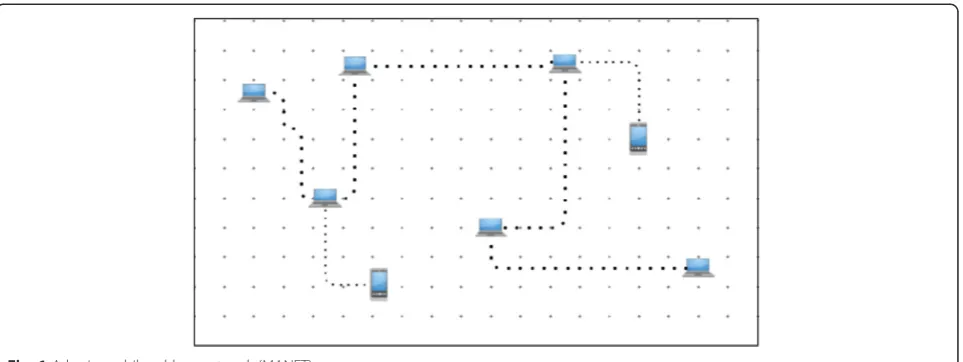
A mobile ad hoc network (MANET) is a collection of wire-less mobile nodes which dynamically form a wirewire-less net-work without a fixed infrastructure or a wired backbone network, as shown in Fig. 1. A mobile ad hoc network is a multi-hop network without any predetermined topology or central control, hence making routing a crucial design issue for these networks [1]. One of the most important and thoroughly discussed areas in wireless communication has been channel assignment and usage. As ad hoc networks are decentralized, they require advanced bandwidth alloca-tion schemes [2]. Various issues ranging from topology control and network coverage to channel assignment have been addressed recently, and viable solutions have come forth. The issue of topology control and streamlined data communication has been thoroughly discussed [3, 4]. The advent of wireless technology in the public domain has
raised issues related to network coverage for reliable com-munication [5–7]. Recently, a new area of concern for re-searchers has emerged known as green mobile networks, which are wireless networks sensitive to energy usage and dissipations [8].
The rapid node addition or departure frequency of wireless nodes adds to the complexity of routing in MANETs. The inherent issue of rapid mobility compli-cates the issue further, by making it difficult to address a particular topology for a long [9–11]. The fundamental concern related to the complexity of routing has been addressed, but still some inherent bottlenecks are unre-solved. The issue related to delay in route selection has been discussed, and many viable solutions have been proposed in the past [12, 13]. The issues related to con-gestion and its impact on data delivery have also been addressed [14]. In the past, the basic principle of routing protocols generally was limited to identifying a single path between source and destination node, with a con-straint of minimum hop counts. This genre of routing Correspondence:[email protected]
Department of Computer Engineering, Al-Baha University, Al-Baha, Saudi Arabia
protocols had limitations of reliability and bandwidth usage owing to path breakdown. Nevertheless, in a rea-sonably well-connected network, there exists several paths between a source node and a destination node. Multipath routing is one of the most effective trends in the area of wireless routing [15]. The concept of multi-path routing involves discovering all available multi-paths from the source node to the destination by taking advantage of path redundancy of the underlying network. These multiple available paths may be used alternately or in certain scenarios concurrently for data transfer [16, 17].
The process of routing both in general computer net-works, as well as in wireless netnet-works, can be reactive or proactive. The category of reactive routing protocols has been the most effective for wireless scenarios, and the introduction of reactive multipath on demand protocols has steered to a new generation of MANET routing. The most rigorously discussed reactive wireless (on-demand) routing protocols to date have been Dynamic Source Routing (DSR), Ad hoc On-Demand Distance Vector Routing(AODV) andTemporally Ordered Routing Algo-rithm (TORA) [18–20]. All these reactive routing proto-cols flood a network with route request packets (RREQ) to discover and maintain routes, only after receiving a request for data transfer. Proactive routing protocols such as Destination Sequenced Distance Vector Routing (DSDV) or other DSDV variants tend to discover and maintain routes between all pairs of nodes in advance to any data requests [21]. The application of proactive pro-tocols seems unrealistic for mobile wireless scenarios, as the frequent topology changes, that may require fre-quent updating of routing tables which will incur huge routing overhead [22].
The transfer of data over a single path among the vari-ous paths has been the principle of the most on-demand multiple path routing schemes. If the route fails again, a new route is evaluated from source to destination,
consuming time and resources. So it is obvious that dis-tributing data packets among the discovered multipaths is the key solution. The research in the recent past has resulted in some advanced techniques for routing in wireless communication networks [23]. Advanced areas of data communication in wireless sensor networks have been taken both by the academia and industry and have yielded significant results [24, 25]. Techniques address-ing the issues related to sensor networks for data pro-cessing and delivery have also been part of recent research developments in wireless technology [26–28]. The concept of information-centric networks (ICN) has also come into light during the last half decade. These information-centric networks pose quite a different set of challenges [29]. Advances in making IoT a successful technology in future requires greater integration be-tween existing network platforms and the internet, thus enabling their ability to provide services across the globe [30].
The work through this paper mainly concentrates on effectively balancing the data load among the discovered multipaths in order to maintain nodes resources and re-duce the traffic to avoid creating traffic load or bottlenecks.
This paper is organized as follows. Section 2 covers re-lated work in the area of on-demand multipath routing protocols. Section 3 proposes the LBAOMDV load-bal-anced ad hoc on-demand multipath distance vector routing protocol. Section 4 provides the simulation de-tails of the environment set for the NS2 network simula-tor. Section 5 of this paper discusses in detail the results generated from simulation of the proposed LBAOMDV protocol.
2 Background
Many conventional routing protocols developed in the past have least emphasized the optimum utilization of
Fig. 1A basic mobile ad hoc network (MANET)
network bandwidth and node energy [31]. But lately, several multipath routing protocols have targeted the en-ergy consumption issues while devising routing schemes for wireless mobile networks [32]. A detailed discussion of the advances in mobile ad hoc routing is provided in this section.
Effective load balancing of data across multiple avail-able paths has been utilized for fair bandwidth usage in mobile ad hoc networks [33]. Pearlman et al. proposed analternate path routing (APR) that provided load bal-ancing by distributing traffic among a set of diverse paths. APRis an ideal candidate for mobile ad hoc net-works with limited channel bandwidth [34]. Yin et al. in-troduced a load balancing technique called multipath adaptive load balancing (MALB). MALB dynamically distributes the traffic among multiple paths, based on path statistics measurement. MALB is an inclusive framework and can collaborate with any kind of multi-path source routing protocols [35]. Mérindol et al. had proposed a scheme that offers the possibility to use tem-porarily alternative routes in order to reduce packet loss and degraded throughput [36]. Nagarjun et al. proposed
a Packet Count-Based Routing Mechanism (PCRM)
protocol. PCRM is based on Dynamic Source Routing (DSR)protocol. In contrary of all other regular load bal-ancing techniques,PCRMselects the least used path for sending data packets rather than the mostly used one that regularly includes the minimum hop count [37]. Sharma et al. proposed a similar solution to utilize avail-able bandwidth of the channel multiple disjoint paths. The approximation of bandwidth of a given path is done by sending detector packets across a network. The source node chooses the path with maximum bandwidth as the primary route for forwarding data [38]. Recently, Qi et al. proposed a multipath routing protocol (EM-AODV), based onAODV. EM-AODVevaluates the paths using the parameter values of path energy and hop counts [39]. The advancements in AODV have resulted in more efficient protocols like ad hoc on-demand mul-tipath distance vector (AOMDV) that is more suitable for MANET scenarios [40]. Advancements in the routing techniques in wireless communication have also been based on various intelligent techniques. Athanasios et al. introduced an intelligent approach to improve quality of service (QoS) routing in ATM networks [41]. Thrasyvou-los et al. in their work provided insights into design of routing algorithms for vehicular ad hoc networks [42]. Moustafa et al. described the routing metrics for routing in cognitive radio networks in detail [43]. The designing of vehicular networks is also quite challenging owing to rapid mobility. Few techniques to enhance the function-ality of vehicular networks are being floated for discus-sion in the industry and academia [44, 45]. The latest advancements in improving the quality of routing has
been studied by researchers, and their findings have un-covered new challenges [46]. The most interesting solu-tion for these kinds of challenges in dynamic routing has been the efficient multipath routing schemes [47]. Some recent work carried out in the direction of QoS, the quality of service constrained efficient path selection has been noteworthy [48–50]. The applications of basic net-work concepts have been realized in other spheres of science and technology as well. These realizations have also been incorporated into wireless networks to achieve significant gains in efficient routing [51, 52]. The current work is in continuation of the previous established at-tempts and has shown significant improvement in the same direction. The current work has utilized the popu-lar NS2 network simulator for deriving and showcasing the results [53]. In the next section, we propose the LBAOMDV protocol that takesQoS to a higher level by enhancing both performance and reliability of MANETs.
3 Load balancing ad hoc on-demand multipath distance vector (LBAOMDV) protocol
A MANET can be realized by an undirected graph G(V,E), where V is the number of nodes and E is the total possible edges. Here, we associate a definite weight representing the amount of energy that gets consumed for the transfer of a single fixed length data packet be-tween a pair of nodes. So, each edge in the given net-work graph will have a weight WEij representing the amount of energy consumed for a single hop transfer from nodeito nodej. The amount of energy for a single hop transfer between the given two network nodes can be calculated by a trivial function given in Equation (1):
WEij¼E Vi; Vj
ð1Þ
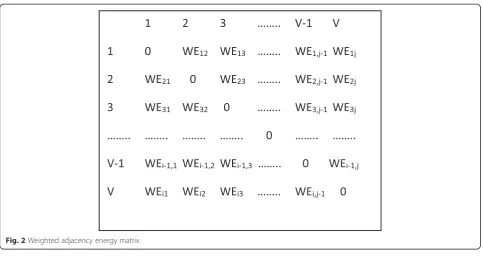
The set of WEijvalues for all the possibilities of edges of the given network graphG(V,E) can be represented by a weighted adjacency matrix depicted in Fig. 2.
The value of the weight WEij of a given edge may be zero, in case a direct link is not available between a node pair Vij. A given path “Pij” from a source node Vi to a destination node Vjcan be comprised ofn nodes andn −1multiple hops where1≤n≤V.
The amount of energy required for the transfer of a single data packet fromVitoVjcan be calculated by the summation of weights WEijof all participating hops and can be given by Equation (2).
PEij¼ Xn−1
i¼1 E Wð iÞ ð2Þ
transferring a message “M” from source to destination node along a given pathPijcan be calculated as given in Equation (3).
£¼ Q PEij
ð3Þ
A message M comprising ofQpackets of data can be divided into fixed C-sized chunks of data to be distrib-uted among K available multiple channels as given in Equation (4).
C¼M=K ð4Þ
The load balancing of data across multiple channels ensures optimum utilization of the available bandwidth for a given wireless network. A path Pijis a sequence of nodes and links from the intended sender to the intended receiver. The efficiency of data transfer among a node pair primarily depends on node capacity L and link traffic Tof a given data channel. A protocol is said to have a fair bandwidth usage if it allows balanced traf-fic across the available paths. The amount of unused bandwidth (UB) is a firm indicator for ensuring equal usage of bandwidth across different paths. The UB par-ameter for a node pair or hop provides us the value of unused bandwidth at the particular hop and can be de-rived as given in Equation (5).
UB¼L−T ð5Þ
To ensure that the node with minimum unused band-width (MUB) over a path Pij can handle the allocated data chunk, it can be derived from Equation (6).
MUBij ¼ mini¼1 tojðUBÞ ð6Þ
3.1 Dynamic load balancing
The abrupt increase in the non-uniform requests from individual network nodes for data has lead to a burst mode of data transfer across network channels. This burst mode of network data transfer has increased the importance of reliability assessment at peak times. The challenges of increasing the reliability of a given network has been associated to the two significant factors, namely node energy and channel bandwidth. By transfer-ring data across multiple paths, theLBAOMDVprotocol addresses both these factors of bandwidth and node energy.
Fig. 2Weighted adjacency energy matrix
Table 1Simulation details
Simulator NS-2.35
Routing protocols LBAOMDV, AOMDV, PCRM,
and AntHocNet
Various simulation time spaces (s) 50, 100, 200, 400, 1000
Simulation area 1000 m * 1000 m
Various network sizes (node number) 25,50,100,200
Transmission range (m) 250
Mobility model Random way point
Maximum speed 5 m/s
Data packet size 512 KB
Traffic source CBR Traffic source CBR
Initial energy of participating network nodes
40 J
The basic path finding technique given in theAOMDV protocol is used exactly in the LBAOMDV protocol based on the flooding of route request packets (RREQ) across the whole network. Each reverse route is estab-lished on reception of positive route reply packet (RREP). A set of multiple disjoint paths are established by interleaved exchange of the RREQ and RREP route establishing packets [20]. Among these multiple discov-ered routes or paths, the final set of paths for actual data transfer is selected based on effective energy utilization assessment. The criterion for path selection is based on the amount of energy to be consumed over a path for transfer of data chunkC. A pathPijbelongs to the set of paths for final data transfer if the value of PEis greater than the amount of energy required for each chunk transfer, as given in Equation (7).
PEij≥£=K−1 ð7Þ
Where Kis the number of discovered paths, after the route discovery session gets completed. The selection of paths on the condition given in Equation (7) allows bal-anced energy utilization of nodes in a given network. After the selection of paths, the qualified paths are ar-ranged based on the average unused bandwidth (PUB) of a particular path Pij. This arrangement ensures that paths are used in the descending order of value for PUBij.
message will result in the end of the LBAOMDV protocol process. An unsuccessful data transfer due to path breakdown will require that the failed data chunk be retransferred. This retransfer of data will be treated as a new message and will be distributed across all the K−1 available channels.
3.2 LBAOMDV algorithm
The implementation of LBAOMDV protocol is di-vided into three phases.
3.3 Reliability assessment of the LBAOMDV Protocol In a load-balanced multipath routing environment, a message is decomposed into equal-sized data chunks and each such data chunk is transferred over a single path to its intended destination. Here, we assume that “K” number of available multiple paths are both dis-joint (node and link) and non-cyclic for the current discussion. An intermediate node “n” which is part of ith disjoint path “Ki” may fail due to any of the
reasons like exhausting energy below the given energy threshold, malfunctioning of any node component, physical damage, or any another correlated reasons. Here, we define three node failure types based on the consequences a node breakdown may have on an on-going data transmission.
Type 1 failure: A breakdown of an intermediate net-work node which will halt current ongoing data transfer and initiates a retransmission of the same data chuck over the rest of the alternate available paths, as proposed in the LBAOMDValgorithm.
Type 2 failure: A breakdown of an intermediate net-work node which does not belong to any of the mul-tiple possible paths for the current data transmission; thus, it will not affect the ongoing data transfer over the network.
Type 3 failure: A breakdown of source/destination node or both or a breakdown of multiple network nodes at the same time, thus affecting the overall functionality of the whole network.
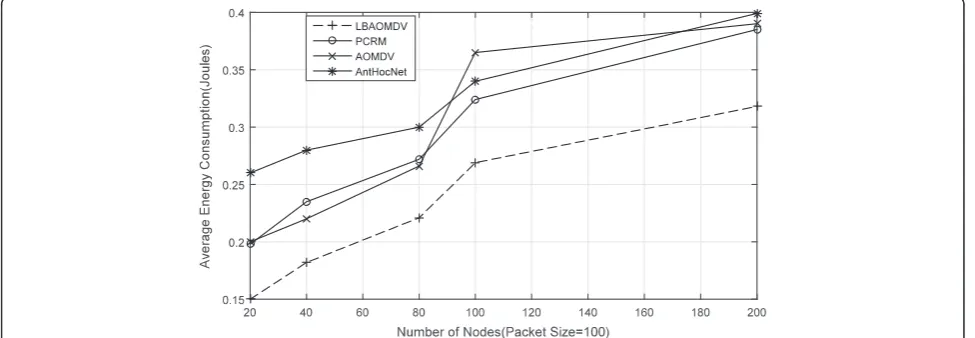
Fig. 4Average node energy consumption vs. no. of nodes for 100-packet size
Fig. 3Average end-to-end delay vs. no. of packets
Here, in this work, we will be limited to only type 1 failures, and the mention of the term failurein the sub-sequent discussion will be taken astype 1failure.
The reliability assessment of the proposedLBAOMDV protocol is done on the mean time between failure (MTBF) metric of reliability evaluation. Here, we define the MTBFof a given MANET as the average number of data retransmissions required during the whole span of data transmission given by Equation (8).
MTBF¼ Xn i¼1f tð Þ
h i
=n ð8Þ
Where n is the number of retransmissions and f(t) is the failure time. The mean time to repair (MTTR) metric is defined as the additional delay (time) imposed due to the rerouting and retransmission of the failed data chunk given by Equation (9).
MTTR¼r tð Þ þλ ð9Þ
The results for the reliability and related improve-ments in energy and delay are discussed in following section of this paper.
4 Simulation and results of the LBAOMDV protocol
4.1 Performance metrics
The performance of the LBAOMDV protocol is evalu-ated with respect to existing standard routing schemes like AOMDV, PCRM, and AntHocNet for measuring its performance for standard QOS metric parameters and reliability. LBAOMDV is an advanced version of the AOMDV scheme; the comparison is done to show the improvements achieved.PCRMand AntHocNetschemes are also simulated for comparison with the LBAOMDV, as the former two protocols have been quite successful
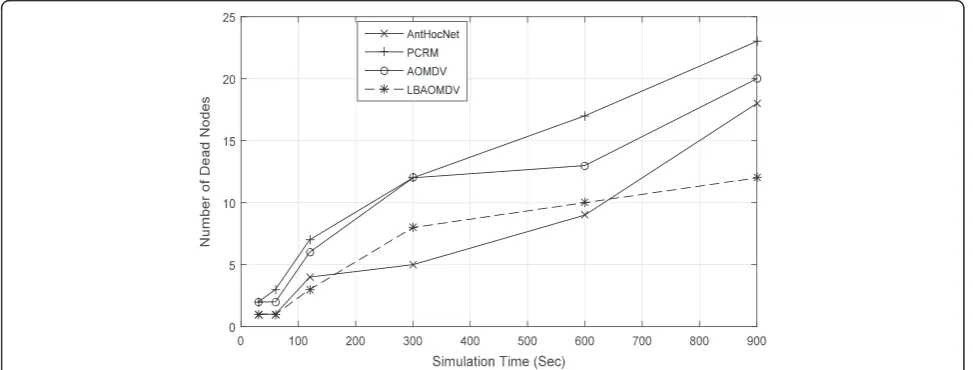
Fig. 6Number of dead nodes vs. simulation time
in wireless ad hoc scenarios. The evaluation metrics are given in the following listing:
1. End-to-end delay: the average delay of data packets from a source to a destination
2. Average energy consumption: the average energy consumed by all nodes in the network
3. Number of dead nodes: the number of node breakdowns during complete data transfer simulations
4.2 Simulation environment
The proposed LBAOMDV protocol was simulated, and its performance was evaluated against AOMDV, PCRM, and AntHocNetprotocols using the prominent NS2 net-work simulator. Table 1 shows the details of the simula-tion environment features.
4.3 End-to-end delay
The study of delay associated with the LBAOMDV protocol can be assessed by the comparison of the end-to-end delays of the data packets transferred over a net-work using AOMDV, PCRM, and AntHocNet. The
comparison of the average end-to-end delays versus packet number is shown in Fig. 3. The proposed LBAOMDV showed higher average end-to-end delays thanAOMDV, while showing better results compared to PCRM and AntHocNet. The average end-to-end delay for 50 packets is 0.83 s for LBAOMDV while for AOMDV is 0.5 s. While at 1000 packets, LBAOMDV is over AOMDV by nearly 1.2 s for end-to-end delays. It is also obvious that the increasing rate of average end-to-end delay of LBAOMDV is much higher than AOMDV, the reason being additional computation required for load balancing. The increase in end-to-end delay in LBAOMDV requires a trade-off with the efficiency achieved by the protocol in terms of efficient bandwidth and energy usage. A real-time network application may require minimum end-to-end data delay, while as non-real-time applications may be concerned about efficient bandwidth and energy usage.
4.4 Average energy consumption
The study of energy consumption of individual nodes across the whole MANET can be assessed by the average energy consumption of the participating nodes after the
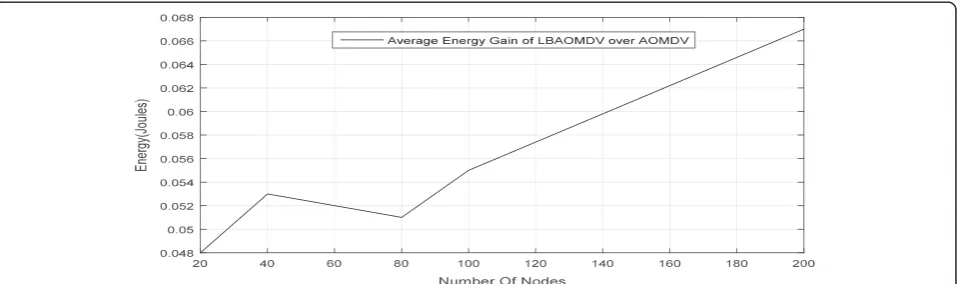
Fig. 8Average energy gain vs. node size
Fig. 7Additional overhead of LBAOMDV
data is transferred over a network using various standard protocols likeAOMDV,PCRM, and AntHocNetin com-parison to LBAOMDV. Here, energy consumption was tested in two different scenarios of 100 and 500 packets, while each packet was having a size of 512 KB. This can be noticed from Fig. 4 that the performance of LBMODV is much better with lower data loads of 100 packets in this case. The comparison for the average en-ergy consumption of nodes shows improvement in
LBAOMDVcompared toAOMDV, PCRM,and
AntHoc-Net. While Fig. 5 provides a lucid picture for 500 packets, the LBAOMDVachieved a real improvement as compared to AOMDV, PCRM, and AntHocNet, for the consumed energy which was one of the objectives of this work. For example, at 200 nodes LBAOMDVconsumes 0.31 while AOMDVscores 0.53 thus signifying that the network and data load size is a factor in increased en-ergy consumption.
4.5 Number of dead nodes
The increasing number of dead nodes causes a double jeopardy to the MANET as it causes data loss and net-work partitioning. One of the objectives of LBAOMDV is the drastic decrease in the frequency of node break-downs. Figure 6 shows a less number of dead nodes while simulating LBAOMDV as compared to AOMDV, PCRM, and AntHocNet. A 900 s of simulation showed that LBAOMDV resulted in a drastic decrease for the number of dead nodes (35 out of 200 nodes) which nearly equals half of the number of dead nodes resulted while usingAOMDV(64 out of 200 nodes).
Further, it can be concluded that LBAOMDV per-formed better thanAOMDV, PCRM, and AntHocNet in reducing the energy consumption and frequency of node breakdowns (dead nodes). LBAOMDV has clearly showed superiority making it as a better alternative than
existing standard multipath ad hoc on-demand routing protocols.
4.6 Reliability analysis
Assuming that the time of data transmission for a fixed-sized data remains constant across all the multiple avail-able paths and is denoted here by “λ”. The amount of additional overhead imposed by LBAOMDV as com-pared to AOMDV, due to the load balancing phase for data rerouting, is shown in Fig. 7. Thus, simulation re-sults generated for the average energy gain of a wireless mobile ad hoc network shown in Fig. 8 show the im-provements achieved by the proposedLBAOMDV proto-col. The possible improvements in average energy consumption and degradation in the number of dead nodes has resulted in the significant improvement in the reliability of the given network. These improvements in average node energy and node lifetime consequently im-pact on general reliability of the given wireless network as can be seen in Fig. 9.
5 Conclusion
A multipath routing protocol needs to be governed by a load balancing scheme in order to escape from devour-ing the energy of participatdevour-ing nodes. Unbalanced bat-tery energy consumption may lead to node breakdown consequently affecting the reliability of the given net-work in general. The objective of this research net-work was to develop a bandwidth and energy-aware multipath on-demand routing protocol for MANETs. The proposed LBAOMDV protocol achieves the objective by load bal-ancing of data across multiple available paths. The LBAOMDV protocol further ensures balanced retrans-mission of the data, in case of any path or node break-down during a data transmission. The results generated from the simulation for node breakdown and average
energy consumption parameters showed the improve-ments achieved by LBAOMDV in comparison to AOMDV, PCRM, and AntHocNet. These results con-clude to the fact that theLBAOMDV protocol enhances the reliability of a givenMANETand ensures better net-work performance at peak data transfer times. This net-work requires further enhancements in future so as to im-prove the computational efficiency of load balancing.
Competing interests
The authors declare that they have no competing interests.
Received: 16 May 2015 Accepted: 16 September 2015
References
1. S. Corson, J. Macker, Mobile ad hoc networking (MANET): routing protocol performance issues and evaluation considerations, RFC2501, Naval Research Laboratory, University of Maryland, (1999).
2. C Hongju, Xiong, AV Vasilakos, Y Laurence Tianruo, C Guolong, Z Xiaofang, Nodes organization for channel assignment with topology preservation in multiradio wireless mesh networks. Ad Hoc Networks10(5), 60773 (2012). 3. L Mo, L Zhenjiang, AV Vasilakos, A survey on topology control in wireless sensor networks: taxonomy, comparative study, and open issues. Proc. IEEE
101(12), 25382557 (2013).
4. M. Reza. Rahimi, Nalini, Venkatasubramania, MAPCloud: mobile applications on an elastic and scalable 2tier cloud architecture, IEEE/ACM UCC (2012). 5. Yanjun Yao; Qing Cao; Vasilakos, A.V, EDAL: An energy efficient delay aware,
and lifetime balancing data collection protocol for wireless sensor networks. MASS (2013), IEEE International Conference, 182-190.
6. S Yuning, L Liang, M Huadong, AV Vasilakos, A biology based algorithm to minimal exposure problem of wireless sensor networks. IEEE Trans. Netw. Serv. Manag.11(3), 417430 (2014).
7. S Sengupta, S Das, M Nasir, AV Vasilakos, W Pedrycz, An evolutionary multi objective sleep scheduling scheme for differentiated coverage in wireless sensor networks. IEEE Trans Syst Man Cybern Part C42(6), 10931102 (2012). 8. W Xiaofei, AV Vasilakos, C Min, L Yunhao, K Ted Taekyoung, A survey of
green mobile networks: opportunities and challenges. MONET17(1), 4–20 (2012).
9. Niranjan Potnis, Atulya Mahajan, Mobility models for vehicular ad hoc network simulations, Proceedings of the 44th annual Southeast regional conference, ACM New York, Melbourne, Florida, (2006).
10. E. Royer and C-K. Toh, A review of current routing protocols for ad hoc mobile wireless networks, IEEE Journal Personal Communications,6(2), 46-55, (1999).
11. S Marwaha, D Srinivasan, CK Tham, A Vasilakos, Evolutionary fuzzy multi objective routing for wireless mobile ad hoc networks, Evolutionary Computation, in Proceedings of the 2004 Congress on Evolutionary Computation (CEC '04),21964–1971, (2004).
12. D Der-Rong, J Jhong-Yan, Delay-constrained survivable multicast routing problem in WDM networks. Comput Commun35(10), 1172–1184 (2012). 13. Z Xin Ming, Z Yue, Y Fan, AV Vasilakos, Interference-based topology control
algorithm for delay-constrained mobile ad hoc networks, in mobile computing. IEEE Trans14(4), 742–754 (2015).
14. C Busch, R Kannan, AV Vasilakos, Approximating congestion + dilation in networks via“quality of routing”games. IEEE Trans. Computers61(9), 12701283 (2012).
15. S Mueller, RP Tsang, D Ghosal, Multipath routing in mobile ad hoc networks: issues and challenges, inPerformance tools and applications to networked systems, vol. 2965 of lecture notes in computer science(Springer, Berlin, Germany, 2004), 209–234.
16. Peng Li; Song Guo; Shui Yu; Vasilakos, A.V., CodePipe: an opportunistic feeding and routing protocol for reliable multicast with pipelined network coding, in INFOCOM, 2012 Proceedings IEEE, 100-108, 25-30 (2012). 17. W Lou, W Liu, Y Zhang, Performance optimization using multipath routing
in mobile ad hoc and wireless sensor networks. Combinator. Optim. Commun. Netw.2, 117–146 (2006).
18. L Peng, G Song, Y Shui, AV Vasilakos, Reliable multicast with pipelined network coding using opportunistic feeding and routing. IEEE Trans Parallel Distrib Syst25(12), 32643273 (2014).
19. R. N. Noorani, Comparative analysis of reactive MANET routing protocols under the traffic of TCP VEGAS with mobility considerations, International Conference on Emerging Technologies, 457-461, 19-20 Oct. (2009). 20. D. Johnson and D. Maltz., Dynamic source routing in ad hoc wireless
networks, In Mobile Computing book, The Kluwer International Series in Engineering and Computer Science, Springer USA,353153-181, (1996). 21. C. E. Perkins and E. M. Royer, Ad hoc on-demand distance-vector routing, In
IEEE Workshop on Mobile Computing Systems and Applications, Louisiana, 90-100, (1999).
22. V. D. Park & M. S. Corson, A highly adaptive distributed routing algorithm for mobile wireless networks, In Proceedings of the INFOCOM 97, IEEE, Japan,31405-1413, (1997).
23. C. E. Perkins & P. Bhagwat, Highly dynamic destination-sequenced distance vector routing (DSDV) for mobile computers. In ACM SIG-COMM, 234-244, (1994).
24. Y-S Yen, H-C Chao, R-S Chang, A Vasilakos, Flooding-limited and multi-constrained QoS multicast routing based on the genetic algorithm for MANETs. Math Comput Model Int J53(11-12), 2238–2250 (2011). 25. B Berger, M Brady, D Brown, T Leighton, Nearly optimal algorithms and
bounds for multilayer channel routing. J ACM42(2), 500–542 (1995). 26. Vasilakos, W MinYou, CDC: compressive data collection for wireless sensor
networks. IEEE Trans Parallel Distrib Syst26(8), 21882197 (2015). 27. Xi Xu, Rashid Ansari, Ashfaq Khokhar, Athanasios V. Vasilakos, Hierarchical
Data Aggregation Using Compressive Sensing (HDACS) in WSNs. ACM Transactions on Sensor Networks (TOSN),11(3) March (2015).
28. Liu Xiang, Jun Luo, Athanasios V. Vasilakos: Compressed data aggregation for energy efficient wireless sensor networks. SECON, IEEE, USA: 46-54, (2011).
29. AV Vasilakos, L Zhe, S Gwendal, Y Wei, Information centric network: research challenges and opportunities. J Netw Comput Appl52, 110 (2015). 30. S Zhengguo, Y Shusen, Y Yifan, A Vasilakos, J McCann, L Kin, A survey on
the ietf protocol suite for the internet of things: standards, challenges, and opportunities. Wirel Commun IEEE20(6), 91–98 (2013).
31. X Yang, P Miao, J Gibson, GG Xie, D Ding-Zhu, AV Vasilakos, Tight performance bounds of multihop fair access for mac protocols in wireless sensor networks and underwater sensor networks. Mob Comput IEEE Trans
11(10), 1538–1554 (2012).
32. N Chilamkurti, S Zeadally, A Vasilakos, V Sharma, Cross-layer support for energy efficient routing in wireless sensor networks. Journal of Sensors, Hindawi Publishing Corporation2009, 9 (2009).
33. Pham, P.P.; Perreau, S. Performance analysis of reactive shortest path and multipath routing mechanism with load balance, INFOCOM, San Francisco, CA, USA, 2003. Twenty-Second Annual Joint Conference of the IEEE Computer and Communications. IEEE Societies,1251–259, (2003). 34. M.R. Pearlman, Z.J. Haas, P. Sholander and S.S. Tabrizi,On the impact of
alternate path routing for load balancing in mobile ad hoc networks, Proceedings of the ACM MobiHoc, ACM, Boston, 3-10, (2000).
35. S Yin, X Lin, MALB: MANET adaptive load balancing. IEEE Vehicular Technol Conf4, 2843–2847 (2004).
36. P Merindol, J-J Pansiot, S Cateloin,Improving load balancing with multipath routing, Proceedings of 17th International Conference on Computer Communications and Networks, 2008(ICCCN’08, Seattle, Washington, USA, 27–38, (2008).
37. B Nagarjun, L Sathish, S Chaitanya, Md. Ansari, S Tapaswi, Packet count based routing mechanism–a load balancing approach in MANETS. Networked Digital Technologies, Communications in Computer and Information Science88, 669–675 (2010).
38. B. Sharma, S. Chugh, V. Jain, Energy efficient load balancing approach to improve AOMDV routing in MANET, In 2014 Fourth International Conference on Communication Systems and Network Technologies, IEEE, India, (2014).
39. X Qi, Q Wang, F Jiang, Multi-path routing improved protocol in AODV based on nodes energy. Int J Futur Gener Commun Netw8(1), 207–214 (2015).
40. S. Ijlal Ali Shah, M. Ilyas & H.T. Mouftah, Pervasive communications handbook, In CRC Press Taylor & Francis Group, LLC, ISBN-10: 1420051091, ISBN-13: 978-1420051094, (2011).
41. A Vasilakos, MP Saltouros, AF Atlassis, W Pedrycz, Optimizing QoS routing in hierarchical ATM networks using computational intelligence techniques, Systems, Man, and Cybernetics, Part C: Applications and Reviews, IEEE Transactions (2003).
42. S Thrasyvoulos, R Rao Naveed, T Thierry, O Katia, V Athanasios, Routing for disruption tolerant networks: taxonomy and design. Wirel Netw16(8), 2349–2370 (2010).
43. Moustafa Youssef, Magdy Abd El-Azim, Mohamed El-Derini, Channel assignment with closeness multipath routing in cognitive networks, Alexandria Engineering Journal,52(4) 665-670, (2013).
44. Z Yuanyuan, X Kai, L Deshi, AV Vasilakos, Directional routing and scheduling for green vehicular delay tolerant networks. Wirel Netw19(2), 161173 (2013).
45. Y Liu, N Xiong, Y Zhao, AV Vasilakos, J Gao, Y Jia, Multi-layer clustering routing algorithm for wireless vehicular sensor networks. Commun IET4(7), 810-816 (2010).
46. W. Pattara-Atikom, P. Krishnamurthy, Quality of service support in IEEE 802.11 Wireless Lan, IEEE Wireless Communications,10(3) 26-34, (2003). 47. Mahesh K. Marina and Samir R. Das, Ad hoc on-demand multipath distance
vector routing, in wireless communications and mobile computing, Wireless Comm,692-96, (2006).
48. H Kai, L Jun, L Yang, AV Vasilakos, Algorithm design for data communications in duty-cycled wireless sensor networks: a survey. Commun Mag IEEE51(7), 107–113 (2011).
49. Meng, T.; Wu, F.; Yang, Z.; Chen, G.; Vasilakos, A., Spatial reusability-aware routing in multi-hop wireless networks, in Computers, IEEE Transactions on,
PP(99) 1-13, (2015).
50. Y Yanjun, C Qing, AV Vasilakos, EDAL: an energy-efficient, delay-aware, and lifetime-balancing data collection protocol for heterogeneous wireless sensor networks. Netw IEEE/ACM Trans23(3), 810–823 (2015). 51. Zhang, I., Dhurandher, S.K., Anpalagan, A., Vasilakos, A.V., Routing in
opportunistic networks. Springer book, New York, (2013). 52. L Liang, S Yuning, Z Haiyang, M Huadong, AV Vasilakos, Physarum
optimization: a biology-inspired algorithm for the Steiner Tree Problem in networks. Comput IEEE Trans64(3), 818–831 (2015).
53. The Network Simulator - ns-2 available on: http://www.isi.edu/nsnam/ns/. September 2015.
Submit your manuscript to a
journal and benefi t from:
7 Convenient online submission
7 Rigorous peer review
7 Immediate publication on acceptance
7 Open access: articles freely available online
7 High visibility within the fi eld
7 Retaining the copyright to your article