R E S E A R C H
Open Access
Multi-cell cooperative transmission based on
unitary space-time modulation
Heng Liu
*, Pingzhi Fan and Li Hao
Abstract
As a non-coherent transmission scheme that does not require channel state information at both transmitters and receivers, unitary space-time modulation is a promising technique that can be applied in high mobility scenario where the fading coefficients are changing too fast to be tracked and estimated. This article proposes a multi-cell cooperative transmission scheme based on unitary space-time modulation. Each cooperative base-station transmits an individual unitary signal from the common constellation set to the mobile unit which is located at the cell edge and suffers from severe inter-cell interference. Compared with traditional unitary space-time modulation, cooperation among multi-cells not only eliminates the inter-cell co-channel interference but also increases the transmission rate by expanding the constellation size. Performance of error probability is analyzed for the proposed scenario with maximum-likelihood decoding, in which the exact pairwise error probability is derived. Additionally, constellation optimization for cooperative transmission is also discussed to achieve the balance between transmission efficiency and reliability. Simulation results are provided to confirm the effectiveness of the proposed scheme in both block-fading channels and fast-fading channels.
Introduction
At present, the development of high-speed railway has put forward higher requirements for the wireless communi-cation systems. The latest four-generation (4G) standard allows for a cellular mobile unit moving at speeds up to 350 km/h [1]. Increasing commercial demand for broad-band wireless communication to provide information and onboard entertainment services in the high-speed vehi-cles indicates that the network architecture, hardware devices and software algorithms should adapt to such super high-speed.
One major challenge of communications in high speed scenario is the time-selectivity caused by Doppler shifts or Doppler spread. Channel estimation becomes unreal-istic in such time-variant channels, resulting the many of the current coherent reception techniques degrade in per-formance or even fail to work [2-4]. In 2000, Hochwald and Marzetta [5] investigate the capacity of Rayleigh flat-fading channels where neither the transmitter nor the receiver knows the channel state information (CSI) and
*Correspondence: [email protected]
Key Lab of Information Coding & Transmission, Institute of Mobile
Communications, Southwest Jiaotong University, Chengdu, Sichuan, 610031, P. R. China
propose a space-time modulation scheme. The constel-lation of proposed scheme consists of a set of unitary matrices, hence, the name unitary space-time modulation. Following the similar philosophy, Hochwald and Sweldens [6] and Hughes [7] present differential unitary space-time modulation, which is an extension of differential phase-shift keying (DPSK). All these studies are based on the assumption that channel-fading coefficients are constant over an entire block of T temporal samples, however, a number of following studies shows that this non-coherent receiving scheme is still effective in the fast-fading chan-nels, even when the mobile units are moving at very high speeds [8,9].
This is the case of single link transmission. In the prac-tical cellular network, all the cells share the same time and frequency channels, leading to the co-channel inter-ference (CCI) which greatly degrades the system perfor-mance. In the high-speed scenario, multi-cell CCI also exists and becomes more serve when the mobile units are moving across the cells or along the border area of the adjacent cells. Multi-base-stations (BSs) cooperation is believed to be the most effective way to eliminate the
inter-cell CCI [10-12]. However, most of current coop-erative transmission schemes assume coherent transmis-sion based on CSI exchange, which is impractical for the high-speed scenario. To avoid CSI exchange, this article proposes a multi-cell cooperative scenario by employing unitary space-time modulation, in which not only inter-cell CCI is eliminated in the fast-fading channel without CSI exchanging but also data rate is increased since all the cooperative BSs are transmitting individual data bits simultaneously. Error probability is analyzed in the pro-posed scenario and exact pairwise error probability (PEP) is derived for the general case, and the special case as well, in which the signals are mutually orthogonal. Based on the PEP results, cooperative constellation optimization is also considered to achieve the balance between the trans-mission rate and error performance. To the best of our knowledge, the multi-cell cooperative transmission based on unitary space-time modulation has not been treated before.
The rest of the article is organized as following: Section “Cooperative transmission based on unitary modula-tion” presents the system model, signal formulation and maximum-likelihood (ML) receiver for the cooperative transmission based on unitary space-time modulation. Performance analysis is in Section “Performance analysis” where exact PEP is derived for general case and special case. In Section “Cooperative constellation optimization”, the cooperative constellation optimization is discussed. Simulation results are provided in Section “Simulation results”. Section “Conclusion” concludes the article.
Cooperative transmission based on unitary modulation
System model
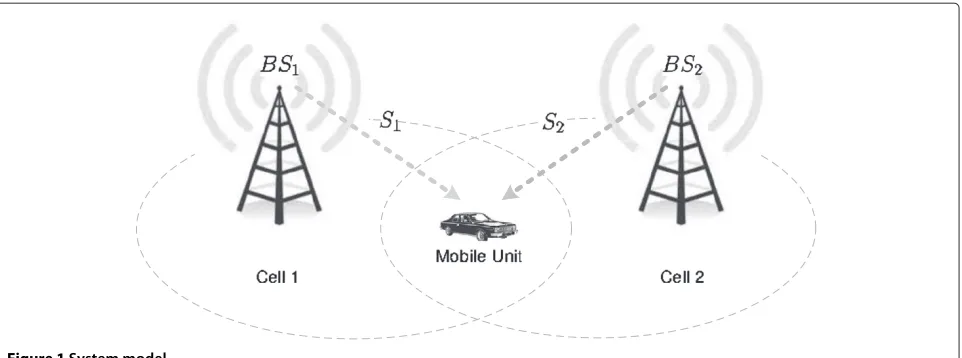
Consider a cellular network consisting ofKBSs, denoted asBS1 ∼ BSK and each equipped withMantennas. A mobile unit configured with N antennas is moving at a very high speed in the cell-edge area. Suppose that sig-nals are transmitted in blocks ofTsuccessive symbols and each cooperative BS is transmitting an individual signal to the mobile unit. The channels are assumed to be Rayleigh flat-fading and constant within one block in the signal formulation, however in the simulation we also evaluate the realtime channels in which the fading coefficients are changing as a function of time. Channels from the kth cooperative BS to the mobile unit are denoted by aM×N matrix Hk and all the elements within Hk are assumed to be independently complex Gaussian distributed with zeros mean and variance ofσk2. Obviously,σk2corresponds to the average power level of the link from thekth BS to mobile unit influenced by the large-scale fading. A typical example of the system is depicted in Figure 1, in which two cooperative BSs are involved. The benefits of the coop-eration are straightforward to be seen from Figure 1: the
link fromBS2which used to be interference link in the non-cooperative mode turns to be the desired link, not only eliminating the inter-cell CCI but also increasing the transmission rate.
Signal formulation
According to the system model mentioned above, for any block time, the received signals in baseband form can be represented by
X=√ρ K
k=1
SkHk+W, (1)
whereSk(T×M) is the signal from thekth cooperative BS,
W(T×N) is the additive noise observed at the receiver and follows independently complex Gaussian distributed with zeros mean and unit variance, andρrepresents the signal-to-noise ratio (SNR).
Conditioned on transmitted symbolSk,k=1, 2,. . .,K, the received signalX(T×N) has independent and iden-tically distributed columns (across theNreceiving anten-nas) [5]. At a particular antenna, theT received symbols are zero-mean symmetric complex Gaussian, withT×T covariance matrix
=IT+ ρ
M
K
k=1σk2SkS†k, (2)
whereIT is theT ×T identity matrix andA†represents the conjugate transpose ofA.
Then the conditional probability density of the received signals is calculated as
p(X|{S1,S2,. . .,SK})=
exp(−tr{−1XX†})
detN , (3)
where tr{·}denotes the trace function. Equation (3) pro-vides a basis to design the ML receiver.
ML receiver
We now consider the ML non-coherent reception of multi-cell unitary space-time modulated signals. Suppose the signals transmitted by different cooperative BSs are from the same constellation setS, named root constella-tion set, which consists ofLsignals, i.e.
Sk∈S = {
√
T1,√T2,. . .,√TL}, (4) in which l,∀l, are T × M unitary matrices satisfy-ing †ll = I and the scaling factor ensures that the transmitted signals meet the energy constraint so that
1
Figure 1System model.
= {S1,S2,. . .,SK} ∈ C, then to perform the ML receiver, (3) is to be maximized and ML decoding becomes
opt=arg max Sk∈S,∀k
p(X|{S1,S2,. . .,SK})
=arg max
Sk∈S,∀k
exp(−tr{[IT+MρKk=1σk2SkS†k]−1XX†})
πTNdetN[I
T+MρKk=1σk2SkS†k] ,
(5)
which is optimal in the sense of ML receiver.
Performance analysis
The probability of decoding error for the multi-cell coop-erative signals is analyzed in this section. The multi-cell signals within the cooperative constellation are no longer unitary, resulting in the more complicated PEP analysis compared with traditional unitary space-time modula-tion. The general case is firstly discussed, followed by the special case in which the unitary signals within the con-stellation set are mutually orthogonal. Pair-wise errors are categorized into three error patterns for the special case, which provides a baseline for the constellation opti-mization discussed in Section “Cooperative constellation optimization”.
General case
Consider the case that the transmit signals fromK coop-erative BSs are{S1,. . .,SK}while the detected signals are
{˜S1,. . .,S˜K}. The error probability is
P{˜S
1,...,˜SK}|{S1,...,SK} =P
e−tr[(IT+ρ/MKk=1σ2
kS˜kS˜†k)−1XX†] ˜
>
e−tr[(IT+ρ/MKk=1σ2
kSkS†k)−1XX†]
,
(6)
where ˜ = detN(IT + ρ/MKk=1σk2S˜kS˜ †
k) and = detN(IT + ρ/MKk=1σk2SkS†k). Due to the property of
unitary matrices,Kk=1σk2SkS†kandKk=1σk2S˜kS˜ † kcan be decomposed as following
K
k=1
σk2SkS†k=UU†,
K
k=1
σk2S˜kS˜†k= ˜U˜U˜ †
,
(7)
where bothUandU˜ are unitary matrices, bothand˜ are diagonal matrices. By taking (7) into (6) and invoking the matrix inversion lemma, (6) is written as
P{˜S
1,...,S˜K}|{S1,...,SK}=P
κ >M ρ log
˜
, (8)
where κ is defined as tr{X†[U˜(˜−1 + ρ/MIT)−1U˜† −
U(−1+ρ/MIT)−1U†]X}. By using the vector notation, κcan be further written as [13]
κ =vec(X)†[(IT⊗ ˜U)(IT⊗ ˜D)(IT⊗ ˜U)†
−(IT⊗U)(IT⊗D)(IT⊗U)†] vec(X), (9)
whereD=(−1+ρ/MIT)−1andD˜ =(˜− 1
+ρ/MIT)−1,
⊗denotes the Kronecker product of two matrices, vec(X) is obtained by stacking the columns ofXin the order from the first one to the last. According to (2) and (7), it is obvi-ous that the covariance matrix of vec(X)is calculated as
RX=ITN+ρ/M(IN⊗U)(IN⊗)(IN ⊗U)†. (10)
form in Gaussian vector vec(X), it is straightforward to obtain its CHF as
E[ exp(sκ)]=det(ITN−sDXRX)−1=
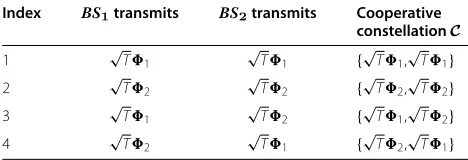
It is seen from (12) that the PEP expression for the general case is very complicated and not straightforward. Here, we extend the results to the special case, in which all the sig-nals within the root constellation are mutually orthogonal to each other, i.e. †ij = 0,∀i = j. Two-cell coopera-tion with the root constellacoopera-tion size of 2 is considered as a typical example, in which the cooperative constellation generated from the root constellation is shown in Table 1. It can be easily extended to the scenarios with more coop-erative cells or larger size of root constellation. To analyze the PEP, signal pairs are categorized into three patterns according to their different analysis methods, as shown in Table 2. The detailed PEP analysis will be derived based on different pairwise error patterns, respectively.
Pairwise error Pattern I
Pattern-I includes the pair of {√T1,√T1} and
{√T2,
√
T2}, indicating that both BSs transmit the same signals and detected signals are also the same. In this case, theDXRXin (11) can be calculated as
Table 1 Two-cell cooperative constellation based on the root constellation size of 2
Index BS1transmits BS2transmits Cooperative
constellationC
Table 2 Pairwise error pattern categories
Pairwise error pattern Pairs include
I {√T1,√T1} {√T2,√T2} matrix DXRX has 2MN eigenvalues, MN of which are
ρT(σ12+σ22)/M
1+ρT(σ12+σ22)/M and the restMN are−ρT(σ 2
1 +σ22)/M. According to (12), the PEP of this error pattern is
P√
Pairwise error Pattern II
The pair falling into this pattern are the signals of
{√T1, consist of the same root signals, but in different orders. TheDXRXin (11) can be calculated as
which also has 2MN eigenvalues, MN of which are
generality, assume σ12 ≥ σ22, therefore, the PEP of this
Pairwise error Pattern III
Consider the case that {√T1,√T1} is transmitted
Unlike the signal pairs of previous two patterns, the error probability when{√T1,√T2}is transmitted but
{√T1,
√
T1} is received is not the same as (22) due to the asymmetrical structure of these two signals. How-ever, following the same steps, the PEP for this case when M=N=1 is calculated as
For any types of modulation, the transmission rate Ris determined by the constellation size Z in R = log2Z. Compared with the root constellation,the size of coop-erative constellation increases fromZ = Lto Z = LK, leading to the increase of transmission rate. However, as it is well known, efficiency and reliability are two sides of the communication, which are hardly to obtain simulta-neously. Increase in constellation size may result in the closer Euclidean distance among signals, which degrades the transmission reliability. In this section, we will dis-cuss the cooperative constellation optimization problem to achieve the balance between the transmission rate and symbol-error rate (SER) performance. General speaking, some of the signals, which cause high error probabil-ity or even detection failure, will be removed from the signal constellation. For the ideal case, the goal of the optimization is to minimize the overall SER given any tar-get transmission rate fulfilled. In other words, following optimization problem should be solved
Copt=arg min
Ci⊆C Ps
s.t. |Ci|>Zˆ,
(24)
ρ
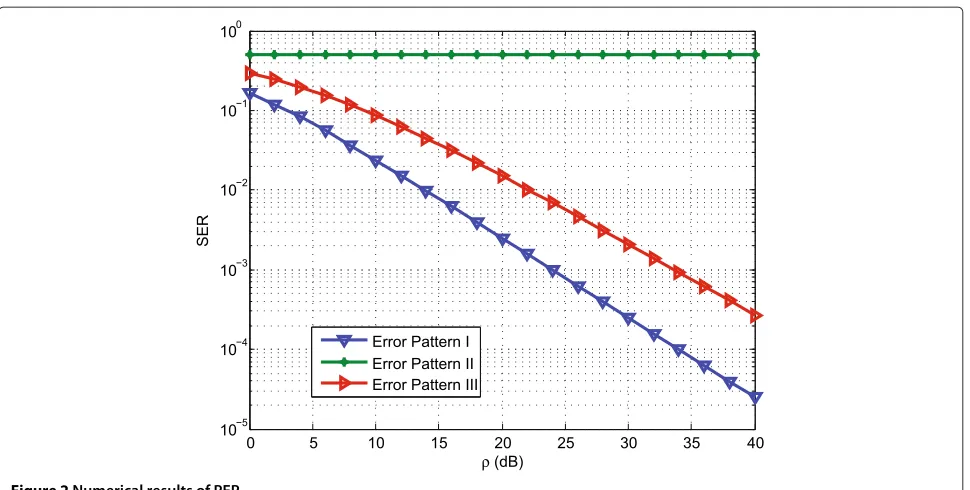
Figure 2Numerical results of PEP.
which can be further confirmed in Figure 2. This indi-cates the order of signal discarding in the process of the constellation optimization: to avoid Pattern-II error takes first priority, then the error Pattern-III and finally error Pattern-I. Table 3 gives an example of signal optimiza-tion based on the cooperative constellaoptimiza-tion presented in Table 1, when the target constellation sizes Z are set to 3 and 2, respectively. In this example, it is obvious to see whenZ=3 the Pattern-II pairwise error is prevented and whenZ = 2 both Patterns-II and III pairwise errors are prevented.
After the optimization, the SER performance may be upper-bounded in terms of PEP through the union bound [14]
Ps= 1 Z
Z
z=1
P{error|{S1,. . .,SK}}
= 1
Z Z
z=1
{˜S1,...,S˜K}={S1,...,SK} P{˜S
1,...,S˜K}|{S1,...,SK}. (25)
Table 3 Two-cell cooperative constellation optimization based on the root constellation size of 2
Index BS1
transmits
BS2
transmits C
opt,Z=3 Copt,Z=2
1 √T1
√
T1 {
√
T1,
√
T1} {
√
T1,
√
T1} 2 √T2 √T2 {√T2,√T2} {√T2,√T2}
3 √T1 √T2 {√T1,√T2} –
Simulation results
In the section, the performance of the cooperative trans-mission based on unitary space-time modulation will be evaluated by using Monte Carlo simulations. Different channel models are considered with respect to the speeds of the mobile unit, as well as the different symbol periods. For the root constellation construction, only the signals which are mutually orthogonal will be selected.
Block-constant channels are first considered, which provides the lower bounds in terms of SER performance.
Assume two-cell cooperation in whichM = N = 1 and
0 5 10 15 20 25 30 35 40
10−5
10−4
10−3
10−2
10−1
100
ρ(dB)
SER
Non−cooperative, Z = 2 Non−opt, Z=4 Union Bound, Z=4 Opt, Z=3 Union Bound, Z=3 Opt, Z=2 Union Bound, Z=2
Figure 3SER-versus-SNR.Block constant channels,T=2,σ12=1,σ22=0.32.
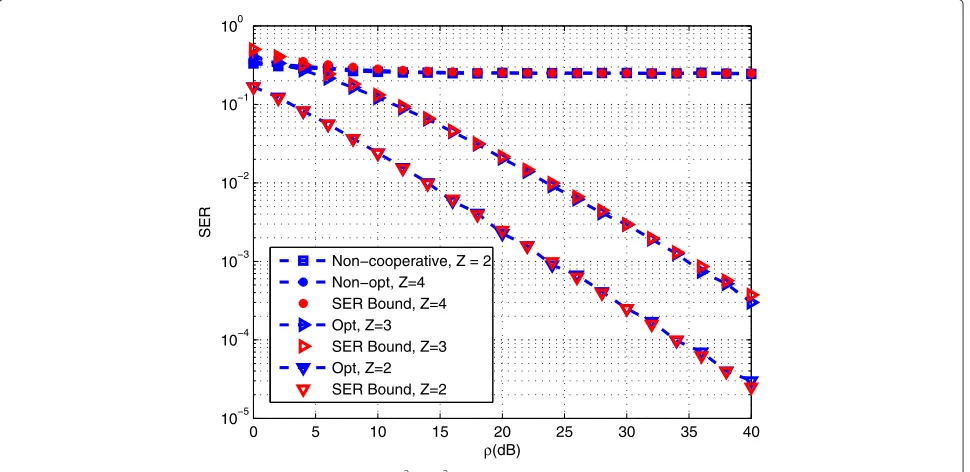
to 2. Besides the simulation results, the SER union bounds computed from (25) are also plotted in Figure 3, in which it is seen that the simulated SER are well-bounded by the SER union bounds. When the link power levels from the two cooperative BSs are equal, i.e.σ12 = σ22 = 1, same simulation is performed as the results shown in Figure 4. Non-cooperative case degrades in performance and has even worse error floor due to the increase level of CCI. On the contrast, the SER performance with optimized
cooperation improves by small degrees since both BSs transmits desired signals instead of interference. Figure 5 provides the SER results in terms of the constellation size Z, in which the symbol periodT increases to 5 and SNR ρ is set to 25 dB. As expected, in Figure 5 the SER per-formance degrades as the constellation sizeZ increases. Two critical points happen whenZ = 5 andZ = 15, in which the Pattern-III and Pattern-II errors are involved respectively, leading to the sharp increasing of SER.
0 5 10 15 20 25 30 35 40
10−5
10−4
10−3
10−2
10−1
100
ρ(dB)
SER
Non−cooperative, Z = 2 Non−opt, Z=4 SER Bound, Z=4 Opt, Z=3 SER Bound, Z=3 Opt, Z=2 SER Bound, Z=2
Figure 4SER-versus-SNR.Block constant channels,T=2,σ2
5 10 15 20 25
10−4
10−3
10−2
10−1
100
Constellation Size Z
SER
Opt, T=5
Figure 5SER-versus-Z.Block constant channels,T=5,ρ=25 dB.
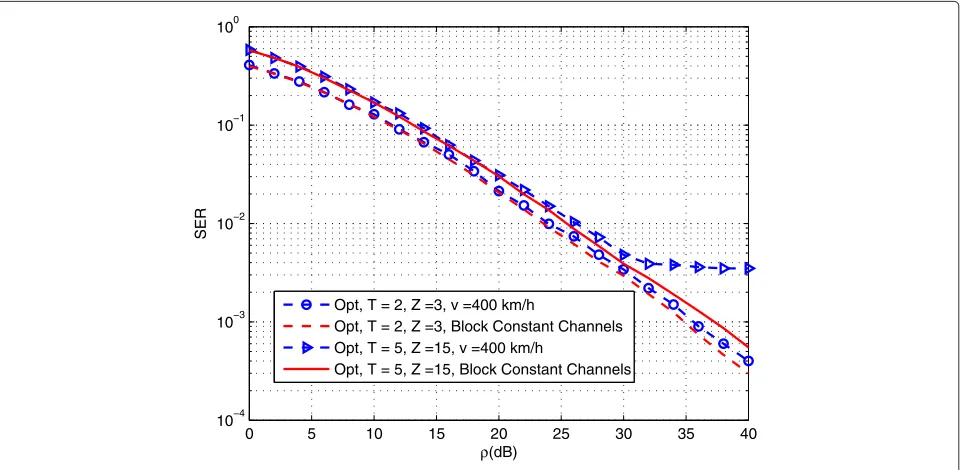
The fast fading channels are considered next. Accord-ing to the Jakes model [15], the autocorrelation function of the fading coefficients in wireless channels can be represented by the 0th-order Bessel function of the first kind, i.e.J0(2πfdTst), whereTsis the chip interval andfd corresponds to the maximum Doppler shift which can be further denoted by the carrier wavelengthλand velocity vasfd = λv. During the simulation, the carrier frequency
and chip rate are set to 2,400 MHz and 100 kBd, respec-tively. SER-versus-SNR curves are plotted in Figure 6, where the velocity of the mobile unit is assumed to be 400 km/h resulting in the correlation of 0.9992 between
two chips within one symbol when T = 2 and 0.9876
between the first and last chips when T = 5, respec-tively. As comparison, the results under block-constant channels are also plotted. From Figure 6, it is seen the
0 5 10 15 20 25 30 35 40
10−4 10−3 10−2 10−1 100
ρ(dB)
SER
Opt, T = 2, Z =3, v =400 km/h
Opt, T = 2, Z =3, Block Constant Channels Opt, T = 5, Z =15, v =400 km/h
Opt, T = 5, Z =15, Block Constant Channels
Figure 6SER-versus-SNR.Time-variant channels,v=400 km/h,σ2
0 200 400 600 800 1000
10−3
10−2
10−1
v(km/h)
SER
Opt, T = 2, Z =3 Opt, T = 5, Z =15
Figure 7SER-versus-speed.ρ=25 dB,σ12=σ22=1.
SER performance almost shows no difference as in
block-constant channels whenT = 2, whenT = 5, the SER
complies with the block-constant channels at the low SNR region, however, exhibits an error floor whenρincreases to 30 dB. Figure 7 plots the SER curves as a function of velocity in the case ofρ = 25 dB. WhenT = 2, the SER performance remains the same level even when the speed increases to 1,000 km/h, and in the case ofT = 5, SER also rises modestly untilv>600 km/h.
We also extend the proposed scheme to the doubly-selective channels, in which the unitary space-time modulation can work as the unitary space-frequency modulation by utilizing orthogonal frequency division multiplexing (OFDM) [16]. In the simulation, the carrier frequency and velocity of the mobile unit are still assumed to be 2,400 MHz and 400 km/h, respectively. OFDM with 2048 sub-carriers is exploited and the symbol durationTs is assumed to be 0.5/7 ms, which complies with the frame
0 5 10 15 20 25 30 35 40
10−4
10−3
10−2
10−1
100
ρ(dB)
SER
T = 4, M = 2, N = 2, Z = 2 T = 4, M = 2, N = 1, Z = 2 T = 4, M = 2, N = 2, Z = 3 T = 4, M = 2, N = 1, Z = 3
Figure 8SER-versus-SNR.Doubly-selective channel,σ2
structure of long term evolution (LTE) [17]. Figure 8 pro-vides the SER-versus-SNR curves, in which it is seen that the proposed scheme is still effective under the doubly-selective channels, though suffering from the error floor at the high SNR region which can be explained by the fact that time selectivity causes inter-carrier-interference (ICI) which restricts SER performance at the high-SNR region. Besides, more receiving antennas lead to more reliable reception, which can be confirmed from PEP expression that larger diversity gain can be achieved when more receiving antennas are involved.
Conclusion
This article proposed a multi-cell cooperative transmis-sion scheme based on unitary space-time modulation. Each cooperative BS sends an individual signal to a com-mon mobile unit therefore the inter-cell CCI is eliminated and the data transmission rate increases as well. Error probability for the proposed transmission scheme is ana-lyzed. Based on the PEP analysis, cooperative constella-tion optimizaconstella-tion is presented, in which by selecting the proper constellation subset, the overall SER is reduced. Simulation results confirm the effectiveness of the pro-posed transmission scheme in both block-constant chan-nels, fast fading channels and doubly-selective channels.
Competing interests
The authors declare that they have no competing interests.
Acknowledgements
This work was supported by the National Basic Research Program of China (973 Program No. 2012CB316100), the NSFC (No. 61032002 & No. 60872014) and the 111 project (No. 111-2-14).
Received: 15 February 2012 Accepted: 12 June 2012 Published: 10 August 2012
References
1. ITU-R, Guidelines for evaluation of radio interface technologies for IMT-Advanced. Rep. M, 2135 (2008 )
2. J Li, M Kavehrad, Effects of time selective multipath fading on OFDM systems for broadband mobile applications. IEEE Commun. Lett.3(12), 332–334 (1999)
3. H Steendam, M Moeneclaey, Analysis and optimization of the performance of OFDM on frequency-selective time-selective fading channels. IEEE Trans. Commun.47(12), 1811–1819 (1999)
4. Y Zhang, H Liu, MIMO-OFDM systems in the presence of phase noise and doubly selective fading. IEEE Trans. Veh. Technol.56(4), 2277–2285 (2007) 5. BM Hochwald, TL Marzetta, Unitary space-time modulation for
multiple-antenna communication in Rayleigh flat-fading. IEEE Trans. Inform. Theory.46(2), 543–564 (2000)
6. BM Hochwald, W Sweldens, Differential unitary space-time modulation. IEEE Trans. Commun.48(12), 2041–2052 (2000)
7. BL Hughes, Differential space-time modulation. IEEE Trans. Inf. Theory.46, 2567–2578 (2000)
8. B Bhukania, P Schniter, Multiple-symbol detection of differential unitary space-time modulation in fast-fading channels with known correlation. in Conference on Information Sciences and Systems (CISS). (Princeton University, 1–6 , 2002)
9. M Ramezani, M Hajiaghayi, C Tellambura, Receive antenna selection for unitary space-time modulation over semi-correlated ricean channels. IEEE Trans. Commn.58(2), 521–530 (2010)
10. GJ Foschini, K Karakayali, Coordinating multiple antenna cellular networks to achieve enormous spectral efficiency. Proc. IEEE Commun.153, 548–555 (2006)
11. H Zhang, H Dai, Cochannel interference mitigation and cooperative processing in downlink multicell multiuser mimo networks. EURASIP J. Wirel, Commun. Netw.2004(2), 222–235 (2004)
12. W Hardjawana, B Vucetic, Y Li, Multi-User cooperative base station systems with joint precoding and beamforming. IEEE J. Sel. Topic Signal Process.3(6), 1079–1093 (2009)
13. DP Liu, QT Zhang, Q Chen, Structures and performance of noncoherent receivers for unitary space-time modulation on correlated fast-fading channels. IEEE Trans. Veh. Technol.53(4), 1116–1125 (2004) 14. BM Hochwald, TL Marzetta, TJ Richardson, W Sweldens, R Urbanke,
Systematic design of unitary space-time constellations. IEEE Trans. Inf. Theory.46(6), 1962–1973 (2000)
15. WC Jakes,Microwave Mobile Communications[M]. (Piscataway, NJ, IEEE Press, 1993)
16. Z Jia, S Handa, F Sasamori, S Oshita, Multiple-symbol differential detection for unitary space-time–frequency coding. inConference of Circuits and Systems for Communications (ICCSC’08). (Shanghai, 139–142, 2008) 17. 3GPP TS 36.211 v910. Evolved Universal Terrestrial Radio Access (E-UTRA):
Physical Channels and Modulation (Release 9)
doi:10.1186/1687-1499-2012-251
Cite this article as:Liuet al.:Multi-cell cooperative transmission based on unitary space-time modulation.EURASIP Journal on Wireless Communications and Networking20122012:251.
Submit your manuscript to a
journal and benefi t from:
7Convenient online submission 7Rigorous peer review
7Immediate publication on acceptance 7Open access: articles freely available online 7High visibility within the fi eld
7Retaining the copyright to your article