R E S E A R C H
Open Access
Cross-layer link adaptation for goodput
optimization in MIMO BIC-OFDM systems
Riccardo Andreotti
1, Vincenzo Lottici
2and Filippo Giannetti
2*Abstract
This work proposes a novel cross-layer link performance prediction (LPP) model and link adaptation (LA) strategy for soft-decoded multiple-input multiple-output (MIMO) bit-interleaved coded orthogonal frequency division
multiplexing (BIC-OFDM) systems employing hybrid automatic repeat request (HARQ) protocols. The derived LPP, exploiting the concept of effective signal-to-noise ratio mapping (ESM) to model system performance over frequency-selective channels, does not only account for the actual channel state information at the transmitter and the adoption of practical modulation and coding schemes (MCSs), but also for the effect of the HARQ mechanism with bit-level combining at the receiver. Such method, named aggregated ESM, orαESM for short, exhibits an accurate performance prediction combined with a closed-form solution, enabling a flexible LA strategy, that selects at every protocol round the MCS maximizing the expected goodput (EGP), i.e., the number of correctly received bits per unit of time. The analytical expression of the EGP is derived capitalizing on theαESM and resorting to the renewal theory. Simulation results carried out in realistic wireless scenarios corroborate our theoretical claims and show the performance gain obtained by the proposedαESM-based LA strategy when compared with the best LA algorithms proposed so far for the same kind of systems.
Keywords: Orthogonal frequency division multiplexing (OFDM), Bit-interleaved coded modulation (BICM), Hybrid automatic-repeat-request (HARQ), Goodput, Link performance prediction, Link adaptation
1 Introduction
To meet the demanding need for ever increasing data rate and reliability, orthogonal frequency division multiplex-ing (OFDM), bit-interleaved coded modulation (BICM) [2], spatial multiplexing (SM) via input multiple-output (MIMO) [3], adaptive modulation and coding (AMC) [4], and hybrid automatic repeat request (HARQ) [5] are well-known techniques currently adopted, as advanced LTE (LTE-A) [6], and envisaged to be exploited in the future wireless systems [7]. To be specific, the HARQ technique combines the automatic repeat request (ARQ) mechanism with both the channel coding error correction and the error detection capability of the cyclic
*Correspondence: [email protected]
Part of this work was one of the subjects of the first author PhD thesis [1]. This work has been partially supported by the PRA 2016 research project 5GIOTTO funded by the University of Pisa and by SVI.I.C.T.PRECIP. project, in the framework of Tuscany’s “Programma Attuativo Regionale,” co-funded by “Fondo per lo Sviluppo e la Coesione” (FSC) and Italy’s Ministry for Education, University and Research (MIUR), Decreto Regionale n .3506, 28/07/2015 2Department of Information Engineering, University of Pisa, Pisa, Italy Full list of author information is available at the end of the article
redundancy check (CRC) [5]. If the CRC is successfully detected, the packet is correctly received and an acknowl-edgement (ACK) is fed back to the transmitter. Con-versely, a CRC failure means that the received packet is affected by uncorrected errors and a non-ACK (NACK) is sent back. In the latter condition, a retransmission of the corrupted packet is performed according to one of the following HARQ strategies [8]: (i) type I or Chase Com-bining (CC), the packet is retransmitted using the same redundancy; (ii) type II with partial Incremental Redun-dancy (IR), only a subset of previously unsent redunRedun-dancy is transmitted; and (iii) type II with full IR, the system-atic bits plus a different set of coded bits than those previously transmitted are sent. The HARQ mechanism potentials are fully exploited when the receiver suitably combines, e.g., using maximum ratio combining (MRC), the currently retransmitted packet with the previously unsuccessfully received ones, thus building a single packet whose reliability is more and more increased [5]. HARQ combining can be performed either on the received sym-bols or, should a different symbol mapping be employed in
each transmission round, at bit-level, i.e., by accumulating the bit log-likelihood ratio (LLR) metrics [9].
Background and related works. In the literature, a considerable effort has been put in quantifying the per-formance limits for HARQ-based transmissions, mainly focusing on the ergodic capacity and outage probability [10–12]. In [10], an information-theoretical study about the throughput of HARQ signaling schemes is given for the Gaussian collision channel. Then, starting from [10, 11] presents a mutual information (MI) based anal-ysis of the long-term average transmitted rate achieved by HARQ in a block-fading scenario, which allows to adjust the rate so that a target outage probability is not exceeded. In [12], the optimal tradeoff among throughput, diversity gain, and delay is derived for an ARQ block-fading MIMO channel with discrete signal constellations.
In order to further enhance the system performance, the HARQ approach can be made adaptive by applying link adaptation (LA) strategies that do not only account for the information coming not only from the physical layer, but also from the higher layer schemes based on packet com-bining, so obtaining a cross-layer optimization of the link resource utilization. Most of the works considering such an issue, however, focus on theoretical performance lim-its based on capacity and channel outage probability, as in [13–17]. Specifically, [13] investigates the problem of power allocation for rate maximization under quantized channel state information (CSI) feedback, [14] adapts the transmission rates using the outdated CSI, whereas [15] proposes two power allocation schemes: one minimizes the transmitted power under a given packet drop rate con-straint and the other minimizes the packet drop rate under the available power constraint. Note that in [13–15], IR HARQ is considered to optimize performance under nar-rowband fading channels. In [16], user and power are jointly selected in a multi-user contest under slow-fading channels and outdated CSI to maximize system goodput (GP), whereas [17] proposes a user, rate, and power allo-cation policy for GP optimization in multi-user OFDM systems with ACK-NACK feedback.
Only few recent works, however, consider practical modulation and coding schemes (MCSs). In [18], the out-lined AMC algorithm maximizes the spectral efficiency under truncated HARQ for narrowband fading channels. A power minimization problem under individual user GP constraint is tackled in [19] for an orthogonal frequency division multiple access (OFDMA) network employing type II HARQ and only statistical knowledge of CSI. The work in [20] proposes the selection of the MCS to maximize GP performance in MIMO-OFDM systems under CC HARQ, where the packet error rate is evaluated through the exponential effective SNR mapping (ESM) method (EESNR). A similar approach is proposed in [21],
although the physical layer performance is modeled using the MI based effective SNR (MIESM).
Rationale and contributions.In this paper, we propose a novel cross-layer link performance prediction (LPP) methodology for packet-oriented MIMO bit-interleaved coded (BIC)-OFDM transmissions which accounts for (i) practical MCSs, (ii) the HARQ mechanism with bit-level combining at the receiver, and (iii) the CSI informa-tion at the transmitter. The method allows the deriva-tion of an LA strategy which is capable of selecting the MCS that maximizes the number of information bits cor-rectly received per unit of time, or GP for short, at the user equipment (UE). The main features of the proposed method and the relevant improvements compared with the literature are outlined as follows.
1. The proposed LPP model, namedaggregated ESM, orαESM, relies on the ESM concept [22], which enables the prediction of the performance of a multicarrier system affected by frequency-selective fading by compressing all the per-subchannel (identified by the pair subcarrier and spatial stream) SNRs into a scalar value representing the SNR of a coded equivalent binary system working over additive white Gaussian noise (AWGN) channel.
• The LPP we put forward exhibits an accurate performance prediction combined with a closed-form solution which makes it eligible for practical implementation of LA algorithms. Indeed, at the generic protocol round (PR)of a given packet, theαESM is obtained recursively, by combining the aggregated effective SNR (ESNR), that stores the performance up to the previous retransmission (step−1), with the actual ESNR at PR, which depends on the current CSI and choice of the MCS.
2. The proposedαESM is derived from the ESM method originally proposed in [23] asκESM, by taking into account the per-subchannel SNRs along with the HARQ mechanism. The key idea of the αESM method is to properly combine together the bit LLR metrics relevant to the retransmissions of the same packet, with the result of increasing decoding reliability. Specifically, the combined bit LLR metrics are characterized following an accurate method based on the cumulant moment generating function (CMGF).
the MCS optimizing the GP metric within the retransmissions of the same packet, as a result, it enables a much more flexible LA strategy.
3. The formulation of the GP at the transmitter, named expected goodput (EGP), is derived resorting to the renewal theory framework [24] and the long-term channel static assumption [20, 21]. The goal is, indeed, to obtain a reliable performance metric that can lead to a manageable LA optimization problem. Towards this end, both theoretical and numerical analyses are employed throughout the paper to corroborate our claims and findings.
4. Finally, simulation results carried out over realistic wireless channels testify the advantages obtained employing the proposed LA strategy based on the αESM, when compared with the best algorithms known so far.
Organization. The rest of the paper is organized as follows. Section 2 describes the HARQ retransmis-sion mechanism and the MIMO BIC-OFDM system. In Section 3, after a brief rationale and review of theκESM
LPP, the proposed αESM model is derived. Section 4
derives the EGP formulation and describes the proposed GP-oriented (GO) LA strategy. Finally, Section 5 illus-trates the numerical results, whereas in Section 6, a few conclusions are drawn.
Notations.Matrices are in uppercase bold, column vec-tors are in lowercase bold, [·]Tis the transpose of a matrix or a vector,ai,jrepresents the entry(i,j)of the matrixA,
×is the Cartesian product, calligraphic symbols, e.g.,A, represent sets,|A|is the cardinality ofA,A(i)is theith element ofA,·denotes the ceil function, and Ex{·}is the
statistical expectation with respect to (w.r.t.) the random variable (RV)x.
2 System model
In this section, we first describe the HARQ retransmission protocol. Then, the MIMO BIC-OFDM signalling system is outlined.
2.1 HARQ retransmission protocol
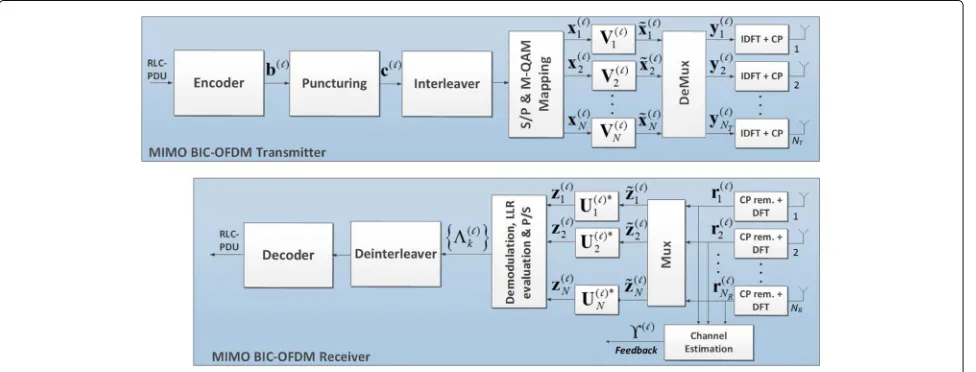
In order to enable reliable and spectral efficient packet transmissions, a HARQ retransmission protocol, with a maximum ofLrounds, is jointly designed along with an AMC mechanism. The information to be transmitted is conveyed by packets (typically IP packets) received from the upper layers of the stack, i.e., layer 3 and above, and stored in an infinite-length buffer at the data link layer. At the radio link control (RLC) sublayer, each packet is mapped into a RLC protocol data unit (PDU) made of the three sections: (i) header, with sizeNh; (ii) payload, with sizeNp; and (iii) CRC for error detection, with sizeNCRC. As shown in Fig. 1, at the generic PR∈LPR{1,· · ·,L},
the RLC-PDU is encoded with a code rater() ∈ Dr
{r0,r1,· · ·,rmax}, thus producing Nc() Ns/r() ≤ ¯Nc
coded binary symbols, or coded bits for short, whereNs
Nh+Np+NCRCandNc¯ Ns/r0, which is the number of coded bits at the output of the mother code, i.e., prior to puncturing. TheNc()coded bits are transmitted using the MIMO BIC-OFDM system described in Section 2.2 over the available bandW.
After the transmission of each packet1, the receiver sends back a 1-bit feedback about the successful (ACK) or unsuccessful (NACK) packet reception. Whenever a NACK is received, the transmitter sends again the packet by encoding it with either the same puncturing pattern, a different subset of redundancy bits, or a tradeoff, according to the type of HARQ. This goes on until the transmitter receives an ACK or the maximum number of retransmissionsL is reached. For both cases, the packet
is removed from the buffer and the transmitter moves on sending the subsequent ones. At the receiver side, according to the HARQ scheme, for a given packet, the previously unsuccessfully received copies are stored and combined with the new received ones, thus creating more reliable metrics [5]. Since at each PR a different symbol mapping per subchannel may be applied, it is not possi-ble to pre-combine received symbols. Hence, the packet combining strategy consists of accumulating the bit LLR metrics [9], as explained in detail in the following sections.
2.2 MIMO BIC-OFDM system
At the PR ∈ LPR, the Nc() coded bits are randomly interleaved and mapped onto the physical resources available in the space-time-frequency grid of the MIMO BIC-OFDM system, whose equivalent block scheme is depicted in Fig. 1. Specifically, we consider a MIMO
BIC-OFDM system with N available subcarriers, NT
transmit and NR receive antennas, employing SM and
uniform power allocation across the subchannels. We further assume a block-fading channel model and spa-tially uncorrelated antennas. Moreover, denoting with
H()n ∈ CNR×NT, the channel matrix over the nth sub-matrix where the off-diagonal elements are zero, while the ordered diagonal elements areϑn(),1 ≥ϑn(),2 ≥ · · · ≥ϑn(),M≥ 0, withMmin{NT,NR}. Thus, at most, the system con-sists ofC=N·Mparallel subchannels. In the following,
A1) we assume the CSIH()n ,∀n∈N, to be known at the transmitter side.
Specifically, with reference to Fig. 1, the interleaved sequence of punctured coded bits is subdivided into sub-sequences ofm()n,νbits each, which are gray-mapped onto the unit-energy symbolsx()n,ν ∈ 2m
()
n,ν-QAM constellation,
i.e., one symbol per available subchannel (n,ν) ∈ C {(n,ν)|1 ≤ n ≤ N, 1 ≤ ν ≤ M}, withm()n,ν ∈ Dm =
{2, 4,· · ·,mmax}.
Further, let us denote ()(·,·,·) as a function map-ping the puncturedNc()coded bits, out of theNc¯ coded
bits at the output of the mother code, into the label bits of the QAM symbols transmitted on the available sub-channels, summarizing the puncturing, interleaving, and QAM mapping functions. Specifically, ()(j,n,ν) = k
According to the SM approach, each sequence of
QAM symbolsx()n 1,· · ·,NT, to which conventional inverse discrete Fourier transform (DFT), parallel-to-serial conversion, and cyclic prefix (CP) insertion are applied. The resulting signal is then transmitted over a MIMO frequency-selective block-fading channel, using NOFDM() Nc()/(n,ν)∈Cm()
n,ν
OFDM symbols.
At the receiver side, after CP removal and DFT process-ing at each antenna, we get
r()ν1 =
is the thermal noise vector, whose generic entry is a zero-mean circular symmetric complex Gaussian RV with standard deviation σn(),ν. After demultiplexing the
received vectors r()ν1,ν1 = 1,· · ·,NR,z˜
via U()n , the output samples over each subcarrier are
obtained as [25]
BIC-OFDM channel can thus be seen as a set ofC
par-allel subchannels, represented by the diagonal matrix
γn(),ν
Finally, the receiver evaluates the soft metrics, followed by de-interleaving and decoding.
3 Link performance prediction for HARQ-based MIMO BIC-OFDM systems
This section is organized as follows. In Section 3.1, the rationale underlying the LA strategy and LPP method
is recalled. In Section 3.2, the concept of the κESM
ESNR technique for MIMO BIC-OFDM systems with simple ARQ mechanism is briefly summarized. Finally,
in Section 3.3, the novel LPP method, named αESM,
is derived for HARQ-based MIMO BIC-OFDM systems with bit-level combining.
3.1 Rationale of the adaptive HARQ strategy
The approach to follow is to properly choose the param-eters of the system described in Section 2.2, e.g., mod-ulation order and coding rate, in order to obtain the best link performance. Such LA strategy can be for-malized as a constrained optimization problem where the objective function, representing the system perfor-mance metric, is optimized over the constrained set of the available transmission parameters. Specifically, for a packet-oriented system, information-theoretical perfor-mance measure based on capacity, which relies on ideal assumptions of Gaussian inputs and infinite length code-books, is inadequate to give an actual picture of the link performance [26]. More suitable metrics have been recently identified as the packet error rate (PER) and the GP [20, 21, 26], which in turn depends on the PER itself. Therefore, a simple yet effective link performance pre-diction method is required, accounting for both the CSI as well as the information coming from different tech-niques that further improve the transmission quality, i.e., the HARQ mechanisms with bit-level combining. In the sequel, we will focus on LPP techniques based on the well-known ESM concept, which has been shown to be the most effective framework to solve this issue, especially for multicarrier systems [22].
3.2 Background on theκESM LPP model
In multicarrier systems, where the frequency-selective channel introduces large SNR variations across the sub-carriers and practical modulation and coding schemes are adopted, an exact yet manageable expression of the PER reveals to be demanding to derive. Due to these above reasons, ESM techniques are successfully employed, according to which the PER depends on the SNRs on each subcarrier through a scalar value, called ESNR. The latter represents the SNR of a single-carrier equivalent coded system working over AWGN channel, whose performance
can be simply evaluated either off-line according to ana-lytical models [27].
Within the ESM framwork, the κESM method,
pro-posed for MIMO BIC-OFDM systems in [23], shows a remarkable tradeoff between accuracy and complexity when ARQ mechanisms are applied without any combin-ing at the receiver. Such technique is based on the in-depth statistical characterization of the soft metrics at the input of the decoder, i.e., the bit LLR metrics()k , which, for the Section 2.2 after (1),
λj
denotes the bit decoding metric, bk is the complement
of bk, χ(a,j,n,ν) represents the subset of all the symbols
belonging to the modulation adopted on the subchannel
(n,ν), whosejth label bit is equal toa, whereaszn(),ν is the generic entry of the vectorz() defined in (3) with γn(),ν
given by (4). If coded bitb()k is not transmitted, i.e., it is punctured at PR, note that()k 0. After a few approx-imations, it is shown in [23] that the PER performance of the coded MIMO BIC-OFDM system over frequency-selective channel is accurately given by that of a coded BPSK system over AWGN channel having SNR equal to
theκESM ESNR
n,ν being the constant values depend-ing on the modulation order adopted on subchannel(n,ν) at PR. Expression (7) comes from the CMGFκ()(sˆ)
log Eesˆ ()k
of the bit LLR metric ()k given by (5)
evaluated at the saddlepoint ˆs = 1/2 and, specifically,
From (7)–(8), it has to be pointed out thatγ()depends on the modulation order adopted on each subchannel
given().
3.3 TheαESM model
In this section, we introduce the concept of aggregate
ESNR mapping, or αESM for short, in order to predict
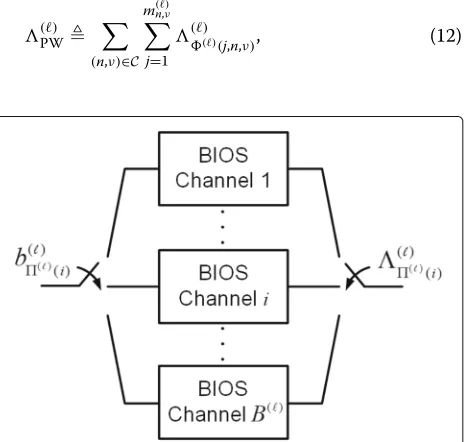
the performance of the system of interest under HARQ mechanism. Specifically, by extending to the HARQ con-text, the method presented in [28] for the estimation of the pairwise error probability (PEP), the key idea of theαESM we will propose is built upon two concepts: (i) the decod-ing score, a RV whose positive tail probability yields the PEP [28], and (ii) the equivalent binary input output sym-metric (BIOS) model of the BICM scheme [2] applied to the MIMO BIC-OFDM system described in Section 2.2. According to the latter, at each PR ∈ LPRand for each
of the NOFDM() symbols during such round, the MIMO
BIC-OFDM channel is modeled as a set of
B() (n,ν)∈C
m()n,ν (9)
parallel BIOS channels. We recall from Section 2.2 that
B()·NOFDM() ≥ Nc(). From now on, for the sake of
sim-plicity but w.l.g., we assume that only one OFDM symbol is sufficient for the transmission of theNc()-bit-long
code-word, so that the dependence on the OFDM symbol index is avoided. In particular, we haveB()=Nc().
Considering that the exact estimation of the PER for the system at hand is a demanding problem, we will first eval-uate the PEP expression, then resort to the standard union bound. The one-to-one mapping between the codeword and the associated vector of modulation symbols allows us to express the PEP as follows. Letc()
c()1 ,· · ·,c() Nc()
be the reference codeword (corresponding to the
trans-mitted RLC-PDU at the th PR) at the output of the
puncturing device andc() c()1 ,· · ·,c() Nc()
the
com-peting codeword, beingc()i theith coded bit after punc-turing. Besides, let us define()(i)=k,i=1,· · ·,Nc(), k ∈ {1,· · ·,N¯c}, as the puncturing mapping such that c()i = b()()(i), whereb()()(i)is thekth coded bit prior to
puncturing. Then, upon denoting the reference and
com-peting codewords as b()
b()()(1),· · ·,b() ()N()
c
and b()
b()()(1),· · ·,b() ()Nc()
, respectively, the
PEP results as
PEP
b(),b()
Pr
λb(),z()
> λb(),z()
,
(10)
whereλ(·)is the soft decoding metric depending on the chosen decoding strategy. In the sequel, we will first recall the case where no bit combining is performed [28], and then, we will extend this approach to thebit-level combin-ing receiver, which represents the novel contribution of the work.
No bit combining at the receiver. With reference to the equivalent BIOS model of the MIMO BIC-OFDM system as depicted in Fig. 2, the following observations hold.
• The input to thei th BIOS channel,1≤i≤B(), is the bitb()()(i), which is mapped in thej th position of the label of the QAM symbolx()n,νsent on subchannel (n,ν), being()(j,n,ν)=k.
• The output is the bit log-likelihood metric()k , also named bit score, evaluated as in (5).
• The decoder metric for the reference codewordb()is the BICM maximum a posteriori metric results as [28]
λ(b(),z())= (n,ν)∈C
m()n,ν
j=1
λj
b()()(j,n,ν),z()n,ν
,
(11)
whereλj(·,·)is the decoding metric associated to bit b()()(j,n,ν), evaluated according to (6), whereas that
one for the competing codewordb() is obtained as in (11) by simply replacingb()withb().
Hence, the pairwise decoding score (PDS) relevant to the transmitted codewordb()with respect tob() can be written as2
()PW
(n,ν)∈C m()n,ν
j=1
()()(j,n,ν), (12)
where the LLR bit metric ()()(j,n,ν) is defined by (5).
Therefore, upon plugging (11) evaluated for bothb()and
b() in the PEP expression (10), after some algebra, we obtain
Bit-level combining at the receiver. The optimal receiver that accounts for the combination of all the received copies should perform a joint decoding of the pairwise decoding scores over all the possible L trans-missions. However, it would result in an unfeasible com-plexity, exponentially increasing withL[29]. On the other side, exploiting the bit-level combining offers an effec-tive trade-off between performance and complexity [30]. Accordingly, this is the approach we will pursue in the sequel. The decoding metric in (11) shall now account for the recombination mechanism up to the PR. At every PR indeed, the actual bit scores are evaluated as in (5) and, for each bit k, added to the bit scores evaluated during the previous PRs. Thus, the output of the equivalent BIOS channel is now theaggregate bit score
L()k q()k T()k , (14) 0 if it has been punctured. In turn, theaggregate PDSat roundis given by
Then, after some algebra, the PEP using bit-level com-bining at the receiver results as
PEP(b(),b())=Pr
where the expectation is done w.r.t. all the random vari-ables, and rely on the following assumption:
A2) the patternq()k can be modeled as a sequence of independent and identically distributed (i.i.d.) binary RVs taking values 0 or 1, independently of the bit indexk.
The above is motivated by the fact that at each PR, a random subset of the coded bit is selected among the
ones at the input of the puncturing device. As a conse-quence ofA2, the puncturing pattern can be designated asq()=[q(1),· · ·,q()]T. Then, exploiting the law of total probability, from (14), the CMGF (17) turns out to be
κL()(s)=log possible puncturing patternsq¯()over the firstPRs. Fur-ther, recalling that κ()(ˆs) log Eeˆs()k
Following the line of reasoning about the no bit com-bining case previously recalled [28], in case of sufficiently long interleaving and linear binary code, the per-round bit scores()k are, to a practical extent, i.i.d RVs and inde-pendent ofq(). Hence, resorting to the so-called Gaussian approximation, the PEP can be approximated by [31]
PEP(d)Q
−2dκL()(ˆs) , (20)
wheredis the Hamming distance betweenb()andb()
andˆsrepresents the saddle point, withsˆ= 1/2 for BIOS channels [31].
The above expression (20) can be seen as the PEP of an equivalent coded BPSK system operating over AWGN channel with SNR equal to−κL()(ˆs). Thus, using (19) and exploiting the first equality in (7), we can eventually define theaggregate effective SNR, orαESNR for short, as
()α −log theith HARQ round, derived in [23] and reported in (7).
In conclusion, (21) can be property rearranged, leading to the result stated in the following.
where r()is the coding rate employed at PR,1≤≤L, (1)
α =γ(1), R(1)=r(1),
ξ() r() R(−1), R
()min{R(−1),r()}, 1< ≤L,
(23)
and
g(x,a)=
−log1+a(e−x−1), r()≤R(−1)
x, r()>R(−1), 1< ≤L,
f(x,a)=
x, r()≤R(−1)
−log1+1a(e−x−1), r()>R(−1), 1< ≤L. (24)
ProofSee Appendix A.
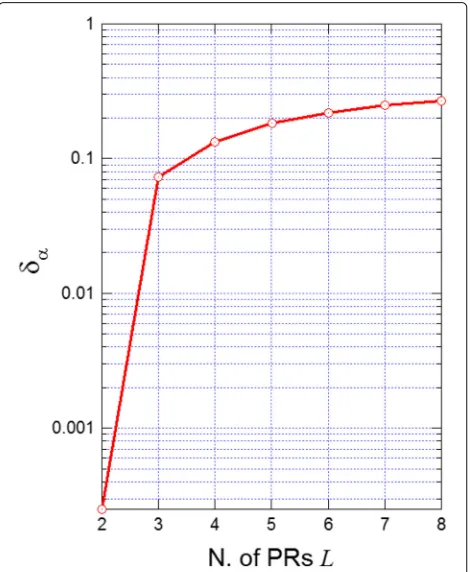
RemarkIn order to evaluate the tightness of the lower bound of in Theorem 1, the relative error δα
()α − ¯()α
/ ()α is depicted in Fig.3, with¯()α being the right-hand side of (22), i.e., the lower bound on the true αESM value, while the exact expression (21) is evaluated numerically, as a function of the PRs∈ [1, 8]. Specifically, for a given value of , α() is averaged over
Fig. 3Relative error between the exactαESM value and lower bound
Navg = 104 independent realizations. At each realiza-tion: the sequence of coding rates{r(i)}i=1, thanks to which the puncturing patterns probability in(21)are evaluated, is randomly drawn from the set of available coding rates
Dr; the sequence of ESNRs{γ(i)}i=1is drawn as γ(i)dB ∈
U[−3, 3]. The lower bound(22)is evaluated for the above sets{r(i)}i=1and{γ(i)}i=1and then averaged over the Navg realizations. In Fig.3, despite the derived lower bound gets looser for higher L, it can be considered tight for more prac-tical values of L, i.e., at least for L≤5. In particular, it can be noted that it is very accurate up to L=3, where we have δα≤0.07.
Upon definingϕ() {m(),r()}as the MCS at PR, withm()n,ν = m(),∀(n,ν) ∈ C,m() ∈Dmandr()∈ Dr,
so thatϕ()∈Dϕs Dm×Dr is the set of the allowable
MCSs, a few comments are now discussed.
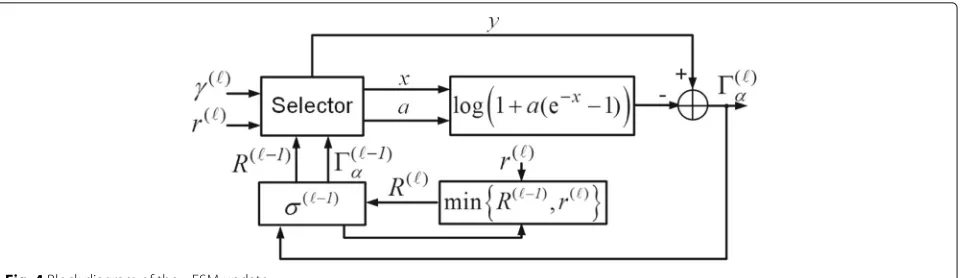
1. Updating()α through (22) requires only (i) the aggregate quantitiesα(−1)andR(−1)related to the
previous(−1)th step, (ii) together with theκESNR γ(), which is evaluated at the currentth PR according to (7), based on the current SNRsϒ()and MCSϕ(). Accordingly,σ()α(),R()can be defined as the “state” of the HARQ scheme we are processing. Hence, theαESNR()α at theth PR depends only on the stateσ(−1)(related to the past retransmissions up to the(−1)th one), the current SNRsϒ(), both known at PRat the transmitter, and the MCSϕ(), which stands for the optimization parameter to find in order to improve the link performance. Thus, theαESM can be written as ()α (ϕ()|(σ(−1),ϒ())), whereas theκESM in (7) can be expressed asγ()(ϕ()|ϒ()). The update recursion is depicted in Fig. 4, where the selector output is(x,y,a)=γ(),α(−1),R(−1)/r()if
r()>R(−1)or(x,y,a)=α(−1),γ(),r()/R(−1) ifr()≤R(−1).
2. The PER performance of the MIMO BIC-OFDM system over frequency-selective fading channel with HARQ and packet combing mechanism can be approximated up to roundas
PERϕ(1),· · ·,ϕ(),ϒ(1),· · ·,ϒ()r()
()
α (ϕ()|(σ(−1),ϒ()))
,
(25)
wherer()
Fig. 4Block diagram of theαESM update
monotone decreasing and convex function in the SNR region of interest [27].
3. It can be shown that the lower-bound (22) is exactly met whenr()≤R(−1),1≤≤L, i.e., if the coding rate decreases along the retransmissions.
4. Under the assumption that the coding rate is not adapted, i.e.,r(j)=r(j−1),2≤j≤, then α()=γ
(j)
j=0, thus meaning that the aggregate ESNR
of the HARQ mechanism is obtained as expected by accumulating the ESNRs evaluated at each PR.
4 Link adaptation for EGP optimization
In this section, we first derive the EGP expression under a
HARQ mechanism according to theαESM concept. Then,
in order to choose the modulation and coding parameters, we formulate aper-roundαESM-based LA strategy, which optimizes the GP performance metric.
4.1 Expected goodput formulation
Capitalizing on the results gained in the previous section, let us now derive the expression of the EGP metric at the generic PR. Toward this end, we resort to therenewal theory[24], which was first introduced in [32] to analyze the throughput performance of a HARQ system, under the assumptions of error- and delay-free feedback channel and infinite-length buffer.
As an initial step, let us assume that at the th PR,
the system has previously experienced−1
unsuccess-ful packet transmission attempts and there are stillL− + 1 PRs available. Then, let us define arenewal event
as the following occurrence: the system stops transmit-ting the current packet because either an ACK is received or because the PR limitLis reached. Let
X()i
be inde-pendent identically distributed non-negative RVs,
denot-ing the time elapsed between the renewal event i and
i+1, i.e., the inter-renewal time, and
Z()i
a sequence of independent positive randomrewardsearned at every renewal event.
Theorem 2(Renewal Reward Theorem, [24]) The long-time average reward Y()(t)per unit of time satisfies
lim
t→∞
1
tY
()(t)= E
Zi()
EXi()
. (26)
ProofFrom the renewal theory [24].
RemarkTheorem2states that the accumulated reward over time equals the ratio between the expected reward
EZ()i and the expected time EX()i in which such reward is earnead.
In light of Theorem2 and theαESM model derived in Section3.3, the EGP metric can be formulated as follows.
Theorem 3The EGP at theth PR for the HARQ-based system is
η()ϕ()|σ(−1),ϒ()
= Np
W
1−PUPD
ϕ(),()
α ,· · ·,α(L)
Tf
ϕ(i)−1
i=1
+TD
ϕ(),()α ,· · ·,(L)α ,
(27)
where
PUPD
ϕ(),α(),· · ·,(L)α
L−
j=0
r()
α(+j)
ϕ()|σ(−1),ϒ()
(28)
represents the the probability of unsuccessful packet decod-ing (UPD) within the retry limit L, Tf
{ϕ(i)}−1
i=1
TD
ϕ(),()α ,· · ·,(L)α Tu(ϕ())·
L−
j=0 ⎡
⎣(j+1)1−r()
(α+j)
ϕ()|σ(−1),ϒ()
·
j
k=0
r()
(+k−1)
α
ϕ()|σ(−1),ϒ() ⎤ ⎦
(29)
is the expected delivery time, with
Tu(ϕ())=
NsTB
r() (n,ν)∈Cm
() n,ν
(30)
denoting the time interval required to transmit a packet of Nc() = Ns/r()coded bit employing MCSϕ(), and TB
being the OFDM symbol duration.
ProofSee Appendix B.
The following remarks are now in order.
1. Thanks to long-term static channel assumption:
A3) at PR, each packet experiences the current channel conditionϒ())over its possible future retransmissions, thenϕ(+j)=ϕ(),
j∈[0,L−].
Therefore, at theth PR, the ESNRs
()α ,(α+1),· · ·,(α+L)are only function ofϕ() given the status(σ(−1),ϒ()), i.e., we can write
(α+j)%ϕ()|σ(−1),ϒ()&,j∈[0,L−].
2. AssumptionA3may seem counterintuitive. Indeed, if the channel does not change, there would not be the need to adapt the MCS at each retransmission. However, the channel does change from PR to PR and, everytime, the corresponding metric is fed back to the transmitter (see assumptionA1). The latter exploits this information to evaluate the EGP and adapt the MCS for the current retransmission. As a matter of fact, it is only for the sake of evaluating the EGP that the channel is assumed, during the following PRs, to be constant and equal to the current one, so as to obtain a manageable expression for the EGP.
3. The UPD expression (28) is obtained assuming independent PER among the PRs, even though they are related by the recursiveαESM expression. Such an assumption is confirmed in Section 5, where numerical results obtained over realistic wireless channels show that the proposed LA strategy, optimizing the EGP, outperforms the best LA known so far.
4. Recalling remark 1) and approximating theαESM ()α (ϕ()|(σ(−1),ϒ()))with the lower bound given by Theorem 1, we have
(α+j)
ϕ()|σ(−1),ϒ()
=g
(−1) α ,ξ()
+(j+1)f
γ()ϕ()|ϒ(),ξ(),
≤j≤L−.
(31)
Expression (31) can be simply shown by induction upon noting that, due to remark 1), we have ϕ(+j)=ϕ()and hencer(+j)=r()and γ(+j)=γ(), forj∈[0,L−].
Thus, remark 4) paves the way for the following proposition.
Proposition 1Upon plugging(31)into(28)and(29), the EGP(27)turns into
ζ()ϕ()|σ(−1),ϒ()
= Np
W
1−PUPD%ϕ()|%σ(−1),ϒ()&&
Tf
ϕ(i)−1 i=1
+Tu(ϕ())φ%ϕ()|%σ(−1),ϒ()&& ,
(32)
where
PUPD
ϕ(),α(),· · ·,α(L)≡PUPD
ϕ()|σ(−1),ϒ()=
= L−
j=0 r()
gα(−1),ξ()
+(j+1)f
γ()ϕ()|ϒ(),ξ(),
(33)
whereas TD
ϕ(),()
α ,· · ·,(L)α
given by (29) turns
into TD%ϕ()|%σ(−1),ϒ()&&=Tu%ϕ()&φ%ϕ()|%σ(−1),
φϕ()|σ(−1),ϒ()
L−
j=0 ⎡
⎣(j+1)1−r()
gα(−1),ξ()+(j+1)fγ()ϕ()|ϒ(),ξ()
·
j
k=0
r()
g(α−1),ξ()+kfγ()ϕ()|ϒ(),ξ() ⎤ ⎦.
(34)
It is worth noting that:
1. In view of the normalization by the OFDM signal bandwidthW, the EGP in (32) can be read as a spectral efficiency metric measured in (bit/s/Hz); 2. Due to (31), it is apparent that the EGP depends on
the MCS only, which has to be optimized according to the AMC optimization problem (OP) outlined in the next section.
4.2 Goodput-oriented-AMC (GO-AMC) OP
The AMC OP whose objective function is given by the EGP (32) is summarized in the following proposition.
Proposition 2 (GO-AMC)The GO-AMC OP consists at each PR in searching for the best MCS ϕ()o that
maximizes the EGP(32)according to
ϕ()o = arg max
ϕs
ζ()%ϕ|%σ(−1),ϒ()&&
s.t. ϕ∈Dϕs
. (35)
The OP (35) can be easily solved through an exhaustive search over all the pairs of modulation order and cod-ing rateϕ ∈ Dϕs. Since all the quantities to be evaluated
have a closed-form expression, it can be pointed out that the complexity of the GO-AMC OP simply reduces to O(|Dϕs|) =O(|Dm| · |Dr|), i.e., linear with the allowable
MCS pairs.
5 Simulation results
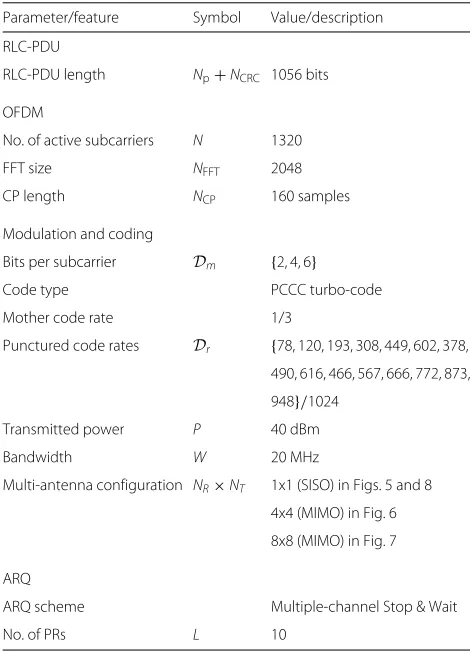
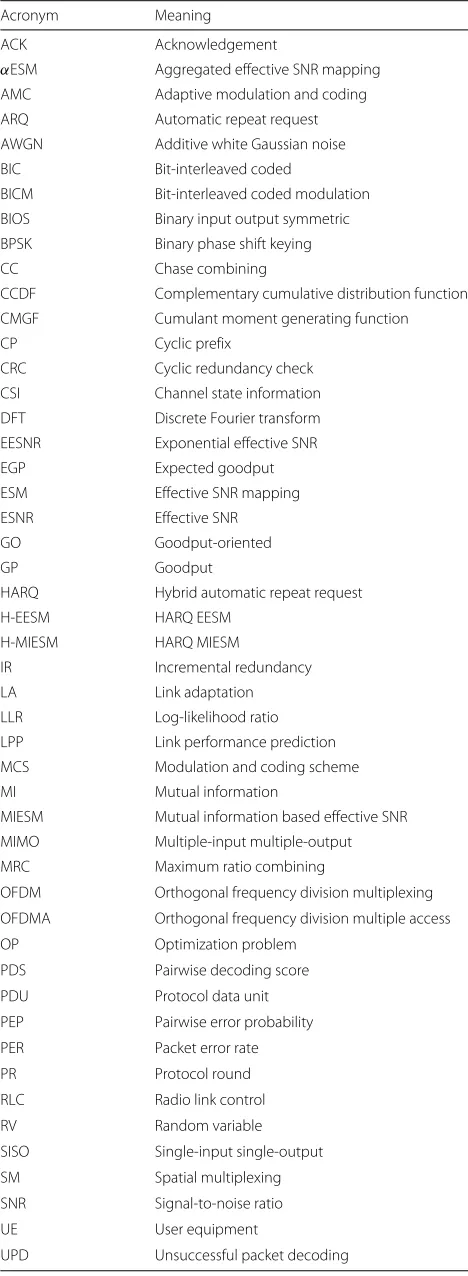
Numerical simulation tests have been carried over typi-cal wireless links between a generic eNodeB-UE pair to verify the effectiveness of the proposed LA algorithm when the proposed HARQ scheme is applied. The list of parameters/features of both the MIMO BIC-OFDM system and the wireless channel adopted for the simula-tions are reported in Tables 1 and 2, respectively, whereas Table 3 reports the list of acronyms. In the following, for simplicity and w.l.g., we assume the header sizeNh=0, so that the number of bit to code turns to beNs=Np+NCRC; see Table 1. Specifically, we consider an LTE-compliant eNodeB based on turbo parallel concatenated convolution
code (PCCC) with mother code 1/3 and rate matching
mechanism [33], giving rise to the equivalent coding rates listed in the setDrof Table 1. The performance metric is
evaluated as a function of the average symbol energy-to-noise spectral density ratioEs/N0, and obtained averaging over 103 independent channel realizations. The perfor-mance of the proposed algorithm is compared against that of the best known LA algorithms published in the lit-erature that also account for the HARQ mechanism, as outlined hereafter. The benchmark algorithm [20], tagged as HARQ EESM (H-EESM), selects the best MCS that maximizes the EGP by exploiting the EESM method to predict the link performance. The second one, tagged as HARQ MIESM (H-MIESM), was originally suggested in
Table 1Parameters and features of the HARQ-based MIMO
BIC-OFDM system
Parameter/feature Symbol Value/description
RLC-PDU
RLC-PDU length Np+NCRC 1056 bits
OFDM
No. of active subcarriers N 1320
FFT size NFFT 2048
CP length NCP 160 samples
Modulation and coding
Bits per subcarrier Dm {2, 4, 6}
Code type PCCC turbo-code
Mother code rate 1/3
Punctured code rates Dr {78, 120, 193, 308, 449, 602, 378,
490, 616, 466, 567, 666, 772, 873,
948}/1024
Transmitted power P 40 dBm
Bandwidth W 20 MHz
Multi-antenna configuration NR×NT 1x1 (SISO) in Figs. 5 and 8
4x4 (MIMO) in Fig. 6
8x8 (MIMO) in Fig. 7
ARQ
ARQ scheme Multiple-channel Stop & Wait
Table 2Parameters and features of the wireless propagation channel model
Parameter/feature Value/description
Path-loss model NLOS urban scenario [IEEE 802.16]
Carrier frequency 2 GHz
Base station height 12.5 m
Mobile terminal height 1.5 m
Noise power level −100 dBm
Long-term fading model Log-normal distribution
Variance of the shadowing 6 dB
Short-term fading model 3 GPP typical urban channel
the introduction of [21], though no analysis nor perfor-mance is shown therein. The H-MIESM algorithm uses the same method as [20] but employing the MIESM as the LPP method. Further, as described in [34], in order to account for receiver implementation non-idealities, the H-MIESM obtains the actual ESNR valueγ¯MIESMby
cor-recting the MIESM-based ESNR γMIESM by a constant
valueγc(m),∀m∈Dm, depending on the modulation order.
¯
γMIESM|dB= γMIESM|dB− γc(m) dB.
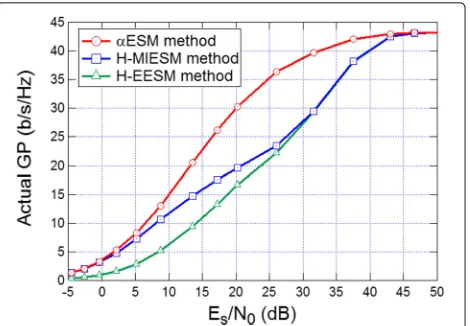
Figure 5 depicts the actual normalized GP, i.e., the num-ber of error-free received information bits per second per Hz, for the GO-AMC approach employing the proposed
αESM method against the H-MIESM and H-EESM, for
the single-input single-output (SISO) case. It is
appar-ent that theαESM outperforms both the H-MIESM and
H-EESM, offering a gain of about 4 and 7.5 dB w.r.t. to the former and the latter, respectively, at 4 bit/s/Hz. In particular, theαESM approach, when compared with the H-MIESM, shows a considerable gain in the medium SNR region; thanks to a more flexible AMC strategy, allowing the change of the MCS among different retransmissions of the same failed packet. On the other side, at low- and high-SNR regions, there is no room for improvements, as both the strategies select the most and the less efficient MCS, respectively, thus achieving the same performance. How-ever, the αESM, w.r.t. the H-MIESM, has the appealing property of having a closed-form solution, thereby trad-ing off efficiency and complexity together. The gain of
the proposedαESM method scales when the number of
antennas is increased as well, as shown in Figs. 6 and 7, for the SM-MIMO configurations 4×4 and 8×8, respec-tively. Specifically, a gain of around 12 dB is obtained for the 8×8 scheme at 30 bit/s/Hz. The number of the resources (i.e., the subchannels) available at each PR sig-nificantly increases if the number of antennas increases too. Since, differently from the other methods, theαESM one is applied at each PR, the latter is able to exploit this increment of resources enabling higher GP levels which scale with the number of antennas.
Table 3List of acronyms
Acronym Meaning
ACK Acknowledgement
αESM Aggregated effective SNR mapping AMC Adaptive modulation and coding
ARQ Automatic repeat request AWGN Additive white Gaussian noise
BIC Bit-interleaved coded
BICM Bit-interleaved coded modulation BIOS Binary input output symmetric
BPSK Binary phase shift keying
CC Chase combining
CCDF Complementary cumulative distribution function
CMGF Cumulant moment generating function
CP Cyclic prefix
CRC Cyclic redundancy check
CSI Channel state information
DFT Discrete Fourier transform EESNR Exponential effective SNR
EGP Expected goodput
ESM Effective SNR mapping ESNR Effective SNR
GO Goodput-oriented
GP Goodput
HARQ Hybrid automatic repeat request
H-EESM HARQ EESM
H-MIESM HARQ MIESM
IR Incremental redundancy
LA Link adaptation
LLR Log-likelihood ratio
LPP Link performance prediction MCS Modulation and coding scheme
MI Mutual information
MIESM Mutual information based effective SNR MIMO Multiple-input multiple-output
MRC Maximum ratio combining
OFDM Orthogonal frequency division multiplexing
OFDMA Orthogonal frequency division multiple access
OP Optimization problem
PDS Pairwise decoding score
PDU Protocol data unit
PEP Pairwise error probability
PER Packet error rate
PR Protocol round
RLC Radio link control
RV Random variable
SISO Single-input single-output
SM Spatial multiplexing
SNR Signal-to-noise ratio
UE User equipment
Fig. 5GO-AMC performance comparison for the SISO case
In order to shed light on the improved performance achieved by the proposed method, Fig. 8 quantifies the complementary cumulative distribution function (CCDF) of the discrete RVξ() r()·m(), which is the data rate per subcarrier, related to the selected MCS at each PR, for theαESM and H-MIESM, atEs/N0 = 8.8 dB in the SISO case with uniform bit loading. At the first PR, the probability of selecting a more spectral efficient MCS, i.e., a higher data rate, is slightly greater for theαESM. In the following PRs, this probability even greatly increases for the latter model, which has the possibility to change the MCS on a per-PR basis given the current “memory” σ(−1) and CSI. Conversely, as previously observed, also
the H-MIESM model applies the recombination mecha-nism, though it keeps the initial MCS along all the retrans-missions of the same packet, thus resulting to be more conservative. The above can be considered the key rea-son why the actual GP obtained by the proposed more flexibleαESM is considerably greater, as corroborated by the previous Figs. 5, 6 and 7.
Fig. 6GO-AMC performance comparison for the MIMO 4×4 case
Fig. 7GO-AMC performance comparison for the MIMO 8×8 case
Finally, we outline the computational complexity of the proposed method. To this end, we take as the reference
the proposed αESM method and the H-EESM, since
they represent the best and worst case, respectively, as apparent from Figs. 5, 6 and 7. The H-EESM method has a closed form and is based on the logarithm of a sum of negative exponential functions, as can be seen in Eq. (15) of [20]. Also, theαESM method, for a given PR, has a closed form and is based on the logarithm of a sum of negative exponential functions, as can be seen from Eq. (8), and the recursive Eq. (22). The complexity required by the recursive equation can be considered negligible when compared to the evaluation of the cor-responding ESNR, in that the functionsg(·,·)andf(·,·) defined in (24) can be properly calculated using a look-up table. Therefore, their computational complexity at each PR can be considered comparable. The only difference is that, while the H-EESM is evaluated only at the first PR, theαESM is re-evaluated PR by PR. Thus, its complexity increases linearly with the number of PRs. Since this
number is limited (usually below 10), the increment of complexity w.r.t. the H-EESM is lower (or at most equal to) one order of magnitude, but with a great gain in performance, as previously shown.
6 Conclusion
This paper presented an innovative cross-layer LPP
methodology, named αESM, suited for packet-oriented
MIMO BIC-OFDM transmissions, which accounts for
CSI, practical MCSs, and HARQ. The proposed αESM
suitably extends the κESM method so to account also
for the HARQ mechanism with bit-level combining at the receiver. The proposed LPP method gives an accurate closed-form solution and the possibility to enable a flexi-ble LA strategy, where at each PR the MCS that maximizes the GP performance at the UE is selected based on the information about the past transmissions and actual CSI. In particular, the formulation of the GP at the transmit-ter, named EGP, is derived resorting to the renewal theory. Simulation results carried out over realistic wireless
chan-nels demonstrate that LA strategy based on the αESM
method outperforms the best known algorithms proposed so far, providing gains of about 5 and 7.5 dB in SISO and up to 11 dB in MIMO configurations, respectively. An interesting follow-up of this work consists in mov-ing the focus from the LPP method itself, applied here to the reference conventional (MIMO)-OFDM system, to its extension to more advanced transmission schemes such as (MIMO)-OFDM with spatial modulation [35], index mapping [36], or UFMC [37].
Endnotes
1From now on, without loss of generality (w.l.g.), the
terms “packet” means “RLC-PDU” packet.
2In (12), only the bit differing in the codewordsb()and
b() have a non-zero bit score.
Appendix
A. Proof of Theorem 1
In order to prove Theorem 1, two different cases are taken into account. Let us start with the case in which the coding rate is monotonically increasing up to theth PR, i.e.,r(j) > r(j−1), 1 ≤ j ≤ , and introduce the nota-tion1x(0x), denoting anx-sized vector whose entries are
all set to 1 (0). Besides, denoting asNc(j) Ns/r(j), with Nc(j)≤Nc(j−1), the number of coded bits transmitted at the
jth PR, 1≤j ≤, the setQ()containing all the possible puncturing patterns among theth PRs can be written as
Q()
in that a given coded bit can be transmitted at PRs 1, 2,· · ·,(patternq0), or at PRs 1, 2,· · ·,−1 (pattern
q1), and so on, or only at PR 1 (patternq−1). Hence, defin-ingpj Prq()k =qj, withpj ∈P(), as the probability that thekth coded bit is punctured at theth PR using the patternqj, 0≤j≤−1, it can be verified that the set of the probabilities can be represented as
P()
Now, let us prove (22) of Theorem 1 by induction. It can be easily verified that the expression holds for=1, 2,· · ·.
that after some algebra can be rearranged as
(+1)
Then, considering that the last two terms within the curly brackets of (39) correspond to e−()α , and
e−
j=1γ(j)
e−α() ≤
1 as the coding rate is increasing, we end up
to and the assumption of increasing coding rate.
In the case the coding rate is not increasing up to the
th PR, i.e.,r(j) ≤r(j−1), 1≤j≤ , the set of puncturing patterns at theth PRs turns into
with probabilities
Therefore, following the same procedure as above, at the
(+1)th PR we can write
that after some algebra can be rearranged as
(+1)
Then, considering that the last two terms within the curly brackets of (44) correspond to e−α(), we end up with
where R() = r() due to the assumption of decreasing
coding rate.
B. Proof of Theorem 3
In order to prove Theorem 3, let us first map the quan-tities the renewal-reward theorem relies on, that is, the interarrival times Xi() and rewards Zi(), to the system under analysis. Theith interarrival time can be written as
Xi()=Tf(−1)+
i
j=
Tu(ϕ(j)), (46)
where the first term on the right hand side (RHS) is the
time elapsed over the previous − 1 failed
transmis-sions, which is a known quantity at theth PR;Tu %
ϕ(j)&is
defined in Eq. (30), whereas ≤ i ≤ Lis a RV
depend-ing on the number of packet transmissions after which the renewal event happens.
Besides, since we are interested in correctly receiving theNpinformation bits out of theNc()transmitted ones, the reward is Z()i = Np/W if the renewal is due to a successful decoding; otherwiseZi()=0.
Before proceeding further, let us introduce Ak as the
event of receiving an ACK at roundk, A¯k as the event
of receiving a NACK at roundk andRk as the event of
having a renewal event after round k. Accordingly, the probability ofRkis
Pr{Rk}PrA¯1,· · ·,A¯k−1,Ak
, (47)
and, since a renewal event always happens when the retry limitLis reached,
Pr(RL)=1− L−1
k=1
Pr(Rk). (48)
On the other hand, defining Nk as the event of not
receiving ACKs inkattempts, with 1≤ k ≤L, the more manageable probability Pr(Nk)can be introduced,
Pr(Nk)Pr{ ¯A1,· · ·,A¯k} =1− k
j=1
Pr(Rj). (49)
It easily follows that
Pr(Rk)=Pr(Nk−1)−Pr(Nk) (50)
ability of not receiving an ACK within the remainingL−
PRs, and
It follows that Eϒs(+k) in (26) after the substitutions listed above, the EGP formulation (27) follows.
Acknowledgements
This work has been partially supported by the PRA 2016 research project 5GIOTTO funded by the University of Pisa and by SVI.I.C.T.PRECIP. project, in the framework of Tuscany’s “Programma Attuativo Regionale,” co-funded by “Fondo per lo Sviluppo e la Coesione” (FSC) and Italy’s Ministry for Education, University and Research (MIUR), Decreto Regionale n .3506, 28/07/2015. The authors would like to thank Prof. Luc Vandendorpe and Ivan Stupia, PhD, from Université catolique de Louvain, Louvain-la-Neuve, Belgium, for the fruitful discussions and their helpful suggestions.
Authors’ contributions
RA worked on the derivation of both the link performance prediction method for HARQ-based MIMO BIC-OFDM systems and the link adaptation for EGP optimization. He also run numerical simulations which provided numerical results. VL contributed to the introduction’s background and to the bibliographical survey on related works. Also, he contributed to the analytical derivation of the link performance prediction method for HARQ-based MIMO BIC-OFDM systems and to the interpretation of the numerical results. FG provided the system model description and the definitions of the
performance metrics for the proposed algorithms. He also contributed to the interpretation and to the comments of the numerical results. All authors read and approved the final manuscript.
Competing interests
The authors declare that they have no competing interests.
Publisher’s Note
Springer Nature remains neutral with regard to jurisdictional claims in published maps and institutional affiliations.
Author details
1Wireless Systems Engineering and Research (WISER) S.r.l., Livorno, Italy. 2Department of Information Engineering, University of Pisa, Pisa, Italy.
Received: 18 August 2017 Accepted: 17 December 2017
References
1. R Andreotti, Adaptive techniques for packet-oriented transmissions in future multicarrier wireless systems, PhD Thesis. http://etd.adm.unipi.it. Accessed 29 Dec 2017
2. G Caire, G Taricco, E Biglieri, Bit-interleaved coded modulation. IEEE Trans. Inf. Theory.44(3), 927–946 (1998)
3. H Bolcskei, D Gesbert, AJ Paulraj, On the capacity of OFDM-based spatial multiplexing systems. IEEE Trans. Commun.50(2), 225–234 (2002) 4. ST Chung, AJ Goldsmith, Degrees of freedom in adaptive modulation: a
unified view. IEEE Trans. Commun.49(9), 1561–1571 (2001)
5. DJ Costello, J Hagenauer, H Imai, SB Wicker, Applications of error-control coding. IEEE Trans. Inf. Theory.44(6), 2531–2560 (1998)
6. J Wannstrom, LTE-Advanced. http://www.3gpp.org/technologies/ keywords-acronyms/97-lte-advanced. Accessed 29 Dec 2017 7. M Agiwal, A Roy, N Saxena, Next generation 5g wireless networks: a
comprehensive survey. IEEE Commun. Surv. Tutorials.18(3), 1617–1655 (2016)
8. YJ Guo,Advances in Mobile Radio Access Networks. (Artech House Publishers, Boston-London, 2004)
9. JF Cheng, inthe proceedings of the 21st Annual IEEE International Symposium on Personal, Indoor and Mobile Radio Communications. Coding
performance of HARQ with BICM – part I: unified performance analysis, (Istanbul, 2010), pp. 976–981
10. G Caire, D Tuninetti, The throughput of hybrid-ARQ protocols for the gaussian collision channel. IEEE Trans. Inf. Theory.47(5), 1971–1988 (2001) 11. P Wu, N Jindal, Performance of hybrid-ARQ in block-fading channels: a
fixed outage probability analysis. IEEE Trans. Commun.58(4), 1129–1141 (2010)
12. A Chuang, A Guillen I Fabregas, LK Rasmussen, IB Collings, Optimal throughput-diversity-delay tradeoff in MIMO ARQ block-fading channels. IEEE Trans. Inf. Theory.54(9), 3968–3986 (2008)
13. B Makki, T Eriksson, On hybrid ARQ and quantized CSI feedback schemes in quasi-static fading channels. IEEE Trans. Commun.60(4), 986–997 (2012) 14. L Szczecinski, SR Khosravirad, P Duhamel, M Rahman, Rate allocation and
adaptation for incremental redundancy truncated HARQ. IEEE Trans. Commun.61(6), 2580–2590 (2013)
15. TVK Chaitanya, EG Larsson, Outage-optimal power allocation for hybrid ARQ with incremental redundancy. IEEE Trans. Wirel. Commun.10(7), 2069–2074 (2011)
16. W Rui, VKN Lau, Combined cross-layer design and HARQ for multiuser systems with outdated channel state information at transmitter (CSIT) in slow fading channels. IEEE Trans. Wirel. Commun.7(7), 2771–2777 (2008) 17. ZKM Ho, VKN Lau, RSK Cheng, Cross-layer design of FDD-OFDM systems
based on ACK/NAK feedbacks. IEEE Trans. Inf. Theory.55(10), 4568–4584 (2009)
18. P Zhang, Y Miao, Y Zhao, inthe proceedings of the 2013 IEEE Wireless Communications and Networking Conference (WCNC). Cross-layer design of AMC and truncated HARQ using dynamic switching thresholds, (Shangai, 2013), pp. 906–911
19. N Ksairi, P Ciblat, CJL Martret, Near-optimal resource allocation for type-II HARQ based OFDMA networks under rate and power constraints. IEEE Trans. Wirel. Commun.13(10), 5621–5634 (2014)
20. S Liu, X Zhang, W Wang, in2006 the proceedings of the First International Conference on Communications and Electronics. Analysis of modulation and coding scheme selection in MIMO-OFDM systems, (Hanoi, 2006), pp. 240–245
21. J Meng, EH Yang, Constellation and rate selection in adaptive modulation and coding based on finite blocklength analysis and its application to LTE. IEEE Trans. Wirel. Commun.13(10), 5496–5508 (2014)
22. K Brueninghaus, D Astely, T Salzer, S Visuri, A Alexiou, S Karger, G-A Seraji, inthe proceedings of the 16th IEEE International Symposium on Personal, Indoor and Mobile Radio Communications, 2005. PIMRC 2005. Link performance models for system level simulations of broadband radio access systems. vol. 4, (Berlin, 2005)
23. I Stupia, V Lottici, F Giannetti, L Vandendorpe, Link resource adaptation for multiantenna bit-interleaved coded multicarrier systems. IEEE Trans. Signal Process.60(7), 3644–3656 (2012)
24. K Sigman,Lecture Notes on Stochastic Modeling I - Introduction to renewal theory. (Columbia University, New York, 2009). http://www.columbia. edu/~ks20/stochastic-I/stochastic-I-RRT.pdf. Accessed 29 Dec 2017 25. D Tse, P Viswanath,Fundamentals of Wireless Communication. (Cambridge
University Press, Cambridge, 2005). http://ee.sharif.edu/~wireless.comm. net/references/Tse,%20Fundamentals%20of%20Wireless
%20Communication.pdf. Accessed 29 Dec 2017
26. L Xiao, M Johansson, SP Boyd, Simultaneous routing and resource allocation via dual decomposition. IEEE Trans. Commun.52(7), 1136–1144 (2004)
27. L Song, NB Mandayam, Hierarchical SIR and rate control on the forward link for CDMA data users under delay and error constraints. IEEE J. Sel. Areas Commun.19(10), 1871–1882 (2001)
28. i Guillen, A Fabregas, A Martinez, G Caire,Bit-Interleaved Coded Modulation (Foundations and trends in communications and information theory). (Now Publishers Inc., Breda, 2008)
29. EW Jang, J Lee, H-L Lou, JM Cioffi, On the combining schemes for MIMO systems with hybrid ARQ. IEEE Trans. Wirel. Commun.8(2), 836–842 (2009)
30. J Lee, H-L Lou, D Toumpakaris, E Jang, J Cioffi, Transceiver design for MIMO wireless systems incorporating hybrid ARQ. IEEE Commun. Mag. 47(1), 32–40 (2009)
32. M Zorzi, RR Rao, On the use of renewal theory in the analysis of ARQ protocols. IEEE Trans. Commun.44(9), 1077–1081 (1996)
33. 3GGP technical specification 36.212 v12.0.0,Evolved universal terrestrial radio access (E-UTRA); multiplexing and channel coding (Release 12). (Sophia-antipolis, France, 2013)
34. J Meng, EH Yang, in2013 IEEE Wireless Communications and Networking Conference (WCNC). Constellation and rate selection in adaptive modulation and coding based on finite blocklength analysis, (2013), pp. 4065–4070
35. RY Mesleh, H Haas, S Sinanovic, CW Ahn, S Yun, Spatial modulation. IEEE Trans. Veh. Tech.57(4), 2228–2241 (2008)
36. E Basar, On multiple-input multiple-output OFDM with index modulation for next generation wireless networks. IEEE Trans. Signal Proc.64(15), 3868–3878 (2016)
37. G Wunder, P Jung, M Kasparick, T Wild, F Schaich, Y Chen, S ten Brink, I Gaspar, N Michailow, A Festag, L Mendes, N Cassiau, D Kténas, M Dryjanski, S Pietrzyk, P Eged, B Vago, F Wiedmann, 5GNOW: