R E S E A R C H
Open Access
Secure ubiquitous authentication protocols for
RFID systems
Md Monzur Morshed
*, Anthony Atkins and Hongnian Yu
Abstract
In this article, the possible privacy and security threats to the radio frequency identification (RFID) systems are investigated and new authentication protocols are proposed which provide the identified privacy and security in a very efficient manner for a ubiquitous computing environment. The approach utilizes the concepts of two very different, widely known RFID protocols, i.e. the“low-cost authentication protocol (LCAP)”approach and the “one-way hash-based LCAP“approach. The resulting protocols combine the advantages of both protocols and eliminate the problems from these. The approaches are evaluated using a variety of criteria that are relevant in practice. The proposed protocols use random numbers and a hash function to encrypt the key to protect the RFID system from the adversary attacks. The hash value is used as a hash address to reduce the search time to locate the tag in the database from a large number of records. A simulation experiment is conducted to verify some of the privacy and security properties of the proposed protocols.
Keywords:RFID, security, authentication protocol, ubiquitous, hash address
1. Introduction
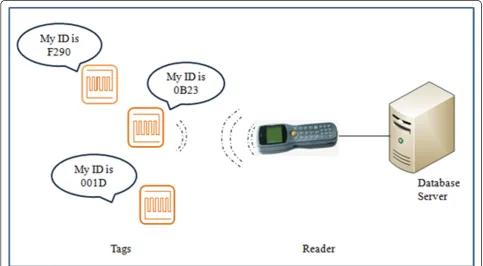
Radio frequency identification (RFID) tags emerge as the successor of barcodes and are used in many applications such as in automation of automobiles, animal tracking, highway toll collection and supply-chain management [1]. An RFID tag has some advantages over an optical barcode that makes it more suitable in automation. A barcode indicates the type of the object on which it is printed but the RFID tag gives a unique serial number that distinguishes the object uniquely from many millions of similar types of products. Another advantage of an RFID tag is that it does not require line-of-sight contact with the readers as in optical barcodes. RFID is a technol-ogy to identify objects or people automatically [2]. An RFID system consists of three components: tag, reader and back-end database [3]. It is a small and extremely low-priced device consists of a microchip with very lim-ited functionality and data storage and an antenna for wireless communication with readers. An RFID tag can be passive or active depending on the powering techni-que. In general, passive tags are inexpensive. They have no on-board power; they get power from the signal of the
interrogating reader. Active tags contain batteries to power their transmission. RFID readers with antennas are devices used to read or write data from or to the RFID tags. The readers send query to a tag to obtain information from the tag. The database stores the infor-mation about the tags and the readers [4].
The RFID tag in the form of electronic product code (EPC) tag is the most popular standard and is specified by an organization called EPCglobal Inc. [5]. An EPC tag tra-ditionally contains some information such as a product type identifier, a manufacturer identifier and a unique serial number those are exposed to the reader. This unique serial number works as a unique identifier (ID). Due to this unique serial number in an RFID tag, it is pos-sible to track the tag uniquely. Due to this, the information in an RFID system is vulnerable to unauthorized readers. An RFID system is vulnerable to various attacks such as eavesdropping, traffic analysis, spoofing and denial of ser-vice. These attacks may reveal sensitive information of tags and hence break a person’s privacy. Another type of privacy violation is traceability which establishes a relation between a person and a tag. If a link can be established between a person and the tag, the tracing of the tag makes the tracing of the person possible [1]. To protect the priv-acy in an RFID system, a tag needs to authenticate a * Correspondence: [email protected]
Faculty of Computing, Engineering and Technology, Staffordshire University, Stafford, UK
reader. However, it is infeasible to use conventional cryp-tography in a passive RFID tag due to its extremely limited processing and memory limitations. A typical RFID system is shown in Figure 1.
The objective of the article is to propose new efficient and effective protocols to address these issues for RFID systems in ubiquitous computing environment. The proto-cols are based on the challenge-response method using a one-way hash function, a static identifier and two random numbers in the RFID systems. The purpose of the hash function is to give a one-way hash result so that an adver-sary cannot extract the input from the output. The value of the hash function is also used as a hash address for the tags in the database. The purpose of the random numbers is to make the response anonymous. This protocol pro-tects the privacy and security of RFID systems of the issues outlined above.
The rest of the article is organized as follows. In Section 2, the privacy and security model in RFID system is dis-cussed. Also the performance criteria of the RFID systems are discussed in this section. Section 3 contains the related studies. In Section 4, contributions and protocols are pre-sented. Section 5 outlined the privacy, security and effi-ciency analysis for evaluation of our protocols. Section 6 describes the simulation result and evaluation. Section 7 concludes the article citing major contributions.
2. Privacy and security in RFID systems
The privacy and security objective in RFID system is to protect the communication between the reader and the
tag from various attacks. We identify the following priv-acy and security issues:
• Information leakage: In a typical RFID system, a tag has a unique identifier that is transmitted to the reader. So it can easily be identified with this unique serial number. Due to this unique serial number, the information in it is vulnerable to an adversary. For the protection from information leakage, an RFID system needs to provide privacy control so that unauthorized readers cannot access the tags.
• Traceability and location privacy: If the response of a tag can be linked to the tag then the location of the tag can be tracked. If a tag transmits a static response to a reader, an adversary can distinguish it from other responses. If the responses from the tags are anonymous, then the tracking problem can be avoided.
•Impersonation and replay attack:An adversary can query to a tag or a reader and can impersonate the tag or the reader. If an adversary can collect the information during communication from the tag and the reader they can impersonate the tag to explore more information. An adversary can use this information and replay in the future.
• Denial of service (DoS):An adversary may disrupt the communication between a valid reader and a tag. If the adversary can successfully block the transmission it can cause the server and the tag to lose synchronization. The RFID system should be able to handle this to keep the synchronization of the tag and the reader.
3. Related studies
There are many approaches for the privacy and security of the RFID systems. Sharma et al. [6] mentioned about the resource constrained in an RFID tag as a main chal-lenge to provide privacy and security. The first approach towards the privacy and security of an RFID tag is to kill [7] the tag at the point of sale. Due to various reasons for which killing a tag is not expected because consumer may wish to reuse the tag. Weis et el. [8] proposed a hash-based access control (HAC) approach to protect a tag using a one-way hash function. To do it, the tag stores the hash of a random key as a metaID. Since the metaID is same for a tag all the times, it always transmits the same metaID, which can easily be tracked by an adversary [9]. Another problem in this system is that the information is transmitted in plain text which can easily be eavesdropped. Weis et al. [8] also suggested another approach that is extended from HAC called randomized access control [8]. It uses a random number to prevent location privacy. In each session, the tag produces a response with newly generated random number and its
IDusing a hash function. It cannot protect the system
from replay attack and is not suitable in a real-life system where a large number of tags are used as it requires many expensive hash operations at the back-end database.
To protect location privacy several protocols use hash function of varied identifier or varied secret [9-13]. Chien and Chen [9] proposed a challenge-response-based authentication protocol to prevent replay attack. This pro-tocol uses a database in the server which maintains new and old tag keys to protect DoS attack. To prevent trace-ability, authentication and access keys are updated. How-ever, this scheme is still vulnerable to backward and forward traceability because if an active attacker compro-mise a tag this can identify the tag’s past interactions from previous transactions and the fixedIDof the tag and can deduce the future transaction. Ohkubo et al. [10] proposed an RFID privacy scheme using a hash chain (HC) mechan-ism. This method uses two hash functions to protect the privacy and security. It is also not suitable in practical use because the back-end database requires a large number of HCs. Henrici et al. [11] proposed a scheme referred to the hash-basedIDvariation scheme (HIDV). It uses a one-way hash function to protect location privacy by changing the
IDafter each session. However, if any authentication
session is unsuccessful it replies with the same hashedID
again for which it opens up the vulnerability for imperso-nation attack such as spoofing. Lee et al. [12] proposed a low-cost authentication protocol (LCAP) which simplifies and enhances HIDV scheme in both efficiency and secur-ity. It has the similar problem as in HIDV that a tag always replies with the same hashedIDbefore the next successful
authentication which allows tag tracking. Dimitriou [13] proposed an RFID authentication scheme that preserves user privacy and also protects against tag cloning. This protocol uses the hash of its identifier as a response to a reader query to maintain scalability at the server, and the back-end server sends a message using the updated identi-fier to the tag after getting the tag response. This scheme also has a problem of tracking as between valid sessions the tag identifier remains the same.
Varying identifier may cause problem in ubiquitous computing environment. To solve the problem, static identifiers are used in many authentication protocols. Molnar et al. [14] proposed a private authentication scheme for library RFID systems. It uses a pseudorandom number and a shared secret key by the tag and the reader for efficient authentication. This scheme does not ensure forward security since the tag’s identifier and the secret key are static and the random number forwarded is in plain text which can be captured by an adversary. Rhee et al. [15] proposed challenge response-based RFID authen-tication protocol (CRAP) which is designed to use in ubi-quitous computing. However, this scheme requires (N/2 +1) hash function computations in the database which is impractical for large number of tags in ubiquitous com-puting. Choi et al. [16] proposed a one-way hash-based LCAP (OHLCAP), which is suitable for ubiquitous envir-onment. Ha et al. [17] claim that OHLCAP suffers from traceability and impersonation attack. The authors also proposed a solution of using hash function to protect from traceability attack. Tsudik [18] described an RFID identification protocol that provides a basic level of tag identification using time-stamps. Tsudik [18] also pro-posed two further schemes that provide tag authentica-tion. The schemes use monotonically increasing time-stamps for tracking-resistant tag authentication, and employ a keyed hash functionf.
In the next two sections, two prominent protocols LCAP [12] and OHLCAP [16] will be discussed in more detail as they are more related to the proposed work.
3.1 LCAP approach
LCAP scheme uses one-way hash function to protect the privacy and security of the tag. The notations and symbols used in LCAP operation are as follows [12]:
h: {0, 1}*®{0, 1}lis a one-way hash function
ID: IDdenotes identity of a tag and is a random value in {0, 1}l.
Data fields of a tag and a reader are initialized to the following values:
Tag:The data field of a tag is initialized to its ownID.
Reader: A reader picks uniformly a random numberr
in {0, 1}l.
The data fields of a back-end database are initialized toHaID, ID, TDand DATA.
HaID: HaID value is the hash value of ID used for identifying or addressing the tag.
TD: TD-entry is used to trace previous data informa-tion of a tag when loss of message occurs in the current session.
DATA:DATA stores the information about an
accessi-ble tag.
The back-end database maintains two rows;Prevfor
the previous session andCurrfor the current session.
Each row containsHaID, ID, TD, andDATAfields. In
Prev, the back-end database recordsHaIDandIDin the
previous session. InCurr, it updatesHaIDandIDof
Prev.TD-field ofCurrhasHaIDvalue ofPrevandTD -field ofPrevcontainsHaID-value ofCurr. The protocol is shown in Figure 2.
LCAP works as follows:
1. A reader selects a random number r and sends a
Queryandrto the tag.
4. The back-end database then compares if the value of
HaIDinPrevis same as the value ofHaIDreceived from the reader. If successful, then the back-end database com-puteshR(ID||r) usingrreceived from the reader andIDin
Prev, wherehR(ID||r) is the right half ofh(ID||r). For the
next session, the back-end database computes and stores
HaID=h(ID⊕r) andID = ID⊕rinCurr.TD-field of
Previs filled with currentHaID = h(ID⊕r). Finally, the back-end database sendshR(ID||r) to the reader.
5. The reader forwardshR(ID||r) to the tag.
6. The tag checks hR(ID||r). If it matches, the tag
updates itsIDtoID⊕r.
In LCAP scheme, IDis changed in each
authentica-tion. So, it does not work in ubiquitous environment. Also mentioned earlier, it cannot overcome the trace-ability problem.
3.2 OHLCAP approach
OHLCAP uses a static identifier and secrets and is sui-table for ubiquitous environment. It also uses a one-way hash function for privacy and security of the tag.
OHL-CAP requires anID and a hash functionhas in LCAP.
Some additional fields are also required.GI is used as a
group index.Kis a common secret used in all tags and
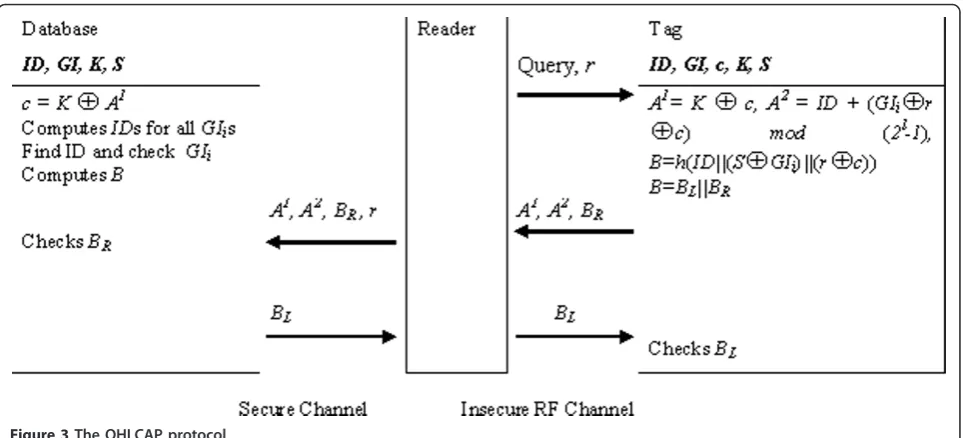
Sis a tag secret. The protocol computes three messages:
A1 =K ⊕c, A2 =ID + (GIi ⊕r ⊕c) mod(2l-1), and
B = h(ID||(S ⊕GIi)||(r ⊕c)).BLandBRare the left and
right half ofB, respectively. cis used as a counter and initialized to an arbitrary value. It is increased every time a reader sends a query to the tag. The protocol is shown in Figure 3.
OHLCAP works as follows [16]:
Step 1: A reader selects a random valuerand sends a query withrto a tag.
Step 2: The tag checks a random value rwhether it is all zero value or not.
1. Ifrvalue is all zero, the tag sends“stop”message to the reader and stop the protocol.
2. Otherwise, the tag performs the following
- The tag computesA1=K⊕c, A2= ID +(GIi⊕r⊕c)
mod(2l-1),
B = h(ID||(S⊕GIi)||(r ⊕c)) and sendsA1, A2 andBR
to the reader, whereBRis a right half ofB,
- Then, the tag increases the counter cwhich should
not exceed 2l- 1.
If the counter c exceeds 2l - 1, it is initialized by initialc.
Step 3. After receiving from the tag,
1. The reader forwards A1, A2, BRandr to the
back-3. The back-end database checks if one of computed ID/j(∈{1...n}) is matching to one of the stored IDs in the end database. If this process succeeds, the
back-end database check if theGIjused to compute the ID
/ j
is equal to the group indexGIithat contains the
match-ing ID/j.
- If this is successful, the database computesB=h(ID||
(S⊕GIi)||(r⊕c)) using the matchedID.
4. Then, the back-end database authenticates the tag by matching the received valueBR.
5. The back-end database sends BL to the reader,
whereBLis a left half of B. The reader forwards BLto
the tag.
Step 4. The tag authenticates the reader by comparing the received valueBL.
OHLCAP is an efficient approach in ubiquitous environ-ment that uses one-way hash function for privacy and security. However, Ha et al. [17] find its security weakness and proposes an enhanced OHLCAP (EOHLCAP) scheme. The authors showed that this protocol is vulner-able to traceability attack and impersonation attack because of its special property, namely,cc=cp+ 1 for two
successive sessions. The adversary eavesdrops the mes-sages transmitted between the tag and the reader and obtains the successiveA1pandA1c whereA1p=K⊕cp,
A1c=K⊕cc. Afterwards, it computesA=A1p⊕A1c=cp
⊕cc=cp⊕(cp+ 1) and removes the secret keyKin this
equation. In this way, the adversary can trace the tag’s holder. Similarly, the adversary can implement impersona-tion attack by selecting special random numberrc=rp+
1. Ifrc⊕cc=rp⊕cpthen the value ofBpis equal toBc
sinceB=h(ID||(S⊕GIi)||(r⊕c)). To overcome the
secur-ity weakness, Ha et al. [17] add a pseudorandom number generator to generate a random number and removes the counter in the tag to prevent traceability attack.
4. Our contributions: secure ubiquitous authentication protocols (SUAP)
OHLCAP is not protected against traceability and imper-sonation attacks. It requires much storage in the tag side and database side. EOHLCAP eliminates the privacy pro-blem in OHLCAP with reduced amount of storages in the tag side and the database side but it takes many hash operations to locate the tag in the database [17]. LCAP
Figure 2The LCAP protocol.
requires less storage in the tag and reduces search time in the database but it is not suitable for ubiquitous comput-ing environment as theIDis updated after each authenti-cation process. To overcome these problems, three Secure Ubiquitous Authentication Protocols SUAP1, SUAP2 and SUAP3 for RFID systems are proposed in this section. SUAP1 is a simple RFID authentication pro-tocol that will work in a system where the number of tags is small. The preliminary version of SUAP1 is pre-sented in [23]. The final version of SUAP1 is improved over the preliminary version with privacy and security enhancement. SUAP2 and SUAP3 are the extension of SUAP1 and work in a large group-based system where RFID tags are divided into several groups. These proto-cols are low-cost and secured based on challenge-response method using a one-way hash function, hash-address as a search index. The proposed protocols com-bine the features of the hash address and hash function of the LCAP protocol and the ubiquitous property of OHLCAP protocol and overcome the existing privacy and security problems in these two schemes. The advan-tage of hash address is to reduce the search time in the database. The notations used in the SUAP1, SUAP2 and SUAP3 protocols are as follows:
Notations
lThe length of an identifier. The value oflis assumed 96 bits.
SUAP1 protocol uses a static identifier and a secret num-ber, hash functions and two random numbers. The objec-tive of this protocol is to preserve the ubiquitous property of the protocol and is suitable for a small number of tags. In this case a common secret is stored in all the tags. Two random numbers make the hash response unpredictable so that it is impossible to perform impersonation and tra-cing attack by a malicious reader. The system set-up of SUAP1 protocol is as follows:
System Set-up
Tag:Each tag contains the following fields:
ID: Tag Identifier
x: Common secret number
Reader:Reader does not contain any field.
Back-end database:Back-end database contains the following fields:
ID: Tag identifier
x: Common secret number
Had: Hash addressh(ID)
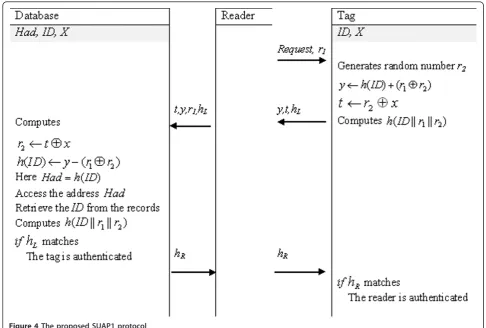
When a tag enters into the range of a reader, the reader can initiate the authentication protocol. The pro-tocol is shown in Figure 4. The steps in the authentica-tion protocol are as follows:
1. The reader generates a random number r1 and
sends it to the tag.
2. Receiving the number r1 the tag generates another
random numberr2.
Ifr1orr2 is 0 stop protocol
Otherwise, the tag performs the following computa-tions
4. The back-end database will calculate the following.
r2=t⊕x
h(ID)←y−(r1⊕r2)
h(ID) is the address of the record containing the ID
whereHad=h(ID)
Access the addressHad
Retrieves theIDfrom the record
Then the back-end database computesh(ID||r1||r2)
IfhLmatches, the tag is authenticated
SendshRto the reader, wherehRis the right half ofh
(ID||r1||r2)
5. The reader forwards thehRto the tag
6. If the received hR matches, the reader is
authenticated.
xfor all the tags it cannot ensure privacy and security for a large organization having millions of tags in many departments.
4.2 SUAP2
To overcome the problem in SUAP1 of having only one secret for all the tags, SUAP2 maintains groups for the different departments and different types of products. In
addition to the IDand secrets in the SUAP1, one extra
variable GIDis needed in the tag side and the database side. It represents a group identifier. This is also a secret
number. The database divides the tags into n groups
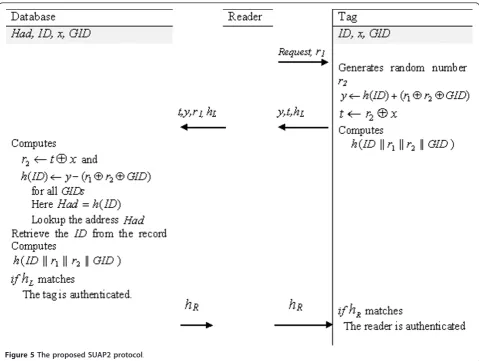
and the protocol is shown in Figure 5. The only differ-ence between the SUAP1 and SUAP2 is that SUAP2 maintains the groups of the tags and there is a common secret for each group. In this case one secret value xis used for all the tags in a group. It will reduce the tag search time in the database. This is suitable for the case where the tags of the same group are not distributed in various places. It ensures better security but requires less computation and search times in the database. The system set-up of SUAP2 protocol is as follows:
System Set-up
Tag:Each tag contains the following fields:
ID: Tag Identifier
x: Secret number for a group
GID: Group identifier
Reader:Reader does not contain any fields.
Back-end database:Back-end database contains the following fields:
ID: Tag identifier
x: Secret number for a group
Had: Hash addressh(ID)
GID: Group identifier
The steps in the authentication protocol are as follows:
1 .The reader generates a random number r1 and
sends it to the tag.
2 .Receiving the number r1 the tag generates another
random numberr2.
ifr1orr2 is 0 stop protocol
Otherwise, the tag performs the following computa-tions
y←h(ID) + (r1⊕r2⊕GID)
Computes h(ID||r1||r2||GID)
The tag then sends the value of y, t and hL to the
reader.
WherehLis the left half ofh(ID||r1||r2||GID)
3. The reader then sends the value ofy,tand r1to the
back-end database.
4. The back-end database calculates the following for allGIDs
r2=t⊕x
h(ID)←y−(r1⊕r2⊕GID)
h(ID) is the address of the record containing the ID
whereHad=h(ID)
Lookup the addressHad
Retrieves theIDfrom the record
Then the back-end database computesh(ID||r1||r2|| GID)
IfhLmatches, the tag is authenticated
Sends hRto the reader, where hRis the right half ofh
(ID||r1||r2||GID)
5. The reader forwards thehRto the tag
6. If the received hR matches, the reader is
authenticated.
4.3 SUAP3
The SUAP3 enhances the SUAP2 in efficiency by remov-ing the secretxfrom the tag and the database. It keeps the
group variable GIDin the tag and the database as in
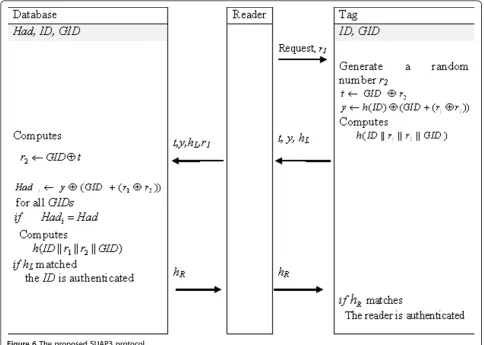
SUAP2. It represents a group identifier and also a secret number. The database divides the tags intongroups and the protocol is shown in Figure 6. The only difference between the SUAP2 and SUAP3 is that SUAP3 does not use the secretxfor the tag and the database. The group-based structure is used for the searching tags in the data-base. The privacy will not be hampered due to the elimi-nation of the secretxas theGIDworks as anlbits secret which is also difficult to guess by the adversary. It reduces the number of searches significantly. Since the hash func-tion is one-way it still gives the same security protecfunc-tion
to the ID. The system set-up of SUAP3 protocol is as follows:
System Set-up
Tag:Each tag contains the following fields:
ID: Tag Identifier
GID: Group identifier
Reader:Reader does not contain any fields.
Back-end database:Back-end database contains the following fields:
ID: Tag identifier
Had: Hash addressh(ID)
GID: Group identifier
The steps in the authentication protocol are as follows:
1. The reader generates a random number r1 and
sends it to the tag.
2 .Receiving the number r1 the tag generates another
random numberr2.
ifr1 orr2 is 0 stop protocol
Otherwise, the tag performs the following computa-tions
t←GID⊕r2
y ¬h(ID) ⊕(GID+(r1 ⊕r2))and computes h(ID||r1|| r2||GID)
The tag then sends the value of y, t and hL to the
reader.
WherehLis the left half ofh(ID||r1||r2||GID)
3. The reader then sends the value ofy,r1 andtto the
back-end database.
4. The back-end database calculates the following for allGIDs
r2←GID⊕t
Hadi←y⊕(GID+ (r1⊕r2))
Hadiis the address of the record containing theID
whereHadi=h(ID)
Lookup the addressHadiin the database
IfHadi = Had for any IDretrieves the ID from the
record
Then the back-end database computesh(ID||r1||r2|| GID)
IfhLmatches, the tag is authenticated
SendshRto the reader, wherehRis the right half ofh
(ID||r1||r2||GID)
5. The reader forwards thehRto the tag
6. If the received hR matches, the reader is
authenticated.
5. Evaluation of the proposed protocols
The protocols are analysed in two ways: first is the privacy and security analysis and the second one is the efficiency analysis.
5.1 Privacy and security analysis
The privacy and security of the proposed protocols are analysed against various threats introduced in Section 2; information leakage of a tag, location privacy, imperso-nation and replay attack, DoS attack and traceability. The privacy and security analysis against the identified threats is outlined as follows:
•Information leakage:In SUAP1 protocol, the adver-sary must be authenticated to access any sensitive infor-mation from a tag. To authenticate the systems an adversary must knowID,xandr2to access any
informa-tion from the tag. The SUAP2 protocol has addiinforma-tional
GIDsecret to make the response more unpredictable.
The SUAP3 uses theGIDas a secret instead ofx. The
combination ofr1andr2makes the responseyso
unpre-dictable that the adversary can only guess the value ofhR
andhL. The advantage of an adversary is at most
1 2l,
which is negligible forl= 96 or more.
• Location privacy:The responses from the tags are always changing in every new session. The value oft,y
and hL cannot be linked with any particular tag in
SUAP1, SUAP2 and SUAP3. The protocols ensure loca-tion privacy by using new values of r1 andr2 each time.
Even if a malicious reader sends the same random value
r1all the times, a tag transmits the refreshed values that
are refreshed byr2 and secret valuexorGID.
• Impersonation and replay attack:The protocols work in a complete challenge-response fashion by mutual authentication. When a tag reaches within the range of a reader, the reader sends queries with a random number to the tag. An adversary may also request a tag with a
random number. Without knowingID, hash function,
secretxand random numberr2generated by the tag, the
adversary cannot find the response y. In SUAP2 and
SUAP3, the group identifierGIDalso makes the response more unidentifiable. For each session the tag gives a new value ofythat is totally indistinguishable and different
from other sessions. So, impersonation and replay attack is nearly impossible in practical scenario. Impersonation and replay attack could be possible if the attacker waits
for a matched response (same hL) from the tag and
replays thehRto authenticate itself. Such repeating hash
response could only be reproduced once in 2lresponses (where the responses are uniformly random in nature) as the length of the hash response isl.
• DoS:Since theID and the secret are never changed
in the proposed protocols, if the attacker prevents the last flow to the tag from the reader it will not cause any problem of desynchronization.
• Traceability: The schemes SUAP1, SUAP2 and SUAP3 are fully protected from future forward and backward traceability. The attacker has no access over
r2, and the combination ofr1andr2and the hash
func-tion. The responses are always anonymous and the
attacker does not know the value of the ID and the
secret. So the previous, present and future interactions are all indistinguishable. The attacker cannot identify the past and future interactions.
5.2 Efficiency analysis
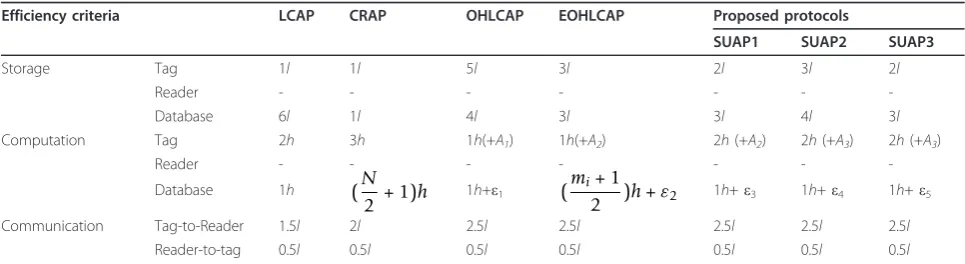
For efficiency analysis the storage, communication and computation cost of the proposed protocols are compared with other protocols in Table 1. The storage cost indicates the storage requirements in the tag, database and the reader. The communication cost means the length of bits the tag and the reader send during the authentication pro-cess. The computation cost is the maximum computations require in the tag and the database during the execution of the authentication protocol.
In Table 1, LCAP [12] performs better than other pro-tocols for almost all criteria but it suffers from traceabil-ity problem and it is not ubiquitous. The proposed protocols show better performance because it requires less tag side and database side storage and gives protec-tion from all the known attacks. The storage requirement for the tag and the database are 2land 3l, respectively, in
SUAP1 and SUAP3, whereas OHLCAP [16] requires 5l
and 4l, respectively. CRAP [15] uses only 1lstorage for a tag but it needs (N/2+1) hash operations which is practi-cally unsuitable because in ubiquitous environment the value ofNis extremely high and it does not divide the tags into groups. It requires many hash operations and hence requires long search time to obtain the tag infor-mation in the database. Similarly, the EOHLCAP [17] requires 3lstorages in the tag side and 3lstorages in the database side but requires a large number of hash opera-tions for a group. This is also high for a group having a large number of tags. The main computation costs in the tags are the hash operations. OHLCAP requires 1 hash operations and additional operationsA1which are four
hash operation and additional operationsA2 which are
two XOR operations in the tag. The proposed protocols require two one-way hash operations in each tag. SUAP1
requires additional operations A2which are two XOR
operations. Both SUAP2 and SUAP3 require additional operationsA3which are three XOR operations in the tag.
In each protocol, the tag requires one addition operation. Since both XOR-operation and addition operation are very simple bit operation, hardware embodiment of these operations is simpler than one-way hash function. There-fore, the proposed protocols are suitable to a low-cost RFID tag systems.ε1,ε2,ε3, ε4 and ε5 are additional
operations other than hash functions in the correspond-ing databases as shown in Table 1.
6. Simulation expeeriment and evaluation
To validate the proposed protocols, simulation experi-ments have been conducted. The privacy and security protections are ensured with the hash functions and ran-dom numbers. A hash function is a one-way function for which the possibility of information leakage is negligible
from the hash response. In the simulation experimentl
takes different values, i.e. 16, 32, 64 and 96. However, many combinations of the hash inputs can give the same response that can be used by the adversary to imperso-nate the RFID systems through replay attack. This is the main reason to conduct the simulation. The objective of the simulation program is to verify the protection for impersonation, replay attack and location privacy. It checks the responseyif it recurs more than once for one tag during the attacks by an adversary in a given number of attempts. If the same response is generated for any given random number pair it can be used by the adver-sary for impersonation and replay attack and the location privacy of the tag may be broken.
We simulate the impersonation and replay attack using Monte Carlo simulation method. To replay the hash valueh(hL||hR) for a particular ID andGID, hash
responses are generated for 1011times with the same ID
andGID and different set ofr1 andr2. The hash value
generated atith attempthiis considered vulnerable for
impersonation and replay attack ifhi=h. The generated
random sequences for r1 andr2 are tested for uniform
random distribution using chi square test to ensure the validity of the simulation using Monte Carlo method. The number of matches found is recorded to generate the performance results. For a particular data length ten simulations are executed using different set of random numbers and the possible impersonation and replay attacks are observed in the simulation. The averages of the successful replay attacks are reported in Table 2.
The output of a hash function is the same for the same random number pair. Some different random number pairs may also give the same response. The objective is to ensure unique response for different inputs of random number pair so that an adversary is unable to use any response at later stage to access the tag or the reader. We select one tag and generate a response for two random numbers as in SUAP1, SUAP2, SUAP3 and EOHLCAP. Then the program attempts 1011times to check that how many times the same response is generated. This is the role of an adversary. In each attempt a new response is generated with a new pair of random number. The aver-age number of times a similar response generated in SUAP1, SUAP2, SUAP3 and EOHLCAP are given in Table 2. The expected number of matches are also reported in a column to compare the obtained result. The value of the expected number of matches is calcu-lated using the analysis of repeating hash response pre-sented for replay attack in Section 5.1 and it is calculated as 1011/2l. All the selected protocols show almost similar results. The number of matches represents the success of the adversary to attack the tag. The experiment was con-ducted for 16, 32, 64 and 96 bits of secret value, random number,IDand hash response. The success of the adver-sary was found for 16 and 32 bits since many occurrences of the same response are found. There was no recurrence of the same response for 64 and 96 bits for the specified
Table 1 Efficiency analysis
Efficiency criteria LCAP CRAP OHLCAP EOHLCAP Proposed protocols
SUAP1 SUAP2 SUAP3
Communication Tag-to-Reader 1.5l 2l 2.5l 2.5l 2.5l 2.5l 2.5l
Reader-to-tag 0.5l 0.5l 0.5l 0.5l 0.5l 0.5l 0.5l
number of attempts, i.e. 1011times. We did not perform simulation experiments for LCAP, OHLCAP and YA_TRAP* protocols since these are not protected against all the privacy threats [16-18]. CRAP is also not included since it requires many hash operations [16].
The simulation program has been developed using Turbo C++ compiler and the experiment was conducted in a desktop computer with 2.93GHz Intel (R) Core 2 Duo Processor, 3.46 GB memory and Windows XP pro-fessional Operating System.
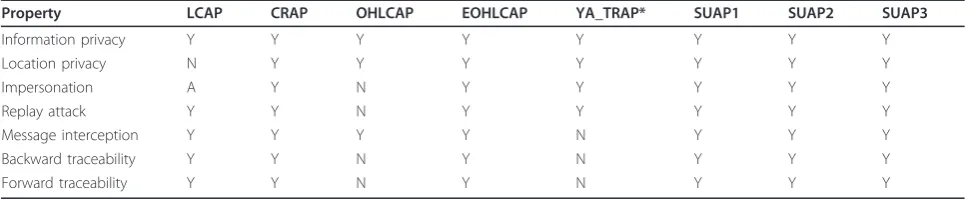
According to the privacy and security analysis in Sec-tion 5.1 and the simulaSec-tion results the summary of the privacy and security properties are given in Table 3.
The privacy and security properties of the proposed protocols are compared with five other schemes. The five schemes were chosen because all of these protocols involved tag authentication. LCAP involves secret update but other four protocols CRAP, OHLCAP, EOHLCAP and YA_TRAP* do not support secret update. Proposed protocols are more similar to CRAP, OHLCAP, EOHL-CAP and YA_TRAP* than LEOHL-CAP since all these protocols support authentication in ubiquitous computing environ-ment and do not update the identifier and secret value. Table 3 shows that the proposed protocols provided pro-tections from all the identified privacy and security threats.
7. Conclusion
Three efficient and secure authentication protocols SUAP1, SUAP2 and SUAP3 are proposed to protect priv-acy and security for the low-cost RFID system in ubiqui-tous computing environment. The privacy and security problems of LCAP and OHLCAP are overcome in these
protocols. SUAP1 is suitable for the organization having small number of tags. SUAP2 and SUAP3 are suitable for medium and large organizations having many depart-ments. All the proposed schemes require only two one-way hash function operations and avoid large number of hash computations in the database and hence are very effi-cient. The tag search time in the database is reduced by using the hash value as the address of the corresponding tag. EOHLCAP also overcomes the problem in OHLCAP and protects the RFID system from most of the attacks but it requires many complex hash operations. The pro-posed protocols ensure privacy and security protections from all the identified threats. The storage requirements in SUAP1 and SUAP3 are also less than OHLCAP and EOHLCAP protocols. The comparison shows that the proposed protocols are both secure and efficient than other schemes and have practical advantages over them because these are simple and provide a larger range of privacy and security protections for low storage and computations.
Competing interests
The authors declare that they have no competing interests.
Received: 14 July 2011 Accepted: 8 March 2012 Published: 8 March 2012
References
1. A Jules, S Garfinkel, R Pappu, RFID privacy: an overview of problems and proposed solutions. IEEE Security Privacy.3(3), 34–43 (2005). doi:10.1109/ MSP.2005.78
2. A Jules, RFID security and privacy: a research survey. IEEE J Sel Areas Commun.24(2), 1–19 (2006)
3. R Want, An introduction to RFID technology. IEEE Pervasive Comput.5, 25–33 (2005)
Table 2 Attacker’s success for one tag
Number Number of attempts Data lengthl(bits) Expected number of matches Average number of matches (attacker’s success) EOHLCAP SUAP1 SUAP2 SUAP3
1 1011 16 1525878.91 1532979.81 1536442.83 1535009.84 1526520.77
2 1011 32 23.28 21.34 20.30 21.20 20.81
3 1011 64 5.42 × 10⁻⁹ 0 0 0 0
4 1011 96 1.26 × 10⁻¹⁸ 0 0 0 0
Table 3 Privacy and security comparisons
Property LCAP CRAP OHLCAP EOHLCAP YA_TRAP* SUAP1 SUAP2 SUAP3
Information privacy Y Y Y Y Y Y Y Y
4. BS Prabhu, X Su, H Ramamurthy, C Chu, R Gadh, WinRFID-a middleware for the enablement of radio frequency identification (RFID) based applications UCLA, inWireless Internet for the Mobile Enterprise Consortium (WINMEC), Los Angeles, CA, 1–23(2003)
5. http://www.EPCglobalinc.org. EPCglobal Web site, 2005. Referenced 2005 6. S Sarma, S Weis, D Engels, Radio-frequency identifcation: security risks and
challenges. CryptoBytes.6(1), 2–9 (2003)
7. A Juels, RL Rivest, M Szudlo, The blocker tag: selective blocking of RFID tags for consumer privacy, inthe 8th ACM Conference on Computer and Communications Security, (ACM Press, Washington DC, USA, 2003), pp. 103–111
8. SA Weis, SE Sarma, RL Rivest, DW Engels, Security and privacy aspects of low-cost radio frequency identification systems, inSecurity in Pervasive Computing, vol. 2802. (Lecture Notes in Computer Science, 2004), pp. 201–212. doi:10.1007/978-3-540-39881-3_18
9. H Chien, C Chen, Mutual authentication protocol for RFID conforming to EPC class 1 generation 2 standards. Comput Standard Interface.29(2), 254–259 (2007). doi:10.1016/j.csi.2006.04.004
10. M Ohkubo, K Suzki, S Kinoshita, Cryptographic approach to“ privacy-friendly”tags, inRFID Privacy Workshop, MIT, MA, USAhttp://rfidprivacy. media.mit.edu/2003/papers/ohkubo.pdf (November 2003)
11. D Henrici, P Muller, Hash-based enhancement of location privacy for radio-frequency identification devices using varying identifiers. inInternational Workshop on Pervasive Computing and Communication Security -PerSec 2004, ed. by Sandhu R, Thomas R IEEE Computer Society, Orlando, FL,
USA149–153 (March 2004)
12. SM Lee, YJ Hwang, DH Lee, JI Lim, Efficient authentication for low-cost RFID systems, inICCSA05, LNCS, vol. 3480. (Springer-Verlag, 2005), pp. 619–629 13. T Dimitriou, A lightweight RFID protocol to protect against traceability and
cloning attacks, inConference on Security and Privacy for Emerging Areas in Communication Networks - SecureComm, IEEE Athens, Greece, pp. 59–66 (September 2005).
14. D Molnar, D Wagner, Privacy and Security in Library RFID: Issues, Practices, and Architectures, inConference on Computer and Communications Security, ed. by Pfitzmann B, Liu P (ACM CCS, Washington, DC, USA, 2004), pp. 210–219. ACM Press
15. K Rhee, J Kwak, S Kim, D Won, Challenge-response based RFID authentication protocol for distributed database environment. SPC 2005, LNCS 3450 70–84 (2005)
16. EY Choi, SM Lee, DH Lee, Efficient RFID authentication protocol for ubiquitous computing environment. Embed Ubiquit Comput.3832, 945–954 (2005)
17. J Ha, S Moon, JMG Nieto, C Boyd, Security analysis and enhancement of one-way hash based low-cost authentication protocol. Emerging Technol Knowl Disc Data Mining.4819, 574–583 (2007). doi:10.1007/978-3-540-77018-3_57
18. G Tsudik, A family of dunces: trivial RFID identification and authentication protocols, in7th International Symposium on Privacy Enhancing Technologies-PET 2007, Lecture Notes in Computer Science, vol. 4776, ed. by Borisov N, Golle P (Ottawa, Canada, 2007), pp. 45–61. Springer-Verlag, Berlin 19. S Karthikeyan, N Nesterenko, RFID security without extensive cryptography,
inWorkshop on Security of Ad Hoc and Sensor Networks - SASN’05, (Alexandria, Virginia, USA, 2005), pp. 63–67. ACM Press
20. B Song, CJ Mitchell, RFID authentication protocol for low-cost tags, (WiSEC’08, Alexandria, Virginia, USA, 2008), pp. 140–147
21. B Song, RFID tag ownership transfer, in4thWorkshop on RFID Security, RFIDsec08, (Budaperst, Hungary, 2008), p. 16
22. S Cai, Y Li, T Li, RH Deng, Attacks and improvements to an RFID mutual authentication protocol and its extensions, inWiSec’09, (Zurich, Switzerland, 2009), pp. 51–58
23. MM Morshed, H Yu, A Atkins, SI Ahamed, MM Akbar, A two-way RFID authentication protocol in pervasive computing, inThe 16th International Conference on Automation and Computing (ICAC’10), (Birmingham University, UK, 2010), pp. 164–169
doi:10.1186/1687-1499-2012-93
Cite this article as:Morshedet al.:Secure ubiquitous authentication protocols for RFID systems.EURASIP Journal on Wireless Communications
and Networking20122012:93.
Submit your manuscript to a
journal and benefi t from:
7Convenient online submission
7 Rigorous peer review
7Immediate publication on acceptance
7 Open access: articles freely available online
7High visibility within the fi eld
7 Retaining the copyright to your article