R E S E A R C H
Open Access
The delta-shock wave for the two
variables of a class of Temple system
Guodong Wang
1, Jia-Bao Liu
1*, Lin Zhao
1and Mingjun Hu
1*Correspondence: [email protected] 1School of Mathematics and
Physics, Anhui Jianzhu University, Hefei, P.R. China
Abstract
We investigate the Riemann problem for one-dimensional Temple class, obtain the Riemann solutions containing delta-shock wave, and discover that each variable of this system contains the Dirac delta function in different region. By the interaction of the delta-shock wave with the elementary waves we present the generalized Riemann problem for this system and construct the global solutions. By studying the limits of the solutions as perturbed parameter
ε
approaches zero we observe that the Riemann solutions are stable for such perturbations of the initial data.MSC: 35L65; 35L67; 35J70
Keywords: Temple class; Riemann problem; Delta-shock wave; Generalized Riemann problem
1 Introduction
In this paper, we are concerned with the conservation laws ⎧
⎨ ⎩
∂tu+∂x(u2v) = 0,
∂tv+∂x(uv2) = 0,
(1.1)
whereu≥0 andv≥0. By introducing the functionφ(u,v) =uvsystem (1.1) can be derived directly from the Temple system
⎧ ⎨ ⎩
∂tu+∂x(uφ(u,v)) = 0,
∂tv+∂x(vφ(u,v)) = 0.
(1.2)
System (1.2) plays a key role in many engineering applications such as the enhanced oil recovery [33] and the theory of elasticity [11]. Ifφ(u,v) =φ(uv), then this system can also be seen as a symmetric Keyfitz–Kranzer system [11,27]; also see [15]. In this case, we can see the corresponding Riemann problem introduced by Shen [27]. For the Temple system, its chock curves coincide with rarefaction wave curves in the phase plane [33,34]. For the related results on Temple systems, we refer to [1,2] and the references therein.
Many studies of system (1.2) have been delivered from various aspects. Tan, Zhang, and Zheng [32] studied a reduced one-dimensional system and established the corresponding Riemann solutions. Moreover, they obtained the existence, uniqueness, and stability of
delta-shock waves. In fact, settingφ(u,v) =u, we can obtain the reduced system in [32]. Recently, the nonlinear chromatography
⎧ ⎨ ⎩
∂tu+∂x(u+1–uu+v) = 0,
∂tv+∂x(v+1–vu+v) = 0,
(1.3)
has been extensively studied by many researchers [5, 8, 38, 39]. By the change of the coordinates and letting a1=a2 , system (1.3) can be derived from the nonlinear
chro-matography system in [16,17]. In addition, system (1.3) can also be obtained by setting
φ(u,v) = 1 +1–1u+vin (1.2); see [35,40]. There is an important phenomenon that the delta-shock-type solutions occur in two component for these systems.
The delta-shock wave is a kind of nonclassical nonlinear waves in which at least one state variable becomes a singular measure; see [4,6,7,9,10,12–14,19–29,31,32,37,40] and the references therein.
The motivation for studying system (1.1) comes from the fact that the delta-shock-type solutions occur in two components. Moreover, Yang and Zhang [38, 39] assumed that
φ(u,v) =φ(au+bv) is a given smooth function satisfyinga2+b2= 0 orφ(u,v) =φ(αu,αv),
α> 0, and constructed the corresponding Riemann solutions.
Based on these two aspects, we first consider the Riemann problem for system (1.1) with the initial data
(u,v)(x, 0) = ⎧ ⎨ ⎩
(u–,v–), x< 0,
(u+,v+), x> 0,
(1.4)
whereu±≥0 andv±≥0 are some constants. With the help of the characteristic analysis,
we discover that there exists the delta-shock-type solution for (1.1) and (1.4). Different from the nonlinear chromatography system, there does not exist a delta-shock-type solu-tion for both two components (u,v) in the plane, that is,
(1) whenu–> 0,v–> 0andu+= 0,v+> 0, there exists a delta-shock wave for the
componentv;
(2) whenu–> 0,v–> 0andu+> 0,v+= 0, there exists a delta-shock wave for the
componentu.
Moreover, to investigate the stability of the Riemann solution, we consider the initial value problem with three pieces of constant states
(u,v)(x, 0) = ⎧ ⎪ ⎪ ⎨ ⎪ ⎪ ⎩
(u–,v–), x< 0,
(um,vm), 0 <x<ε, (u+,v+), x>ε,
(1.5)
The organization of this paper is as follows. In Sect.2, the Riemann solutions to system (1.1) are constructed, and the existence of the nonclassical solutions,δ-shock waves, is analyzed. In Sect.3, we consider the initial value problem with three pieces of constant states. The global solutions are constructed. Moreover, we obtain that the solutions of the perturbed initial value problem converge to the corresponding Riemann solutions as ε
approaches zero. Finally, we present the conclusions.
2 Solutions to the Riemann problem
In this section, we discuss Riemann solutions of (1.1) with initial data (1.4). By calculation we can obtain that the eigenvalues of (1.1) are
λ1=uv and λ2= 3uv (2.1)
with the corresponding right-eigenvectors
r1= (u, –v)T and r2= (u,v)T. (2.2)
It is easy to see that∇λ1·r1= 0 and∇λ2·r2= 0, where∇ denotes the gradient with
respect to (u,v). Henceλ1 is linearly degenerate,λ2is genuinely nonlinear, and system
(1.1) is nonstrictly hyperbolic foruv= 0. It is easy to obtain that the Riemann invariants of system (1.1) can be taken as
w=uv, z=v/u. (2.3)
Since equations (1.1) and the Riemann data are invariant under uniform stretching of coordinates
(x,t)−→(κx,κt), κis constant,
we consider the self-similar solutions of (1.1) and (1.4)
(u,v)(x,t) = (u,v)(ξ), ξ=x/t.
Then the Riemann problem becomes a boundary value problem of ordinary differential equations
⎧ ⎨ ⎩
–ξuξ+ (u2v)ξ= 0,
–ξvξ+ (uv2)ξ= 0,
(2.4)
with
(u,v)(±∞) = (u±,v±).
For smooth solutions, equations (2.4) can be rewritten as
2uv–ξ u2
v2 2uv–ξ
u v
ξ
It follows from (2.5) that, besides the constant solution, it provides a continuous solution of (2.5) of the form (u,v)(ξ).
Given a left state (u–,v–), the possible states which can be connected to (u–,v–) on the
right by a rarefaction wave lie on a curve given as follows:
R(u–,v–) :
For a bounded discontinuous solutions, the Rankine–Hugoniot conditions ⎧
of a functionhon the left- and right-hand sides of the discontinuity curve, respectively, andσis the velocity of the discontinuity. So, we obtain from (2.7) that
(u+v+–u–v–)(u+v––u–v+) = 0, (2.8)
which gives (u+v––u–v+) = 0 or (u+v+–u–v–) = 0. Thus, for a left state (u–,v–), (u+v––
u–v+) = 0, and the Lax entropy conditions imply that the possible states can be connected
to (u–,v–) on the right by a shock wave satisfying
For this system (1.1), we can see that the shock wave curves coincide with the rarefaction wave curves.
If (u+v+–u–v–) = 0, thenu+v+=u–v–. Since the first characteristicλ1=uvis linearly
degenerate, this means that it is a contact discontinuity. Then the possible states that can be connected to (u–,v–) on the right by a contact discontinuity lie on the curve Hence we divide this case to four subcases as follows.
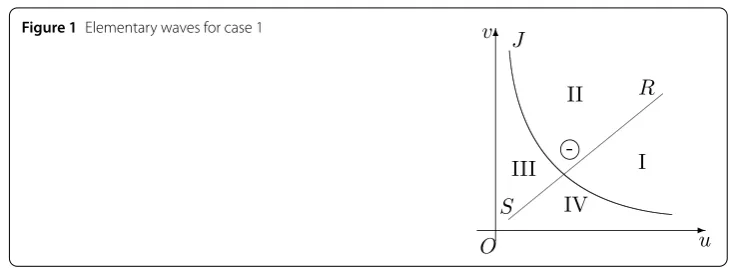
Case 1.1: (u+,v+)∈I or II. The Riemann solutions can be described as
Figure 1Elementary waves for case 1
Moreover, the rarefaction waveRcan be expressed as follows:
R:
where the speed of the shock waveSis
Case 1.4:. (u+,v+)∈B. In this case, we can see that
λ+2=λ+1= 0 <λ–1=u–v–<λ–2= 3u–v–, (2.19)
which implies that the solutions cannot be constructed as before. Hence the Riemann solutions containing a weightedδ-measure supported on a line should be constructed to establish the existence.
To define the measure solutions, we introduce the following definitions.
Definition 2.1 A pair of(u,v)constitutes a solution of(1.1)in the sense of distributions if ⎧
Definition 2.2 A two-dimensional weighted δ-measureω(s)δ supported on a smooth
curve={(t(s),x(s)) :a<s<b}is defined by
and satisfies Definition2.1,where(ul,vl), (ur,vr)are piecewise smooth bounded solutions of (1.1),ω(t)∈C1[0, +∞),δ(·)is the standard Dirac measure supported on the curve x=x(t), andω(t)is the weight of the delta-shock wave on the state variable u or v.
Now, we consider the case (u–,v–)∈Aand (0,v+)∈B. Similarly, we also describe the
other case (u–,v–)∈Aand (u+, 0)∈B.
condition: ⎧ ⎪ ⎪ ⎨ ⎪ ⎪ ⎩
dx dt =σδ,
σδ[u] = [u2v],
dω(t)
dt =σδ[v] – [uv
2],
(2.24)
with
σδ=u–v–, ω(t) =u–v–v+t. (2.25)
In addition to the generalized Rankine–Hugoniot condition, the discontinuity must sat-isfy the delta-shock wave entropy condition (2.19), which means that all the characteristic lines on both sides of the discontinuity are not outcoming.
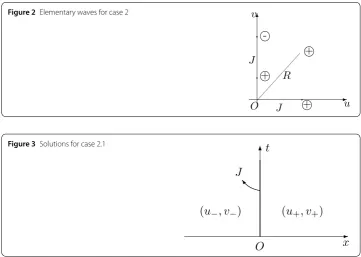
Case 2. (u–,v–)∈B. Here, we only consider the case (u–,v–)∈Bandu–= 0. As for the
other case (u–,v–)∈Bandv–= 0, we can obtain the same results and omit the details. We
divide this case into two subcases; see Fig.2.
Case 2.1. (u+,v+)∈B∪C. The corresponding Riemann solutions are expressed by
(u–,v–) +J+ (u+,v+), (2.26)
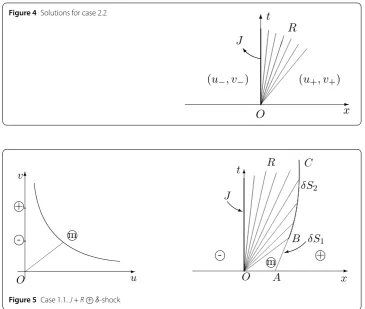
where the speed of the contact discontinuityσJ= 0; see Fig.3. Case 2.2. (u+,v+)∈A. The Riemann solutions are constructed as
(u–,v–) +J+ (0, 0) +R+ (u+,v+), (2.27)
where the speed ofJvanishes. TheJandRare formed as a composite wave; see Fig.4. So, we complete the construction of the Riemann solutions to system (1.1).
Figure 2Elementary waves for case 2
Figure 4Solutions for case 2.2
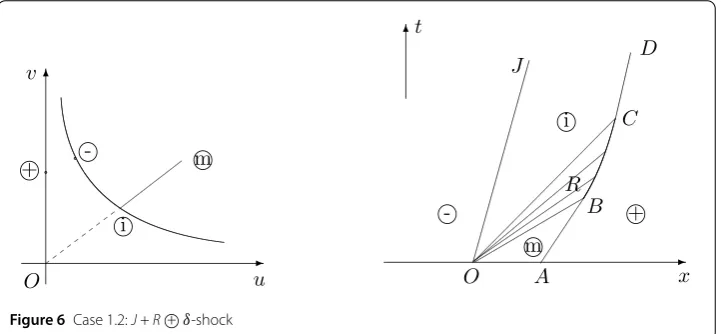
Figure 5Case 1.1.J+R+δ-shock
3 Interactions of
δ
-shock wave with elementary wavesIn this section, we consider problem (1.1) and (1.5). We divide this into four cases.
J+R+ δ-shock, δ-shock +J+R, J+S+ δ-shock, δ-shock +J.
Case 1.J+R+δ-shock. This case can be divided into two subcases.
Case 1.1. (u–,v–)∈B, (u+,v+)∈B, (um,vm)∈A, andu–=u+= 0 (or v–=v+= 0); see
Fig.5.
A composite wave emitting from the pointOconsists of a contact discontinuity and a rarefaction wave. The Riemann solutionRP(m, +) is a delta-shock waveδS1, whose speed
isσδ=umvm.
As for the characteristic lineOBof rarefaction waveR, we haveλ=dxdt = 3umvm. The rarefaction waveRwill overtake the delta shock at some finite time. The intersection point B(x,t) is determined by
⎧ ⎨ ⎩ x
t = 3umvm, x–ε
t =umvm,
(3.1)
which implies
(xB,tB) =
3ε
2 ,
ε
2umvm
After the timetB, theδ-shock interacts with the rarefaction waveRand changes into another newδ-shock (denoted byδS2), which is calculated by
⎧ ⎪ ⎪ ⎪ ⎪ ⎪ ⎨ ⎪ ⎪ ⎪ ⎪ ⎪ ⎩ x t = 3uv, v u=
vm
um, 0 <u≤um, 0 <v≤vm, dx
dt =σδ=uv, x|tB=xB.
(3.3)
From (3.3) we obtain
x=xB
t tB
1 3
, σδ=
vm um
u2, 0 <u≤um, (3.4)
from which we have
lim
u→0σδ= 0 (3.5)
and conclude that the delta shockδS2has the straight line dxdt = 0 as its asymptote, which
gives that the delta shock cannot penetrate the rarefaction waveR. For large time, that is, ast→ ∞, the solution can be expressed as
(u–,v–) +J+ (0, 0) +R+δS2+ (u+,v+).
Asε→0, we can see that the limit of solution (1.1) and (1.5) is the corresponding Riemann solution in this case.
Case 1.2. (u–,v–)∈A, (um,vm)∈A, (u+,v+)∈B, andu+= 0 (orv+= 0). In addition, we
assume thatu–v–<umvm; see Fig.6.
By case 1.1 we can see that theδAB-shock will be overtaken by the rarefactionRand the intersection point (xB,tB) can be given by (3.2). After the timetB, theδ-shock begins to interact with the rarefaction waveR, and theδ-shock can be determined by (3.3). Unlike case 1.1, theδ-shock will penetrate theRat finite time.
In fact, when theδ-shock interacts with theR, its speed isσδ=dxdt =uv. With the help of
(3.3), we haveddt22x< 0, which means thatσδdecelerates in the penetration. In addition, we
also haveσδ( i, +) =uivi<λR( i) = 3uivi, which implies that theδ-shock can penetrate Rat some pointC(xC,tC).
From the first equation of (3.3) we have
xC tC
= 3uivi.
Combining this equation and (3.4), we have
xC=
x3B 3uivitB
, tC=
x3B (3uivi)3tB
. (3.6)
Meantime, a new Riemann problem is formed, and the Riemann solutionRP( i, +) is a
δCD-shock with speedσδ=uivi. It is easy to see that theδCD-shock is parallel to the contact discontinuityJ; see Fig.6.
Lettingε→0, the limit of the solution (1.1) and (1.5) is the corresponding Riemann solution.
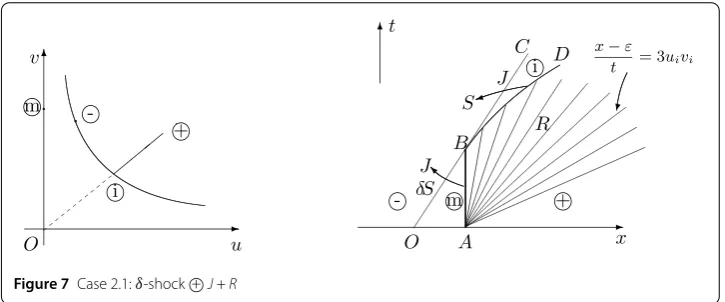
Case 2.δ-shock +J+R. In this case, (u–,v–)∈A, (u+,v+)∈A, and (um,vm)∈B. We divide this case into two subcases.
Case 2.1.u–v–<u+v+; see Fig.7.
The speed of theδOB-shock isσδ=u–v–and that of the contact discontinuityJABisλ1=
0 <u–v–. Obviously, theδ-shock overtakesJat some pointB(xB,tB), which satisfies
⎧ ⎨ ⎩
x=ε, x t =u–v–.
(3.7)
Thus we have
xB=ε, tB=
ε
u–v–
. (3.8)
After the pointB, theδ-shock entropy condition (2.19) is not satisfied, a contact discon-tinuityBCand a shock waveBD emit from the pointB. The contact discontinuityBCis JBC:x–xB=u–v–(t–tB) andt>tB. The shockSBDwill cross the rarefaction waveRwith varying speed of propagation during the penetration, which means that the shockSBD is
no longer a straight line. Moreover, the shock waveSBD is determined by
Obviously, during the penetration, we havedu
dt > 0, which implies d2x
dt2 > 0. Thus, the shock
wave curveSBDis concave in the (x,t)-plane, as shown in Fig.7.
From the last two equations of (3.9) we have
x–ε
t = 3u
2vi ui ,
which, combined with the first equation of (3.9), gives
dt
Unlike case 2.1, the shock waveSBDE can penetrate the rarefaction wave at finite time.
whereu+<ui. We obtain from (3.12) that, at some timetD, the shock waveSBDE penetrate R, where
tD=tBexp u+
0
6u (u2+uu
i+u2i) – 3u2 du
. (3.13)
The shock waveSBD is given by (3.9), where 0 <u≤u+<uiand 0 <v≤v+<vi. At the
pointD, a straight shockSDEemits with speedσS=vu++(u2++uiu++u2i). Thus, for large time, the solutions can be described as
(u–,v–) +J+ (ui,vi) +S+ (u+,v+).
Moreover, asε→0, the limit of the solution (1.1) and (1.5) is the corresponding Riemann solution.
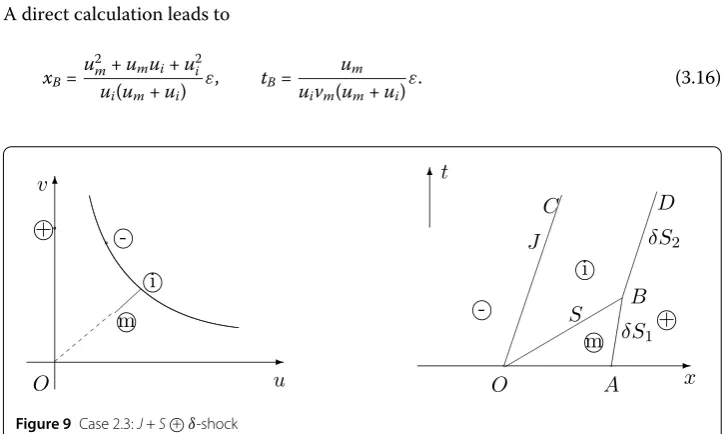
Case 3.J+S+ δ-shock. In this case, we have (u–,v–)∈A, (um,vm)∈A, (u+,v+)∈B,
andu–v–>umvm; see Fig.9. Here, we assume thatu+= 0 and also obtain the same results
for the casev+= 0.
The propagation speed of the shockSOBisσδ=uvmm(u2m+umui+u2i), which is greater than that of the delta-shock waveδAB,σδ=umvm, where (ui,vi) may be calculated by (2.12), that is,
⎧ ⎨ ⎩
uivi=u–v–,
vi ui =
vm um.
(3.14)
ThenSintersects with theδ-shock at a pointB(xB,tB), which is calculated by ⎧
⎨ ⎩
x=vm um(u
2
m+umui+u2i)t, x–ε=umvmt.
(3.15)
A direct calculation leads to
xB=
u2m+umui+u2i ui(um+ui)
ε, tB=
um uivm(um+ui)
ε. (3.16)
Figure 10 Case 2.4:δ-shock +J
At the pointB, a new delta-shock wave δBD occurs, the propagation speed of which is
σδ=uivi. Meantime, the speed of the contact discontinuityJOCisσJ=uivi=u–v–, which
leads to that it is parallel to theδBD-shock.
Ast→ ∞, the time-asymptotic solution can be described as
(u–,v–) +J+ (ui,vi) +δ-shock + (u+,v+).
Asε→0, the intermediate state (ui,vi) disappears, whereasδBD-shock andJOCunify into one delta-shock wave sinceδBD-shock andJOCpropagate with the same speedu–v–. So
the solution tends to the corresponding Riemann solution asε→0.
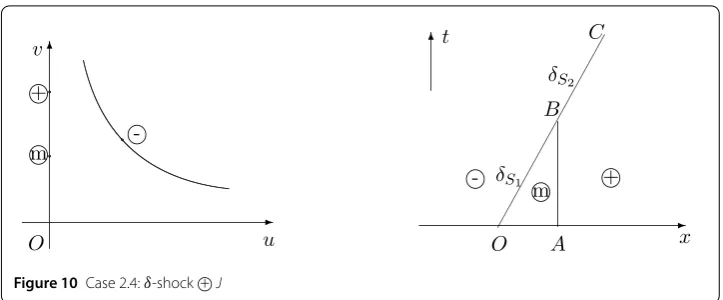
Case 4.δ-shock +J. In this case, we have (u–,v–)∈A, (um,vm)∈B, and (u+,v+)∈B.
We can check that the propagating speed of theδOB-shockσδ =u– –v–is greater than
that of the contact discontinuityJAB,σJ= 0, which implies thatδS1will overtake theJABat
some pointB(xB,tB), which is expressed by (3.8). They interact with each other and yield a new delta-shock waveδS2 with the propagating speedσδ=uivi; see Fig.10.
So far, we have finished the discussion on the interactions of theδ-shock and the ele-mentary waves, and the global solutions for the perturbed initial value problem (1.1) and (1.5) have been constructed. We summarize our results in the following:
Theorem 3.1 The limit of the perturbed Riemann solution of(1.1)and(1.5)is exactly the corresponding Riemann solution of(1.1)and(1.4).The Riemann solution of(1.1)and(1.4) is stable and admissible with respect to such small perturbations of the initial data.
4 Conclusions
In this paper, we discuss the delta-shock waves of a class of symmetric nonstrictly hyper-bolic conservation law equations in which each variable may contain the Dirac delta func-tion in different regions. This enriches the content of the Temple system. Furthermore, we discuss the interaction of elementary waves, involving the composite wave, which is different from the corresponding contents in [35,36,38–40]. In the future, we will focus ourselves on the corresponding two-dimensional equations and the related content.
Funding
Postdoctoral Science Foundation under grant No. 2017M621579 and Postdoctoral Science Foundation of Jiangsu Province under grant No. 1701081B. The work of M.J. Hu was partly supported by the Science Project of Education Department of Anhui Province under Grant KJ2018JD21.
Competing interests
The authors declare that they have no competing interests.
Authors’ contributions
All authors carried out the proofs, and the authors conceived of the study. All authors read and approved the final manuscript.
Publisher’s Note
Springer Nature remains neutral with regard to jurisdictional claims in published maps and institutional affiliations.
Received: 27 March 2018 Accepted: 13 July 2018 References
1. Ambrosio, L., Crippa, G., Figalli, A., Spinolo, L.: Some new well-posedness results for continuity and transport equations, and applications to the chromatography system. SIAM J. Math. Anal.41, 1890–1920 (2009)
2. Bianchini, S.: Stability ofL∞solutions for hyperbolic systems with coinciding shocks and rarefactions. SIAM J. Math. Anal.33, 959–981 (2001)
3. Chang, T., Hsiao, L.: The Riemann Problem and Interaction of Waves in Gas Dynamics. Pitman Monogr. Surv. Pure Appl. Math., vol. 41. Longman, Harlow (1989)
4. Chen, G.Q., Liu, H.: Formation ofδ-shock and vacuum states in the vanishing pressure limit of solutions to the Euler equations for isentropic fluids. SIAM J. Math. Anal.34, 925–938 (2003)
5. Cheng, H., Yang, H.: Delta shock waves in chromatography equations. J. Math. Anal. Appl.380, 475–485 (2011) 6. Danilov, V.G., Shelkovich, V.M.: Dynamics of propagation and interaction ofδ-shock waves in conservation law
systems. J. Differ. Equ.221, 333–381 (2005)
7. Danilov, V.G., Shelkovich, V.M.: Delta-shock type solution of hyperbolic systems of conservation law systems. Q. Appl. Math.63, 401–427 (2005)
8. Guo, L., Pan, L., Yin, G.: The perturbed Riemann problem and delta contact discontinuity in chromatography equations. Nonlinear Anal.106, 110–123 (2014)
9. Guo, L., Sheng, W., Zhang, T.: The two-dimensional Riemann problem for isentropic Chaplygin gas dynamic system. Commun. Pure Appl. Anal.9, 431–458 (2010)
10. Huang, F., Wang, Z.: Well-posedness for pressureless flow. Commun. Math. Phys.222, 117–146 (2001)
11. Keyfitz, B.L., Kranzer, H.C.: A system of nonstrictly hyperbolic conservation laws arising in elasticity. Arch. Ration. Mech. Anal.72, 219–241 (1980)
12. Korchinski, D.J.: Solution of a Riemann problem for a system of conservation laws possessing no classical weak solution. Thesis, Adelphi University (1977)
13. Lai, G., Sheng, W., Zheng, Y.: Simple waves and pressure delta waves for a Chaplygin gas in multi-dimensions. Discrete Contin. Dyn. Syst.31, 489–523 (2011)
14. Li, J., Zhang, T., Yang, S.: The Two-Dimensional Riemann Problem in Gas Dynamics. Pitman Monographs, vol. 98. Longman, Harlow (1998)
15. Lu, Y.G.: Existence of global bounded weak solutions to a symmetric system of Keyfitz–Kranzer type. Nonlinear Anal., Real World Appl.13, 235–240 (2012)
16. Mazzotti, M.: Nonclassical composition fronts in nonlinear chromatography: delta-shock. Ind. Eng. Chem. Res.48, 7733–7752 (2009)
17. Mazzotti, M., Tarafder, A., Cornel, J., Gritti, F., Guiochond, G.: Experimental evidence of a delta-shock in nonlinear chromatography. J. Chromatogr. A1217, 2002–2012 (2010)
18. Nedeljkov, M., Oberguggenberger, M.: Interactions of delta shock waves in a strictly hyperbolic system of conservation laws. J. Math. Anal. Appl.344, 1143–1157 (2008)
19. Nedeljkov, M.: Shadow waves: entropies and interactions for delta and singular shocks. Arch. Ration. Mech. Anal.197, 489–537 (2010)
20. Panov, E., Shelkovich, V.M.:δ’-shock waves as a new type of solutions to system of conservation laws. J. Differ. Equ. 228, 49–86 (2006)
21. Rykov, Yu.G., Sinai, Ya.G., Weinan, E.: Generalized variational principles, global weak solutions and behavior with random initial data for systems of conservation laws arising in adhesion particle dynamics. Commun. Math. Phys. 177, 349–380 (1996)
22. Shao, Z.: Riemann problem with delta initial data for the isentropic relativistic Chaplygin Euler equations. Z. Angew. Math. Phys.67, 66 (2016)
23. Shao, Z.: The Riemann problem for the relativistic full Euler system with generalized Chaplygin proper energy density-pressure relation. Z. Angew. Math. Phys.69, 44 (2018)
24. Shelkovich, V.M.: One class of systems of conservation laws admitting delta-shocks. In: Hyperbolic Problems: Theory, Numerics and Applications, vol. 2, pp. 667–674 (2012)
25. Shen, C.: The Riemann problem for the pressureless Euler system with the Coulomb-like friction term. IMA J. Appl. Math.81, 76–99 (2016)
26. Shen, C.: The Riemann problem for the Chaplygin gas equations with a source term. Z. Angew. Math. Mech.96, 681–695 (2016)
27. Shen, C.: Delta shock wave solution for a symmetric Keyfitz–Kranzer system. Appl. Math. Lett.77, 35–43 (2018) 28. Shen, C., Sun, M.: Formation of delta shocks and vacuum states in the vanishing pressure limit of Riemann solutions
29. Sheng, W., Zhang, T.: The Riemann problem for the transportation equations in gas dynamics. Mem. Am. Math. Soc. 137, 654 (1999)
30. Sun, M.: Interaction of elementary waves for the Aw–Rascle model. SIAM J. Appl. Math.69, 1542–1558 (2009) 31. Sun, M.: Singular solutions to the Riemann problem for a macroscopic production model. Z. Angew. Math. Mech.97,
916–931 (2017)
32. Tan, D., Zhang, T., Zheng, Y.: Delta-shock waves as limits of vanishing viscosity for hyperbolic systems of conservation laws. J. Differ. Equ.112, 1–32 (1994)
33. Temple, B.: Global solution of the Cauchy problem for a class of 2×2 nonstrictly hyperbolic conservation laws. Adv. Appl. Math.3, 335–375 (1982)
34. Temple, B.: Systems of conservation laws with invariant submanifolds. Trans. Am. Math. Soc.280, 781–795 (1983) 35. Wang, G.: One-dimensional nonlinear chromatography system and delta-shock waves. Z. Angew. Math. Phys.64,
1451–1469 (2013)
36. Wang, G.: The Riemann problem for one dimensional generalized Chaplygin gas dynamics. J. Math. Anal. Appl.403, 434–450 (2013)
37. Yang, H.: Riemann problems for a class of coupled hyperbolic systems of conservation laws. J. Differ. Equ.159, 447–484 (1999)
38. Yang, H., Zhang, Y.: New developments of delta shock waves and its applications in systems of conservation laws. J. Differ. Equ.252, 5951–5993 (2012)
39. Yang, H., Zhang, Y.: Delta shock waves with Dirac delta function in both components for systems of conservation laws. J. Differ. Equ.257, 4369–4402 (2014)