CSEIT1722182 | Received : 22 March 2017 | Accepted: 31 March 2017 | March-April-2017 [(2)2: 517-523]
International Journal of Scientific Research in Computer Science, Engineering and Information Technology © 2017 IJSRCSEIT | Volume 2 | Issue 2 | ISSN : 2456-3307
517
An Efficient Resource Aware Scheduling Algorithm for
Mapreduce Clusters
Sharmilarani D, Vinothini K, Ramya V, Shobika R
Department of Computer Science Engineering, Sri Krishna Institute of Technology, Coimbatore, TamilNadu, India
ABSTRACT
MapReduce has become a popular model for data-intensive computation in recent years. The schedulers are critical in enhancing the performance of MapReduce/Hadoop in presence of multiple jobs with different characteristics and performance goals. The propose improve the resource aware scheduling technique for Hadoop map-reduce multiple jobs running that aims to improving resource utilization across multiple virtual machines while observing completion time goals. The propose algorithm influences job profiling information to dynamically adjust the number of slots allocation based on job profile and resource utilization on each machine, as well as workload placement across them, to maximize the resource utilization of the cluster. This single node experimental result show the resource aware scheduling that improves job running time and reduce the resource utilization without introducing stragglers.
Keywords : Hadoop, Map-Reduce, Resource Aware Scheduling Profiling
I.
INTRODUCTION
AIS
MapReduce is a processing technique and a program model for distributed computing based on java. The MapReduce algorithm contains two important tasks, namely Map and Reduce. Map takes a set of data and converts it into another set of data, where individual elements are broken down into tuples (key/value pairs). Secondly, reduce task, which takes the output from a map as an input and combines those data tuples into a smaller set of tuples. As the sequence of the name MapReduce implies, the reduce task is always performed after the map job. located along coast lines or, when out of range of terrestrial networks, through a growing number of satellites that are fitted with special AIS receivers which are capable of deconflicting a large number of signatures. MapReduce is that it is easy to scale data processing over multiple computing nodes. Under the MapReduce model, the data processing primitives are called mappers and reducers. Decomposing a data processing application into mappers and reducers is sometimes nontrivial. But, once we write an application in the MapReduce form, scaling the application to run over hundreds, thousands, or even tens of thousands of machines in a cluster is
merely a configuration change. This simple scalability is what has attracted many programmers to use the MapReduce model.
II.
METHODS AND MATERIAL
1. Ease of Use
A. MAP-REDUCE Map stage
Figure 1. Map-Reduce work flow
The key and value classes have to be serializable by the framework and hence, it is required to implement the Writable interface. Additionally, the key classes have to implement the Writable Comparable interface to facilitate sorting by the framework.
Reduce stage: This stage is the combination of the Shuffle stage and the Reduce stage. The Reducer’s job is to process the data that comes from the mapper. After processing, it produces a new set of output, which will be stored in the HDFS.
B. HDFS File System
Hadoop File System was developed using distributed file system design. It is run on commodity hardware. Unlike other distributed systems, HDFS is highly fault tolerant and designed using low-cost hardware.
Figure 3. HDFS follows the master-slave architecture
HDFS holds very large amount of data and provides easier access. To store such huge data, the files are stored across multiple machines. These files are stored in redundant fashion to rescue the system from possible data losses in case of failure. HDFS also makes applications available to parallel processing.
C. Hadoop MRv1
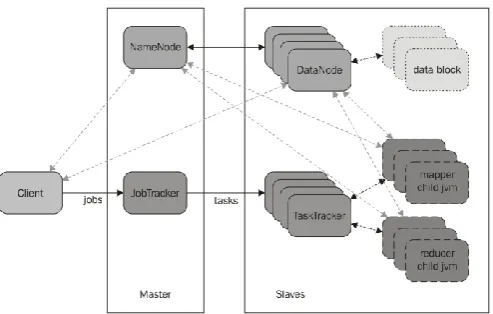
Apache Hadoop 1.x and its processing framework, MRv1 (Classic), so that we can get a clear picture of the differences in Apache Hadoop 2.x MRv2 (YARN) in terms of architecture, components, and processing framework. In Hadoop 1, a single Namenode managed the entire namespace for a Hadoop cluster. With HDFS federation, multiple Namenode servers manage namespaces and this allows for horizontal scaling, performance improvements, and multiple namespaces. The implementation of HDFS federation allows existing Namenode configurations to run without changes. For Hadoop administrators, moving to HDFS federation requires formatting Namenodes, updating to use the latest Hadoop cluster software, and adding additional Namenodes to the cluster.
Figure 2. Hadoop MRv1 architecture diagram
Apache Hadoop is a scalable, fault-tolerant distributed system for data storage and processing. The core programming model in Hadoop is MapReduce.
2. Hybrid Job-Driven Scheduling
separately achieve a better map-data locality and a faster task assignment.
In order to provide an appropriate scheduling scheme for a tenant to achieve a high map-and-reduce data locality and improve job performance in his/her virtual MapReduce cluster, in this paper we propose a hybrid job-driven scheduling scheme (JoSS for short) by providing scheduling in three levels: job, map task, and reduce task. JoSS classifies MapReduce jobs into either large or small jobs based on each job’s input size to the average datacenter scale of the virtual MapReduce cluster, and further classifies small MapReduce jobs into either map-heavy or reduce-heavy based on the ratio between each job reduce-input size and the job’s map-input size. Then JoSS uses a particular scheduling policy to schedule each class of jobs such that the corresponding network traffic generated during job execution (especially for inter-datacenter traffic) can be reduced, and the corresponding job performance can be improved. In addition, we propose two variations of JoSS, named JoSS-T and JoSS-J, to guarantee a fast task assignment and to further increase the VPS-locality, respectively.
D. State of the Art JoSS schduling Algorithms
Job Classification: Before introducing the algorithm of JoSS, first describe how JoSS classifies jobs and schedules each class of jobs. Let Sreduce and Smap be the total reduceinput size and the total map-input size of J, respectively. Based on the ratio of Sreduce over Smap, J can be classified into either a reduce heavy job or a map-heavy job. If J satisfies Eq. (1), implying that the network overhead is dominated by J’s reduce-input data, then J is classified as a reduce-heavy job (RH job for short). Otherwise, J is classified as a map-heavy job (MH job for short). Note that td is a threshold to determine the classification, td 0:
Scheduling Policies: JoSS utilizes the following three scheduling policies
Policy B : This policy is designed for a small MH job. If J is a small MH job, it would be better that each mapper of J is close to its input block, and each reducer of J is close to most mappers of J. Hence, policy B works as follows: It schedules J’s map tasks based on the number of unique input blocks of J held by each datacenter. If a datacenter holds more unique blocks of J, more map tasks of J will be scheduled to the VPSs at this datacenter. The purpose is allowing each mapper of J to retrieve its input block from its local datacenter. In addition, to make J’s reducers close to most J’s mappers, policy B schedules all reduce tasks of J to the datacenter that holds the maximum number of J’s unique blocks.
input from their local datacenters. Hence, the worst-case inter-datacenter traffic for this classification, denoted by TR1, is
E. Disadvantage of Hybrid Job-Driven Scheduling
JOSS, jobs are still forced to wait significantly when the MapReduce system assigns equal sharing of resources due to dependencies between Map, Shuffle, Sort, Reduce phases. JOSS response time is still longer than necessary due to dependencies between the Map/Shuffle/Sort/Reduce phases. Joss Task assignment problem into a Linear Sum Assignment Problem so as to find the optimal assignment so it will take long time for job assign.
III.
RESULTS AND DISCUSSION
1. Proposed Framework
In our framework, each Task Tracker node monitors resources such as CPU utilization, disk channel IO in bytes/s, and the number of page faults per unit time for
records) a data block and produces intermediate results in the form of key-value pairs. Generally, the number of map tasks for a job is determined by input data. There is one map task per data block. The execution time for a map task is determined by the data size of an input block. The reduce tasks consists of shuffle/sort/reduce phases. In the shuffle phase, the reduce tasks fetch the intermediate outputs from each map task. In the sort/reduce phase, the reduce tasks sort intermediate data and then aggregate the intermediate values for each key to produce the final output. The number of reduce tasks for a job is not determined, which depends on the intermediate map outputs.
H. Task Scheduler
Task Scheduler is responsible for enforcing the placement decisions, and for moving the system smoothly between a placement decision made in the last cycle to a new decision produced in the most recent cycle. The Task Scheduler schedules tasks according to the placement decision made by the Placement Controller. Whenever a task completes, it is the responsibility of the Task Scheduler to select a new task to execute in the freed slot, by providing a task of the appropriate type from the appropriate job to the given Task Tracker. The placement algorithm generates new placements, but these are not immediately enforced as they may overload the system due to tasks still running from the previous control cycle. The Task Scheduler component takes care of transitioning without overloading any Task Trackers in the system by picking jobs to assign to the Task Tracker that do not exceed its current capacity, sorted by lowest utility first. For instance, a Task Tracker that is running 2 map tasks of job A may have a different assignment for the next cycle, say, 4 map tasks of job B. Instead of starting the new tasks right away while the previous ones are still running, new tasks will only start running as previous tasks complete and enough resources are freed.
I. Job Profiles
The proposed job scheduling technique relies on the use of job profiles containing information about the resource consumption for each job. Profiling is one technique that has been successfully used in the past for MapReduce clusters. Its suitability in these clusters stems from the fact that in most production environments jobs are ran periodically on data corresponding to different time windows. V
2. Resource Aware Scheduling Algorithm
The job given a placement matrix, it defines a utility function that combines the number of map and reduce slots allocated to the job with its completion time goal and job characteristics. Below we provide a description of this function. Given placement matrices PMand PR, it can define the number of map and reduce slots allocated to a job j
The intuition behind it is that reduce tasks should start at the earliest possible time, so the shuffle sub-phase of the job (reducers pulling data produced by map tasks) can be fully pipelined with execution of map tasks.
J. Map /Reduce Programming Model
RAS is to find a new placement P of jobs on Task Trackers that maximizes the global objective of the system, U(P), which is expressed as follows:
The proposed algorithm consists of two major steps: placing reduce tasks and placing map tasks. Reduce tasks are placed first to allow them to be evenly distributed across Task Trackers. By doing this we allow reduce tasks to better multiplex network resources when pulling intermediate data and also enable better storage usage. The placement algorithm distributes reduce tasks evenly across Task Trackers while avoiding collocating any two reduce tasks. If this is not feasible due to the total number of tasks it then gives preference to avoiding collocating reduce tasks from the same job. Recall that in contrast to other existing schedulers, RAS dynamically adjusts the number of map and reduce tasks allocated per Task Tracker while respecting its resource constraints. Notice also that when reduce tasks are placed first, they start running in shuffle phase. demand of resources is directly proportional to the number of map tasks placed for the same job. Therefore, in the absence of map tasks for the same job, a reduce task in shuffle phase only consumes memory. The second step is placing map tasks. This stage of the algorithm is utility-driven and seeks to produce a placement matrix that balances satisfaction across jobs while treating all jobs fairly. This is achieved by maximizing the lowest utility value in the system. This part of the algorithm executes a series of rounds, each of which tries to improve the lowest utility of the system. In each round, the algorithm removes allocated tasks from jobs with the highest utility, and allocates more tasks to the jobs with the lowest utility. For the sake of fairness, a task gets de-allocated only if the utility of its corresponding job remains higher than the lowest utility of any other job in the system. This results in increasing the lowest utility value across
3. Advantage of Traffic Knowledge
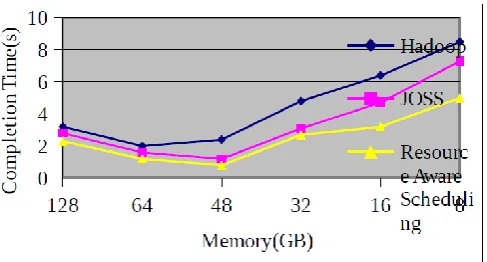
Balancing different kinds of workload in Task Tracker to increase the resource utilization of both I/O bound and CPU bound jobs. The resource aware scheduling algorithm that is said to improve the job execution without introducing stragglers. The resource aware scheduling algorithm for this and show that produces up to 18% improvement in resource utilization while allowing jobs to complete up to 1.3 times faster than current Hadoop schedulers. The resource aware priorities can accommodate multiple tasks' lengths, job sizes, and jobs' waiting time in this environment while reducing average response time. The resource aware scheduler based on dynamic priority in order to reduce the delay for variable length concurrent jobs, and relax the order of jobs to maintain data locality.
4. Implementation
Hadoop is a framework written in Java for running applications on large clusters of commodity hardware and incorporates features similar to those of the Google File System (GFS) and of the MapReduce computing paradigm. Hadoop’s HDFS is a highly fault-tolerant distributed file system and, like Hadoop in general, designed to be deployed on low-cost hardware. It provides high throughput access to application data and is suitable for applications that have large data sets.
K. Word Count Job Running
Figure 4. Comparison of job completion Time
IV.
CONCLUSION
The proposed resource-aware scheduling technique for MapReduce multi-job workloads that aims at improving resource utilization across machines while observing completion time goals. Job profiling information to dynamically adjust the number of slots on each machine, as well as workload placement across them, to maximize the resource utilization of the cluster. Phase and Resource Information-aware Scheduler for MapReduce clusters that performs resource-aware scheduling at the phase level.
V.
REFERENCES
[1] G. Z. Guo, G. Fox, and M. Zhou, "Investigation of data locality in mapreduce," in Proc. 12th IEEE/ACM Int. Symp. Cluster, Cloud Grid Comput., May 2012, pp. 419–426.
[2] M. Zaharia, D. Borthakur, J. Sen Sarma, K. Elmeleegy, S. Shenker, and I. Stoica, "Delay scheduling: A simple technique for achieving locality and fairness in cluster scheduling," in Proc. 5th Eur. Conf. Comput. Syst., Apr. 2010, pp. 265– 278.
[3] J. Jin, J. Luo, A. Song, F. Dong, and R. Xiong, "BAR: An efficient data locality driven task scheduling algorithm for cloud computing," in Proc. 11th IEEE/ACM Int. Symp. Cluster, Cloud Grid Comput., May 2011, pp. 295–304.
[4] M. Ehsan, and R. Sion, "LiPS: A cost-efficient data and task coscheduler for MapReduce," in Proc. IEEE 27th Int. Symp. Parallel Distrib. Process. Workshops PhD Forum, May 2013, pp. 2230– 2233.
[5] J. Park, D. Lee, B. Kim, J. Huh, and S. Maeng, "Locality-aware dynamic VM reconfiguration on MapReduce clouds," in Proc. 21st Int. Symp. High-Perform. Parallel Distrib. Comput., Jun. 2012, pp. 27–36.
[6] X. Bu, J. Rao, and C.-Z. Xu, "Interference and locality-aware task scheduling for Mapreduce applications in virtual clusters," in Proc. 22nd Int. Symp. High-Perform. Parallel Distrib. Comput., Jun. 2013, pp. 227– 238.
[7] C. Tian, H. Zhou, Y. He, and L. Zha, "A dynamic mapreduce scheduler for heterogeneous workloads," in Proc. IEEE 8th Int. Conf. Grid Cooperative Comput., 2009, pp. 218–224.