Application of the International Germ Cell Consensus Classification
to the Nova Scotia population of patients with germ cell tumours
Elana Maydanski Murphy, MD;
*Jo-Anne Douglas, BSc;
†Kara Thompson, MSc, BSc;
†Lori Wood, MD, MSc
*†Abstract
Background:The International Germ Cell Consensus Classification
(IGCCC) is the internationally accepted, clinically based prognos-tic classification used to assist in the management and research of metastatic germ cell tumours (GCTs). The goal of this study was to determine whether the IGCCC is applicable to a population-based cohort.
Methods:We completed a retrospective chart review of patients
who received diagnoses of GCT in Nova Scotia between 1984 and 2004 and who received treatment with platin-based chemo-therapy for metastatic disease. We assigned the IGCCC to each patient based on the site of the primary lesion, the presence or absence of nonpulmonary visceral metastases and prechemother-apy tumour marker values. We calculated Kaplan–Meier estimates of 5-year progression-free survival (PFS) and overall survival for each IGCCC group.
Results:The study cohort comprised 129 patients. The distribution
and outcomes in each group of patients in Nova Scotia was sim-ilar to that published in the IGCCC. Among patients with nonsemi-noma GCTs (NSGCT) 61% had good, 22% had intermediate and 17% had poor prognoses. Among those with seminomas, 85% had good and 15% had intermediate prognoses. Among patients with NSGCTs, the 5-year PFS was 90%, 69% and 55%, and the 5-year overall survival was 94%, 84%, 61% in the good, inter-mediate, and poor prognostic categories respectively. Among patients with seminomas, the 5-year PFS was 95% and 50% and the 5-year overall survival was 94% and 50% in the good and inter-mediate prognostic categories, respectively.
Conclusion::The IGCCC seems applicable to a population-based
cohort, with similar distribution of categories and clear prog-nostic ability.
Résumé
Contexte :L’IGCCC (International Germ Cell Consensus
Classifica-tion) est un système de classification pronostique mondialement reconnu, basé sur les données cliniques et utilisé pour faciliter la prise en charge des tumeurs germinales métastatiques et la recherche sur ces tumeurs. Le but de la présente étude était de déter-miner si cette classification s’applique à une cohorte de population.
Méthodologie :On a mené une étude rétrospective par examen de
dossiers de patients ayant reçu un diagnostic de tumeur germinale en Nouvelle-Écosse entre 1984 et 2004 et traités par chimiothérapie antimétastatique à base de platine. On a classé les patients selon l’IGCCC en fonction du siège de la tumeur primitive, de la présence ou de l’absence de métastases viscérales non pulmonaires et des valeurs des marqueurs tumoraux avant la chimiothérapie. La survie sans progression de la maladie (SSP) et la survie globale (SG) sur 5 ans pour chaque groupe formé en fonction de l’IGCCC ont été évaluées par la méthode de Kaplan-Meier.
Résultats :La cohorte étudiée comptait 129 patients. La
distri-bution et l’issue du traitement étaient similaires pour tous les patients à celles publiées dans la classification IGCCC. Chez les patients avec tumeurs germinales non séminomateuses, 61 % avaient un pronostic favorable, 22 % un pronostic moyen et 17 % un pronostic médiocre. Chez les patients avec tumeurs sémino-mateuses, 85 % avaient un pronostic favorable et 15 % un pronos-tic moyen. Chez les patients avec tumeurs germinales non sémi-nomateuses, la SSP après 5 ans était de 90 %, 69 % et 55 % et la survie globale après 5 ans était de 94 %, 84 % et 61 % en fonc-tion de pronostiques favorable, moyen et médiocre, respectivement. Chez les patients avec tumeurs séminomateuses, la SSP après 5 ans était de 95 % et 50% et la survie globale après 5 ans était de 94 % et 50 % en fonction de ces mêmes catégories pronostiques.
Conclusion :L’IGCCC semble bien s’appliquer à une cohorte de
population; la distribution entre les classes est similaire, et la capac-ité pronostique est très bonne.
Can Urol Assoc J 2009;3(2):120-4
Introduction
Germ cell tumours (GCTs) are the most common solid can-cers with a rising incidence in young men.1,2The tumours
can be classified into 2 major histological types: seminoma and nonseminoma germ cell tumours (NSGCT), with semi-nomas comprising about 40%–50% of GCTs and NSGCTs comprising 50%–60%.3
The approval of cisplatin in 1978 led to improved out-comes in this patient population, with cure rates exceeding 90%.4It was soon recognized, however, that many
degree of tumour marker elevation. Different prog-nostic factor classification systems were developed in different institutions and countries in an attempt to divide patients into prognostic groups for both clinical and research purposes.5–7These
classifica-tion systems included different variables and var-ied substantially. A comparison of different clas-sification systems was performed and poor agreement was achieved when assigning patients into good- or poor-risk categories.8 Because of
these differences, comparison of different trials and databases or collaboration in randomized clinical trials was difficult.
In 1991, the International Germ Cell Cancer Collaborative Group comprising international researchers and clinicians was formed to develop a stratification system for use in both clinical prac-tice and clinical trials. In 1997, the International Germ Cell Consensus Classification (IGCCC) was published and has become the gold standard used in daily clinical practice and GCT research.9
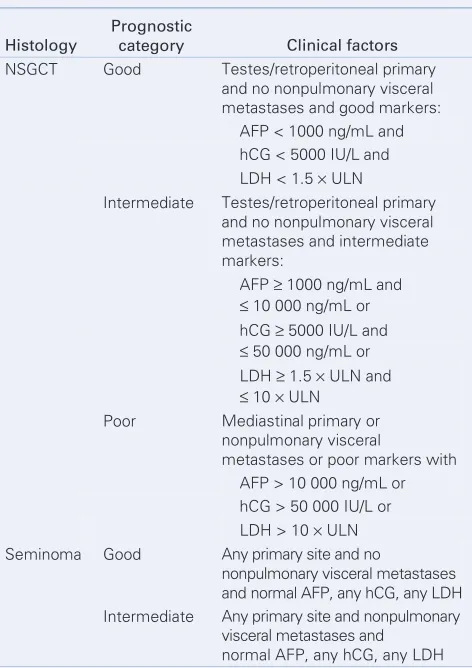
Independent prognostic variables include histol-ogy of the primary tumour, site of the primary tumour, the degree of pretreatment tumour mark-er elevation (αfetoprotein [AFP], human chorion-ic gonadotrophin and lactate dehydrogenase) and the presence of nonpulmonary visceral metastases, as seen in Table 1.
The IGCCC was derived from the pooled clin-ical data from 5202 patients with NSGCTs and 660 patients with seminomas treated between 1975 and 1990 using platin-based chemotherapy. These patients were treated at specific, well-recognized centres with an expertise in the man-agement of GCTs.
The goal of our study was to determine whether the IGCCC can be applied to a population-based cohort of patients with GCTs. The specific aim was to determine the proportion and outcomes of patients with metastatic GCTs treated with platin-based chemotherapy in Nova Scotia who had good, intermediate and poor prognoses according to the IGCCC and to compare the Nova Scotia data with that reported in the IGCCC.
Methods
We obtained approval from our research ethics board. We performed a search of the QEII Health Science Centre Surveillance and Epidemiology Databases to identify patients with GCTs in Nova
Scotia diagnosed between 1984 and 2004. Patients in this geographic region have tended to be non-migratory, which allows for fairly complete follow-up. We performed a retrospective chart review to determine which patients received platin-based chemotherapy for metastatic disease. Data collec-tion included histology, locacollec-tion of primary site, presence and location of metastatic sites, serum levels of AFP, human chorionic gonadotropin (hCG) and lactate dehydrogenase (LDH) before chemotherapy, start and finish date of chemother-apy, date of disease progression, date of last con-tact and date of death.
We analyzed patients in 2 groups: 1) NSGCT (which also included patients with seminoma and an increased AFP) and 2) seminoma. We cate-gorized patients into good, intermediate and poor prognosis groups, as per the IGCCC criteria.
Table 1. Definition of the Germ Cell Consensus Classification
Histology
Prognostic
category Clinical factors
NSGCT Good Testes/retroperitoneal primary
and no nonpulmonary visceral metastases and good markers: AFP < 1000 ng/mL and hCG < 5000 IU/L and
LDH < 1.5 × ULN
Intermediate Testes/retroperitoneal primary
and no nonpulmonary visceral metastases and intermediate markers:
Poor Mediastinal primary or
nonpulmonary visceral
metastases or poor markers with AFP > 10 000 ng/mL or hCG > 50 000 IU/L or
LDH > 10 × ULN
Seminoma Good Any primary site and no
nonpulmonary visceral metastases and normal AFP, any hCG, any LDH
Intermediate Any primary site and nonpulmonary
visceral metastases and normal AFP, any hCG, any LDH
Primary outcomes in our study were identical to those in the IGCCC. We measured progression-free survival (PFS) from the date of initial chemotherapy and defined it as freedom from pro-gression of disease at any time after the start of chemotherapy or death from any cause. We meas-ured overall survival from the date of initial chemotherapy.
We obtained follow-up data from the Nova Scotia Cancer Registry, the QEII Health Sciences Centre charts, the provincial radiology database, regional laboratory databases and the national death registry.
Statistical analysis
We used SAS version 8.2 (SAS Institute Inc.) to ana-lyze the data. We calculated the PFS and overall
survival using the Kaplan–Meier method. We ana-lyzed LDH values as relative increases above the upper limit of normal. We considered AFP in nanograms per millilitre and hCG in internation-al units to be absolute vinternation-alues. If tumour marker values were missing, we placed patients into prog-nostic categories based on the remaining data.
Results
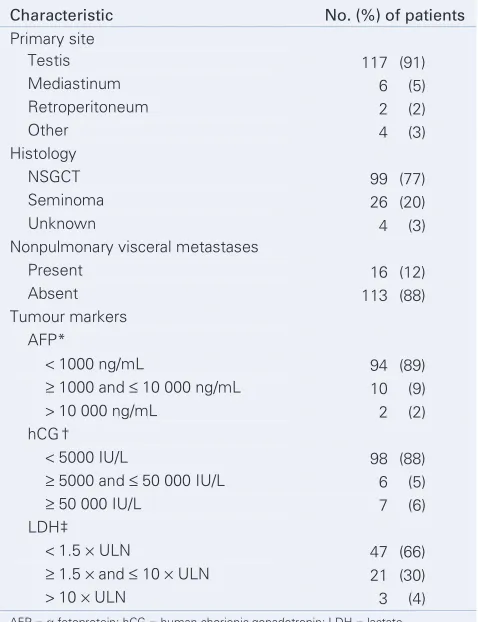
Between 1984 and 2004, 425 patients received diagnoses of GCT in Nova Scotia. Of these, 132 patients had metastatic disease and received platin-based chemotherapy. We excluded 3 pa-tients (1 who received prior chemotherapy, 1 whose treatment could not be ascertained and 1 who was younger than 16 years old). General information about our study population is provided in Table 2. The testis was the primary site in more than 90% of the patients. Nonseminoma GCTs accounted for more than 75% of all GCTs. Eight patients had seminoma and elevated AFP, thus we classified them in the NSGCT group. Only 12% of patients had nonpulmonary visceral spread of their cancer. The average age at the time of diagnosis was 32.1 years and the median follow-up time for surviving patients in the cohort was 6.1 years.
The distribution and outcomes of patients with good, intermediate and poor prognoses is shown in Table 3. The proportion of patients in Nova Scotia with good, intermediate and poor prognoses for NSGCTs was similar to that in the IGCCC (61% v. 56% with good, 22% v. 28% with intermedi-ate and 17% v. 16% with poor prognoses). The percentage of patients with good and intermedi-ate prognoses for seminomas was also similar (85% v. 90% with good and 15% v. 10% with inter-mediate prognoses).
The outcomes of the Nova Scotia cohort com-pared with those in the IGCCC are also shown in Table 3. Among patients with NSGCTs, the 5-year PFS was 90%, 69% and 55% for patients with good, intermediate and poor prognoses, respectively. The 5-year overall survival was 94%, 84% and 61% for patients with good, intermedi-ate and poor prognoses, respectively. This com-pares favourably to the IGCCC, although the 5-year PFS for the intermediate and poor prog-nosis categories and the 5-year overall survival for the poor prognosis category in our cohort fell out-side the IGCCC confidence intervals (CIs).
Table 2. Demographic characteristics of patients with germ cell tumours in Nova Scotia
Characteristic No. (%) of patients
Nonpulmonary visceral metastases
Present 16 (12)
AFP = α fetoprotein; hCG = human chorionic gonadotropin; LDH = lactate dehydrogenase; NSGCT = nonseminoma germ cell tumour; ULN = upper limit of normal.
The outcomes for the NS cohort with semino-ma revealed a 5-year PFS of 95% and 50% among patients with good and intermediate prognoses, respectively. The 5-year overall survival was 94% and 50% among patients with good and inter-mediate prognoses, respectively. The IGCCC did not publish CIs for 5-year PFS and overall survival, thus comparison is more difficult. The outcome for patients with good prognoses was slightly bet-ter in Nova Scotia, and the outcomes among thoses with intermediate prognoses was slightly worse.
Discussion
Although GCTs are uncommon, worldwide inci-dence of this cancer is on the rise. With the advent of platin-based chemotherapy, GCT has become one of the few curable cancers, even in the ad-vanced stage or at relapse. An accurate prognos-tic classification system is required to guide phys-icians to make evidence-based decisions with regard to treatment, to appropriately advise patients on their prognoses and to optimize research to assist in clinical trial design and interpretation of results. The IGCCC was developed to meet these needs.
The IGCCC has become a gold standard used in decision-making for patients with metastatic GCTs and in clinical trials. Much of the data that provide the basis for the IGCCC, however, were obtained from specialized centres in the treatment of GCTs, which have been shown to produce bet-ter outcomes than nonspecialized or low-volume centres.10–13Analyzing only patients from
special-ized centres may also introduce a referral bias because perhaps only a certain subset of patients, such as those perceived to have the worst prog-noses, would be referred.14In addition, much of
the data come from patients who participated in clinical trials, which may also influence the out-come compared with a general population of treat-ed patients. Whether the results of the IGCCC can be applied to a general patient population has not been proven.
Our study examined a general population from a later time period to determine whether the dis-tribution of patients with good, intermediate or poor prognoses was similar to that in the IGCCC and whether the patient outcomes in terms of 5-year PFS and overall survival were comparable. Our study had limitations, including the small sam-ple size, the variation of care over time, patients lost to follow-up, missing data and the fact that a direct statistical comparison between the patients in Nova Scotia and the IGCCC was not possible. The reason that the 5-year PFS among patients in the intermediate and poor prognosis categories and the 5-year overall survival among patients in the poor prognosis category for the NSGCT patients fell outside the IGCCC CIs was likely the small sample size, as evidenced by the wide CIs in our cohort. Our study also had strengths, the largest being that it was population-based and that the data were more recent.
The percentage of patients in Nova Scotia with diagnoses of GCT with good, intermediate and poor prognoses was very similar to that in the IGCCC, suggesting the patient populations were similar in terms of prognostic factors when treatment began. Our study showed that the patients with GCTs treat-ed in Nova Scotia between 1984 and 2004 had sim-ilar outcomes to those in the consensus paper and that the IGCCC has clear prognostic ability in this population-based cohort. Our findings support the applicability of the IGCCC to a population-based
Table 3. Comparison of the distribution and outcomes of the Nova Scotia cohort to the International Germ Cell Consensus Classification
% (95 % CI)
Group Prognosis
No. (%) of NS
patients IGCCC % NS 5-yr PFS IGCCC 5-yr PFS NS 5-yr OS IGCCC 5-yr OS
NSGCT Good 60 (61) 56 90 (78–96) 89 (87–91) 94 (82–98) 92 (90–94)
Intermediate 22 (22) 28 69 (37–84) 75 (71–79) 84 (55–92) 80 (76–84)
Poor 17 (17) 16 55 (27–76) 41 (35–47) 61 (33–80) 48 (42–54)
Seminoma Good 22 (85) 90 95 (69–99) 82 94 (67–99) 86
Intermediate 4 (15) 10 50 (5.8–84) 67 50 (5.8–84) 72
CI = confidence interval; IGCCC = International Germ Cell Consensus Classification; NS = Nova Scotia;NSGCT = nonseminoma germ cell tumour; OS = overall survival;
cohort to determine the classification and prog-nosis of patients with metastatic GCTs.
RReeffeerreenncceess
1. Oosterhof GON, Verlind J. Testicular tumours. BJU Int 2004;94:1196-201. 2. Canadian Cancer Society. Canadian Cancer Statistics 2008. Toronto: The Society; 2008.
Available at: www.cancer.ca/Canada-wide/About%20cancer/Cancer%20statistics/~ /media/CCS/Canada%20wide/Files%20List/English%20files%20heading/pdf%20not %20in%20publications%20section/Canadian%20Cancer%20Society%20Statistics%20PD F%202008_614137951.ashx (accessed 2009 Feb 19).
3. Reuter VE. Origins and molecular biology of testicular germ cell tumors. Mod Pathol 2005;18:S51-60.
4. Bosl GJ, Motzer RJ. Testicular germ-cell cancer. N Engl J Med 1997;337:242-53. 5. Bosl GJ, Geller NL, Cirrincione C, et al. Multivariate analysis of prognostic variables in
patients with metastatic testicular cancer. Cancer Res 1983;43:3403-7. 6. Birch R, Williams S, Cone A, et al. Prognostic factors for favorable outcome in
dis-seminated germ cell tumors. J Clin Oncol 1986;4:400-7.
7. De Wit R, Stoter G, Sleijfer DT, et al. Four cycles of BEP versus an alternating regi-men of PVB and BEP in patients with poor-prognosis metastatic testicular non-seminoma: a randomized study of the EORTC Genitourinary Tract Cancer Cooperative Group. Br J Cancer 1995;71:1311-4.
8. Bajorin D, Katz A, Chan E, et al. Comparison of criteria for assigning germ cell tumor patients to “good risk” and “poor risk” studies. J Clin Oncol 1988;6:786-92. 9. International Germ Cell Cancer Collaborative Group. International Germ Cell Consensus
Classification: a prognostic factor-based staging system for metastatic germ cell can-cers. J Clin Oncol 1997;15:594-603.
10. Feuer EJ, Frey CM, Brawley OW, et al. After a treatment breakthrough: a compari-son of trial and population-based data for advanced testicular cancer. J Clin Oncol 1994; 12:368-77.
11. Harding MJ, Paul J, Gillis CR, et al. Management of malignant teratoma: Does refer-ral to a specialist unit matter? Lancet 1993;341:999-1002.
12. Collette L, Sylvester RJ, Stenning SP, et al. Impact of the treating institution on survival of patients with “poor-prognosis” metastatic nonseminoma: European Organization for Research and Treatment of Cancer Genito-Urinary Tract Cancer Collaborative Group and the Medical Research Council Testicular Cancer Working Party. J Natl Cancer Inst 1999;91:839-46.
13. Aass N, Klepp O, Cavallin-Stahl E, et al. Prognostic factors in unselected patients with nonseminomatous metastatic testicular cancer: a multicenter experience. J Clin Oncol 1991;9:818-26.
14. Feuer EJ, Sheinfeld J, Bosl GJ. Does size matter? Association between number of patients treated and patient outcome in metastatic testicular cancer. J Natl Cancer Inst 1999; 91:816-8.
Competing interests:None declared.
Correspondence:Dr. Lori Wood, Division of Medical Oncology, Queen Elizabeth II Health Sciences Centre, Rm. 471, Bethune Building, 1278 Tower Rd., Halifax NS B3H 2Y9; fax 902 473-6186; [email protected]
Acknowledgements:This project was funded by a Norah Stephen Oncology Scholars Summer Studentship Grant from Cancer Care Nova Scotia. Thank you to Sandra Bellefontaine for her administrative assistance.
From the *Division of Medical Oncology, Queen Elizabeth II Health Sciences Centre, Halifax, NS, and the †Department of Medicine, Faculty of Medicine, Dalhousie University, NS
This article has been peer reviewed.
Support your journal
and submit your
manuscripts to
CUAJ
.
Send them to [email protected]
Any questions, contact the managing editor,
Josephine Sciortino, at
[email protected]
The official journal of the Canadian Urological Association
• Le journal officiel de l’Association des urologues du Can ada
Avril 2009 Volume 3, Numéro 2 April 2009
Volume 3, Issue 2
www.cua.org
Annual Meeting June 28–July 1 2009 Le 28 juin–1 juillet 2009Toronto, ON June 27–30 2010
HRT for voiding dysfunction: the debate Examining a granular cell tumour in
volving the ureter
How does treatment dela
y affect disease recurrence and survival? Using 3D ultrasonography to monitor