R E S E A R C H
Open Access
Implicit methods for the first derivative of
the solution to heat equation
Suzan C. Buranay
1*and Lawrence A. Farinola
1*Correspondence:
1Department of Mathematics,
Faculty of Arts and Sciences, Eastern Mediterranean University, Famagusta, North Cyprus, Turkey
Abstract
We propose special difference problems of the four point scheme and the six point symmetric implicit scheme (Crank and Nicolson) for the first partial derivative of the solutionu(x,t) of the first type boundary value problem for a one dimensional heat equation with respect to the spatial variablex. A four point implicit difference problem is proposed under the assumption that the initial function belongs to the Hölder spaceC5+α, 0 <
α
< 1, the nonhomogeneous term given in the heat equationis from the Hölder spaceC3+α, 3+α
2
x,t , the boundary functions are fromC 5+α
2 , and
between the initial and boundary conditions the conjugation conditions up to second order (q= 0, 1, 2) are satisfied. When the initial function belongs toC7+α, the
nonhomogeneous term is fromC5+α, 5+α
2
x,t , the boundary functions are fromC 7+α
2 and
the conjugation conditions up to third order (q= 0, 1, 2, 3) are satisfied, a six point implicit difference problem is given. It is proven that the solution of the given four point and six point difference problems converge to the exact value of∂∂uxon the grids of orderO(h2+
τ
) andO(h2+τ
2), respectively, wherehis the step size in spatial variablexandτ
is the step size in time. Theoretical results are justified by numerical examples.MSC: 65M06; 65M12; 65M22
Keywords: Finite difference method; Approximation of derivatives; Uniform error; Heat equation
1 Introduction
In science, especially in mathematical physics, not only the calculation of the solution of the differential equation but also the calculation of the first and second derivatives of the solution is very important to provide information about some physical phenomena [1]. For example, Tuttle [2] in a theory of the drying wood adopts the fundamental hypothesis that the rate of which transfusion takes place transversely with respect to the wood fibers (∂θ
∂t)
is proportional to the slope of the moisture gradient (∂∂2xθ2), whereθis the moisture content
expressed as a percentage of the oven-dry weight of the wood. Therefore, accurate approx-imation of∂θ
∂xis very important to provide information about the moisture gradient. Since
the differentiation operation is ill-conditioned, to find a highly accurate approximation for the derivatives of the solution of a differential equation is problematic.
In [3] the uniform convergence of the difference derivatives over the whole grid do-main to the corresponding derivatives of the exact solution for the two dimensional
Laplace equation with orderO(h2) is proved. In [4], under the conditions that the bound-ary functions belong to C6,λ, 0 <λ< 1, on the sides of the rectangle and are con-tinuous on the vertices and second, fourth order derivatives satisfy the compatibility conditions on the vertices which result from the Laplace equation, difference schemes are constructed for the first and pure second order derivatives of the solution. It is proved that the order of convergence of the solutions of these difference schemes is O(h4).
For the 3D Laplace equation on a rectangular parallelepiped, recent studies are given in [5] and [6] and the constructed difference schemes converge with the order ofO(h2) and
O(h4), respectively, to the first and pure second derivatives of the exact solution of the 3D Dirichlet problem. It is assumed in [5] that the fourth derivatives of the boundary func-tions on the faces of a parallelepiped satisfy the Hölder condition, and on the edges their second derivatives satisfy the compatibility condition, whereas in [6] they are assumed to have sixth order derivatives satisfying the Hölder condition on the faces, and their second and fourth order derivatives satisfy the compatibility conditions on the edges. Most re-cently, in [7] difference schemes on a cubic grid for obtaining the solution of the Dirichlet problem for the 3D Laplace equation on a rectangular parallelepiped, its first and pure sec-ond derivatives difference schemes are constructed and the approximate values of the first and pure second derivatives converge with ordersO(h6|lnh|) andO(h5+λ), 0 <λ< 1, re-spectively. It is assumed that the boundary functions on the faces have seventh derivatives satisfying the Hölder condition and on the edges their second, fourth and sixth derivatives satisfy the compatibility condition. At the same time in [8], anO(hp–1),p∈[4, 5] order of approximation for the first order derivatives of the solution of the 3D Laplace equation is proven under a weaker assumption on the smoothness of the boundary functions on the faces of the parallelepiped than those used in [6].
In this study special difference problems of four point and six point symmetric im-plicit difference schemes for the derivative of the solutionu(x,t) of the first type boundary value problem for one dimensional heat equation with respect to the spatial variablexare proposed. For the construction of the four point implicit difference problem we require that:
(a) the initial function belongs toC5+α, the nonhomogeneous term given in the heat
equation is fromC3+α,
3+α
2
x,t , the boundary functions are fromC
5+α
2 , and the
conjugation conditions of ordersq= 0, 1, 2are satisfied at the corners of the boundary. For the construction of the six point implicit difference problem it is assumed that:
(b) the initial function belongs toC7+α, the nonhomogeneous term is fromC5+α,5+2α
x,t , the
boundary functions are fromC7+2α, and the conjugation conditions of orders
q= 0, 1, 2, 3are satisfied.
constructed difference scheme converges uniformly to the exact value of ∂∂ux on the grids of orderO(h2+τ) wherehis the step size in spatial variablexandτ is the step size in time. In Sect.4, we require that the boundary value problem satisfies the conditions (b) hence, a special six point implicit difference problem for the approximation of ∂u
∂x is
pro-posed. Uniform convergence of orderO(h2+τ2) for this scheme is shown. In Sect.5, to justify the theoretical results numerical examples are constructed and obtained results are presented via tables and figures. In Sect.6, concluding remarks are given.
2 Implicit difference solution of first type boundary value problem for one dimensional heat equation
2.1 Basic notations and first type boundary value problem
Based on Section 5, Chapter IV in [10], we give the following definitions. We denote by
L(x,t, ∂ ∂x,
∂
∂t) the linear parabolic differential operator with real coefficients
L
LetΩbe a bounded domain inn-dimensional Euclidean spaceEn. It is assumed that the
coefficients of the operator of (1) are defined in a layerD=En×(0,T). In the
cylindri-Letqbe a non-negative integer. We use the notations
The conjugation (compatibility) conditions up to orderm≥0 are
ous inQtogether with all derivatives of the form∂j0
t ∂ j
xfor 2j0+j<sand have finite norm defined inCsx,,st/2(Q).Cs(Ω) is the Hölder space whose elements are continuous functions
g(x) inΩ having inΩ continuous derivatives up to order [s] inclusively, and have finite norm defined inCs(Ω) (see [10]).
Theorem 1(From Theorem 5.2, Section 5, Chapter IV in [10]) Suppose s> 0is a
non-integer number, the coefficients of the operatorL belongs to the class Cs, s
2.2 Implicit difference solution of one dimensional problem
TakeΩ= (0,b),σT= (0,T), andΩ,σTare the closure of these sets respectively, alsoQT=
dxk to present thekth partial and ordinary derivatives respectively with respect to time variablet, spatial variablex. We consider the first type boundary value problem for a one dimensional heat equation:
Furthermore, the conjugation conditions up to orderm≥0 in (10) for the one dimensional
(i) The boundary value problem (11)–(13) satisfying the conditions
u0(x)∈C5+α(Ω), f(x,t)∈C (ii) The boundary value problem (11)–(13) satisfying the conditions
u0(x)∈C7+α(Ω), f(x,t)∈C
Proof The proof of Theorem2follows from Theorem1.
respectively. Assume thatc1,c2, . . . are positive constants independent fromhandτ; in each section, those constants are enumerated anew. For the numerical solution of the Problem1(i), we use the four point difference problem (= 3) and for the numerical solu-tion of the Problem1(ii), we use the six point symmetric difference problem (= 6) [9]. We denote the solution of these difference problems byuand use the notationsu0m=u(xm, 0)
onωh,0,u0j =u(0,tj) onω0,τ, andujN=u(b,tj) onωb,τ. The difference schemes are as follows: uht,,mτ =aΘuh,τ
m +Φfh,τ onωh,τ, = 3 or = 6, (28)
u0m=u0(xm) onωh,0, (29)
uj0=u1(tj) onω0,τ, ujN =u2(tj) onωb,τ, (30)
where
uht,,mτ =1
τ
ujm+1–ujm, (31)
Θ3uhm,τ= 1 h2
ujm+1–1– 2umj+1+ujm+1+1, (32)
Θ6uhm,τ= 1 2h2
ujm+1–1– 2umj+1+ujm+1+1+ 1 2h2
ujm–1– 2umj +ujm+1, (33)
Φfh,τ= ⎧ ⎨ ⎩
f(xm,tj+1) if= 3,
f=f(xm,tj+12) if= 6.
(34)
The operatorΘ3uh,τ
m is the central difference formula andΘ6uhm,τ is the averaging central
difference formula with three points and six points respectively, for approximating∂x2u. Heretj+1
2 =tj+ 0.5τ,f(x,t) is the given function in (11) andu0(x) given in (12),u1(t),u2(t)
given in (13) are the initial and boundary functions, respectively. Consider the following systems:
qht,,mτ =aΘqmh,τ+gh,τ onωh,τ, = 3 or = 6, (35)
q0m= 0 onωh,0, (36)
qj0= 0 onω0,τ, qjN= 0 onωb,τ (37) qht,,mτ =aΘqhm,τ+gh,τ onωh,τ, = 3 or = 6, (38)
q0m≥0 onωh,0, (39)
qj0≥0 onω0,τ, qjN≥0 onωb,τ (40)
wheregh,τ,gh,τ
are given functions and|gh,τ| ≤gh,τ
onωh,τ alsoqth,,mτ,qht,,mτ are difference formulae analogous to (31) andΘqh,τ
m ,Θqh,
τ
m are difference formulae analogous to (32)
or (33) for= 3 or= 6, respectively.
Lemma 3 The solutionq of the system(35)–(37)and the solution q of the system(38)–(40) satisfy the inequality
for any r by the four point implicit scheme(= 3)and for r≤1,by the six point symmetric
Chap. 4 in [9]) because the coefficients of the finite difference schemes (42) and (43) satisfy all conditions of the comparison theorem for anyrand forr≤1, respectively.
Lemma 4 For the solution of the problem
qht,,mτ =aΘqmh,τ+β onωh,τ, = 3 or = 6, (44)
q0m= 0 onωh,0, (45)
qj0= 0 onω0,τ, qjN = 0 onωb,τ, (46)
the following inequality holds true:
Proof For the four point implicit scheme (= 3), we consider the functions
For the six point symmetric implicit scheme (= 6), we consider the functions
q61(x,t) =1
satisfies the following pointwise estimation:
|u–u| ≤c1Υ
h2+τ, (54)
for any value of r where u is the exact solution of Problem1(i).The solutionu of the six point finite difference problem(28)–(30) (= 6)satisfies the following pointwise estimation:
|u–u| ≤c2Υ
h2+τ2, (55)
for r≤1where u is the exact solution of Problem1(ii).
Proof On the basis of Theorem 2, the exact solution u of Problem 1(i) belongs to
C5+α, From Theorem2, the exact solutionuof Problem1(ii) belongs toC7+α,
7+α
2
the derivatives∂4
xu,∂t3uare bounded up to the boundary. The error functionεuh,τ satisfies
the following difference problem:
εhu,,τt,m=aΘ6εhu,,τm+ψu onωh,τ, (59)
ε0u,m= 0 onωh,0, (60)
εju,0= 0 onω0,τ, ε
j
u,N= 0 onωb,τ. (61) Using Taylor’s formula for the functionu(x,t) about the node (xm,tj+12) shows thatψu=
O(h2+τ2). Applying Lemma3to the six point implicit difference problem (44)–(46) (= 6) and (59)–(61) and on the basis of Lemma4we obtain|εh,τ
u | ≤c2Υ(h2+τ2). 3 Implicit four point difference approximation of
∂
xuProblem 2
(i) Given the Problem1(i), we denotepi=∂xuonγi,i= 1, 2, 3and set up the next
boundary value problem forv=∂xu,
Lv=∂xf(x,t) onQT, (62)
v(x, 0) =p2 onγ2, (63)
v(0,t) =p1 onγ1, v(b,t) =p3 onγ3, (64)
wheref(x,t)is the given function in (11). We take
p1h=
1 2h
–3u1(t) + 4u(h,t) –u(2h,t)
onω0,τ, (65)
p2h=∂xu0(x) onωh,0, (66)
p3h=
1 2h
3u2(t) – 4u(b–h,t) +u(b– 2h,t)
onωb,τ, (67)
andu0(x)given in (12),u1(t),u2(t)given in (13) are the initial and boundary functions, respectively,uis the solution of the four point difference problem (28)–(30) (= 3).
Lemma 6 The following inequality holds:
pih(u) –pih(u)≤c1
h2+τ, i= 1, 3, (68)
where u is the solution of the differential Problem1(i)andu is the solution of the four point difference problem(28)–(30) (= 3).
Proof Taking into consideration Theorem2, and using (65) and (67) and Theorem5, we have
pih(u) –pih(u)≤ 1 2h
4(c2h)
h2+τ+ (c22h)
h2+τ≤c1
h2+τ, i= 1, 3. (69)
Lemma 7 The following inequality is true:
max
ω0,τ∪ωb,τ
pih(u) –pi≤c3
h2+τ, i= 1, 3, (70)
whereu is the solution of the four point difference problem(28)–(30) (= 3).
Proof On the basis of Theorem2, the exact solutionu∈C5+α,
5+α
2
x,t (QT). Then at the end
points (0,σ τ)∈ω0,τ and (b,σ τ)∈ωb,τ of each line segment [(x,t) : 0≤x≤b, 0 <t≤T] (65) and (67) give the second order approximation of∂xu, respectively. From the
trunca-tion error formula (see [11]) it follows that
max
ω0,τ∪ωb,τ
pih(u) –pi≤
h2 3 maxQT
∂x3u≤c3h2, i= 1, 3. (71)
Using Lemma6and the estimation (66), (71) follows.
We construct the following difference problem for the numerical solution of Prob-lem2(i):
vht,,mτ =aΘ3vmh,τ+Φ∂xfh,τ onωh,τ, (72)
v0m=p2h onωh,0, (73)
vj0=p1h(u) onω0,τ, vjN=p3h(u) onωb,τ, (74)
where thepihare defined by (65)–(67) andΦ∂xfh,τ =∂xf|(xm,tj+1) anduis the solution of
the four point difference problem (28)–(30) (= 3).
Theorem 8 The solutionv of the finite difference problem(72)–(74)satisfies
max
ωh,τ
|v–v| ≤c4
h2+τ, (75)
where v=∂xu is the exact solution of Problem2(i).
Proof Let
εhv,τ =v–v onωh,τ, (76)
wherev=∂xu. Denote byεvh,τ=maxωh,τ|v–v|. From (72)–(74) and (76) we have
εh,τ
v,t,m=aΘ
3εh,τ
v,m+ψv onωh,τ, (77)
ε0v,m= 0 onωh,0, (78)
εjv,0=p1h(u) –v onω0,τ, ε
j
v,N=p3h(u) –v onωb,τ, (79) whereψv=aΘ3v–vt,m+Φ∂xfh,τ. We take
where
ε1,v,th,,mτ=aΘ3ε1,v,mh,τ onωh,τ, (81)
ε1,0v,m= 0 onωh,0, (82)
ε1,v,0j=p1h(u) –v onω0,τ, ε 1,j
v,N=p3h(u) –v onωb,τ, (83)
ε2,v,th,m,τ=aΘ3εv2,,mh,τ+ψv onωh,τ, (84)
ε2,0v,m= 0 onωh,0, (85)
εv2,,0j= 0 onω0,τ, εv2,,Nj = 0 onωb,τ. (86)
From Lemma7and by maximum principle for the solution of the system (81)–(83) we have
max
ωh,τ
ε1,vh,τ≤max
i=1,3 maxωh,τ
pih(u) –v≤c4
h2+τ. (87)
The solutionε2,h,τ
v of system (84)–(86) is the error of the approximate solution obtained
by the finite difference method for the boundary value Problem2(i) when the boundary values satisfy the conditions
p2∈C4+α(Ω), ∂xf(x,t)∈C
2+α,1+α2
x,t (QT), pi∈C2+
α
2(σT), i= 1, 3, (88)
⎧ ⎨ ⎩
p(1q)(0) =v(q)(0),
p(3q)(0) =v(q)(b), q= 0, 1, 2. (89)
Since the functionv=∂xusatisfies Eq. (62) with the initial functionp2onγ2and bound-ary functionsp1,p3 onγ1 andγ3, respectively, and on the basis of Theorem1and the maximum principle, we obtain
max
ωh,τ
ε2,vh,τ≤c5
h2+τ, (90)
and using (80), (87) and (90) we obtain (75).
4 Implicit six point symmetric difference approximation of
∂
xuProblem 2
(ii) Given the Problem1(ii), we denotepi=∂xuonγi,i= 1, 2, 3and set up the boundary
value problem (62)–(64) forv=∂xu.
Lemma 9 The following inequality holds:
pih(u) –pih(u)≤c1
h2+τ2, i= 1, 3, (91)
Proof On the basis of Theorem2, and from (65), (67) and using Theorem5, we have
pih(u) –pih(u)≤
1 2h
4(c2h)
h2+τ2+ (c22h)
h2+τ2
≤c1
h2+τ2, i= 1, 3. (92)
Lemma 10 The following inequality is true:
max
ω0,τ∪ωb,τ
pih(u) –pi≤c3
h2+τ2, i= 1, 3, (93)
whereu is the solution of the six point difference problem(28)–(30) (= 6)for r≤1.
Proof Using Theorem2, the proof is analogous to the proof of Lemma7.
We propose the following six point difference problem for the numerical solution of Problem2(ii):
vht,,mτ =aΘ6vmh,τ+Φ∂xfh,τ onωh,τ, (94)
v0m=p2h onωh,0, (95)
vj0=p1h(u) onω0,τ, v
j
N=p3h(u) onωb,τ, (96) wherepihare defined by (65)–(67) andΦ∂xfh,τ=∂xf|(xm,tj+ 1
2
)anduis the solution of the six point difference problem (28)–(30) (= 6) forr≤1.
Theorem 11 For r≤1,the solutionv of the finite difference problem(94)–(96)satisfies
max
ωh,τ
|v–v| ≤c4
h2+τ2, (97)
where v=∂xu is the exact solution of Problem2(ii).
Proof The proof is analogous to the proof of Theorem8. From (94)–(96) and (76) we have
εhv,,tτ,m=aΘ6εhv,,mτ +ψv onωh,τ, (98)
ε0v,m= 0 onωh,0, (99)
εjv,0=p1h(u) –v onω0,τ, εvj,N=p3h(u) –v onωb,τ, (100)
whereψv=aΘ6v–vt,m+Φ∂xfh,τ. We take
εvh,τ =εv1,h,τ+ε2,vh,τ, (101)
where
ε1,0v,m= 0 onωh,0, (103) ε1,v,0j=p1h(u) –v onω0,τ, ε
1,j
v,N=p3h(u) –v onωb,τ, (104)
ε2,v,th,m,τ=aΘ6εv2,,mh,τ+ψv onωh,τ, (105)
ε2,0v,m= 0 onωh,0, (106)
εv2,,0j= 0 onω0,τ, εv2,,Nj = 0 onωb,τ. (107) From Lemma10and by the maximum principle for the solution of the system (102)–(104) we have
max
ωh,τ
ε1,vh,τ≤max
i=1,3maxωh,τ
pih(u) –v≤c4
h2+τ2. (108)
The solutionεv2,h,τof system (105)–(107) is the error of the approximate solution obtained by the finite difference method for the boundary value Problem2(ii) when the boundary values satisfy the conditions
p2∈C6+α(Ω), ∂xf(x,t)∈C
4+α,2+α2
x,t (QT), pi∈C3+
α
2(σ
T),i= 1, 3, (109)
⎧ ⎨ ⎩
p(1q)(0) =v(q)(0),
p(3q)(0) =v(q)(b), q= 0, 1, 2, 3, . . . . (110) Since the functionv=∂xusatisfies Eq. (62) with the initial functionp2onγ2and boundary functionsp1,p3onγ1andγ3, respectively and on the basis of Theorem1and the maximum principle in Chap. 4 of [9] we obtain
max
ωh,τ
ε2,vh,τ≤c5
h2+τ2 (111)
using (80), (108) and (111) we obtain (97).
5 Numerical aspects
Two problems are considered such that the first type boundary value problem for the one dimensional heat equation in Example 1 and in Example 2 are chosen as exam-ples for Problem1(i) and Problem1(ii), respectively, and the exact first derivatives of their solutions with respect to xare known. The third example is also given as an ex-ample of Problem 1(ii), however, the exact first derivative of the solution of this prob-lem with respect toxis not given. All the computations are carried out in double pre-cision using the Fortran programming language. For the constructed examples we take QT ={(x,t) : 0 <x< 1, 0 <t≤1}, γ1={(0,t) : 0≤t≤1}, γ2={(x, 0) : 0≤x≤1}, and γ3={(1,t) : 0≤t≤1}, and the constantain the operatorL≡∂∂t–a
∂2
∂x2 is taken asa= 1.
Example1
Lu=f(x,t) onQT,
u(x, 0) =x265 +sin
π
2x
u(0,t) =t135 onγ1,
2x). Using the proposed implicit four point difference scheme (28)–(30) (= 3) we obtain the approximate solu-tionuby the applying the Gauss–Thomas method [12] for solving an algebraic system of equations at each time level with space step sizeh= 2–μand time step sizeτ= 2–λwhere
μ,λare positive integers. Next the boundary value problem forv=∂u
∂x is constructed
us-ing the obtained approximate solutionuand the proposed Problem2(i). Furthermore, the approximate solutionvof the difference problem (72)–(74) is obtained at the same grid points. The exact solution is known:v(x,t) = 26
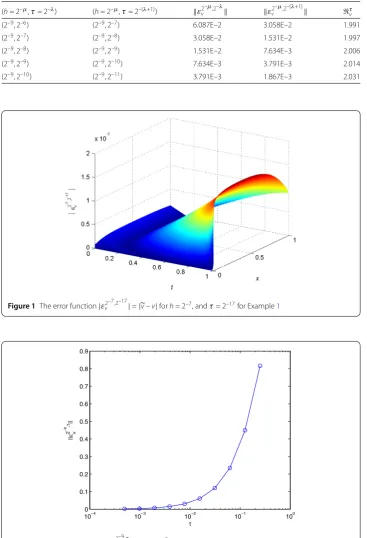
ofvwith respect tohandτ for Example1. Table2represents the maximum errors for h= 2–9,τ = 2–λ,λ= 6, 7, 8, 9, 10, 11 and the order of convergence
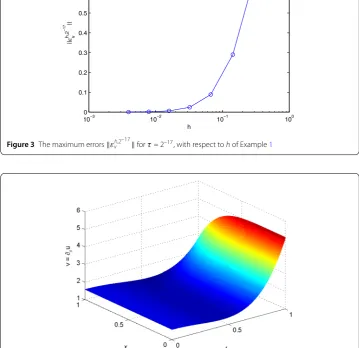
ofvwith respect toτfor Example1. According to the definition of the maximum error the third and fourth columns of Table1and Table2present the theoretical upper bound errors given in (75). Note that theO(h2+τ) order of convergence corresponds to 22 of the quantities defined by (113), and 21of the quantities defined by (114). Figure1presents the error function|ε2–7,2–17
Table 1 Maximum errors and the order of convergence of approximate solutionv˜with respect toh
Table 2 Maximum errors and the order of convergence of approximate solutionv˜with respect toτ
for Example1
(h= 2–μ,τ= 2–λ) (h= 2–μ,τ= 2–(λ+1)) ε2–μ,2–λ
v ε2–
μ,2–(λ+1)
v τv
(2–9, 2–6) (2–9, 2–7) 6.087E–2 3.058E–2 1.991
(2–9, 2–7) (2–9, 2–8) 3.058E–2 1.531E–2 1.997
(2–9, 2–8) (2–9, 2–9) 1.531E–2 7.634E–3 2.006
(2–9, 2–9) (2–9, 2–10) 7.634E–3 3.791E–3 2.014
(2–9, 2–10) (2–9, 2–11) 3.791E–3 1.867E–3 2.031
Figure 1The error function|ε2–7,2–17v |=|v–v|forh= 2–7, andτ= 2–17for Example1
Figure 2The maximum errorsε2–9,v τforh= 2–9, with respect toτof Example1
u(0,t) = 5 18t
18
5 onγ1,
u(1,t) = 5 18t
18 5 + 5
36 5 18cos
Figure 3The maximum errorsεh,2–17v forτ= 2–17, with respect tohof Example1
Figure 4The functionvpresenting the exact solution∂xufor Example1
wheref(x,t) = –365x365t135 sin(t185) +t135 –31
18x
26
5 cos(t185) +π2
4 sin( πx
2). Using the proposed implicit six point difference scheme (28)–(30) (= 6) we obtain the approximate solution uby applying the Gauss–Thomas method [12] for solving algebraic system of equations at each time level for r= 2–ωwhereωis nonnegative integer. Next the boundary value problem for v= ∂∂ux is constructed from the proposed Problem2(ii) using the obtained approximate solutionu. Furthermore, the approximate solutionvfor∂∂uxis obtained at the same grid points by solving the system of equations using (94)–(96), and compared on the grids with the known exact solutionv(x,t) = 5
18x
31 5 cos(t
18 5) +π
2cos( πx
2 ). We use
h,τ
v =
ε2v–μ,2–λ ε2v–(μ+1),2–(λ+1)
(116)
Figure 5The grid functionv2–7,2–17presenting the approximate solutionvof∂xuwhenh= 2–7,τ= 2–17for Example1
Table 3 Maximum errors and the order of convergence of approximate solutionv˜with respect toh
andτfor Example2
(h= 2–μ,τ= 2–λ) (h= 2–(μ+1),τ= 2–(λ+1)) ε2–μ,2–λ
v ε2–(
μ+1),2–(λ+1)
v h,vτ
(2–4, 2–13) (2–5, 2–14) 1.0567E–2 3.1449E–3 3.360
(2–5, 2–14) (2–6, 2–15) 3.1449E–3 8.5353E–4 3.685
(2–6, 2–15) (2–7, 2–16) 8.5353E–4 2.2209E–4 3.843
(2–7, 2–16) (2–8, 2–17) 2.2209E–4 5.6628E–5 3.922
maximum errors forh= 2–μ,μ= 4, 5, 6, 7, 8 andτ= 2–λ,λ= 13, 14, 15, 16, 17, respectively, and the ordersh,τ
v for Example2. The third and fourth columns of this table present the
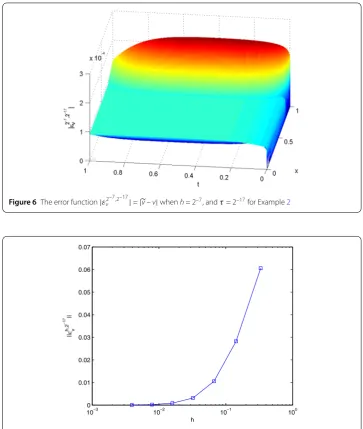
theoretical upper bound errors given in (97). Figure6presents the error function|εv2–7,2–17|
forh= 2–7, andτ = 2–17for Example2. The maximum errorsεh,2–17
v whenτ= 2–17, with
respect toh, is demonstrated by Fig.7for Example2. Figure8shows the exact solution v(x,t) =∂xu, and the grid functionv2
–7,2–17
presenting the approximate solutionvof∂xu
whenh= 2–7,τ= 2–17for Example2.
Example3
Lu=f(x,t) onQT,
u(x, 0) =e–x onγ2,
u(0,t) = 1 + 0.001t257 onγ
1,
u(1,t) = 0.0001sint257+ 0.001t257 +e–1 onγ
3, (117)
wheref(x,t) = 0.0001257x507t187 cos(t257 ) + 0.00125
7t
18
7 – 0.000150
7 43
7x
36
7 sin(t257) –e–x. The
us-Figure 6The error function|ε2–7,2–17v |=|v–v|whenh= 2–7, andτ= 2–17for Example2
Figure 7The maximum errorsεh,2–17v forτ= 2–17, with respect tohfor Example2
ing the obtained approximate solutionu; then the approximate solutionvofv=∂xuis
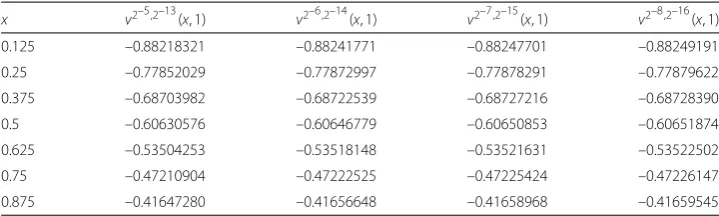
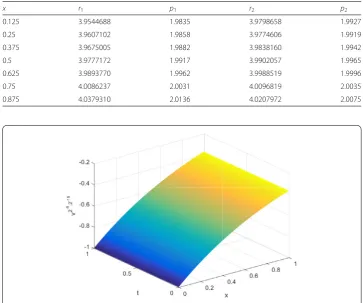
ob-tained at the same grid points by solving the system of equations resulting from (94)–(96). Letv2–μ,2–λ(x,t) be the approximate solutionvat (x,t) whenh= 2–μandτ= 2–λ. The exact solutionvis not given. To verify the order of convergence of the computed solutionvto the exact solutionvwe compute the solution at grid points with successively reduced step sizeshandτby a factor of two and the ratio of the absolute successive errors (see Chap. 2 of [13]). Table4presentsv2–μ,2–λ(x,t) at the grid points (0.125, 1), (0.25, 1), (0.375, 1), (0.5, 1), (0.625, 1), (0.75, 1) and (0.875, 1) for the pairs (μ,λ) = (5, 13), (6, 14), (7, 15), (8, 16, ) which means that the step sizeshinxandτ intare halved successively. Table5demonstrates the absolute error ratios
r1=
v2–5,2–13(x, 1) –v2–6,2–14(x, 1) v2–6,2–14
(x, 1) –v2–7,2–15
Figure 8The exact solution∂xuand the grid functionv2–7,2–17forh= 2–7,τ= 2–17of Example2
Table 4 The approximate solutionv˜at some grid points ont= 1 for Example3
x v2–5,2–13(x, 1) v2–6,2–14(x, 1) v2–7,2–15(x, 1) v2–8,2–16(x, 1)
0.125 –0.88218321 –0.88241771 –0.88247701 –0.88249191
0.25 –0.77852029 –0.77872997 –0.77878291 –0.77879622
0.375 –0.68703982 –0.68722539 –0.68727216 –0.68728390
0.5 –0.60630576 –0.60646779 –0.60650853 –0.60651874
0.625 –0.53504253 –0.53518148 –0.53521631 –0.53522502
0.75 –0.47210904 –0.47222525 –0.47225424 –0.47226147
0.875 –0.41647280 –0.41656648 –0.41658968 –0.41659545
r2=
vv22–6–7,2,2–15–14(x, 1) –v2–7,2–15(x, 1)
(x, 1) –v2–8,2–16
(x, 1) ,
and the corresponding orders
p1=log2
vv22–5–6,2,2–14–13(x, 1) –v2–6,2–14(x, 1)
(x, 1) –v2–7,2–15
(x, 1) ,
p2=log2
vv22–6–7,2,2–15–14(x, 1) –v2–7,2–15(x, 1)
(x, 1) –v2–8,2–16
(x, 1) ,
for the considered points att= 1. By analyzing the values ofp1andp2in the third and fifth columns of Table5, respectively, we conclude that the order of convergence is quadratic in the two variablesxandtont= 1. Figure9illustrates the grid functionv2–8,2–16presenting the approximate solutionvofv=∂xuwhenh= 2–8,τ= 2–16for Example3.
6 Concluding remarks
Table 5 The absolute error ratios at some grid points ont= 1 and the ordersp1,p2for Example3
x r1 p1 r2 p2
0.125 3.9544688 1.9835 3.9798658 1.9927
0.25 3.9607102 1.9858 3.9774606 1.9919
0.375 3.9675005 1.9882 3.9838160 1.9942
0.5 3.9777172 1.9917 3.9902057 1.9965
0.625 3.9893770 1.9962 3.9988519 1.9996
0.75 4.0086237 2.0031 4.0096819 2.0035
0.875 4.0379310 2.0136 4.0207972 2.0075
Figure 9The grid functionv2–8,2–16presenting the approximate solutionvof∂xuwhenh= 2–8,τ= 2–16for Example3
a number of derivatives in the variablesxandtnecessary in this connection for perform-ing current and subsequent manipulation in approximatperform-ing∂u
∂x. We prove that the solution
of the proposed four point and six point difference schemes converge to the exact value of ∂u
∂xon the grids of orderO(h
2+τ) andO(h2+τ2), respectively.
Remark12 These results can be used in some domain decomposition methods allowing for parallel computation [14,15]. Furthermore, the proposed approach may be applicable to similar equations, given in the phenomena of impact of a moving foot on the transfer of heat from a constantly heated warm water into the foot immersed within a footbath [16] and the enhancement of performance by increasing the thermal efficiency of a direct absorption solar collector based on an alimino-water nanofluid [17].
Remark13 The proposed approach can also be applied to finding second order deriva-tives of the solution of the first type boundary value problem for a one dimensional heat equation and this research will be presented in a subsequent article. Also the methodology may be extended to a two dimensional heat equation.
Acknowledgements
The authors thank Professor A.A. Dosiyev for his attention to this work and valuable advices.
Funding
Competing interests
The authors declare that they have no competing interests.
Authors’ contributions
The authors contributed equally to the writing of this paper. All authors read and approved the final manuscript.
Publisher’s Note
Springer Nature remains neutral with regard to jurisdictional claims in published maps and institutional affiliations.
Received: 13 February 2018 Accepted: 12 November 2018
References
1. Bateman, H.: Partial Differential Equations of Mathematical Physics. Dover, New York (1944) 2. Tuttle, F.: A mathematical theory of the drying of wood. J. Franklin Inst.200, 609–614 (1925)
3. Volkov, E.A.: On convergence inC2of a difference solution of the Laplace equation on a rectangle. Russ. J. Numer. Anal. Math. Model.14(3), 291–298 (1999)
4. Dosiyev, A.A., Sadeghi, M.M.H.: A fourth order accurate approximation of the first and pure second derivatives of the Laplace equation on a rectangle. Adv. Differ. Equ.2015, Article ID 67 (2015).
https://doi.org/10.1186/s13662-015-0408-8
5. Volkov, E.A.: On the grid method by approximating the derivatives of the solution of the Dirichlet problem for the Laplace equation on the rectangular parallelpiped. Russ. J. Numer. Anal. Math. Model.19(3), 209–278 (2004) 6. Dosiyev, A.A., Sadeghi, M.M.H.: On a highly accurate approximation of the first and pure second derivatives of the
Laplace equation in a rectangular parellelpiped. Adv. Differ. Equ.2016, Article ID 145 (2016).
https://doi.org/10.1186/s13662-016-0868-5
7. Dosiyev, A.A., Abdussalam, A.: On the high order convergence of the difference solution of Laplace’s equation in a rectangular parallelepiped. Filomat32(3), 893–901 (2018)
8. Dosiyev, A.A., Sarikaya, H.: 14-point difference operator for the approximation of the first derivatives of a solution of Laplace’s equation in a rectangular parallelepiped. Filomat32(3), 791–800 (2018)
9. Samarskii, A.A.: The Theory of Difference Schemes. Dekker, New York (2001)
10. Ladyženskaja, O.A., Solonnikov, V.A., Ural’ceva, N.N.: Linear and Quasi-Linear Equations of Parabolic Type. Translation of Mathematical Monographs, vol. 23. Am. Math. Soc, Providence (1967)
11. Burden, R.L., Faires, J.D.: Numerical Analysis. Cengage Learning, Boston (2011)
12. Fausett, L.V.: Applied Numerical Analysis Using Matlab. Pearson Prentice Hall, Upper Saddle River (2008) 13. Einarsson, B.: Accuracy and Reliability in Scientific Computing. SIAM, Philadelphia (2005)
14. Kuznetsov, Y.: New algorithms for approximate realization of implicit difference schemes. Sov. J. Numer. Anal. Math. Model.3(2), 99–114 (1998).https://doi.org/10.1515/rnam.1988.3.2.99
15. Dawson, C.N., Du, Q., Dupont, T.F.: A finite difference domain decomposition algorithm for numerical solution of the heat equation. Math. Comput.57(195), 63–71 (1991)
16. Turkyilmazoglu, M.: Heat transfer from warm water to a moving foot in a footbath. Appl. Therm. Eng.98, 280–287 (2016)
17. Turkyilmazoglu, M.: Performance of direct absorption solar collector with nanofluid mixture. Energy Conserv. Manag.