R E S E A R C H
Open Access
Stability analysis of a certain class of
difference equations by using KAM theory
Senada Kalabuši´c
1*, Emin Bešo
1, Naida Muji´c
2and Esmir Pilav
1*Correspondence:
[email protected] 1Department of Mathematics, Faculty of Science, University of Sarajevo, Sarajevo, Bosnia and Herzegovina
Full list of author information is available at the end of the article
Abstract
By using KAM theory we investigate the stability of equilibrium points of the class of difference equations of the formxn+1=fx(nx–1n),n= 0, 1,. . .,f: (0, +∞)→(0, +∞),fis
sufficiently smooth and the initial conditions arex–1,x0∈(0, +∞). We establish when
an elliptic fixed point of the associated map is non-resonant and non-degenerate, and we compute the first twist coefficient
α
1. Then we apply the results to severaldifference equations.
Keywords: Area-preserving map; Difference equation; KAM theory; Periodic orbit
1 Introduction and preliminaries
By using KAM (Kolmogorov–Arnold–Mozer) theory we investigate the stability proper-ties of solutions of the following class of second-order difference equations:
xn+1=
f(xn)
xn–1
, n= 0, 1, . . . , (1)
where f is sufficiently smooth, f : (0, +∞)→ (0, +∞), and the initial conditions are
x–1,x0∈(0, +∞).
Equation (1) is considered in the book [18] wheref : (0, +∞)→(0, +∞) and the
ini-tial conditions arex–1,x0∈(0, +∞). In particular, several open problems and conjectures
concerning the possible choice of the functionf, for which the difference equation (1) is
globally periodic, are listed. In [25] the answers to some open problems and conjectures
listed in the book [18] are given. Precisely, for the casesp≤5, necessary and sufficient
conditions onf for all solutions to be periodic with periodpare found.
The well-known difference equation of the form (1) is Lyness’ equation
xn+1=
xn+β
xn–1
, n= 0, 1, . . . . (2)
Several authors have studied the Lyness equation (2) and have obtained numerous results
concerning the stability of equilibrium, non-existence of solutions that converge to the
equilibrium point, the existence of invariants, etc.; see [2,14,15,17,19,35]. See [16] for
the application of the KAM theory to Lyness equation (2). See also [3,4,6] for the results
on the feasible periods for solutions of (2) and the existence of non-periodic solutions
of (2). See [20,21] for the results on the stability of Lyness equation (2) with period two and period three coefficients. These proofs were based on the construction of the cor-responding Lyapunov functions associated with the invariants of the equation. See also
[21] for the results on the stability of Lyness equation with period two coefficient by using
KAM theory.
In [1,7] authors consider the rational second-order difference equation
xn+1= α
(1 +xn)xn–1
, n= 0, 1, 2, . . . , (3)
as a special case of the rational difference equation
xn+1=
α+βxnxn–1+γxn–1
A+Bxnxn–1+Cxn–1
, n= 0, 1, 2, . . . ,
with nonnegative parameters and with arbitrary nonnegative initial conditions such that
the denominator is always positive. Equation (3) is of the form (1). Equation (3) possesses
the following invariant:
xn–1+xn+xn–1xn+α
1 xn–1
+ 1
xn
= constant, ∀n≥0.
See [1]. Equation (3) has a unique positive equilibrium point, and the characteristic
equa-tion of the linearized equaequa-tion of (3) about the equilibrium point has two complex
con-jugate roots on|λ|= 1. Several conjectures and open problems concerning the stability of
the equilibrium point as well as the periodicity of solutions are listed, see [1]. For a more
general case of Equation (3), see [10].
The following equation, which is of the form (1):
yn+1= αy2
n
(1 +yn)yn–1
, n= 1, 2, . . . , (4)
whereαis a parameter, is known as May’s host parasitoid equation, see [22]. In [22] the
authors investigated the corresponding map known as May’s map. More precisely, they investigated the following system of rational difference equations:
un+1= αun
1 +βvn
,
vn+1= βunvn
1 +βvn
, n= 0, 1, 2, . . . ,
(5)
whereαandβare positive numbers and initial conditionsu0andv0are arbitrary positive
numbers. When α∈(1, +∞) andβ ∈(0,∞) this system is a special case of May’s host
parasitoid model. The change of variablesxn=βunandyn=βvnreduces System (5) to
xn+1= αxn
1 +yn
,
yn+1=
xnyn
1 +yn
, n= 0, 1, 2, . . . .
By eliminatingxnfrom the right-hand side, System (6) reduces to Equation (4). In [23,24,
33] it was asserted that the positive equilibrium (α
β, α–1
β ) of System (5) is not asymptotically
stable. In [22] it was proved that this is the case, and then, by employing KAM theory, the
authors showed that the positive equilibrium of System (5) is stable. See [30] for results
on periodic solutions.
In [12] authors analyzed a certain class of difference equations governed by two
param-eters
xn+1=
xk n+a
xpnxn–1
, (7)
wherek,p, andaare positive and the initial conditionsx0,x1are positive. They fixed the
value ofaasa= (2k–p–2– 1)/2kand gave an essentially complete description of the global
behavior of solutions in the first quadrant. They showed how Equation (7) leads to
dif-feomorphismF and showed that, for certain parameter value, all suchFshare four key
properties. One of these is thatFhas precisely two fixed points. Then they showed that an
“upper” fixed point is hyperbolic, and they showed by using KAM theory that, by further
restrictingkandl, the origin becomes a neutrally stable elliptic point. Also, they showed
that outside a compact neighborhood of the origin containing the two fixed points, all
points tend to infinity at an exponential rate under the iterates of F andF–1 and two
branches of the eigenmanifolds of the hyperbolic point intersect at a homoclinic point.
Notice that Equation (7) has the form (1).
In [28] authors considered the following difference equation:
xn+1=
Ax3 n+B
axn–1
, n= 0, 1, . . . , (8)
where the parametersA,B,aand the initial conditionsx–1,x0are positive numbers. They
employed KAM theory to investigate stability property of the positive elliptic equilibrium.
Equation (8) is a special case of the following equation:
xn+1=
Axkn+B axn–1
, n= 0, 1, . . . .
See [19]. See [13] for the equation
xn+1=
Ax2 n+F
exn–1
, n= 0, 1, . . . .
In [8] authors considered the following difference equation:
xn+1=
A+Bxn+x2n
(1 +Dxn)xn–1
, n= 0, 1, . . . .
They employed KAM theory to investigate stability property of the positive elliptic equi-librium.
Notice that all of these equations are of the form (1).
By using the methods of algebraic and projective geometry in [4,5], the authors
global behavior of the following difference equations:
un+2un=a+bun+1+u2n+1, un+2un=
a+bun+1+cu2n+1
c+un+1
and
un+2un=
a+bun+1+cu2n+1
c+dun+1+u2n+1
.
They obtained very precise description of complicated global behavior which includes finding the possible periods of all solutions, proving the existence of chaotic solutions through conjugation of maps, and so forth. These methods were first used by Zeeman in
[35] for the study of Lyness equation. Notice that each of these equations has the form (1).
Motivated by all these results, we consider any real functionfof one real variable which
is sufficiently smooth andf : (0, +∞)→(0, +∞), and then we consider Equation (1). In
Sect.2we show how (1) leads to diffeomorphismsT andF. We prove some properties
of the mapT, and we establish the condition under which a fixed point (x¯,x¯) of the map
T, in (u,v) coordinates (0, 0), is an elliptic fixed point, wherex¯is an equilibrium point of
Equation (1). In Sect.3we compute the first twist coefficientα1, and we establish when an
elliptic fixed point of the mapT is non-resonant and non-degenerate. In Sect.4we apply
our results to several difference equations of the form (1), and we visualize the behavior
of solutions for some values of the corresponding parameters.
2 Logarithmic coordinate change and area-preserving property
We may write Equation (1) as a mapT: (0, +∞)2→(0, +∞)2by setting
un=xn–1, vn=xn, T
u v
=
v
f(v) u
. (9)
The fixed point (u¯,v¯) of the mapTsatisfies the following:
¯
u=v¯ and f(v¯)
¯
u =v¯,
which implies
¯
u2=f(u¯).
Note thatu¯=v¯=x¯, wherex¯is the equilibrium point of Equation (1).
We will assume that all maps are sufficiently smooth to justify subsequent calculations.
The mapTitself must be diffeomorphism of (0, +∞)2, and therefore we assume that this
is the case. The inverse ofT is given by
T–1
u v
=
u
f(u) v
.
The planar mapF isarea-preservingorconservativeif the mapF preserves area of the
planar region under the forward iterate of the map, see [11,19,32]. A differentiable map
of the mapFis equal to 1, that is,|detJF(x,y)|= 1 at every point (x,y) of the domain ofF,
see [11,32].
We claim that map (9) is exponentially equivalent to an area-preserving map, see [16].
Let
E(u,v) =xe¯ u,xe¯ vT.
Then
E–1(x,y) =
lnx ¯
x,ln y
¯
x T
,
and if we setF(u,v) =E–1◦T◦E(u,v), where◦denotes composition of functions, then we
obtain a new mappingF, which is given by
F(u,v) =E–1◦T◦E(u,v) =
v
ln(f(evx¯)) – 2ln(x¯) –u
.
The mapFis defined on all of R2. In fact, sinceTwas a diffeomorphism of the open first
quadrantQand sinceEis a diffeomorphism of R2ontoQ,Fis a diffeomorphism of R2
onto itself.
In the study of area-preserving maps, symmetries play an important role since they yield
special dynamic behavior. A transformationRof the plane is said to be a time reversal
symmetry forT ifR–1◦T◦R=T–1, meaning that applying the transformationRto the
mapTis equivalent to iterating the map backwards in time. If the time reversal symmetry
Ris an involution, i.e.,R2=id, then the time reversal symmetry condition is equivalent to
R◦T◦R=T–1, and T can be written as the composition of two involutionsT =I
1◦I0,
withI0=RandI1=T◦R. Note that ifI0=Ris a reversor, then so isI1=T◦R. Also, the
jth involution, defined asIj:=Tj◦R, is also a reversor.
Similar to the proof of Theorem 2.1 in [12], we prove some properties of the mapFin
the following lemma.
Lemma 1 Assume f ∈C1[(0, +∞), (0, +∞)],f(x¯) =x¯2,andx¯> 0,then F shares the following properties:
(a) Fhas the origin as a fixed point; (b) Fis globally area-preserving;
(c) Fsatisfies a time-reversing,mirror image,symmetry condition; (d) All fixed points ofFare located on the diagonal in the first quadrant.
Proof Assertion (a) is immediate. The Jacobian matrix of the mapFis
JF(u,v) =
0 1
–1 evxff¯(ev(ex¯v)x¯)
, (10)
and sodetJF(u,v) = 1. To explain (c), letR(x,y) = (y,x) which is reflection about the
equation may be rewritten asR◦F=F–1◦R. For the final assertion (d), it is easier to work
with the original form of our functionT.
A fixed point (x¯,x¯) is anelliptic point of an area-preserving map if the eigenvalues of
JT(x¯,y¯) form a purely imaginary, complex conjugate pairλ,λ¯, see [11,19]. The following
3 The KAM theory and Birkhoff normal form
The stability of an elliptic fixed point of nonlinear area-preserving map cannot be deter-mined solely from linearization, and the effects of the nonlinear terms in local dynamics must be accounted for. This task is facilitated by simplifying the nonlinear terms through appropriate coordinate transformations into Birkhoff normal form.
Consider a smooth, area-preserving map (u,v)→F(u,v) of the plane that has (0, 0) as
an elliptic fixed point, and letλbe an eigenvalue ofJF(0, 0). By putting the linear part of
such a map into Jordan canonical form, by making an appropriate change of variables, we can represent the map in the form
Assume that the eigenvalueλof the elliptic fixed point satisfies the non-resonance
condi-tionλk= 1 fork= 1, . . . ,q, for someq≥4. By Lemma 15.37 [11] there exist new canonical
complex coordinates (ζ,ζ¯) relative to which mapping (12) takes the normal form (Birkhoff
normal form)
in a neighborhood of the elliptic fixed point, whereα(ζζ¯) =α1|ζ|2+· · ·+α
s|ζ|2sis a real
polynomial,s= [q2] – 1, andgvanishes with its derivatives up to orderq– 1 atζ=ζ¯= 0.
The square brackets denote the largest integer inq/2. The numbersα1, . . . ,αsare called
twist coefficients.
Consider an invariant annulusa<|ζ|<bin a neighborhood of an elliptic fixed point
(0, 0). It is easy to see that the normal form approximationζ→λζeiα(ζζ¯)leaves invariant all
circles|ζ|= const. This map is called a twist mapping. It is easy to describe the dynamics of
the twist map: the orbits are simple rotations on these circles. Also note that if at least one
of the twist coefficientsαjis nonzero, then the angle of rotation is not constant. Applying
KAM-theory (Moser’s twist map theorem [9,27,29,31]) it follows that if a system is close
enough to a twist mapping with rotation angle varying with the radius, then still infinitely
many of the invariant circles survive the perturbation. By [29], p. 245, the rotation angles
of these circles are only badly approximable by rational numbers. According to KAM-theory there exist states close enough to the fixed point, which are enclosed by an invariant curve. Within these gaps, one finds, in general, orbits of hyperbolic and elliptic periodic points. These facts cannot be deduced from computer pictures. By continuity arguments the interior of such a closed invariant curve will then map onto itself. The same is true for a state within an annulus enclosed between two such curves.
The KAM theorem requires that the elliptic fixed point be resonant and
non-degenerate. Note that, forq= 4, the non-resonance conditionλk= 1 requires thatλ=±1
or±i. The above normal form yields the approximation
ζ →λζ+c1ζ2ζ¯+O
|ζ|4
withc1=iλα1 andα1being the first twist coefficient. We will call an elliptic fixed point
non-degenerate ifα1= 0.
The following is a consequence of Lemma 15.37 [11] and Moser’s twist map theorem [9,
11,27,29].
Theorem 1 Let F:R2→R2be an area-preserving diffeomorphism and(x,y)be an elliptic
fixed point.Assume thatα1= 0.Then there exist periodic points of F with arbitrarily large
period in every neighborhood of(x,y).In addition,ifλ=±1or±i,then the(x,y)is a stable fixed point.
In the sequel we set
f1:=f (x¯), f2:=f (x¯) and f3:=f (x¯).
We prove the following theorem.
Theorem 2 Assume that|f (x¯)|< 2x¯,wherex is an equilibrium point of Equation¯ (1).The elliptic fixed point(0, 0)of the map F,in the(u,v)coordinates,is always non-degenerate. It is non-resonant if and only if
f3=
f2(f2+ 6)x¯4+f1(f2(2f2– 1) + 2)x¯3– 4f12(f2+ 1)x¯2–f13f2x¯+ 2f14 ¯
x3(f
1– 2x¯)(x¯+f1)
Proof To compute the first twist coefficientα1, we follow the procedure in [9]. LetFbe
with determinant 1, we change coordinates
The system in the new coordinates becomes
A tedious symbolic computation done with package Mathematica yields
ξ20=
The above normal form yields the approximation
ζ →λζ+c1ζ2ζ¯+O
|ζ|4
withc1=iλα1andα1being the first twist coefficient.
The coefficientc1can be computed directly using the formula
derived by Wan in the context of Hopf bifurcation theory [34]. In [26] it is shown that when
one uses area-preserving coordinate changes Wan’s formula yields the twist coefficientα1
that is used to verify the non-degeneracy condition necessary to apply the KAM theorem. By using
It can be proved that
α1= –iλ¯c1
Since map (9) is exponentially equivalent to an area-preserving mapF, an immediate
consequence of Theorems1and2is the following result.
Theorem 3 Letx¯> 0be the equilibrium point of (1)such that|f (x¯)|< 2x¯.If (13)holds, then there exist periodic points of T with arbitrarily large period in every neighborhood of (x¯,x¯).In addition,x is a stable equilibrium point of¯ (1).
4 Examples
In this section, we apply Theorem3to several difference equations of the form (1) that
have been listed in Sect.1.
wherek,p,aand the initial conditionsx0,x1are positive, is analyzed in [12] with fixed the
value ofaasa= (2k–p–2– 1)/2k, wherek>p+ 2 andp≥1.
Now, we assume thatais any positive real number.
The equilibrium point of Equation (16) satisfies
¯
xp+2=x¯k+a.
Similar as in Proposition 2.2 [12] one can prove the following.
Proposition 1 Assume that k,p,and a are positive.Let x0be the positive solution of the
equation xk0–p–2= (p+ 2)/k,and let y0=xp0+2–xk0.Then the following holds:
(a) Ifk>p+ 2,then for0 <a<y0Equation(16)has exactly two positive equilibrium points,fora=y0it has exactly one,and fora>y0it has none.
(b) Ifk<p+ 2,then Equation(16)has exactly one positive equilibrium point.
Since
f (x¯) – 2x¯= –(px¯
k–kx¯k+ 2x¯p+2+ap) ¯
xp+1
and
f (x¯) + 2x¯= –(px¯
k–kx¯k– 2x¯p+2+ap) ¯
xp+1 ,
we have that ifx¯> 0 then|f (x¯)|< 2x¯if and only if
(k–p– 2)x¯k<a(p+ 2) and (k–p+ 2)x¯k>a(p– 2). (17)
Hence,x¯is an elliptic point if and only if condition (17) is satisfied.
A tedious symbolic computation done with package Mathematica yields
α1=
ak3x¯k((k–p– 2)(k–p+ 1)x¯2k+ 2akx¯k–a2(p2+p– 2))
4((–k+p– 2)x¯k+a(p– 2))((–k+p– 1)x¯k+a(p– 1))((–k+p+ 2)x¯k+a(p+ 2))2.
Therefore we have the following statement.
Theorem 4 Assume that k,p,and a are positive and the initial conditions x0,x1are
posi-tive.Letx¯> 0be an equilibrium point of (16)and T be the map associated with Equation
(16).Then(x¯,x¯)is an elliptic fixed point of T if and only if
(k–p– 2)x¯k<a(p+ 2) and (k–p+ 2)x¯k>a(p– 2).
Further,if
(k–p– 2)(k–p+ 1)x¯2k+ 2akx¯k–a2p2+p– 2= 0,
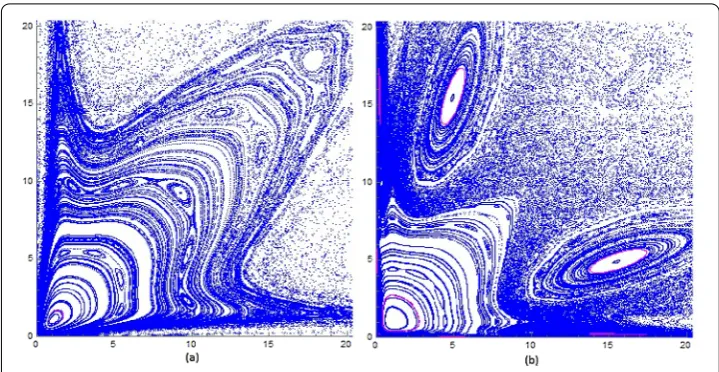
Figure 1Some orbits of the mapTassociated with Eq. (16) for (a)k= 2.1,p= 1, anda= 0.1 and (b)k= 2.01, p= 2, anda= 0.1
Figure1shows phase portraits of the orbits of the mapTassociated with Equation (16)
for some values of the parametersp,k, anda. Neither of these two plots shows any
self-similarity character.
4.2 Example 2:xn+1= A+Bxn+Cxn2 (D+Exn)xn–1
The equation
xn+1=
A+Bxn+Cx2n
(D+Exn)xn–1
, (18)
where A,B,C,D, andE are nonnegative and the initial conditionsx0,x1 are positive, is
analyzed by using the methods of algebraic and projective geometry in [4,5] whereC=D
andE= 1 and by using KAM theory in [8] whereC=D= 1 andA,B,E> 0. Now, we assume
that
(D,E> 0∧A+B> 0)∨(D,E> 0∧A+B= 0∧C>D).
The equilibrium point of Equation (18) satisfies
Ex¯3–x¯2(C–D) –Bx¯–A= 0.
By using Descartes’ rule of sign, we obtain that this equation has one positive root.
There-fore, Equation (18) has one positive equilibrium point.
IfD,E> 0, then the changexn=DEynconjugates Equation (18) to
yn+1=
a+byn+cy2n
(1 +yn)yn–1
, (19)
where the parametersa,b, andcare
a=AE
2
D3 , b=
BE
D2 and c=
One can see that the following holds.
Proposition 2 Assume a,b,c≥0and a+b> 0 or a+b= 0∧c> 1.Letx be a positive¯ equilibrium of Equation(19),then|f (x¯)|< 2x¯.
A tedious symbolic computation done with package Mathematica yields
α1=
Γ1+Γ2x¯+Γ3x¯2
2(x¯+ 1)2(2cx¯+x¯+b)(2x¯(b–c+ 1) + (c+ 2)x¯2+ 3a–b)2(2x¯(b+c+ 1) + (3c+ 2)x¯2+a+b),
where
Γ1=a3b2+ 25a3bc2+ 66a3bc+ 11a3b+ 20a3c3+ 70a3c2+ 55a3c–a3– 2a2b3
– 12a2b2c3+ 5a2b2c2– 8a2b2c– 5a2b2– 29a2bc5– 44a2bc4– 82a2bc3
– 46a2bc2+ 22a2bc+ 2a2b– 8a2c7– 8a2c6– 16a2c5– 2a2c4+ 8a2c2+ 8a2c
+ 3ab4c2+ 8ab4c+ab4+ab3c4+ 16ab3c3– 6ab3c2– 2ab3c– 7ab3– 3ab2c6
+ 10ab2c5– 26ab2c4– 3ab2c3+ab2c2– 5ab2c–ab2–abc8+ 6abc7– 14abc6
+ 8abc5+abc4+ac9– 3ac8+ 3ac7–ac6+b4,
Γ2= 11a3bc+ 4a3b+ 8a3c3+ 63a3c2+ 54a3c+a3+ 24a2b2c2+ 75a2b2c+ 16a2b2
– 20a2bc4– 18a2bc3+ 18a2bc2+ 110a2bc+ 6a2b– 8a2c6– 17a2c5– 33a2c4
– 35a2c3+ 21a2c2+ 37a2c–a2+ab4c–ab4– 10ab3c3+ 18ab3c2–ab3c– 19ab3
– 31ab2c5– 38ab2c4– 95ab2c3– 54ab2c2– 15ab2c– 6ab2– 9abc7– 4abc6
– 25abc5– 3abc4– 4abc2+ 8abc+ab+ac8– 2ac7+ac6+ 3b5c2+ 8b5c+b5
+b4c4+ 16b4c3– 6b4c2– 2b4c–b4– 3b3c6+ 10b3c5– 26b3c4– 3b3c3+b3c2
+ 2b3c–b3–b2c8+ 6b2c7– 14b2c6+ 8b2c5+b2c4+bc9– 3bc8+ 3bc7–bc6,
Γ3= 16a3c2+ 19a3c+a3+ 12a2b2c+ 8a2b2+ 22a2bc3+ 92a2bc2+ 84a2bc+ 6a2b
– 8a2c5– 6a2c4– 10a2c3+ 33a2c2+ 28a2c–a2–ab4+ab3c2+ 15ab3c– 7ab3
– 33ab2c4– 16ab2c3– 65ab2c2– 25ab2c– 6ab2– 38abc6– 30abc5– 78abc4
– 7abc3+ 5abc2+ 9abc+ab– 8ac8+ac7– 9ac6+ 14ac5+ 2ac4+b5c+b5
+ 5b4c3+ 18b4c2–b4–b3c5+ 21b3c4– 35b3c3– 4b3c2+b3c–b3– 4b2c7
+ 17b2c6– 45b2c5+ 22b2c4+ 4b2c3–bc9+ 8bc8– 22bc7+ 23bc6– 7bc5–bc4
+c10– 4c9+ 6c8– 4c7+c6.
In Table1we compute the twist coefficient for some valuesa,b,c≥0.
Theorem 5 Assume that a,b,and c are positive numbers such that a+b> 0.Letx¯> 0be an equilibrium point of Equation(19)and T be the map associated with Equation(19). Then(x¯,x¯)is an elliptic fixed point of T and,ifα1= 0,then there exist periodic points of
Table 1 The first twist coefficient for some values ofa,b,c≥0
Parameters Equation The first twist coefficient
a=b= 0,c> 1,¯x=c– 1 yn+1= cy 2 n
(1+yn)yn–1 α1=12c2+10c c+2
a=c= 0,x¯=12(√4b+ 1 – 1) yn+1=(1+ynbyn)yn–1 α1=2(4b+1)(3(√4b(+1+1)+b–1)bb(√4b+1+6)) b=c= 0,a=x¯3+x¯2 yn
+1=(1+yna)yn
–1 α1=
(x¯–1)x¯
2(x¯+2)(3¯x+2)2 c= 0,a=x¯3+x¯2–bx¯ yn+1=(1+ayn+byn)yn
–1 α1=
(b–¯x2)(2b3x¯–4b¯x4–(b(b+5)–1)x¯3+(b–2)bx¯2–¯x5+b3) 2(x¯+1)(¯x+b)(¯x(x¯+2)+b)(b–¯x(3x¯+2))2
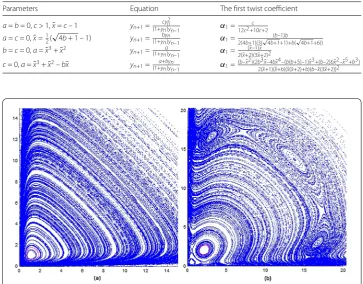
Figure 2Some orbits of the mapTassociated with Eq. (19) for (a)a= 0.2,b= 1.05, andc= 1.03 and (b) a= 0.1,b= 0.05, andc= 0.3
Figure2shows phase portraits of the orbits of the mapTassociated with Equation (19)
for some values of the parametersa,b, andc.
4.3 Example 3:xn+1=a+bxn+cx2n xn–1
In [4,5] the authors analyzed the equation
xn+1=
a+bxn+cx2n
xn–1
, (20)
wherea,b, andcare nonnegative and the initial conditionsx0,x1are positive, by using the
methods of algebraic and projective geometry wherec= 1. It is easy to see that Equation
(20) has one positive equilibrium
¯
x=b+
√
4ac+ 4a+b2
2(1 –c)
forc< 1. Further,|f (x¯)|– 2x¯= –b2+ 4a(1 –c) < 0.
By using package Mathematica, we obtain
α1=16a
2(c– 1)2c(c+ 1) +ab2(–8c3+ 8c2+c– 1) +bΓ 4
√
–4ac+ 4a+b2+b4(c2–c+ 1)
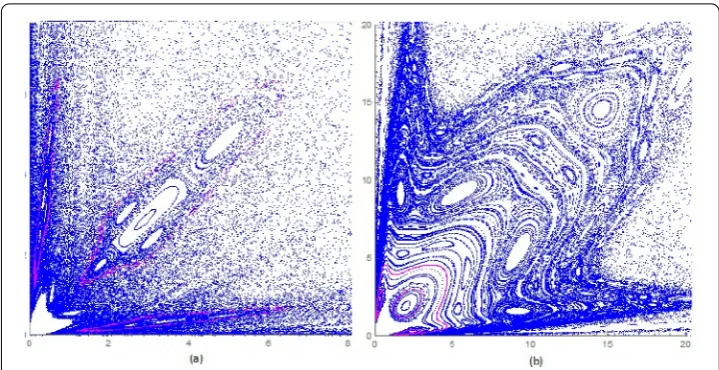
Figure 3Some orbits of the mapTassociated with Eq. (20) for (a)a= 0.1,b= 0.002, andc= 0.001 and (b) a= 0.1,b= 0.02, andc= 0.001
where
Γ4=a
4c3– 12c2+ 7c+ 1–b2c2– 3c+ 1.
Theorem 6 Assume that a,b,and c are positive numbers such that a+b> 0and c< 1.Let
¯
x> 0be the equilibrium point of Equation(20)and T be the map associated with Equation
(20).Then(x¯,x¯)is an elliptic fixed point of T and,ifα1= 0,there exist periodic points with
arbitrarily large period in every neighborhood of(x¯,x¯).In addition,x is a stable equilibrium¯ point of (20).
Figure3shows phase portraits of the orbits of the mapTassociated with Equation (20)
for some values of the parametersa,b, andc.
5 Conclusion
In this paper, we investigated the stability of a class of difference equations of the form
xn+1=fx(nx–1n),n= 0, 1, . . . . We assume that the functionfis sufficiently smooth and the initial
conditions are arbitrary positive real numbers. It is enough to assume that the functionf
is inC(3)(0, +∞). We show how the mapTassociated with this difference equation leads to
diffeomorphismF. We prove some properties of the mapF, and we establish the condition
under which an equilibrium point (0, 0) inu,vcoordinates is an elliptic fixed point. Also,
we compute the first twist coefficient. The condition for an elliptic fixed point to be non-degenerate and non-resonant is established in closed form. This condition depends only
on the values of the first, second, and third derivatives of the functionf at the equilibrium
point. We apply our result to several difference equations that have been investigated by others. By numerical computations, we confirm our analytic results.
Acknowledgements
The authors are thankful to the anonymous referees for their helpful comments and the editor for constructive suggestions to improve the paper in current form.
Availability of data and materials Not applicable.
Ethics approval and consent to participate Not applicable.
Competing interests
The authors declare that they have no competing interests.
Authors’ contributions
All authors contributed equally and significantly in writing this article. All authors read and approved the final manuscript.
Author details
1Department of Mathematics, Faculty of Science, University of Sarajevo, Sarajevo, Bosnia and Herzegovina.2Faculty of
Electrical Engineering, University of Sarajevo, Sarajevo, Bosnia and Herzegovina.
Publisher’s Note
Springer Nature remains neutral with regard to jurisdictional claims in published maps and institutional affiliations.
Received: 22 March 2019 Accepted: 20 May 2019 References
1. Amleh, A.M., Camouzis, E., Ladas, G.: On the dynamics of a rational difference equation, part 1. Int. J. Difference Equ. 3(1), 1–35 (2008)
2. Barbeau, E., Gelbord, B., Tanny, S.: Periodicity of solutions of the generalized Lyness recursion. J. Differ. Equ. Appl.1, 291–306 (1995)
3. Bastien, G., Rogalski, M.: Global behavior of the solutions of Lyness’ difference equationun+2un=un+1+a. J. Differ.
Equ. Appl.10, 977–1003 (2004)
4. Bastien, G., Rogalski, M.: On some algebraic difference equationsun+2un=g(un+1) related to families of conics or
cubics: generalization of the Lyness’ sequences. J. Math. Anal. Appl.300, 303–333 (2004)
5. Bastien, G., Rogalski, M.: On the algebraic difference equationsun+2un=ψ(un+1) inR+∗, related to a family of elliptic
quartics in the plane. Adv. Differ. Equ.2005, 948567 (2005)
6. Beukers, F., Cushman, R.: Zeeman’s monotonicity conjecture. J. Differ. Equ.143, 191–200 (1998)
7. Denette, E., Kulenovi´c, M.R.S., Pilav, E.: Birkhoff normal forms, KAM theory and time reversal symmetry for certain rational map. Mathematics4(1), 20 (2016)
8. Garic-Demirovic, M., Nurkanovic, M., Nurkanovic, Z.: Stability, periodicity, and symmetries of certain second-order fractional difference equation with quadratic terms via KAM theory. Math. Methods Appl. Sci.40, 306–318 (2017) 9. Gidea, M., Meiss, J.D., Ugarcovici, I., Weiss, H.: Applications of KAM theory to population dynamics. J. Biol. Dyn.5(1),
44–63 (2011)
10. Grove, E.A., Janowski, E.J., Kent, C.M., Ladas, G.: On the rational recursive sequencexn+1=(γxnαxn+δ+)xnβ–1. Commun. Appl.
Nonlinear Anal.1(13), 61–72 (1994)
11. Hale, J.K., Kocak, H.: Dynamics and Bifurcation. Springer, New York (1991)
12. Haymond, R.E., Thomas, E.S.: Phase portraits for a class of difference equations. J. Differ. Equ. Appl.5, 177–202 (1999) 13. Jašarevi´c-Hrusti´c, S., Kulenovi´c, M.R.S., Nurkanovi´c, Z., Pilav, E.: Birkhoff normal forms, KAM theory and symmetries for
certain second order rational difference equation with quadratic terms. J. Differ. Equ.10(2), 181–199 (2015) 14. Kocic, V.L., Ladas, G.: Global Behavior of Nonlinear Difference Equations of Higher Order with Applications. Kluwer
Academic, Dordreht (1993)
15. Kocic, V.L., Ladas, G., Rodrigues, I.W.: On the rational recursive sequences. J. Math. Anal. Appl.173, 127–157 (1993) 16. Kocic, V.L., Ladas, G., Tzanetopoulos, G., Thomas, E.: On the stability of Lyness equation. In: Dynamics of Continuous,
Discrete and Impulsive Systems (1), pp. 245–254 (1995)
17. Kulenovi´c, M.R.S.: Invariants and related Liapunov functions for difference equations. Appl. Math. Lett.13, 1–8 (2000) 18. Kulenovi´c, M.R.S., Ladas, G.: Dynamics of Second Order Rational Difference Equations: With Open Problems and
Conjectures. Chapman and Hall/CRC, London (2001)
19. Kulenovi´c, M.R.S., Merino, O.: Discrete Dynamical Systems and Difference Equations with Mathematica. Chapman Hall/CRC, Boca Raton (2002)
20. Kulenovi´c, M.R.S., Nurkanovi´c, Z.: Stability of Lyness equation with period three coefficient. Rad. Mat.12, 153–161 (2004)
21. Kulenovi´c, M.R.S., Nurkanovi´c, Z.: Stability of Lyness equation with period-two coefficient via KAM theory. J. Concr. Appl. Math.6, 229–245 (2008)
22. Ladas, G., Tzanetopoulos, G., Tovbis, A.: On May’s host parasitoid model. J. Differ. Equ. Appl.2, 195–204 (1996) 23. May, R.M.: Host-parasitoid system in patchy environments. A phenomenological model. J. Anim. Ecol.47, 833–843
(1978)
24. May, R.M., Hassel, M.P.: The dynamics of multiparasitoid host interactions. Am. Nat.117, 234–261 (1981) 25. Mestel, B.D.: On globally periodic solutions of the difference equationxn+1=fxn(xn–1). J. Differ. Equ. Appl.3, 201–209
(2001)
26. Moeckel, R.: Generic bifurcations of the twist coefficient. Ergod. Theory Dyn. Syst.10(1), 185–195 (1990) 27. Moser, J.: On invariant curves of area-preserving mappings of an annulus. Nachr. Akad. Wiss. Gött., 21962, 1–20
(1962)
28. Nurkanovi´c, M., Nurkanovi´c, Z.: Birkhoff normal forms, KAM theory, periodicity and symmetries for certain rational difference equation with cubic terms. Sarajevo J. Math.25, 217–231 (2016)
30. Siezer, W.: Periodicity in the May’s host parasitoid equation. In: Advances Studies in Pure Mathematics 53 (2009) 31. Sternberg, S.: Celestial Mechanics. II. W. A. Benjamin, New York (1969)
32. Tabor, M.: Chaos and Integrability in Nonlinear Dynamics. An Introduction. Wiley, New York (1989)
33. Taylor, A.D.: Aggregation, competition, and host-parasitoid dynamics: stability conditions don’t tell it all. Am. Nat.141, 501–506 (1993)
34. Wan, Y.H.: Computation of the stability condition for the Hopf bifurcationof diffeomorphisms onR2. SIAM J. Appl.
Math.34(1), 167–175 (1978)