Near-Collision Attack and Collision-Attack on
Double Block Length Compression Functions
based on the Block Cipher IDEA
Donghoon Chang
Center for Information Security Technologies(CIST), Korea University, Korea
Abstract. IDEA is a block cipher designed by Xuejia Lai and James L. Massey and was first described in 1991. IDEA does not vary the constant in its key schedule. In [1], Donghoon Chang and Moti Yung showed that there may be a weakness of hash function based on block cipher whose key schedule does not use various constants. Based on their result, we investigate the security of double block length compression functions based on the block cipher IDEA such that the key size of IDEA is 128 bits and its block length is 64 bits. We use the double block length hash functions proposed by Shoichi Hirose in the second hash workshop in 2006 [2]. Then, we can easily find a near-collision by hand. And also, for a constantcof DBL hash functions, we can find a collision by hand.
This means that the constantcmay be used as a trapdoor to make the
attacker find collision easily.
Keywords :Hash Function, Double Block Length Compression Function, Near-Collision Attack, Near-Collision Attack, IDEA.
1
Introduction.
schedule of the block cipher. This results support the result of [1]. And also, for a constantcof DBL hash functions, we can find a collision by hand. This means that the constantcmay be used as a trapdoor to make the attacker find collision easily.
2
IDEA and DBL Compression Functions
2.1 the Block Cipher IDEA
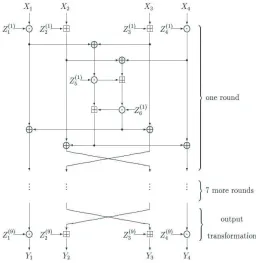
Let the block be 16-bit. X1||X2||X3||X4 is a 64-bit plaintext such that eachXi
is 16-bit. IDEA consists of 8 rounds. From the 128-bit master key K, we get (7×128)-bitS as follows.
S=K||K≪25||K≪50||K≪75||K≪100||K≪125||K≪22||K≪47
The first 52 blocks ofS are used as subkeys.i-th round subkeys areZi
=
Z1(i)||Z2(i)|| · · · ||Z6(i). For example, the first round subkeys are the first 6 blocks of
S.⊞means the addition modulo 216.⊙means the multiplication modulo 216+ 1
such that the zero is treated as 216.
2.2 DBL Compression Functions
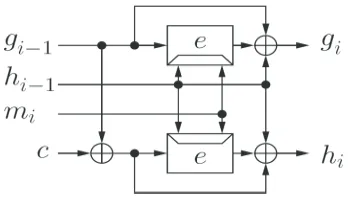
Here, we describe only two DBL compressin functions which are used in our security analysis.eis a block cipher withn-bit block and 2n-bit key.gi−1,hi−1
andmi aren-bit.cis a non-zeron-bit constant. Shoichi Hirose [2] showed that
the the compression functions in Fig. 2 and 3 are collision resistant in the ideal cipher model. In case of IDEA,n= 64.
Fig. 2.Double Block Length Compression Function 1
Fig. 3.Double Block Length Compression Function 2
3
Near-Collision Attack on DBL Compression Functions
based on IDEA
The attack strategy is similar to that of [1].
· · · =Z8. The candidates of the master key are all zero bits and all one bits. Since IDEA uses ⊞and ⊙, we choose all zero bits, i.e. K= 0128. Then all
sub-keys are all zero bits.
Analysis of Round Function of IDEALetRoundi(Z i
||Xi
) be thei-th round function of IDEA such that Zi
is the 6-block round key and Xi
is the 4-block input of roundi. Since the master key is 0128,Roundi(Z
i
||Xi
)=Roundi(096||X i
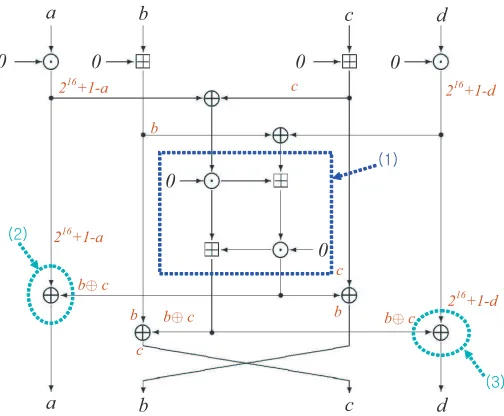
). Then, we want to findX such thatRoundi(096||X) =X. LetX=a||b||c||dsuch
thata, b, canddare 1-block. In order to findX such thatRoundi(096||X) =X, X have to satisfy conditions (1), (2) and (3) in Fig. 4.
a b c d
a b c d
0 0 0 0
0 0 b c c c b
b⊕c b⊕c
216+1-d 216+1-d 216+1-a
216+1-a b
OZP
OXP
b⊕c OYP
Fig. 4.Analysis of Round Function of IDEA
Condition (2) is that b⊕c = (216+ 1−a)⊕a. Condition (3) isb⊕c =
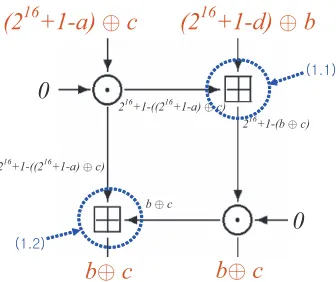
(216+ 1−d)⊕d. In order to know the condition (1), we look closely like Fig. 5.
Since 216⊙216= 1, (216)−1 = 216. In Fig. 5, we have two conditions (1.1) and
(1.2). Condition (1.1) is that 216+ 1−((216+ 1−a)⊕c) + ((216+ 1−d)⊕b) =
216+ 1−(b⊕c). Condition (1.2) is that 216+ 1−((216+ 1−a)⊕c) = 0.
Therefore, we want to obtaina, b, c and dsatisfying conditions (1.1), (1.2), (2) and (3).
(1.1) 216+ 1−((216+ 1−a)⊕c) + ((216+ 1−d)⊕b) = 216+ 1−(b⊕c).
(1.2) 216+ 1−((216+ 1−a)⊕c) = 0.
0
0
b
⊕
c
b
⊕
c
(2
16+1-a)
⊕
c
(2
16+1-d)
⊕
b
216+1-((216+1-a) ⊕c)
b ⊕c 216+1-((216+1-a) ⊕c)
216+1-(b ⊕c)
OXUYP
OXUXP
Fig. 5.Analysis of Conditioin (1) Of the Round Function of IDEA
(3)b⊕c= (216+ 1−d)⊕d.
It is easy to find a solution thata= 1, b= 0, c= 1, d= 1. And also we can know that Roundi(096||T) = T′ and Roundi(096||T′) = T where T = 1||0||1||0
andT′= 0||1||0||1. Since IDEA has 8 rounds, we can know thate0128(1||0||1||1) =
(0||0||1||0) and e0128(1||0||1||0) = (0||0||1||1) like the Fig. 6.
0 0 0 0
0
0
0 0 0 0
1 0 1 1
1 0 1 1
0 0 1 0
0 0 0 0
0
0
0 0 0 0
1 0 1 0
1 0 1 0
0 0 1 1
0 0 0 0
0
0
0 0 0 0
1 0 1 1
1 0 1 1
0 0 1 0
0 0 0 0
0
0
0 0 0 0
1 0 1 0
1 0 1 0
0 0 1 1
Fig. 6.Two inputs and Two outputs of IDEA
and e0128(1||0||1||0) = (0||0||1||1). In Fig. 2 and 3, if gi
−1 = (1||0||1||1) and g′
i−1 = (1||0||1||0) and mi = m′i = hi−1 = h′i−1 = 064, then gi = gi′. If c =gi−1⊕gi′−1 = (0||0||0||1), then gi =gi′ andhi =h′i, i.e., we get a collision
of DBL compression function based on IDEA. Therefore, c should be chosen carefully so that there is no trapdoor inc.
4
Comment on the result of [1]
We considered two DBL compression functions in Fig. 2 and 3. In [1], they suggested two kinds of modifications of block cipher based hash function. One solution is to change the XOR operation into the addition operation. But, in case of DBL compression function based on IDEA, even though we change the XOR operation into the addition operation in Fig. 2 and 3, the previous results can be applied in the same way. Therefore, based on this result, we can know that to vary the constants of the key schedule of the block cipher is required to guarantee the security.
5
Conclusion
In this paper, based on the result of [1], we showed the near-collision attack and the collision attack on DBL compression functions based on IDEA. In order to instantiate a block cipher in hash function based on the block cipher, we recommend to vary the constants in the key schedule of the block cipher.
References
1. D. Chang and M. Yung,Do We Need to Vary the Constants? (Methodological Inves-tigation of Block-Cipher Based Hash Functions), Cryptology ePrint Archive, Report 2006/467.
2. S. Hirose,How to Construct Double-Block-Length Hash Functions, In second Hash Workshop, 2006.