ABSTRACT
NADKARNI, ADWAIT PRAVIN. Towards Practical Data Secrecy in Modern Operating Systems. (Under the direction of Dr. William Enck.)
Modern commodity operating systems such as Android, iOS, and Windows 8 have changed the way consumers interact with computing devices. On these operating systems, third-party applications provide tremendous functionality for creating, processing, man-aging, and sharing user data. Moreover, users can complete complex tasks by stringing together purpose-specific third-party applications (e.g., an email application, a document viewer, a barcode scanner). However, while user-directed information sharing among appli-cations provides value, it exposes user data to the risk of accidental or malicious exfiltration from the device.
© Copyright 2017 by Adwait Pravin Nadkarni
Towards Practical Data Secrecy in Modern Operating Systems
by
Adwait Pravin Nadkarni
A dissertation submitted to the Graduate Faculty of North Carolina State University
in partial fulfillment of the requirements for the Degree of
Doctor of Philosophy
Computer Science
Raleigh, North Carolina
2017
APPROVED BY:
Dr. Douglas Reeves Dr. Munindar Singh
Dr. Jessica Staddon Dr. William Enck
DEDICATION
BIOGRAPHY
ACKNOWLEDGEMENTS
This dissertation is the culmination of 6 years of my education at the North Carolina State University (NC State). My experiences at NC State, whether with the faculty, students, staff or the institution itself, have played an important role in my growth as a professional and as a person. I would like to use this opportunity to thank all the people that have contributed to my life and career.
I would like to thank my advisor, Dr. William Enck, for his guidance and support over the course of my time in graduate school. Will’s class on computer security was the first class I took at NC State. His teaching and philosophy are what inspired me to pursue research in computer security and an academic career. Over the years, Will helped me mature as an independent researcher with his unconditional support and unbiased advice. He taught me to always put students first, a philosophy that has now become an inseparable part of my personality as a mentor. I owe the successful completion of my PhD entirely to Will’s mentoring, dedication, and friendship.
Over the course of my PhD, I have had the benefit of interacting with fellow researchers who have helped shape my research with their insights and broad perspectives. I would like to thank my collaborators, specifically Dr. Somesh Jha, Dr. Ahmad-Reza Sadeghi, Dr. Jessica Staddon, Dr. Xiaohui Gu, Dr. Tao Xie, Dr. Stephan Heuser, Dr. Anmol Sheth, Dr. Nina Taft, Dr. Udi Weinsberg, Benjamin Andow and Rui Shi for their efforts and guidance. I would like to thank Michael Grace for mentoring me during my internship at Samsung Research America, and for giving me the freedom to explore a broad array of research problems during the course of my internship. I would like to thank members of my doctoral committee, Dr. Douglas Reeves, Dr. Munindar Singh, and Dr. Jessica Staddon for their valuable feedback during the course of my degree. I would also like to thank Dr. Somesh Jha, in particular, for mentoring me during the last couple of years of my PhD, and guiding me through to the next step of my career.
past members of the security lab at NC State, specifically, Jitesh Shah, Vasant Tendulkar, Ashwin Shashidharan, Dr. Jason Gionta and Zach Jorgensen, for their feedback during my early years at NC State.
TABLE OF CONTENTS
LIST OF TABLES . . . x
LIST OF FIGURES. . . xi
Chapter 1 Introduction. . . 1
1.1 Thesis Statement . . . 4
1.2 Contributions . . . 7
1.3 Dissertation Outline . . . 9
Chapter 2 Background . . . 11
2.1 Modern Operating Systems . . . 12
2.1.1 Applications as Security Principals . . . 12
2.1.2 User-directed Information Sharing . . . 13
2.1.3 User Data Secrecy in Modern Operating Systems . . . 13
2.2 Android . . . 14
2.2.1 Architectural Overview . . . 15
2.2.2 Application Model . . . 16
2.2.3 Inter-Component Communication . . . 17
2.2.4 Android’s Security Architecture . . . 18
2.3 DIFC Fundamentals . . . 19
Chapter 3 Related Work . . . 22
3.1 Operating Systems Security . . . 22
3.1.1 Discretionary and Mandatory Access Control . . . 24
3.1.2 Information Flow Control (IFC) . . . 24
3.1.3 Decentralized Information Flow Control (DIFC) . . . 26
3.1.4 DIFC on Android . . . 30
3.2 Modern OS Security . . . 31
3.2.1 Threats to User Data . . . 31
3.2.2 Defense of User and Application Data . . . 34
3.3 Policy Specification . . . 40
3.3.1 Automatic customization of privacy policies . . . 40
3.3.2 Languages for expressing security policies . . . 41
3.3.3 Enforcement of security policies . . . 42
3.3.4 Usability of policy interfaces . . . 42
Chapter 4 A Programmable Framework for Extending Android Security . . . 44
4.1 Design Goals . . . 46
4.2 Authorization Hook Semantics . . . 47
4.4 Authorization Hooks . . . 50
4.4.1 Callbacks Modifying Data . . . 50
4.4.2 Lifecycle Hooks . . . 51
4.5 Summary . . . 54
Chapter 5 Aquifer: Preventing Accidental Data Disclosure in Modern Operating Systems. . . 55
5.1 The Problem of Accidental Data Disclosure . . . 57
5.1.1 Use Case: Signing a Document . . . 58
5.1.2 Problem Definition . . . 58
5.1.3 Threat Model . . . 60
5.2 Aquifer Overview . . . 60
5.3 Aquifer Policy . . . 63
5.3.1 Policy Types . . . 63
5.3.2 Policy Logic . . . 65
5.4 Aquifer System Design . . . 67
5.4.1 Managing UI Workflows . . . 67
5.4.2 Enforcing Policy . . . 69
5.4.3 Tracking Background Functionality . . . 70
5.5 Implementation . . . 72
5.6 Evaluation . . . 73
5.6.1 Application Survey . . . 73
5.6.2 Security Evaluation . . . 74
5.6.3 Performance Evaluation . . . 75
5.6.4 Case Studies . . . 77
5.7 Discussion . . . 80
5.8 Summary . . . 81
Chapter 6 Weir: Practical DIFC Enforcement on Android. . . 82
6.1 Motivation for Practical and Secure Data Sharing . . . 85
6.1.1 Motivating Example and Threat Model . . . 85
6.1.2 Why Information Flow Control (IFC)? . . . 86
6.2 DIFC Challenges on Android . . . 87
6.2.1 Multitasking on Android . . . 87
6.2.2 Background components . . . 88
6.2.3 Public and Private Application storage . . . 88
6.2.4 Internet-driven environment . . . 89
6.2.5 Prior DIFC Proposals for Android . . . 89
6.3 Design Goals for Practical Enforcement . . . 91
6.4 Weir Overview . . . 92
6.5 Weir Design . . . 94
6.5.2 Polyinstantiation of Application Storage . . . 98
6.5.3 Binder Enforcement and Label Changes . . . 101
6.5.4 Domain Declassification . . . 102
6.6 Implementation . . . 103
6.6.1 Weir DIFC Policy . . . 103
6.6.2 Component Polyinstantiation and Compatibility . . . 104
6.6.3 Initialization of Labeled Processes . . . 105
6.6.4 Weir Kernel Enforcement . . . 105
6.6.5 Tag Creation and Labeling API . . . 107
6.7 Security of Polyinstantiation . . . 107
6.8 Evaluation . . . 109
6.8.1 Experiment Overview and Highlights . . . 110
6.8.2 Compatibility with Activity Launch Modes . . . 111
6.8.3 Microbenchmarks . . . 112
6.8.4 Scalability of Component Polyinstantiation . . . 113
6.9 Case Study . . . 114
6.10 Trade-offs and Limitations . . . 117
6.11 Summary . . . 119
Chapter 7 Policy by Example (PyBE): An approach for Security Policy Specifica-tion. . . 120
7.1 Motivation and Problem . . . 123
7.1.1 Motivating Example . . . 124
7.1.2 The Problem . . . 125
7.2 Policy by Example (PyBE) . . . 125
7.2.1 The Policy Example . . . 126
7.2.2 Our Approach . . . 127
7.3 The PyBE Algorithm . . . 130
7.3.1 The Metric . . . 131
7.3.2 The Weighted Metric . . . 133
7.3.3 Active Learning . . . 134
7.3.4 Addressing no majority during prediction . . . 136
7.4 Evaluation . . . 137
7.4.1 Study Setup . . . 138
7.4.2 Data Collection . . . 139
7.4.3 Experiments . . . 141
7.5 Results . . . 143
7.5.1 Accuracy of Predictions . . . 144
7.5.2 Effectiveness of Active Learning . . . 147
7.6 Analysis of Results . . . 148
7.6.2 Policy Change . . . 151
7.6.3 Unconfirmed Policy Change . . . 152
7.6.4 Tag Confusion . . . 152
7.7 Lessons . . . 153
7.8 Threats to Validity . . . 154
7.9 Summary . . . 155
Chapter 8 Directions for Data Security in Modern Commodity Platforms . . . 156
8.1 The Inevitability of User-directed Sharing . . . 157
8.2 Future Directions in User-driven Policy Specification . . . 158
8.2.1 Quantifying the information needed from the user . . . 158
8.2.2 Acquiring policies from non-experts . . . 159
8.2.3 Identifying and providing the contextual information needed by the user . . . 160
8.2.4 Accounting for change in the user’s policy . . . 161
8.3 Security of User Resources in Emerging Environments . . . 162
8.3.1 Automation, and the Absence of UI Interaction . . . 162
8.3.2 Network Export and Declassification . . . 163
8.3.3 Integrity Requirements . . . 164
8.4 Concluding Remarks . . . 164
BIBLIOGRAPHY . . . 166
APPENDICES . . . 185
Appendix A Aquifer Policy Safety Proof . . . 186
Appendix B Weir Appendix . . . 190
B.1 Weir Component Polyinstantiation Logic . . . 190
B.2 Weir DIFC Policy . . . 192
B.3 Application List for Compatibility Evaluation . . . 193
Appendix C Policy By Example (PyBE) Appendix . . . 195
C.1 Tags used in the User Study . . . 195
C.2 Collecting Examples . . . 195
C.3 Collecting Weights . . . 196
C.3.1 Grouping tags . . . 196
C.3.2 Ordering Groups . . . 197
C.4 Review of Examples . . . 198
C.4.1 Manual Review . . . 198
C.4.2 Semi-automatic Review . . . 199
C.5 Testing with Random Examples . . . 200
C.5.1 Labeling Test Samples . . . 200
LIST OF TABLES
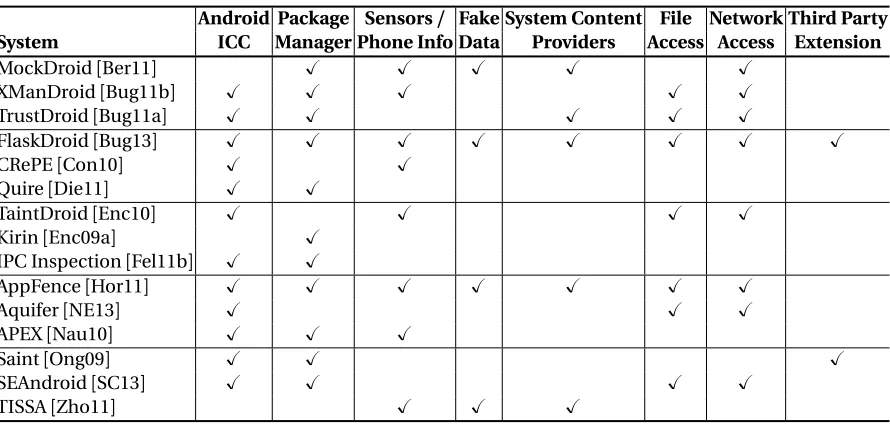
Table 4.1 Classification of authorization hook semantics required by Android security enhancements . . . 47
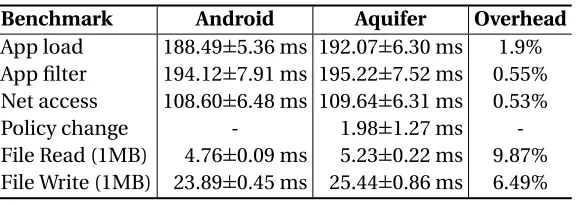
Table 5.1 Application Survey Results . . . 74 Table 5.2 Microbenchmark Results . . . 75
Table 6.1 Performance - Unmodified Android (AOSP), Weir in unlabeled context, Weir in labeled context. . . 112
Table 7.1 Bob’s example policies for theWorkCloudpolicy. . . 126 Table 7.2 Bob’s extended set of examples for theWorkCloudpolicy target, with
newly added examples inbold. . . 128 Table 7.3 The policy targets used in our study, along with the action they control. 138 Table 7.4 Number of unique example scenarios created by each user, as well as
the total number of policy examples created after assigning decisions for 5 policies. . . 144 Table 7.5 Number of random policy scenarios created for testing predictions for
each user. Policy decisions are acquired from the user and predicted by PyBE for 5 policies. . . 144 Table 7.6 Accuracy of PyBE in comparison with theCoinFlip(abbreviated to
CF) baseline, for all 40 user-policy cases. Cases where the accuracy of CF is greater are highlighted inbold. . . 145 Table 7.7 Accuracy of PyBE in comparison with theMostFreq(abbreviated to
MF) approach, for all 40 user-policy cases. Cases where the accuracy of MF is greater are highlighted inbold. . . 145 Table 7.8 The number of errors identified via manual review of examples
(ab-breviated as MR), and the additional errors found in the PyBE-assisted review. Cases where the manual review finds more errors are high-lighted inbold. . . 147 Table 7.9 Breakdown of incorrect predictions into misconfigured weights (W),
policy change (C), unconfirmed policy change (U) and label confu-sion (L), across all participants and policies. . . 148 Table 7.10 A subset of policy examples initially specified byP1, which includes
only those examples that contain
Work
. . . 149LIST OF FIGURES
Figure 2.1 Architecture of the Android operating system. . . 15
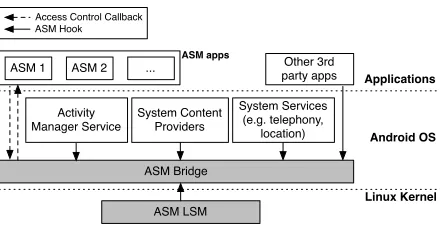
Figure 4.1 ASM framework architecture . . . 49
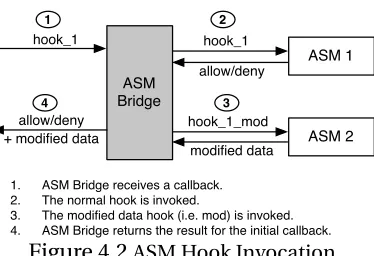
Figure 4.2 ASM Hook Invocation . . . 50
Figure 4.3 A lifecycle hook that allows modified data to be returned to the re-ceiving application. . . 51
Figure 4.4 The
getDeviceId
Hook . . . 52Figure 4.5 Third Party Hooks . . . 53
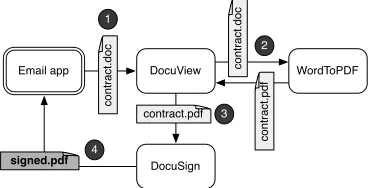
Figure 5.1 Document signing use case with four apps. A confidential contract received via Email is 1) read in a viewer, 2) converted to PDF, 3) em-bedded with a written signature, and 4) emailed back to the sender. 59 Figure 5.2 Aquifer policy abstraction . . . 61
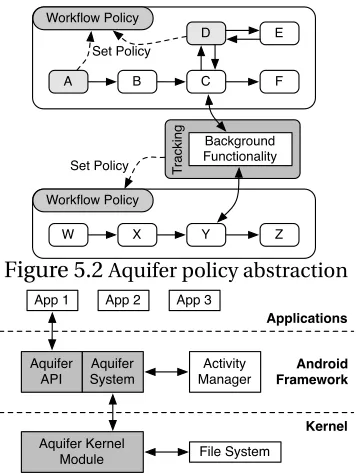
Figure 5.3 Aquifer architecture for Android . . . 61
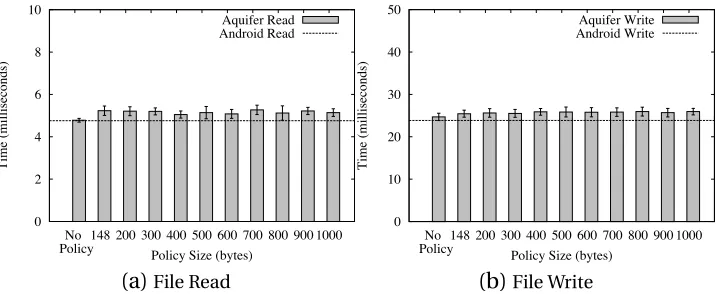
Figure 5.4 Aquifer File Label Propagation Time. Error bars indicate 95% confi-dence intervals . . . 76
Figure 5.5 Aquifer policy modifications to K-9E Mail . . . 77
Figure 5.6 Aquifer Workflow Filter, a) Without policy and b) With Policy that allows only K-9E Mail . . . 79
Figure 6.1 Shared state in memory: Instances of theWPS Officeapplication performing different tasks in the same process. . . 87
Figure 6.2 Overview of floating labels w/polyinstantiation relative to explicit and floating labels. . . 92
Figure 6.3 Illustration ofWeir’slazy polyinstantiation, with three app compo-nents; activitiesAandB, and a serviceC. . . 96
Figure 6.4 Weir’sstorage polyinstantiation using layers. . . 99
Figure 6.5 OfficeEmailcreates and adds a tag to an intent . . . 107
Figure 6.6 Floating label DIFC system:Qreceives 1 and guesses 0 for every reply not received. . . 108
Figure 6.7 Weir:Q always receives data “11” . . . 109
Figure 6.8 Time to start a component when 0!100 instances (in steps of 10) already exist. . . 114
Figure 6.9 BCloud’spolicy configuration . . . 115
Figure 6.10 BCloudraises its label . . . 115
Figure 6.11 BCloudstarts itself with a new label . . . 116
Figure 7.1 An overview of the PyBE approach. . . 125
Figure 7.3 There is no majority policy decision among the nearest neighbors of {
Home, Photo
}. . . 130 Figure 7.4 NN graph for vertexp, consisting of neighborsq andr at the closestdistanced, violates Inv-1 and Inv-2. . . 136 Figure 7.5 Screenshot ofP1’s partial order over tag groups. . . 141 Figure 7.6 A suggestion made by the PyBE algorithm during the interactive
review process . . . 142
Figure B.1 Flow of the Activity Manager starting a component. The areas modi-fied or added byWeirare shaded. . . 191
CHAPTER
1
INTRODUCTION
Smartphones and tablets have dominated the commodity computing discourse for the last decade. As of 2016, more than a half of the world’s adult population owns a smartphone. This number is projected to rise to more than 80% by 2020 [Eco15]. The dramatic rise in the use of mobile devices can be attributed to their advanced computing capabilities, combined with nearly unlimited mobility. Today, smartphones and tablets have replaced traditional computing devices (e.g., laptops, desktops) as the key mediums of Internet access[Smi15].
smartphones and tablets have replaced traditional computing devices at home and work is nothing short of a revolution.
The primary drivers of this revolution are mobile applications, colloquially known as
apps. While the mobile device connects users to the Internet on the go, apps empower the user to exploit the Internet in every way conceivable. The catch-phrase “there’s an app for that” correctly captures the diversity and endless potential of applications. Applications connect users to social networks (e.g., Facebook, Twitter), increase productivity by facilitat-ing communication (e.g., Gmail, WhatsApp) or document editfacilitat-ing on the go (e.g., MS Word, Google Docs), or even perform tasks that have traditionally required separate office equip-ment, such as using a mobile device’s camera to transform it into a hand-held document scanner (e.g., CamScanner, TinyScanner). As of December 2016, the two mobile platforms with the most market share, i.e., Android and iOS[IDC16], also have the largest application stores, with each offering more than 2 million applications[Sta16]. The availability of a large array of applications may be imperative for the success of a mobile computing platform.
For promoting applications, a mobile platform requires an operating system (OS) that can seamlessly install and run third party applications. Applications often need to access various user and device resources to fulfill their purpose; e.g., location-based applications need GPS location (e.g., Google Maps, Groupon), file managers need storage access (e.g., ES File Explorer, Root Explorer), scanners and camera applications need access to the camera (e.g., Camscanner, Open Camera). The task of providing applications access to security and privacy-sensitive resources, while securing the resources against malicious applications, falls squarely on the OS.
issued a subset of the user’s privileges (e.g., GPS, camera, SD Card access), thereby limiting the potential damage caused by a Trojan; e.g., while a Trojan executed by a user on Linux can steal all of the user’s data, a Trojan on Android can only access data explicitly authorized by the user either at install-time or run-time.
As security principals, applications get ownership of the data they bring to the device. The OS provides applications with private data stores that are only accessible by the re-spective applications, i.e.,data owners(e.g., private application directories on Android and iOS[Dev; Inc]). However, this isolation of data is not rigid. When the user wants to combine the data and functions of multiple applications, the user can direct applications to explicitly share data. For example, when the user chooses to view an email attachment (e.g., a PDF file), the email application shares the attachment with the document viewer application chosen by the user. User-directed information sharing enables the user to accomplish complex tasks with purpose-specific applications.
The utility of user-directed data sharing is accompanied by the risk of unauthorized data disclosure, as third party applications may not be implicitly trusted with the data of other applications. The security enforcement for application data on modern commodity OSes isnon-transitive, i.e., once the data owner shares data with another application, it loses control over the flow or use of its information. For example, the email application cannot prevent a malicious or compromised document viewer from exfiltrating the user’s attachments. The problem of unauthorized disclosure of user data is particularly relevant to modern commodity OSes, where applications can control access to their own data by the virtue of being security principals, but must give up that control at the user’s direction.
1.1 Thesis Statement
Smartphone applications are generally purpose-specific, which requires applications to cooperate for performing complex tasks; e.g., an email application does not implement a “viewer” for attachments, instead outsourcing the functionality to a viewer selected by the user. Inter-application communication primitives in the OS facilitate such inter-operability, while user-directed sharing allows users to dynamically choose the best application to process their data. This dissertation addresses the challenge of providing protection against the unauthorized disclosure of user data while supporting seamless application integration.
Purpose-specific applications often develop application-specific user data objects that capture the abstractions required by their core purpose. As app-specific data objects such as notes, whiteboard snapshots and scanned documents are stored and processed using conventional OS data objects (e.g., files), the OS is oblivious to their existence or properties. That is, app-specific user data is abstract from the OS’s perspective; its security requirements (i.e., the security context) is only known to the application developer or the user. Thus, access control policies defined by a system designer or administrator are insufficient for protecting app-specific data, as the designer lacks knowledge of the security context.
Modern commodity operating systems expose nominal protection mechanisms to ap-plications. For instance, Android’s permissions are the main line of defense for protecting application-specific user data. Each application is assigned a certain set of permissions, which are capabilities that control access to user data and resources. Applications can de-fine and use permissions to control access to their own application-specific data. However, permissions only provide protection at the point of access, and not security for the infor-mation accessed. That is, permissions do not apply to copies of data made after an initial access, and the data owner loses all control over the flow of its data once data is shared with other application. The application receiving the data can export it to an adversary on the network, without authorization from the user or the data owning application. Unautho-rized disclosure is an information flow problem that permissions or other non-transitive mechanisms are not designed to solve.
been limited to restricted scenarios such as the militarily, mainly due to the practicality challenges of integrating IFC with commodity OS architectures. More importantly, IFC systems require a centrally mandated policy, which is insufficient for expressing the security requirements of abstract user data on commodity OSes.
Prior work has proposed the use ofdecentralizedinformation flow control (DIFC)[ML97; ML00]to allow mutually mistrustful security principals to define the security policy for their own data. Taking advantage of the fact that applications are security principals on modern commodity OSes, this dissertation demonstrates how applications acting as data owners may specify security policies for their application-specific data. As described previously, we choose Android as the target platform for our analysis and experimentation.
In this dissertation, we study the challenges and opportunities for integrating practical data secrecy guarantees for application-specific user data in modern OSes, specifically Android. First, we design DIFC policies that allow applications toexpressthe secrecy re-quirements for their data, specifically the network export of their data by other applications on the device[NE13]. While our policy design accounts for an adversarial setting, our en-forcement is relaxed for backwards compatibility with unmodified third party applications. Second, we analyze the challenges in providing practical and sound primitives toenforce
DIFC policies in the presence of a malicious adversary[Nad16]. We design the primitive of
lazy polyinstantiationto enable sound enforcement without modifying legacy applications. Third and finally, we identify the lack of practical policy specification for abstract user data. We describe the approach of Policy by Example (PyBE) (in submission) tospecify
user-specific security policies for application-specific user data.
From our analysis of modern commodity operating systems, we observe that the unique abstractions in modern OSes such as Android provide opportunities to integrate practical and secure information flow control guarantees for user data. This observation leads us to the thesis statement of this work, as follows:
Modern operating systems not only expose new secrecy risks for user data, but also provide unique abstractions that enable practical and secure information secrecy guarantees.
systems may be addressed using a common set of authorization hooks in the operating system. Our second study motivates the enforcement of secrecy guarantees for application-specific user data. We design DIFC policies that control the export of information, and demonstrate how Android’s component model and user-directed sharing abstractions fa-cilitate the design of complex policies that rely on conditions on application chains created via user-directed sharing. Our third study leverages Android’s indirect inter-component communication for practical and sound DIFC enforcement, i.e., without relaxing security guarantees or breaking existing applications. Our final study demonstrates the feasibility of user-specific policy specification for application data using organizational tags provided by applications as the building blocks of user-specific policies.
Our results motivate future directions in the security of user data on emerging com-modity platforms. First, we drive future security research to consider user-directed inter-application sharing as an indispensable aspect of emerging commodity platforms. Doing so requires keeping the user in the loop when forming the security policy. The Policy by Example (PyBE) approach proposed in this dissertation provides a feasible starting point for user-specific policy specification. However, a general and complete treatment of the problem requires addressing four specific research problems, i.e.,
(1)
Quantifying the minimum fraction of access control information that must be acquired from the user to sufficiently supplement static policies (i.e., the user’s context),(2)
Designing abstractions and mechanisms that allow usable acquisition of the required information from the user,(3)
Identifying the information required by the user for specifying access control policies, and(4)
Designing mechanisms to account for changes in the user’s policies. Second, we discuss the need for strong security guarantees in emerging commodity platforms, such as smart homes (e.g., Samsung SmartThings). While the prevalence of user-directed information flows in these systems exposes familiar security problems, their unique functional require-ments and limitations present new challenges in integrating information flow control. We discuss these challenges, along with potential solutions that direct future research.on network traffic, and consider such attacks outside the scope of this dissertation.
1.2 Contributions
In this dissertation, we make the following contributions:
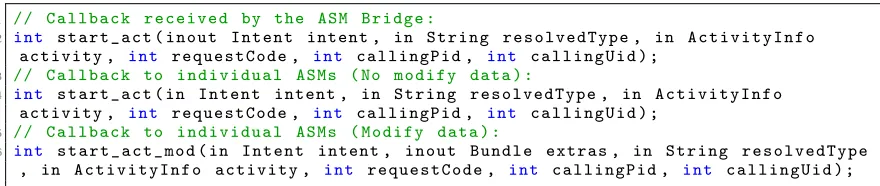
• We design an extensible architecture to integrate diverse security enhancements for Android.Modern operating systems not only expose traditional system resources to applications, but also mediate access to private user data (e.g., contacts, location) and application-specific resources. The coarse-grained nature of this mediation exposes new security risks for user data, which has prompted the development of numerous security enhancements, especially for Android. We study the semantics of the au-thorization hooks needed by these security enhancements, and demonstrate that enhancements solving disparate security challenges may use a set of common autho-rization hooks. With this intuition, we design the Android Security Modules (ASM) framework[Heu14](described in Chapter 4), which allows security enhancements to be deployed as modules, without modifying the OS. ASM provides authorization hooks for mediating common protected operations including accesses to kernel objects (opening files, sockets), special API exposed by Android’s middleware (e.g., getting the Location, IMEI), as well as communication between application compo-nents (e.g., start activity, bind service). More importantly, ASM addresses the special challenges of modern commodity OSes, such as providing ways to modify data sent to applications, as well as allowing third-party applications to extend ASM’s interface to protect their own resources. This dissertation explores a solution for one such new security challenge, i.e., the lack of data secrecy for application-specific user data.
tasks. In Aquifer, application developers specify the secrecy policies to protect their own application-specific data objects. Aquifer prevents unintended disclosure by enforcing the DIFC policy at the network interface, while allowing seamless sharing among applications on the device. We provide a proof-of-concept implementation of Aquifer, and integrate into Android. In doing so, we demonstrate how Aquifer can be practically realized within an existing platform. We provide three case studies by modifying popular open source applications to demonstrate the effectiveness of Aquifer’s policies in protecting data against accidental disclosure.
• We design and implement IFC enforcement that is secure as well as practical.IFC has seen limited practical adoption due to the security and practicality limitations of its enforcement on commodity operating systems. We identify the challenges of enforc-ing DIFC on Android, and observe that while some challenges are specific to Android, some apply to the trade-off between security and privacy in DIFC enforcement in gen-eral. We develop the primitive of “lazy polyinstantiation” for context-sensitive DIFC label propagation, and discover that adding context-sensitivity to label propagation (or floating labels) resolves the fundamental trade-off of soundness (i.e., security) vs precision (i.e., practicality) in DIFC enforcement. We design the Weir DIFC sys-tem[Nad16](described in Chapter 6) by modifying Android, and leverage Android indirect inter-component communication to implement lazy polyinstantiation. Our initial performance evaluation of Weir demonstrates less than 4ms overhead for start-ing components. We demonstrate Weir’s utility with a case study usstart-ing the K-9 Mail application.
• We design an approach for policy specification for application-specific user data.
(i.e., policy decisions) for new scenarios, thereby making policy specification tractable. Our prediction algorithm uses the k nearest neighbor approach, for which we de-velop a novel distance metric for policy examples. Our framework is cognizant of the fact that users may make mistakes in their initial examples, and uses an interactive approach to assist users in locating incorrect policy decisions in their examples. A feasibility study with expert users demonstrates 76% prediction accuracy on average, and better performance than a baseline as well as a naive approach. Finally, our interactive error correction approach finds five times as many errors as a manual review by participants.
Remark:A preliminary effort on the system described in Chapter 5 was performed as a part of the author’s Masters thesis[Nad12]requirements. This effort has been expanded in Chapter 5 with a thorough evaluation and case study. Further, the ASM framework de-scribed in Chapter 4 was a joint effort with Stephan Heuser, William Enck and Ahmad-Reza Sadeghi. The author and Stephan Heuser were credited as co-first authors, and contributed equally to the implementation of the ASM framework. The author’s specific contributions include the design and implementation of a majority of the middleware authorization hooks, authorization hook placement in third-party applications, the data modification abstraction, and the implementation of the two modules for demonstrative purposes.
1.3 Dissertation Outline
The goal of this dissertation is to investigate practical solutions for user data secrecy on modern commodity operating system. We now provide a brief outline of the rest of this dissertation.
Following the background, we discuss related work in Chapter 3. Specifically, Chapter 3 provides insights into the related work in three primary domains: OS security, modern OS security, and policy specification. Along with general takeaways from prior work, the chapter also describes new threats to user data on modern commodity operating systems.
Chapter 4 describes the unique access control semantics of modern operating systems required to address the threats discussed in Chapter 3. It then describes the ASM frame-work[Heu14], a programmable and extensible access control enhancement for Android.
Chapter 5 describes Aquifer[NE13], our policy framework that demonstrates the utility of DIFC policy for common data use cases on Android, and also explores novel policy abstractions for Android applications.
While Aquifer provides policy primitives tailored to the user-directed sharing in modern commodity platforms, it relaxes security guarantees for practicality. Chapter 6 describes Weir[Nad16], our DIFC system for Android that demonstrates how context sensitivity can enable DIFC enforcement that is secure as well as practical.
Chapter 7 describes the Policy by Example (PyBE) paradigm for user-specific security policy specification. We demonstrate the feasibility of our approach with a user study, and its effectiveness over purely manual efforts and naive approaches.
CHAPTER
2
BACKGROUND
Modern commodity operating platforms are primarily designed with the goal of supporting third party applications. Applications offer a variety of services not directly supported by the OS, and may even enhance or replace core OS functionality. For the purpose of this dissertation, we consider the security of user data on modern operating system architectures such as Android, iOS and Windows Phone. Specifically, we focus on providing practical and secure data secrecy guarantees to third party applications, in order to protect application-specific user data.
in later chapters.
2.1 Modern Operating Systems
This dissertation focuses on the characteristics of modern operating systems that are relevant for the security of user data. We identify two general characteristics that are present in all three popular modern commodity OSes, namely Android, iOS and Windows Phone, i.e.,
(1)
applications designated as first-class security principals and(2)
user-directed data sharing among applications. We discuss these characteristics, followed by a description of the new secrecy challenges for user data that are exposed as a result of these characteristics.2.1.1 Applications as Security Principals
Modern operating systems take the suggestion of decades of security research[Wic90; Ioa02; ST05; Enc08]and treat applications as unique security principals. That is, an application executed by the user does not gain the full authority of the user, unlike access control in traditional operating systems (e.g., Linux). Every application is a security principal with its own set of privileges, which are a subset of the user’s privileges.
As a result, an application run by the user (e.g., an antivirus) does not have direct access to data imported or created via another application (e.g., the user’s phone book maintained by a Contacts application). Access must be explicitly granted by the user via user-directed sharing of information, or by the application that owns the data. Being designated as security principals allows applications to protect their data from unauthorized access by other applications, and provides applications with ownership and control over the data they bring to the device. The data that is protected may not just be limited to traditional private data associated with the user or the device (e.g., the IMEI number, the user’s location, the user’s contacts), but may also include application-specific user data such as notes, document scans and email attachments.
2.1.2 User-directed Information Sharing
As described previously, applications developed for modern commodity platforms are often purpose-specific. It is typical for applications to focus on a core purpose, while relying on other applications for auxiliary functions; e.g., the camera application allows the user to take pictures, but does not implement complex photo editing features, which may instead be found in a photo editor application such as Adobe Photoshop. For complex tasks that involve more than one kind of processing, the OS allows users to link together the functionality of multiple applications. To facilitate such linking, applications (i.e., the data owners) have to share data as per the user’s direction.
Consider the Android platform where applications are often designed to work together to seamlessly perform large, user-defined tasks. For example, a shopping app might:
(1)
invoke a barcode scanner app that uses the camera to read the UPC from an item,(2)
look up that item on the Web, and then(3)
use a social networking app to share the item and best deal with friends. This modularity strikes a balance between simple UNIX tools (e.g.,sed
,grep
) and monolithic GUI applications (e.g., MS Office). Android, Windows Phone and even iOS expose abstractions to facilitate such data sharing between applications[And16a; Mic13; App13]. Android applications use intent messages addressed to action strings to help the OS find the best application for a task. Similarly, Windows Phone provides “share charms” to help users complete tasks with different applications. Finally, iOS provides limited sharing and navigation between applications using URL protocol handlers.While data sharing among applications facilitates complex user tasks along with a seamless smartphone experience, it also exposes new challenges for user data security, as we discuss in the next section.
2.1.3 User Data Secrecy in Modern Operating Systems
enforcement exposes application-specific user data to the risk of unauthorized disclosure to the network. For example, a photo of a whiteboard containing meeting notes might be inadvertently shared and uploaded to a social networking site, or a confidential email attachment might be exported to a remote adversary by a malicious document viewer. A key challenge for modern OS security is controlling the flow of data between apps and preventing accidental or malicious information disclosure.
Preventing data disclosure is not as simple as restricting the set of applications that an application with access to sensitive data can interact with (e.g., Saint[Ong09]). A trusted ap-plication receiving data might share that data with another apap-plication that has unexpected disclosure. Hence, in the collaborative application environment, we must address the ac-cidental disclosure problem as one of information flow, by integrating information flow secrecy guarantees into modern operating systems. In fact, the lack of data secrecy is one of the fundamental problems addressed by information flow control (IFC) systems[Den76; BL73]. However, the data flows described in prior solutions are often among users running known user programs or system applications with different labels, and are often possible to predict a priori. Providing data secrecy is much more challenging and complex in modern operating systems, where a single user dynamically directs data sharing between mutually mistrustful applications at runtime, and where the resulting flows may be unpredictable from a centralized perspective.
2.2 Android
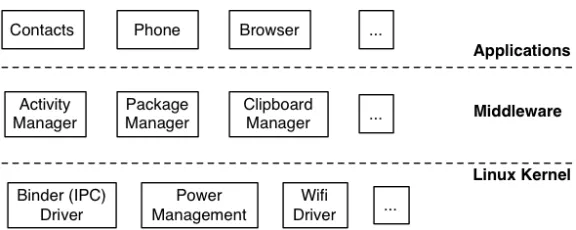
Figure 2.1Architecture of the Android operating system.
for experimentation, make Android a suitable candidate for research into the security of the emerging modern operating systems.
This section focuses the unique abstractions in Android that enable advanced data security mechanisms such as the ones described in later chapters. We start by providing a brief overview of Android’s system architecture. We then describe Android’s application model, which requires applications to be divided into modules with fixed functions and abilities. The modularization of applications, and the control over the different functional aspects of an application, allows fine-grained access control on Android. We then discuss Android’s inter-component communication abstractions that allow the OS to mediate interactions among components, following which we describe the life-cycles of Android’s component types. Finally, we discuss the security architecture of Android, with a specific focus on the policy and enforcement for protecting user and system data.
2.2.1 Architectural Overview
Figure 2.1 shows Android’s system architecture.1Android runs a Linux kernel, but defines its
own application runtime environment. The kernel enforces isolation between applications and access control for some resources for which it has context (e.g., Internet).
Android applications use the middleware API to request hardware and software re-sources that the kernel does not regulate (e.g., Location coordinates). As a result, some policy decisions for high-level resources are taken by the reference monitor implemented
1The figure only shows layers that are relevant to this dissertation, while other layers (e.g., the hardware
in trusted system services that operate in the middleware layer. For example, the Activity Manager service regulates interactions between application components, while the Package Manager service controls aspects of an applications installation and removal.
The Java-based middleware API forces developers to design their applications within a component framework. Android defines four component types:activity,service,content provider, andbroadcast receiver. We now describe Android’s components, followed by the inter-component communication in Android.
2.2.2 Application Model
The Android application model consists of four components, namelyactivities,services,
content providers, andbroadcast receivers. Activity components define the application’s user interface (UI). Each UI screen is defined by a different activity component. The other components types run in the background and are started by the Android middleware as needed. These component types provide daemon-like functionality. Service components are general purpose daemons; content provider components provide a uniform interface to application data, and broadcast receiver components listen for asynchronous broadcast messages from the system or other applications.
Android uses the abstraction of atask(i.e., a collection of activities) to denote complex user task involving more than one activity component. Activities are foreground compo-nents that can have multiple simultaneous instances in different user tasks[Andb]. Activity instances are placed in a “stopped” state when not in the foreground, but remain in the system’s memory, to be killed only in low memory conditions. On the contrary, broadcast receivers have very short lifetimes, and are aggressively destroyed as soon as they finish processing the broadcast. Service and content provider components can have only one active instance at a time, that can continue to operate in the background unless they are deliberately stopped or exit by themselves.
allocated a separate task of its own. Every call to such an activity resumes its instance in the said task. The only difference between the two modes is that the singleInstance activity can be the only activity in its own task, whereas other activities can be placed in a singleTask activity’s task.
2.2.3 Inter-Component Communication
Android’sbinderframework (backed by the binder kernel driver) provides process con-trol and IPC between components. Applications generally do not interact with binder directly. Instead, they useintent messages, which start activity and service components, and send messages to broadcast receiver components. The key attribute of intent messages is their ability to be sent to implicit addresses. For this, Android usesaction strings, such as
ACTION_VIEW
andACTION_SEND
. Applications defineintent filtersto register to receive messages addressed to specific action strings. The Android framework then automatically determines potential intent message destinations (i.e. resolves the intent), presenting the user with a list of targets if a single destination must be chosen from a set.From the IPC mechanism perspective, inter-component communication on Android can be divided into two categories: 1) indirect and 2) direct. Indirect communication in-volves an asynchronous call from one component to another, through theActivity Manager
service (e.g., startActivity, bindService). Direct communication involves a synchronous Binder remote procedure call (RPC) using the “Binder object” of the callee component to call a remote method defined in that component. Note that while direct communication does not require the Activity Manager, its setup involves an asynchronous call to the Activity Manager to retrieve the callee’s Binder object.2For example, the first operation executed
on a content provider (e.g., query, update, delete, insert) by a caller is routed through the Activity Manager service, which retrieves the Binder object of the target content provider, and loads it into the memory of the caller. Future calls are routed directly to the target content provider. Similarly, “bindService” sets up a Binder connection to a target service via the Activity Manager, to be later used for Binder RPC.
2.2.4 Android’s Security Architecture
Android is a multi-user Linux system, where applications are installed as Linux users with their own unique UIDs. The UID (and GID for some resources such as the Internet) of an application are used during enforcement. That is, applications are treated as first class security principals in their own right, and granted access to only a subset of device’s data and functions available based on their identity and group membership. Further, applications are granted their own private storage, and access to application component instances as well as data is regulated using application UIDs.
Android’spermissions(i.e., text strings that represent resources) are used to control access to system and user resources. Applications request for permissions to protected resources statically, in their application manifest files. Permissions protect access to pro-tected resources (e.g., Internet, bluetooth), user data (e.g., Contacts, Call Logs), and access to an application’s own components as well. That is, applications can define their own permissions, or use system-defined permissions, to restrict access to specific components.
Before Android version 6 (i.e., Android Marshmallow), the user had to agree to all the permissions requested by an application before it could be installed. This all-or-nothing deployment model made it difficult for users to install applications with only a subset of the permissions requested, resulting in the problem of over-privileged applications[Enc11; Fel11a; Au11; Ber11; Nad14]. To mitigate the drawbacks of the install-time permission model, Google recently introduced runtime permissions in Android 6.0. The new model allows users to deny some or all of the permissions demanded by applications through runtime prompts as well as application settings.
Once a permission is allocated to an application (using the install-time or runtime approach), it is associated with the application package, and hence the assigned UID or GID for enforcement3. To protect sensitive system API, Android’s system services (i.e.,
middleware) retrieve the UID (supplied in the Binder call), and query the Package Manager service’scheckPermission()function to resolve access by the specific UID to the required permission for that API. Third party applications can also use the same method to protect their Binder-accessible API. Third party applications can also set their components to only
3A single UID may be “shared” by more than one application with the same signature, and hence allow
be internally accessible, by setting the exported manifest attribute of the component to false. To grant temporary access to subsets of data backed by content providers, applications can grant “URI permissions” for specific content provider URIs. However, not all functions are protected using checkPermission(). Some low level resources are protected using Linux GIDs (i.e., through application membership to resource-specific groups such as sdcard_rw for SD card read-write access). The GID-based access is enforced by the kernel.
A primary drawback of permission enforcement is that permissions are not transitively enforced. That is, a permission is only enforced at the first point of access (e.g., acquiring a URI-permission protected data object from an application). Once the data object is copied in the memory of the adversary, permissions do not prevent unauthorized uses of the data, such as exporting it to an untrusted remote server. As a result, permissions cannot be used to ensure data secrecy.
Android relies on Linux Discretionary Access control (DAC) to enforce its UID-based isolation. To overcome the shortcomings of DAC[Los98], Android enforces type-based Mandatory Access Control through SEAndroid[SC13]. To elaborate, SEAndroid enforces least privilege on daemons that execute with root and system privileges, and to control the damage in case such daemons are compromised and fall prey to confused deputy attacks. While SEAndroid may be configured to provide transitive enforcement for system resources, its policy specification is centralized, limiting its ability to accurately express the secrecy requirements of dynamic application-specific user data (e.g., Emails, notes) that are only known to the user or the application.
2.3 DIFC Fundamentals
(i.e., declassification) by the policy administrator. Thus, IFC ensures that secret user data only leaves the device through authorized channels, preventing the unauthorized data disclosure described in the motivating example.
Traditionally, IFC systems (e.g., MLS[BL73]) use a central definition of security labels, which does not meet the needs of applications with varying secrecy requirements for their data. Myers and Liskov[ML97]defined a decentralized label model (DLM) that allowed applications to extend the IFC lattice with their own labels. Many such decentralized infor-mation flow control (DIFC) policy models and systems (e.g., Asbestos[Van07], HiStar[Zel06], Flume[Kro07; KT09], Laminar[Roy09], and Fabric[Liu09a; Ard12]) have since been pro-posed, that extend the enforcement of IFC guarantees to include unknown subjects and objects, such as app-defined components and data. We now describe the fundamental aspects of DIFC, which directly motivate the challenges to making DIFC practical raised in this dissertation (specifically Chapter 6).
2.3.0.1 Label Definition
In a DIFC system, security principals create labels (i.e., security classes) for their own secret data. The resultant lattice is infinite, and dynamically adapts to the secrecy policy of each data owning security principal. On Android, decentralized label definition would allow apps to articulate trust on a fine granularity by creating labels for their data, and controlling assignment of these labels to subjects and objects, eventually controlling the flow of their data. Note that while DIFC can also provide integrity guarantees, we describe DIFC with respect to data secrecy as it is the focus of this dissertation.
2.3.0.2 Label Changes andFloatingLabels
The finality of subject and object label assignment is calledtranquility, an important prop-erty of mandatory protection systems. Tranquility constraints have to be relaxed for a decentralized IFC policy. Data owners may then control the ability of subjects to explicitly raise or lower their labels, through the assignment of privileges (i.e., capabilities) related to the security classes. The mechanism ensures that label changes using a data owner’s security class are safe, i.e., permitted by the data owner.
practical for general-purpose subjects that may be invoked from various secrecy contexts. To support such cases,floatinglabel DIFC systems (e.g., Asbestos[Van07]) allow seamless data flows through implicit label propagation. That is, the caller’s and the callee’s labels are joined, and the resultant label is set as the callee’s label. Floating labels make DIFC compat-ible with unmodified applications, and are required on Android, where inter-application communication is often user-directed and unpredictable.
2.3.0.3 Declassification
DIFC enforcement only allows data flows permitted by the policy lattice, and any exceptions require authorization (i.e., declassification) by the data owner. Thus, declassification pro-vides the data owners with control over the export of their data. Data owners may choose to explicitly declassify data whenever required, or delegate other security principals to declassify on their behalf. Further, as DIFC enforcement is limited to the device, data has to be declassified before it is exported to the network. In an Internet-driven environment where security principals may always be connected to the network, explicit declassification is impractical due to its frequency. Another alternative is delegating the declassification capability to security principals that may potentially connect to the Internet, which would bloat the application’s TCB. Practical and secure declassification for network export is thus a challenging aspect of DIFC design.
2.3.0.4 System Integration
CHAPTER
3
RELATED WORK
The objective of this dissertation is to provide strong security guarantees for user data on modern commodity operating systems, through practical and secure policy and enforce-ment primitives. As a result, the contributions of later chapters draw upon the lessons and insights learned from prior research in the fields of operating systems security, Android security and policy specification. This chapter describes relevant prior work in these areas.
3.1 Operating Systems Security
As described by Lampson in 1974, the original motivation for integrating protection mech-anisms into computer systems was to prevent one user’s malice or faults from harming other users[Lam71]. It was identified that the “harm” itself can be inflicted in three ways:
potential for harm in these previously described ways is what motivates the fundamental security goals ofsecrecy,integrity, andavailability. As Lampson argued, the threats that affect users also similarly affect “programs” and other runtime abstractions; hence, it is necessary to take an abstract approach to treat these security concerns, rather than a few ad hoc mechanisms. The domain of operating systems security performs this crucial function. Given that operating systems form the backbone of modern computing, OS security can be said to be one of the most essential areas of computer science.
In an operating system, the execution context of a program is known as aprocess. Like many of the core concepts of OS security, theprocessabstraction was first developed in Multics[Sal74], and provided separation between the runtime contexts of different user programs. Each process has aprotection domain, which defines the degree of access a process has to system and user resources. Anaccess control matrixmay be used to represent all the protection domains in the system[Lam71]. The rows of the access control matrix are labeled by a set ofsubjects(e.g., processes, users) or subject domains, and its columns are labeled by a set ofobjects(e.g., processes, files). In simple terms, a subject is an entity that may be associated with an execution context of a program, whereas an object is the generalization of all things that may hold information. The cells of the matrix are the actions that the subjects can perform on the objects (e.g., read, write, execute). We refer the reader to Jaeger’s far-reaching book[Jae08]for elaborate explanations of these concepts, as well as for discussions on orthogonal topics in OS security not covered by this section.
In practice, an access control matrix is a sparse data structure. Therefore, alternate representations are used in place of the matrix, namely access control lists(ACL) and
3.1.1 Discretionary and Mandatory Access Control
The access control matrix represents the bounds of protection, i.e., the protection state. However, it alone is not sufficient to achieve the security goals of secrecy and integrity, which depend on the protection system. Protection systems are of two types, discretionary or mandatory, based on how they are managed. A protection system where individual subjects are able to modify the protection state is known as adiscretionary access control
(DAC) system. In such a system, untrusted user processes can modify the protection state of objects owned or created by the user. That is, the protection state is at the discretion of users and the untrusted programs they execute, and may result in violation of the security goals of secrecy and integrity.
Owing to the discretionary management of the protection state, thesafety problem
was found to be undecidable for DAC systems[Har76]. That is, it may not be possible to guarantee that all possible future protection states derivable from the current protection state of a DAC system may be safe; i.e., may never allow accesses that violate secrecy or integrity goals. Amandatory access control(MAC) systems, on the contrary, has a mandatory protection state, in which the access control permissions on objects are managed by an authorized administrator. Additionally, MAC systems separate the execution context of a process (which is discretionary) from its security context, which is predetermined by the administrator. As a result, the safety problem is decidable for a MAC system.
It is important to note that in commodity operating systems such as Linux, the use of MAC is limited to protecting system resources, such as system daemons and critical system data. MAC protection for third-party application resources is scarce, and for a valid reason: system policy administrators cannot reason about the secrecy and integrity requirements of user data generated via third party applications. As a result, DAC enforcement is often used in conjunction with MAC. For example, Android uses SEAndroid to sandbox system daemons, but uses Linux user-based DAC enforcement to isolate private application data.
3.1.2 Information Flow Control (IFC)
of the subject or object. Jaeger defines a mandatory protection system as composed of
(1)
a mandatory protection state, which is defined in terms of subject and object labels, and the privileges subject labels have over object labels,(2)
a labeling state, which maps subjects and objects to labels, and(3)
a transition state, which describes legal transitions between labels, i.e., rules for relabeling subjects and objects[Jae08]. Using this definition, a MAC policy may control the flow of information in the system, by labeling sensitive and public data objects, and regulating read/write accesses and label transitions between sensitive and non-sensitive labels. That is, MAC systems can be designed to provide provable information flow guarantees of data secrecy, integrity, or both.In 1973, Bell and LaPadula formalized the US Department of Defense’s Multi-level Security (MLS) policy for providing access control for military computers and applica-tions[BL73]. The resultant Bell-LaPadula model is a mandatory protection system whose labels and labeling state are predetermined by a trusted administrator. The model provides data secrecy, guaranteed by two properties in particular: thesimple security property(i.e., “no read up”), which states that a subject must not read data from an object at a higher security level, and the*-property(i.e., “no write down”), which states that a subject must not write to an object at a lower security level. Both these properties ensure information flow from lower to higher security levels. The model also defines atranquilityprinciple, which requires that the label of an object may not be changed during the normal operation of the system. As a result, dynamically upgrading an object for the *-property to hold may not be possible under the model. This aspect of the model limits its practicality in non-military systems, as we discuss further in this chapter.
Just as the Bell-LaPadula model formalizes secrecy, the Biba model[Bib77]represents its dual and defines the access control rules for guaranteeing data integrity. More precisely, it defines the simple integrity property (i.e., “no read down”) and the *-integrity property (i.e., “no write up”), with the notion of integrity being that a process must behave as it is expected, if it does not rely on low-integrity inputs. It is important to note that secrecy and integrity requirements are duals of one another. Achieving both simultaneously in one system is possible, but only when the system uses two disjoint sets of labels, one for each guarantee. The Flume model[Kro07], described later in this chapter, is a good example if such a system that provides both secrecy and integrity.
model assign subjects and objects with labels, or security classes, and define the security policy in terms of the allowable flows between the labels. Denning defined a lattice repre-sentation for IFC policies, where the policy would be represented in terms of a lattice of labels[Den76]. In Denning’s lattice model, the allowable information flows between two classes are represented by a binarycan-flow(!) relation, which governs the order of the two classes in the IFC lattice. Further, a binaryjoinoperator ( ) allows distinct classes to be joined to result in another class in the lattice. As a result, the system’s IFC policy can be entirely represented in the IFC lattice.
The IFC lattice is a verifiable representation of the system’s IFC policy, but only for previously known subjects and objects. That is, the IFC lattice cannot incorporate the security policy for new types of secret objects created by applications in the system, which may not be known to the administrator beforehand. For example, a Web server may want to provide secrecy guarantees for private data generated by its clients, by assigning a different security class to each client’s private data objects. Such requirements are also common in modern commodity operating systems, where third party applications often have secrecy or integrity requirements that may not known to the administrator a priori.Decentralized
information flow control (DIFC) supports such requirements, by allowing the IFC lattice to be extended by data owners other than the administrator, in a way that only makes the existing IFC policy more restrictive. While Section 2.3 provides general background information on DIFC, we now describe specific prior DIFC systems and policy models.
3.1.3 Decentralized Information Flow Control (DIFC)
may not specify readers for any other class. As a result, the DLM model, and DIFC systems in general, only make the enforcement more restrictive by further restricting information flows for application data.
Based on the approach, DIFC systems can be loosely classified into three types, namely language-based, OS-based and hybrid systems. We discuss examples and trade-offs of each approach as follows:
Language-based DIFC:Language-based DIFC systems (e.g., JFlow [Mye99], Jif [ML00], SIF[Cho07]) define information flow policies in terms of flows between programming language objects. While the techniques employed by such approaches may be similar (e.g., static type checking), the end objectives are diverse. For instance, JFlow[Mye99](and later Jif[ML00]) is an extension of Java that employs static checking of information flow constraints using the decentralized labeling model, and treats information flow checks as an extended form of type-checking. The objective of Jif and JFlow is to ensure that a program follows the information flow constraints set by mutually mistrustful security prin-cipals represented in the program. The Fabric platform[Liu09a]provides similar guarantees for confidential user objects in a distributed setting, by extending the Jif language to cre-ate the Fabric language for distributed computing. Further, SIF provides IFC support for servlets[Cho07].
Language-based DIFC has its advantages, both in terms of precision and security. Language-based systems can reason about flows at the level of a programming language object, providing information flow tracking that is more precise than using coarser ab-stractions such as OS processes. Additionally, compile-time checking is resilient against implicit flows (i.e., implicit value assignments resulting from control flows). Finally, static information checks incur no run-time overhead, and failures of such checks do not result in data leaks.
languages mitigate this limitation to some extent.
OS-based DIFC:OS-based DIFC systems such as HiStar[Zel06]and Flume[Kro07]define information flow control policies in terms of flows between OS objects (e.g., processes, files, sockets). The DIFC systems described in this dissertation (i.e., Aquifer[NE13]and Weir[Nad16]fall in this category. OS-based DIFC can be used to regulate data flows between well-defined pieces of a single program, as well as among multiple programs.
Research in OS-based DIFC systems has produced entirely new operating systems with novel abstractions, or has retrofitted the treatment of existing OS objects with IFC checks. Novel DIFC operating systems such as Asbestos[Efs05; Van07]and HiStar[Zel06] are of the former kind. Asbestos is primarily designed to separate the data of different Web application users users connected to a common Web server, in spite of untrusted, potentially vulnerable Web application code. Its abstraction of the event process allows a single server process to isolate data from multiple user-requests into different internal process states, thereby preventing the problem of label explosion described in Section 2.3. However, it uses floating label propagation, making it prone to implicit data leaks. While HiStar[Zel06]avoids implicit data leaks by making information flows explicit, it cannot offer the seamless communication of Asbestos. A major hindrance in using Asbestos and HiStar for commodity computing is that they are fairly new and complex operating systems, and expecting application developers to redesign legacy applications to simply execute on these new systems is impractical.
Flume[Kro07], however, adapts standard UNIX abstractions for enforcing information flow control policies, making only minimal changes to communication primitives. Hence, while developers would need to make minimal modifications to applications for Flume, a complete redesign may not be required. However, similar to HiStar, Flume also requires explicit declaration of label changes, making it incompatible with ad hoc information flows. Recall that for an IFC system to provide both secrecy and integrity, it would need to use two sets of labels; otherwise, each subject’s access would be limited to only its own security level. A key aspect of Flume is that it uses two disjoint sets of labels, one for secrecy and another for integrity, enabling it to support both.
label changes such as in Asbestos are prone to implicit data leaks, but offer seamless communication. On the contrary, explicit label changes or flow declarations such as in Flume or HiStar are secure, but possible only when all the flows can be predetermined. Due to user-directed sharing in modern operating systems, it is not feasible to define all flows a priori, leaving implicit label propagation as the only alternative. Chapter 6 explores a modification to the traditional implicit label propagation logic that may be resilient to data leaks. It is important to note that language-based systems do not suffer from the same trade-off, as implicit data leaks are easier to address with static checking. In fact, a simple language-based solution to this problem has been proposed by Fenton[Fen73]and Gat and Sal[GS76], that of restoring the value of the affected variable to its value before the condition, after the completion of the condition’s execution.
Although OS-based approaches are less precise, their guarantees extend to the entire operating system, i.e., from the application to the kernel, and to the network and file system interfaces. With moderate effort by the developer, OS-based systems can also secure intra-application resources (e.g., trusted components), although the precision does not extend to the language-level.
However, the lack of precision may give rise to false negatives. For example, if an ap-plication process executes multiple functional components, only one of which accesses secret information, the entire process would be labeled for that secret access by a process-granularity DIFC system (e.g., Flume). Some systems attempt to reduce false negatives within the process by taking a hybrid approach, as we discuss next.
3.1.4 DIFC on Android
This section describes prior DIFC systems for Android (i.e, Jia et al[Jia13]and Maxoid[XW15]. Note that Aquifer[NE13], our contribution in Chapter 5 preceded Maxoid, and was one of the first DIFC systems for Android along with the system proposed by Jia et al. This section provides a brief overview of these prior approaches; Chapter 6 provides a detailed explanation of the enforcement challenges of DIFC on Android, the lessons learned from prior work.
Jia et al.:In their ESORICS’13 paper[Jia13](supported by the technical report by Aljuraidan et al.[Alj12]), Jia et al. port the Flume DIFC Logic[Kro07]to Android. The paper uses floating labels, to allow multi-purpose applications (e.g., editors and viewers) to be instantiated with the caller’s labels. A key contribution of the proposal is its non-interference proof.
To prevent false positives due to process-level labeling, the proposal treats Android applications and components as single-instance, and blocks on every new call until the component or application voluntarily exits and the process dies. However, this approach is contradictory to the traditional lifecycles of Android components and applications, which we described in Chapter 2. Hence, the approach is not backwards compatible with existing applications. Additionally, the proposal does not account for label explosion via storage writes, which is a major concern for DIFC enforcement.
Maxoid:Maxoid [XW15]is a recent system that attempts to solve the problem of label explosion via storage using a file system polyinstantiation approach, first described in Solaris containers[LS05]. Maxoid groups application instances into chains of initiators and delegates, similar to Aquifer’s workflows (described in Chapter 5), and enforces the DIFC policy defined by the initiators.