ABSTRACT
NESBITT, ROBERT. Toward an Understanding of Noncompliant Behavior in Outdoor Recreation: Linking the Theory of Planned Behavior to Off-Leash Dogs at William B. Umstead State Park. (Under the direction of Dr. Christos Siderelis.)
The present study used the theory of planned behavior to elicit attitude, subjective norm and perceived behavioral control measures of dog walkers at William B. Umstead State Park in Raleigh, North Carolina. The theory states that all behaviors are performed as a result of behavioral intention mediated through the influence of attitudes, subjective norms and perceived behavioral control. These three components are, in turn, influenced by beliefs, social pressure and perceived facilitation of the behavior.
The three tenets of the theory of planned behavior were used to explain the propensity to engage in noncompliant behavior in a park setting—specifically, illegally walking a dog off-leash inside park boundaries. Measures of salient beliefs were accomplished by the addition of Gramann and Vander Stoep’s (1986) six typologies of normative violations.
Forty-eight percent of dog owners surveyed during the data collection period reported that they had allowed their dog off-leash inside park boundaries within the past 12 months. A combination of attitudes, subjective norms, and perceived behavioral control were found to be significant determinants of allowing dogs to run off-leash inside the park. Consistent with previous research, attitude and perceived control influenced behavior more than the
subjective norm. Likewise, salient beliefs were significantly linked to attitude, perceived control and subjective norm statements. Based upon this study’s findings, the majority of off-leash incidents were classified as belonging to Gramann and Vander Stoep’s
TOWARD AN UNDERSTANDING OF NONCOMPLIANT BEHAVIOR IN OUTDOOR RECREATION: LINKING THE THEORY OF PLANNED BEHAVIOR
TO OFF-LEASH DOGS AT WILLIAM B. UMSTEAD STATE PARK
By
ROBERT KEITH NESBITT
A thesis submitted to the Graduate Faculty of North Carolina State University
in partial fulfillment of the requirements for the Degree of
Master of Science
NATURAL RESOURCES
Raleigh, North Carolina 2006
APPROVED BY:
_________________________ _________________________ Aram Attarian Roger L. Moore
________________________________ Christos D. Siderelis
DEDICATION
I dedicate this thesis to my family and friends—those still with me and those who have gone on—who had so much influence on the person that I am today.
To Mama and Daddy: My words will never be enough to express my gratitude for the boundless love and support you have given me the past 24 years. Mandy and I could not have asked for better parents. I love you both!
To Mandy: Ever since I grew up enough to avoid your size advantage in our fights, we’ve grown closer and closer—not just as siblings, but as friends. I appreciate the fact that we have come to lean on one another in the worst of times and rejoice together in the best.
To Mama Dude, Granny and Granddaddy: Although all of you are gone from my earthly sight, I still close my eyes and know that you see me. There have never been grandparents loved more than you three. I miss you all, but I am honored to carry on your wisdom, grace, humility and faith in what remains of my own life.
To Willie, Sean, and the Guys from H.Q.: We’ve had a lot of fun over the years and gotten into a little bit of trouble, but it was all worth it. Even though hundreds or thousands of miles may separate us, I am blessed to have such friends.
BIOGRAPHY
Keith Nesbitt grew up in a rural area just north of Weaverville, North Carolina— literally “where everybody knows your name.” Although their small community is growing, his parents, Robert and Patricia, still live there to this day. Keith graduated from North Buncombe High School in May of 2000 with high honors. A deeply held, almost spiritual, connection to the outdoors led him to begin college in the Department of Parks, Recreation and Tourism Management at North Carolina State University the following spring. Keith graduated summa cum laude in August 2004 and continued at NC State as a graduate student in Natural Resources—Outdoor Recreation Management Option.
In addition to his schoolwork, Keith remained active in North Carolina State University’s College of Natural Resources, Rho Phi Lambda Recreation Honor Fraternity and Campus Crusade for Christ. In what spare time still available to him, one will likely spot Keith somewhere in the outdoors—be it on a hiking trail, in a canoe or at a favorite fishing hole.
ACKNOWLEDGEMENTS
TABLE OF CONTENTS
Page
List of Tables . . . vii
List of Figures . . . viii
Introduction . . . 1
Reasoned Action . . . 2
Planned Behavior . . . 5
Prediction of Outdoor Recreation Behavior . . . 10
Deviant Behavior . . . 11
Noncompliant Behavior . . . 12
Purpose and Objectives . . . 14
Methods . . . 16
Location . . . 16
Operationalizing the Theory of Planned Behavior . . . 16
Questionnaire . . . 17
Data Collection Procedure . . . 19
Results . . . 21
Sample . . . 21
Objective 1: Demographic and Behavioral Picture of Dog Walkers . . . 22
Objective 2: Exploring the Link between Off-Leash Use and the Theory of Planned Behavior . . . 25
Objective 3: Connecting Off-Leash Users to One of Six Typologies of Normative Violations . . . 29
Discussion . . . 34
Objective 1: Demographic and Behavioral Picture of Dog Walkers . . . 34
Objective 2: Exploring the Link between Off-Leash Use and the Theory of Planned Behavior . . . 35
Objective 3: Connecting Off-Leash Users to One of Six Typologies of Normative Violations . . . 38
Changing Outdoor Recreation Behavior . . . 39
Implications for Management . . . 40
Limitations . . . 41
References . . . 45 Appendices . . . 51 Appendix A: Questionnaire . . . 52 Appendix B: Map of William B. Umstead State Park Showing Data
LIST OF TABLES
Page Table 1 How often do you allow your own dog to run off-leash in the park? . . . 23 Table 2 Opinions of Off-Leash Dog Use in William B. Umstead State Park on
a 5-point Agreement Scale . . . 24
Table 3 Probability of an Association between Off-Leash Dog Use and Attitudes . . . 26 Table 4 Probability of an Association between Off-Leash Dog Use and Perceived
Behavioral Control . . . 27
Table 5 Correlation Analysis between Attitude Measures.. . . 28
Table 6 Correlation Analysis between Perceived Behavioral Control Measures. . . 29
Table 7 Salient Motivations of Off-Leash Dog Use in William B. Umstead State
Park on a 5-Point Agreement Scale . . . 30 Table 8 Probability of an Association between Off-Leash Use and Typologies
LIST OF FIGURES
Introduction
In the past century, the analysis and prediction of human behavior has been of interest to psychologists, sociologists and social psychologists alike (Ajzen, 1985). The most
influential theories for understanding and predicting behavior since the 1970s have been Ajzen and Fishbein’s theory of reasoned action and its extension, the theory of planned behavior (Trafimow, Paschal, Conner & Finlay, 2002).
Conceptually, individual behavior can best be described as a series of “more or less well-formulated plans” (Ajzen, 1985, p. 11). A person’s general disposition tends to be a poor predictor of their behavior in specific situations (Ajzen, 1991). Rather, behavior is largely a function of salient information, or beliefs, related to that behavior (Ajzen & Madden, 1986). A state of compliance is said to occur when attitudes and behaviors are adopted from an understanding of the costs and benefits in the context of one’s own belief system (Becker, Randall & Riegel, 1995).
Beliefs affect decision-making to the extent that they take into consideration the likelihood of future events (Mellers, Schwartz & Cooke, 1998). Indeed, the decision of whether to engage in any behavior is based upon a deliberative processing of information regarding the attributes of a likely outcome, attitudes toward the behavior and the costs associated with performance (Michener & DeLamater, 1998).
beliefs to behavior with a valued outcome (Ajzen, 1985). However, correlations reported from historical research consistently show that something other than attitude also influences behavior (Armitage & Christian, 2003; Becker et al., 1995; Fishbein & Ajzen, 1975).
Individual psychological processes are subject to social influences from, among others, parents, peers and media (Deutsch & Gerard, 1955; Ewert, Place & Sibthorp, 2005). Fishbein (1967) combined all beliefs about the consequences of an act into a single attitude component and combined all social influences into a single “norm expectation” component. The model became the precursor for the theory of reasoned action (Fishbein & Ajzen, 1975).
Reasoned Action
The theory of reasoned action is specified by measures of attitude (Aact), subjective norm (SN), and behavioral intention (BI) as a means of predicting behavior (B), such that: B ~ BI = (Aact)w1 + (SN)w2; where
Aact =
Σ
BiAi ; (1)SN =
Σ
NBjMCjproduct. All belief scores are then summed to obtain an overall positive or negative attitude score (Fishbein & Ajzen, 1975).
The second component of the theory of reasoned action, what Ajzen and Fishbein (1980) identify as “subjective norm” (SN), is calculated in a similar fashion. Subjective norms are defined as a person’s perception that most people who are important to them think he/she should or should not perform the behavior in question. Like attitude, subjective norm is a function of two components: normative beliefs about whether one should or should not perform a behavior based on social control (NBj) and a motivation to comply with significant others he or she aims to please (MCj) (Becker et al., 1995). The two components are
multiplied for each pair and summed to arrive at a total subjective norm score (Fishbein & Ajzen, 1975).
According to theory, behavior (B) is directly related to (~) behavioral intention (BI) if intentions do not change. Intention is influenced to the extent that the weighted sums (w1, w2) of attitude and subjective norms affect the overall determinant score. Determinant scores of positive value indicate that the behavior will be performed while a negative sum indicates that the costs of performing the behavior outweigh the benefits (Ajzen & Fishbein, 1980; Fishbein & Ajzen, 1975).
mediated through their prior influence on the individual’s held beliefs, attitudes or subjective norms (Randall, 1989; Sheppard, Hartwick & Warshaw, 1988).
The theory of reasoned action makes several assumptions in its prediction of behavior:
1. People are rational and make systematic use of the information available to them (Fishbein & Ajzen, 1975; Ajzen & Fishbein, 1980; McCool & Cole, 2000; Michener & DeLamater, 1998). However, the model’s predictive ability is limited to those behaviors that are under a person’s direct, volitional control (Fishbein & Ajzen, 1975; Williams, 1990).
2. The relative importance of attitude and subjective norm is expected to vary across behaviors, situations and individuals (Fishbein & Ajzen, 1975; Ajzen & Fishbein, 1980; Armitage & Connor, 2001). The weights attributed to each component are easiest inferred through attitude-behavior and subjective norm-behavior correlational analysis (Randall, 1989).
3. Overall, the theory is consistent in only a single situation or context; it is not consistent across situations or product types. For example, the theory of reasoned action could not be used to accurately predict the choice between multiple brand names in a retail store. Instead, the theory would be most accurate in predicting the purchase of Brand X from Store Y at Time Z (Warshaw, 1980).
5. Fishbein and Ajzen (1975) hold that demographic characteristics and attitudes toward other groups do not help to explain intentions beyond their effect on attitude and subjective norm.
Planned Behavior
The foremost criticism of reasoned action is that it provides predictive power only to those behaviors under a person’s complete volitional control (Ajzen, 1991; Ajzen &
Fishbein, 1980; Chang, 1998). A behavior may only be under complete volitional control if the person decides to perform it or not perform it and manifest their intention with voluntary behavior (Ajzen & Madden, 1986). For that reason, a measure of “perceived behavioral control” was added to reasoned action to incorporate a measure of predictability to those behaviors not under complete control of the individual (Ajzen, 1991).
B ~ BI = (Aact)w1 + (SN)w2 +(PBC)w3; where (2) PBC =
Σ
CBxPFxPerceived behavioral control (PBC) is the perception of the ease or difficulty of performing the behavior of interest (Ajzen & Fishbein, 1980). The antecedents of perceived behavioral control are beliefs about the level of personal control, or control beliefs, over the behavior (CBx) and perceived power, or facilitation, over the necessary resources to perform the behavior (PFx) (Ajzen, 1985; Ajzen, 1991; Ajzen & Madden, 1986). It is important to stress that control is viewed as “perceived” rather than “actual” (Ajzen, 1991). Control may not be realistic when there is little information about the behavior, when available resources change or when new or unfamiliar elements enter into the situation (Beck & Ajzen, 1991).
dependence on others. Hence, Ajzen and Madden (1986) state that perceived control should be viewed on a continuum. For example, one may state that he or she will “try” to quit smoking or will “try” to wake up at 5 a.m. to see the sunrise. When we state that we will “try” to perform a behavior, it generally indicates subliminal control issues (Ajzen, 1985). Also, consider an individual who decides to drive their car to the supermarket—an action which, one would assume, is completely controllable. When the individual attempts to start their car, the battery is dead. Barring convenient public transportation, the goal of getting to the supermarket was compromised by a complete lack of control (Ajzen & Madden, 1986).
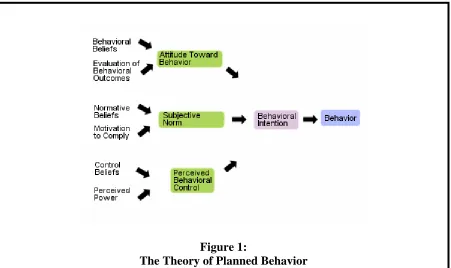
Figure 1 depicts the flow of influence in both the theories of reasoned action and planned behavior.
Note. The theory of planned behavior is public domain. Ajzen (2006) allows for reproductions and adaptations of flow models consistent with the theory.
Figure 1:
Attitudes and subjective norms have no direct effect on behavior, but rather indirectly affect intentions to perform the behavior through their respective belief systems (Ajzen & Driver, 1992; Hrubes, Ajzen & Daigle, 2001; Young, Lierman, Powell-Cope, Kasprzyk & Benoliel, 1991). To the extent to which perceived control reflects actual control, perceived control can also directly influence behavior. Thus, it acts in both an indirect and direct manner (Ajzen, 1988; Ajzen & Madden, 1986; Beck & Ajzen, 1991).
The original theory of reasoned action assumes that attitude and normative variables have separate roles in the model. However, these variables were often found to be
interdependent to one another (Budd, 1986; Ryan, 1982; Shimp & Kavas, 1984). These earlier findings can be explained by the addition of a perceived control construct (Ajzen & Madden, 1986).
Armitage and Christian (2003) report in their meta-analysis that the theory of planned behavior, in its present form, is the most dominant model of attitude-behavior relations. The revised model has been shown to yield greater explanatory power than the original theory of reasoned action for behavioral prediction (Sheppard, et al., 1988; Young, et al., 1991). A meta-analysis of the original theory conducted by Sheppard et al. (1988) found the attitude-subjective norm-intention correlation to be at .66 and significant at the .001 statistical level while Armitage and Conner (2001) reported that the theory of planned behavior accounted for 27% and 39% of the total variance in behavior and intention, respectively.
(Budd, 1986), coupon usage (Shimp & Kavas, 1984), family planning, weight loss, exercise, immunization (Young et al., 1991), education, contraceptive use, seat belt use (Vallerand, Deshaies, Cuerrier, Pelletier & Mongeau, 1992) and business marketing decisions (Sheppard et al., 1988). In addition to meta-analyses of multiple behaviors (eg., Armitage & Christian, 2003; Armitage & Conner, 2001), the theory of planned behavior accurately predicted the intention to exercise, eat healthy (Sheeran, Norman & Orbell, 1999) and recycle (Oskamp, Burkhardt, Schultz, Hurin & Zelezny, 1998; Oskamp & Schultz, 1996). The theory also accurately predicted the intention to hunt, although hunting was found to be largely under volitional control (Hrubes et al., 2001).
Most behaviors have been found to be influenced more by intentions based on attitudes than intentions based on subjective norms (Armitage & Conner, 2001; Sheeran et al., 1999). Perhaps this is due to the fact that motivations are thought to emanate from one’s self (internal) or because of pressures external to the self. Both will eventually manifest themselves as attitudes unless the external pressure is from an important reference group (Sheeran et al., 1999). Because the measure of subjective norm does not distinguish between social influences affecting the individual, it is difficult to differentiate social pressure from the harmless opinions of others (Minard & Cohen, 1983).
theory based on attitude, subjective norm and perceived behavioral control, other authors have found that the use of past behavior as an independent variable yielded almost no additional explanation of variance. As long as a sufficient number of attitude, subjective norm and behavioral control variables are present, an interaction between these variables and any behavior in question should be present (Beck and Ajzen, 1991). Similarly, Hrubes, Ajzen and Daigle (2001) report that such measures of previous behavior are common, and indeed, a significant interaction exists between past behavior and intention to engage in the same behavior in the future.
To this point, the theories of reasoned action and planned behavior have been lauded as, arguably, the most powerful measure of behavioral prediction (Armitage & Christian, 2003; Trafimow et al., 2002). However, the theories are not without limitation:
1. They are much less robust in predicting goal achievement than predicting specific goal-driven behaviors (Sheppard et al., 1988).
2. In the case of intentions, direct measures of intent are much more predictive than derived or inferred intentions (Warshaw, 1980).
3. Minard and Cohen (1983) state that intentions are relatively easy to measure, but the redundancy among attitude and subjective norm components makes it difficult to distinguish the relative importance of each.
4. Attitude and subjective norm are often naturally correlated with one another, providing no obvious determinant of behavior (Chang, 1998; Fishbein, 1967; Warshaw, 1980).
beliefs, attitudes, norms and intentions (Beck & Ajzen, 1991). Warshaw (1980) stated that the theory of reasoned action often produced weak or inconsistent predictions in marketing applications simply because the burden to produce accurate predictions is too great to “guess.” The theory has also failed in predicting employee altruism and tardiness behavior, largely due to differences in volitional control—eg., playing sick vs. being sick (Becker et al., 1995).
Two limitations of the theories of reasoned action and planned behavior bear special mention. First, self-reports create the potential for inaccuracies and misperceptions in the attitude-subjective norm-perceived control-intention relationship (Beck & Ajzen, 1991). The discrepancy between reported behavior and actual behavior is difficult and time-consuming to measure (Oskamp et al., 1998; Shimp & Kavas, 1984). For example, Oskamp et al. (1998) found that, of 56% of city residents who say they recycle, only 14% actually do. The authors emphasized the need to incorporate multiple methods to assess actual behavior and
recommend comparing it to actual behavior. Second, socially desirable reports could
compromise the power of the study (Armitage & Conner, 2001; Beck & Ajzen, 1991; Young et al., 1991).
Prediction of Outdoor Recreation Behavior
Those who engage in recreational pursuits evaluate their leisure behavior in the same manner as other personal decisions: by weighing instrumental costs and benefits as well as positive and negative feelings (Ajzen & Driver, 1992). While outdoor education and
pro-environmental behaviors (Oskamp et al., 1998). Ajzen and Driver (1992) found the addition of perceived behavioral control significantly improved the prediction of leisure behaviors while Oskamp et al. (1998) reported that environmental stewardship behavior is better explained by specific attitudes and environmental knowledge. Pro-environmental belief was not a significant predictor variable.
Deviant Behavior
Only a limited number of investigators have used the theories of reasoned action or planned behavior to explain unethical, amoral or deviant decision making. Among those are unethical decisions by medical professionals (Randall & Gibson, 1991), cheating by
university students (DeVries and Ajzen, 1971), lying, shoplifting (Beck & Ajzen, 1991), cheating in sports (Vallerand et al., 1992) and making unauthorized software copies (Chang, 1998). With the exception of Vallerand et al. (1992), the intention-behavior relationship was significant, lending predictive power to the theories of reasoned action and planned behavior to deviant or amoral situations (Chang, 1998; Randall, 1989).
Deviance is not inherent in any behavior; rather, it is conferred by audiences (Gibbs, 1966). Differences in audiences ensure that not all norms are equally enforced, not all rule-breakers find themselves labeled as deviant and not all forms of deviant behavior have any concrete rule against them (Knopf & Dustin, 1992).
prosocial behavior is caused by feelings of moral obligation, a desire to please others and the offering of rewards or threatened punishment (Gramann & Vander Stoep, 1986).
Noncompliant Behavior
In general, behavior is seen as unethical, amoral or deviant in natural areas if it goes against the social norms put in place by important referents. Whether acts taken in a natural setting are considered unacceptable depends upon the legally mandated purposes of the area, management and visitor preferences (Roggenbuck, 1992). These behaviors are not
capricious acts, but are calculated actions taken in expectation of some outcome or reward, and are more correctly termed noncompliant (Knopf & Dustin, 1992). Ward and
Roggenbuck (2003) provided three reasons why individuals might engage in noncompliant behavior:
1. The individual is refusing to comply with social norms.
2. The individual is pursuing an internalized goal of equity, control or arousal. 3. The individual views their “right to use” the resource as an inalienable, unconstrained right—a true “tragedy of the commons” mindset.
believed taking any chip was wrong, while thieves felt that “only a small piece” was all right. In the end, the thieves defended their act in such a manner as to make their behavior
acceptable (Ward & Roggenbuck, 2003).
Knowledge and experience level often plays a large role in the degree and
characteristics of normative regulation (Allessa et al., 2003; Gramann & Vander Stoep, 1986; Williams, 1990). Allessa et al. (2003) found that visitors who knew the most about Pacific Rim National Park and Reserve created the most damaging effects because their overzealous interest in the already-fragile resource was manifested into damage. Just the opposite, 84% of hikers on the Blue Ridge Parkway in North Carolina were unaware whether they had strayed from a public trail onto the privately-controlled trails of Grandfather Mountain. Only 11% knowingly crossed over onto the private trails with no permit (Williams, 1990).
One of the most practical systems for classifying noncompliant behavior in terms of motivation is Gramann and Vander Stoep’s typologies of normative violations (Roggenbuck, 1992). Gramann and Vander Stoep (1986) state that “taxonomy serves a useful
organizational purpose, although in actual fact normative violations may result from several contributing factors acting simultaneously” (p.17). The typologies of normative violations are as follows:
1. Unintentional actions are taken by individuals who are unfamiliar with expected behavior.
3. Releasor-cue violations occur when conditions in the physical environment release the social inhibitions controlling the behavior. These violations take place when clear
evidence of similar actions have not been sanctioned directly through enforcement or indirectly through social stigma.
4. Responsibility denial violations occur when an individual supports a social norm in principle, but the norm may seem unreasonable or impossible in certain circumstances.
5. Status confirming violations occur in response to social influence from important reference groups.
6. Willful violations are taken freely for financial gain, ideological protest, revenge, malice or fun. Willful violators act in defiance of social or regulatory enforcement.
Purpose and Objectives
The central factor in both the theories of reasoned action and planned behavior is the intention to engage in a behavior (Beck & Ajzen, 1991). However, actions taken in the past have already been controlled by the influence of intention and only a measure of behavior remains.
One area of research that is severely lacking is an understanding of noncompliant behavior in outdoor recreation. Noncompliance is one of the most significant problems facing natural resource managers, and yet studies that have been conducted on depreciative or noncompliant behavior in natural areas have been only site-specific attempts to control or reduce the performance of a behavior, not evaluate the decision-making process (Ward & Roggenbuck, 2003).
1988). Subjects used to test the theory have often been university students; much less has focused on members of the general population and their decision-making processes (Armitage & Christian, 2003).
Dog owners comprise a loyal and extensive market for park and natural resource areas. One pressing issue to many natural resource managers is the presence of off-leash dogs in violation of a policy designed to protect both the natural environment and other visitors. “For many dog owners, running dogs unleashed is a justifiable act of civil
disobedience” (Krohe, 2005, p. 24). This study will use the theory of planned behavior and the typologies of normative violations to address that claim. Drawing from the relevant literature that has been reviewed, the purpose of the present study is three-fold:
1. To form a demographic and behavioral “picture” of dog owners who visit William B. Umstead State Park.
2. To explore any possible link between the attitudinal, subjective norm and perceived control elements of the theory of planned behavior and noncompliance with a posted park rule.
3. To determine salient motivations of unleashed dog walkers by connecting them to one of six typologies of normative violations (Gramann and Vander Stoep, 1986).
The theory of planned behavior predicts behavioral intentions and behavior quite well and is useful for identifying where and how to target strategies for changing behavior
(Sheppard et al., 1988). Once salient beliefs, attitudes, subjective norms and perceived behavioral control have been identified, interventions can be designed to target these factors. The theory of planned behavior and the typologies of normative violations offers a
step in the design of appropriate management actions. Management implications will be discussed in detail at the conclusion of the study.
Methods
Location
Data were collected in July of 2006 at William B. Umstead State Park. William B. Umstead is comprised of 5,577 acres of restored woodland tucked between the growing cities of Raleigh, Cary and Durham in the central Piedmont of North Carolina. Recreational
activities within the park include approximately 20 miles of hiking trails, 13 miles of bridle trails, camping, picnicking and non-motorized, lake-based activities. The park employs between 4 and 7 law enforcement, education and protection rangers at any given time, but only 2 to 4 are regularly on patrol.
Operationalizing the Theory of Planned Behavior
Ajzen and Fishbein (1980) set forth five clear steps in developing a study based on the theory of planned behavior:
1. One must select the behavior of interest, define it in terms of action target, context and time elements. The behavior of interest in this study is the prior behavior of walking a dog off-leash in William B. Umstead State Park—a violation of park ordinance.
2. Define the corresponding behavioral intention. Because only past behavior is in question, intention must be structured in a manner to reflect its influence on past behavior.
off-leash within the park. Social norms reflect the general social perception of off-leash dogs and their owners, while perceived behavioral control reflects the respondent’s view as to whether they have volitional control and facilitation over walking their own dog off-leash.
4. Salient behavioral, normative and control beliefs about target behavior must be elicited. These salient beliefs were gathered through unobtrusive field observation prior to the study. For example, locations of off-leash dogs, activities of dog and owner and
temperaments of dog and owner were observed to the best of the researcher’s ability. Given more time, Ajzen and Fishbein (1980) suggest a lengthy piloting and scaling process for development of salient beliefs.
5. A questionnaire should be developed from the salient attitudinal, normative and control beliefs previously gathered. All measures of intention, attitude, subjective norm and control must be compatible with the behavior that is to be predicted (Ajzen, 1991).
Questionnaire
When appropriate, a “do not know” response was included. The question addressing off-leash behavior is followed by a matrix containing statements of attitude, subjective norm, behavioral control and items relating to Gramann and Vander Stoep’s (1986) typologies of normative behavior. All items in the matrix used a five-point ordinal level of measurement.
Many studies attempting to predict behavior have applied Fishbein and Ajzen’s (1975) suggested format for measuring attitudes (Chang, 1998; Shimp and Kavas, 1984; Hrubes et al., 2001; Ryan, 1982). The suggested format included a 7-point semantic differential matrix, coded “good-bad”, “wise-foolish” or “harmful-beneficial” to predict behaviors of a non-sensitive nature. However, Ajzen (2001) noted that attitudinal strength has been successfully operationalized in many different ways, including importance of issue, extremity of attitude, stability over time, certainty of position, vested interest and knowledge.
It has been speculated that many visitors of William B. Umstead willingly or knowingly walk their dog in violation of park rules and regulations. For that reason, all attitude, subjective norm and control items were presented in the form of statements that were based on the salient beliefs of park users, as inferred through unobtrusive observations by the researcher. The respondent was asked to answer their agreement to each statement on a 5-point, “Strongly Agree to Strongly Disagree” Likert-type scale. For the purpose of this study visitors were presented with six attitudinal measures, one subjective norm measure and five behavioral control measures. One to three questions corresponding to each of the six typologies of normative violations were included in the questionnaire matrix (Gramann and Vander Stoep, 1986).
subjective norm statements together, etc. This suggestion was heeded for all matrix items related to investigation of planned behavior. Likewise, Gramann and Vander Stoep’s (1987) typologies were randomized separately within the matrix.
Demographic data consisting of gender, age, education level and ZIP Code was included at the end of the questionnaire. In accordance with the first objective of this study, this information will contribute to a demographic profile of those users most inclined to walk their dogs off-leash within the park.
The questionnaire was developed to minimize time burden and maximize comfort with a potentially sensitive subject. Because off-leash dog use is a widely practiced behavior in the park, Chang (1998) believes that such widespread behavior is easier to solicit from respondents—regardless of legality. Nevertheless, assurances of confidentiality and anonymity were made in the introductory letter as well as in person upon the respondents’ receipt of the questionnaire. Generally, accuracy of responses to a self-administered questionnaire is improved by providing thorough explanations when requested, clearly written questions, adequate time burden and promoting a relaxed and acceptable data collection environment (Young, et al., 1991).
Data Collection Procedure
entrance received identical amounts of collection time. Times were also determined by a stratified sampling of weekday and weekend, morning and afternoon. Short periods of rain were acceptable, and only one collection day was totally compromised by rain. Another day, identical in time and location, was selected at random.
A table was set up with several folding chairs on most-likely traveled routes to and from the parking area. Shaded areas were preferred for the comfort of both researcher and respondents. Respondents were asked if they would complete a short questionnaire
regarding dog use in the park, and assurances of confidentiality and anonymity were stressed personally and in writing. If interest was shown, the respondent was handed a clipboard and one questionnaire; when complete, the respondent could drop their questionnaire into a sealed box. In exchange for their time, all respondents received a dog-shaped keychain containing a small picture frame. At the close of the collection period, the researcher removed all completed questionnaires for that day and coded them by time and location of collection.
overheard by the researcher were also discreetly recorded after the respondent had left the table. These comments have been transcribed in Appendix C as accurately as possible. Visitors who refused to complete the questionnaire on-site were asked if they were willing to take home a stamped and labeled envelope containing a questionnaire. It was thought that this method would further reduce non-response than simply obtaining the respondent’s own address. By this method, the burden is placed on the respondent to complete the questionnaire that they have agreed to take home. However, only two respondents refused an on-site completion and accepted a stamped envelope.
In addition to potential non-response, socially desirable answers were the second major concern of the study. Powell-Cope and colleagues (1991) report that, for sensitive issues such as illegal activity or norm violation, anonymous questionnaires tend to yield less socially desirable answers than interviews. Beck and Ajzen (1991) note that even self-reports can be biased by social desirability, but there are few practical alternatives. Even for sensitive issues, Beck and Ajzen (1991) were encouraged by a pilot study discovering moderately high honesty levels in self-reporting consistent with previous findings.
Results
Sample
between 31 and 40 years while education was highly skewed toward those with a bachelor’s degree or higher (91%).
The Graylyn Drive collection point yielded 56.6% of respondents. The remainder of respondents was split between the Harrison Avenue entrance and Reedy Creek Road
entrance—24.5% and 18.9%, respectively. Questionnaires collected on weekend mornings comprised 50% of the sample, followed by weekend afternoons (22.6%), weekday afternoons (15%) and weekday mornings (12.3%).
Over 50% of the sample noted their ZIP Code as 27612 (25%), 27613 (17.3%) or 27607 (11.5%). Considering these ZIP Codes surround the highest-yielding collection points—Graylyn Drive and Harrison Avenue entrances—one could postulate that a majority of dog walkers are local, if not literally adjacent, to William B. Umstead State Park.
Objective 1: Demographic and Behavioral Picture of Dog Walkers
Total trips in the previous twelve months are positively skewed with a median of 36 trips. Of those total trips, the median trips including at least one dog approached 100%, indicating that most dog walkers surveyed visit the park only with their dogs. Upon analysis, reasons for choosing William B. Umstead for dog use were mixed. Respondents consistently checked that “natural beauty”, “longer trails” and “less crowded” were all reasons for visiting the park. The most common response in the “other” category was related to the park’s close proximity to their home—mirroring the results of the ZIP Code analysis described above— followed by the perception of isolation.
Know” on their questionnaire. This response was generally reported by those who had visited the park fewer than 5 times in the past twelve months.
A large majority of dog walkers (86%) have had no previous conflicts with dogs in the park. However, those with problems frequently recounted stories of dog bites, belligerent owners and conflict between dogs. Nearly 76% of respondents correctly answered the
true/false question, “The park allows some places for dogs to be off-leash.” Another 23.6% indicated that they did not know. Only one respondent indicated that this was a true
statement.
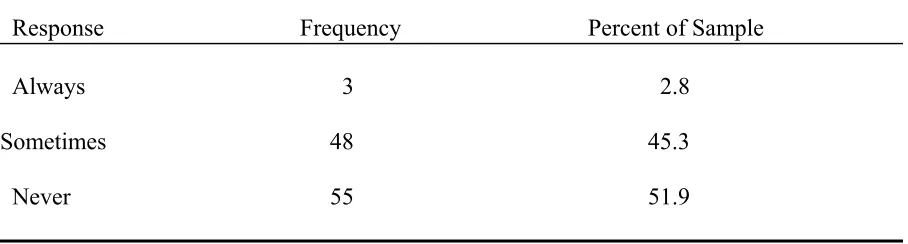
Although the largest majority of respondents are familiar with the leash rule in William B. Umstead State Park, 48.1% indicated that they allow their dog to run off leash within the park (Table 1).
Table 1
How often do you allow your own dog to run off-leash in the park?
Response Frequency Percent of Sample
Always 3 2.8
Sometimes 48 45.3
Never 55 51.9
Table 2
Opinions of Off-Leash Dog Use in William B. Umstead State Park on a 5-point Agreement Scale (1 = Strongly Disagree, 3 = Neutral, 5 = Strongly Agree)
Item N
x
Dogs should be allowed to swim in the lakes. 104 4.13 I have complete control over whether my dog stays 106 3.77 on-leash or off-leash.
Letting my dog off-leash allows both the dog and I to 106 3.54 have a better experience.
It would be easy to let my dog run off-leash 104 3.49 There is enough room to allow my dog to run 105 3.40 off-leash.
Sometimes it is OK if a dog runs off-leash 105 3.30 If the park is not crowded, off-leash dogs should be 106 3.19 allowed to run freely.
My dog has ample opportunities to be allowed 105 2.76 off-leash.
Off-leash use should be allowed at any time. 105 2.54 It is never OK to let your dog run off-leash 105 2.46 The opinion of others has no effect on whether 106 2.17 I allow my dog off-leash.
use on weekday mornings (76.9%), followed by weekday afternoons (56.3%), weekend mornings (43.4%) and weekend afternoons (37.5%).
Two thirds of respondents who reported previous problems with other dogs choose to keep their dog on-leash. Only 49.5% of respondents who had no prior negative experiences keep their dogs on-leash all the time. Of those respondents who indicated that they did allow their dog to run off-leash, 51.3% correctly stated that there were no areas in the park legally open for off-leash use. Surprisingly, the only incorrect respondent indicated that they did not allow their dog off-leash and only 40% of those answering “Do Not Know” allowed their dog off-leash.
Objective 2: Exploring the Link between Off-Leash Use and the Theory of Planned Behavior Reliability concerns the degree to which an instrument is measuring consistently over time (Fishbein & Ajzen, 1975). Although the questionnaire matrix items in the present study were not scaled per se, the reliability coefficient was acceptable (a = .87) (Warshaw, 1980). Inter-attitude reliability was .80 and reliability between perceived control measures was slightly lower at .67. Only one subjective norm measure was included in the matrix.
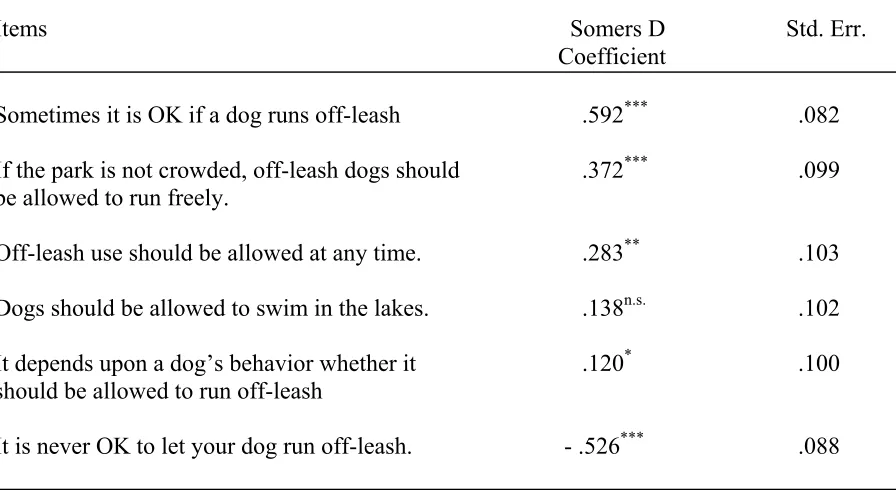
Table 3
Probability of an Association between Off-Leash Dog Use and Attitudes
Items Somers D Std. Err.
Coefficient
Sometimes it is OK if a dog runs off-leash .592*** .082 If the park is not crowded, off-leash dogs should .372*** .099 be allowed to run freely.
Off-leash use should be allowed at any time. .283** .103 Dogs should be allowed to swim in the lakes. .138n.s. .102 It depends upon a dog’s behavior whether it .120* .100 should be allowed to run off-leash
It is never OK to let your dog run off-leash. - .526*** .088 Notes. The dependent variable is measured by response to Question 8 in the questionnaire, “How often do you allow your own dog to run off-leash in the park?” Possible responses included always, sometimes and never. Each item represents a separate, independent variable corresponding to an attitude measure.
* = p<.05 ** = p<.01 *** = p<.001
The reader can interpret the coefficients in Table 3 as probabilities. As an example, take the question, “Sometimes it is OK if a dog runs off-leash.” As park visitors increasingly allow their dogs to run off-leash, there is 59% probability that they will agree that
“sometimes it is OK if a dog runs off-leash.” In fact, with 95% confidence, there will be a 43% to 75% [.59 + 2(.082)] probability that visitors will act on this attitude in letting their dogs run off-leash.
coefficient for this attitude, and indeed, it is present. The negative coefficient signifies that, as respondents’ willingness to allow their dog off-leash increases, their agreement with the statement “It is never OK to let your dog run off-leash in the park” decreases by 53%.
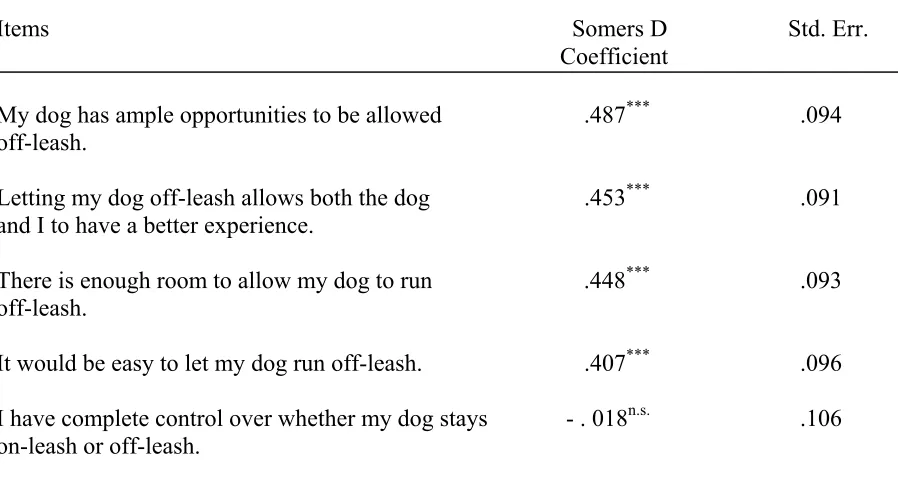
Results from a Somers D operation to measure the relationship between off-leash use and measures of perceived behavioral control is located in Table 4.
Table 4
Probability of an Association between Off-Leash Dog Use and Perceived Behavioral Control
Items Somers D Std. Err.
Coefficient
My dog has ample opportunities to be allowed .487*** .094 off-leash.
Letting my dog off-leash allows both the dog .453*** .091 and I to have a better experience.
There is enough room to allow my dog to run .448*** .093 off-leash.
It would be easy to let my dog run off-leash. .407*** .096 I have complete control over whether my dog stays - . 018n.s. .106 on-leash or off-leash.
Notes. The dependent variable is measured by response to Question 8 in the questionnaire, “How often do you allow your own dog to run off-leash in the park?” Possible responses included always, sometimes and never. Each item represents a separate, independent variable corresponding to a perceived control measure.
* = p<.05 ** = p<.01 *** = p<.001
p<.05). Two subsequent tests of independence for ordinal variables, Kendall’s Tau and Spearman’s Rho, confirmed the significance of the noted variables in Tables 3 and 4 at p<.05 or below. One can observe from the tables that two attitude statements and four behavioral control statements achieved a significant correlation to off-leash use of .40 or better.
According to the theory of planned behavior, these six measures carry the most weight in the decision process of the sample.
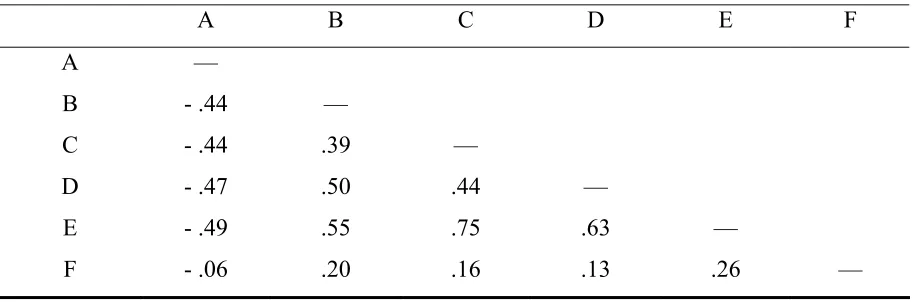
Correlation analysis between attitudes in Table 5 yielded additional information regarding relationships between the six measures of attitude employed by the questionnaire. Essentially, Variables A through E were consistently correlated with one another, but
considerably lower correlations were found between “Dogs should be allowed to swim in the lakes” and all other variables. Correlations between the “Never OK” attitude were negatively correlated with all other attitudes.
Table 5
Correlation Analysis between Attitude Measures (n = 101) A. It is never OK allow a dog off-leash.
B. Sometimes it Ok to allow a dog off-leash. C. Dogs should be allowed off-leash at any time.
D. It depends on a dog’s behavior whether it should be allowed off-leash. E. If the park is not crowded dogs should be allowed off-leash.
F. Dogs should be allowed to swim in the lakes.
A B C D E F
A —
B - .44 —
C - .44 .39 —
D - .47 .50 .44 —
E - .49 .55 .75 .63 —
Midrange to lower correlations characterize the relationship between perceived behavioral control measures in Table 6. Correlations between “I have complete control over how I walk my dog” and all other perceived control measures were consistently lower than correlations between the other variables.
Table 6
Correlation Analysis between Perceived Behavioral Control Measures (n = 104) A. There is enough room to allow a dog off-leash in the park.
B. My dog has ample opportunities to be allowed off-leash. C. It would be easy to allow my dog off-leash.
D. Allowing my dog off-leash lets both my dog and me to have a better experience. E. I have complete control over whether I allow my dog off-leash.
A B C D E
A — B .37 —
C .53 .40 —
D .57 .35 .37 —
E .07 .11 .07 .09 —
Objective 3: Connecting Off-Leash Users to One of Six Typologies of Normative Violations The last nine items of the questionnaire matrix explored salient beliefs and
motivations behind an individual’s choice to allow his or her dog to run off-leash inside William B. Umstead State Park. The typologies of normative violations identified by Gramann and Vander Stoep (1986) are: unintentional, uninformed, releasor-cue,
and a comparison of the respondents’ knowledge of park rules, “The park allows some places for dogs to be off-leash.”
Respondents were placed into one of Gramann and Vander Stoep’s (1986) six
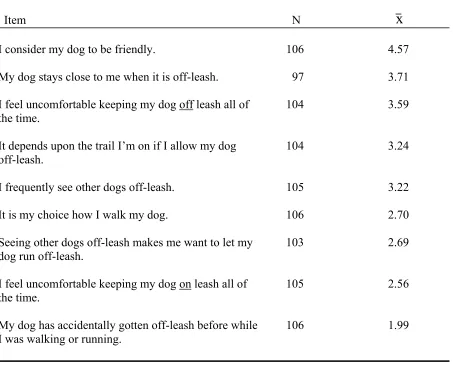
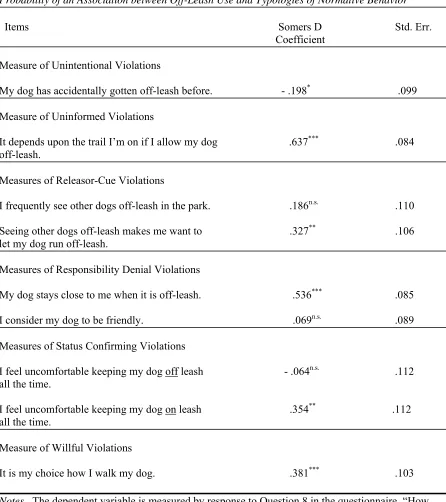
typologies using results from descriptive statistics (Table 7), cross-tabulation and a Somers D ordinal regression (Table 8).
Table 7
Salient Motivations of Off-Leash Dog Use in William B. Umstead State Park on a 5-point Agreement Scale (1 = Strongly Disagree, 3 = Neutral, 5 = Strongly Agree)
Item N
x
I consider my dog to be friendly. 106 4.57
My dog stays close to me when it is off-leash. 97 3.71 I feel uncomfortable keeping my dog off leash all of 104 3.59 the time.
It depends upon the trail I’m on if I allow my dog 104 3.24 off-leash.
I frequently see other dogs off-leash. 105 3.22 It is my choice how I walk my dog. 106 2.70 Seeing other dogs off-leash makes me want to let my 103 2.69 dog run off-leash.
I feel uncomfortable keeping my dog on leash all of 105 2.56 the time.
My dog has accidentally gotten off-leash before while 106 1.99 I was walking or running.
respondents indicated that they both allowed their dog off-leash and the dog had gotten off by accident. These respondents would be placed in the “unintentional” category.
Uninformed respondents are more likely to disregard rules due to low knowledge levels of total impact. These visitors may be aware that a rule is in place, but feel that the rule is inappropriate or unreasonable given their limited knowledge. Over 38% of off-leash users indicated that their choice depends largely upon the trail that they are on.
Gramann and Vander Stoep (1986) argued that releasor-cue violators engage in noncompliant behavior in response to seeing evidence of others doing the same. Twenty-two percent of off-leash users noted that they frequently saw other dogs off-leash, but only 16.5% signified that seeing other dogs off-leash made them want to let their own dog off-leash.
The fourth category, responsibility denial, is characterized by an individual’s deferral of responsibility in certain circumstances. 38% of off-leash users stated that their dog remains close while it is on leash. Another 41.5% indicated that their dog was friendly. These two common responsibility-denial responses signify that a large majority of off-leash users defer responsibility by weighing their dog’s behavior in an off-leash situation.
Only 16.8% of off-leash users felt uncomfortable by the status confirming violation of keeping a dog on-leash while 27.9% felt uncomfortable keeping the dog off-leash all the time.
Finally, willful violations are taken in flagrant disregard for posted rules. Only 15.1% of respondents who allow their dog off-leash agreed with the statement, “It is my choice how I walk my dog.”
Table 8
Probability of an Association between Off-Leash Use and Typologies of Normative Behavior
Items Somers D Std. Err.
Coefficient
Measure of Unintentional Violations
My dog has accidentally gotten off-leash before. - .198* .099
Measure of Uninformed Violations
It depends upon the trail I’m on if I allow my dog .637*** .084
off-leash.
Measures of Releasor-Cue Violations
I frequently see other dogs off-leash in the park. .186n.s. .110
Seeing other dogs off-leash makes me want to .327** .106
let my dog run off-leash.
Measures of Responsibility Denial Violations
My dog stays close to me when it is off-leash. .536*** .085
I consider my dog to be friendly. .069n.s. .089
Measures of Status Confirming Violations
I feel uncomfortable keeping my dog off leash - .064n.s. .112 all the time.
I feel uncomfortable keeping my dog on leash .354** .112
all the time.
Measure of Willful Violations
It is my choice how I walk my dog. .381*** .103
Notes. The dependent variable is measured by response to Question 8 in the questionnaire, “How
often do you allow your own dog to run off-leash in the park?” Each item represents a separate, independent variable corresponding to statements characteristic of one of the typologies of normative violations.
In both reasoned action and planned behavior, salient motivations underlie the
formation of attitudes, subjective norms and levels of perceived control. The values in Table 8 are interpreted in a similar fashion to those in Tables 3 and 4. For example, consider the question, “It depends upon the trail I’m on if I allow my dog off-leash.” As park visitors increasingly allow their dogs off-leash, there is a 64% probability that they will agree with this statement, characteristic of an uninformed violator. With 95% confidence, one can infer that there will be a 47% to 81% [.64 + 2(.084)] probability that visitors will agree that, depending on the trail, they will, in fact, allow their dog to run off-leash.
In addition to Somers D, a Kendall’s Tau test was conducted to gauge whether the choice to engage in off-leash behavior and these salient motivations were independent of one another. Seeing other dogs off leash, feeling uncomfortable keeping a dog on-leash, feeling that a dog stays close while leash, judging leash behavior by trail and feeling that off-leash behavior should be the owner’s choice were all significantly related at the p = .01 level or below. A third test of independence for ordinal variables, Spearman’s Rho, mirrored these results at the p = .01 level or below.
Discussion
Objective 1: Demographic and Behavioral Picture of Dog Walkers
As stated, all North Carolina State Parks require all pets to “be on a leash no longer than six feet.” Visitors are made aware of the leash rule through the park’s website,
Results show that visitors who choose to illegally walk their dogs off-leash do so with a heightened knowledge of park rules, signifying that they make a willing and conscious decision to disregard the posted ordinance.
Respondents were in agreement with elements in the questionnaire related to allowing dogs to swim in the lakes and control issues such as behavior, close proximity and
temperament of off-leash dogs. However, these results are not without limits. Lower mean scores for off-leash use at any time and being uncomfortable keeping a dog off-leash all the time imply that respondents generally feel that only some dogs should be allowed off leash some of the time in only some areas.
Although the location and ranger contact variables were not significant to one another (χ2 = 4.34; p = .63), an interesting coincidence developed that the majority of the sample who allowed their dogs off-leash were intercepted at the least patrolled entrances and when the fewest rangers are on duty. It stands to reason that persuasive messages and enforcement should be targeted to those walkers who visit the park on weekdays—especially weekday mornings.
Objective 2: Exploring the Link between Off-Leash Use and the Theory of Planned Behavior Consistent with the original theories of reasoned action and planned behavior,
demographics had no significant relationship to the choice to engage in any given behavior (Fishbein & Ajzen, 1975). Specifically related to noncompliant behavior, the relationship between interest in the resource and behavior were not consistent with findings by Allessa et al. (2003). Unlike visitors to Pacific Rim National Park and Reserve who engaged in
Alessa et al. (2003) argued that increased knowledge of the delicate tidewater ecosystem at Pacific Rim led to increased noncompliance out of sheer curiosity. It is likely that William B. Umstead simply presents an appealing and convenient medium to exercise oneself and one’s dog in a natural setting.
It should be stressed that the objective of this research was to explore the relationship of elements in the theory of planned behavior to previous off-leash dog use, not to predict future actions. The theory of planned behavior states that a weighted combination of attitudes, subjective norms and perceived behavioral control contribute to the intention to engage in any given behavior. The results of this study find relatively high correlations to support that theory. The attitude variables that maintained both a high correlation to off-leash behavior and statistical significance were those pertaining to “It is never OK to allow a dog off-leash” and “Sometimes it is OK to allow a dog off-leash.” According to theory, the presence or absence of these two independent variables would carry the most weight in influencing the dependent variable of off-leash behavior. Moderately correlated attitudes included “Allowing dogs off leash anytime” and “If the park is not crowded” allow for inferences in secondary motivations.
The subjective norm component was minimally correlated. As such, the theory would state that this is the variable least likely to influence off-leash behavior—which is consistent with a number of previous studies (eg., Armitage & Conner, 2001; Sheeran et al., 1999). These findings are supported by the lower importance of releasor-cue and status confirming salient beliefs elicited through Gramann and Vander Stoep’s (1986) typologies of normative violations.
Of the two measures found to be not-significant, dogs’ swimming was the most surprising. Swimming in one of the three lakes is a common occurrence in the park. Perhaps respondents do not equate off-leash swimming with off-leash walking. Likewise, common responses from individuals on either side of the off-leash debate (See Appendix C) signified that a dog’s behavior is the single-largest contributing factor to whether it should be allowed off-leash. Although behavior was found to be slightly significant, the correlation was likely low because both on-leash walkers and off-leash walkers place great amounts of faith in well-behaved dogs and less in the discretion of other owners.
Comments received by the researcher through questionnaires, conversation or
Objective 3: Connecting Off-Leash Users to One of Six Typologies of Normative Violations Operationalizing the theory of planned behavior includes strict measurement of salient beliefs and motivations underlying attitude, subjective norm and perceived behavioral control scores. These measures improve the study’s predictive and explanatory power (Budd, 1986).
Although somewhat exploratory, this study used Gramann and Vander Stoep’s (1986) typologies of normative violations to arrive at some understanding of salient motivations behind the noncompliant act in question. The typologies were found to be significantly related to, on average, five attitude components, four perceived control components and one subjective norm component, signifying that the selected salient motivations most influence attitude, perceived control and subjective norm in that order.
relatively small portion of the sample. Monetary and human resources would be used less efficiently to reach such a small portion of the population.
Changing Outdoor Recreation Behavior
Ward and Roggenbuck (2003) report that the three most common justifications for taking petrified wood from Petrified Forest National Park were: (a) small pieces were not as important, (b) the prevalence of wood and (c) “everyone was doing it”. Clear connections can be made between Ward and Roggenbuck (2003) and the present study. If there are no obvious consequences, if resources are abundant (i.e. the relative size of William B.
Umstead) and if others are engaging in the same behavior, then off-leash actions may seem justified to the violator. When the personal benefit of achieved outcomes seems greater than the cost shared by everyone, then it is reasonable to conclude that cosmetic measures will not be enough to stop depreciative or noncompliant behaviors such as vandalism, plant removal or off-leash dog use.
Behavior change is achieved by influencing the salience of beliefs and changes in commitment and confidence in the intention to engage in that behavior (Ajzen, 1985). Attempts to bring about change in behavior invariably involve the introduction of new knowledge. Beliefs, evaluations and subsequent attitudes are influenced in such ways (Bright, Manfredo, Fishbein & Bath, 1993; Fishbein & Ajzen, 1975; Randall & Gibson, 1991). The key to changing subjective norms lie in changing the individual’s perception of what others want. Changes in subjective norm must involve changes in normative beliefs or the motivation to comply with an important referent group (Bright et al., 1993).
or enforcement is ineffective—both of which were found to be true in the present study— then violations will be expected to continue (Roggenbuck, 1992).
Bright et al., (1993) note that effective communication of appropriate messages will affect the public acceptance of proposed or stated management actions. As a result,
management policies must first endure the scrutiny of the public before acceptance and compliance. A clear message that reaches the target audience is imperative; one that enjoins the target group to unite in the protection of the resource is optimal. Although personal interpretation often yields no greater benefit than non-personal (Roggenbuck, 1992), the message must be placed in an area where the visitor’s attention is not diverted by an environmental attribute or outdoor goal (McCool & Cole, 2000).
Implications for Management
The results of this study emphasize the utility of understanding salient motivations as a first step in curbing noncompliant behavior. Managers in natural areas should elicit salient beliefs from their visitors and develop an effective communication regime to target a change in those beliefs. They must then successfully persuade visitors of the positive and negative outcomes of adherence to the policy. Generally, there are three conceptual approaches to persuasion (Roggenbuck, 1992):
1. Applied behavior analysis focuses on changing overt behavior through physical manipulation, strict enforcement and offering rewards and punishments for appropriate behavior.
3. The peripheral route to persuasion attempts to change beliefs indirectly through persuasive messages given little or no attention by the visitor.
Often, applied behavior analysis only serves as a “quick fix” to problem behaviors. The central and peripheral routes attempt to affect beliefs, attitudes, thoughts and values inherent in the visitor (Roggenbuck, 1992). Knopf and Dustin (1992) echo these principles by noting that management of noncompliant behavior is more effective with positively oriented controls (education) than with coercive control and enforcement.
Specifically, Gramann and Vander Stoep (1986) give general guidelines to managers wishing to target certain normative violators. Managers desiring to reduce actions of
noncompliance by responsibility denial violators should, optimally, structure policy so that a clear choice exists between a moral and an amoral action. Although difficult, this may be accomplished by giving reasonable alternatives to violators or revamping education efforts to target salient beliefs. Uninformed violators should be made aware of the negative
consequences of their actions to activate feelings of personal responsibility. Moral appeals and aggressive education have high potential to correct these violations. Willful violators have shown consistent disregard for normative rules and regulations. While direct
management may be an over-reaction to other types of violations, regulatory enforcement or staff presence are the most successful interventions to change the behavior of willful
violators.
Limitations
longer amount of time would certainly have enabled more robust and generalizable data. Although I believe that the data and method of collection were sound enough to reflect the beliefs, attitudes, subjective norms and perceived control of dog walkers at the collection areas, estimated confidence intervals between 8 and 9 create some concern over the widespread generalizability of the data.
Second, no pretest was conducted on the instrument to elicit salient beliefs and attitudes of a representative population, as suggested by Ajzen (1991). In this study, the pretest was conducted through unobtrusive observation by the researcher. Salient beliefs were evaluated as objectively as possible and imagination kept to a bare minimum.
However, I must grant that content validity could be compromised by a failure to solicit and refine pretest statements from a representative population.
Third, Fishbein and Ajzen (1975) report the “widespread mistreatment” of data, manipulation of statistical procedures and frequency of invalid conclusions in attitude and behavioral research. The conclusions drawn in this study are my own, based upon
comparisons with relevant literature and relatively routine statistical tests. Again, imagination was kept to a minimum.
Conclusions and Recommendations for Future Research
Managers of natural resource areas are increasingly concerned with impacts caused by visitors as the area approaches the primitive or natural end of the Recreation Opportunity Spectrum (Roggenbuck, 1992). Noncompliance becomes problematic when it manifests itself physically—as is the case with vandalism, littering or dog waste—or socially with regards to comfort and recreational experience of other visitors. When exploring the motivations behind noncompliance to park rules, one must ask, “Is it true that the ultimate culprit is the one committing the behavior?” Or could it be the failure of society and specifically, outdoor recreation managers, to accurately convey messages relevant to the behavior at hand?
This research has shown that the ultimate decision of individuals to engage in noncompliant behavior is explained reasonably well by elements of the theory of planned behavior: attitude, subjective norm and perceived behavioral control. Although we still know little about the motivations behind noncompliant behavior, this study used the theory of planned behavior as a basic model for predicting the propensity to engage in off-leash dog use and a second theory— Gramann and Vander Stoep’s (1986) typologies of normative violations—to gauge salient beliefs underlying attitude, subjective norm and perceive behavioral control. Significant relationships were found to exist between attitudes, subjective norms, perceived behavioral control and off-leash dog use. Likewise, the
Research is still lacking in the general realm of predicting and mitigating noncompliant or destructive behavior in parks. Specifically, I recommend that future research be conducted on specific attitudes toward general environmental health and propensity to engage in depreciative or noncompliant behavior. For example, the New Ecological Paradigm could be used to gauge a total attitude score for general environmental concern and incorporated into the theory of planned behavior. Additional research should also be conducted on discrepancies between self-reported and actual behavior in natural areas and the effect of attitude strength (crystallization) on managers’ ability to change the
References
Ajzen, I. (1985). From intentions to actions: A theory of planned behavior. In J. Kohl and J. Beckmann (Eds), Action control: From cognition to behavior. Berlin:
Springer-Verlang.
Ajzen, I. (1988). Attitudes, personality and behavior. Milton Keynes, United Kingdom: Open University Press.
Ajzen, I. (1991). The theory of planned behavior. Organizational Behavior and Human Decision Processes, 50(1): 179-211.
Ajzen, I. (2001). Nature and operation of attitudes. Annual Review of Psychology, 52, 27-58.
Ajzen, I. (2006). The theory of planned behavior. Icek Ajzen, Personal Webpage. Retrieved July 27, 2006, from http://www.people.umass.edu/aizen/index.html Ajzen, I. & Driver, B. L. (1992). Applications of the theory of planned behavior to leisure choice. Journal of Leisure Research, 24(3), 207-224.
Ajzen, I. & Fishbein, M. (1980.) Understanding attitudes and predicting social behavior. Englewood Cliffs, NJ: Prentice-Hall.
Ajzen, I. & Madden, T. (1986). Prediction of goal-directed behavior: Attitudes, intentions and perceived behavioral control. Journal of Experimental Social Psychology, 22(5), 453-474.
Armitage, C. & Christian, J. (2003). From attitudes to behaviour: Basic and applied research on the theory of planned behaviour. Current Psychology: Developmental, Learning, Personality, Social, 22(3), 187-195.
Armitage, C. & Conner, M. (2001). Efficacy of the theory of planned behaviour: a meta- analytic review. British Journal of Social Psychology, 40, 471-499.
Beck, L. & Ajzen, I. (1991). Predicting dishonest actions using the theory of planned behavior. Journal of Research in Personality, 24(4), 285-301.
Becker, T., Randall, D. & Riegel, C. (1995). The multidimensional view of commitment and the theory of reasoned action: A comparative evaluation. Journal of
Management, 21(4), 617-638.
Bright, A., Manfredo, M., Fishbein, M. & Bath, A. (1993). Application of the theory of reasoned action to the National Park Service’s controlled burn policy. Journal of Leisure Research, 25(3), 263-280.
Budd, R. (1986). Predicting cigarette use: The need to incorporate measures of salience in the theory of reasoned action. Journal of Applied Social Psychology, 16(8), 663-685. Chang, M. (1998). Predicting unethical behavior: A comparison of the theory of reasoned
action and the theory of planned behavior. Journal of Business Ethics, 17, 1825-1834.