Tractable XML Data Exchange via Relations
Rada Chirkova
#1, Leonid Libkin
∗2, Juan Reutter
∗3 #NC State University1
∗University of Edinburgh
2
[email protected] 3[email protected]
Abstract— We consider data exchange for XML documents:
given source and target schemas, a mapping between them, and a document conforming to the source schema, construct a target document and answer target queries in a way that is consistent with source information. The problem has primarily been studied in the relational context, in which data-exchange systems have also been built.
Since many XML documents are stored in relations, it is natural to consider using a relational system for XML data exchange. However, there is a complexity mismatch between query answering in relational and XML data exchange, which indicates that restrictions have to be imposed on XML schemas and mappings, and on XML shredding schemes, to make the use of relational systems possible.
We isolate a set of five requirements that must be fulfilled in order to have a faithful representation of the XML data-exchange problem by a relational translation. We then demonstrate that these requirements naturally suggest the inlining technique for data-exchange tasks. Our key contribution is to provide shred-ding algorithms for schemas, documents, mappings and queries, and demonstrate that they enable us to correctly perform XML data-exchange tasks using a relational system.
I. Introduction
Data exchange is the problem of finding an instance of a target schema, given an instance of a source schema and a schema mapping, that is, a specification of the relationship between the source and the target. Such a target instance should correctly represent information from the source instance under the constraints imposed by the target schema, and should allow one to evaluate queries on the target instance in a way that is semantically consistent with the source data. The problem has received much attention in the past few years, with several surveys already available [22], [9], [8].
The general setting of data exchange is this:
queryQ
sourceS targetT
mappingM
We have fixed source and target schemas, an instance S
of the source schema, and a mapping M that specifies the
relationship between the source and the target schemas. The goal is to construct an instanceT of the target schema, based on the source and the mapping, and answer queries against the target data in a way consistent with the source data.
The mappings rarely specify the target instance completely, that is, for each sourceSand mappingM, there could be mul-tiple target instancesT1,T2, . . . that satisfy the conditions of
the mapping. Such instances are called solutions. The notion of query answering has to account for their non-uniqueness. Typi-cally, one tries to compute certain answersCERTAINM(Q,S), i.e., answers independent of a particular solution chosen. If
Q produces relations, these are usually defined asT iQ(Ti).
Certain answers must be produced by evaluating some query
– not necessarily Q but perhaps its rewriting Qrewr over a
particular solutionT, so thatQrewr(T) =CERTAINM(Q,S). Thus, the key tasks in data exchange are: (a) choosing a particular solution T among {T1,T2, . . .} to materialize,
and (b) finding a way of producing query answers over that solution by running a rewritten queryQrewrover it. Usually one builds a so-called universal solution [13], [8]; these solutions behave particularly nicely with respect to query answering.
These basics of data exchange are independent of a partic-ular model of data. Most research on data exchange, however, occurred in the relational context [13], [14], [22], [8] or slight extensions [33], [19]; the first paper that attempted to extend relational results to the XML context was [6], and a few followups have since appeared [4], [3]. They all concentrate on the algorithmic aspects of query answering and constructing solutions, with the main goal of isolating tractable cases. The problem these papers do not address is how XML data
exchange can be implemented?
Previous work on algorithms for XML data exchange has tacitly assumed that one uses a native XML DBMS such as [20]. However, this is not the only (and perhaps not even the most common) route: XML documents are often stored in relational DBMSs. In fact, many ETL products claim that they handle XML data simply by producing relational translations (known as shredding [23]). This leads to a two-step approach:
• first shred XML data into relations;
• then apply a relational data-exchange engine (and publish
the result back as an XML document).
The approach seems very natural, but the key question is whether it will work correctly. That is, are we guaranteed to have the same result as we would have gotten had we implemented a native XML data-exchange system?
documents, (c) XML schema mappings, and (d) XML queries. Then the concept of correctness of such a translation is shown below:
XML : sourceS mappingM- targetT query-Q answer
Relations : σ(S) shred
? σ(M)
- σ(T)
shred
? σ(Q)
- answer
shred
?
That is, suppose we start with an XML document S and
an XML schema mapping M. In a native system, we would
materialize some solution T over which we could answer
queries Q.
But now we want a relational system to do the job. So we shred S into σ(S)and then apply toσ(S)the translation
of the mapping σ(M) to get a solution – which itself is a
shredding of an XML solution – so that the answer toQcould
be reconstructed from the result of the query σ(Q) over that relational solution.
The idea seems simple and natural on the surface, but starts looking challenging once we look deeper into it. Before even attempting to show that the relational translation faithfully rep-resents the XML data-exchange problem, we need to address the following.
Complexity mismatch. Without restrictions, there cannot be a faithful representation of XML data exchange by a
relational system. Indeed, it is well known that positive relational-algebra queries can be efficiently evaluated in relational data exchange [13], [22], [8], but even for simple XML analogs of conjunctive queries finding query answers can be coNP-hard [6]. So any claim that a relational data-exchange system correctly performs XML data exchange for arbitrary documents and queries is bound to be wrong. We thus need to identify the cases that can be handled by a relational system.
Which shredding scheme to use? There are several, that can
roughly be divided into two groups: those that do not take the schema information into account (e.g., the edge repre-sentation [15], interval codings [34], and other numbering schemes [31]), and those that are based on schemas for XML, such as variants of the inlining technique [29], [23]. Since in data-exchange scenarios we start with two schemas, it seems more appropriate to apply schema-based techniques.
Target constraints. In relational data exchange, constraints
in target schemas are required to satisfy certain acyclic-ity conditions; without them, the chase procedure that constructs a target instance does not terminate [13], [22], [8]. Constraints imposed by general XML schema specifications need not in general be even definable in relational calculus, let alone be acyclic [21]. We thus need to find a shredding technique that enables us to encode targets schemas by means of constraints that guarantee chase termination.
As for the complexity issue, the work on the theory of XML data exchange has identified a class of mappings for which efficient query answering is possible [6], [4], [3]. The schemas
(say, DTDs), have rules of the form db → book∗
, book →
author∗
subject(we shall give a formal definition later), and the mappings transform patterns satisfied over the source into patterns satisfied over targets.
This restriction suggests a relational representation to use. Going with the edge representation [15] is problematic: first, each edge in an XML pattern used in a mapping will result in a join in the relational translation, making it inefficient, and second, enforcing even a simple schema structure under that representation takes us out of the class of target constraints that relational data-exchange systems can handle. Verifiably correct translations based on numerical encodings [31], [34] will necessarily involve numerical and/or ordering constraints in relational translations of mappings, and this is something that relational data exchange cannot handle at the moment [22], [8] (beyond simple ordering constraints [2]).
One translation scheme however that fits in well with restrictions identified in [6], [4], [3] is the inlining scheme. It works very well for DTDs of the “right” shape, and its output schemas involve only acyclic constraints, which is perfect for data-exchange scenarios.
Desiderata for the translation We now formulate some basic
requirements for the translation σ, in order to be able to
achieve our goals described in the diagram above. We need the following:
Requirement 1: translation of schemas A translationσ(D)
that, when applied to a DTD of a special form, produces a relational schema that only has acyclic constraints, which can be used in a relational data-exchange setting.
Requirement 2: translation of documents A translation
σD(·) for a DTD D that, when applied to documentT
conforming to D, produces relational database σD(T)
of schemaσ(D).
Requirement 3: translation of queries For a DTD D, a
translationσD(Q)of (analogs of) conjunctive queries so thatσD(Q) σD(T)
=Q(T)(that is, the result ofQ(T)
can be computed by relational translations).
Requirement 4: translation of mappings For a mapping
M between a source DTD Ds and a target DTD Dt,
its translation σ(M) is a mapping between σ(Ds) and
σ(Dt)that preserves universal solutions. That is: (a) Each σDt-translation of a universal solution for T
under M is a universal solution for σDs(T) under
σ(M); and
(b) Each universal solution for σDs(T) under σ(M)
contains1 a σ
Dt-translation of a universal solution
ofT underM.
Requirement 5: query answering For (analogs of)
conjunc-tive queries over trees, computing the answer toQunder
1We cannot require the equivalence, as relational solutions are open to
M over a source tree T is the same as computing a
σ(M)-solution ofσ(T), followed by evaluation ofσ(Q)
over that solution, as is normally done in a relational data-exchange system.
Satisfaction of these five requirements would guarantee that we have a correct relational translation of an XML data-exchange problem, which would guarantee correct evaluation of queries.
For the choice of the query language, one has to be careful since the definition of certain answers depends on the output of the queries. We consider two classes of conjunctive queries over trees. The first is tree patterns that output tuples of attribute values. These are the queries most commonly considered in XML data exchange [6], [4], [3] because for them we can define certain answers as the usual intersection
CERTAINM(Q,S) = TiQ(Ti). The second type of queries we use is a simple XML-to-XML query language from whose queries output trees. It is essentially the positive fragment of FLWR expressions of XQuery [32]. For outputs which are XML trees, the intersection operator is no longer meaningful for defining certain answers. Instead, we use recent results of [11] that show how to define and compute certain answers for XML-to-XML queries.
Contributions Our main contributions are as follows. First,
we introduce an architecture for XML data exchange using relational vehicles, with a focus on correct evaluation of (analogs of) conjunctive queries on XML data. Second, we identify a class of XML schema mappings and a shredding mechanism that allows us to overcome the complexity mis-match. Third, we provide algorithms for relational translation of schemas, XML documents, schema mappings, and queries in our proposed architecture. Finally, we prove the correctness of the translations: namely, we show that they satisfy the above five requirements, and thus enable us to use relational data exchange systems for XML data-exchange tasks.
Related work In recent years, significant effort has been
de-voted to developing high-performance XML database systems, and to building tools for data exchange. One major direction of the XML effort is the “relational approach”, which uses relational DBMSs to store and query XML data. Documents could be translated into relational tuples using either a “DTD-aware” translation [30], [29] or a “schemaless” translation. The latter translations include the edge [15] and the node [34] representations of the data. Indexes could be prebuilt on the data to improve performance in relational query processing, see, e.g., [31], [34]. Constraints arising in the translation are sometimes dealt with explicitly [7], [24]. See [18] for a survey of the relational approach to answering XML queries.
The work on data exchange concentrated primarily on relations, see [8], [22] for surveys and [27], [28] for system descriptions. Mappings for the XML data exchange problem were studied in [6], [4]; it was noticed there that the com-plexity of many tasks in XML data exchange in higher than for their relational analogs, which suggests that restrictions must be imposed for a relational implementation. The problem
of exchanging XML data was also studied in [16], [28], which give translations of documents and DTDs into nested-relational schemas, and then show how to perform XML data exchange under this translation. Most RDBMSs, however, do not provide support for nested relational schemas, and, thus, specific machinery has to be developed in order to implement this translation under a strictly relational setting. In fact, the results of this paper may aid towards the development of a relational implementation for both XML and nested-relational data exchange.
Outline Key definitions are given in Section II. Section III
pro-vides translations of schemas and documents and shows that they fulfill Requirements 1 and 2. Section IV provides the main concepts of relational and XML data exchange. Section V pro-vides translations of mappings and queries, and shows that Re-quirements 3, 4, and 5 are fulfilled. Section VI studies queries that output XML trees. Finally, section VII extends the results to handle target constraints. Formal proofs of correctness of all the algorithms can be found in the full version which is available at www.csc.ncsu.edu/research/tech/index.php, as technical report TR-2010-16.
II. Preliminaries
Relational schemas and constraints: A relational schema,
or just schema, is a finite set R={R1, . . . , Rk} of relation
symbols, possibly with a set of integrity constraints
(depen-dencies). Constraints used most often in data exchange are
egd’s and tgd’s [13], [22], [8] (equality- and tuple-generating dependencies), but for our purposes it will suffice to consider only keys and foreign keys. If R is a relation over attributes
U, and X is a set of attributes, then X is a key of R if
no two tuples of R coincide on X-attributes (that is, for all tuplest1, t2∈Rwitht16=t2 we haveπX(t1)6=πX(t2)). If
R1 and R2 are relations over sets of attributes U1 and U2,
respectively, then an inclusion constraint R1[X] ⊆ R2[Y],
whereX ⊆U1andY ⊆U2are of the same cardinality, holds
when πX(R1)⊆πY(R2). We further say that a foreign key
on the attributes ofR1[X]⊆F K R2[Y]holds if the inclusion
constraintR1[X]⊆R2[Y] holds, andY is a key ofR2.
With each set of keys and foreign keys, we associate a graph
in which we put an edge between attributesAandB if there
is a constraint R1[X]⊆F K R2[Y] withA∈X and B ∈Y.
If this graph is acyclic, we say that the set of constraints is
acyclic. A schema is acyclic if its constraints are acyclic. In
data exchange, one often uses a more technical notion of weak acyclicity: it includes some cyclic schemas for which the chase procedure still terminates. For us, however, the simple concept of acyclicity will suffice, as our translations of schemas only produce acyclic constraints.
XML documents and DTDs Assume that we have the
following disjoint countably infinite sets:Elof element names,
Att of attribute names, andStr of possible values of string-valued attributes. All attribute names start with the symbol
1: r
2: book
‘Algorithm Design’
4: author
9: name Kleinberg
10: aff CU
5: author
11: name Tardos
12: aff CU
6: subject CS
3: book ‘Algebra’
7: author
13: name Hungerford
14: aff SLU
8: subject Math
(a)TreeT
r → book∗
book → author∗subject
author → name aff
AD(book) = @title AD(subject) = @sub AD(name) = @nam AD(aff) = @aff
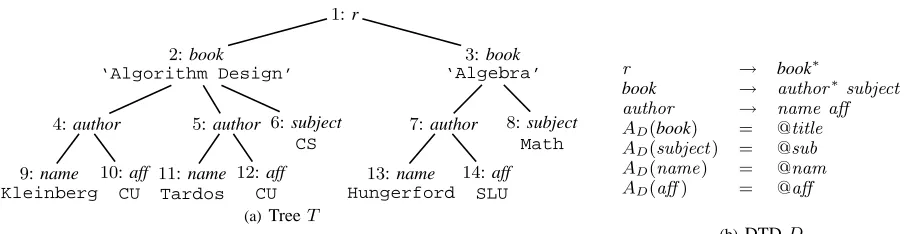
(b)DTDD Fig. 1. The XML treeT conforms toD
An XML tree is a finite rooted directed tree T = (N, G), whereN is the set of nodes andGis the set of edges, together with
1) a labeling functionλ:N →El;
2) attribute-value assignments, which are partial functions
ρ@a :N →Str for each@a∈Att; and
3) an ordering on the children of every node.
A DTD D over El with a distinguished symbolr (for the
root) and a set of attributesAttconsists of a mappingPDfrom
El to regular expressions over El− {r}, usually written as productionsℓ→eifPD(ℓ) =e, and a mappingAD fromEl
to2Attthat assigns a (possibly empty) set of attributes to each
element type. For notational convenience, we always assume that attributes come in some order, just like in the relational case: attributes in tuples come in some order so we can write
R(a1, . . . , an). Likewise, we shall describe an ℓ labeled tree
node withn attributes asℓ(a1, . . . , an).
A treeT conforms to a DTDD (written as T |=D) if its
root is labeled r, the set of attributes for a node labeledℓ is
AD(ℓ), and the labels of the children of such a node, read from left to right, form a string in the language of PD(ℓ).
A class of DTDs In this paper we consider a restriction on
DTDs called nested-relational DTDs [1], [6], a class of DTDs that naturally represent nested relational schemas such as the ones used by the Clio data-exchange system [27]. The reason for using them is that outside of this class, it is very easy to construct instances of XML data-exchange problems that will exhibit coNP-hardness of answering conjunctive queries (which are known to be tractable in practically all instances of relational data exchange), see [6].
A DTD D is non-recursive if the graph G(D) defined as
{(ℓ, ℓ′)|ℓ′ is mentioned in P(ℓ)} is acyclic. A non-recursive
DTD D is nested-relational if all rules ofD are of the form
l→˜l0. . .˜lm where all theli’s are distinct, and each˜li is one
ofli andli∗. From now on, unless otherwise noted, all DTDs
are assumed to be nested-relational. We also assume, without loss of generality, that the graphG(D)is not a directed acyclic graph (DAG) but a tree. (One can always unfold a DAG into a tree by tagging occurrences of element types with the types of their predecessors.)
EXAMPLE2.1. Figure 1(a) shows an example of an XML
tree. In the Figure, the node identifiers precede the correspond-ing labels of each node inT; we omit the attribute names and only show the attribute values of each node. In addition, Figure 1(b) shows an example of a nested relational DTD. Moreover, it is easy to see that the treeT of Figure 1(a) conforms toD.
III. Translations of schemas and documents
We now review the inlining technique [29], provide a precise definition of the translation, and show that it satisfies our
Re-quirements 1 and 2. The main idea of inlining is that separate
relations are created for the root and each element type that appears under a star, and other element types are inlined in the relations corresponding to their “nearest appropriate ancestor”. Each relation for an element type has an ID attribute that is a key, as well as (for non-root) a “parent-ID” attribute that is a foreign key pointing to the “nearest appropriate ancestor” of that element in the document. All the attributes of a given element type in the DTD become attributes in the relation corresponding to that element type when such a relation exists, or otherwise become attributes in the relation for the “nearest appropriate ancestor” of the given element type.
We begin with a formal definition of the nearest appropriate
ancestor for the element types used in D. Given a nested-relational DTD D= (PD, AD, r), we “mark” inG(D) each
element type that occurs under a star in PD. In addition,
we mark the root element type in G(D). Then, for a given
element typeℓ, we define the nearest appropriate ancestor of
ℓ, denoted by µ(ℓ), as the closest marked element type ℓ′ in the path from the root element to ℓin the graph G(D). The inlining schema generation is formally captured by means of
the procedure INLSCHEMA below.
EXAMPLE3.1. Consider again DTDDin Figure 1(b). The relational schema INLSCHEMA(D) is as follows:
Rr(rID)
Rbook(bookID,@title,rID,subID,@sub)
Rauthor(authID,bookID,nameID,afID,@nam,@aff)
Keys are underlined; we also have the following foreign keys:Rbook(rID)⊆F K Rr(rID)andRauthor(bookID)⊆F K
Procedure INLSCHEMA(D)
Input : A nested relational DTDD.
Output: A relational schemaSD and a set of integrity
constraints∆D
Set SD=∅ and∆D=∅
for each marked element type ℓofD:
add toSD a relationRℓ, with attributes:
attr(Rℓ) =
idℓ
AD(ℓ)
idµ(ℓ) | if ℓ6=r.
idℓ′ | µ(ℓ′) =ℓ, ℓ′ is not marked,
AD(ℓ′) | µ(ℓ′) =ℓ, ℓ′ is not marked.
endfor
for each relationRℓ inSD:
add to∆D the constraint stating thatidℓ is key ofRℓ
and, ifℓ6=r, the foreign key
Rℓ[idµ(ℓ)]⊆F KRµ(ℓ)[idµ(ℓ)].
endfor
add to ∆D the dependency (stating the uniqueness of the
root)
∀y¯∀zR¯ r(x,y¯)∧Rr(x′
,z¯)→x=x′
.
return (SD,∆D)
The following shows that our Requirement 1 is satisfied.
Proposition 3.2: For every nested relational DTD D, the output of INLSCHEMA(D) is an acyclic relational schema.
Shredding of XML documents: We now move to the
shredding procedure. Given the inlining INLSCHEMA(D) =
(SD,∆D)of a DTDD, and an XML treeT conforming toD,
we use the algorithm INLDOCto shred T into an instance of the relational schemaSDthat satisfies the constraints in ∆D. Let us first explain this translation by means of an example.
EXAMPLE3.3. Recall treeT from Figure 1(a) and DTDD
from Figure 1(b). Figure 2 shows relationsRbookandRauthor
in the shredding of T.
To present the algorithm, we define the nearest appropriate
ancestorµ(n)of a nodenof an XML documentT = (N, G)
that conforms to a DTD D, as follows. Mark each nodenof
T such that λ(n) is starred in D, as well as the root of T. Then µ(n)is the closest marked node n′
that belongs to the path from the root to n. In the following algorithm, and for
the remainder of the paper, we denote by idn the relational
element representing the node nof a treeT.
The following proposition shows our Requirement 2 is satisfied.
Proposition 3.4: Let D be a DTD, and T an XML tree such that T |=D. Then INLDOC(T, D) is an instance of the schema computed by INLSCHEMA(D).
Procedure INLDOC(T, D)
Input : A nested relational DTDD and an XML treeT
that conforms toD.
Output: A relational instance of the schema
INLSCHEMA(D).
for each marked nodenofT:
Letℓ be the label ofn; Add to the relation Rℓ ofI a
tuple that contains elements
idn
ρ@a(n) | @a∈AD(ℓ)
idµ(n) | ifℓ6=r
idn′ | µ(n′) =n, n′ is not marked.
ρ@a(n′) | µ(n′) =n,@a∈AD(λ(n′))and
n′
is not marked
where the identifiers and attributes values for each of the elementsidn′,idµ(n) andρ@a(n′)coincide with the position of the attributes foridλ(n′),idµ(ℓ) and
AD(λ(n′))ofR
ℓ.
endfor
returnI
IV. Relational and XML Data Exchange
We now quickly review the basics of relational data exchange and introduce XML schema mappings that guarantee tractable query answering.
Relational Data Exchange A schema mappingMis a triple
(S,T,Σ), where S is a source schema, T = (T,∆T) is a
target schema with a set of constraints ∆T, and Σ is a set
of source-to-target dependencies that specify how the source and the target are related. Most commonly these are given as source-to-target tuple generating dependencies (st-tgds):
ϕ(¯x)→ ∃¯z ψ(¯x,z¯), (1)
where ϕ and ψ are conjunctions of relational atoms over S
andT, respectively.
In data-exchange literature, one normally considers in-stances with two types of values: constants and nulls. Inin-stances S of the source schemaSconsist only of constant values, and nulls are used to populate target instancesT when some values are unknown.
An instanceT ofT(which may contain both constants and
nulls) is called a solution for an instance S of S under M,
or an M-solution, if every st-tgd (1) from Σ is satisfied by
(S,T)(that is, for each tuple ¯asuch that ϕ(¯a) is true in S, there is a tuple¯bsuch thatψ(¯a,¯b)is true inT).The set of all M-solutions forSis denoted by SOLM(S)(or SOL(S)isM is understood).
Certain answers and canonical universal solution The main
authID bookID nameID afID @nam @af
id4 id2 id9 id10 ’Kleinberg’ CU
id5 id2 id11 id12 ’Tardos’ CU
id7 id3 id13 id14 ’Hungerford’ SLU
(a) RelationRauthor in INLDOC(T, D)
bookID @title rID subID @sub
id2 ’Algorithm Design’ id1 id6 CS
id3 ’Algebra’ id1 id8 Math
(b) RelationRbookin INLDOC(T, D)
Fig. 2. Shredding ofT into INLSCHEMA(D)
a mappingM, we defineCERTAINM(Q,S)asT{Q(T)| T ∈ SOLM(S)}.
Building all solutions is impractical (or even impossible), so it is important to find a particular solutionT0∈SOLM(S), and a rewritingQrewrofQ, so thatCERTAINM(Q,S) =Qrewr(T0). Universal solutions were identified in [13] as the preferred
solutions in data exchange. Over them, every positive query can be answered, with a particularly simple rewriting: afterQ
is evaluated on a universal solutionT0, tuples containing null
values are discarded. Even among universal solutions there are ones that are most commonly materialized in data-exchange systems, such as the canonical solution CANSOLM(S),
com-puted by applying the chase procedure with constraintsΣand
∆T to the source instanceS. If all the constraints in∆T are acyclic (in fact, even a weaker notions suffices), such a chase
terminates and computes CANSOLM(S) in polynomial time
[13].
Note that our Requirement 4 relates universal solutions in relational and XML data exchange; in particular, we do not insist on working with the canonical solutions, and others, such as the core [14] or the algorithmic constructions of [26] can be used as well.
Towards XML schema mappings: patterns To define XML
schema mappings, we need the notions of schemas and source-to-target dependencies. The notion of schema is well under-stood in the XML context. Our dependencies, as in [6], [4], [3] will be based on tree patterns. Patterns are defined inductively as follows:
• ℓ(¯x)is a pattern, whereℓis a label, andx¯ is a (possibly empty) tuple of variables (listing attributes of a node); • ℓ(¯x)[π1, . . . , πk] is a pattern, where π1, . . . , πk are
pat-terns, andℓ andx¯are as above.
We writeπ(¯x)to indicate thatx¯is the tuple of all the variables used in a pattern. The semantics is defined with respect to a node of a tree and to a valuation of all the variables of a pattern as attribute values. Formally, (T, v)|=π(¯a) means thatπ is satisfied in nodev whenx¯is interpreted as¯a. It is defined as follows:
• (T, v)|=ℓ(¯a)if v is labeled ℓand its tuple of attributes is ¯a;
• (T, v)|=ℓ(¯a)[π1(¯a1), . . . , πk(¯ak)]if 1) (T, v)|=ℓ(¯a)and
2) there exist children v1, . . . , vk of v (not necessarily
distinct) so that(T, vi)|=πi(¯ai)for everyi≤k. We write T |= π(¯a) if (T, r) |=π(¯a), that is, the pattern is witnessed at the root.
EXAMPLE4.1. Consider treeT from Figure 1(a), and the tree pattern π(x, y) = r[book(x)[author[name(y)]]], which finds books together with the names of their authors. Then it
is easy to see thatT |=π(’Algorithm Design’,Tardos).
In fact, evaluation of π(x, y) over T returns the tuples
(’Algorithm Design’, Tardos), (’Algorithm Design’,
Kleinberg), and (’Algebra’,Hungerford).
Given a DTD D and a tree pattern π, we say that π is
compatible with D if there exists a tree T that conforms to
D and a tuple of attribute values ¯a such that T |= π(¯a). In general, checking compatibility of patterns with DTDs is NP-complete [10], but for the DTDs we consider here it can be easily done in polynomial time.
EXAMPLE4.2.[Example 4.1 continued] The patternπ(x, y)
is compatible with the DTD D of Figure 1(b). On the other
hand, the patternπ′
(x) =r[author(x)]is not, because no tree consistent withD can have a child ofr labeled as author, or
an author-labeled node with an attribute.
Remark More general patterns have been considered in the
literature [5], [25], [10], [4]; in particular, they may involve descendant navigation, wild cards for labels, and horizontal axes. However, [6], [4] showed that with these features added, query answering in data exchange becomes intractable even for very simple queries. In fact, the restrictions we use in our definition were identified in [6] as essential for tractability of query answering.
XML schema mappings As our descriptions of XML
schemas we shall use DTDs (since for complex schemas, query answering in data exchange is known to be intractable [6], and DTDs will suffice to capture all the known tractable cases). Source-to-target constraints will be given via patterns.
Formally, an XML schema mapping is a triple M =
(DS, DT,Σ), whereDSis the source (nested relational) DTD,
DT is the target (nested relational) DTD, and Σ is a set of
XML source-to-target dependencies [6], or XML stds, that are
expressions of the form
π(¯x)→π′(¯x,z¯), (2) whereπandπ′ are tree patterns compatible withD
S andDT,
As in the relational case, target trees may contain nulls to account for values not specified by mappings. Given a treeT
that conforms toDS, a treeT′(over constants and nulls) is an M-solution forT ifT′
conforms toDT, and the pair(T, T′)
satisfies all the dependencies (2) from Σ. The latter means
that for every tuplea¯of attribute values fromT, ifT satisfies
π(¯a), then there exists a tuple¯b of attribute values fromT′ such that T′ satisfies π′(¯a,¯b). The set of allM-solutions for
T is denoted by SOLM(T).
EXAMPLE 4.3. Consider the data-exchange scenario
(D, DT,M) given by the DTDsD and DT of Figures 1(b)
and 3(b), respectively, and where M is specified by the
dependency
r[book(x)[author[name(y)]]]→
r[writer[name(y), work(x)]],
that restructures book-author pairs as writer-work. It can be
shown that the XML treeT′ in Figure 3(a) is an M-solution
forT.
V. XML data exchange using relations
We now provide algorithms for implementing XML data exchange via relational translations. Since we have already shown how to translate DTDs and documents, we need to present translations of stds of mappings and queries. Both of them are based on translating patterns into relational conjunctive queries. We first concentrate on that translation. Then we show how to extend it easily to mappings and queries, and prove the correctness of the translations. This will complete our program of using a relational system for XML data exchange in a semantically correct way.
Inlining tree patterns: The key ingredient in our
al-gorithms is a translation of patterns π compatible with a
DTDDinto a conjunctive query INLPATTERN(π, D)over the relational schema INLSCHEMA(D). Very roughly, it can be viewed as this:
1) View a patternπ(¯x)as a treeTπ in which some attribute
values could be variables;
2) Compute the relational database INLDOC(Tπ, D)(which
may have variables as attribute values);
3) View INLDOC(Tπ, D) as a tableau of a conjunctive
query; the resulting query is INLPATTERN(π, D). The algorithm is actually more complicated because INLDOC cannot be used in Step 2; we shall explain shortly why.
Towards defining INLPATTERN, observe that each tree pat-tern π(¯x) can be viewed as an XML document Tπ(¯x), in
which both values and variables can be used as attribute values. It is defined inductively as follows: Tℓ(¯x) is a
single-node tree labeled ℓ, with x¯ as attribute values, and if π is
ℓ(¯x)[π1(¯x1), . . . , πk(¯xk)], then the root of Tπ is labeled ℓ
and has x¯as attribute values. It also has k children, with the subtrees rooted at them being Tπ1(¯x1), . . . , Tπk(¯xk).
However, even for a pattern π(¯x) compatible with a DTD
D, we may not be able to define its inlining as the inlining ofTπ(¯x), becauseTπ(¯x)need not conform toD. For example,
if a DTD has a rule r → ab and we have a pattern r[a], it is compatible with D, butTr[a] does not conform toD, as it
is missing ab-node. Hence, the procedure INLDOC cannot be used ‘as-is’ in our algorithm.
Nevertheless, we can still mark the nodes of Tπ(¯x) with
respect to D and define the nearest appropriate ancestor
exactly as it has been done previously. Intuitively, the proce-dure INLPATTERNshreds each node of Tπ(¯x) into a different
predicate, and then joins these predicates using the nearest appropriate ancestor.
Procedure INLPATTERN(π,D)
Input : A DTDD, a tree patternπ(¯x)compatible with
D.
Output: Conjunctive query over INLSCHEMA(D).
for each nodev ofTπ(¯x) of formℓ(¯xv):
Construct a queryQv(¯xv)as follows:
if v is marked then
Qv(¯xv):=∃idv∃idµ(v)∃zR¯ ℓ(idv,x¯v, idµ(v),z¯),
where¯zis a tuple of fresh variables, and the positions of variablesidv,x¯v andidµ(v) are
consistent with the attributesidℓ,AD(ℓ)and
idµ(ℓ)respectively in attr(Rℓ).
Ifℓ=r, thenQv does not useidµ(v).
else (v is not marked):
setv′
:=µ(v), ℓ′ :=λ(v′
), and letQv(¯xv)be
∃idv′∃idµ(v′)∃idv∃zR¯ ℓ′(idv′, idµ(v′), idv,¯xv,z¯), where¯zis a tuple of fresh variables, and the positions of the variablesidv′,idµ(v′),idv andx¯v are consistent with the attributesidℓ′,idµ(ℓ′),idℓ
andAD(ℓ)respectively in attr(Rℓ′). Ifℓ′=r, thenQv does not useidµ(v′).
endfor
returnV
v∈Tπ(¯x)Qv(¯xv).
Note that the compatibility of π with D ensures that
INLPATTERN is well defined. That is, (1) every attribute formula of the form ℓ(¯x) only mentions attributes in AD(ℓ), and (2) for all nodesv, v′∈T
π(¯x), if v′ is a child of v, then
λ(v′)∈PD(λ(v)).
Correctness: Given a patternπ(¯x), the evaluation ofπon
a treeTisπ(T) ={¯a|T |=π(¯a)}. The following proposition shows the correctness of INLPATTERN.
Proposition 5.1: Given a nested relational DTDD, a
pat-tern πcompatible with D, and a tree T that conforms toD,
we haveπ(T) = INLPATTERN(π, D) INLDOC(T, D). That is, the inlining ofπ, applied to the inlining ofT, returns
r
writer
name Tardos
work
’Algorithm Design’
writer
name Hungerford
work ’Algebra’
writer
name Kleinberg
work
’Algorithm Design’
(a)Target TreeT′
r → writer∗
writer → name work∗
AD(name) = @nam
AD(work) = @title
(b)Target DTDDT
Fig. 3. TreeT′is anM-solution forT
Conjunctive queries over trees: We use the language that
is essentially conjunctive queries over trees [6], [17], [10]
with navigation along the child axis. The language CT Q is
obtained by closing patterns under conjunction and existential quantification:
Q := π|Q∧Q| ∃x Q,
whereπis a fully specified tree-pattern formula. The semantics is straightforward, given the semantics of patterns defined above:Q(¯a)∧Q′
(¯b)is true iff bothQ(¯a)andQ′
(¯b)are true, and ∃x Q(¯a, x) is true iff Q(¯a, c) is true for some value c. The output of Qon a treeT is denoted byQ(T).
We say that a query Qis compatible with the DTD D if
every pattern used in it is compatible with D.
The inlining of queries Q compatible with D is given by
the recursive algorithm INLQUERYbelow.
Procedure INLQUERY(Q,D)
Input : A DTDD, a queryQcompatible with D.
Output: A conjunctive query over INLSCHEMA(D).
if Q=π then
return INLPATTERN(π, D)
else if Q=Q1∧Q2 then
return INLQUERY(Q1, D)∧INLQUERY(Q2, D)
else if Q=∃xQ1 then
return∃xINLQUERY(Q1, D)
Now we show that every queryQinCT Qcan be computed
by its inlining on the inlining of its input (assuming, of course, compatibility with a DTD). In other words, Requirement 3 is satisfied.
Theorem 5.2: Given a DTD D, a tree T that conforms to it, and a compatible queryQ, we have
Q(T) = INLQUERY(Q, D) INLDOC(T, D).
Inlining XML schema mappings We use our transformation
of tree patterns to define the procedure INLMAP, that, given
source and target DTDs DS and DT, transforms an XML
mapping M into a relational mapping INLMAP(M,DS,DT)
specified with a set of source-to-target tuple generating depen-dencies.
Correctness While one could be tempted to ask for a
transla-tion that preserves all solutransla-tions, such a result need not hold. The relational mapping INLMAPuses null values to represent the shredded nodes of XML trees, and thus we should only consider solutions whose null values have not been renamed. However, relational solutions are open to renaming of nulls.
Procedure INLMAP(M,DS,DT)
Input : An XML mappingMfrom a source DTD DS
to a target DTDDT.
Output: A relational mapping from INLSCHEMA(DS)
to INLSCHEMA(DT).
Set INLMAP(M, DS, DT):=∅
for dependencyπ(¯x)→ ∃zπ¯ ′
(¯x,z¯)inMdo
INLMAP(M, DS, DT) := INLMAP(M, DS, DT)S {INLQUERY(π, DS)(¯x)→ ∃z¯INLQUERY(π′, DT)(¯x,¯z)}
end
return INLMAP(M, DS, DT)
This intuition can be formalized by means of the universal solutions, which are the most general among all solutions, and thus do not permit null renaming. Furthermore, one typically materializes a universal solution, as these solutions contain all the information needed to compute certain answers of conjunctive queries. This motivates the restriction of our
Requirement 4 to universal solutions.
The theorem below shows that parts (a) and (b) of
Re-quirement 4 hold. Note that in part (b), relational universal
solutions are only required to contain a shredding of an XML universal solution. This is because relational solutions are also open to adding arbitrary tuples, which need not reflect a tree structure of an XML document.
Theorem 5.3: a) Let M = (DS, DT,Σ) be an XML
schema mapping andT an XML document that conforms to
DS. IfT′ is an M-universal solution forT, then its inlining
INLDOC(T′, DT)is an INLMAP(M, DS, DT)-universal
solu-tion for INLDOC(T, DS).
b) Let M = (DS, DT,Σ) be an XML schema mapping,
and T an XML document that conforms to DS. Then
for every INLMAP(M, DS, DT)-universal solution R for
INLDOC(T, DS)there exists anM-universal solutionT′such that INLDOC(T′, DT)is contained inR.
Answering XML queries using relational data exchange:
The semantics of query answering in data exchange, both relational and XML [13], [22], [8], [6], [4], is defined by means of certain answers. That is, given a schema mapping M= (DS, DT,Σ), a treeT that conforms toDS, and a
every possibleM-solution forT, that is,T {Q(T′
)|T′ is an M-solution forT}. Note that our queries return sets of tuples, so we can talk about the intersection operator.
It was shown in [6], [4] that, for conjunctive tree queries and mappings using nested-relational DTDs, computing certain
answers for a given source tree T is solvable in polynomial
time. Thus, for the classes of mappings and queries we consider, there is no complexity mismatch between relational and XML data exchange. The next theorem shows that our translation is correct with respect to query answering, that is, our Requirement 5 is satisfied.
Theorem 5.4: Let M= (DS, DT,Σ) be an XML schema
mapping. Then, for every XML tree T that satisfies DS and
for every conjunctive tree queryQ, the certain answers ofQ
forTunderMand the certain answers of INLQUERY(Q, DT)
for INLDOC(T, DS)over INLMAP(M, DS, DT)coincide:
CERTAINM(Q, T) =
CERTAININLMAP(M)(INLQUERY(Q, DT),INLDOC(T, DS)).
This result, combined with the standard procedure of evaluat-ing conjunctive queries in relational data exchange, also gives us an algorithm for computing certain answers.
Corollary 5.5: Under the conditions of Theorem 5.4, CERTAINM(Q, T)can be obtained by the following procedure: 1) run INLQUERY(Q, DT) on an INLMAP(M, DS, DT)
-universal solution for INLDOC(T, DS); 2) discard all tuples that contain null values.
VI. XML-to-XML Queries
Up to now, we have only considered XML queries that output tuples of attribute values. In this section, we shall focus on proper XML-to-XML query languages, that is, queries that output XML trees.
Some immediate questions arise when dealing with these formalisms in a data exchange context. LetM= (DS, DT,Σ)
be an XML schema mapping,T be a tree conforming toDS,
andQ be an XML-to-XML query. Since the evaluation ofQ
overT returns an XML tree, we cannot define certain answers
as T{Q(T′))|T′ is a solution forT}, since the meaning of the intersection operator for XML documents is not clear.
To overcome this problem, we use recent results from [11] which showed how to define certain answers for queries returning XML trees, and how to use them in the data exchange context. The key idea of [11] is to use tree patterns to define information contained in documents, and to use them to represent compactly the certain knowledge from the collection {Q(T′
))|T′
is a solution forT}. More precisely, ifΠis a set of tree patterns which are matched by every tree Q(T′
), we look for a small setΠ0of patterns that is equivalent toΠas a
description of certain answers. By equivalence we mean that a tree matches every pattern inΠiff it matches every pattern in
Π0. If the setΠ0is finite, then its patterns can be put together
to create a tree with nulls, which we then view as the certain answer.
We shall not need additional details of the construction; instead we shall use a result from [11] that tells us how certain answers can be computed for a specific XML-to-XML query language. The language, called TQL (to be defined shortly), is inspired by XQuery’s FLWR expressions, and is restricted to positive features (i.e., no negation). The key result from [11] is the following:
Proposition 6.1 ([11]): LetM= (DS, DT,Σ)be an XML
schema mapping, Q a TQL query, and T a tree that
con-forms to DS. If T′ is an M-universal solution for T, then CERTAINM(Q, T) =Q(T′).
Given this result, we now do the following. We provide a formal definition of the TQL language of [11], which can express XML-to-XML analogs of relational conjunctive queries. We then show how to adapt the machinery we have previously developed for evaluating certain asnwers over a universal solution. Note that for this new translation, a TQL
query Q returning trees needs to be translated into a set of
relational queries generating views that define the shredding of the treeQ(T).
A. TQL queries
TQL queries [11] are inspired by the FLWR (for-let-where-return) expressions of XQuery [32], but they only use positive features. The key construct is for π(¯x) return q(¯x), where
π(¯x) is a pattern and q(¯x) is a query that defines a forest expression. Formally, the syntax of forest expressions is
q(¯x) ::= ǫ
| ℓ(¯a,x¯′
)[q′
(¯x′′
)] | q′
(¯x′
), q′′
(¯x′′
)
| forπ(¯a,x,¯ y¯)returnq′
(¯x,y¯)
where ℓ ranges over node labels, ¯a over constant attribute
values, and x¯etc are tuples of variables.
A TQL query Qis an expression of the form r[q], where
q is a forest expression without variables. To define the
semantics of this language, we first define inductively the forest [[q(¯x)]]T,v, for a valuation v of all variables in x¯ as attribute values. We use the notationℓ(¯a)[f]for a tree whose root is labeledℓ and carries a tuple of attributes¯a, and f is the forest of subtrees below the root.
[[ǫ]]T,v = ǫ(empty forest) [[ℓ(¯a,x¯′
)[q′
(¯x′′
)]]]T,v = ℓ(¯a, v(¯x′
)) [[q′
]]T,v [[q′
(¯x), q′′
(¯x′′
)]]T,v = [[q′
]]T,v∪[[q′′
]]T,v
[[forπ(¯a,x,¯ y¯)return q′
(¯x,y¯)]]T,v =
[
[[q′]]T,v′ |v ′
extendsv andT |=π(¯a, v′(¯x), v′(¯y))
For a tree T and a query Q= r[q], the evaluation Q(T) of
Q over T is defined as the tree r[[[q]]T], i.e., the forest[[q]]T
under rootr.
EXAMPLE6.2. Recall the tree T from figure 1(a). The tree
Q(T) resulting from the evaluation of a TQL query Q over
T, whereQ=r[q], andq is defined as
forr/book(x)/author/name(y)return
writer[name(y),work(x)] (3)
For the sake of readability, we use the / operator to denote
the child axis in tree patterns.
B. Inlining TQL queries
If Q is a TQL query, then, to be able to define its inlining
translation, we need to specify a DTD for trees Q(T). Note that TQL queries define the shape of their outputs, and at the same time do not put restrictions on the number of appearances of labels. Hence it is natural to define the DTD for outputs of
Q as a starred DTD DQ, whose shape is determined by Q,
and where each element type except the root occurs under the Kleene star.
More precisely, for a forest expressionq, we define a forest
Fq inductively as follows: Fε is the empty forest; Fℓ[q′] is
ℓ[Fq′]; Fq′∪q′′ = Fq′ ∪Fq′′, and Fforπ return q′ = Fq′. For
Q=r[q] we letTQ=r[Fq].
Then DQ is a non-recursive DTD that has a rule p →
c∗
1· · ·c
∗
n for each node p in TQ with children labelled
c1, . . . , cn. As usual, we require that DQ be acyclic and we
assume without loss of generality thatG(DQ)is a tree.
EXAMPLE 6.3.[Example 6.2 continued] Recall query
Q = r[q]. Then, TQ is the XML tree given by
r[writer[name,work]], and thus DQ contains productions r → writer∗, writer → name∗work∗
, name → ǫ and
work →ǫ.
Before showing the algorithm INLTQL, we need to
introduce some features that will be used in the
algo-rithm. Consider again query (3) and DTD DQ in
exam-ples 6.2 and 6.3. For each pair of attributes that satisfy
r/book(x)/author/name(y), the query Q creates a subtree
writer[name(y),work(x)] in the tree Q(T). Thus, the re-lational translation would need to create one tuple in the relations corresponding to writer, name and work for each pair of attributes x, y that satisfy the relational translation of the pattern r/book(x)/author/name(y) in the instance INLDOC(T).
Thus, in the relational translation we need a way to associate each particular writer wih a particular name and work. One possible way of doing this is by creating a (Skolem) functionf
that associates with each pair(name,work)a unique identifier
for the corresponding writer. Thus, the function f must be
defined in such a way thatf(book,name)is different for each different pair (name,work). We enforce this requirement by letting each term f(¯a)represent a distinct constantcf(¯a).
We will define our translation algorithm inductively. The
key procedure TQLSTEP for the inductive step is described
below. Its inputs, in addition to a query and a DTD, include a conjunctive query corresponding to the conjunction of patterns in the query, and a function term corresponding to the parent in
the treeQ(T)(for example, when creating views for relation
Rwork, we would input the identifierf(x, y)of the parent node
labelled writer). This is illustrated by the example below. EXAMPLE6.4.[Example 6.3 continued] Assume that query
Q = r[q] of examples 6.2 and 6.3 is posed over T under
schemaD. The following views define the translation forQ:
Rr(fr):=true
Rwriter(fwriter(x, y), fr):=
INLQUERY(r/book(x)/author/name(y), D)
Rname(fname(x, y), fwriter(x, y), y):=
INLQUERY(r/book(x)/author/name(y), D)
Rwork(fwork(x, y), fwriter(x, y), x) :=
INLQUERY(r/book(x)/author/name(y), D)
Notice how each tuple in relationsRname andRwork is set
to reference the correct tuple in relationRwriter.
Procedure TQLSTEP(Q,D,ϕ,t)
Input : A forest expressionq(¯x), a DTDD, a
conjunctive queryϕ(¯x)and a skolem termt.
Output: A set of views over INLSCHEMA(DQ).
ifq(¯x) ::=ǫthen
return ∅
else ifq(¯x) ::=q′
(¯x′
), q′′
(¯x′′
)then
return TQLSTEP(q′, D, ϕ, t)∪TQLSTEP(q′′, D, ϕ, t)
else ifq(¯x) ::=ℓ(¯a,x¯′
)[q′
(¯x′′
)] then
Letf be a fresh skolem function. Define viewV as
Rℓ(f(¯x), t,¯a,¯x′
) :=INLQUERY(ϕ, D), or just
Rℓ(f(), t,a¯) :=trueif ϕ=∅.
return {V} ∪TQLSTEP(q′, D, ϕ, f(¯x))
else ifq(¯x) ::=forπ(¯a,x,¯ y¯)return q′
(¯x,y¯)then
Letϕ′
(¯a,x,¯ y¯) =ϕ(¯x)∧π(¯a,¯x,y¯).
return TQLSTEP(q′, D, ϕ′, t)
To define the inlining translation INLTQL, we simply need a Skolem term for the root of the tree, as the basis for the
inductive procedure TQLSTEP.
Procedure INLTQL(Q,D)
Input : A TQL queryQ=r[q] and a DTD D.
Output: A set of views over INLSCHEMA(DQ).
Create a 0-ary functionfr.
return TQLSTEP(Q, D,∅, fr())
A TQL query Q is compatible with a DTD D if all the
patterns used in Q are compatible with D. The following
proposition shows that INLTQL satisfies an analog of
require-ment 3 for queries that outputs trees.
Proposition 6.5: Given a DTDD, a TQL queryQ compat-ible withD, and and a treeTthat conforms toD, we have that INLDOC(Q(T), DQ) = INLTQL(Q, D)(INLDOC(T)), up to renaming of nulls.
Translating relations back into XML
To complete the translation, we need an algorithm to publish back the relational data as an XML document. This is done by means of the algorithm PUBREL. We say that an instance
I of INLSCHEMA(D)D-represents a treeT that conforms to
D if I=INLDOC(T, D).
Procedure PUBREL(D,I)
Input : A DTDD and an instance I thatD-represents
some tree.
Output: An XML tree T that isD-represented by I.
for each nodeℓofG(D), traversed as Depth-first-search
do
for each tupletofRℓ inI with elementsn,a¯andn′
corresponding to attributesidn,AD(ℓ)andidµ(n).
do
Add toT a nodenlabelled ℓ, with attributesa¯, whose parent isn′ (no parent ifℓ=r);
for every non-starred nodeℓ′
ofG(D)such that
µ(ℓ′
) =ℓ, and elements n′′
and¯b int
corresponding to attributesidℓ′ andAD(ℓ′)do Create a noden′′
inT labelledℓ′ , with attributes¯b, in a parent-child scheme that resemblesG(D).
endfor endfor endfor
return T
This algorithm will only work for relational instances that represent shredded documents. The following proposition shows its correctness.
Proposition 6.6: Given a DTD D and a relational
instance I of INLSCHEMA(D), it is the case that
INLDOC(PUBREL(D, I)) =I.
C. TQL queries in XML data exchange
Combining the previously mentioned result in [11] with the correctness of the algorithms we presented we conclude that
requirements 1-5 are satisfied for data exchange with
XML-to-XML queries:
Theorem 6.7: Let M= (DS, DT,Σ) be an XML schema
mapping. Then, for every XML tree T that satisfies DS and
for every TQL query Q, the certain answers of Q for T
under M and the certain answers of INLTQL(Q, DT) for
INLDOC(T, DS)over INLMAP(M, DS, DT)coincide:
INLDOC(CERTAINM(Q, T), DQ) =
CERTAININLMAP(M)(INLTQL(Q, DT),INLDOC(T, DS)).
Remark: The notion of certain answers naturally
(component-wise) extends to queries computing multiple relations.
Theorem 6.7 and Proposition 6.6 give us a way
of computing CERTAINM(Q, T). First, compute
CERTAININLMAP(M)(INLTQL(Q, DT),INLDOC(T, DS))by
materializing views INLTQL(Q, DT) over the canonical
solution for INLDOC(T, DS) and then use the procedure
PUBREL to output it as the tree CERTAINM(Q, T).
VII. Adding XML constraints
So far, we assumed that target schemas consist of DTDs only; now we extend them with target constraints. Constraints have been studied and used extensively in the XML context.
Analogs of keys and foreign keys such asIDandIDREFare
very common. Thus, it is natural to ask whether our procedures continue to work when target schemas are augmented with such constraints. Here we look at keys and foreign keys that naturally extend the functionality ofIDandIDREF:
• A keyℓ.@a→ℓ states that the value of the attribute@a uniquely determines an ℓ-labeled node;
• a foreign key ℓ1[@a] ⊆F K ℓ2[@b]states that each value of the @a attribute of anℓ1-node must occur as a value
of the@battribute of an ℓ2-node, and the latter is a key
forℓ2.
We now show how to translate XML keys and foreign keys into relational integrity constraints in a way that preserves the satisfaction of the key requirements. Recall that we use the assumption that graphs of DTDs are trees.
Procedure INLCONSTR(∆,D)
Input : A DTDD, a set of keys and foreign keys∆.
Output: A set of relational keys and foreign keys.
Set INLCONSTR(∆, D) =∅
for each key@a→ℓin∆:
add to INLCONSTR(∆, D)the key@a→Rℓ if ℓis
marked, or the key @a→Rµ(ℓ) if ℓis not marked.
endfor
for each foreign keyℓ1[@a]⊆F K ℓ2[@b] in∆
Add to INLCONSTR(∆, D) the foreign key
Rℓ1[@a]⊆F K Rℓ2[@b], replacingRℓi forRµ(ℓi) if ℓ1
orℓ2 are not marked.
endfor
return INLCONSTR(∆, D)
Using INLCONSTR, we extend the procedure INLMAP for
the case of schema mappings with target constraints∆T in a
way that retains its good properties. This is formalized in the procedure EXTINLMAPbelow.
Procedure EXTINLMAP(M,DS,DT,∆T)
Input : An XML mappingMfrom a source DTD DS
to a target DTDDT with a set of target
constraints∆T.
Output: A relational mapping from INLSCHEMA(DS) to
INLSCHEMA(DT) with a set of target
constraints.
return INLMAP(M, DS, DT), and the set of constraints
Proposition 7.1: For XML data-exchange settings that
in-clude a set∆of XML keys and foreign keys, the extensions of procedure INLMAPand INLQUERYusing INLCONSTR(∆, D)
satisfy our Requirement 4 and Requirement 5, respectively. Unlike in other results in the paper, the restriction to DTDs whose graphs are trees is essential here: Without such a restriction, a foreign key can be translated into a disjunctive tgd, and those are known to lead to intractability in data-exchange scenarios [12].
VIII. Concluding Remarks
Our technique provides a relational approach to solve two of the most important problems of XML data-exchange settings: materializing solutions and answering queries. The diagram below summarizes this. In a pure XML setting, we can start
with a documentT and use a mappingMto find a (universal)
solution T′
univ, over which we can then answer a query Qto
produce certain answers.
T M - T′
univ
Q
- certain answer
R
INLDOC
? I
NLMAP(M)
- R′ univ
INLDOC
?
INLQUERY(Q)
- certain answer
w w w w w w w w w w
Using the translation INLDOCof documents, we generate a relational instanceR, on which the translation of the mapping INLMAP(M)generates a universal solutionR′
univ. This solu-tion is a shredding, via INLDOC, of a universal XML solution, and also conforms to the shredding of source DTD. Finally, we apply the standard technique [13] for evaluating queries in re-lational data exchange to the query translation INLQUERY(Q)
or INLTQL(Q) to produce the correct answers, in the latter case with the possibility of using PUBRELto publish back the results into XML.
We finish with a remark about the possibility of allowing
operators ? and + in DTDs, as well as a choice operator
for representing multiple choices. We say that a non-recursive
DTDD is an extended nested relational DTD if all rules of
D are of the formℓ→ℓ˜0. . .ℓ˜m, orℓ→ℓ0+. . .+ℓm, where
all the ℓi’s andℓ˜i’s are distinct, and eachℓ˜i is one of ℓi,ℓi?,
ℓ∗
i orℓ+i (as usualℓ?stands forℓ|ǫ andℓ+ forℓℓ
∗ ).
The procedure INLSCHEMAcan be extended to these DTDs.
For each element ℓ that is under the operator?, the transfor-mation creates a special relation ℓthat references the relation
of the nearest appropriate ancestor of ℓ. Furthermore, the
transformation for a rule of the form ℓ1→ℓ+2 can be defined
by including a dependency that ensures that there is at least one tuple in the relationRℓ2 for each tuple inRℓ1. Finally, for
the choice operatorℓ→ℓ0+. . .+ℓmthe transformation would
create one relationRℓ for each possible choice ofℓ0, . . . , ℓm.
Then, it is possible to extend all the procedures in a way that still satisfies requirements 1-5 under extended nested relational DTDs.
References
[1] S. Abiteboul, L. Segoufin and V. Vianu. Representing and querying XML with incomplete information. TODS, 31(1) (2006), 208-254 [2] F. Afrati, C. Li, V. Pavlaki. Data exchange in the presence of arithmetic
comparisons. In EDBT 2008, pages 487-498.
[3] S. Amano, C. David, L. Libkin, F. Murlak. On the tradeoff between mapping and querying power in XML data exchange. In ICDT 2010. [4] S. Amano, L. Libkin, F. Murlak. XML schema mappings. In PODS
2009, pages 33-42.
[5] S. Amer-Yahia, S. Cho, L. Lakshmanan, D. Srivastava. Tree pattern query minimization. VLDB J. 11 (2002), 315–331.
[6] M. Arenas, L. Libkin. XML data exchange: consistency and query answering. J. ACM 55(2): (2008).
[7] A. Balmin and Y. Papakonstantinou. Storing and querying XML data using denormalized relational databases. VLDB J., 14:30–49, 2005. [8] P. Barcel´o. Logical foundations of relational data exchange. SIGMOD
Record 38(1): 49–58 (2009).
[9] P. A. Bernstein, S. Melnik. Model management 2.0: manipulating richer mappings. SIGMOD’07, pages 1-12
[10] H. Bj¨orklund, W. Martens, T. Schwentick. Conjunctive query contain-ment over trees. In DBPL 2007, pages 66-80.
[11] C. David, L. Libkin, F. Murlak. Certain answers for XML queries. In
PODS 2010, pages 191-202.
[12] A. Deutsch, V. Tannen. Reformulation of XML queries and constraints. In ICDT’03, pages 225–241.
[13] R. Fagin, P. G. Kolaitis, R. Miller, L. Popa. Data exchange: semantics and query answering. TCS 336(1): 89–124 (2005).
[14] R. Fagin, P. G. Kolaitis, and L. Popa. Data exchange: getting to the core.
ACM TODS 30(1):174–210, 2005.
[15] D. Florescu, D. Kossman. Storing and querying XML data using a RDBMS IEEE Data Engineering Bulletin 22(3): 27–34, 1999. [16] A. Fuxman, M. Hern´andez, H. Ho, R. Miller, P. Papotti, L. Popa. Nested
mappings: schema mapping reloaded. VLDB’06, pages 67-78. [17] G. Gottlob, C. Koch, K. Schulz. Conjunctive queries over trees. JACM
53(2): 238-272, 2006.
[18] G. Gou and R. Chirkova. Efficiently querying large XML data reposi-tories: A survey. IEEE TKDE, 19:1381–1403, 2007.
[19] M. Hern´andez, H. Ho, L. Popa, A. Fuxman, R. Miller, T. Fukuda, P. Papotti. Creating nested mappings with Clio. In ICDE 2007. [20] H. V. Jagadish, S. Al-Khalifa, A. Chapman, L. Lakshmanan, A. Nierman,
S Paparizos, J. Patel, D. Srivastava, N. Wiwatwattana, Y. Wu, C. Yu. TIMBER: A native XML database. VLDB J. 11 (2002).
[21] N. Klarlund, T. Schwentick, D. Suciu. XML: model, schemas, types, logics, and queries. In Logics for Emerging Appl. of Databases 2003. [22] Ph. Kolaitis. Schema mappings, data exchange, and metadata
manage-ment. In PODS 2005, pages 61-75.
[23] R. Krishnamurthy, R. Kaushik, J. F. Naughton. XML-to-SQL query translation literature: the state of the art and open problems. In XSym’03. [24] R. Krishnamurthy, R. Kaushik, and J. Naughton. XML views as integrity
constraints and their use in query translation. In ICDE’05.
[25] L. Lakshmanan, G. Ramesh, H. Wang, Z. Zhao. On testing satisfiability of tree pattern queries. VLDB 2004, pages 120–131.
[26] G. Mecca, P. Papotti, S. Raunich. Core schema mappings. In SIGMOD
2009, pages 655-668.
[27] R. Miller, M. Hern´andez, L. Haas, L. Yan, H. Ho, R. Fagin, L. Popa. The Clio project: managing heterogeneity. SIGMOD Record. 30 (2001). [28] L. Popa, Y. Velegrakis, R. Miller, M. Hern´andez, R. Fagin. Translating
Web data. In VLDB 2002, pages 598–609.
[29] J. Shanmugasundaram, K. Tufte, C. Zhang, G. He, D.J. DeWitt, J.F. Naughton. Relational databases for querying XML documents: limitations and opportunities. In VLDB 1999, pages 302-314. [30] J. Shanmugasundaram, E. Shekita, J. Kiernan, R. Krishnamurthy, S.
Vi-glas, J. Naughton, and I. Tatarinov. A general techniques for querying XML documents using a relational database system. SIGMOD Record, 30:20–26, 2001.
[31] I. Tatarinov, et al. Storing and querying ordered XML using a relational database system. In SIGMOD’02, pages 204–215.
[32] XQuery 1.0: An XML Query Language. http://www.w3.org/TR/xquery. [33] C. Yu, L. Popa. Constraint-based XML query rewriting for data
integration. In SIGMOD 2004, pages 371-382.