PLAN
Conducting
Full Spectrum
Operations
I think the time has come when we should attempt the boldest moves, and my experience is that they are easier of execution than more timid ones...
Major General William Tecumseh Sherman
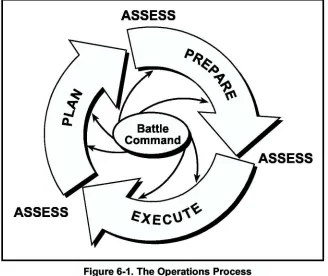
6-1. While differing dra-matically in their par-ticulars, full spectrum operations follow a cycle of planning, preparation, execution, and continu-ous assessment. These cyclic activities are se-quential but not discrete; they overlap and recur as circumstances de-mand. As a whole, they make up the operations process. Battle command drives the operations process (see Figure 6-1, page 6-2). Army forces design and conduct op-erations to win on the offensive; dictate the terms of combat and avoid fighting the enemy on his terms; seize and retain the initiative; and
build momentum quickly to win decisively.
CONTENTS
Plan 6-1
Operational and Tactical Planning 6-3
Phasi ng 6-4
Branches and Sequels 6-5 Concept of Operations 6-5
Risk Management 6-6
Orders 6-6
Prepare 6-6
Staff Preparation 6-7
Unit Preparation 6-7
Individual Preparation 6-7
Rules of Engagement 6-7
Execute 6-9
Seize and Retain the Initiative 6-9 Build and Maintain Momentum 6-10
Exploit Success 6-12
Combine Decisive, Shaping, and
Sustaining Operations 6-13 Complex Operational Considerations.. 6-17 Follow-On Operations 6-20
Assess 6-22
6-2. The commander's intent and planning guidance direct the activities of the staff and subordinate commanders. The staff assists the commander with the coordination and detailed analysis necessary to convert the planning guidance and commander's intent into a plan. The plan becomes a common reference point for operations (see FM 5-0).
maximizes opportunities. It guides subordinates as they progress through each phase of the operation. Any plan is a framework from which to adapt, not a script to be followed to the letter. The measure of a good plan is not whether execution transpires as planned but whether the plan facilitates effective action in the face of unforeseen events. Good plans foster initiative.
ASSESS
ASSESS
Figure 6-1. The Operations Process
6-4. Scope, complexity, and length of planning horizons differ between opera-tional and tactical planning. Campaign planning coordinates major actions across significant periods. Planners mesh service capabilities with those of joint and multinational formations as well as interagency and
nongovern-mental organizations. Tactical planning has the same clarity of purpose as operational planning, but has a shorter planning horizon. Comprehensive, continuous, and adaptive planning characterizes successful operations at both the operational and tactical levels.
6-5. Plans specify what commanders will decide personally. In the offense, for example, commanders normally decide when to commit the reserve. In a tense stability operation, the commander may decide the exact positions of tactical elements. Regardless of echelon, commanders identify those informa-tion requirements they consider most important to their decisions--the com-mander's critical information requirements (CCIR). These are typically in-formation requirements that help them confirm their vision of the battlefield or identify significant deviations from it. The staff incorporates CCIR into the appropriate parts of the plan and passes them to subordinate units.
delivering weapons of mass destruction (WMD) wherever located, no matter what their mission at the time. Some operations require tight control over subordinate elements. However, commanders ensure that plans remain as flexible as possible and impose the minimum control required for mission success. Commanders encourage subordinates to seize the initiative through plans and directions that provide guidance concerning opportunity.
6-7. German Field Marshal Helmuth von Moltke (victor in the Franco-Prus-sian war of 1870) observed that "no plan...extends with any degree of cer-tainty beyond the first encounter with the main enemy force." This is as true today as it was more than a century ago. Moltke's dictum, rather than con-demning the value of planning, reminds commanders and staffs of the rela-tionship between planning and execution during operations. The purpose of any plan is to establish the conceptual basis for action. The plan provides a reasonably accurate forecast of execution. However, it remains a starting point, not the centerpiece of the operation. As GEN George S. Patton Jr. cau-tioned, ".. .one makes plans to fit circumstances and does not try to create cir-cumstances to fit plans. That way danger lies."
OPERATIONAL AND TACTICAL PLANNING
6-8. Planning is dynamic and continuous (see JP 5-0). Operational-level plan-ning focuses on developing plans for campaigns, subordinate campaigns, and major operations. Combatant commanders develop theater campaign plans to accomplish multinational, national, and theater strategic objectives. Subor-dinate unified commands typically develop subordinate campaign plans or operation plans that accomplish theater strategic objectives. Joint task force (JTF) commanders may develop subordinate campaign plans if the mission requires military operations of sufficient scope, size, complexity, and dura-tion. Land component commanders normally develop plans for major opera-tions that support the campaign plan.
6-9. In major operations, Army force commanders choose to accept or decline battle, decide what use to make of tactical successes and failures, and advise joint force commanders (JFCs) on the long-term needs and prospects of their operations. Since campaign plans generally set a series of long-term objec-tives, they often require phases. Therefore, a campaign plan normally pro-vides a general concept of operations for the entire campaign and a specific operation order for the campaign's initial phase. Planning for major opera-tions mirrors planning for the overall campaign but is reduced in scope. Even if a major operation is not the initial phase of a campaign, planning for it as a branch or a sequel may begin long before actual execution.
6-11. Brevity is essential; so is speed. Staffs must avoid consuming too much time developing lengthy plans that contain irrelevant details. When plans arrive late, subordinate units can only react. To save time and shorten plans, commanders and staffs anticipate support requirements and forecast options. Headquarters at each level plan in parallel with higher and lower headquar-ters. Parallel planning expedites the exchange of information among head-quarters and should be used as much as possible. Commanders exploit tech-nology to increase situational understanding and speed of planning.
Change of Plans at Normandy
On 6 June 1944, Army forces executed Operation Overlord, an air and sea invasion of Western Europe. VII Corps planned an assault on Utah Beach by the 4th Infantry Division along with predawn airborne drops by the 82d and 101st Airborne Divisions. Like most D-Day operations, events proceeded differently than planned.
Upon execution, the airborne units were scattered across the French countryside with some units forming quickly while others grouped into small, isolated pockets. Regardless, airborne troops pressed on to their objectives or fought where they were, creating disorder among the defenders.
The 4th Infantry Division landed at Utah Beach where, of four beach control vessels guiding the force, one broke down and two others were sunk. The remaining vessel guided the landing force to the beaches, but they arrived south of their designated areas. BG Theodore Roosevelt Jr., the assistant division commander, made a personal reconnaissance and realized that the original plan must change. He returned to the landing site and ordered the two infantry batta-lions to advance inland instead of realigning onto the original amphibious landing sites, a decision that was executed without confusion. Changing plans fit the circumstances, and the 4th Infantry Division successfully pressed the fight inland.
6-12. There are two doctrinal planning procedures (see FM 5-0). In units with a formally organized staff, the military decision making process helps com-manders and staffs develop estimates, plans, and orders. It provides a logical sequence of decision and interaction between the commander and staff. The military decision making process provides a common framework for all staffs that supports the maximum use of parallel planning. At the lowest tactical echelons, commanders do not have a staff. Consequently, commanders and leaders follow the troop leading procedures. Both procedures hinge on the commander's ability to visualize and describe the operation. Both are means to an end: their value lies in the result, not the process.
PHASING
6-14. If Army forces lack the means to overwhelm an enemy in a single si-multaneous operation, then commanders normally phase the operation. A phase is a period when a large portion of the force conducts similar or mutu-ally supporting activities. Operations link successive phases. Individual phases gain significance only in the larger context of the campaign or major operation. Each phase should strive for simultaneity in time, space, and pur-pose. In this way, commanders combine simultaneous operations within phases while sequencing operations to achieve the end state.
6-15. Links between phases and the requirement to transition between phases are critically important. Commanders establish clear conditions for how and when these transitions occur. Although phases are distinguishable to friendly forces, the operational design conceals these distinctions from op-ponents through concurrent, complementary joint and Army actions.
BRANCHES AND SEQUELS
6-16. Operations never proceed exactly as planned. An effective design places a premium on flexibility. Commanders incorporate branches and sequels into the operational design to gain flexibility. Visualizing and planning branches and sequels are important because they involve transition--changes in mission, in type of operation, and often in forces required for execution. Unless planned and executed efficiently, transitions can reduce the tempo of the operation, slow its momentum, and cede the initiative to the adversary.
6-17. A branch is a contingency plan or course of action (an option built into the basic plan or course of action) for changing the mis-sion, disposition, orientation, or direction of movement of the force to aid success of the current operation, based on anticipated events, opportunities, or disruptions caused by enemy actions. Army forces prepare branches to exploit success and opportunities, or to counter disruptions caused by enemy actions. Commanders anticipate and devise counters to enemy actions. Although anticipating every possible threat action is impossible, branches anticipate the most likely ones. Commanders execute branches to rapidly respond to changing conditions.
6-18. Sequels are operations that follow the current operation. They are future operations that anticipate the possible outcomes-success, failure, or stalemate---of the current operation. A counteroffensive, for example, is a logical sequel to a defense; exploitation and pursuit follow suc-cessful attacks. Executing a sequel normally begins another phase of an op-eration, if not a new operation. Commanders consider sequels early and re-visit them throughout an operation. Without such planning, current operations leave forces poorly positioned for future opportunities, and leaders are unprepared to retain the initiative. Both branches and sequels should have execution criteria, carefully reviewed before their implementation and updated based on assessment of current operations.
CONCEPT OF OPERATIONS
maneuver and concept of fires. The concept of operations expands the commander's selected course of action and expresses how each element of the force will cooperate to accomplish the mission. Where the commander's intent focuses on the end state, the concept of operations focuses on the method by which the operation uses and synchronizes the bat-tlefield operating systems (BOS) to translate vision and end state into action. Commanders ensure that the concept of operations is consistent with both their intent and that of the next two higher commanders.
RISK MANAGEMENT
ORDERS
PREPARE
6-20. Risk management is the process of identifying, assessing, and controlling risk arising from operational factors, and making an in-formed decision that balances risk cost with mission benefits. It pro-vides leaders with a systematic mechanism to identify risk associated with a course of action during planning (see FM 3-100.14; FM 5-0). Commanders in-tegrate risk management into all aspects of the operations process. During planning, commanders identify, assess, and weigh risks. They convey risk considerations as guidance. Risk guidance affects course of action develop-ment. It also affects application of some elements of operational design, such as end state, designation of objectives, and lines of operation. Risk manage-ment also influences task organization; control measures; and the concepts of operations, fires, and CSS. During execution, assessment of risk assists com-manders in making informed decisions regarding changes to task organiza-tion, shifting priorities of effort and support, and shaping future operations. Effective risk management results in mission accomplishment at least cost.
6-21. Orders translate plans into execution. When possible, commanders is-sue them personally, face- to- face. If this is not possible, a video teleconference or other communication means can substitute. Commanders allow their sub-ordinates maximum freedom of action, providing mission-type orders when-ever practical. Mission-type orders specify what to do and the purpose for doing it, without prescribing how to do it (see FM 6-0). Control measures should aid cooperation among forces without imposing needless restrictions on their freedom of action.
STAFF PREPARATION
6-23. Each staff section and element conducts activities to maximize the op-erational effectiveness of the force. Coordination between echelons and preparation that precedes execution are just as important, if not more impor-tant, than developing the plan. Staff preparation includes assembling and continuously updating estimates. For example, continuous intelligence preparation of the battlefield (IPB) provides accurate situational updates for commanders when needed. Whether incorporated into a formal process or not, the preparatory activities of staff sections and force elements inform planning and continue throughout preparation and execution. Updated esti-mates form the basis for staff recommendations; the value of current, rea-sonably accurate estimates increases exponentially with tempo.
UNIT PREPARATION
6-24. Warfighting skills developed and honed in training form the base of mission success. Without the Army's ability to fight and win, commitment of its units to a theater would entail unacceptable risks. Combat-ready units can adapt readily to noncombat situations; units not trained to standard can-not survive in combat situations. The knowledge, discipline, cohesion, and technical skill necessary to defeat an enemy are also fundamental for success in environments that seem far removed from the battlefield. The combat ca-pability of Army forces is the basis for all it does. In a stability operation, the threat of force may deter escalation. In a support operation, it may preempt violence and lawlessness.
6-25. The tempo may not allow commanders to withdraw entire formations for extensive reorganization and training. However, Army unit modularity lets commanders designate some elements for training while the rest of the force continues the mission. This concurrent training may take place in thea-ter-designated training areas, where units receive intensified maintenance support while conducting individual and collective training. The creation of training areas is both necessary and a challenge for Army commanders.
INDIVIDUAL PREPARATION
6-26. Before the force deploys, soldiers prepare for overseas action. Army units frequently receive augmentation and replacements during preparation for deployment. Commanders pay special attention to the reception and preparation of these soldiers and to integrating their families into support groups. In addition to preparing replacements for deployment, commanders ensure that gaining units rapidly assimilate them as team members.
RULES OF ENGAGEMENT
effective ROE are responsive to the mission and permit subordinate com-manders to exercise initiative when confronted by opportunity or unforeseen circumstances.
6-28. In all operations, whether using lethal or nonlethal force, ROE may im-pose political, practical, operational, and legal limitations upon commanders. Commanders factor these constraints into planning and preparation as early as possible. Withholding employment of particular classes of weapons and ex-empting the territory of certain nations from attack are examples of such limitations. Tactically, ROE may extend to criteria for initiating engagements with certain weapons systems (for example, unobserved fires) or reacting to an attack. ROE never justify illegal actions. In all situations~ soldiers and commanders use the degree of force that is militarily necessary, proportional to the threat, and prudent for future operations.
6-29. ROE do not assign specific tasks or require specific tactical solutions; they allow commanders to quickly and clearly convey to subordinates a de-sired posture regarding the use of force. In passing orders to subordinates, commanders act within the ROE received. However, ROE never relieve com-manders from the responsibility to formulate an operational design. The end state, objectives, and mission must be clear. Commanders at all levels con-tinually review the ROE to ensure their effectiveness in light of current and projected conditions. Such considerations may include ROE for computer network attack. Soldiers who thoroughly understand ROE are better pre-pared to apply the proper balance of initiative and restraint.
Home Station, Predeployment, and Deployment Training
EXECUTE
6-30. Execution is concerted action to seize and retain the initiative, build and maintain momentum, and exploit success. The tenet of initiative is fundamental to success in any operation, yet simply seizing the initiative is not enough. A sudden barrage of precision munitions may surprise and disorganize the enemy, but if not followed by swift and relentless action, the advantage diminishes and disappears. Successful operations maintain the momentum generated by initiative and exploit successes within the commander's intent.
SEIZE AND RETAIN THE INITIATIVE
Take Action
6-31. Initiative gives all operations the spirit, if not the form, of the offense. Operationally, seizing the initiative requires leaders to anticipate events so their forces can see and exploit opportunities faster than the enemy. Once they seize the initiative, Army forces exploit opportunities it creates. Initia-tive requires constant effort to force an enemy to conform to friendly purposes and tempo while retaining friendly freedom of action. From the leader's per-spective, commanders place a premium on audacity and making reasoned de-cisions under uncertain conditions. The commander's intent and aggressive-ness of subordinates create conditions for exercising disciplined initiative.
6-32. Enemies who gain and maintain the initiative compel Army forces to react to their strengths and asymmetric capabilities. Ways enemies may try to do this include attempting to neutralize US technological and organiza-tional superiority, adapting the tempo to their capabilities, and outlasting Army forces. Therefore, Army forces seize the initiative as soon as possible and dictate the terms of action throughout the operation. Army forces compel the adversary to accept action on terms established by friendly forces. Provoked to react to US actions, the adversary cedes the initiative and opens himself to exploitation when he errs or fails to react quickly enough.
6-33. Commanders create conditions for seizing the initiative by acting. Without action, seizing the initiative is impossible. Faced with an uncertain situation, there is a natural tendency to hesitate and gather more informa-tion to reduce the uncertainty. However, waiting and gathering information might reduce uncertainty, but will not eliminate it. Waiting may even in-crease uncertainty by providing the enemy with time to seize the initiative. It is far better to manage uncertainty by acting and developing the situation. When the immediate situation is unclear, commanders clarify it by action, not sitting and gathering information.
6-35. Action is not solely offensive. Force projection may initiate enemy reac-tions. Movement of forces, together with military deception, often triggers an enemy response. Commanders may deter or induce a desired enemy action by beginning defensive preparations. Aggressive reconnaissance, in particular, allows commanders at every level to gain and maintain contact with enemy forces. Reconnaissance develops the situation, protects friendly forces from surprise, and retains the initiative. Action includes force protection activities that preclude or reduce specific enemy threats.
Create and Exploit Opportunities
6-36. Events that offer better ways to success are opportunities. The key to recognizing them is continuous monitoring of the battlespace in light of the objectives and the commander's intent. Failure to understand the opportuni-ties inherent in an enemy's action surrenders the initiative. CCIR must in-clude elements that support seizing and retaining the initiative so soldiers can recognize opportunities as they develop.
6-37. Commanders encourage subordinates to act within their intent as op-portunities occur. Vision, clear communication of intent, and the command climate create an atmosphere conducive to the exercise of subordinate initia-tive. Digitized information processes, the common operational picture (COP), and situational understanding enhance commanders' ability to recognize pos-sibilities, visualize opportunities, and share them with others.
Assess and Take Risk
6-38. Uncertainty and risk are inherent in all military operations. Recogniz-ing and actRecogniz-ing on opportunity means taking risks. Reasonably estimating and intentionally accepting risk is not gambling. Carefully determining the risks, analyzing and minimizing as many hazards as possible, and executing a su-pervised plan that accounts for those hazards contributes to successfully ap-plying military force. Gambling, in contrast, is imprudently staking the suc-cess of an entire action on a single, improbable event. Commanders assess risk in ascending orders of magnitude by answering three questions:
.
Am I minimizing the risk of losses?.
Am I risking the success of the operation?.
Am I risking the destruction of the force itself?6-39. When commanders embrace opportunity, they accept risk. Audacity is a catalyst that can reverse a situation through its influence on enemy percep-tion. It is counterproductive to wait for perfect preparation and synchroniza-tion. The time taken to issue complete orders across successive nets could mean an opportunity lost. It is far better to quickly summarize the essentials, get things moving, and send the details later. Leaders optimize the use of time with warning orders, fragmentary orders, and routine COP updates. Too great a desire for orderliness leads to overdetailed orders, overcontrol, and failure to seize and retain the initiative.
BUILD AND MAINTAIN MOMENTUM
seizing the initiative do not last long, given enemy determination to over-throw the friendly design. Momentum retains and complements initiative.
6-41. Momentum derives from seizing the initiative and executing shaping, sustaining, and decisive operations at a high tempo. Momentum allows com-manders to create opportunities to engage the enemy from unexpected direc-tions with unanticipated capabilities. Having seized the initiative, com-manders continue to control the relative momentum by maintaining focus and pressure, and controlling the tempo. They ensure that they maintain momentum by anticipating transitions and moving rapidly between types of operations. When the opportunity presents itself to exploit, commanders push all available forces to the limit to build on momentum gained.
6-42. In the stress of combat, a commander's instinct may be to focus on the dangers enemy activity poses. That concern is valid, but it must not cloud the commander's primary focus: achieving his own purpose and objectives. Commanders assess enemy activity in terms of the end state and concentrate on what their forces can do to attain it.
Further, commanders assess the situation to determine how they can best attack enemy decisive points and protect friendly ones. Commanders evaluate the current situation, seeking opportunities to turn enemy activity to their immediate advantage.
Maintain Focus
...1 am heartily tired of hearing about what Lee is going to do. Some of you always seem to think he is suddenly going to turn a double somersault and land in our rear and on both flanks at the same time. Go back to your command and try to think what we are going to do ourselves, instead of what Lee is going to do.
LieutenantGeneral U.S. Grant Battleof the Wilderness, 1864
Pressure the Enemy
6-43. Pressure derives from the uninterrupted pace, level, and intensity of activity applied to an enemy. Once Army forces gain contact, they maintain it. Constant pressure and prompt transition to an exploitation deny the en-emy time to regain balance and react. Operational pauses, even if intentional and designed to improve a combat service support (CSS) posture or restore order, may carry real dangers--to include potential loss of the hard-won benefits of the offensive. Army forces press relentlessly without hesitation and are ruthlessly opportunistic.
Control the Tempo
6-45. Speed promotes surprise and can compensate for lack of forces. It mag-nifies the impact of success in seizing the initiative. By executing at a rapid tempo, Army forces present enemies with new problems before they can solve current ones. Rapid tempo should not degenerate into haste. Ill-informed and hasty action usually precludes effective combinations of combat power; it may lead to unnecessary casualties. The condition of the enemy force dictates the degree of synchronization necessary. When confronted by a coherent and dis-ciplined enemy, commanders may slow the tempo to deliver synchronized blows. As the enemy force loses cohesion, commanders increase the tempo, seeking to accelerate the enemy's moral and physical collapse.
EXPLOIT SUCCESS
6-46. Ultimately, only successes that achieve the end state count. To deter-mine how to exploit tactical and operational successes, commanders assess them in terms of the higher commander's intent. An operational design links objectives along lines of operations. However, success will likely occur in ways unanticipated in the plan. Commanders may gain an objective in an unex-pected way. Success signals a rapid assessment to answer these questions:
.
Does the success generate opportunities that more easily accomplish the objectives?.
Does it suggest other lines of operations?.
Does it cause commanders to change their overall intent?.
Should the force transition to a sequel?.
Should the force accelerate the phasing of the operation?6-47. Operationally, success may signal a transition to the next phase of the campaign or major operation. Ideally, an appropriate sequel is ready. How-ever, even a prepared sequel requires rapid refinement to reflect the realities of the actual success. Commanders see beyond the requirements of the mo-ment. They employ every available asset to extend their operations in time and space to make the success permanent. Commanders understand that they must maintain momentum and initiative to win rapidly and decisively.
6-48. Exploitation demands assessment and understanding of the impact of sustaining operations. CSS provides the means to exploit success and convert it into decisive results. Sustainment preserves the freedom of action neces-sary to take advantage of opportunity. Commanders remain fully aware of the status of units and anticipate CSS requirements, recognizing that CSS of-ten determines the depth to which Army forces exploit success.
COMBINE DECISIVE, SHAPING, AND SUSTAINING OPERATIONS
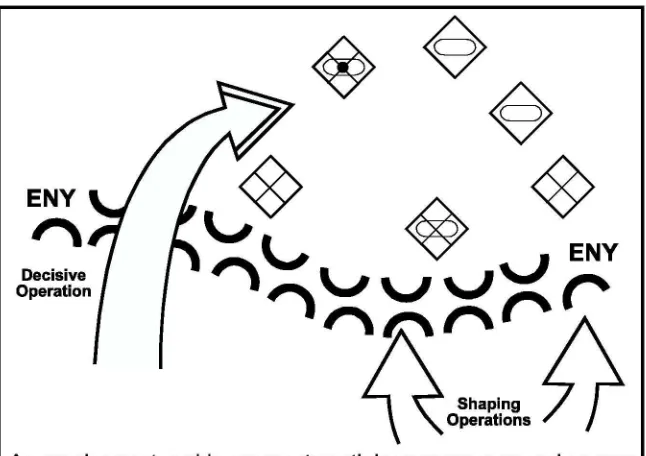
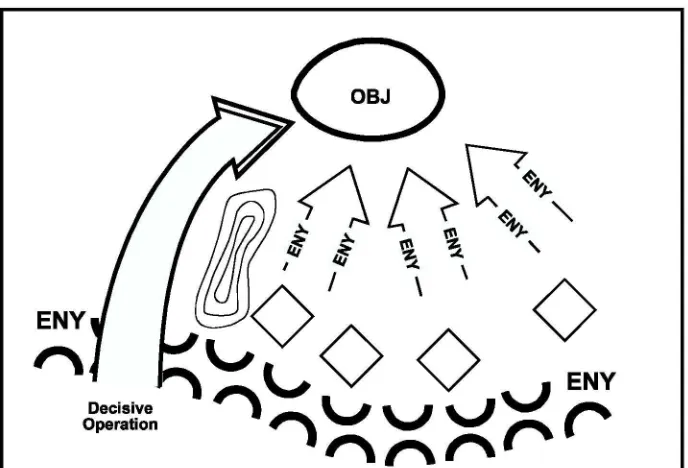
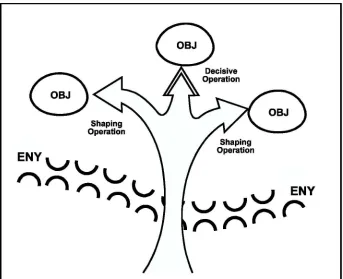
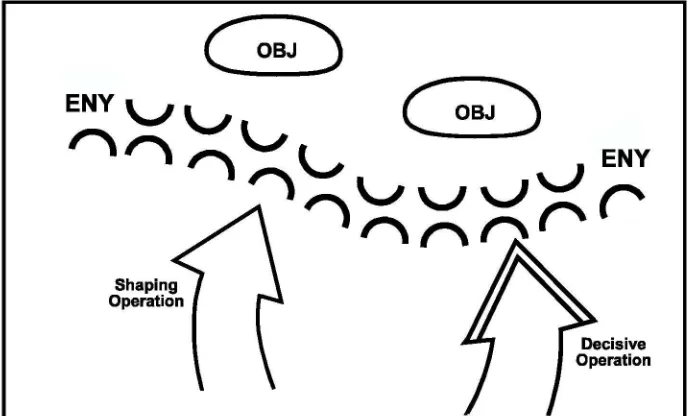
6-50. During execution, commanders combine and direct decisive, shaping, and sustaining operations. Ideally, the decisive operation occurs approxi-mately as planned. However, opportunity and circumstances often alter the sequence and details of the decisive operation. Commanders create or pre-serve opportunities through shaping operations. Shaping operations precede and occur concurrently with the decisive operation. Sustaining operations en-sure freedom of action to maintain momentum and exploit success.
6-51. Ideally, decisive, shaping, and sustaining operations occur at the same time. Simultaneous operations allow commanders to seize and retain the in-itiative. However, they require overwhelming combat power and information superiority. Commanders determine if they can accomplish the mission with a single, simultaneous operation; if they cannot, they phase it. In making this decision, they consider the skill and size of the opponent, the size of the area of operations (AO), operational reach, available joint support, and the scope of the mission. The crucial consideration is the success of the decisive operation, which must have enough combat power to conclusively determine the out-come. If that combat power is not available, commanders phase the operation to achieve the maximum possible simultaneous action within each phase.
Maneuver and Fires
6-52. Through maneuver, Army forces seek to defeat the enemy decisively. Maneuver directly engages the enemy center of gravity if feasible; if not, it concentrates against decisive points. Maneuver implies more than the use of fire and movement to secure an objective; it aims at the complete overthrow of the enemy's operational design. It requires audacious concepts and ruth-less execution.
6-53. Maneuver avoids those enemy forces best prepared to fight; it engages them at a time or place or in a manner that maximizes relative friendly force advantages. Maneuver creates and exposes enemy vulnerabilities to the massed effects of friendly combat power.
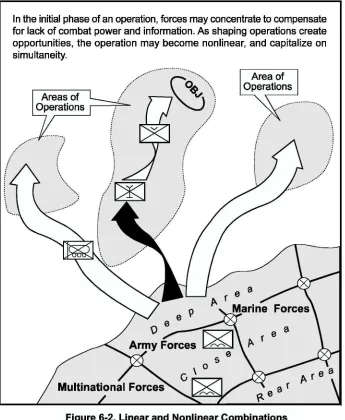
6-54. Operations may include periods of extremely fluid, nonlinear opera-tions, alternating with linear operations (see Figure 6-2, page 6-14). A commander may start an operation with a compact arrangement of forces and quickly transition into nonlinear maneuver against an array of objectives throughout the AO. In different circumstances, the commander might direct multiple attacks in depth to disorganize the enemy and seize key terrain; the attacking force would then consolidate, defend, and prepare to resume the offensive. Another example: A joint land force seizes a lodgment using airborne, air assault, and amphibious operations, while special operations forces attack important facilities distributed across a portion of the AO. The airborne and amphibious units then establish a defense around the lodgment to defend against enemy reaction. When additional forces arrive, the land forces conduct nonlinear operations to end the conflict.
accordingly, blending multinational and US capabilities. The multinational participants might conduct linear operations, while US Army forces conducted simultaneous nonlinear maneuver in depth. Such an operational design would employ each force according to its capabilities and complement linear operations with nonlinear operations.
In the initial phase of an operation, forces may concentrate to compensate for lack of combat power and information. As shaping operations create opportunities, the operation may become nonlinear, and capitalize on simu Itaneity.
-~. ~.
.-- .
.- .
~ .
.- .
. .
.,' :
. .
. .
. .
. .
. .
. .
. .
. .
. .
. .
. .
. .
. .
. .
. .
. .
j
""'~
\
)
"'.' '"
. .
. .
-..-...
Figure 6-2. Linear and Nonlinear Combinations
Commanders determine the appropriate combination of shaping operations needed to ensure success of the decisive operation, recognizing that the ef-fects of fire are transitory.
6-57. The integration of operational fires with operational maneuver requires careful design and effective coordination with the joint force headquarters. Intelligence, surveillance, and reconnaissance (ISR) identify specific enemy capabilities whose loss significantly degrades enemy coherence. Army forces attack the targets with organic lethal and nonlethal means or pass the mission to a supporting joint element. Ideally, the attacks are simultaneous. Simultaneity shocks enemy command and control (C2) systems and often in-duces paralysis. When the means are insufficient for simultaneous action, commanders plan sequential attacks.
Create Overmatch
6-58. Decisive operations synchronize the BOS to create overmatch at deci-sive points in the AO. Overmatch is a quantitative or qualitative disparity of such magnitude that the stronger force overwhelms the weaker. Overmatch may apply to one or all of the elements of combat power in combination. Rapid tempo, offensive information operations (10), and lethal fires combine to disrupt enemy C2 and create a condition of information superiority. Fire support, force protection capabilities, and maneuver neutralize enemy fire support. Supported by indirect and joint fires, maneuver forces close with the enemy and complete his destruction with close combat.
Sustain Combat Power
6-59. Commanders develop a keen understanding of the effects of sustain-ment on operations. They balance audacity and prudence in terms of CSS and the other BOS. To a significant degree, sustainment determines operational reach and approach. Sustaining operations establish the staying power of Army forces and the depth of operations. They enable commanders to mass the effects of combat power repeatedly and maintain freedom of action.
Use Adaptive Combinations
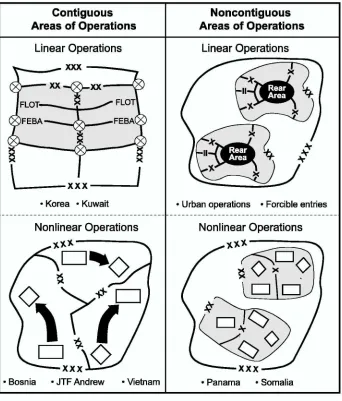
6-60. As they visualize their battlefield framework and operational design, commanders consider incorporating combinations of contiguous and noncon-tiguous AOs with linear and nonlinear operations. They choose the combina-tion that fits the situation and the purpose of the operation. Association of contiguous and noncontiguous AOs with linear and nonlinear operations cre-ates the four combinations in Figure 6-3, page 6-16).
6-61. Linear Operations in Contiguous AOs. Linear operations in con-tiguous AOs (upper left in Figure 6-3) typify sustained offensive and defen-sive operations against powerful, echeloned, and symmetrically organized forces. The contiguous areas and continuous forward line of own troops (FLOT) focus combat power and protect sustaining operations. Commanders normally shape in the deep area, conduct the decisive operation in the close area, and sustain in the rear area.
noncontiguous AOs. In this case, the higher headquarters retains responsi-bility for the portion of its AO outside the subordinate unit AOs. The higher headquarters operational design uses nonlinear operations. The subordinate units are conducting linear operations. The subordinate units' battlefield organizations have close, deep, and rear areas; the higher headquarters battlefield organization does not. This combination might be appropriate when the higher headquarters is conducting widely separated simultaneous operations, for example, a vertical envelopment against a decisive point (the decisive operation) from a lodgment (shaping and sustaining operations).
Contiguous Areas of Operations
Linear Operations
xxx
xx-@-xx
FLOT~
FLOT
FEBA~FEBA
~
a
s
\
xxx
I. Korea. Kuwait
Noncontiguous Areas of Operations
Linear Operations
~
""
.
Urban operations. Forcible entries
---Nonlinear Operations
.
Bosnia.
Vietnam.
Panama.
SomaliaFigure 6-3. Combinations of Contiguous and Noncontiguous Areas of Operations with Linear and Nonlinear Operations
subordinate units. Within the subordinate AOs, operations are nonlinear, with the subordinate headquarters receiving support and resources from the higher headquarters. On a tactical scale, search and attack operations are often nonlinear operations conducted in contiguous AOs.
6-64. Nonlinear Operations in Noncontiguous AOs. The lower right box depicts units conducting nonlinear operations in noncontiguous AOs. The op-erations of both higher and subordinate units are nonlinear. The size of the land AO, composition and distribution of enemy forces, and capabilities of friendly forces are important considerations in deciding whether to use this battlefield organization and operational design. In Somalia in 1992, for ex-ample, Army forces conducted nonlinear stability operations and support op-erations in widely separated AOs around Kismayu and Mogadishu.
COMPLEX OPERATIONAL CONSIDERATIONS
6-65. Army forces execute full spectrum operations in environments that con-tain complex operational considerations. All operations include challenges. However these complex operational considerations require special attention by commanders and staffs:
.
Nuclear, biological, and chemical (NBC) environments..
Local populace and displaced persons..
Unconventional threats..
Urban operations.Nuclear, Biological, and Chemical Environments
6-66. The threat of WMD profoundly changes theater conditions and imposes major force protection requirements. A major JFC objective is to deter WMD deployment, and if deterrence fails, to find and destroy enemy WMD before they are used. The potential for destruction or contamination of infrastruc-ture by NBC weapons increases the requirement for Army forces that can op-erate effectively in and around contaminated environments. To a significant degree, the readiness of Army forces to operate in NBC environments deters enemies from using WMD and encourages them to seek solutions that avoid the risk of strategic retaliation.
6-67. Operations in NBC environments demand careful preparation (see JP 3-11; FM 3-11). Vaccines protect soldiers against some biological weapons, but inoculations may need weeks to fully protect recipients. Therefore, pro-tection against these weapons becomes part of the continuous process of keeping units ready. In similar fashion, soldiers may receive medical coun-termeasures, such as pretreatment before the operation or antidotes during the operation. Medical surveillance programs provide tactical commanders with a tool to develop a baseline of disease threats in the AO. This baseline aids in detecting when the enemy begins biological warfare.
6-69. Commanders at all echelons recognize that the WMD threat is also psy-chological. Every soldier fears these weapons and has doubts concerning countermeasure and antidote effectiveness. In many cases, the actual threat is less than soldiers imagine, but only realistic individual training will mini-mize their fear. Training gives soldiers confidence in their equipment and their ability to use it.
6-70. The psychological impact of NBC use goes beyond individual soldiers. Commanders and staffs must be prepared to conduct operations in an NBC environment. Failure to exercise command and staff procedures in scenarios featuring realistic use of NBC weapons can lead to a mentality that NBC hazards present insurmountable obstacles. Only tough command post exer-cises that force commanders and staffs to work through the problems NBC hazards pose can overcome this attitude. Realistic training demonstrates that NBC hazards, like any other condition, are simply obstacles to overcome.
6-71. Successful US operations may increase the likelihood of enemy WMD use. If the enemy believes that only WMD will retrieve victory, he may resort to using them. Army forces adjust operations accordingly. Rapid maneuver places Army forces near the enemy, compelling him to risk employing WMD on his own forces. Army forces disperse as much as possible and concentrate swiftly, and only as necessary to mass effects. Nonlinear operations position Army forces deep within the enemy AO, complicating his targeting decisions. Precision attacks destroy enemy C2 and CSS systems. Commanders empha-size active and passive force protection. They disperse assembly areas and CSS units. ISR focuses on locating and identifying WMD-capable enemy forces. Reconnaissance units detect and mark hazardous and contaminated areas. Planning also considers US retaliatory or preemptive strikes. Other active measures include theater missile defense, counter air operations, preci-sion fires against enemy WMD systems, and offensive 10.
Local Populace and Displaced Persons
6-72. Army forces create opportunities for success by enlisting the support of the local populace and displaced persons. Frequently, Army forces operate in AOs characterized by chaos and disorder. They may encounter populations with diverse cultures and political orientations that may support, oppose, or remain ambivalent to US presence. In any operation, Army forces will likely encounter displaced civilians or persons of unknown status. Commanders identify these people and design operations with their protection in mind.
6-73. Commanders depend on accurate knowledge of group locations and be-liefs to ensure actions taken are consistent with achieving JFC goals and ob-jectives. 10, especially psychological operations, and its related activities
(public affairs, and civil-military operations) help commanders influence per-ceptions and attitudes of the local population. In some operations, 10 and its related activities may constitute the decisive operation. The importance of in-fluencing civilians varies, depending on the mission and force objectives.
hostility and fosters respect. ROE guide the use of lethal force, not to inhibit action and initiative but to channel it within acceptable limits. The disciplined application of force is more than a moral issue; it is a critical contributor to operational success.
Unconventional Threats
6-75. Commanders protect the force from unconventional threats in four ways. First, they train units and soldiers to protect themselves against ter-rorist tactics and intrusion. They complement self-defense capabilities by en-forcing security policies, such as movement procedures, appropriate to the situation. Second, commanders consider the threat posed by unconventional elements and act to fill gaps in protective capabilities. Actions may include requesting additional combat forces. Third, commanders use all available in-formation resources (including host nation, theater, national, and organic as-sets) to understand unconventional threats to the force. Commanders at ma-jor headquarters may form a national intelligence support team with a total focus on unconventional threats. Finally, by example and constant attention, commanders dispel any sense of complacency toward unconventional threats.
Urban Operations
6-76. Urban operations include offense, defense, stability, and sup-port operations conducted in a topographical complex and adjacent natural terrain where manmade construction and high population density are the dominant features. The world is largely urban in terms of population concentration. Army forces conduct urban operations in large, densely populated areas that present distinct problems in clearing enemy forces, restoring services, and managing major concentrations of people. The topography and proximity of noncombatants degrade the effectiveness of technically advanced sensors and weapons. Thus, cities are likely battle-grounds where weaker enemies attempt to negate the advantages Army forces have in more open terrain.
6-77. From a planning perspective, commanders view cities not just as a topographic feature but as dynamic entities that include hostile forces, local population, and infrastructure. Planning for urban operations requires care-ful IPB, with particular emphasis on the three-dimensional nature of the to-pography and the intricate social structure of the population. CSS planning accounts for increased consumption, increased threats to lines of communica-tions, and anticipated support to noncombatants. Commanders develop ROE carefully, adapting them to a variety of circumstances, and ensuring soldiers thoroughly understand them.
FOLLOW-ON OPERATIONS
6-79. All operations evolve in terms of nature, purpose, and type. Successful operations create new conditions that lead to significant changes in the situa-tion. A new or fundamentally altered center of gravity may emerge. Typically, new conditions initiate sequels.
Transition
6-80. Transitions mark the intervals between the ongoing operation and full execution of branches and sequels. Transitions often mark the change from one dominant type of operations, such as offense, to another such as stability. At lower echelons, transitions occur when one formation passes through another, for example, or when units must breach an obstacle belt. Commanders consider transitions from the current operation to future operations early in the planning process. Command arrangements, for example, often change. Typically, the command structure evolves to meet changing situations. A JTF, for example, may dissolve, and forces revert to their parent components. The operational requirements for Army forces may pass to a new commander, who continues postconflict missions even as some Army forces prepare to redeploy. Frequently, US forces transition from a US-led coalition to a multinational United Nations structure supported by US troops. This occurred at the end of Operation Restore Democracy in Haiti, as US combat forces withdrew.
6-81. Changes in the strategic situation require adjusting the strength and composition of deployed forces. When the dominant type of operation changes--from offense to stability, for example--the types of units originally deployed may no longer be appropriate. As each new force prepares for opera-tions, the JFC and the commander of the Army service component command tailor the Army force to meet mission requirements and theater constraints. The force that initiated the operation may only superficially resemble the force in theater when the operation concludes.
6-82. Transitions are the sequels that occur between types of operations. Commanders anticipate and plan for them as part of any future operation. Transitions between operations are difficult and during execution may create unexpected opportunities for Army forces, enemies, or adversaries. Such opportunities must be recognized quickly, developed as branches to the transition operation, and acted upon immediately. Transition between operations may be the most difficult follow-on operation to accomplish.
Reconstitution
Reorganization is that action taken to shift internal resources within a degraded unit to increase its level of combat effectiveness.
6-84. The headquarters two echelons up normally controls reconstitution. Commanders and staffs plan reconstitution to fit mission priorities and sup-port the higher commander's intent. The reconstitution plan takes into ac-count follow-on missions. The final decision on whether to reconstitute a de-pleted unit depends on the situation. Commanders remain flexible. Mission requirements and available resources (including time) determine appropriate reconstitution actions.
6-85. Reconstitution planning is part of course of action development. Units with roles in reconstitution train to perform it. Commanders, staffs, and exe-cuting units plan and prepare for reconstitution before they confront it. Any combat, combat support, or CSS unit may require reconstitution. In particu-lar, operations in an NBC environment increase the likelihood that some units will require reconstitution after decontamination.
6-86. Reconstitution requires aggressive application of the tenets of Army op-erations. Reconstitution actions must regenerate units that allow command-ers to continue to set the terms of battle. These actions are necessary to maintain the agility of the force. Quickly recognizing the need for and exe-cuting reconstitution help provide the combat effective forces needed to retain the initiative. Commanders visualize reconstitution in terms of depth of time, space, and resources just as they do other operations. They look ahead, con-sider the resources required and available, and direct the extensive synchro-nization required.
Conflict Termination
6-87. Conflict termination describes the point at which the principal means of conflict shifts from the use or threat of force to other means of persuasion. Conflict termination may take several forms: for example, the adversary may surrender, withdraw, or negotiate an end to the conflict. Commanders and staffs consider conflict termination requirements when developing campaign plans. If the end state is a situation that promotes economic growth, for ex-ample, commanders consider the effects of destroying the economic infra-structure. Regardless of how the conflict ends, it often changes into less vio-lent, but persistent, forms of confrontation.
6-88. Conflict termination is more than the achievement of a military end state: it is the military contribution to broader success criteria. As the policy governing the conflict evolves, so does the end state at both joint and Army levels. Effective campaign plans account for more than military objectives; they specify end states that support national policy. They are also careful to distinguish between the military and other instruments of national power.
ASSESS
operations and support operations---conducted by Army forces--transform temporary battlefield successes into lasting strategic results.
6-90. Commanders, assisted by the staff, continuously assess the situation and the progress of the operation, and compare it with the initial vision. As-sessment is the continuous monitoring-throughout planning, prepa-ration, and execution--of the current situation and progress of an operation, and the evaluation of it against criteria of success to make decisions and adjustments. Commanders direct adjustments to ensure that operations remain aligned with the commander's intent. Subordinates assess their unit's progress by comparing it with the senior commander's intent and adjusting their actions to achieve the envisioned end state, par-ticularly in the absence of orders.
6-91. Assessment precedes and guides every activity within the operations process and concludes each operation or phase of an operation. Assessment entails two distinct tasks: continuously monitoring the situation and the pro-gress of the operation, and evaluating the operation against measures of ef-fectiveness. Together, the two tasks compare reality to expectations.
6-92. Not all operations proceed smoothly toward the desired end state. Commanders examine instances of unexpected success or failure, unantici-pated enemy actions, or operations that simply do not go as planned. They assess the causes of success, friction, and failure, and their overall impact on the force and the operation. In assessing the cause of failure or substandard performance, commanders address immediate causes while retaining the in-tellectual flexibility to look for related or hidden contributors. For example, a commander may replace an ineffective leader after an engagement in which Army forces suffer severe losses. In another instance, the commander may re-tain subordinate commanders within a defeated force. In both instances, the commander seeks answers to larger questions concerning operations security, enemy doctrine, leadership, equipment, and the state of training of friendly and enemy forces. Commanders also learn from their mistakes and allow subordinates to learn from theirs.
6-93. The American way of war has historically included rapid adaptation to unexpected challenges and situations. A tactical or operational success may prove the worth of a significant technological or procedural innovation. Con-versely, Army forces may discover a dangerous vulnerability during the op-eration. Leaders continuously identify, assess, and disseminate lessons learned throughout the force.
Conducting Decisive Full Spectrum Operations
Part Three discusses the four types of operations offensive, defensive, stability, and support-that Army forces conduct. It illustrates how to apply the concepts de-scribed in Part Two within the operational environment dede-scribed in Part One.
Chapter 7 discusses offensive operations. The offense is the decisive form of war. The will to seize, retain, and exploit the initiative defines the spirit and purpose of the offense. It is essential to success in all operations-defensive, stability, and sup-port-as well as offensive. Combined with a demonstrated combat capability, it makes Army forces credible in any situation. Circumstances may require defending; however, victory requires shifting to the offense as soon as possible. The offense ends when the force accomplishes the mission, reaches a limit of advance, or ap-proaches culmination. It then consolidates, resumes the attack, or prepares for an-other operation.
Chapter 8 discusses defensive operations. Commanders direct defensive opera-tions to defeat enemy attacks, buy time, economize forces, or develop condiopera-tions fa-vorable for the offense. Although the defense is the stronger form of war, it normally cannot achieve a decision. Thus, commanders simultaneously or sequentially com-bine defensive operations with offensive operations.
Chapter 9 discusses stability operations. Stability operations include a range of ac-tions that Army forces conduct outside the US and US territories. Their purpose is to promote and sustain regional and global stability. Stability operations are diverse, continuous, and often long-term. However, the credibility and staying power of Army forces allow them to maintain stability until the situation is resolved. Army forces may execute stability operations as part of a theater engagement plan, smaller-scale contingency, or follow-on operation to a campaign or major operation. They are in-herently complex and place great demands on leaders, units, and soldiers. Stability operations require the mental and physical agility to shift among situations of peace, conflict, and war and between combat and noncombat operations.
conduct decisive full spectrum operations. Commanders synchronize offensive, de-fensive, stability, and support operations to defeat any enemy or dominate any situation--anywhere, anytime.
Chapter 7
Offensive
Operations
In war the only sure defense is offense, and the efficiency of the offense depends on the war-like souls of those conducting it.
General George S. Patton Jr. War as I Knew It
7-1. The offense is the decisive form of war. Offensive operations aim to de-stroy or defeat an enemy. Their purpose is to impose US will on the enemy and achieve decisive victory. While immediate considerations often require defending, decisive results require shifting to the offense as soon as possible.
PURPOSES
OF OFFENSIVE
OPERATIONS
7-2. Offensive operations seek to seize, retain, and exploit the initiative to de-feat the enemy decisively. Army forces attack simultaneously throughout the area of operations (AO) to throw enemies off balance, overwhelm their cap-abilities, disrupt their defenses, and ensure their defeat or destruction. The offense ends when the force achieves the purpose of the operation, reaches a limit of advance, or approaches culmination. Army forces conclude a phase of an offensive by consolidating gains, resuming the attack, or preparing for future operations. Additional tasks offensive operations accomplish
include---.
Disrupting enemy coherence..
Securing or seizing terrain..
Denying the enemy resources..
Fixing the enemy..
Gaining information.OFFENSIVE
OPERATIONS
AT THE OPERATIONAL
AND TACTICAL
LEVELS OF WAR
commanders direct of-fensive operations to achieve objectives---de-stroying enemy forces or seizing terrain-that produce the theater-level effects operational com-manders require.
OPERATIONAL OFFENSE
7-4. At the operational level, offensive opera-tions directly or indirec-tly attack the enemy center of gravity. Com-manders do this by at-tacking enemy decisive points, either simultan-eously or sequentially. Massed effects of joint and multinational forces allow attackers to seize the initiative. They deny the enemy freedom of action, disrupt his sour-ces of strength, and cre-ate the conditions for op-erational and tactical success.
CONTENTS
Purposes of Offensive Operations 7-2 Offensive Operations at the Operational
and Tactical Levels of War 7-2 Operational Offense 7-3
Tactical Offense 7-3
Characteristics of Offensive Operations 7-4
Surprise 7-4
Concentration 7-5
Tempo 7-6
Audacity 7-6
Offensive Operations Within the
Operational Framework 7-6 Decisive Operations in the Offense 7-7 Shaping Operations in the Offense 7-8 Sustaining Operations in the
Offense 7-10
Considerations for Nonlinear
Offensive Operations 7-10
Forms of Maneuver 7-10
Envelopment 7-11
Turning Movement 7-12
Infiltration 7-13
Penetration 7-13
Frontal Attack 7-15
Types of Offensive Operations 7-16 Movement to Contact 7-17
Attack 7-18
Exploitation 7-21
Pursuit 7-22
Conducting Offensive Operations 7-23 Planning Considerations for
Offensive Operations 7-23 Preparing for Offensive Operations.. 7-26 Executing Offensive Operations 7-26 The Impact of Technology 7-28 7-5. To attain unity of
effort, operational com-manders clearly identify objectives and reinforce the relationships among subordinate forces. By minimizing interopera-bility challenges and harnessing system
cap-abilities, commanders tailor their forces to achieve decisive effects. They allocate sufficient joint and multinational forces to achieve their objectives.
TACTICAL OFFENSE
7-6. Tactical commanders exploit the effects that joint and multinational forces contribute to the offense. They synchronize these forces in time, space, resources, purpose, and action to mass the effects of combat power at decisive points. Commanders direct battles as part of major operations. Battles are related in purpose to the operational commander's objectives.
boundaries, control measures, and intent from their higher commander. They determine the decisive, shaping, and sustaining operations within their AO. They direct fires and maneuver to attack and destroy the enemy and attain terrain objectives. Tactical commanders normally have clearly defined tasks-defeat the enemy and occupy the objective.
CHARACTERISTICS
OF OFFENSIVE
OPERATIONS
7-8. Surprise, concentration, tempo, and audacity characterize the offense. Effective offensive operations capitalize on accurate intelligence and other relevant information regarding enemy forces, weather, and terrain. Com-manders maneuver their forces to advantageous positions before contact. Force protection, including defensive information operations (10), keeps or inhibits the enemy from acquiring accurate information about friendly forces. The enemy only sees what the friendly commander wants him to see. Contact with enemy forces before the decisive operation is deliberate, designed to shape the optimum situation for the decisive operation. The decisive opera-tion is a sudden, shattering action that capitalizes on subordinate initiative and a common operational picture (COP) to expand throughout the AO. Com-manders execute violently without hesitation to break the enemy's will or destroy him.
SURPRISE
7-9. In the offense, commanders achieve surprise by attacking the enemy at a time or place he does not expect or in a manner for which he is unprepared. Estimating the enemy commander's intent and denying him the ability to gain thorough and timely situational understanding is necessary to achieve surprise. Unpredictability and boldness help gain surprise. The direction, timing, and force of the attack also help achieve surprise. Surprise delays en-emy reactions, overloads and confuses his command and control (C2) systems, induces psychological shock in enemy soldiers and leaders, and reduces the coherence of the defense. By diminishing enemy combat power, surprise en-ables attackers to exploit enemy paralysis and hesitancy.
7-10. Operational and tactical surprise complement each other. Operational surprise creates the conditions for successful tactical operations. Tactical sur-prise can cause the enemy to hesitate or misjudge a situation. But tactical surprise is fleeting. Commanders must exploit it before the enemy realizes what is happening.
7-12. Surprise can come from an unexpected change in tempo. Tempo may be slow at first, creating the conditions for a later acceleration that catches the enemy off guard and throws him off balance. US forces demonstrated such a rapid change in tempo before Operation Just Cause in 1989. Accelerated tempo resulted in operational and tactical surprise despite increased publicity and heightened tensions beforehand.
7-13. Commanders conceal the concentration of their forces. Units mask ac-tivity that might reveal the direction or timing of an attack. Commanders di-rect action to deceive the enemy and deny his ability to collect information.
Surprise--Coup
de Main in Panama
The activity of US forces throughout Panama during 1989 before Operation Just Cause provides an example of achieving strategic surprise. After assuming power in 1984, Manuel Noriega threatened Panamanian democracy and American legal guarantees under the Panama Canal treaties. In response, US forces developed military contingency plans known as Prayer Book and Blue Spoon. In May 1989, Noriega's Dignity Battalions and the Panama Defense Forces increased political pressure on the US to leave Panama by harassing American service members at gunpoint. President George Bush responded by deploying Army and Marine forces during Operation Nimrod Dancer as a show of force. Over the next six months, Army forces conducted Purple Storm and Sand Fleas exercises to reinforce American maneuver rights and gain moral ascendancy over Noriega's forces. Despite the increased US activity, Noriega discounted the possibility of an invasion. On 20 December 1989, SOF conducted the initial assault upon Panama Defense Forces garrisons, airports, media centers, and transportation facilities. Conventional forces soon followed, attacking decisive points throughout Panama. Noriega and his forces were completely surprised. He fled, losing control over his forces as US forces tracked him down.
CONCENTRATION
7-14. Concentration is the massing of overwhelming effects of combat power to achieve a single purpose. Commanders balance the necessity for concen-trating forces to mass effects with the need to disperse them to avoid creating lucrative targets. Advances in ground and air mobility, target acquisition, and long-range precision fires enable attackers to rapidly concentrate effects. C2 systems provide reliable relevant information that assists commanders in determining when to concentrate forces to mass effects.
they may disperse again. Commanders adopt the posture that best suits the situation, protects the force, and sustains the attack's momentum.
7-16. Concentration requires coordination with other services and multina-tional partners. At every stage of an attack, commanders integrate joint in-telligence assets with joint fires. They capitalize on air superiority to deny the enemy the ability to detect or strike friendly forces from the air. Commanders direct ground, air, and sea resources to delay, disrupt, or destroy enemy re-connaissance elements or capabilities. They also direct security, 10, and counterfire to protect friendly forces as they concentrate.
TEMPO
7-17. Controlling or altering tempo is necessary to retain the initiative. At the operational level, a faster tempo allows attackers to disrupt enemy defen-sive plans by achieving results quicker than the enemy can respond. At the tactical level, a faster tempo allows attackers to quickly penetrate barriers and defenses and destroy enemy forces in depth before they can react.
7-18. Commanders adjust tempo as tactical situations, combat service sup-port (CSS) necessity, or operational opportunities allow to ensure synchroni-zation and proper coordination, but not at the expense of losing opportunities to defeat the enemy. Rapid tempo demands quick decisions. It denies the enemy the chance to rest and continually creates opportunities.
7-19. By increasing tempo, commanders maintain momentum. They identify the best avenues for attack, plan the action in depth, provide for quick transi-tions to other operations, and concentrate and combine forces effectively. Commanders and staffs ensure that CSS operations prevent culmination. Once combat begins, attackers execute violently. They follow reconnaissance units or successful probes and quickly move through gaps before defenders recover. Attackers shift combat power quickly to widen penetrations, roll up exposed flanks, and reinforce successes. Friendly forces attack in depth with fires and maneuver to shatter the enemy's coherence and overwhelm his C2. While maintaining a tempo faster than the enemy's, attackers balance the tempo with the ability to exercise C2. Commanders never permit the enemy to recover from the shock of the initial assault. They prevent defenders from massing effects against the friendly decisive operation.
AUDACITY
7-20. Audacity is a simple plan of action, boldly executed. Commanders dis-play audacity by developing bold, inventive plans that produce decisive re-sults. Commanders demonstrate audacity by violently applying combat power. They understand when and where to take risks and do not hesitate as they execute their plan. Commanders dispel uncertainty through action; they compensate for lack of information by seizing the initiative and pressing the fight. Audacity inspires soldiers to overcome adversity and danger.
OFFENSIVE OPERATIONS WITHIN THE OPERATIONAL
FRAMEWORK
their forces in time, space, resources, purpose, and action to conduct simulta-neous and sequential decisive, shaping, and sustaining operations in depth (see Figure 7-1). In certain situations, commanders designate deep, close, and rear areas.
Area of Operations
G:J
Sustaining OperationI
SPT
I
Sustain.ing Operation
D
Battlespace encompasses all things commanders must understand to apply combat power effectively.
Reserve
Figure 7-1. Operational Framework in the Offense
DECISIVE OPERATIONS IN THE OFFENSE
7-22. Decisive offensive operations are attacks that conclusively determine the outcome of major operations, battles, and engagements. At the opera-tional level, decisive operations achieve the goals of each phase of a cam-paign. Ground operations within campaigns may include several phases. Within each phase is a decisive operation. Its results substantially affect the course of the campaign. At the tactical level, decisive battles or engagements achieve the purpose of the higher headquarters mission. Commanders win decisive operations through close combat that physically destroys the enemy; overcomes his will to resist; or seizes, occupies, and retains terrain.
where, and if to commit additional supporting fires and reserves. Command-ers shift priority of fires as necessary. Maneuvering forces positions them to mass fires against the enemy.
7-24. Commanders designate a reserve to provide additional combat power at the decisive time and place. The more uncertain the situation is, the larger the reserve. Once the reserve is committed, the commander designates an-other. The initial strength and location of reserves vary
with-.
Potential missions, branches, and sequels..
Form of maneuver..
Possible enemy actions..
Degree of uncertainty.Audacity-Turning
Movement at Inchon
On 25 June 1950, North Korean forces invaded South Korea. By August, the North Korean People's Army (NKPA) occupied most of the peninsula, with US and Republic of Korea forces confined to a shrinking perimeter behind the Naktong and Nam Rivers. For over a month, both sides engaged in a series of bloody attacks and counterattacks. On 15 September, while United Nations (UN) and North Korean forces were decisively engaged far to the south, X Corps conducted a two-division amphibious landing at Inchon, on the west coast of Korea north of Seoul. This operational turning movement, code-named Operation Chromite, caught the NKPA completely by surprise. Simultaneously, UN aircraft bombarded North Korean forces along the Naktong River to support an Eighth Army counteroffensive. During the following days, American and South Korean Marines pressed toward Seoul. The remainder of X Corps captured the Seoul-Suwon area and severed NKPA supply lines. Army forces soon averaged 10 miles per day over rugged terrain, with the North Korean retreat soon turning into a general rout. By October 1950, the NKPA had dissolved into disorganized remnants fleeing into borderlands adjacent to Manchuria and the Soviet Union.
Reserves provide a hedge against uncertainty. Commanders assign them only those tasks necessary to prepare for their potential mission. Only the com-mander who designates the reserve can commit it, unless he specifically dele-gates that authority.
SHAPING OPERATIONS IN THE OFFENSE
7-25. Shaping operations create conditions for the success of the decisive op-eration. They include attacks in depth to secure advantages for the decisive operation and to protect the force. Commanders conduct shaping operations by engaging enemy forces simultaneously throughout the AO. These attacks deny the enemy freedom of action and disrupt or destroy the coherence and tempo of his operations. Attacking enemy formations in depth destroys, de-lays, disrupts, or diverts enemy combat power. They may expose or create vulnerabilities for exploitation. Shaping operations in the offense