Range condition assessment and the concept of thresholds:
A viewpoint
M.H. FRIEDEL
Abstract
Dissatisfaction persists with current approaches to range condi- tion and trend assessment. Sometimes assessed condition does not truly represent the past or the potential of range. One of the likely causes is a failure to re-examine and change if necessary the theo- retical basis of assessment, in line with developing understanding of ecological processes. The concept of thresholds of environmen- tal change appears to provide a reasonable alternative in some circumstances to the concepts of gradual retrogression and secon- dary succession which are currently accepted. I suggest that envi- ronmental change can be discontinuous, with thresholds between alternative states. Once a threshold is crossed to a more degraded state, the former state cannot be attained without significant man- agement effort, such as prescribed burning, ploughing, or herbi- cide application, rather than simple grazing control. Examination of data from extensive monitoring programs and from a study of grazing impact, as well as more general sources of information, indicates that thresholds of change may be identifiable in arid rangelands. A practical means of monitoring proximity to thresh- olds is available and, with the aid of multivariate analysis, the effects of spatial variability and season can be separated from those of management. The potential of this approach deserves investiga- tion in a wider variety of environments.
Key Words: succession, site potential, ordination, classification, trend
The assessment of range condition and trend remains a source of controversy, despite years of practical experience and discussion (Lauenroth and Laycock 1989). What attributes are measured and how they are measured, and how the measurements are inter- preted, are the subject of continuing debate. More importantly, perhaps, the advances in our understanding of ecological processes have not been matched by developments in the theory and practice of range assessment. The concept of thresholds of environmental change between domains of relative stability is well recognized in ecological literature (Holling 1973, Wissell984). It is not at present a part of range assessment philosophy and may offer a new approach to range monitoring.
Anomalies in the condition assessments of central Australia’s arid rangelands stimulated an examination of existing data sets (e.g., Foran et al. 1986) and alternative methods of data collection (e.g., Friedel et al. 1988b). At the same time, the “quantitative climax” approach of Dyksterhuis (1949) as commonly applied demanded challenge. In this paper, I present evidence from a variety of sources that the concept of thresholds offers a useful framework for identifying important environmental changes. I also consider whether practical ways of recognizing thresholds can be devised for range assessment.
Concepts of Environmental Change
The quantitative climax approach to range management and assessment has focused attention on successional processes (Lauen- roth and Laycock 1989). Excessive grazing is perceived to lead to
The author is principal research scientist, CSIRO Division of Wildlife and Ecology, Alice Springs, Northern Territory 0871, Australia.
Manuscript accepted 19 October 1990.
422
retrogression or decline in range condition (Stoddart et al. 1975) and it is assumed that reduction or removal of grazing pressure allows successional processes to restore the range to what it was, essentially by reversing the path taken by retrogression.
In environments driven by unpredictable events, e.g., highly variable rainfall throughout any year or a variable starting time for rainy seasons, succession and retrogression do not coincide, and there is commonly a hysteresis effect where decline and recovery follow different paths (Noy-Meir and Walker 1986), even if the system returns to its original starting point.
In practice, a starting point cannot be determined because it depends on current seasonal conditions. An alternative model is of range in a series of short-lived states under different combinations of seasons, grazing, fire, and local variability. Most of these states do not preclude a shift to other short-lived states. However, certain combinations may push the system into a new state that is not readily reversed; e.g., an eroded soil surface can develop following heavy grazing coupled with torrential rain, in which case the sys- tem has crossed a threshold.
A threshold has these characteristics: first, it is the boundary in space and time between 2 states, e.g., grassland and shrub-invaded grassland; and second, the initial shift across the boundary is not reversible on a practical time scale without substantial intervention by the range manager, e.g., with herbicides, heavy machinery, or fire. The concept is compatible with the state-and-transition model of Westoby et al. (1989), focusing on those transitions which, for management purposes, are l-way. Stocking-rate reductions are not enough to cause a reversion to the former state.
Current Approaches to Range Assessment
Two different philosophies have influenced assessment up to the present: the ecological approach based on comparisons with the climax state (e.g., Dyksterhuis 1949); and the site potential approach based on productive potential for a particular use (e.g., Humphrey 1949). Both focus on the forage layer. Wilson (1986) has outlined an alternative based on multivariate site potential, which combines important elements of the 2 philosophies and includes soil assessment. This approach has yet to significantly affect entrenched range monitoring systems, although it represents a philosophical advance.
The ecological or climax approach to range condition assess- ment has,been criticized for some time (Smith 1978, 1989; Wilson 1989), but it is still in active use in a wide variety of rangelands (Tainton 1986, Pendleton 1989). The weaknesses of the approach have been summarized by Smith (1978) as: (1) climax is not always the most desirable condition; (2) pristine conditions may not be the actual climax for a site; (3) it does not allow for exotic species; and (4) it is not well suited to woodland and forested rangeland.
If one takes the approach of assessing site potential for particu- lar uses, a single vegetation state can have a variety of potentials depending on use, Site stability or degradation cannot be inferred from the condition rating because the rating will vary with poten- tial use. Whatever approach is taken to assessment, irreversible changes in the soil will be important indicators of site deteriora- tion. As a consequence, range monitoring must incorporate 3 tiers of assessment-the herbaceous layer and soil, and the tree-shrub layer, where it is present.
2.40
1.60 Fusion Level -
0.80
0.00
-1
A
-3:-
,_ _---
________
l-3
_
r-l
Ltal information. This approach does not assume a climax, but produces classes and orders of locations which can be interpreted according to known site factors, seasonal conditions, and man- agement history.
1
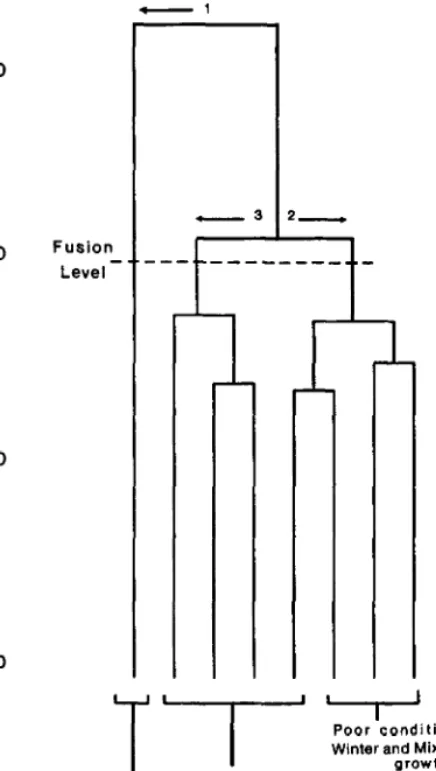
J_Foran et al. (1986) classified forage composition from 65 moni- toring locations within an arid shrubby grassland range site. They concluded that, apart from differences attributable to soil “type”(= variable depth or minor textural differences, G.N. Bastin pers. comm.) or season of assessment, there were just 2 classes associated with management effects (Fig. 1). These classes were identified as good and poor condition states, also distinguished by ordination on the basis of forage quality and quantity and soil stability. The same divisions into 2 classes of condition were apparent in moni- toring data from 4 other range sites, each analysed independently. The gradual deterioration implied by percentage deviation from a climax state, which the ecological approach creates, was not in evidence. Instead, a shift from 1 state or “domain”to another (Fig. 2, from Bradbury et al. 1983/4) appeared to have occurred.
v
--T-I
Poor condition”
Winter and Mixedgrowth response Minor soil variability Poor condition
Summer growth response Minor soil variability Good condition
Summer growth response
Fig. 1. Classification of 65 monitoring locations in an arid shrubby grass- land range site, on the basis of forage composition (from Foran et al. 1986).
In the application of the ecological or climax approach, as outlined by Dyksterhuis (1949) and Tainton et al. (1980), the seasonal fluctuations in forage composition are allowed for by comparing the monitored vegetation to an ecological benchmark which represents the vegetation climax and which is presumed to have experienced the same seasonal variations. There are many weaknesses in such a system. Benchmarks may be in atypically favoured locations, they may experience different rainfall or have a different fire history, or they may simply not exist and must be theoretically constructed. Differences due to variability within a site may be inappropriately attributed to management. Multiple benchmarks have been proposed (Wilson 1984, Bosch et al. 1987) to represent the variability within a range site or land unit.
Fig. 2. An ecosystem experiencing mild impacts, e.g., light graxing and changing seasons, shifts about within its original domain. A severe impact, e.g., extended heavy grazing, shifts the ecosystem across a thresh- old and into an entirely new domain (from Bradbury et al. 1983/4).
A similar shift is evident in an ordination of the forage composi-
Changing States: Evidence of Thresholds
The development of multivariate analysis and increasingly easy access to it suggest the next step in the assessment of condition: the comparison of each monitored location with all others, using classification and ordination of forage composition. Classification assigns locations to classes on the basis of composition, not neces- sarily in any hierarchical order. Ordination arranges them in a lowdimensional space so that similar locations are near each other and dissimilar locations are far apart (Gauch 1982). Ordination axes identify major elements in the distribution patterns of the locations, which can be compared with independent environmen-
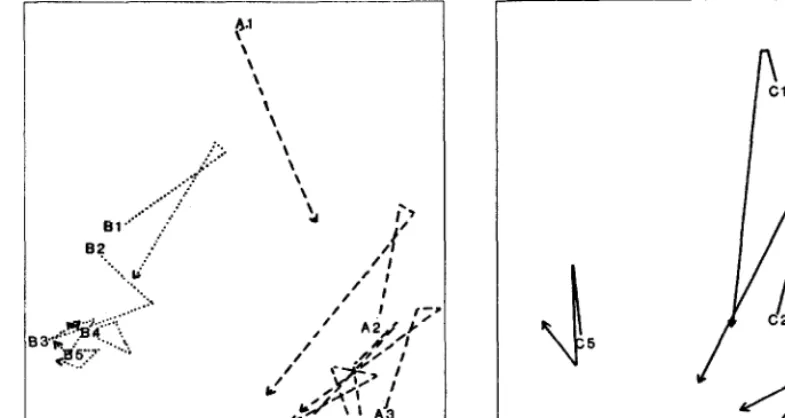
tion on a series of sample plots in an arid shrubby grassland range site (Friedel unpubl.). The plots were distributed along a gradient of grazing, centered on 3 independent watering points. Waterpoint A (Fig. 3a) had a history of heavy grazing by cattle while B (also Fig. 3a) was only lightly grazed because the water supply was ephemeral. The history of C (Fig. 3b) is detailed below. Sample plots Al and Bl were within 100 m of their waterpoints, A5 and BS were 2.0 km and 3.7 km, respectively, out from their waterpoints and intermediate plots were distributed along the radius from the waterpoint to sample plot 5. Each plot was 10 X 10 m, divided into 100, l-m2 quadrats. Ten quadrats from within each plot were chosen at random on the first sampling occasion and were resampled on 3 subsequent 6-monthly visits, making 4 samples in all. Frequency data for all species were collected from the quadrats and analysed with the multivariate analysis package TAXON (Ross et al. 1983), using the Bray-Curtis measure of dissimilarity. In the ordination graph (Fig. 3a,b), similar samples are close together, so that species composition of B5 for instance did not I
change much over the 4 sampling occasions, whereas Bl changed a lot, but remained more like B5 than like A5.
B
1
i
\ \
!41 +
Fig. 3. (a) left, (b) right. Ordination of the forage composition on sample plots in an arid shrubby grassland range site, showing axes 1 (x-axis) and 2 (y-axis). Plots were distributed on a radius out from 3 independent watering points and were measured 4 times at Cmonthly intervals. Watering points A and B (3a) are shown separately from water point C (3b) for clarity but are from the same ordination. Lines connect the sequential samples for each plot; arrows indicate the final occasion. Note that not all samples are distinguishable when composition differences are small. Craxing around waterpoints A and C was generally heavy; around waterpoint B it was generally light. The plots furthest from water were AS 2.Okm, B5 3.7km and CS 5.7km. See text for further details.
species composition over time can be large (Fig. 3a), and tend to become less at increasing distance from the waterpoints. A and B plots occupy different areas of the ordination space although they approach one another in their most degraded state (Al, Bl). In other words, A and B appear to be in 2 different domains of system behaviour.
If we now consider Fig. 3b, extracted from the same ordination as Fig. 3a, the change from 1 domain to another is indicated more clearly. Waterpoint C had a history of heavy grazing but CS was 5.7 km out from it, beyond the distance commonly walked by cattle. The closer 4 plots were in the same domain as those centered on A, while C5 was in the same domain as B. Although the range site is regarded as the same throughout, there is a change in state, in this case possibly a change in the soil, as a consequence of greater grazing pressure. Almost certainly a threshold has been crossed, but I have yet to determine finally that the change cannot be reversed.
Examples of Thresholds
Two thresholds are readily recognized in arid and semiarid rangelands: one separates grassland from woodland, and the other, stable from degraded soil. The change from grass to woody vegeta- tion can arise when the grass layer is grazed beyond its capacity to recover quickly, and fire suppression enhances the survival of woody plant seedlings. Grasses which have been grazed too heavily cannot grow fast enough to compete effectively for moisture in the topsoil. Germinating woody plants, which are not grazed, can out-compete the grasses and subsequently gain access to subsoil water as their root systems develop.
This kind of change has occurred in western New South Wales, where open eucalypt woodlands have become infested with inedi- ble shrubs, to the detriment of grazing sheep (Harrington et al. 1984). In southern New Mexico, drought rather than grazing has enabled honey mesquite (Prosopis glandulosa Torr.) to occupy black grama (Bouleloua eriopodu (Torr.) Torr.) grassland, and to modify the site to the extent that black grama is unable to establish (Hennessy et al. 1983).
Alternatively, periods of high rainfall can produce more topsoil
424
moisture than grasses can use, even when there is no grazing, and so woody seedlings once again can reach and tap the subsoil water supply. After a series of high rainfall years in central Australia, I found no evidence that grazing by cattle had affected the massive growth of shrubs in Acacia woodlands (Friedel 1985) and attrib- uted the cause to the absence of fire. Without fire, the conversion to shrubland was essentially permanent.
The second threshold is reached when soil erosion outstrips replenishment and soil physical and chemical properties are effec- tively altered irreversibly, for example when the sandy, nutrient-
rich A horizon is stripped from an impoverished medium or flne- textured B horizon. Rainfall is lost in runoff and the environment becomes too xeric for the ready establishment of either grasses or woody plants. In all cases, crossing a threshold means the vegeta- tion occupies a new domain and will not revert to its former state without considerable intervention.
Other thresholds include the change from palatable perennial species to palatable but shorter-lived species, e.g., from Atriplex spp. to grasses and Sclerolaena spp., which may not be significant in terms of animal production (Wilson 1989). Less commonly, there is a change from palatable short-lived grasses to unpalatable perennial grasses, e.g., from Enneupogon spp. to Aristidu strigosu (Henr.) S.T. Blake ex J.M. Black (B.D. Foran pers. comm.).
Noy-Meir and Walker (1986) have outlined models of grass/ woody plant and palatable/unpalatable grass interactions in Afri- can savannas. The Themeda triandra Forsk. grasslands of Natal change to Aristida junciformis Trin. & Rupr., B with overgrazing and this may represent a change of state which is not reversible within a realistic time frame for management. A wide variety of North American examples has been provided by Laycock (1991). Different range sites have differential susceptibilities to change. Some grasslands on heavy clay plains are unlikely to approach either threshold; species composition and productivity will simply shift about in response to grazing, fire, and season. Some savannas may develop into woodlands in the absence of deliberate interven- tion with fire, but may not be liable to soil erosion. Friedel(1987) found evidence for the existence of both types of threshold within a
I
2-I I I i
400 600 ,200 1600 2000
Tree equivalents (TEllha
Fig. 4. Proposed relationship between condition index (bezed on forzge composition) and tree density in a zemierid zevznne rznge site, where tree equivalents are the number of treez standrrdieed to a height of 1.5 m. A-G are zempie points. Arrows indicate suggested areas for tbrezholds of
chenge from (1) a graskdomineted domain to a tree-domineted domzin and (2) a tree-dominated dom& to en eroded domzin with reduced regeneration of vegetation (from Friedei 1987). The regression applies to points from D znd E to A.
South African savanna range site (Fig. 4). There, increased grazing was initially associated with greater tree density but, at an extremely overgrazed area, soil loss was considerable and tree establishment was suppressed. Both thresholds are found in some arid and semiarid Australian range sites and, almost certainly, the same is true elsewhere.
All the examples given so far refer to environmental changes away from a preferred state, that is, to range deterioration. Lay- cock (1989,199l) has observed that there are “suspended”stages of succession during the recovery process in arid range, too. Despite careful grazing management, range condition does not improve. Sometimes, for example, a rare combination of environmental conditions must occur before recovery proceeds; the necessary conditions are the means by which a threshold can be crossed.
The discontinuities in environmental change that are implied by the threshold concept can often be linked to the pulsed nature of rainfall, particularly in arid environments. Rainfall at different times of the year favours plants with different growth strategies; e.g., broad-leafed species may respond to winter rain, grasses to summer rain, while amount of rain determines whether perennial species or only ephemerals will establish (Westoby 1979/ 80). These shifts give rise to short-lived vegetation states. Changes from one long-lived state to another can also be driven by larger climatic events: several wet years may produce massive shrub establishment or enough fuel for major fires, or single large storms may initiate extensive erosion.
Detecting Thresholds
In view of the seasonal and spatial variability of vegetation in arid and semiarid rangelands, especially those rangelands that are currently dominated by short-lived species, range monitoring may be best served by a focus on the identification of thresholds. I investigated the possibility of recognizing thresholds at a single point in time, by developing relationships between the species composition of forage and the yield, the quantity of woody vegeta- tion and the soil erosion status of sample locations, using several large data sets similar to those described by Foran et al. (1986). If the relationship between composition and, for example, soil ero- sion status was linear, a gradual transition from good to poor condition was indicated; that is, there was no threshold. If on the other hand there was a discontinuity in the relationship, then a threshold was possible. The final test would be to follow monitor- ing locations through time to determine whether the poor condi- tion state was reversible, but assessment at a single point in time might provide a useful first indication.
For 21 relatively uniform range monitoring locations in a spar-
- good condition f poor condition n atypical
-0 100 200 300 400 500 600 700
Yield(kg/ha)
Fig. 5. Reiztionship between specie-s composition end yield of forage in 8n arid open woodland range site. The ordinztion zcore which provided the composition index was adjusted to zero end multiplied X 1,000 to simplify presentation. Clusters of monitoring iocationz eszeszed in good condition (+) end poor condition (*) ue outlined to emphzsize their dizcontinuity. Remaining locations (a) are ztypicai, e.g., ecotonai, unusually wet.
sely treed arid woodland, assessed between July and September 1986, a potential threshold was indicated in the relationship between the forage yield and composition (Fig. 5). The ordination score of species composition was obtained from ordination of the range monitoring locations, using the Bray-Curtis metric in the TAXON package, as described earlier. Other attempts to detect thresholds at a single point in time were not successful due to site variability and the influence of the tree layer on forage composition.
A more promising approach is to follow the trend in forage composition over time. Foran et al. (1986) followed the time trajec- tories of a series of monitored areas on the same range site, traced through ordination space by a procedure similar to that described above for grazing gradients (Friedel unpubl.). They found that composition on poorly managed areas fluctuated much more than that on well-managed areas, and that the 2 areas occupied different parts of the ordination space (Fig. 6). The same behaviour was observed in the grazing gradient study (Fig. 3). More importantly, they showed that location No. 245 (Fig. 6) was shifting across the ordination space from the well managed area, dominated by palat- able Enneapogon spp. in summer and winter, to the poorly man- aged area, occupied by a fluctuating mix of short-lived species, in response to heavy grazing pressure. It was nearing or crossing a threshold and, at this point, management action was required to reverse the trend.
-
Site No. 245
t2*
Fig. 6. Ordination of 10 monitoring locationsin an arid shrubby grassland range site, assessed on 4 different occasions (from Fonn et al. 1986). First year of data collection, 0, good condition state -, poor condition state - -, site (location) no. 245 -. Ordination axis 2 (x-axis) and
axis 3 (y-axis) are indicated.
The use of thresholds is compatible with the multivariate site potential approach of Wilson (1986). Climax is not identified. Instead, on the basis of potential for livestock production, areas are assessed to be on one side of a threshold or the other-they are in good or bad condition. If there are 2 thresholds, then 3 condition classes should be evident. The trend over time is determined by shifts in ordination space; departure from the pattern of seasonal responses shown by most monitoring locations signals the crossing of a threshold. Such a departure may be bad or good, and the management causes are worth investigating in either case.
Conclusiops
There are a number of problems associated with existing methods of range condition assessment, not the least of which is an inadequate theoretical base. As a consequence, assessments are produced that do not fit what we know to be happening in our rangelands. I have put forward the possibility of focusing on thresholds of change from one domain or state, to another. I propose that range does not necessarily deteriorate linearly as grazing pressure increases. Instead, it may retain the capacity to recover up to a critical point, beyond which it cannot readily return to its former state. Often some other factor, such as drought, fire, or torrential rain, coincides with excessive grazing to tip the balance.
Thus far, the proposition has had a preliminary testing in some arid rangelands. It requires much further testing in a variety of environments before we can be certain that it offers a real alterna- tive to existing approaches. Its greatest relevance may be in envi- ronments like the arid rangelands which are highly variable and unpredictable.
References
Bosch, O.J.H., F.P.J. van Rensburg,andS. duT. Truter. 1987. Identifica- tion and selection of benchmark sites on litholitic soils of the western grasslands biome of South Africa. J. Grassl. Sot. Southern Afr. 45962.
426
Bradbury, R.H., L.S. Hammond, R.E. Reichelt, and P.C. Young. 1983/4.
Prediction versus explanation in environmental impact assessment. Search 14:323-325.
Dyksterhuis, E.J. 1949. Condition and management of range land based on quantitative ecology. J. Range Manage. 2: 104-l 15.
Form, B.D., C. Bastin, and K.A. Shaw. 1986. Range assessment and monitoring in arid lands: the use of classification and ordination in range survey. J. Environ. Manage. 22~67-84.
Friedel, M.H. 1985. The population structure and density of central Aus- tralian trees and shrubs, and relationships to range condition, rabbit abundance and soil. Aust. Rangel. J. 7: 130-l 39.
Friedel, M.H. 1987. A preliminary investigation of woody plant increase in the Western Transvaal and implications for veld assessment. J. Grassl. Sot. Southern Afr. 425-30.
Friedel, M.H., G.N. Bastin, and G.F. Griffin. 1988~. Range assessment and monitoring in arid lands: the derivation of functional groups to simplify vegetation data. J. Environ. Manage. 27:85-97.
Friedel, M.H., V.H. Chewings, and G.N. Bastin. 198813. The use of com- parative yield and dry-weight-rank techniques for monitoring arid range- land. J. Range Manage. 41:430-435.
Gauch, H.G. 1982. Multivariate analysis in community ecology. Cam- bridge Univ. Press, Cambridge.
Harrington, G.N., D.M.D Mills, A.J. Pressland, and K.C. Hodgkinson. 1984. Semi-arid woodlands, p. 189-206. In: G.N. Harrington, A.D. Wilson, and M.D. Young (eds), Management of Australia’s Rangelands. CSIRO Australia, Melbourne.
Hennessy, J.T., R.P. Gibbens, J.M. Tremble, and M. Cudenas. 1983.
Vegetation changes from I935 to 1980 in mesquite dunelands and former grasslands of southern New Mexico. J. Range Manage. 36:370-374.
Helling, C.S. 1973. Resilience and stability of ecological systems. Annu. Rev. Ecol. Systematics 4: l-23.
Humphrey, R.R. 1949. Field comments on the range condition method of forage survey. J. Range Manage. 2:1-10.
Laycock, W.A. 1989. Secondary succession and range condition criteria: introduction to the problem. In: W.K. Lauenroth, and W.A. Laycock (eds), Secondary succession and the evaluation of rangeland condition. Westview Press, Boulder, Colo.
Laycock, W.A. 1991. Stable states and thresholds of range condition on North American rangelands: A Viewpoint. J. Range Manage. 44z427-433.
Lauenroth, W.K., and W.A. Laycock. (eds.). 1989. Secondary succession and the evaluation of rangeland condition. Westview Press, Boulder, Cola.
Noy-Meir, I., and B.H. Walker. 1986. Stability and resilience in rangelands, p. 21-25. In: P.J. Joss, P.W. Lynch, and O.B. Williams (eds), Range- lands: a resource under seige. Australian Acad. Sci., Canberra.
Pendleton, D.T. 1989. Range condition as used in the Soil Conservation Service. In: W.K. Lauenroth, and W.A. Laycock (eds), Secondary suc- cession and the evaluation of rangeland condition. Westview Press, Boulder, Colo.
Ross, D., M. Dale, K. Shields, and C. Hulett. 1983. TAXON use&manual, edn P4. CSIRO Div. of Computing Res., St. Lucia, Queensland.
Smith, E.L. 1978. A critical evaluation of the range condition concept. Inter. Congr. Rangel. Proc. 1st (Denver, Colo.) p. 266-267.
Smith, E.L. 1989. Range condition and secondary succession: a critique. In: W.K. Lauenroth, and W.A. Laycock (eds), Secondary succession and the evaluation of rangeland condition. Westview Press, Boulder, Colo.
Stoddart, L.A., A.D. Smith, and T.W. Box. 1975. Range management. McGraw-Hill, New York, 3rd edn.
Tainton, N.M. 1986. A system for assessing range condition in South Africa. Inter. Congr. Rangel. Proc. 2nd (Adelaide, So. Aust.) p. 524.
Tainton, N.M., P.J. Edwards, and M.T. Mentis. 1980. A revised method for assessing veld condition. Proc. Grassl. Sot. Southern Afr. 15:3742.
Westoby. M. 1979/80. Elements of a theorv of veeetation dynamics in arid rangeiands. Is&l J. Bot. 28:169-194. _ -
Westoby, M., B. Walker, and I. Noy-Meir. 1989. Opportunistic manage- ment for rangelands not at equilibrium. J. Range Manage. 42:265-273.
Wilson, A.D. 1984. Points of reference in the assessment of change in vegetation and land condition. Aust. Rangel. J. 6:69-74.
Wilson, A.D. 1986. The monitoring of changes in range condition: a multivariate site potential approach. Inter. Congr. Rangel. Proc. 2nd (Adelaide, So. Aust.) p. 517-521.
Wilson, A.D. 1989.The development of systems of assessing the condition of rangeland in Australia. In: W.K. Lauenroth, and W.A. Laycock (eds), Secondary succession and the evaluation of range condition. Westview Press, Boulder, Colo.
Wissel, C. 1984. A universal law of the characteristic return time near thresholds. Oecologia 65:101-107.