FRMAC, a Fast Randomized
Message Authentication Code
´
Eliane Jaulmes1and Reynald Lercier2
1 DCSSI Crypto Lab, 51 Bd de Latour Maubourg, F-75700 Paris 07 SP, France [email protected],
2 CELAR, Route de Laill´e, F-35570 Bruz, France
Abstract. We revisit the randomized approach followed in the design of the RMAC message authentication code in order to construct a MAC with similar properties, but based on Wegman-Carter’s ε-universal hash families instead of a classical CBC chain. This yields a new message authentication code called FRMAC whose security bounds are, as in RMAC, beyond the birthday paradox limit. With efficient hash functions in software, the performance of FRMAC for large messages is similar to those of the fastest previously known schemes. FRMAC can also be more efficient for small messages. Furthermore, due to relaxed requirements about the nonces in the security proof, the implementation of FRMAC in real applications tends to be easier.
Keywords:Block Ciphers, Message Authentication Codes.
1
Introduction
When shared symmetric keys are available, MACs (message authentication codes) are methods of choice for protecting the integrity of information. In this field of research, Wegman-Carter’s approach yields efficient provably secure constructions [7, 8]. It consists in using, first, a keyed efficient hash function hk, member of a so-called ε-almost delta universal family, in order to reduce the messageMto a fixed size, and then, in adding modulo two the hash result and the image of a nonceRby a keyed pseudo-random functionfK. That is, the resulting MAC can be expressed asfK(R)⊕hk(M).
The most efficient of these MACs currently known on software targets for large messages is the UMAC-2000 scheme due to Black, Halevi, Krawczyk, Krovetz, and Rogaway (see [21] for a performance comparison of older constructions in software or [12] for a recent proposal). This MAC is an evolution of an older design based on CBC-MAC or HMAC [6] and was submitted by its authors to the NESSIE european project [23]. The UMAC-2000 hash families, UHash 16 or UHash 32, are especially well conceived. They are incredibly efficient on modern computers, easily parallelizable and their collision probabilities can be easily tuned to the user needs. A nice feature of Wegman-Carter’s MACs is that their security proofs are easily understandable. They mainly state that the forgery probability of an attacker can not exceed the sum of two terms. The first one is the advantage to distinguish a familyF of functions withn-bit outputs from perfect pseudo-random functions. The second one is the number of forgery attempts, denoted q, times the collision probability ε. This yields a bound of the form AdvprfF (A) +
q(ε+ 1/2n) [6]. The first term depends onF. For a secure cryptographic family of permutations of {0,1}n, as for instance the AES block cipher [22], one can assume that Advprf
q2/2n+1[2]. The second term is nearly the same as the advantage of an attacker whose strategy consists in checking whether a randomly generated tag is the correct one for a messageM. Despite the undeniable simplicity of the underlying theory, a few difficulties may arise when we try to implement such a MAC in practical applications. We list two of them below.
– It is crucial in the security proof that all nonces be distinct. If, for instance, a nonce R
is used for the tag TM of a message M and for the tag TN of another message N, then any other tag TM0 for M with nonce R0 6= R can be forged into a tag forN with nonce
R0, that isTN0 = TM0 ⊕TM⊕TN. In an application where several users share the same key, it can be a real difficulty to ensure the uniqueness of the nonces. Each user may for instance concatenate its identity and a counter but, first, an attacker can easily ascertain the number of messages which have been sent during a session, and second, the application has to manage very carefully a database of identities. It would be much more satisfactory, since in this case there is no need of a database, to use (pseudo-)random nonces. However, in order to avoid any repetition, the number of messages can not exceed √2n whenR is a
n-bit nonce.
– A second complication is that the families of functions that we have got in practice are most of the time n-bit permutations. We would expect that tags of n-bits yield a forgery probability equal toq/2n afterq attempts. Unfortunately, due to theAdvprf
F (A) term,q can not exceed √2n. In other words, with a 1/2128-almost delta universal family of hash functions with 128-bit outputs, we have to use the 256-bit block version of Rijndael and random nonces of size 256 bits in order to get a security bound which corresponds to the 128-bit size of the tags. It would have been more efficient to use the 128-bit block cipher AES for this level of security. Let us note that there exist solutions in the literature to build families of pseudo-random-function upon families of permutations [4, 1], but it is not clear to the authors how efficient it can be in practice.
We observe that the randomized approach followed in the RMAC construction [11, 10] seems to overcome these two difficulties if we assume an additional, but classical, security requirement on the block cipher (resistance toXORn related key attacks). Especially, it yields slightly better security bounds, since they are beyond the birthday paradox limit, even with random nonces. Unfortunately, RMAC is not an efficient software MAC. So, FRMAC, the MAC that we study in this paper, combines the best part of both approaches. It consists, as in the Wegman-Carter approach, in using at first a hash function in order to reduce the message to a fixed size and then, as in RMAC, in applying a randomized permutation to the hash result. Although, for large messages, performance results may be the same as those of UMAC-2000, for small messages they can be slightly better, since a block cipher with a smaller block size can be used. Thus, for a given security bound, we are able to relax the requirements on nonces without any loss of performance.
The more closely related approach that the authors are aware of in this field is the construction
fK(hk(M), R). When all nonces R are supposed to be distinct, a security proof can be, for instance, found in [6], wherehk is a hash function with output length proportional to the size ofMandfK is a CBC-MAC or a HMAC function. On the other hand, nothing seemed to be really known before this paper when collisions among the nonces are authorized.
Notations:
– Mrepresents a message, that is a bit string. Its size is denoted|M|orm. The concatenation of two messagesMandN is denoted M||N.
– H represents a family of 2d hash functions. A function in the family is denoted h. The output of the hash functions has sizenbits.
– F represents a family of functions. Elements of the family are denoted f. Likewise, Π
represents a family of permutations and a permutation in the family is denotedπ.
– Let (n, ν) be two integers. The set Rand(n, ν) represents the set of all functions from{0,1}n to{0,1}ν.
– Letnbe an integer. The set Perm(n) represents the set of all permutations of {0,1}n.
– Let (k, n) be two integers. The set FPerm(k, n) represents the set of all families of 2k permutations of{0,1}n.
2
Fast Randomized MACs
2.1 Almost-Universal Families of Hash Functions
In the definition below,εm is a monotonic increasing function fromNto [1/2n,∞[.
Definition 1. A familyH of 2d hash functions is anε
m-almost universal family (orεm-AU) of hash functions if, for allM 6=N in{0,1}m,
|{h∈H |h(M) =h(N)}|6εm2d.
Whenεm=εis a constant,His a classicalε-AU family of hash functions. In the cryptographic context, many families ofε-AU hash functions with fixed output length areεm-almost universal. Often,εm= (cm+d)e/2n withc,d,esuitable positive constants.
Let now Π be a family of permutations of Perm(n), indexed by anr-bit blockR. An element of this family is denotedπR. The MAC that we study here is given by
FRMACΠ(M) = (πR(h(M)), R) , (1)
where R is an r-bit block randomly chosen for the MAC generation. The familyΠ and the function hare secret. In order to verify a MACC= (T, R) corresponding to a messageM, we check whetherT =πR(h(M)).
2.2 Fast Randomized MACs in Software
We focus in the paper on efficient MACs in software. Of course, the time needed for MACs generations or verifications depends on the size of the messages.
– For large messages, the costly part is the computation ofh. The fastest such functions known for pentium microprocessors are the UHash 16e family of hash functions used in UMAC-2000 [15, 23]. Krovetz proved that these functions areεe-almost universal for ε= 3/216+ 1/218+ 1/228 and messages of size smaller than 264 bits. For the purpose of completeness, we consider in the following a slight modification of these functions, the UH 16efunctions, whose performance is similar to that of UMAC but which are easier to describe and analyze. We refer to [15] for complete details about the UHash 16e family of hash functions. With these settings, we obtain
FRMACE(M) = (EK⊕R(UH 16ek(M)), R) ,
– For small messages (few bytes), the costly part is the computation ofπR. The smaller the block size of this permutation is, the better the performance is. In our construction, the block size can be close to log2(1/ε) (cf. Sect. 3).
For a detailed description of the UH 16e hash functions see appendix A.
Proposition 1. Hash familyUH 16e isεe
m-AU withεm= 1/215+ 3/224+m/2142.
Remark 1. In some applications, the key size of the hash functions can be prohibitive. This size can be significantly decreased with other efficient εm-AU hash families, like the HASH127 [5] or POLYR [14] families. Otherwise, like UMAC, a Toeplitz approach, due to Krawczyk [13], enables to save key materials between iterations of the functions UH 161
k(M).
Security Results. For messages M of size m at most 2118 bits, since in this case ε m < 1/215+ 1/222, Proposition 1 and Theorem 2 show that codes (T
M, R) of size 32e computed with FRMACE, whereEis a block cipher with a 16e-bit block size and a 32e-bit key size yields a security bound close to L(2e+ 2e−7+ 1)(16e+ 1)/216e (L is the total size, in bits, of the messages which form the queries of the attacker).
Fore = 4, we have 64-bit tags and one can use an efficient 64-bit block cipher (for instance some of the 64-bit block ciphers considered by the NESSIE european project [23]) in order to have a security bound ofL/253. Fore= 8, one can use the 256-bit key size version of the 128-bit block cipher AES to obtain a security bound ofL/2112.
Performance Results in Software. In order to compare the Wegman-Carter’s approach
EK(R)⊕hk(M) versus the FRMAC approach EK⊕R(h(M)), we have to compare the time needed for one encryption with a fast 2n-bit block cipher versus one key setup for a 2n-bit key and one encryption with a fastn-bit block cipher.
For 64-bit tags, if we refer to measurements done on pentium processors for the NESSIE euro-pean project [24], one of the fastest 128-bit block cipher is the AES algorithm [22] while one of the fastest 64-bit block cipher is the IDEA algorithm [16].
– From [18], the encryption of one 128-bit block with AES needs at best 16×14.13'226 cycles.
– From [17], the encryption of one 64-bit block with IDEA needs on MMX processors (when four encryptions are done at the same time) at best 8×14.13 ' 110 cycles. However, IDEA does exhibit weak key classes of substantial size and this might yield flaws with FRMAC [23]. But a classical Feistel ladder built over the IDEA round function (initialized with constants instead of subkeys) provides an easy substitute for the weak IDEA key setup. In this case, it seems reasonable to assume that the Feistel key setup is not slower than one 64-bit IDEA encryption and this yields a total amount of 220 cycles.
More generally when the sizenof the tags increases, it would be very surprising that twon-bit encryptions (among which the time for one encryption is the time of a Feistel 2n-bit key setup) could be done faster than one 2n-bit encryption. Indeed, the security level required in full generality for a 2n-bit encryption is higher than the security reached by twon-bit encryptions, and higher security often results in a speed cost.
3
Provable Security
3.1 Universal Hashing
In order to obtain the security proof of Sect. 3.3, we need two more precise results aboutεm-AU families of hash functions.
Lemma 1 (Collision in a group of messages). Let M1, . . . ,Mq be a group of q distinct messages of sizes m1, . . .mq bits, then
Pr[∃i6=j such thath(Mi) =h(Mj)| h R
←H]6q
q
X
i=1
εmi .
Proof. Since it is always possible to number the messages differently, we can assume that the sizesmi are in decreasing order. LetP =Pr[∃i6=j such thath(Mi) =h(Mj)|h
R
←H], then
P 6 q
X
i=1
X
j>i
Pr[h(Mj) =h(Mi)|h R ←H]6
q
X
i=1
X
j>i
εmax(mj,mi)6 q
q
X
i=1
εmi (Def. 1).
u t
Lemma 2 (Collision with a reference message). Let M0, M1, . . . , Mq be a group of
q+ 1distinct messages of sizes m0,m1, . . . , mq bits, then
Pr[∃i∈ {1, . . . , q} such thath(Mi) =h(M0)|h R
←H]6q max 06i6qεmi . Proof. LetP =Pr[∃i∈ {1, . . . , q} such thath(Mi) =h(M0)|h
R
←H], then
P 6 q
X
i=1
Pr[h(Mi) =h(M0)|h R ←H]6
q
X
i=1
εmax(m0,mi)6q max
06i6qεmi (Def. 1) . u t
3.2 Adversary
Before giving the security result, we first define the adversary against the FRMAC construction.
Oracles. In the general case of the FRMACΠ construction, whereΠ is some family of permu-tations, the adversary can access the construction through two oracles.
– The generation oracle OG chooses a random value R ∈ {0,1} r
and computes the MAC C= (πR(h(M)), R).
– The verification oracleOV verifies whetherπR(h(M)) =T for a given triplet (M, T, R).
Parameters of the adversary. An adversary is defined through three parameters. The number
Lis the total size, in bits, of the messages which form the queries to both oracles. The number
τmeasures the maximal execution time of the adversary. The numberµrepresents a bound on the size of code of the adversary.
Goal of the adversary. The goal of the adversary is to successfully forge a valid MAC for a message M. When this happens, we say that the adversary wins and the security of the construction is broken. Such an event happens when the verification oracle outputs ‘MAC Valid’ on a request (M, T, R) where (T, R) was not an output of the generation oracle for M. The probability of success of the adversaryAis denoted AdvforgeFRMAC(A).As seen above, this is his probability of getting the answer ‘MAC valid’ with access to the two oraclesOGandOV:
AdvforgeFRMAC(A) =Pr[AOG,OV gets the answer ‘MAC valid’] .
We override this notation and we write AdvforgeFRMAC(τ, µ, L) for the maximum value of the previous advantage over all adversaries of parameters (τ, µ, L).
3.3 Security in the Information Theoretic Model
Let FRMACΠ be the construction defined in Sect. 2.1 by (1). We study, first, its security in the information theoretic model. That is, we assume that the adversary has unlimited compu-tational power and that his only limiting parameter isL, the total number of bits in the queries to the oracles.
Security of FRMAC. The security of FRMACΠ in the information theoretic model is given by Theorem 1.
Theorem 1. Let Π be a family of2rrandom permutations ofPerm(n). Ifr=nand ifn >3,
we have, withΣL= 1
LP∀Mmaxi s.t.
|Mi|=L X
i
εmi,
AdvforgeFRMAC
Π(τ, µ, L)6L n+ 1
2n +nΣL+εL
+ 1 2n .
It is not difficult to notice thatΣL 6εL. Theorem 1 thus yields
AdvforgeFRMAC
Π(τ, µ, L)6L(n+ 1)
εL+ 1 2n
+ 1
2n . (2)
In order to prove Theorem 1, we need three lemmas.
Lemma 3. LetΠ be a family of2rrandom permutations ofPerm(n)and let
Abe an adversary with access to the generation oracle ofFRMACΠ. Letr=nand letNo(R)represents the number of times the valueR is chosen by the oracle during the execution of the adversary. IfL62n/4, the probability that a single permutation is queried more thanntimes is bounded by
Lemma 4. Let F be a family of 2r random functions of Rand(n, n). Assume thatr =n and that no value R is chosen more than n times by the generation oracle, then we have, with
ΣL= 1
LP∀Mmaxi s.t.
|Mi|=L X
i
εmi,
AdvforgeFRMAC
F(τ, µ, L)6L(nΣL+εL) .
Lemma 5. Let F be a family of2r random functions of Rand(n, n), with n> 2, and let Π be a family of2r random permutations of Perm(n). Assume thatr=nand that no value R is chosen more than ntimes by the generation oracle, then we have
AdvFRMACF
FRMACΠ(τ, µ, L)6 L
n+ 1 2n .
Here, the advantage AdvFRMACF
FRMACΠ(A) represents the probability, for an adversary A, of
dis-tinguishing the construction FRMACF using functions, from the construction FRMACΠ using permutations.
Proof of the theorem 1. The proof of Theorem 1 can then be easily deduced from Lemmas 3, 4 and 5. First, we observe that, since n> 3, the inequality of Theorem 1 is obviously true for
L >2n/4. So, from now, we assume thatL62n/4.
If the generation oracle chooses a single valueR more thanntimes, we say that the adversary wins and we stop. According to Lemma 3, this gives the adversary a probability 1/2nof winning this way. If this event does not occur, we can apply Lemmas 5 and 4. In the following, we assume that we are in this case.
LetAbe an adversary that forges against FRMACΠ. He has a probability AdvforgeFRMAC
Π(A)
of success. If we execute Aagainst FRMACF and if, according to his own criteria, he is suc-cessful, then A will either produce a valid forgery against FRMACF — and his probability of doing so is bounded by AdvforgeFRMAC
F(τ, µ, L) — or he will have distinguished FRMACF
from FRMACΠ — and his probability of doing so is bounded byAdvFRMACFRMACF
Π(τ, µ, L). Thus
his probability of forging against FRMACΠ cannot exceed the sum AdvforgeFRMAC
F(τ, µ, L) + AdvFRMACF
FRMACΠ(τ, µ, L).
Adding the probability 1/2n of winning due to an excessive number of identicalRs, we finally obtain the probability that the adversary wins in the caseL62n/4:
AdvforgeFRMAC Π(A)6
1
2n +Adv forge
FRMACF(τ, µ, L) +Adv
FRMACF
FRMACΠ(τ, µ, L) .
Since this inequality stands for all adversaries of parameters (τ, µ, L), we get,
AdvforgeFRMAC
Π(τ, µ, L)6
1
2n +Adv forge
FRMACF(τ, µ, L) +Adv
FRMACF
FRMACΠ(τ, µ, L) ,
6 1
2n +L(nΣL+εL) +L
n+ 1 2n .
Since the inequality also stands for L >2n/4, this concludes the proof of Theorem 1.
Proof of Lemma 3. This lemma states that, with high probability, only a few messages will be computed using the same value ofR.
We haveL62r/4. The probability of getting more thanridentical values ofRis bounded by:
Pr[∃R s.t.No(R)>r]6X
R
X
i1<i2<···<ir
Pr[Ri1 =R]· · ·Pr[Rir =R] !
,
6X
R
L r
1 2r
r
62r
Lr
1
2r
r
,
62r
2r 4
r
1 2r
r
6 1 2r .
With probability at most 1/2r, a value ofRis shared among more than rmessages. Ifr=n,
we getPr[∃Rs.t.No(R)>n]6 1
2n. ut
Proof of Lemma 4. We want to boundAdvforgeFRMAC
F(A) for all adversaries A of parameters
(τ, µ, L). The adversary wins when he gets the answer ‘MAC valid’ from the verification oracle. We also declare that the adversary wins when he gets a collision on the outputs of the generation oracle, that is, when he gets the same MAC for two different messages.
First, we observe that all the verification requests of an adversary can be sent at the end of his execution, without changing his probability of success. This is done as follows. When the adversary wants to call the verification oracle during his execution, he stores instead the query and assumes that the answer of the oracle was ‘MAC invalid’. Then, when he reaches the end of his execution, the adversary sends all the stored queries to the verification oracle. This does not change the probability of success. Indeed, if the answer to the verification query was ‘MAC invalid’, nothing is changed from the adversary’s viewpoint between the two executions. If the answer was instead ‘MAC valid’, it only delays the moment the adversary wins: the stored query is simply executed later, at the end of all the generation queries.
In the following, we thus assume that the adversary first do all his generation queries and then his verification queries.
We observe also that, while none of the two winning events has occurred, the adversary has only seen outputs of different random functions on different inputs. He has thus only seen random values. Any adaptive adversary can be replaced by a non adaptive adversary that performs as well. The non-adaptive adversary simply precomputes his queries assuming that the answers that he will receive are random values.
In the following, we thus assume that the adversary does not adapt his generation queries to the answers of the oracle.
Since the adversaryA is not adaptive, we can bound his probability of success assuming the messagesMare independent fromhandF. We can apply Lemmas 1 and 2.
The adversary is successful if one of two events occurs.
– E1: The verification oracle outputs ‘MAC valid’.
– E2: The generation oracle outputs two identical MACs.
There are two cases to consider with E1:
– The query of the adversary is a ‘random guess’, that is the adversary asks (M, T, R) where (T, R) was not obtained through the generation oracle.
In the case of ‘random guesses’, the probability of event E1 is the probability of successfully guessing the output of a random function. Since the output size isnbits and since the adversary gets at mostLtries, we have:
Pr[E1 with ‘random guesses’]6 L 2n .
In the case of ‘collision tests’, letM be a message which got a MACC = (T, R) through the generation oracle. And letLC be the number of bits of messages tested with the tagC through the verification oracle. The probability that the MAC C is valid for one of those messages is equal to the probability of one of the messages having the same output than Mthrough the hash function h.
Pr[E1 with ‘collision tests’]6X C
Pr[One of theLC messages has same output thanM] ,
6X
C
LC max 06i6LCεmi 6
X
C
LCεL6L εL (Lemma 2) .
Now we evaluate the probability of event E2. The probability of getting two identical MACs is equal to the probability of simultaneously getting the sameRand the same output of the hash function. Recall that no value ofR is shared among more thannmessages. We get:
Pr[E2] =X R
Pr[∃collisions within a group of messages indexed byR] ,
6X
R
n X
messages in the group
εmi6L nΣL (Lemma 1) .
Finally, adding the probabilities of the two events, we obtain:
AdvforgeFRMAC F(A)
6L(nΣL+εL) .
u t
Proof of Lemma 5. We want to boundAdvFRMACF
FRMACΠ(A) for all adversaries A of parameters
(τ, µ, L).
The adversary tries to distinguish the FRMAC construction using functions, from the FRMAC construction using permutations. We also say that the adversary wins if the verification oracle outputs ‘MAC valid’. Thus, with the same arguments as in the proof of Lemma 4, we can assume that the verification queries are all done at the end of the execution. We separately study the probability of success of the adversary with the generation queries and with the verification queries.
During the generation phase, the adversary tries to distinguish functions from permutations. Each of them is called at most ntimes. We can apply the PRF/PRP switching lemma of [2]. LetqRdenote the number of calls to eitherfR orπR. We get:
Pr[Awins with generation queries]6X R
q2 R 2n+1 6
X
R
n·qR 2n+1 6
n
2n+1 ×
X
R
qR6
nL
During the verification phase, the adversary can do either ‘collision tests’ (he verifies a MAC previously generated for another messageM) or ‘random guesses’ (he verifies a completely new MAC).
In the ‘collision tests’, the difference between permutations and functions appears when the function gives the same output on two different points. This happens with probability 1/2nfor each try. The advantage gained after at mostLqueries is thus bounded byL/2n.
In the ‘random guesses’, the difference between permutations and functions is that permutations cannot give the same output on two different points. A correct guess happens with probability 1/2n for a function and with probability 1/(2n
−qR) for a permutation, whereqR represents the number of known values of the permutationπR after the generation phase. Each try thus gives an advantage 1/(2n
−qR)−1/2n. Since qR 6n, the advantage gained after at most L queries is bounded byL/(2n
−n)−L/2n.
Summing the two contributions, we find that the adversary gains an advantageL/(2n
−n) in the verification phase.
Finally, the advantages of the generation and verification queries sum up to:
AdvFRMACF
FRMACΠ(A)6
L
2n−n+
nL
2n+1 6 L
n+ 1 2n ,
forn>2. ut
3.4 Security in the Standard Model
Now we study the security of the FRMACE construction in the standard model for a block cipherE. The adversary no longer has unlimited computational power but he can also win by distinguishing the block cipherE from a random family of permutations.
MAC Definition. LetH be anεm-AU family of hash functions. LetEbe a block cipher with blocks of sizenand keys of sizek, withn6k. The MAC that we consider in this model is the following:
FRMACE(M) = (EK⊕R(h(M)), R) ,
whereR is an n-bit block, randomly chosen for the MAC generation. The random value R is of sizen. Ifk > n, the blockR is padded with zeroes to perform theXORoperation.
The PRP-RKA Model. Since the adversary has access to the block cipher with different keys, we need to use the model proposed by Bellare and Kohno in [3]. This model allows proofs in the standard model in the case of related keys attacks:
Advprp-rkaXOR r,E (A) =
Pr[K
R
← {0,1}k : AE·⊕K(
·) = 1]−
Pr[K← {R 0,1}k, Π ←R FPerm(k, n) : AΠ·⊕K(·) = 1] .
Theorem 2. Let E be a block cipher with blocks of size n and keys of sizek, with n6k. If
n>3, we have,
AdvforgeFRMAC
E(τ, µ, L)6L(n+ 1) 1
2n +εL
+ 1
2n +Adv
prp-rka
XORn,E (τ, µ, L) . (3)
The proof of this theorem derives immediately from Theorem 1 and the definition of the ad-vantage Advprp-rkaXOR
n,E (τ, µ, L). Indeed, if an adversary is able to forge a valid MAC against
FRMACE, he is either able to forge directly against FRMACΠ or he provides a way to distin-guish between the two situations.
Most modern concrete block ciphers, including the AES, are designed with the goal of resisting XORn related key attacks. Especially, for block ciphers with keys of sizektwo times larger than theirn-bit block, it seems reasonable to assume thatAdvprp-rkaXOR
n,E (τ, µ, L)'Adv
prp
E (τ, µ, L)'
L/2n.
4
Extensions
As noticed by Bernstein at the end of [5], many efficientεm-AU families of hash functions can be constructed using reductions modulo secret ideals in rings.
More precisely, letRbe a commutative ring with an identity element and letpbe an arbitrary injective function from a set of messages{0,1}∗to a subsetSofRsuch that, for any messagesM andN,p(M)−p(N)∈S. We denote bySmthe finite subsets ofSsuch that for any messages M and N in {0,1}m, p(
M), p(N), p(M)−p(N) ∈ Sm and such that S1 ⊂ S2 ⊂ · · · ⊂ S. Moreover, letI= (Ii)1,...,2dbe a set of 2d distinct ideals ofR. For our cryptographic purposes,
these ideals must satisfy two conditions.
Cond. 1: For any element Ii ofI, the domain R/Ii is finite. We denote by 2n the power of two greater than the cardinality of the largest such domain and byqian arbitrary injective function fromR/Ii to{0,1}n.
Cond. 2: There exists a monotonic increasing functionεmsuch that,
∀z∈Sm, |{I ∈I |zmodI = 0}|< εm2d .
With these notations, we consider the familyH of hash functions (hi)1,...,2d defined by,
hi :{0,1}∗−→ {0,1}n, M −→qi(p(M) modIi) .
Lemma 6. H is anεm-AU family of hash functions.
Proof. LetMandN be two distinct messages of{0,1}m, then
|{h∈H |h(M) =h(N)}|=|{i| qi(p(M) modIi) =qi(p(N) modIi)}| , =|{i |p(M)−p(N) modIi= 0}| (qi injective) , 6 max
z∈Sm|{
i| zmodIi= 0}| (pinjective) ,
6εm2d (Cond. 2) .
Conditions 1 and 2 can seem, at a first glance, a little obscure. They are consequences of mathematical properties. Cond. 1 is, for instance, true for maximal ideals in rings such that their additive group is a finitely generated abelian group [9, Exercise 4.26 p.142], which is generally true for usual mathematic constructions over finite fields. Cond. 2 is a corollary of the uniqueness and the finiteness of the ideal factorization for a large class of rings. It is well known that in Dedekind rings which occurs, for instance, in the context of the global fields (i.e, number fields or function fields), we have unique factorizations in prime ideals [20]. For the more general case of the noetherian rings (like multivariate polynomial algebras), we have a similar result for primary decomposition in maximal ideals [19].
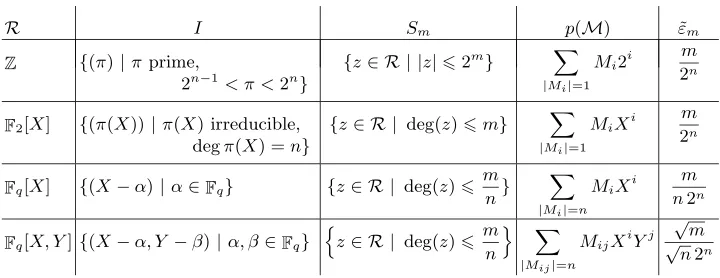
LetFq be a finite field and log2q=n, we give examples of such a construction in Table 1 and, for each of them, an approximation ˜εmof the corresponding collision boundεm.
Table 1.Examples ofεm-almost-universal hash families
R I Sm p(M) ε˜m
Z {(π)|πprime,
2n−1< π <2n }
{z∈ R | |z|62m} X |Mi|=1
Mi2i m
2n
F2[X] {(π(X))|π(X) irreducible,
degπ(X) =n}
{z∈ R | deg(z)6m} X
|Mi|=1 MiXi
m
2n
Fq[X] {(X−α)|α∈Fq} {z∈ R | deg(z)6 m
n}
X
|Mi|=n MiXi
m n2n
Fq[X, Y]{(X−α, Y −β)|α, β∈Fq}
n
z∈ R | deg(z)6 m
n
o X
|Mij|=n
MijXiYj √
m √
n2n
Such a generalization combined with the security results of Sect. 3 enables the design of FRMAC constructions which is adapted to non software targets. The reduction modulo an ideal of the form (X−α) inF2128, for instance, yields a (m/128×1/2128)-AU linear hash family which is
well suited for hardware applications.
5
Conclusion
In this paper, we studied the FRMAC message authentication code, a RMAC construction in which an ε-almost universal hash family is used instead of a CBC chain. This construction enables random nonces. When tags and nonces are of size n bits, we show as a consequence that the FRMAC security bound in the information theoretic model (2) is onlyn+ 1 times larger than the classical bound for Wegman-Carter’s MACs. Furthermore, since FRMAC takes advantage of the resistance of most of the block ciphers toXOR-related key attacks, the security
bound in the computational model (3) is not penalized by the PRF/PRP switching overhead. This finally yields a bound which is, as in RMAC, beyond the birthday paradox. Thus, for a given security level, FRMAC is able to use block ciphers with smaller block sizes, without any unicity requirement on the nonces.
References
1. M. Bellare, O. Goldreich, and H. Krawzyck. Stateless Evaluation of Pseudorandom Functions: Security beyond the Birthday Barrier. InAdvances in Cryptology – CRYPTO ’99. Springer-Verlag, August 1999.
2. M. Bellare, J. Killian, and P. Rogaway. The Security of the Cipher Block Chaining Message Authentication Code. InAdvances in Cryptology — CRYPTO’94, volume 839 ofLecture Notes in Computer Science, pages 341–358. Springer, 1994.
3. M. Bellare and T. Kohno. A Theoretical Treatment of Related-Key Attacks: RKA–PRPs, RKA– PRFs, and Applications. In E. Biham, editor,Advances in Cryptology — Proceedings of EURO-CRYPT 2003, Lecture Notes in Computer Science. Springer, 2003.
4. Mihir Bellare, Ted Krovetz, and Phillip Rogaway. Luby-Rackoff Backwards: Increasing Security by Making Block Ciphers Non-Invertible. In K. Nyberg, editor,Advances in Cryptology - EuroCrypt ’98, volume 1403, Berlin, october 1998. Springer-Verlag,. Lecture Notes in Computer Science. 5. D.J. Bernstein. Floating-Point Arithmetic and Message Authentication, March 2000. Submitted
for publication.
6. J. Black, S. Halevi, H. Krawczyk, T. Krovetz, and P. Rogaway. UMAC: Fast and Secure Message Authentication. InAdvances in Cryptology – CRYPTO ’99. Springer-Verlag, August 1999. 7. J.L. Carter and M.N. Wegman. Universal classes of hash functions. Journal of computer and
system sciences, 18:143–154, 1979.
8. J.L. Carter and M.N. Wegman. New hash functions and their use in authentication and set equality.
Journal of computer and system sciences, 22(18):265–279, 1981.
9. David Eisenbud. Commutative Algebra with a View Toward Algebraic Geometry. Number 150 in Graduate Texts in Mathematics. Springer, 1995.
10. ´Eliane Jaulmes.Analyse de s´ecurit´e de sch´emas cryptographiques. PhD thesis, ´Ecole Polytechnique, June 2003.
11. ´Eliane Jaulmes, Antoine Joux, and Fr´ed´eric Valette. On the Security of Randomized CBC-MAC beyond the Birthday Paradox Limit. A New Construction. In Joan Daemen and Vincent Rijmen, editors,Fast Software Encryption 2002, volume 2365 ofLecture Notes in Computer Science, pages 237–251. Springer Verlag, February 2002.
12. T. Kohno, J. Viega, and D. Whiting. CWC: A high-performance conventional authenticated en-cryption mode. InFast Software Encryption, Lecture Notes in Computer Science. Springer-Verlag, 2004. To appear.
13. H. Krawczyk. LFSR-Based Hashing and Authentication. In Y. Desmedt, editor, Advances in Cryptology — CRYPTO ’94, volume 839 of Lecture Notes in Computer Science, pages 129–139. Springer, 1994.
14. T. Krovetz and P. Rogaway. Fast Universal Hashing with Small Keys and no Preprocessing: The PolyR Construction. In D.H. Won, editor,ICIS 2000, volume 2015 ofLecture Notes in Computer Science, pages 73–89. Springer-Verlag, 2000.
15. Theodore T. Krovetz. Software-Optimized Universal Hashing and Message Authentication. PhD thesis, University of California Davis, September 2000.
16. X. Lai and J. L. Massey. A proposal for a new block encryption standard. In Ivan B. Damg˚ard, editor, Advances in Cryptology - EuroCrypt ’90, pages 389–404, Berlin, 1990. Springer-Verlag. Lecture Notes in Computer Science Volume 473.
17. Helger Lipmaa. IDEA, a cipher for multimedia architecture ? InSelected Areas in Cryptology’99, volume 1556 ofLecture Notes in Computer Science, pages 256–268. Springer-Verlag, 1999. 18. Helger Lipmaa. Fast software implementation of SC2000. In Information Security Conference
2002, volume 2433 ofLecture Notes in Computer Science, pages 63–74. Springer-Verlag, 2002. 19. Hideyuki Matsumura. Commutative Ring Theory, volume 8 of Cambridge studies in advanced
mathematics. Cambridge University Press, 1986.
21. Wim Nevelsteen and Bart Preneel. Software Performances of Universal Hash Functions. In J. Stern, editor,Advances in Cryptology — EUROCRYPT ’99, volume 1592 ofLecture Notes in Computer Science, pages 24–41. Springer, 1999.
22. NIST. Specification for the Advanced Encryption Standard (AES), November 2001. Federal Infor-mation Processing Standards publication 197.
23. B. Preneel, A. Biryukov, E. Oswald, B. van Rompay, L. Granboulan, E. Dottax, S. Murphy, A. Dent, J. White, M. Dichtl, S. Pyka, Schafheutle, P. Serf, E. Biham, E. Barkan, O. Dunkelman, M. Ciet, F. Sica, and H. Raddum L. Knudsen. Nessie security report. Technical report, NESSIE, October 2002. NES/DOC/ENS/WP5/D20/1.
24. B. Preneel, B. Van Rompay, S.B. Ors, A. Biryukov, L. Granboulan, E. Dottax, M. Dichtl, M. Schafheutle, P. Serf, S. Pyka, E. Biham, E. Barkan, O. Dunkelman, J. Stolin, M. Ciet, J-J. Quisquater, F. Sica 5 H.Raddum, and M. Parker. Performance of optimized implementations of the nessie primitives. Technical report, NESSIE, October 2002. NES/DOC/TEC/WP6/D21/1.
A
UH 16
eHash Functions
The functions UH 16e
kare defined from{0,1}∗to{0,1}16e, fore= 1, . . . ,16 andk= (k1, . . . , ke), by UH 161
k1(M)||. . .||UH 16
1
ke(M) where, forκ= (κ1, κ2, κ3),
UH 161κ(M) = IPHash 16κ3(PHash 128κ2(NHHash 16κ1(M))) .
The functions IPHash 16, PHash 128 and NHHash 16 are defined as follows.
– The function NHHash 16κ is based on the NHS 16 function. Mainly, letκ= (κ1, . . . , κ1024) be a 214-bit key, let
M=M1||. . .||Mb where|M1|=· · ·=|Mb−1|= 214, let +16 (resp. ×32) denote the signed addition (resp. multiplication) modulo 216(resp. modulo 232), then
NHHash 16κ(M) = NHS 16κ(M1)||. . .||NHS 16κ(Mb−1)||NHS 16κ(Mb) ,
where, with M =M1||. . .||Mb such thatMi is considered as an integer in [−215,215−1] for 1024>b>i>1 and with Mi= 0 fori > b,
NHS 16κ(M) = (M1+16κ1)×32(M2+16κ2) +· · ·+
(M1023+16κ1023)×32(M1024+16κ1024) +32|M| .
– The function PHash 128κis more classically based on the reduction modulo the primep128 equal to 2128
−159. Letκbe a 128-bit key, letM||1 =M1||. . .||Mb where |M1|=· · ·= |Mb−1|= 120, then,
PHash 128κ(M) =κb+ b−1
X
i=0
κi
Mb−i modp128 .
– The function IPHash 16κ folds its 128-bit input into a 16-bit output. Again, letp24 be the prime equal 224−3, let κ = (κ
0, . . . , κ16) be a 17×24-bit key, let M = M1||. . .||M16 where|Mi|= 16, then
IPHash 16κ(M) = (κ0+ 16
X
i=1
κiMimodp24
!
From [21, 15], we have the following results.
Lemma 7. Hash familyNHHash 16isεm-AU withεm= 1/215.
Lemma 8. Hash familyPHash 128isεm-AU withεm=m/2133.
Lemma 9. Hash familyPHash 128◦NHHash 16isεm-AU withεm= 1/215+m/2142.
Proposition 2. Hash familyUH 16e isεe
m-AU withεm= 1/215+ 3/224+m/2142.