Volume 2009, Article ID 727196,14pages doi:10.1155/2009/727196
Research Article
Downlink Resource Allocation for Autonomous
Infrastructure-based Multihop Cellular Networks
Mahdi Shabany
1and Elvino S. Sousa
21Department of Electrical Engineering, Sharif University of Technology, P.O. Box 11365-8639, Tehran, Iran
2Edward S. Rogers Sr. Department of Electrical and Computer Engineering, University of Toronto, Toronto, ON, Canada M5S 3G4
Correspondence should be addressed to Mahdi Shabany,[email protected]
Received 18 July 2008; Revised 7 December 2008; Accepted 15 February 2009
Recommended by Joerg Kliewer
Considering a multihop cellular system with one relay per sector, an effective modeling for the joint base-station/relay assignment, rate allocation, and routing scheme is proposed and formulated under a single problem for the downlink. This problem is then formulated as a multidimensional multichoice knapsack problem (MMKP) to maximize the total achieved throughput in the network. The well-known MMKP algorithm based on Lagrange multipliers is modified, which results in a near-optimal solution with a linear complexity. The notion of the infeasibility factor is also introduced to adjust the transmit power of base stations and relays adaptively. To reduce the complexity, and in order to analyze the underlying key factors in the system, the framework is restricted to a two-base-station two-relay system. In fact, the output of the proposed algorithm is the joint optimization of the routing path, and base-station selection to achieve the maximum total throughput in the system, which in conjunction with the proposed adaptive scheme leads to the implementation of the cell breathing via allocating the proper transmit power to the base-stations and relays.
Copyright © 2009 M. Shabany and E. S. Sousa. This is an open access article distributed under the Creative Commons Attribution License, which permits unrestricted use, distribution, and reproduction in any medium, provided the original work is properly cited.
1. Introduction
Future wireless systems will require the capability to sup-port very large throughput in selected areas, according to the location dependent and dynamic user demand,
rather than the capability to support uniform traffic and
coverage throughout a large service area. Ultimately given the constraint on the available bandwidth, very large system capacities can only be obtained by going to smaller cells by devising techniques for the reduction of the intercell
interference. One effective approach to do so is to utilize
multihop cellular network architectures [1–7].
In multihop networks, transmissions from a base station (BS) to a terminal occur over a number of hops, where devices other than base stations/access points or end-user terminals act as repeaters. The repeaters can be end-user terminals with a special functionality for relaying messages
in addition to acting as end-user equipment [8–10] (called
Type I multihop in this paper), or they can be devices with functionality restricted to relaying messages not including
the users (Type II multihop). In Type II multihop, repeaters can be designed with a simplified functionality, so that their cost can be significantly less than that of a regular BS or access point. With this approach and with the capability of being self-configuring, these relays can be deployed in an autonomous manner, so that the network infrastructure grows organically according to the local need for the capacity
increase [11]. Therefore, in this paper, we focus on Type II
multihop cellular networks.
as the forwarding traffic. We also refer to the transmission
on the regular FDD bands as in-bandforwarding, and the
transmission on an additional unlicensed band as
out-of-band forwarding. In-band forwarding is normally used in
Type I multihop networks [12], whereas in Type II multihop
networks, out-of-band forwarding is preferred. This is due to the fact that with in-band forwarding, the multihop structure
results in a traffic bottleneck at the BS and at repeaters that
are in the first hop. With out-of-band forwarding, which is the focus of this paper, the added spectrum alleviates this bottleneck problem and results in a much larger capacity per BS. The out-of-band approach also has the attractive feature that all terminals can be legacy terminals. With the proper design of the repeaters, the legacy terminals can easily operate in the multihop cellular network using the same protocols used in the single-hop cellular networks. In other words, the multihop architecture becomes transparent to the end-user terminals. In this case, the approach of adding repeaters in an autonomous manner and in a multihop structure becomes a scalable capacity enhancing technique for a regular cellular system.
We refer to the traffic over hops where the destination
is an end-user terminal as access traffic as opposed to the
forwarding traffic referred to above that involves a repeater
as the receiver. Thus, the forwarding traffic utilizes the
out-of-band spectrum, whereas access traffic utilizes the in-band
spectrum. The out-of-band approach essentially separates
the forwarding and access traffic. In so doing, from the access
traffic standpoint, the repeaters behave as if they are BSs.
In the forward link of wireless systems, a general resource allocation scheme optimized both in time and frequency such as the one in next generation network (NGN) can be considered. Here, without loss of generality, we consider only a time domain scheduling (TDS) scheme, where over short time slots, all the transmitted bits are directed to a given terminal.
In this paper, we propose an architecture for a network utilizing the out-of-band transmission for the forwarding
traffic along with TDS for the access traffic for the joint
optimization of the degree of the multihop, routing path, and BS selection to achieve the maximum total throughput in the system. The architecture under consideration is restricted to a two-BS two-relay system in two adjacent sectors facing each other. Although this model seems limited in scope, studying the resource allocation in this context allows us to derive a significant insight into the network performance behavior with respect to some key parameters of interest. Moreover, this model can be extended to either the case where the adjacent sectors within a cell are involved in the resource allocation or the intrasector cooperation where all BSs and relays within a two-tier hexagonal cell configuration are considered together.
Multihop cellular systems have been proposed in [1–
3,8,13]. These systems have been shown to both improve
the throughput and reduce the required total transmission power. However, there have been only few results clarifying how the self-configuring feature can improve the system capacity. Most current routing algorithms for multihop
cellular systems [8,9, 14] use path loss between terminals
BW1
BW2 BW2 BW2
BW1
Base station Relay User
Figure 1: The proposed system model for the scalable self-configuring networks.
and transmitters as a metric to determine the routing. Although these approaches are easy to implement, they are not optimal and cannot manage the congested areas or cells.
The proposed routing algorithm in [15] is based on the
receiver interference, but the underlying proposed scheme does not optimize the total achieved network throughput. A centralized eigenvalue-based routing algorithm for multihop
cellular networks is presented in [13]. Regardless of the
substantial disparities in the system topology, the objective is to balance between signal to interference plus noise ratio (SINR) and the total network power consumption. Although
[3] addressed the capacity of the multihop relaying with
nonuniform traffic, the topology and the routing issues are
not addressed in [3]. In [16], a multiple-layer access network
that uses the hierarchical routing is proposed, which leads to a low-power architecture for the uplink transmission.
2. System Model
We consider a two-tier hexagonal cell configuration. Each cell has a specific geographical coverage area, which is divided to six sectors. The multihop system under consideration is realized by the insertion of one relay in each sector of a BS. Our proposed scalable network architecture is shown inFigure 1. There are three main elements in the network meaning: BSs, relays, and the users. Thus, there are three possible links between the BS and relays and terminals. Since the insertion of the relays should be transparent to users, the transmission from the relays and BSs to the users (access
traffic) needs to be on the same frequency band, denoted by
f2inFigure 1. In fact, the insertion of relays does not make
any change to the network from the users’ point of view. However, as justified in the introduction, the transmission from the BSs to the relays or between two relays (forwarding
traffic) is of a different frequency band (BW1) from the one
used by the users in the cellular network (BW2). This might
1 k
12
k k2
21 k
Figure2: Two-BS two-relay system configuration.
In this paper, without loss of generality and for quan-titative analysis of the system, we assume that each BS can coordinate only with its six neighboring BSs, and the maximum allowable number of hops is two. The system is
shown inFigure 2, which shows two BS sectors facing each
other. Therefore, in a two-BS two-relay system, there are four
transmittersi=1, 2, 3, 4, wherei=1(2) corresponds to the
BS 1(2), and i = 3(4) denotes the relay 1(2), respectively.
The fast power control, compensating the fast fading, is assumed to be done by its corresponding mechanism, and the open-loop power control, compensating the slow fading
or shadowing, is performed every Tw seconds. Note that
different maximum power constraints for BSs and relays are
considered. We assume that each user jhas a required
aver-age data rate (Rj). Our proposed scheme for the routing and
resource allocation is performed every Tw seconds, which
is the length of a frame in time. The typical value ofTw is
10 milliseconds in the universal mobile telecommunications
system (UMTS) [17]. The proposed scheme in this paper can
be thought of as a scheduler, determining the set of users that should be served within each time slot. Considering the TDS scheme, each user in the set is served within a fraction of the whole period by the maximum BS transmit power.
3. Problem Definition
Our main objective in this paper is to maximize the total network throughput in a multihop cellular system, while considering the power constraints of BSs and relays. In fact, to maximize the total network throughput, the optimum set of users and their corresponding routes to connect to the system should be determined. We assume that users do not have any limitation on their maximum received data
rate, and the buffer size of relays is large enough. Based on
the system inFigure 2, only two BSs, corresponding to two
neighboring sectors, are involved in the resource allocation independent of the others. We assume that each relay covers
p(0≤p≤100) percentage of its corresponding sector area.
The resource allocation problem is solved for a snapshot of
the network whose length isTwseconds, so all the parameters
defined hereafter belong to a snapshot of the system. Let us
assume that there areNusers in the system and letRTdenote
the system total achieved rate vector with a 1×(N + 4)
matrix as RT = [r1,r2,r3,r4,r5,. . .,rN+4], wherer1,r2, r3,
r4 are the allocated rates of the first BS, second BS, first
relay, and second relay, respectively. The rest of the elements, r5,. . .,rN+4, represent the rates of the users. The elements of
RT are positive if they represent the received rate and are
negative if they show the transmitted rate. Due to the system’s
assumptions,ri > 0 for i = 5,. . .,N + 4, as users cannot
forward the access traffic to the others (Type II multihop).
Definition 1. Vi,jis a base vector whoseith element is−1 and
itsjth element is +1 and all the other elements are zero. (e.g.,
V1,3=[−1, 0, 1, 0,. . ., 0] means that BS 1 transmits and relay
1 receives).
Definition 2. VectorRTdefined above is a system rate vector
if and only if it can be written as a linear combination of
V1,j j ∈ {3, 5,. . .,N+ 4},V2,j j ∈ {4,. . .,N+ 4},V3,j j ∈
{4,. . .,N + 4}, or V4,j j ∈ {3, 5,. . .,N + 4}with positive
coefficients.
In fact, RT simply represents the case, where every
transmitter sends to only one receiver at each time slot (TDS). Here, the BSs are the transmitters, relays can be either transmitters or receivers, and the mobiles are always the
receivers. LetRdenote the optimal rate allocation vector at
a specific time slot for a set of two neighboring sectors. Thus,
given the time slot length, Tw, the optimal data allocation
vector would be RTw. Since R is a system’s total achieved
rate vector, based on the definition ofRT, it can be written
as R = [−RT1,−RT2, 0, 0,R1,R2,. . .,RN], where RT1, and
RT2 represent the total allocated data rate by BS 1 and 2,
respectively. Moreover,R1,. . .,RN denote the total received
data rate of N users. This means that the total amount
of transmitted and received data by relays are the same.
Therefore, no data is buffered in relays at the end of each time
slot (two zeros in the matrix). Note that no data buffering
means that no data is buffered once the current time slot is
over (i.e., at the end of eachTwseconds, the relays are empty).
However, data can be buffered in a relay during this period
and be sent at the proper time before the time expires. Using
the definition of the system’s rate vector (R) and the fact
that the transmission at this rate happens duringTwseconds,
the total system’s transmitted data vector can be written as follows:
RTw= N+4
j=5
τ1jR1jV1,j+τ2jR2jV2,j
+τ3jR3j(V1,3+V3,j)
+τ4jR4j(V2,4+V4,j)
+τ5jR3j(V2,4+V4,3+V3,j)
+τ6jR4j(V1,3+V3,4+V4,j)
,
(1)
whereRi jis the maximum data rate that transmitteri(a BS
or relay) can transmit to the receiver j (users) while using
its total allowable power, determined based on the hardware
limitations. Moreover, τi j, (τi j ≥ 0,∀i,j) is the required
time that transmitterihas to consume to be able to support
the average required data rate to userjwhile transmitting by
the maximum rateRi j. Since each userjis assumed to have a
required average rateRj, its serving time,τi j, should be large
enough to be able to support this amount of data. Finally,τ5j
andτ6jrepresent the amount of time during which relays 1
hops, respectively (Figure 3). The first (second) term in the
above summation is corresponding to the case that user jis
served by BS 1(2), while the third (fourth) term corresponds
to the case where user j is served by BS 1(2) via relay 1(2).
The last two terms are the cases where user jis served by BS
1(2) via two hops, respectively.
Because there is no diversity in the system, for each user, only one of the above terms is nonzero meaning that a user is served by a specific route at each time slot. This route determines the set of transmitters that are involved in forwarding the packets of that user and is fixed during each
Tw seconds. Therefore, the nonzero term determines both
the transmitter to which the user is connected to and the
routing paththrough which the packets are being forwarded.
For instance, τ1j=/0 means that user j is served by BS 1
directly;τ3j=/0 means that user j gets its packets from BS
1 after being forwarded to relay 1; finally,τ6j=/0 means that
packets of user jare forwarded from BS 1 to relay 1 then to
relay 2 and eventually to user j, (seeFigure 3for all possible
combinations).
The total power of BSs,PBS, is higher than that of relays,
PRLY (e.g., in our simulations, we usedPBS = LPRLY, where
L =5). This is because the relays are usually much smaller
and less costly than BSs and can be deployed more easily at the required locations. Based on this fact and the location of
BSs and relays (Figure 2), which is assumed to be symmetric,
we can conclude thatR13 ∼=R24 > R34 =R43. Our objective
is to maximize the total downlink throughput in the set of two neighboring BSs, which leads to a suboptimal solution
for the whole system. Therefore, using (1), the problem can
be written as the following optimization problem:
max
τi j N+4
j=5
(τ1jR1j+τ2jR2j+ (τ3j+τ5j)R3j+ (τ4j+τ6j)R4j)
(2)
s.t.
N+4
j=5
τ1j+
τ3jR3j+τ6jR4j R13
≤Tw, (3)
N+4
j=5
τ2j+
τ4jR4j+τ5jR3j R24
≤Tw, (4)
N+4
j=5
τ3j+τ5j+ τ6jR4j
R34
≤Tw, (5)
N+4
j=5
τ4j+τ6j+ τ5jR3j
R34
≤Tw. (6)
(Note that the above optimization problem can be general-ized by considering a weighted summation. This would not change the problem formulation as the proposed suboptimal framework can also be extended in that case. In other words, the proposed scheme can be applied to any arbitrary
weighted summation with different coefficients, appearing
in the problem constraints in (3)–(6). Conceptually, the
introduction of the weights can be used to achieve fairness, prioritize users, or optimize a more general cost function.
However, in this paper, the total achieved throughput is the objective cost function.)
The summation in (2) represents the total forwarded
data to all the users during a time slot (e.g., Nj=+45τ1jR1j
denotes the total amount of data that is sent by BS 1). The
constraints in (3)–(6) represent the time limitations during
each time slot for BS 1, BS 2, relay 1, and relay 2, respectively. This implies that the total allocated time by a transmitter
should be equal or less than the length of a time slot, Tw.
For instance, the first term in (3) denotes the required time
to support user j when it is assigned directly to BS 1. The
second term is the amount of time that BS 1 should spend
in order to support user j via relay 1, and finally, the last
term corresponds to the amount of allocated time of BS 1
to support userjvia relay 1 and then relay 2, respectively. We
assume that relays can transmit and receive at the same time,
andτi jis normalized byTwor simplyTw=1.
The optimization problem in (2) along with the
con-straints in (3)–(6) is NP-hard. Moreover, there is a
depen-dency between the constraints in (3)–(6). Using an adaptive
scheme proposed in Section 5, which converts the above
fourdependentconstraints into sixindependentconstraints,
it is possible to map the above problem to a
multidimen-sional multichoice knapsack problem (MMKP) (Section 4).
Although MMKP is NP-hard, there are polynomial-time
heuristic algorithms to solve it [18, 19]. In our proposed
adaptive scheme, each BS and relay reserves some portion
of its total transmit power for forwarding the traffic of
other relays or BSs. Referring to Figure 2, we assume that
BS 1 reserves k1PBS for serving the packets that should
be forwarded via relay 1. Relay 1 also reserves k12PRLY for
forwarding the packets that should be transmitted via relay 2. These packets are transmitted by two hops. The same thing applies to relay 2 and BS 2. We represent the reserved power
of relay 2 and BS 2 byk21PRLY andk2PBS, respectively. The
values ofk1,k2,k12,k21, all less than 1, are adjusted every
time slot based on the traffic profile of the BSs and relays
so as to make the traffic load as much balanced as possible.
In this paper, we refer to them simply as “kparameters.” In
brief, the proposed adaptive scheme makes the constraints
independent resulting in a balanced traffic load by adjusting
the values ofkparameters. The details will be described in
Section 5.
4. Mapping the Problem to MMKP
Using the adaptive scheme, we show that the optimization
problem in (2) can be mapped to an MMKP.
Proposition 1. Using the proposed adaptive scheme, the constraints in(3)–(6)can be written as
N+4
j=5
τ1j≤1−k1, (7a)
N+4
j=5
(a) (c) (e)
(f) (d)
(b)
τ1j=0 τ3j=0 τ6j=0
τ2j=0 τ4j=0 τ5j=0
Figure3: Possible routing paths for an arbitrary mobile within the network.
N+4
j=5
τ3jR3j≤k1R13−k12R34, (8)
N+4
j=5
τ4jR4j≤k2R24−k21R43, (9)
N+4
j=5
τ5jR3j≤k21R34, (10a)
N+4
j=5
τ6jR4j≤k12R43. (10b)
Proof. SeeAppendix A.
Inequalities (7a)–(10b) are conceptually related to the
different possible routing scenarios shown in Figures3(a)–
3(f). Although these inequalities are time-based constraints,
considering the TDS system, they also have power-based interpretations. In the time domain scheduling, during each time interval, the total power is allocated to a single user, while the rest of the users are inactive. The required
time interval (τ1j,τ2j,. . .) is inversely proportional to the
maximum deliverable data rate (Ri j) in the TDS mode, and
Ri j is proportional to the total available transmit power.
Therefore, more available power means smaller required time interval to serve a specific user. Thus, the available resource can be thought as either the time or power. For
example, constraints in (7a) and (7b) are related to the
maximum power limits of BSs 1 and 2, considering the reserved portion for the packet forwarding to relays 1 and
2, respectively. The constraint in (8) takes into account the
limitation on the transmitted power of the relay 1, which is
limited by the amount of power assigned to it by BS 1 (k1PBS)
minus the portion of its power reserved for relay 2 (k12PRLY).
Inequality (9) is the same constraint as (8) but for relay 2.
Finally, constraints in (10a) and (10b) show the limitation on
the amount of data that can be sent by each BS by forwarding via two relays due to the limited amount of allocated power
for this purpose by relays (k21PRLYandk12PRLY). The values of
k1,k2,k12,k21should be adjusted based on the traffic of BSs
and relays. Note that thekparameters should be chosen such
thatk1R13−k12R34 ≥0 andk2R24−k21R43 ≥0. These two
conditions correspond to the right hand-side of inequalities
in (8) and (9) meaning that relays cannot forward more than
the amount that is allocated by BSs. The constraints in (7a)–
(10b) can be represented in a general form of Nj=+45ai jxj≤Ci
for alli∈ {1,. . ., 6}, wherexjis 1 when user jis assigned to
the network and 0 otherwise,
ai j= ⎧ ⎪ ⎪ ⎪ ⎪ ⎪ ⎪ ⎨ ⎪ ⎪ ⎪ ⎪ ⎪ ⎪ ⎩
τi j ifi=1, 2,
τi jRi j ifi=3, 4,
τ5jR3j ifi=5,
τ6jR4j ifi=6,
(11)
Ci = (1 − k1), (1 − k2), (k1R13 − k12R34), (k2R24 −
k21R43), (k21R34), and (k12R43) fori= 1,. . ., 6, respectively.
Assignment of a user to the network implies that the user is being served during the current time slot.
Using Proposition 1, the optimization problem in (2)
along with its constraints (7a)–(10b) can be mapped to an
MMKP, an extended version of Knapsack problem (KP). In
MMKP, there is anM-dimensional knapsack with M total
allowable volumes ofW1,W2,. . .,WM. Furthermore, there
are N groups of items. Group j has nj items. Each item
has a value and anM-dimensional volume corresponding to
knapsack’sMdimensions. The objective of the MMKP is to
pick up exactly one item from each group to maximize the total value of the selected items, which subject to the volume constraints of knapsack’s dimensions.
The mapping of (2) to an MMKP is as follows. We
consider M knapsacks (here M = 6) presented by (7a)–
(10b) plus an auxiliary knapsack as “one knapsack” with
M + 1 dimensions, where the total allowable volume of
dimension i is Ci. Moreover, CM+1 corresponding to the
user is considered as a group, which has nj (here M + 1)
items. All items of user jexcept the (M+ 1)th item have an
equal value, which is the average required rate of that user.
The value of the last item is always zero. Thekth item of jth
user requires anM-dimensional volume, which is defined as
Ai jk=ai jifi=k /=M+ 1 and zero otherwise.
This ensures that itemkof any group, that corresponds
to knapsackk, can only be assigned to knapsackk. Therefore,
if item k of group j is selected in the optimal solution, it
means that user j has been assigned to the knapsackk, its
corresponding achieved throughput isRj, and the amount of
resource it requires from the knapsackkisak j. We have to
choose exactly one item from each group meaning that each user can be assigned to at most one knapsack. On the other hand, by the definition of MMKP, we have to choose exactly one item from each group. However, the selection of all users
is not feasible at all the times. Therefore, if user j does not
exist in the optimal solution, it means that its last item whose corresponding value and volumes are zero has been selected.
This indirectly implies that user jhas not been assigned to
the network.
Based on the above discussion, we can rewrite the
optimization problem using (2) andAi jkas
max
xk j N
j=1 M+1
k=1 xk jRj
, (12)
s.t.
N
j=1 M+1
k=1
xk jAi jk≤Ci ∀i∈ {1,. . .,M}, (13)
M+1
k=1
xk j =1 ∀j∈ {1,. . .,N},xk j ∈ {0, 1}, (14)
wherexk jis one when the itemkof userjis selected.
Because of the NP-hardness of the MMKP, exhaustive
search algorithms such as branch-and-bound [20] with
the globally optimal solutions are too time-consuming and can only be applied to the very small problems. The
computational complexity of these algorithms is O(2M2N).
However, several heuristic algorithms have been proposed
such as those in [18, 19], which are polynomial-time
suboptimal algorithms. In this paper, we use the modified
version of the algorithm presented in [18], which is based on
the Lagrange multipliers. Numerical results comparing the performance of the suboptimal methods, and the
branch-and-bound method (Section 6) justifies the use of this
heuristic algorithm. Here, for brevity of the discussion, we briefly outline the theory of Lagrange multipliers and the algorithm used to solve the MMKP based on the current notations in this section.
Theorem 1. Let λ1,λ2,. . .,λM be M nonnegative Lagrange
multipliers, and letx∗k jbe the solution of
max
xk j
N
j=1 M
k=1 xk jRj
−
M
i=1 λi
N
j=1 M+1
k=1 xk jAi jk
. (15)
Then, the binary variablesx∗k jare also the solution to
max
xk j N
j=1 M
k=1 xk jRj
, xk j ∈ {0, 1}, (16)
N
j=1 M+1
k=1
xk jAi jk ≤ N
j=1 M+1
k=1
x∗k jAi jk, ∀i∈ {1,. . .,M}. (17)
Proof. See [21].
According to this theorem, the solution to the
uncon-strained optimization problem (15) is also the solution
to the constraint optimization problem (16), which is the
MMKP in (13) with the constraint values Ci replaced by
N
j=1 M+1k=1xk j∗Ai jk. Therefore, if the multipliersλiare known,
the optimization problem is easily solved. This is because that
(15) can be written as
max
xk j N
j=1 M
k=1
Rj− M
i=1 λiAi jk
xk j
, (18)
which implies that the solutions are
x∗k j= ⎧ ⎪ ⎪ ⎨ ⎪ ⎪ ⎩
1 ifRj−
M
i=1
λiAi jk >0,
0, otherwise.
(19)
Therefore, the only step to do is to compute the Lagrange
multipliers λi. It is worth noting that if these multipliers
be computed such that the terms Ci − Nj=1
M k=1xk j∗Ai jk
are nonnegative, the solution is feasible. The heuristic algo-rithm based on the Lagrange multipliers, which produces
suboptimal values for λi and xk j simultaneously is shown
inAlgorithm 1. The algorithm starts with the most valuable
item of each userjas the selected item (Kj), and the Lagrange
multipliers initialized to zero such that the constraints in
(14) and (19) are satisfied. In general, however, the volume
constraints will now be violated. The initial choice of the selected items is revised to obey the volume constraints
by repeatedly improving the most violated constraint, I,
as shown inAlgorithm 1.
Consider the users whose selected items correspond to
the BSI(i.e.,{j | Kj =I}). For each itemkof these users,
the increaseΔk jin multiplierλIthat results from exchanging
the selected item of groupjis computed. Eventually, the item
K∗ of userJ∗, causing the least increase of multiplierλI, is
chosen for exchange. This choice minimizes the widening of
the gap between the optimal solution characterized byCi−
N j=1
M
k=1x∗k jAi jk and the solution returned by the MMKP
algorithm. The process is repeated until for each user an item has been selected such that the volume constraints are satisfied. Since each user has always an item whose value
and theM-dimension volume is zero, the solution is always
feasible.
After completion of DROP phase, there may be some
I. INITIALIZATION
step 1. λi←−0 ∀i=1,. . .,M;
step 2. Ai jk←−Ai jk/Ci ∀j=1,. . .,N;∀k=1,. . .,nj;
step 3.Kj =arg maxk(Rk j) andxkjj←−1 ∀j=1,. . .,N; step 4. Ti←− Nj=1Ai jKj ∀i=1,. . .,M;
II. DROP PHASE
While (Ti>1 for anyi) do
step 5.I=arg maxi{Ti}
step 6.
For{j|Kj=I}
Fork=1 :M
Δk j←−(RI j −Rk j−λI(AI jI−Ak jk))/AI jI
end end
K∗J∗=arg min
k j{Δk j} ∀j,k
step 7. λI←−λI+ΔK∗J∗
xKJ∗J∗←−0
xK∗J∗←−1 (i.e.,KJ∗←−K∗)
TI←−TI−AIJ∗I
TK∗←−TK∗−AK∗J∗K∗
end
III. ADD PHASE
While more items can be exchanged step 8.
Forj=1 :N Fork=1 :M+ 1
μk j=
⎧ ⎨ ⎩
Rk j−RKjj ifRk j−RKjj>0 &Tk+Ak jk≤1
0 o.w.
end end
step 9. KJ=arg max
k j{μk j} ∀j,k
step 10. TkJ←−TKJ−AKJJKJ TK←−TK+AKJK
xKJJ←−0
xKJ←−1 (i.e.,KJ←−K)
end
Algorithm1: MMKP algorithm for resource allocation in multi-hop cellular.
with more valuable ones. Therefore, in ADDphase of the
algorithm, each itemkof every userjis checked against the
selected item of that user (Kj). It is tested to see if item k
is more valuable than the selected item and ifkcan replace
the selected item without violating the volume constraints.
Among all exchangeable items, the itemKof userJcausing
the largest increase of the knapsack value is exchanged with
the selected item of that user (KJ). This process is repeated
until no more exchanges are possible. The resulting solution comprised of the selected items is feasible, and even optimal,
if Nj=1(λiCi− Nj=1
M
k=1xk j∗Ai jk)=0.
Note that due to the equality between the values of
different items of each userj,Rj, except its last item, we have
to make a tiny modification to be able to apply the algorithm. One simple way would be adding a very small value but
different to every item of a user. The last item should be
kept zero. Let us denote the value ofkth item ofjth user by
Rk j =Rj+εk j fork∈ {1,. . .,M}, whereεk j is a very small
value (e.g.,εk j = 0.01 in our simulations) but different for
every item of a user. This modification is necessary when we
are calculating the amount of increasingΔk jof the Lagrange
multiplier corresponding to the most violated constraint,I,
in Drop phase of the algorithm.
Theorem 2. The maximum difference between the total achieved throughput using the above suboptimal algorithm and the globally optimal solution is Mi=1λi(Ci− Nj=1
M+1
k=1x∗k jAi jk),
wherex∗k jis the output of the heuristic algorithm.
Proof. SeeAppendix B.
Based on Theorem 2, the solution is optimal if
M
i=1λi(Ci− Nj=1 M+1k=1xk j∗Ai jk) = 0 (i.e., the case whereby
error is zero). Numerical results inSection 6show that most
of the times of this gap is negligible. Therefore, the result is a good approximation of the globally optimal solution.
4.1. Computational Complexity. The following proposition
indicates that the proposed algorithm has a polynomial-time computational complexity.
Proposition 2. The heuristic algorithm proposed in
Algorithm 1 has a maximum computational complexity
ofO(N2M3).
Proof. Step 1has the complexity order ofO(M), andstep 2
to step 4 have the complexity order of O(NM). In the
while loop, step 5andstep 7 have the complexity order
of O(M) and O(1), respectively. In step 6 for each ofN
users, there are at mostM nonselected routing paths, thus
for each user, the maximum complexity order is M. Since
there is one iteration for each potential path associated with
each user, the total complexity order ofstep 6isO(NM2).
In every iteration ofstep 6, one assigned path is removed
from one user, thus, in the worst case, the while loop in the
DROP phase is executedNM times. Therefore, the overall
complexity order for the execution of the while loop of the
DROP phase isO(N2M3), where we also assume thatN
M. In the ADD phase, the complexity order ofstep 9and
step 10 is O(NM) and O(1), respectively. In step 8, for
each of theNusers, at mostMnonselected paths at most are
considered. Each computation has a complexity ofM. There
is one iteration for each knapsack, resulting in the complexity
order ofO(NM2) forstep 8. Since for each user there are, at
most,M potential knapsacks, which could have higher rate
than the assigned one, the outer while loop of the ADD phase
algorithm is executed at mostNMtimes. This gives an overall
complexity ofO(N2M3) for the ADD phase. Thus, the overall
computational complexity isO(N2M3).
5. Adaptive Scheme to Adjust
k
Parameters
In this section, we propose a scheme for adjusting
Table1: Adjustment of thekparameters. Two highestQ kvalues adjustments Q1 (Q3orQ5) k1↓ k12↓ k2↑ k21↑ Q1 (Q4orQ6) k1↓ k12↑ k2↑ k21↓ Q1 Q2 k1↓ k12↑ k2↓ k21↓ Q2 (Q3orQ5) k1↑ k12↓ k2↓ k21↑ Q2 (Q4orQ6) k1↑ k12↑ k2↓ k21↓ (Q4orQ6) (Q3orQ5) k1↑ k12↓ k2↑ k21↓
self-adaptive to the system’s traffic profile. The idea of
adjusting the values ofkparameters comes from the fact that
the maximum utilization of resources is obtained when there is cooperation between transmitters (BSs and relays). Let us
assume that at time slotn−1, we have solved the problem
(12) with constraints in (13)-(14). Thus, we know the best
suboptimal assignments of users to the relays and BSs at this time slot. Based on the given assignments, we can define the
infeasibility factors. The infeasibility factor of transmitteriat
time slotnis defined as
Qi(n)= N+4
j=5
ai j(n)xj(n)
Ci , (20)
which represents the ratio of the amount of the allocated
resource to the available resource of transmitteriat time slot
n. Remember thati =1(2) corresponds to BS 1(2),i=3, 5
denotes the relay 1, andi= 4, 6 corresponds to the relay 2.
ParameterQi(n) shows the amount of the allocated resource
of the knapsackiat time slotn. Based on these infeasibility
factors at each time slot, we can decide on the values ofk
parameters in the next time slot. One can think of step-based
variations in which, at each time slot, thekparameters are
increased or decreased by a specific predetermined value,
which is the strategy used in our simulations.Table 1shows
all the different possible scenarios and their corresponding
actions that need to be taken. The tables shows the two highest infeasibility factors as the base of the decision. For
instance, ifQ1andQ3are the two highest factors, the value
of the k1 should be decreased to release more resources to
the BS1. At the same timek12should be reduced to give more
resources to relay 1. On the other sidek2andk21may increase
to take care of the possible overload of BS1 and relay1. The other scenarios can be explained in the same way.
6. Simulation Results
We consider a two-tier hexagonal cell configuration with a wrap-around technique. A universal mobile telecommu-nication system, with a fast power controller running at 1500 updates per second, is simulated. The total number of 19 cells with cell radius 1000 m and BTS transmit power
of 10 W were considered. Moreover, the required E/I for
users is−13 dB, thermal noise density is−174 dBm/Hz, and
propagation loss exponent is 4. We focus on the central cell as the BS 1 and one of its neighbors as the BS 2 along with their
0.9 0.95 1 1.05 1.1 1.15 1.2 1.25 1.3 1.35 1.4
T
o
tal
thr
oug
h
put
ratio
in
BS
one
0.1 0.2 0.3 0.4 0.5 0.6 0.7 0.8 Distance of vertex of sub-cell to the boundary of BS (Rc)
k1=0.1,k2=0.3
k1=0.25,k2=0.3
k1=0.35,k2=0.3
k1=0.25,k2=0.4
Figure4: The ratio of the achieved throughput with relaying to the case without relaying in BS 1 versus the distance of the subcell to the BS for different values ofk1.
corresponding sectors. Hereafter, we call themcouple BSsand
couple sectors, respectively.
6.1. Throughput Versus Relay Location. First, we consider a
two-BS two-relay set including the neighboring sectors of BS 1 and BS 2 with 70 users distributed nonuniformly through the BSs’ coverage area as follows. Ten users were distributed randomly and uniformly throughout both cells (BS 1 and BS 2). Then, 60 users were distributed nonuniformly in BS
1 within a small hexagonal, called subcell, with radiusRc/10,
whereRc is the radius of the cells. The maximum number
of intermediate relays was set to 1. The distance of subcell
to BS is changed from 9Rc/10 to 2Rc/10. The ratio of the
achieved throughput in cell 1 for the case with relays to the
case without relays for different values of k parameters is
shown inFigure 4. In this case, we setk12 = k21 = 0 (i.e.,
at most one relaying),k2 =0.3 and we changed the value of
k1. It is seen that when users are on the cell boundaries, our
scheme outperforms greatly the case with no relays. However, by approaching the users toward the BS, our scheme’s result approaches to the case where there is no relay, which is expected. The reason is that for users that are closer to the BS the chance of relaying is small. This concept is seen for the case where the distance between the center of the
sub-cell and the BS 1 is less than 0.5Rc. Moreover, if the
sub-cell approaches further to the BS, the result is degenerated and gets even worse than the case with no relays. The reason is that, in this case, the BS allocates a special portion of its power to the relay, which has a tiny role in supporting the users that are close to the BS. Therefore, the higher the value
of k1, the worse the results. This result indirectly implies
the fact that thekparameters (k1 here) should be adjusted
properly based on the load of every transmitter and the traffic
pattern of the users. Moreover, the ratio of the achieved
throughput for different locations of the sub-cell for the case
is seen that the increase ink2just affects those cases where
the location of the subcell is close to the cell boundary. The
reason is that by adjusting thek1more users are supported
by BS 2 via relay 2.
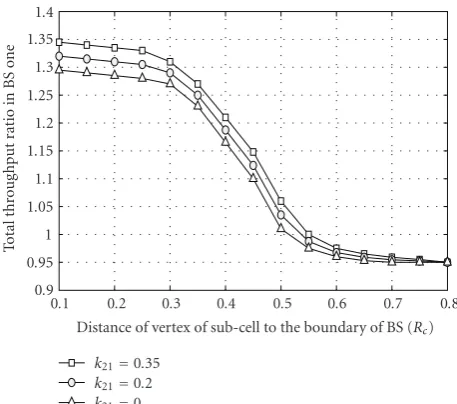
6.2. Intracell Relaying Versus Intercell Relaying. The ratio of the total achieved throughput in cell 1 for the case where there is at most one-relay forwarding option (intra-cell) to the case with two-relay forwarding (intercell) versus the
location of the sub-cell for different values of k21 is shown
inFigure 5. As it is seen, the whole system performance is improved. The location of unity gain is also shifted closer to
the BS. Ask21increases, the result gets better. This is because
some users are supported by BS 2 via relay 2 and then by relay 1, respectively (i.e., two-relay forwarding). Moreover, as the subcell approaches further to the BS further this gain decreases.
6.3. Adaption to the User Topology and Number of Users. Figure 6shows the throughput ratio of both cells, defined as the ratio of transmitted data over the required data versus the number of users in cell 2, which are distributed within a subcell under the relay 2. It clearly shows that depends
on the load of the BS 2, different values for k21 needs to
be used. For example, for 10 users, k21 = 0.2 is the best
choice, while for 14 users we have to switch tok21 = 0.4.
In this simulation, the number of users in BS 1 was set to 40, which were distributed uniformly throughout the cell,
k1=0.3,k12=0, andk2=0.3.
Moreover, 60 users were distributed non-uniformly through the two-BS two-relay set such that half of the users were located too close to the relay 1. The value of
k parameters was set initially to k1 = 0.15, k12 = 0.5,
k2 =0.3, andk21 =0.1. The variations of these parameters
were investigated in the four consecutive time slots. We
assumed quantized variations where at each time slot, thek
parameters can increase or decrease at most 0.05 of a unit.
The result is shown in Figure 7, where the horizontal axis
shows the time, and the vertical axis shows thekparameters.
The values of thekparameters were set improperly initially
to be able to see the performance of our adaptive scheme in conjunction with the knapsack problem. As it was expected,
the values of thekparameters were adaptively adjusted such
that the load becomes balanced between the transmitters. This means that the BS 1 allocated more power to the relay
1. The values ofk1 andk12 changed more compared to k2
andk21as they are directly related to the relay 1. Since the
relay 1 is the most congested transmitter almost in all time
slots, based on the adaptive scheme inSection 5,k1andk12
should increase and decrease, respectively, in the consecutive time slots in order to provide more available resources to the relay 1.
The ratio of the total achieved throughput with relays to that of without relays for the above four consecutive time slots was calculated. The ratio of the achieved throughput
shows an increase from 1.04 at T = 0 to 1.14, 1.25, 1.31,
and 1.34 atT =1,T = 2,T =3, andT =4, respectively.
0.9 0.95 1 1.05 1.1 1.15 1.2 1.25 1.3 1.35 1.4
T
o
tal
thr
oug
h
put
ratio
in
BS
one
0.1 0.2 0.3 0.4 0.5 0.6 0.7 0.8 Distance of vertex of sub-cell to the boundary of BS (Rc)
k21=0.35
k21=0.2
k21=0
Figure5: The ratio of the achieved throughput with relaying to the case without relaying in BS 1 for one-relaying and two-relaying cases versus the distance of the sub-cell to the BS for different values ofk21.
0.3 0.32 0.34 0.36 0.38 0.4 0.42 0.44 0.46 0.48
A
gg
regat
e
thr
oug
h
put
ratio
in
both
base
stations
0 5 10 15 20 25 30
Number of users in BS two
k21=0.2
k21=0.4
k21=0.6
k21
Figure 6: The aggregate throughput ratio in both base-stations versus the number of added users in BS 2 for different values ofk21.
This result clearly shows that the adjustment ofkparameters
results in a better performance.
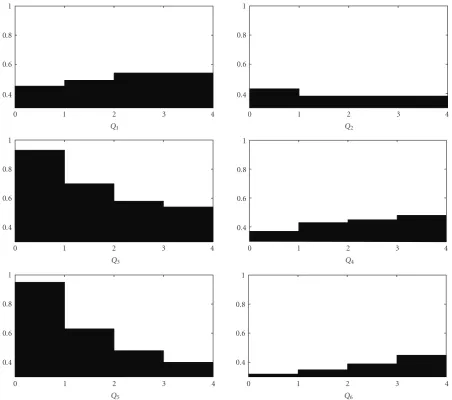
Figure 8shows the variation of infeasibility factors due
to the adjustments of k parameters. The values of these
factors are different at the first time slot because the values
of k parameters are not properly chosen. The difference
in infeasibility factors is translated to difference in the
load levels of knapsacks. By adjusting the k parameters,
0 0.2 0.4 0.6 0.8 1
0 1 2 3 4
k1
0 0.2 0.4 0.6 0.8 1
0 1 2 3 4
k12
0 0.2 0.4 0.6 0.8 1
0 1 2 3 4
k2
0 0.2 0.4 0.6 0.8 1
0 1 2 3 4
k21
Figure7: The variation ofkparameters due to the nonuniform traffic in the central cell.
of knapsacks are shared as much as the system’s topology permits.
6.4. Relay’s Coverage. We also considered the effect of the
relays’ coverage area on the total achieved throughput in the central cell. (There is a minimum SINR value required for each user to decode its data properly. A relay’s coverage is
defined as the area in the cell with an effective received SINR
larger than the threshold value.) Note that if a user is outside of a relay’s coverage, it means that the data of that user cannot be forwarded by that relay, meaning that its corresponding
coefficient in (2) is zero. Two cases are investigated, namely,
the limited coverage and the limited capacity scenarios. In the limited coverage case, the number of users distributed in the cell is not too much (50 users in our simulation). However, in the limited capacity case, 100 users were distributed in the
cell boundary. The results for two different cases (k1 =0.12
andk1=0.2) are shown inFigure 9.
In the limited coverage case, by increasing the coverage area of the relays, the total achieved throughput is increased accordingly. This is because the number of users is not too much and they can be supported if there is a good coverage in the system. In other words, the relay’s coverage is the limiting factor. However, in the limited capacity case, the number of users is so large that before increasing the coverage of relays to the maximum, the system reaches the maximum capacity.
This maximum capacity also depends on the value ofk1, as
shown inFigure 9.
6.5. Complete System Simulation. Finally, a cellular network
with a two-tier hexagonal cell configuration consisting of 19 cells is simulated. The wrap-around technique is also employed. Each cell has six sectors, where each sector is in cooperation with its neighboring sector in the neighboring cell. The pilot channel power is adjusted so that 40% of the users receive the pilot channel of the two BSs with an acceptable quality. The users’ nonuniform spatial
distribution is represented by a nonuniformity factor,χ. This
means that (1−χ)Nusers are distributed uniformly, and the
rest of them are distributed in randomly located spots. For
comparison, we consider three different systems. In system
I, there is no relaying in the system, and the routing scheme is based on a the pilot signal strength, so that the BS with
the greatest Ec/I0 is assigned to the user. In system II, the
transmitter assignment is similar to that of system I; while we consider two relays in the system. Finally, system III uses our proposed joint rate allocation and routing scheme considering both BSs and the relays.
The effect of our proposed scheme on the normalized
average achieved throughput is simulated while considering the nonuniformity factor. Two cases of user spatial
0.4 0.6 0.8 1
0 1 2 3 4
Q1
0.4 0.6 0.8 1
0 1 2 3 4
Q2
0.4 0.6 0.8 1
0 1 2 3 4
Q3
0.4 0.6 0.8 1
0 1 2 3 4
Q4
0.4 0.6 0.8 1
0 1 2 3 4
Q5
0.4 0.6 0.8 1
0 1 2 3 4
Q6
Figure8: The variation of theQfactors due to the adjustment of thekparameters.
are executed 1000 times. For simplicity, the average achieved throughput of systems II and III is normalized by the average
achieved throughput of system I. Figure 10 illustrates the
normalized average achieved throughput versus the average number of users in each cell. As it can be seen, the average throughput of system III is larger than that of system II. The
difference between the throughput gains of systems II and
III indicates the gain due to using the MMKP capability to exploit the local information about the users locations and channel quality within the system. This gain is increased by the nonuniformity of the spatial distribution of the users.
6.6. Complexity Analysis. In order to study the run-time
performance of the algorithm, we implemented it along with the optimal algorithm based on the branch and bound search using linear programming for the upper bound computa-tion. We have performed experiments on an extensive set of the problem sets, where we used randomly generated MMKP instances for our tests. For each set of parameters
NandM, we run the algorithm ten times and tabulated the
average of the achieved throughput and the execution time. Table 2 shows the percentage of the achieved throughput using our heuristic method compared to the value achieved
in the optimal case. Moreover, the third column ofTable 2
shows the required execution time in the heuristic method compared to that of the branch-and-bound method. It shows that the performance is really good for the large sets (greater than 95% most of the time), while the execution time is just a few percent of the time required for the optimal solution (less than 5%).
7. Conclusion
0.9 0.95 1 1.05 1.1 1.15 1.2 1.25 1.3 1.35 1.4
The
ratio
of
to
tal
ac
h
ie
ve
d
thr
oug
h
put
wi
th
to
wi
th
o
u
t
re
la
y
0 0.05 0.1 0.15 0.2 0.25 0.3 0.35
Rc
Capacity limited,k1=0.2 Capacity limited,k1=0.12 Coverage limited,k1=0.12 Coverage limited,k1=0.2
Figure9: The total achieved throughput with and without relaying versus the relays’ coverage.
1.8 2 2.2 2.4 2.6 2.8 3 3.2
N
o
rm
alised
av
er
age
ac
h
ie
ve
d
thr
oug
h
put
20 25 30 35 40 45
Average number of users per cell System III,χ=0.2
System III,χ=0.5
System II,χ=0.2 System II,χ=0.5
χ=0.2
χ=0.5
Figure10: The normalized average achieved throughput of systems III and II versus the average number of users per cell.
algorithm based on the Lagrange multipliers was then modified to find a near-optimal solution with a linear complexity. The concept of the infeasibility factor was introduced to adjust the transmit powers of both the BSs and relays. In fact, the output of our algorithm is the joint rate allocation, routing scheme, and BS/relay assignment, which in conjunction with the proposed adaptive scheme leads to the implementation of the cell breathing via allocating the proper transmit powers to the BSs/relays.
Table 2: Performance comparison of Branch-and-bound and a Heuristic algorithm in terms of total achieved throughput and execution time.
N Value % Time %
40 92.5 15.3
70 95.6 4.2
100 97.3 3.9
130 98.1 2.7
160 97.7 2.7
190 98.1 2.9
220 98.5 3.1
250 98.7 3.1
280 97.5 3.9
310 97.4 3.0
340 98.3 2.4
370 99.3 1.9
400 99.2 2.6
Appendices
A. Proof of
Proposition 1
The idea is to make the constraints independent of one another to be able to formulate the optimization problem
using MMKP. We assume that Tw = 1. First, let us
consider the constraint (3). The BS 1 reservesk1 portion
of its total resource (time in TDS) for relay 1, meaning that the remaining resource that can be used for the direct transmission from BS 1 to the users can be written as
N+4
j=5τ1j≤1−k1, which in turn implies that
N+4
j=5 τ
3jR3j+τ6jR4j R13
≤k1. (A.1)
On the other hand, allocatingk12PRLYof the total power
of the relay 1 to forward the packets to the relay 2 leads to the following two constraints:
N+4
j=5 τ
6jR4j R34
≤k12, (A.2)
N+4
j=5
(τ3j+τ5j)≤1−k12, (A.3)
where (A.2) represents the part of relay 1 resource that is
allocated to relay 2 (rememberτ6jdenotes the required time
to forward the packets from relay 1 to relay 2), and (A.3)
represents the remaining resource for relay 1 to serve the
users (seeFigure 3).
The constraints (A.2) along with (A.1) result in
N+4
j=5 τ
3jR3j R13
≤k1−
k12R34
R13
Taking the same approach for relay 2, a counterpart
constraint like the one forτ5jcan be obtained forτ5jas
N+4
j=5 τ
5jR3j R34
≤k21. (A.5)
There are three constraints onτ3jandτ5j,namely, (A.3),
(A.4), and (A.5). Therefore, we need to prove that (A.4)
and (A.5) are the limiting constraints, meaning that they are
more restrictive than (A.3). To do so, we use the result of the
following proposition.
Proposition 3. Consider two constraints Ni=1xi ≤ a and N
i=1xiyi ≤ b;xi,yi ≥ 0, the second one is more limiting if
and only if1/ yi≤a/b.
Proof. (LetN=2, then two constraints are two straight lines
x1+x2 ≤ a andx1y1+x2y2 ≤ b in the two-dimensional
Euclidean space. The valid values for each constraint are
the area between its corresponding line and the linesx1 =
0 and x2 = 0. Therefore, the second constraint is more
limiting when its area is a subset of the first one and this
happens when 1/ y1 ≤a/band 1/ y2 ≤a/b. Similarly, in the
three-dimensional space, x1y1+x2y2+x3y3 ≤ b is more
limiting thanx1+x2+x3 ≤ a when the projection of this
plane in each two-dimensional surface composed of (x1,x2),
(x1,x3), (x1,x3) satisfies the conditions like the above, which
leads to 1/ yi ≤ a/bfor all i ∈ {1, 2, 3}. This idea can be
generalized for N parameters in N-dimensional Euclidean
space accordingly.)
Proposition 4. The constraints in(A.4)and (A.5)are more restrictive than(A.3).
Proof. Combining (A.4) and (A.5) yields Nj=+45((τ3j +
τ5j)R3j) ≤ k1R13−k12R34+k21R34. UsingProposition 3, it
is just needed to show that based on the realistic values of the parameters, the following inequality holds
1 R3j ≤
(1−k12)
(k1R13−k12R34+k21R34) ∀j∈ {
5,. . .,N+ 4},
(A.6)
where yi = R3j,a = (1−k12), andb = (k1R13−k12R34+
k21R34). On the average, the distance of the relay 1 to any of
its users is less than its distance to the relay 2 and BS (about
half). Moreover, the total power of BSs areLtimes that of the
relays. These all lead to the result thatR3j ∼=16R13/L, where
16 is the result of the power dissipation with exponent 4, and
the values ofkparameters are assumed in average to be 0.4
in our modeling. Therefore, the inequality in (A.6) evaluates
as 1/(16R13/L)≤0.6/0.4R13, which considering the fact that
L ∼=5 (Section 3) holds for all values of j. This means that
constraints in (A.4) and (A.5) are more limiting than (A.3).
B. Proof of
Theorem 2
Let us assumeX∗= {x∗
k j}is the output of the algorithm, and
Y∗ = {y∗
k j}is the result of the globally optimum solution.
Based on the definition in the above algorithm, Ti∗ =
N
j=1 M+1k=1xk j∗Ai jk. Therefore, the total achieved throughput
using the heuristic algorithm can be written as
N
j=1 M
k=1 xk j∗Rj=
M
i=1 N
j=1 M+1
k=1
λix∗k jAi jk
+
N
j=1 M
k=1 x∗k jRj−
M
i=1 N
j=1 M+1
k=1
λixk j∗Ai jk
+
M
k=1 λiTi∗+
N
j=1 M
k=1
Rj− M
i=1 λiAi jk
xk j∗,
(B.1)
where (B.1) is derived using the fact thatAi jk=0 ifk=M+1
for alli,j. For the optimal solution,Y∗, we can rewrite the
same expression as in (B.1) as
N
j=1 M
k=1 yk j∗Rj=
M
k=1 λiTi∗+
N
j=1 M
k=1
Rj− M
i=1 λiAi jk
y∗k j, (B.2)
whereTi∗=
N j=1
M+1
k=1yk j∗Ai jk. By definition,Ti≤Cifor all
i. Therefore, the upper limit for (B.2) is
N
j=1 M
k=1 yk j∗Rj≤
M
k=1 λiCi+
N
j=1 M
k=1
Rj− M
i=1 λiAi jk
y∗k j.
(B.3)
Using (B.1) and (B.3), the difference between the total
achieved throughput using the suboptimal algorithm and the global optimal solution is
N
j=1 M
k=1
Rj(y∗k j−xk j∗)≤ M
k=1
λi(Ci−Ti∗)
+ N
j=1 M
k=1
Rj− M
i=1 λiAi jk
y∗k j
− N
j=1 M
k=1
Rj− M
i=1 λiAi jk
x∗k j
.
(B.4)
Let us denote the last term in (B.4) as W =
N j=1
M
k=1βk jy∗k j − N
j=1 M
k=1βk jx∗k j, where βk j = (Rj −
M
i=1λiAi jk). We define the following setsH1=(X∗∪Y∗)−
Y∗,H2=(X∗∪Y∗)−X∗, andH3=(X∗∩Y∗).
For the elements of H3, it is clear that W is equal
to zero. For the elements of H1, Nj=1
M
k=1βk jyk j∗ = 0
and Nj=1 Mk=1βk jx∗k j ≥ 0, hence W ≤ 0. As for the
elements ofH2, Nj=1 Mk=1βk jy∗k j ≤ 0 (sinceβk j ≤ 0) and
N
j=1 Mk=1βk jx∗k j = 0, thus, againW ≤ 0. Therefore, in all
cases, we haveW≤0, which in conjunction with (B.4) leads
to Nj=1 Mk=1Rj(y∗k j−xk j∗)≤
M
k=1λi(Ci−Ti∗)= M
k=1λi(Ci− N
j=1 M+1