R E S E A R C H
Open Access
Outage probability of a relay strategy allowing
intra-link errors utilizing Slepian-Wolf theorem
Meng Cheng
1*, Khoirul Anwar
1and Tad Matsumoto
1,2Abstract
In conventional decode-and-forward (DF) one-way relay systems, a data block received at the relay node is discarded, if the information part is found to have errors after decoding. Such errors are referred to as intra-link errors in this article. However, in a setup where the relay forwards data blocks despite possible intra-link errors, the two data blocks, one from the source node and the other from the relay node, are highly correlated because they were transmitted from the same source. In this article, we focus on the outage probability analysis of such a relay transmission system, where source-destination and relay-destination links, Link 1 and Link 2, respectively, are assumed to suffer from the correlated fading variation due to block Rayleigh fading. The intra-link is assumed to be represented by a simple bit-flipping model, where some of the information bits recovered at the relay node are theflippedversion of their corresponding original information bits at the source. The correlated bit streams are encoded separately by the source and relay nodes, and transmitted block-by-block to a common destination using different time slots, where the information sequence transmitted over Link 2 may be a noise-corrupted interleaved version of the original sequence. The joint decoding takes place at the destination by exploiting the correlation knowledge of the intra-link
(source-relay link). It is shown that the outage probability of the proposed transmission technique can be expressed by a set of double integrals over the admissible rate range, given by the Slepian-Wolf theorem, with respect to the probability density function (pdf) of the instantaneous signal-to-noise power ratios (SNR) of Link 1 and Link 2. It is found that, with the Slepian-Wolf relay technique, so far as the correlationρof the complex fading variation is|ρ|<1, the 2nd order diversity can be achieved only if the two bit streams are fully correlated. This indicates that the diversity order exhibited in the outage curve converges to 1 when the bit streams are not fully correlated. Moreover, the Slepian-Wolf outage probability is proved to be smaller than that of the 2nd order maximum ratio combining (MRC) diversity, if the average SNRs of the two independent links are the same. Exact as well as asymptotic expressions of the outage probability are theoretically derived in the article. In addition, the theoretical outage results are compared with the frame-error-rate (FER) curves, obtained by a series of simulations for the Slepian-Wolf relay system based on bit-interleaved coded modulation with iterative detection (BICM-ID). It is shown that the FER curves exhibit the same tendency as the theoretical results.
1 Introduction
In many wireless communication systems, channels are assumed to suffer from variations due to fading. One of the most reasonable and hence widely accepted model for block-wise transmission is the block Rayleigh fading channel, where the channel realization changes block-by-block. With the block fading assumption, if the channel state information (CSI) is unknown to the transmitter,
*Correspondence: [email protected]
1School of Information Science, Japan Advanced Institute of Science and Technology (JAIST), 1-1 Asahidai, Nomi, Ishikawa 923-1292, Japan Full list of author information is available at the end of the article
achieving always error-free transmission is not possible. This is simply because the transmission chain parameter cannot be flexibly changed at the transmitter without the knowledge of CSI, which invokes the necessity of the out-age analysis. The result of the outout-age analysis provides the system operators estimate with which probability the quality of service (QoS) requirement can be satisfied [1].
Relay systems [2] have been well studied in the recent years, assuming various relay strategies, such as amplify-and-forward (AF) and decode-amplify-and-forward (DF) tech-niques [3,4], etc. In the case of DF, the information bit streams recovered at the relay may contain errors
occurring in the source-relay link, referred to as the intra-link in this article. In conventional DF systems, the recov-ered data block is discarded if the relay detects errors in the information part after decoding. However, in a setup where the relay forwards data blocks despite possible intra-link errors, the information streams received by the destination via the source-destination link (Link 1) and the relay-destination (Link 2) are highly correlated, because they were transmitted from the same source. In [5], the idea of the Slepian-Wolf coding is first introduced in wireless cooperation scenarios with the aim of exploiting the distributed correlated source coding concept. Refer-ence [6] also formulates the issue from the viewpoint of the Slepian-Wolf theorem, in a different way from [5], where the intra-link error probability is used to express the source-relay correlation [6]. The intra-link error prob-ability can be estimated and further utilized in the joint decoding process at the destination node, by utilizing a log-likelihood ratio (LLR) updating function [6].
The primary goal of this article is to theoretically analyze the outage probability of the relay system pre-sented in [6] and its asymptotic properties, both based on the Slepian-Wolf theorem. Originally, the Slepian-Wolf theorem determines the admissible rate region for the compression of correlated sources. The theorem states that compared with the case where the information bit streams are assumed to be independent, higher compres-sion rate can be achieved by exploiting the correlation knowledge of the sources. Furthermore, the two corre-lated source streams can beseparately encoded at each transmitter side, and the compressed data received by the receiver are jointly decoded by a common decoder. According to the Slepian-Wolf theorem, by utilizing the correlation knowledge of the sources at the receiver, the joint decoder can achieve the same compression rate as in the case that the sources are encoded by optimum joint encoders. This theorem can be applied to many practical applications, such as the sensor networks where measure-ments of the same object are performed by the separated sensors, and hence, the results are correlated.
This article assumes a bit-flipping model for the intra-link transmission [7], where some of the recovered bitsb2 at the relay node areflippedversions of their correspond-ing original information bitsb1at the source node. Hence, b2 = b1⊕ewith probability Pr(e = 1) = pe, and since
μ = (2b1−1) (2b2−1) = 1−2pe,(−1 ≤ μ ≤ 1), with·indicating the expectation operator, we usepeand
μ both equivalently describing the correlation between b1andb2[8]. In fact, the value ofpe depends on many parameters, related to the intra-link transmission such as modulation-and-detection schemes and/or encoding-and-decoding methods. However, this article usespeas a parameter. Thepevalue can be estimated by the destina-tion, block-by-block, as presented by [6], and hence, this
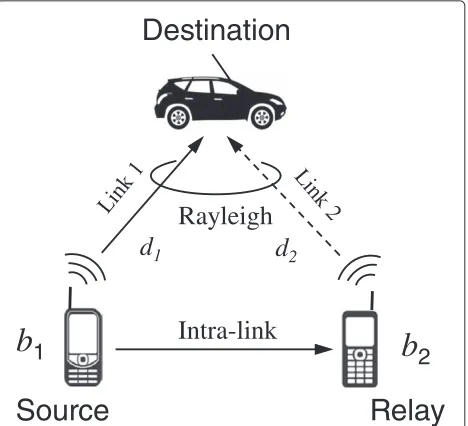
assumption is reasonable in practical applications. On the other hand, if we would calculate the outage probability of the system wherepeis assumed to be a random variable, we would have to derive the distribution of pe, which is not practical due to the fact described above. Hence, we assume that the intra-link is stable and hencepeis a con-stant. The scenario under consideration is exemplified as depicted by Figure 1. In the assumed scenario, the chan-nel gains of either one or both of the two links fade below the threshold values required for successful transmission, which defines the outage event. In this study, we show that the theoretical outage probability of the Slepian-Wolf relay system can be expressed by double integrals over the admissible rate region defined by the Slepian-Wolf theorem, with regard to the probability density function (pdf) of the instantaneous signal-to-noise power ratios (SNRs).
This article is organized as follows. The relay trans-mission model assumed in this article is introduced in Section 2. The admissible rate region is defined in Section 3, based on the Slepian-Wolf theorem, for the relay transmission model introduced in Section 2. The outage probabilities of the Slepian-Wolf relay system are then derived theoretically in Section 3, assuming that Link 1 and Link 2 are suffering from correlated block Rayleigh fading, where the fading variation of Link 1 and Link 2 are assumed to be correlated because of the sce-narios assumption presented in Figure 1. The theoretical proofs of the asymptotic tendency of the outage curves are presented in Section 4. In Section 5, we apply the Slepian-Wolf relay technique provided in [6] to a bit-interleaved
Source
Relay
Destination
Intra-link
b
1
b
2
Rayleigh
d
1d
2coded modulation with iterative detection (BICM-ID), as an example, to demonstrate how the correlation knowl-edge can be used. Numerical results are presented in Section 6, where it is verified that the performance ten-dency obtained by Section 5 is consistent to the simulated results. Conclusions are drawn in Section 7 with same concluding results.
2 System model
We consider a simple one-way relay transmission model, as shown in Figure 1. The original information bit stream b1 is broadcasted from the source node during the first time slot. The relay aims to recoverb1before re-encoding and forwarding it to the destination during the second time slot, as in the DF strategy. The recovery ofb1might not be perfect, however, the proposed Slepian-Wolf relay-ing system will allow re-transmission despite possible intra-link errors.
Because of the reason described in the introduction, the intra-link error probabilitypeis assumed to be constant, even thoughpecan be estimated by the destination only [6], block-by-block, in practice.pedoes not have to rep-resent the bit error probability of therealintra-link signal transmission. It represents the error probability of the vir-tuallink between source and relay node: it may be before or after the decoding of the channel code. This article only uses the probabilitypeas a parameter in theoretical analyzes regardless of the intra-link transmission scheme. Withd1andd2representing the lengths of Link 1 and Link 2, respectively, and with the geometrical gain [9] of Link 1,G1, being normalized to 1, the geometric gain of Link 2, relative to Link 1, can be defined as
G2=
d1 d2
α
, (1)
where in this article the path loss factorαis set at 3.52 as in [10]. The received signalsy1andy2at the destination, received via Link 1 and Link 2, respectively, are expressed as follows:
y1=
G1h1s1+n1, (2)
y2=
G2h2s2+n2, (3)
wheres1ands2 are the modulated symbols transmitted from the source and relay nodes, respectively, andniand hi(i = 1, 2)denote the zero-mean white additive Gaus-sian noises (AWGN) with the varianceσi2per dimension and the complex channel gain of Linki, respectively. It is assumed thatσ12= σ22 =σ2andh1andh2are kept con-stant over one block duration due to the block Rayleigh fading assumption. With the definitions described above, the instantaneous SNR of Link i is denoted by γi = Gi|hi|2Es,i/
2σ2, where Es,i represents the per-symbol signal power of Link i. The joint decoding process then
takes place for the received signals ysd and yrd at the destination node.
3 Outage probability derivation
3.1 Outage definition
The definition of the outage probability of the proposed Slepian-Wolf relay system is derived in this subsection. LetR1 and R2 denote the rates of the bit streams from the source and relay nodes, respectively. According to the Slepian-Wolf theorem [11], if R1 and R2 satisfy the following three inequalities, the transmitted data can be recovered with arbitrary low error probability.
R1H(b1|b2), (4)
R2H(b2|b1), (5)
R1+R2H(b1,b2), (6)
whereH(b1 | b2)andH(b2 | b1)denote the conditional entropy ofb1andb2, given b2 andb1, respectively, and H(b1,b2)denotes the joint entropy of the correlated infor-mationb1andb2. When the rateR1for transmitting the information streamb1is equal to its entropyH(b1), the rate R2 for transmitting the information stream b2 can be less than its entropy H(b2), but it has to be larger than the conditional entropyH(b2 | b1), as indicated by the pointX1in Figure 2. Similarly, whenb2is transmit-ted at the rate H(b2), then b1 can be transmitted at the rate which is less thanH(b1) but should be larger than H(b1| b2)as indicated by the pointX2in Figure 2. Since the binary symmetric source model (Pr(1)=Pr(0)=0.5) is assumed in this article, H(b1) = H(b2) = 1, H(b1 | b2) = H(b2 | b1) = H(pe),H(b1,b2) = 1+H(pe)with
Admissible
Region
H(b1|b2) H(b1) H(b1 ,b2)
H(b2)
1
2
H(b1 ,b2)
R
1R
2H(b2|b1)
3
4
X
2X
1H(pe)= −pelog2(pe)−(1−pe)log2(1−pe). Assume that a channel capacity-achieving code is used for the transmis-sion over Linki. The relationship between the threshold instantaneous SNR and its corresponding rateRi is given by
Ri= 1 Rci
log(1+γi), i=1, 2 (7) whereRcirepresents the spectrum efficiency of the trans-mission chain, including the channel coding scheme and the modulation multiplicity within Linki[7].
As shown in Figure 2, the entire rate region for the rate pairR1andR2 can be divided into four parts, with Pj,j= {1, 2, 3, 4}, representing the probability thatR1and R2fall into Partj. The common admissible rate region for the case of two correlated sources can be expressed by an unbounded polygon, which corresponds to Part 3 of the rate region shown in Figure 2. The two correlated bit streams cannot be successfully recovered if the rates R1 andR2are not within the admissible region Part 3. Hence, the outage event happens whenR1andR2fall outside the Slepian-Wolf admissible region, with the probability of
Pout,sw=1−P3,
=P1+P2+P4.
(8)
However, in this article, both Part 3 and Part 4 are sup-posed to be included as the admissible rate region [12], because in the one-way Slepian-Wolf relay system inves-tigated in this article, we only focus on the transmission of the source information b1. The data to be transmit-ted from the relay node actually is the erroneous copy of the original information bit stream, interleaved by0as shown in Figure 3a. Therefore, analyzing the impact of Link 2 on the outage probability is our target. In other words, an arbitrary value ofR2is satisfactory as long as R1is larger thanH(b1). In this case, theindividual out-age event happens when the pair (R1,R2) falls in Part 1 or Part 2, and the outage probability of the Slepian-Wolf relay model considered in this article is defined as
Pout, relay=1−P3−P4,
=P1+P2.
(9)
Thus, the conditions onR1andR2to achieve arbitrary low bit error rate are given bya
P1=Pr [0<R1<H(b1|b2),R2>0] ,
=Pr0< γ1<2Rc1H(b1|b2)−1,γ2>0
. (10)
P2=Pr [H(b1|b2) <R1<H(b1),R1+R2<H(b1,b2)] ,
=Pr2Rc1H(b1|b2)−1< γ
1<2Rc1H(b1)−1,
0< γ2<2
Rc2H(b1,b2)−RcRc21log(1+γ1)
−1.
(11)
3.2 Outage calculation
3.2.1 Independent links
In this section, the outage probability is derived, based on the Slepian-Wolf relay model. With an assumption that both Link 1 and Link 2 suffer from statistically indepen-dent block Rayleigh fading, the jointpdf of the instanta-neous SNR can be expressed as p(γ1,γ2) = p(γ1)p(γ2), with [13]
p(γi)= 1
i
exp(−γi i
), i=1, 2 (12)
wherei = GiEs,i/
2σ2, which represents the normal-ized average SNR of thei-thlink. Based on (10) and (11), the probabilitiesP1andP2can be mathematically derived as follows
P1=
2Rc1H(b1|b2)−1
γ1=0
∞
γ2=0
p(γ1)p(γ2)dγ1dγ2,
= 2
Rc1H(b1|b2)−1
γ1=0
1
1
exp(−γ1
1
)dγ1,
=1−exp
−2Rc1H(b1|b2)−1 1
, (13)
and
P2=
2Rc1H(b1)−1
γ1=2Rc1H(b1|b2)−1
× 2
Rc2H(b1,b2)−Rc2
Rc1log(1+γ1)
−1
γ2=0
p(γ1)p(γ2)dγ1dγ2,
= 2
Rc1H(b1)−1
γ1=2Rc1H(b1|b2)−1
×p(γ1)
−exp
−γ2 2
2
Rc2H(b1,b2)−Rc2
Rc1log(1+γ1)
−1
γ2=0
dγ1,
= 2
Rc1H(b1)−1
γ1=2Rc1H(b1|b2)−1 1
1
exp
−γ1 1
×
⎡ ⎣1−exp
⎛ ⎝−2
Rc2H(b1,b2)−Rc2
Rc1log(1+γ1)
−1 2 ⎞ ⎠ ⎤ ⎦dγ1,
= 1
1
2Rc1H(b1)−1
γ1=2Rc1H(b1|b2)−1
exp
−γ1 1
−exp
⎛ ⎝−γ1
1 +
1
2−
2Rc2H(b1,b2)
2(1+γ1)
Rc2
Rc1
⎞ ⎠ ⎤ ⎦dγ1.
(14)
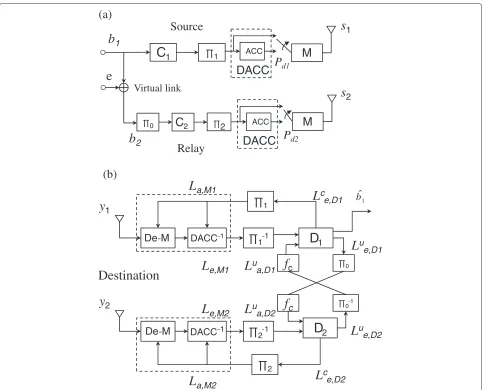
Figure 3The schematic diagram of the proposed Slepian-Wolf relay system.(a)The source and the relay nodes.(b)The destination node. The BICM-ID demapper and the channel decoder exchange soft information via horizontal iterations (HI), while the two channel decoders also exchange information by exploiting the source-relay correlation, via vertical iterations (VI).
3.2.2 Correlated links
This section derivesP1andP2taking into account the cor-relation ρ = h1h∗2
of the fading variations. According to [13], when Link 1 and Link 2 are correlated, the signal
amplitudesA1andA2(Ai=
Gi|hi|2Es,i) follow thejoint pdf p(A1,A2), as shown in (15):
p(A1,A2)=
4A1A2 Pr1Pr2(1− |ρ|2)
I0
2|ρ|A1A2
√
Pr1Pr2(1− |ρ|2)
×exp
− 1
1− |ρ|2
A21 Pr1 +
A22 Pr2
,
(15)
where I0(·) is the zeroth order modified Bessel’s func-tion of the first kind. We define the average SNR of the ith channel as i = Pri/
2σ2, wherePri =
|hi|2Ei
,
denoting the average received signal power of Link i. Since I0(x)can be expanded into a seriesI0(x) = ∞n=0
(x/2)2n (n!)2 ,
(15) can be re-written as [15]
p(A1,A2)= 4A1A2
Pr1Pr2(1− |ρ|2)
exp
−A21/Pr1
1− |ρ|2 −
A2 2/Pr2
1− |ρ|2
,
∞
n=0
1
(n!)2
|ρ|A1A2
√
Pr1Pr2(1− |ρ|2)
2n
,
=
∞
n=0
q(1n)q(2n),
(16)
whereq(1n)andq(2n)can be expressed as
q(1n)= 2A
2n+1 1 |ρ|n
Pnr1+1(1− |ρ|2)n+1/2exp
−A21/Pr1
1− |ρ|2
1
n!
q(2n)= 2A 2n+1 2 |ρ|n
Pnr2+1(1− |ρ|2)n+1/2exp
− A22/Pr2 1− |ρ|2
1 n!
.
(18)
Sincep(A1,A2)can be factored into a product of two independent terms, each for its corresponding random variable, it is easy to calculateP1 andP2by substituting (16)–(18) andγi = A2i/2σ2into (13) and (14), with the aid of the trapezoidal methods.
3.2.3 Outage of MRC
For a comparison with our proposed Slepian-Wolf relay system, the outage probability of the maximum ratio com-bining (MRC) scheme is derived with the assumptions thatpe=0b,ρ=0 and1=2. It is well known that the output of the MRC combiner is a weighted sum of signals received via all the transmission links. Thepdf pγ(γ )of
the instantaneous SNRγ in the block Rayleigh channel after the MRC combining is given by [16]
pγ(γ )=
γN−1exp−γ
N(N−1)! , (19)
whereNdenotes the diversity order, and we have assumed each channel has the same average SNR . The outage probability of MRC is defined as the probability that the instantaneous SNR after combining is less than a given threshold. For a fair comparison, the threshold of the transmission rate is chosen to beRc1H(b1). Then, the out-age probability of the 2nd order MRC diversity can be calculated as follows
Pout,mrc=
2Rc1H(b1)−1
γ=0
pγ(γ )dγ1,
= 2
Rc1H(b1)−1
γ=0
γexp−γ
2 dγ,
=1−exp
1−2Rc1H(b1)
×
2
k=1
(2Rc1H(b1)−1)/ k−1
(k−1)! .
(20)
4 Asymptotic tendency analysis
4.1 Tendency 1: In the casepe=0
This section provides the proof of the fact that, whenb1 andb2are fully correlated(pe = 0), the 2nd order diver-sity of the outage curves can be achieved. In this case, we haveH(b1|b2) = 0,H(b1,b2) = 1 and the value ofP1is always equal to 0 as found from (13). Hence, the outage probability is determined byP2only. By assuming that the fading variations of the two links are statistically
independent (ρ=0) andRc1=Rc2=1, the derivation of P2can be reduced to
P2= 1
γ1=0
2[1−log2(1+γ1)]−1
γ2=0
p(γ1)p(γ2)dγ1dγ2,
= 1
0
p(γ1)dγ1
−exp
−γ2
2
2[1−log2(1+γ1)]−1
0 = 1 1 1 0 exp −γ1
1
−exp
−γ1
1+
1
2−
2
2(1+γ1)
dγ1.
(21)
By using (22) whenxis very small:
e−x=
∞
n=0
(−x)n
n! ≈1−x, (22)
(21) can be approximated as
P2≈ 1
1
1
0
1− γ1
1
−
1− γ1
1+
1
2 −
2
2(1+γ1)
dγ1
= 1 1 1 0 − 1 2 + 2
2(1+γ1)
dγ1
= 1
1
2 ln(1+γ1)−γ1
2
1
0
=2 ln 2−1
12
. (23)
Obviously, the final result shows that with pe = 0, the outage probability curve is inversely proportional to the product of1 and2, which achieves the 2nd order diversity.
4.2 Tendency 2: Slepian-Wolf relay versus MRC
In this section, the proof of the advantage of the Slepian-Wolf relay system over MRC is presented, assuming that
1 = 2 in both the schemes withpe = 0,ρ = 0 and Rc1=Rc2=1. Then, (14) and (20) can be further reduced to
P2= 1
1 1
γ1=0
exp
−γ1
1
× −exp
1
1
1−γ1− 2
1+γ1 dγ1, (24)
and
Pout,mrc= 1
1
1
γ1=0
γ1
1exp
−γ1
1
To prove thatPout,mrc−P2>0, we definePgap=Pout,mrc− P2
Pgap= 1
1
1
γ1=0
exp 1 1
1−γ1− 2 1+γ1
+ γ1 1− 1 exp −γ1
1 dγ1
= 1 1
1
γ1=0
exp
1
1
1−γ1− 2
1+γ1
×dγ1−exp
− 1
1 . (26)
Lety1(x) =exp
!
1−x− 1+2x "
. It is found thaty1(x)
−1 within the range of [0, 1] if y1(x) is concave, since y1(x) min
#
y1(0),y1(1)
$
= −1, according to the prop-erty of the concave function.y1(x) can be proven to be concave by showing that
y1(x)=exp
1−x− 2 1+x
2
(1+x)2−1
2
−4 exp(1−x−
2 1+x)
(1+x)3 <0. (27)
By ignoring the common exponential terms in (27), because they are positive, it is found that giving a proof to (27) is equivalent to proving that y2(x) =
2−(1+x)22−4(1+x) <0. Lett=1+x(t∈[1, 2]). Then,y2(t) =
2−t22−4t = t4−4t2−4t+4. The second-order derivative ofy2(t)can be expressed as
y2(t)=12t2−8. (28)
Obviously,y2(t) > 0 within the range of [1, 2]. There-forey2(t)is convex, andy2(t) <max
#
y2(1),y2(2)
$ = −3. Hence,y2(t) <0, which is equivalent toy1(x) <0. Now y1(x) is proved to be concave, and consequently Pgap is proved to be positive. As a result, Slepian-Wolf relaying yields a lower outage.
4.3 Tendency 3: in the casepe=0
Whenb1 andb2 are not fully correlated (pe = 0), the asymptotic tendency of the outage curve is proven to con-verge into that of the 1st order diversity. Withρ=0, when
1→ ∞and2→ ∞,P2→0 according to (11). There-fore onlyP1dominates the outage probability. Assuming Rc1=1, (10) can be approximated by using (22), as
P1=1−exp
−2H(b1|b2)−1 1
≈ 2H(b1|b2)−1
1
. (29)
Obviously, when the average SNRs 1 and 2 become large, the value ofP1is inversely in proportion to1and hence the diversity order converges into 1.
4.4 Tendency 4: correlated link variation
In the presence of the correlation ρ = 0 of the fading variation, regardless of the source correlationμ, increas-ing the average SNRs1and2, or equivalently increasing Pr1andPr2yields [15]:
2|ρ|A1A2
√
Pr1Pr2(1− |ρ|2)
≈0 (Pr1→ ∞, Pr2→ ∞) (30)
Hence, withI0(0)→1, (15) can be approximated as
p(A1,A2)≈
4A1A2
Pr1Pr2(1− |ρ|2)
exp
−A21/Pr1
1− |ρ|2 −
A22/Pr2
1− |ρ|2
= 2A1
Pr1
1− |ρ|2
exp
− A21
Pr1(1− |ρ|2)
2A2
Pr2
1− |ρ|2exp
− A22
Pr2(1− |ρ|2)
=p(A1)p(A2),
(31)
whereA1 = A1
1− |ρ|2andA2 = A2
1− |ρ|2, with Pr1 = Pr1(1 − |ρ|2) and Pr2 = Pr2(1 − |ρ|2). Obvi-ously,p(Ai)= 2Ai
Pri exp
−Ai2
Pri
, which corresponds to the
well-knownpdf of the Rayleigh-distributed signal enve-lope of Linki[16]. Hence, withPr1 → ∞andPr2 → ∞
(equivalently, Pr1 → ∞ and Pr2 → ∞ ), the asymp-totic property of the outage probability exhibits the same tendency as in the case of independent channels, which indicates that the tendency of the diversity order only depends on the source correlation.
output from the DACC is mapped onto symbolss1 accord-ing to the specified modulation rule and broadcasted to both the relay and destination nodes during the first time slot.
After receiving the signals via the intra-link, the relay node aims to recover the original information bits, according to the DF strategy. However, the relay is not necessarily able to totally eliminate the errors happening in the intra-link [6], and hence some errors may remain in the recovered information b2. The purpose of the simulation is to verify the consistency in the perfor-mance tendency to the theoretical results, and hence the bit-flipping model is used to simplify the intra-link transmission errors occurring in the information part of the recovered bit stream, as shown in Figure 3ac. The recovered information bit stream has to be interleaved by0before being re-encoded byC2. This process plays the crucial role in the sense that it converts the relay sys-tem to a form of distributed turbo code (DTC) [19]. The re-encoded stream is further interleaved by2, and fed into DACC (with a doping ratioPd2). Finally, the DACC output is modulated with a specified mapping rule and the symbolss2at the relay node are sent to the destination during the second time slot.
At the destination as shown in Figure 3b, the received signals from both Link 1 and Link 2 are first demapped based on the BICM-ID principle, as [20,21]:
Le(bv)=ln
Pbv=1|y Pbv=0|y
=ln
sS1
%
exp
− && &y−√Ghs&&&2
2σ2
'M
w=vexp [bwLa(bw)]
(
sS0
%
exp
−&&&y−
√
Ghs&&&2 2σ2
'M
w=vexp [bwLa(bw)]
(,
(32)
wherevis the position of the detecting bit in the symbold. Mis the number of bits per symbol andLa(bw)denotes the a priori LLRs of the wth bit in symbol s, fed back from the channel decoder. DACC−1, and the decodersD
1 andD2for the channel encodersC1andC2, respectively, use the Bahl, Cocke, Jelinek, and Raviv (BCJR) algorithm [22].S0andS1are the sets of symbols having thevth bit being zero or one, respectively. The output extrinsic LLRs of the demapper are brought to DACC−1, followed by the channel decoder via1and2for the first and second time slots, respectively. This process is referred to as the horizontal iterations (HI), as shown in Figure 3b.
Furthermore, the channel decoders D1 and D2 also exchange soft information with each other. This process is referred to as the vertical iterations (VI). It should be noticed that the LLR updating function is used in the VI, as illustrated in Figure 3b), where the knowledge of
correlation μ (equivalently, the information bit flipping probability pe of the intra-link) is utilized. Furthermore according to [6], the intra-link error probability represent-ing the correlation can be estimated at the destination, as
ˆ
pe= 1 N
N
n=1
eLup,D1 +eLup,D2 !
1+eLup,D1 " !
1+eLup,D2
", (33)
wherepˆeis the estimate ofpe, andLup,D1andLup,D2are the a posteriori LLRs of the uncoded information bits, output from the decoders D1 andD2, respectively. A threshold has to be set appropriately, as shown in [6], to select only the reliable LLRs when calculatingpˆeusing (33). N rep-resents the number of the reliable a posteriori LLR pairs Lup,D1 and Lup,D2. The estimate peˆ of the intra-link error probabilitypeis used to modify the bit probability, taking into account the intra-link errors, as [8]:
Pr(b2=0)=(1−pe)Pr(b1=0)+pePr(b1=1), Pr(b2=1)=(1−pe)Pr(b1=1)+pePr(b1=0), (34) which leads to the LLR updating functionfcexpressed as follows [23]:
fc(x)=ln
1− ˆpe·exp(x)+ ˆpe
1− ˆpe
+ ˆpe·exp(x)
. (35)
In (35),xdenotes the extrinsic LLRs of the information bits, obtained byD1andD2, and the output offcare the updated LLRs by exploitingpeˆ as the correlation knowl-edge of the intra-link. The VI operations at the receiver can be expressed as:
Lua,D
1 =fc
)
−01Lue,D
2
*
, (36)
Lua,D2 =fc #
0Lue,D1$. (37)
6 Numerical results
In this section, the numerical results of the theoretical outage probability calculation and the FER performance of the BICM-ID based Slepian-Wolf relay system obtained through simulations are presented. In the simulations for the BICM-ID based Slepian-Wolf relay system, we use the half rate non-recursive systematic convolutional code with generator polynomials of (3,2)8 for both C1 and C2. Non-Gray quaternary-phase-shift-keying (QPSK) was used for both the Link 1 and Link 2 transmissione. Hence, the coefficientsRci(i=1, 2) representing channel coding rate and modulation multiplicity is equal to one (= 12×2) in the theoretical calculations of the outage probability. The interleaver length is 4000 and the doping ratioPd1and Pd2are set to five in the simulations. The LLR threshold for (33) was set to one, as in [6], to select the reliable LLRs output fromD1andD2.
0 5 10 15 20 25 30 10−5
10−4 10−3 10−2 10−1 100
Average SNR of Link 1 (dB), Γ1 = Γ2
Outage Probability
SW, pe = 0 SW, p
e = 0.01
SW, pe = 0.1 SW, pe = 0.5 No diversity MRC, M = 2
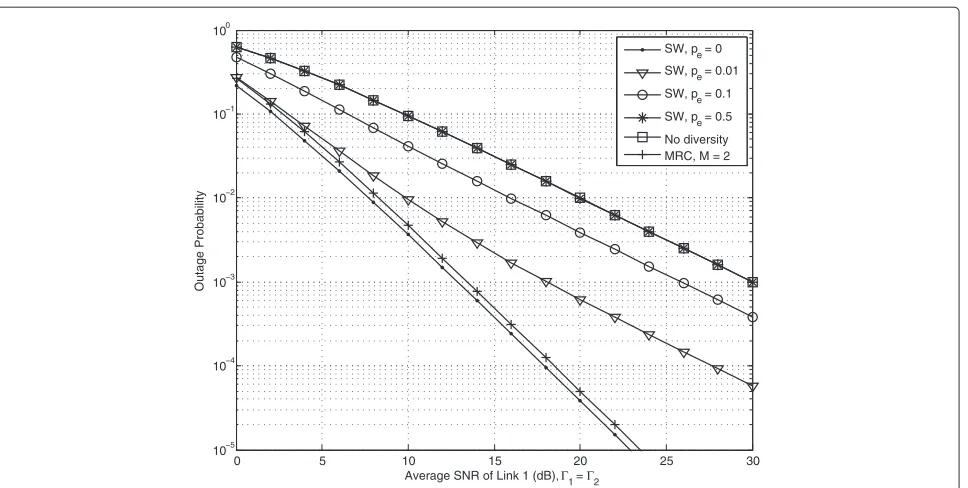
Figure 4The theoretical outage probability of the proposed relay transmission model,1=2, andρ=0, withpeas a parameter.The
2nd order diversity can be achieved only ifb1andb2are fully correlated (pe=0) withρ=0.
and average SNRs1=2. It is found that, only whenb1 andb2are fully correlated(pe = 0), the 2nd order diver-sity can be achieved, which is consistent to the asymptotic tendency analysis presented in Section 4.1. Moreover, it should be noticed that the Slepian-Wolf relay system can achieve slightly better outage performance than that with MRC, which is also consistent to the mathematical proof presented in Section 4.2. However, in the case whenpe= 0, the diversity order of the outage curves always plateaus at one as the average SNR increases. This asymptotic ten-dency agrees with the mathematical proof presented in Section 4.3. When b1 and b2 are completely indepen-dent (pe = 0.5), obviously, the outage curves of the Slepian-Wolf relay is the same as that without diversity.
Figure 5 demonstrates the FER performance of the BICM-ID based Slepian-Wolf relay system (ρ=0), where the theoretical outage curve is also plotted for compari-son. It is found that the FER and the theoretical outage curves exhibit the same decay, however, there is a 2–3 dB gap in average SNR between them. This is because the BICM-ID technique used in this example does not achieve close-capacity performance. This indicates that there is a possibility that the gap can further be reduced by using very close-capacity achieving techniques [21,24].
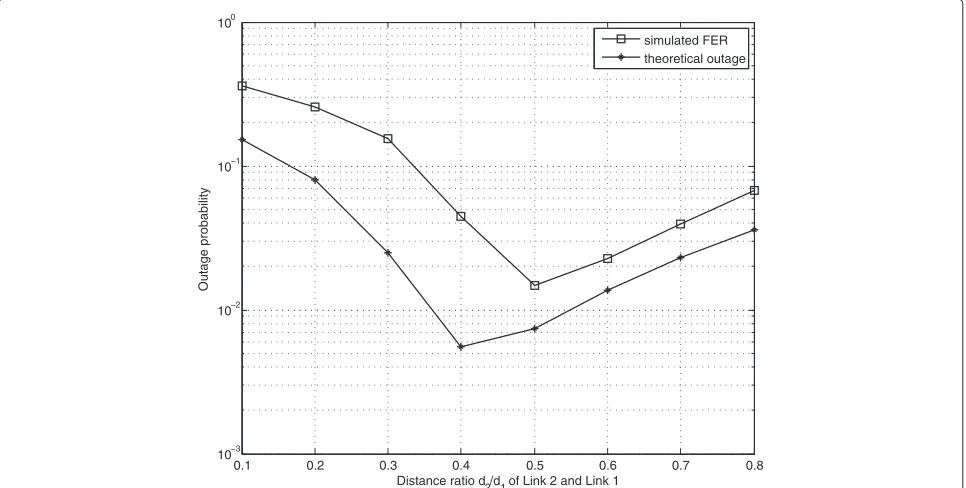
Figure 6 shows the impact of the relay location on the outage probability as a function of the distance ratio d2/d1, by assuming that the relay location is in a line between source and destination nodes. According to (1),
2=1+10 log10
(d1/d2)3.52(dB). Because of the very
stable intra-link assumption that we made in the theoret-ical analysis, in the simulation for the impact evaluation of the relay location, we assume an AWGN source-relay linkf. The received average SNR at the relay is denoted byR, andR = 1+10 log10
(d1/(d1−d2))3.52
(dB). Furthermore, we assume the Slepian-Wolf relaying tech-nique presented in [25], where the coding and modulation parameters are exactly the same as that described in the previous section. The only difference from the technique presented in the previous section is that in [25], the intra-link signal detection process is also included, where instead of performing fully iterative decoding at the relay, only systematic part is extracted (no decoding for C1 is performed after viterbi decoding of DACC). This signifi-cantly reduces the computational complexity of the relay [25].
We first obtained the bit error rate (BER) curve of the intra-link transmission via simulationsg. The SNR values were calculated at different locations using the equation shown above, and then converted intopereferring to the simulation result. With the fixedpevalue, obtained via the methodology described above, we evaluated the FER per-formance via simulations, where Link 1 and Link 2 were assumed to suffer from statistically independent block Rayleigh fading. The FER curves are shown in Figure 6 for
0 2 4 6 8 10 12 14 16 18 20 10−3
10−2 10−1 100
Average SNR of Link 1 (Γ1 = Γ2), (dB)
Outage probability
direct transmission simulated MRC, pe = 0 simulated FER, pe = 0.2 simulated FER, p
e = 0
SW outage, p
e = 0.2
SW outage, p
e = 0
Figure 5Comparison of the theoretical outage probability and the FER of the BICM-ID based Slepian-Wolf relay system.The performance tendencies of the theoretical outage probability and the FER of the BICM-ID based relay system are consistent with each other.
location. This tendency is consistent to the theoretical outage curve also shown in Figure 6. In fact, there are two factors that improve the FER/outage performance: one is the correlation exploitation, and the other is the energy of each link. Let the distance between the source and the optimal location be denoted bydopt. Atdopt, the
combined effect is maximized, while the contribution of Link 2 energy tends to be smaller whend1−d2 < dopt (In this case, thepevalue is already very small and hence the contribution of correlation is fully exploited). It is also found that there is a gap between the FER simu-lation result and theoretical outage curve, because the
0.1 0.2 0.3 0.4 0.5 0.6 0.7 0.8
10−3 10−2 10−1 100
Distance ratio d2/d1 of Link 2 and Link 1
Outage probability
simulated FER theoretical outage
−5 0 5 10 15 20 25 30 10−5
10−4 10−3 10−2 10−1 100
Average SNR of Link 1 (dB), Γ1 = Γ2
Outage probability
|ρ| = 0.99 |ρ| = 0.9 |ρ| = 0.8 |ρ| = 0.5 |ρ| = 0 No diversity
Figure 7The theoretical outage probability when fading of the two links is correlated andpe=0.Whenb1andb2are fully correlated, the 2nd order diversity can still be achieved if|ρ|<1.
BICM-ID relay in this article does not achieve close-capacity performance as stated before.
Figure 7 shows the theoretical outage curves in the pres-ence of fading correlationρ between Link 1 and Link 2 while the source bitsb1andb2are fully correlated (pe = 0). Obviously, the larger the correlation of the fading vari-ation, the larger the outage probability. This is consistent to the theoretical result provided in Section 4.4 that the 2nd order diversity can finally be achieved with arbitrary value of|ρ| =1, by increasing the average SNRs.
7 Conclusions
In this study, we have theoretically analyzed the outage probability and its asymptotic properties of a simple one-way relay transmission system allowing intra-link errors, where the source-relay correlation can be exploited in the joint decoding process at the destination, based on the Slepian-Wolf theorem. The outage probability can be cal-culated by a set of double integrals of the admissible rate region with respect to thepdf of the instantaneous SNRs of the transmission links, identified by the Slepian-Wolf theorem. It has been found through the asymptotic ten-dency analysis that the 2nd order diversity can be achieved only when the information bit streams at the source and the relay are fully correlated. Otherwise, it converges into one as the average SNRs of the source-destination and/or relay-destination links increase. Interestingly, the Slepian-Wolf relay system’s outage probability is found to be smaller than the case where the signals received via the two links are maximum-ratio-combined before decoding.
We have provided a mathematical proof of this discovery. However, this proof has been given to only the case where the two links suffer from independent block Rayleigh fad-ing with the same average SNR. Hence, whether or not this discovery commonly holds for the arbitrary distance ratio d2/d1, and/or for correlated fading variation, is still an open hypothesis. The correlationρof the fading variation [15] of the source-destination and relay-destination links were also taken into account, in addition to the source-relay information correlationμ = (2b1−1) (2b2−1). Interestingly, it has been found that the diversity order is only determined by the information correlation and is independent of the link variation correlation, so far as
|ρ| < 1. It has to be noted that the intra-link transmis-sion is parameterized by a bit-flipping probability pe in this article. This is becausepe is the bit error probabil-ity of the information part after decoding at the relay, which depends on a lot of parameters related to the intra-link transmission. If the probability density function (pdf) of pe is known, obviously it is possible to calculate the outage probability in the case that the three links are all time-varying. However, this is left as a future study.
This article also compared the FER of a BICM-ID based Slepian-Wolf relay system, as an example of our proposed technique, with the theoretical outage probability forρ=
can be reduced by utilizing very close-capacity achieving code.
Endnotes
aA Gaussian codebook is assumed for channel coding. bEven without the interleaver
0at the relay node, a seri-ous error propagation is expected in the case of MRC, if pe=0, due to the use of DACC. Hence, performing MRC at the destination by ignoring the intra-link errors even degrades the performance. However, without DACC, HI cannot reach a point in the extrinsic information transfer (EXIT) chart close enough to the (1,1) mutual information point. The terminologies “DACC” and “HI” are intro-duced in Section 5.
cThis indicates that in the simulations, we did not perform
actual decoding and demapping processes at the relay. dEquation (32) holds both for Link 1 and Link 2.
There-fore, for the sake of simplicity, we omitted the link index from the variables.
eThrough the EXIT chart analysis conducted as a
prelim-inary study, the demapper and the decoder’s EXIT curves are found to be well matched with the transmission chain parameters described above, even though the codes used are very simple and easy to decode.
fThep
evalue is a parameter which follows the distribution of the bit error rate of the intra-link.
gIt should be noted that according to the assumption that
the intra-link is a static AWGN channel, the instantaneous fading channel gain were ignored.
Competing interests
The authors declare that they have no completing interests.
Acknowledgements
This research was supported in part by the Japan Society for the Promotion of Science (JSPS) Grant under the Scientific Research KIBAN, (B) No. 2360170 and (C) No. 2256037.
Author details
1School of Information Science, Japan Advanced Institute of Science and Technology (JAIST), 1-1 Asahidai, Nomi, Ishikawa 923-1292, Japan. Centre for Wireless Communications, University of Oulu, P.O. Box 4500, 90014, Oulu, Finland.
Received: 1 June 2012 Accepted: 1 February 2013 Published: 23 February 2013
References
1. M Dohler, Y Li,Cooperative Communications: Hardware, Channel and PHY. (John Wiley and Sons Ltd, West Sussex, 2010)
2. C Edward, VD Meulen, Three-terminal communication channels. Adv. Appl. Prob.3, 120–154 (1971)
3. G Kramer, M Gastpar, P Gupta, Cooperative strategies and capacity theorems for relay networks. IEEE Trans. Inf. Theory.51(9), 3037–3063 (2005)
4. Q Chen, in2010 IEEE Wireless Communications and Networking Conference (WCNC). Energy efficiency analysis in amplify-and-forward and decode-and-forward cooperative networks, (Sydney, 2010), pp. 1–6 5. H Ruiyuan, J Li, in2005 IEEE 6th Workshop on Signal Processing Advances in
Wireless Communications. Exploiting Slepian-Wolf codes in wireless user cooperation (New York, 2005), pp. 275–279
6. K Anwar, T Matsumoto, Accumulator-assisted distributed turbo codes for relay system exploiting source-relay correlation. IEEE Commun. Lett. 16(7), 1114–1117 (2012)
7. J Garcia-Frias, Y Zhao, Near-Shannon/Slepian-Wolf performance for unknown correlated sources over AWGN channels. IEEE Trans. Commun. 53(4), 555–559 (2005)
8. K Anwar, T Matsumoto, Spatially concatenated codes with turbo equalization for correlated sources. IEEE Trans. Signal Process.60(10), 5572–5577 (2012)
9. H Ochiai, P Mitran, V Tarokh, in2004 IEEE 60th Vehicular Technology Conference, 2004. VTC2004-Fall, vol. 7. Design and analysis of collaborative diversity protocols for wireless sensor networks, (Los Angeles, 2004), pp. 4645–4649
10. R Youssef, AG i Amat, Distributed serially concatenated codes for multi-source cooperative relay networks. IEEE Trans. Wirel. Commun.10, 253–263 (2011)
11. D Slepian, JK Wolf, Noiseless coding of correlated information sources. IEEE Trans. Inf. Theory.19(4), 471–480 (1973)
12. M Cheng, K Anwar, T Matsumoto, in2012 IEEE Vehicular Technology Conference (VTC Fall). Outage analysis of correlated source transmission in block Rayleigh fading channels (Quebec, 2012), pp. 1–5
13. M Schwartz, WR Bennett, S Stein, Communication systems and techniques. IEEE Commun. Mag.34(5), 9 (1996)
14. VE Dale, PJ Edwin, R Steven,Calculus. (Pearson, Prentice Hall, 2007) 15. M Cheng, K Anwar, T Matsumoto, inInternational Conference on
Communication Systems (ICCS). On the duality of source and channel correlations: Slepian-Wolf relaying viewpoint (Singapore, 2012), pp. 388–392
16. A Goldsmith,Wireless Communications. (Cambridge University Press Stanford University, US, 2005)
17. M Cheng, A Irawan, K Anwar, T Matsumoto, inProgress In Electromagnetics Research Symposium (PIERS). BICM-ID for relay system allowing intra-link errors and a similarity constellation to ARQ schemes, (Kuala Lumpur, 2012), pp. 281–286
18. S ten Brink, Convergence behavior of iteratively decoded parallel concatenated codes. IEEE Trans. Commun.49(10), 1727–1737 (2001) 19. B Zhao, MC Valenti, Distributed turbo coded diversity for relay channel.
Electron. Lett.39(10), 786–787 (2003)
20. K Fukawa, D Zhao, A Tolli, T Matsumoto, in5th International ICST Conference on Communications and Networking in China (CHINACOM). Irregular repetition and single parity check coded BICM-ID using extended mapping ‘optimal node degree allocation’, (Beijing, 2010), pp. 1–6 21. L Hanzo, TH Liew, BL Yeap,Turbo Coding, Turbo Equalisation and
Space-time Coding for Transmission over Fading Channels. (John Wiley & Sons, West Sussex, 2002)
22. L Bahl, J Cocke, F Jelinek, J Raviv, Optimal decoding of linear codes for minimizing symbol error rate (Corresp.) IEEE Trans. Inf. Theory.20(2), 284–287 (1974)
23. PS Lu, V Tervo, K Anwar, T Matsumoto, inVehicular Technology Conference (VTC Spring). Low-complexity strategies for multiple access relaying (Budapest, 2011)
24. L Hanzo, R Maunder, J Wang, LL Yang,Near-Capacity Variable-Length Coding. (John Wiley & Sons, West Sussex, 2010)
25. M Cheng, X Zhou, K Anwar, T Matsumoto, Simple relay systems with BICM-ID allowing intra-link errors. IEICE.E95-B(12), 3671–3678 (2012)
doi:10.1186/10.1186/1687-6180-2013-34