An extractive supervised two-stage method for sentence compression
Dimitrios Galanis∗ and Ion Androutsopoulos∗+
∗Department of Informatics, Athens University of Economics and Business, Greece +Digital Curation Unit –IMIS, Research Centre “Athena”, Greece
Abstract
We present a new method that compresses sentences by removing words. In a first stage, it generates candidate compressions by re-moving branches from the source sentence’s dependency tree using a Maximum Entropy classifier. In a second stage, it chooses the best among the candidate compressions using a Support Vector Machine Regression model. Experimental results show that our method achieves state-of-the-art performance without requiring any manually written rules.
1 Introduction
Sentence compression is the task of producing a shorter form of a single given sentence, so that the new form is grammatical and retains the most im-portant information of the original one (Jing, 2000). Sentence compression is valuable in many applica-tions, for example when displaying texts on small screens (Corston-Oliver, 2001), in subtitle genera-tion (Vandeghinste and Pan, 2004), and in text sum-marization (Madnani et al., 2007).
People use various methods to shorten sentences, including word or phrase removal, using shorter paraphrases, and common sense knowledge. How-ever, reasonable machine-generated sentence com-pressions can often be obtained by only remov-ing words. We use the term extractive to refer to methods that compress sentences by only removing words, as opposed to abstractive methods, where more elaborate transformations are also allowed. Most of the existing compression methods are ex-tractive (Jing, 2000; Knight and Marcu, 2002;
Mc-Donald, 2006; Clarke and Lapata, 2008; Cohn and Lapata, 2009). Although abstractive methods have also been proposed (Cohn and Lapata, 2008), and they may shed more light on how people compress sentences, they do not always manage to outperform extractive methods (Nomoto, 2009). Hence, from an engineering perspective, it is still important to inves-tigate how extractive methods can be improved.
In this paper, we present a new extractive sentence compression method that relies on supervised ma-chine learning.1 In a first stage, the method gener-ates candidate compressions by removing branches from the source sentence’s dependency tree using a Maximum Entropy classifier (Berger et al., 2006). In a second stage, it chooses the best among the candi-date compressions using a Support Vector Machine Regression (SVR) model (Chang and Lin, 2001). We show experimentally that our method compares fa-vorably to a state-of-the-art extractive compression method (Cohn and Lapata, 2007; Cohn and Lapata, 2009), without requiring any manually written rules, unlike other recent work (Clarke and Lapata, 2008; Nomoto, 2009). In essence, our method is a two-tier over-generate and select (or rerank) approach to sentence compression; similar approaches have been adopted in natural language generation and parsing (Paiva and Evans, 2005; Collins and Koo, 2005).
2 Related work
Knight and Marcu (2002) presented a noisy channel sentence compression method that uses a language modelP(y)and a channel modelP(x|y), where x
1An implementation of our method will be freely available from http://nlp.cs.aueb.gr/software.html
is the source sentence and y the compressed one.
P(x|y) is calculated as the product of the proba-bilities of the parse tree tranformations required to expand y to x. The best compression of x is the one that maximizes P(x|y)·P(y), and it is found using a noisy channel decoder. In a second, alter-native method Knight and Marcu (2002) use a tree-to-tree transformation algorithm that tries to rewrite directly x to the best y. This second method uses C4.5 (Quinlan, 1993) to learn when to perform tree rewriting actions (e.g., dropping subtrees, combin-ing subtrees) that transform larger trees to smaller trees. Both methods were trained and tested on data from the Ziff-Davis corpus (Knight and Marcu, 2002), and they achieved very similar grammatical-ity and meaning preservation scores, with no statis-tically significant difference. However, their com-pression rates (counted in words) were very dif-ferent: 70.37% for the noisy-channel method and 57.19% for the C4.5-based one.
McDonald (2006) ranks each candidate compres-sion using a function based on the dot product of a vector of weights with a vector of features extracted from the candidate’sn-grams,POStags, and depen-dency tree. The weights were learnt from the Ziff-Davis corpus. The best compression is found us-ing a Viterbi-like algorithm that looks for the best sequence of source words that maximizes the scor-ing function. The method outperformed Knight and Marcu’s (2002) tree-to-tree method in grammatical-ity and meaning preservation on data from the Ziff-Davis corpus, with a similar compression rate.
Clarke and Lapata (2008) presented an unsuper-vised method that finds the best compression using Integer Linear Programming (ILP). The ILP
obejc-tive function takes into account a language model that indicates whichn-grams are more likely to be deleted, and a significance model that shows which words of the input sentence are important. Man-ually defined constraints (in effect, rules) that op-erate on dependency trees indicate which syntactic constituents can be deleted. This method outper-formed McDonald’s (2006) in grammaticality and meaning preservation on test sentences from Edin-burgh’s “written” and “spoken” corpora.2 However, the compression rates of the two systems were
dif-2
See http://homepages.inf.ed.ac.uk/s0460084/data/.
ferent (72.0% vs. 63.7% for McDonald’s method, both on the written corpus).
We compare our method against Cohn and Lap-ata’s T3 system (Cohn and Lapata, 2007; Cohn and Lapata, 2009), a state-of-the-art extractive sentence compression system that learns parse tree transduc-tion operators from a parallel extractive corpus of source-compressed trees. T3 uses a chart-based de-coding algorithm and a Structured Support Vector Machine (Tsochantaridis et al., 2005) to learn to select the best compression among those licensed by the operators learnt.3 T3 outperformed McDon-ald’s (2006) system in grammaticality and meaning preservation on Edinburgh’s “written” and “spoken” corpora, achieving comparable compression rates (Cohn and Lapata, 2009). Cohn and Lapata (2008) have also developed an abstractive version of T3, which was reported to outperform the original, ex-tractive T3 in meaning preservation; there was no statistically significant difference in grammaticality. Finally, Nomoto (2009) presented a two-stage ex-tractive method. In the first stage, candidate com-pressions are generated by chopping the source sen-tence’s dependency tree. Many ungrammatical com-pressions are avoided using hand-crafted drop-me-not rules for dependency subtrees. The candidate compressions are then ranked using a function that takes into account the inverse document frequen-cies of the words, and their depths in the source dependency tree. Nomoto’s extractive method was reported to outperform Cohn and Lapata’s abstrac-tive version of T3 on a corpus collected via RSS
feeds. Our method is similar to Nomoto’s, in that it uses two stages, one that chops the source depen-dency tree generating candidate compressions, and one that ranks the candidates. However, we experi-mented with more elaborate ranking models, and our method does not employ any manually crafted rules.
3 Our method
As already mentioned, our method first generates candidate compressions, which are then ranked. The candidate compressions generator operates by re-moving branches from the dependency tree of the
3
input sentence (figure 1); this stage is discussed in section 3.1 below. We experimented with different ranking functions, discussed in section 3.2, which use features extracted from the source sentence s
and the candidate compressionsc1, . . . , ck.
3.1 Generating candidate compressions
Our method requires a parallel training corpus con-sisting of sentence-compression pairs hs, gi. The compressed sentencesgmust have been formed by only deleting words from the corresponding source sentencess. Thehs, gitraining pairs are used to es-timate the propability that a dependency edgeeof a dependency treeTsof an input sentencesis retained or not in the dependency treeTg of the compressed sentence g. More specifically, we want to estimate the probabilitiesP(Xi|context(ei))for every edge
ei ofTs, whereXi is a variable that can take one of the following three values:not del, for not delet-ingei;del ufor deletingeialong with its head; and
del lfor deletingealong with its modifier. The head (respectively, modifier) ofeiis the nodeeioriginates from (points to) in the dependency tree.context(ei) is a set of features that representsei’s local context in Ts, as well as the local context of the head and modifier ofeiins.
The propabilities above can be estimated using the Maximum Entropy (ME) framework (Berger et al., 2006), a method for learning the distribution
P(X|V) from training data, where X is discrete-valued variable andV = hV1, . . . , Vni is a real or discrete-valued vector. Here,V = context(ei)and
X=Xi. We use the following features inV:
• The label of the dependency edgeei, as well as thePOStag of the head and modifier ofei.
• The entire head-label-modifier triple ofei. This feature overlaps with the previous two features, but it is common in ME models to use feature combinations as additional features, since they may indicate a category more strongly than the individual initial features.4
• ThePOStag of the father ofei’s head, and the label of the dependency that links the father to
ei’s head.
4
http://nlp.stanford.edu/pubs/maxent-tutorial-slides.pdf.
• The POStag of each one of the three previous
and the three following words ofei’s head and modifier ins(12 features).
• ThePOStag bi-grams of the previous two and the following two words ofei’s head and mod-ifier ins(4 features).
• Binary features that show which of the possible labels occur (or not) among the labels of the edges that have the same head asei inTs(one feature for each possible dependency label).
• Two binary features that show if the subtree rooted at the modifier ofei orei’suptree (the rest of the tree, whenei’s subtree is removed) contain an important word. A word is consid-ered important if it appears in the documents
was drawn from significantly more often than in a background corpus. In summarization, such words are called signature terms and are thought to be descriptive of the input; they can be identified using the log-likelihood ratioλof each word (Lin and Hovy, 2000; Gupta et al., 2007).
For each dependency edgeeiof a source training sentence s, we create a training vectorV with the above features. If ei is retained in the dependency tree of the corresponding compressed sentencegin the corpus, V is assigned the category not del. If
ei is not retained, it is assigned the category del l ordel u, depending on whether the head (as in the
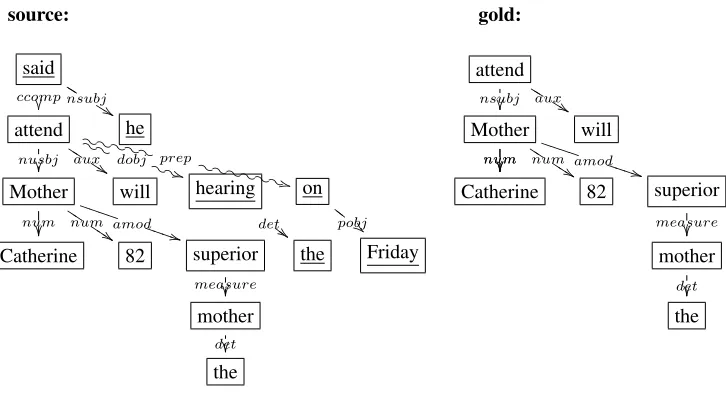
ccompof “said” in Figure 1) or the modifier (as in thedobjof “attend”) ofeihas also been removed. When the modifier of an edge is removed, the entire subtree rooted at the modifier is removed, and simi-larly for the uptree, when the head is removed. We do not create training vectors for the edges of the removed subtree of a modifier or the edges of the removed uptree of a head.
Given an input sentencesand its dependency tree
Ts, the candidate compressions generator produces the candidate compressed sentences c1, . . . , cn by deleting branches of Ts and putting the remaining words of the dependency tree in the same order as in
s. The candidatesc1, . . . , cncorrespond to possible assignments of values to theXivariables (recall that
source: gold:
said
ccomp nsubjKK
%
%
K K
attend
nsubj KauxK
%
%
K K
attend
nusbj JauxJ
%
%
J J*j dobj
*j * * *j *jprep +k +k +k +k +k + + +k +k +k +k +k +k he Mother num
num JnumJ
%
%
J J JTTamod T T * * T T T T will Mother
num JnumJ
$
$
J J JTTamod T T * * T T T T will hearing
detGG##
on
pobj FF
"
"
Catherine 82 superior
measure
Catherine 82 superior
measure
the Friday mother
det
mother
det
the
[image:4.612.119.482.72.272.2]the
Figure 1: Dependency trees of a source sentence and its compression by a human (taken from Edinburgh’s “written” corpus). The source sentence is: “Mother Catherine, 82, the mother superior, will attend the hearing on Friday, he said.” The compressed one is: “Mother Catherine, 82, the mother superior, will attend.” Deleted edges and words are shown curled and underlined, respectively.
Hence, there are at most3m−1 candidate compres-sions, wherem is the number of words in s. This is a large number of candidates, even for modestly long input sentences. In practice, the candidates are fewer, becausedel l removes an entire subtree and
del uan entire uptree, and we do not need to make decisionsXiabout the edges of the deleted subtrees and uptrees. To reduce the number of candidates further, we ignore possible assignments that contain decisions Xi = x to which the ME model assigns probabilities below a thresholdt; i.e., theMEmodel
is used to prune the space of possible assignments. When generating the possible assignments to the
Xi variables, we examine the edges ei of Ts in a top-down breadth-first manner. In the source tree of Figure 1, for example, we first consider the edges of “said”; the left-to-right order is random, but let us assume that we consider first the ccomp edge. There are three possible actions: retain the edge (not del), remove it along with the head “said” (del u), or remove it along with the modifier “at-tend” and its subtree (del l). If theMEmodel assigns a low probability to one of the three actions, that tion is ignored. For each one of the (remaining) ac-tions, we obtain a new form ofTs, and we continue to consider its (other) edges. We process the edges
in a top-down fashion, because theMEmodel allows
del l actions much more often than del u actions, and whendel lactions are performed near the root ofTs, they prune large parts of the space of possible assignments to theXivariables. Some of the candi-date compressions that were generated for an input sentence by settingt = 0.2 are shown in Table 1, along with the gold (human-authored) compression.
3.2 Ranking candidate compressions
Given that we now have a method that generates candidate compressionsc1, . . . , ckfor a sentences, we need a functionF(ci|s)that will rank the candi-date compressions. Many of them are ungrammat-ical and/or do not convey the most important infor-mation ofs. F(ci|s) should help us select a short candidate that is grammatical and retains the most important information ofs.
3.2.1 Grammaticality and importance rate
lan-s: Then last week a second note, in the same handwriting, informed Mrs Allan that the search was on the wrong side of the bridge.
g: Last week a second note informed Mrs Allan the search was on the wrong side of the bridge.
c1: Last week a second note informed Mrs Allan that the search was on the side.
c2: Last week a second note informed Mrs Allan that the search was.
c3: Last week a second note informed Mrs Allan the search was on the wrong side of the bridge.
c4: Last week in the same handwriting informed Mrs Allan the search was on the wrong side of the bridge.
Table 1: A source sentences, its gold (human authored) compressiong, and candidate compressionsc1, . . . , c4.
guage model trained on a large background corpus. However, language models tend to assign smaller probabilities to longer sentences; therefore they fa-vor short sentences, but not necessarily the most ap-propriate compressions. To overcome this problem, we follow Cordeiro et al. (2009) and normalize the score of a trigram language model as shown below, wherew1, . . . , wmare the words of candidateci.
Gramm(ci) = logPLM(ci)1/m=
(1/m)·log(
m
Y
j=1
P(wj|wj−1, wj−2)) (1)
The importance rateImpRate(ci|s), defined be-low, estimates how much information of the original sentencesis retained in candidateci. tf(wi) is the term frequency ofwiin the document that contained
ξ (ξ = ci, s), and idf(wi) is the inverse document frequency ofwi in a background corpus. We actu-ally computeidf(wi)only for nouns and verbs, and setidf(wi) = 0for other words.
ImpRate(ci|s) = Imp(ci)/Imp(s) (2)
Imp(ξ) = X
wi∈ξ
tf(wi)·idf(wi) (3)
The ranking F(c|s) is then defined as a linear combination of grammaticality and importance rate:
F(ci|s) =λ·Gramm(ci) + (1−λ)·
·ImpRate(ci|s)−α·CR(ci|s) (4)
A compression rate penalty factor CR(ci|s) =
|c|/|s|is included, to bias our method towards gen-erating shorter or longer compressions;| · |denotes word length in words (punctuation is ignored). We explain how the weigthsλ, αare tuned in following sections. We call LM-IMPthe configuration of our method that uses the ranking function of equation 4.
3.2.2 Support Vector Regression
A more sophisticated way to select the best com-pression is to train a Support Vector Machines Re-gression (SVR) model to assign scores to feature vec-tors, with each vector representing a candidate com-pression. SVR models (Chang and Lin, 2001) are trained usingltraining vectors(x1, y1), . . . ,(xl, yl), where xi ∈ Rn andyi ∈ R, and learn a function f : Rn → R that generalizes the training data. In
our case,xiis a feature vector representing a candi-date compressionci, andyiis a score indicating how good a compressionciis. We use 98 features:
• Gramm(ci)andImpRate(ci|s), as above.
• 2 features indicating the ratio of important and unimportant words ofs, identified as in section 3.1, that were deleted.
• 2 features that indicate the average depth of the deleted and not deleted words in the depen-dency tree ofs.
• 92 features that indicate whichPOStags appear insand how many of them were deleted inci. For everyPOS tag label, we use two features, one that shows how manyPOS tags of that la-bel are contained insand one that shows how many of thesePOStags were deleted inci. To assign a regression score yi to each training vectorxi, we experimented with the following func-tions that measure how similarciis to the gold com-pressiong, and how grammaticalciis.
the ranking function of section 3.2.1, we add a compression rate penalty factor.
yi =F1(d(ci)), d(g))−α·CR(ci|s) (5)
d(·) denotes the set of dependencies. We call SVR-F1 the configuration of our system that uses equation 5 to rank the candidates.
• Tokens accuracy and grammaticality: Tokens accuracy,T okAcc(ci|s, g), is the percentage of tokens ofsthat were correctly retained or re-moved in ci; a token was correctly retained or removed, if it was also retained (or re-moved) in the gold compression g. To cal-culate T okAcc(ci|s, g), we need the word-to-word alignment of sto g, and sto ci. These alignments were obtained as a by-product of computing the corresponding (word) edit dis-tances. We also want the regression model to favor grammatical compressions. Hence, we use a linear combination of tokens accuracy and grammaticality ofci:
yi =λ·T okAcc(ci|s, g) +
(1−λ)·Gramm(ci)−α·CR(ci|s) (6)
Again, we add a compression rate penalty, to be able to generate shorter or longer compres-sions. We call SVR-TOKACC-LM the config-uration of our system that uses equation 6.
4 Baseline and T3
As a baseline, we use a simple algorithm based on the ME classifier of section 3.1. The baseline
pro-duces a single compressionc for every source sen-tencesby considering sequentially the edges ei of
s’s dependency tree in a random order, and perform-ing at eachei the single action (not del, del u, or
del l) that the ME model considers more probable; the words of the chopped dependency tree are then put in the same order as in s. We call this system Greedy-Baseline.
We compare our method against the extractive version of T3 (Cohn and Lapata, 2007; Cohn and Lapata, 2009), a state-of-the-art sentence compres-sion system that applies sequences of transduction operators to the syntax trees of the source sentences.
The available tranduction operators are learnt from the syntax trees of a set of source-gold pairs. Ev-ery operator transforms a subtreeα to a subtree γ, rooted at symbolsXandY, respectively.
To find the best sequence of transduction opera-tors that can be applied to a source syntax tree, a chart-based dynamic programming decoder is used, which finds the best scoring sequenceq∗:
q∗ = arg max
q score(q;w) (7)
where score(q;w) is the dot product hΨ(q), wi.
Ψ(q)is a vector-valued feature function, andwis a vector of weights learnt using a Structured Support Vector Machine (Tsochantaridis et al., 2005).
Ψ(q)consists of: (i) the log-probability of the re-sulting candidate, as returned by a tri-gram language model; and (ii) features that describe how the opera-tors ofqare applied, for example the number of the terminals in each operator’s α and γ subtrees, the
POStags of theXandY roots ofαandγ etc. 5 Experiments
We used Stanford’s parser (de Marneffe et al., 2006) and ME classifier (Manning et al., 2003).5 For the (trigram) language model, we usedSRILM with modified Kneser-Ney smoothing (Stolcke, 2002).6 The language model was trained on approximately 4.5 million sentences of the TIPSTER corpus. To obtainidf(wi) values, we used approximately 19.5 million verbs and nouns from theTIPSTERcorpus.
T3 requires the syntax trees of the source-gold pairs in Penn Treebank format, as well as a trigram language model. We obtained T3’s trees using Stan-ford’s parser, as in our system, unlike Cohn and La-pata (2009) that use Bikel’s (2002) parser. The lan-guage models in T3 and our system are trained on the same data and with the same options used by Cohn and Lapata (2009). T3 also needs a word-to-word alignment of the source-gold pairs, which was obtained by computing the edit distance, as in Cohn and Lapata (2009) and SVR-TOKACC-LM.
We used Edinburgh’s “written” sentence com-pression corpus (section 2), which consists of source-gold pairs (one gold compression per source
5
Both available from http://nlp.stanford.edu/. 6
sentence). The gold compressions were created by deleting words. We split the corpus in 3 parts: 1024 training, 324 development, and 291 testing pairs.
5.1 Best configuration of our method
We first evaluated experimentally the three
configu-rations of our method (LM-IMP, F1,
SVR-TOKACC-LM), using the F1-measure of the
de-pendencies of the machine-generated compressions against those of the gold compressions as an auto-matic evaluation measure. This measure has been shown to correlate well with human judgements (Clarke and Lapata, 2006).
In all three configurations, we trained the ME
model of section 3.1 on the dependency trees of the source-gold pairs of the training part of the corpus. We then used the trained ME classifier to generate
the candidate compressions of each source sentence of the training part. We set t = 0.2, which led to at most 10,000 candidates for almost every source sentence. We kept up to 1.000 candidates for each source sentence, and we selected randonly approx-imately 10% of them, obtaining 18,385 candidates, which were used to train the twoSVRconfigurations; LM-IMPrequires no training.
To tune the λparameters of LM-IMPand SVR-TOKACC-LM in equations 4 and 6, we initially set
α = 0 and we experimented with different
val-ues of λ. For each one of the two configurations and for every different λ value, we computed the average compression rate of the machine-generated compressions on the development set. In the rest of the experiments, we set λto the value that gave an average compression rate approximatelly equal to that of the gold compressions of the training part.
We then experimented with different values of α
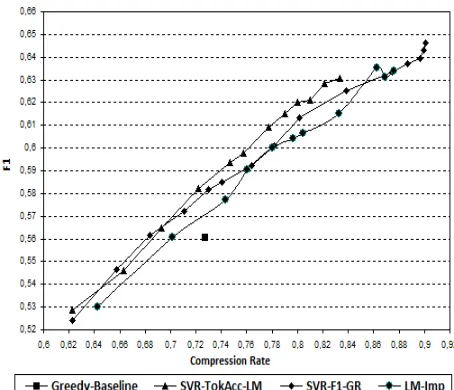
in all three configurations, in equations 4–6, to pro-duce smaller or longer compression rates. Theα pa-rameter provides a uniform mechanism to fine-tune the compression rate in all three configurations, even in SVR-F1 that has no λ. The results on the de-velopment part are shown in Figure 2, along with the baseline’s results. The baseline has no param-eters to tune; hence, its results are shown as a sin-gle point. Both SVR models outperform LM-IMP, which in turn outperforms the baseline. Also, SVR-TOKACC-LM performs better or as well as SVR-F1 for all compression rates. Note, also, that the
perfomance of the twoSVRconfigurations might be
[image:7.612.313.540.110.305.2]improved further by using more training examples, whereas LM-IMPcontains no learning component.
Figure 2: Evaluation results on the development set.
5.2 Our method against T3
We then evaluated the best configuration of our method (SVR-TOKACC-LM) against T3, both
au-tomatically (F1-measure) and with human judges. We trained both systems on the training set of the corpus. In our system, we used the sameλvalue that we had obtained from the experiments of the previ-ous section. We then varied the values of our sys-tem’sαparameter to obtain approximately the same compression rate as T3.
For the evaluation with the human judges, we se-lected randomly 80 sentences from the test part. For each source sentences, we formed three pairs, con-taining s, the gold compression, the compression of SVR-TOKACC-LM, and the compression of T3,
for T3 on a different split of the corpus (F1: 49.48%,
CR: 61.09%).
system G M Ov F1 (%) CR (%)
T3 3.83 3.28 3.23 47.34 59.16
SVR 4.20 3.43 3.57 52.09 59.85
gold 4.73 4.27 4.43 100.00 78.80
Table 2: Results on 80 test sentences. G: grammaticality, M: meaning preservation, Ov: overall score, CR: com-pression rate, SVR: SVR-TOKACC-LM.
Our system outperforms T3 in all evaluation mea-sures. We used Analysis of Variance (ANOVA)
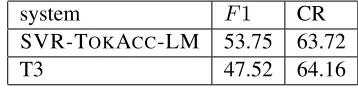
fol-lowed by post-hoc Tukey tests to check whether the judge ratings differ significantly (p <0.1); all judge ratings of gold compressions are significantly differ-ent from T3’s and those of our system; also, our sys-tem differs significantly from T3 in grammaticality, but not in meaning preservation and overall score. We also performed Wilcoxon tests, which showed that the difference in the F1 scores of the two sys-tems is statistically significant (p < 0.1) on the 80 test sentences. Table 3 shows theF1scores and the average compression rates for all 291 test sentences. Both systems have comparable compression rates, but again our system outperforms T3 inF1, with a statistically significant difference (p <0.001).
system F1 CR
SVR-TOKACC-LM 53.75 63.72
[image:8.612.94.273.442.487.2]T3 47.52 64.16
Table 3:F1scores on the entire test set.
Finally, we computed the Pearson correlationrof the overall (Ov) scores that the judges assigned to the machine-generated compressions with the corre-spondingF1scores. The two measures were found to corellate reliably (r = 0.526). Similar results have been reported (Clarke and Lapata, 2006) for Edinburgh’s “spoken” corpus (r = 0.532) and the Ziff-Davis corpus (r= 0.575).
6 Conclusions and future work
We presented a new two-stage extractive method for sentence compression. The first stage gener-ates candidate compressions by removing or not edges from the source sentence’s dependency tree;
anMEmodel is used to prune unlikely edge deletion
or non-deletions. The second stage ranks the can-didate compressions; we experimented with three ranking models, achieving the best results with an
SVR model trained with an objective function that combines token accuracy and a language model. We showed experimentally, via automatic evalua-tion and with human judges, that our method com-pares favorably to a state-of-the-art extractive sys-tem. Unlike other recent approaches, our system uses no hand-crafted rules. In future work, we plan to support more complex tranformations, instead of only removing words and experiment with different sizes of training data.
The work reported in this paper was carried out in the context of projectINDIGO, where an autonomous robotic guide for museum collections is being devel-oped. The guide engages the museum’s visitors in spoken dialogues, and it describes the exhibits that the visitors select by generating textual descriptions, which are passed on to a speech synthesizer. The texts are generated from logical facts stored in an on-tology (Galanis et al., 2009) and from canned texts; the latter are used when the corresponding informa-tion is difficult to encode in symbolic form (e.g., to store short stories about the exhibits). The descrip-tions of the exhibits are tailored depending on the type of the visitor (e.g., child vs. adult), and an im-portant tailoring aspect is the generation of shorter or longer descriptions. The parts of the descrip-tions that are generated from logical facts can be easily made shorter or longer, by conveying fewer or more facts. The methods of this paper are used to automatically shorten the parts of the descrip-tions that are canned texts, instead of requiring mul-tiple (shorter and longer) hand-written versions of the canned texts.
Acknowledgements
This work was carried out in INDIGO, an FP6 IST
project funded by the European Union, with addi-tional funding provided by the Greek General Sec-retariat of Research and Technology.7
7
References
A.L. Berger, S.A. Della Pietra, and V.J. Della Pietra. 2006. A maximum entropy approach to natural language processing. Computational Linguistics, 22(1):39–71.
D. Bikel. 2002. Design of a multi-lingual, parallel-processing statistical parsing engine. InProceedings of the 2nd International Conference on Human Lan-guage Technology Research, pages 24–27.
C.C Chang and C.J Lin. 2001. LIBSVM: a library for Support Vector Machines. Technical report. Software available at http://www.csie.ntu.edu.tw/∼cjlin/libsvm. J. Clarke and M. Lapata. 2006. Models for sentence compression: A comparison across domains, training requirements and evaluation measures. InProceedings of COLING, pages 377–384.
J. Clarke and M. Lapata. 2008. Global inference for sentence compression: An integer linear programming approach.Artificial Intelligence Research, 1(31):399– 429.
T. Cohn and M. Lapata. 2007. Large margin syn-chronous generation and its application to sentence compression. In Proceedings of EMNLP-CoNLL, pages 73–82.
T. Cohn and M. Lapata. 2008. Sentence compression beyond word deletion. In Proceedings of COLING, pages 137–144.
T. Cohn and M. Lapata. 2009. Sentence compression as tree to tree tranduction. Artificial Intelligence Re-search, 34:637–674.
M. Collins and T. Koo. 2005. Discriminative reranking for natural language parsing. Computational Linguis-tics, 31(1):25–69.
J. Cordeiro, G. Dias, and P. Brazdil. 2009. Unsupervised induction of sentence compression rules. In Proceed-ings of the ACL Workshop on Language Generation and Summarisation, pages 391–399.
S. Corston-Oliver. 2001. Text compaction for display on very small screens. InProceedings of the NAACL Workshop on Automatic Summarization, pages 89–98. M.C. de Marneffe, B. MacCartney, and C. Manning. 2006. Generating typed dependency parses from phrase structure parses. In Proceedings of LREC, pages 449–454.
Dimitrios Galanis, George Karakatsiotis, Gerasimos Lampouras, and Ion Androutsopoulos. 2009. An open-source natural language generator for OWL on-tologies and its use in protege and second life. In Pro-ceedings of the Demonstrations Session at EACL 2009, pages 17–20, Athens, Greece, April. Association for Computational Linguistics.
S. Gupta, A. Nenkova, and D. Jurafsky. 2007. Measur-ing importance and query relevance in topic-focused
multi-document summarization. In Proceedings of ACL, pages 193–196.
H. Jing. 2000. Sentence reduction for automatic text summarization. InProceedings of ANLP, pages 310– 315.
K. Knight and D. Marcu. 2002. Summarization beyond sentence extraction: A probalistic approach to sen-tence compression. Artificial Intelligence, 139(1):91– 107.
C.W. Lin and E. Hovy. 2000. The automated acqui-sition of topic signatures for text summarization. In
Proceedings of ACL, pages 495–501.
N. Madnani, D. Zajic, B. Dorr, N. F. Ayan, and J. Lin. 2007. Multiple alternative sentence compressions for automatic text summarization. InProceedings of DUC.
C. D. Manning, D. Klein, and C. Manning. 2003. Op-timization, maxent models, and conditional estimation without magic. Intutorial notes of HLT-NAACL 2003 and ACL 2003.
R. McDonald. 2006. Discriminative sentence compres-sion with soft syntactic constraints. InProceedings of EACL, pages 297–304.
T. Nomoto. 2009. A comparison of model free versus model intensive approaches to sentence compression. InProceedings of EMNLP, pages 391–399.
D. Paiva and R. Evans. 2005. Empirically-based con-trol of natural language generation. InProceedings of ACL.
J. R. Quinlan. 1993. C4.5: Programs for Machine Learning. Morgan Kaufmann.
A. Stolcke. 2002. SRILM - an extensible language mod-eling toolkit. InProceedings of the International Con-ference on Spoken Language Processing, pages 901– 904.
I. Tsochantaridis, T. Hofmann, T. Joachims, and Y. Altun. 2005. Support vector machine learning for indepen-dent and structured output spaces. Machine Learning Research, 6:1453–1484.
V. Vandeghinste and Y. Pan. 2004. Sentence compres-sion for automated subtitling: A hybrid approach. In