Dipanjan Das
∗ Google Inc.Desai Chen
∗∗Massachusetts Institute of Technology
Andr´e F. T. Martins
† Priberam LabsInstituto de Telecomunicac¸ ˜oes
Nathan Schneider
‡ Carnegie Mellon UniversityNoah A. Smith
§Carnegie Mellon University
Frame semantics is a linguistic theory that has been instantiated for English in the FrameNet lexicon. We solve the problem of frame-semantic parsing using a two-stage statistical model that takes lexical targets (i.e., content words and phrases) in their sentential contexts and predicts frame-semantic structures. Given a target in context, the first stage disambiguates it to a semantic frame. This model uses latent variables and semi-supervised learning to improve frame disambiguation for targets unseen at training time. The second stage finds the target’s locally expressed semantic arguments. At inference time, a fast exact dual decomposition algorithm collectively predicts all the arguments of a frame at once in order to respect declaratively stated linguistic constraints, resulting in qualitatively better structures than na¨ıve local predictors. Both components are feature-based and discriminatively trained on a small set of annotated frame-semantic parses. On the SemEval 2007 benchmark data set, the approach, along with a heuristic identifier of frame-evoking targets, outperforms the prior state of the art by significant margins. Additionally, we present experiments on the much larger FrameNet 1.5 data set. We have released our frame-semantic parser as open-source software.
∗Google Inc., New York, NY 10011. E-mail:[email protected].
∗∗Computer Science and Artificial Intelligence Laboratory, Massachusetts Institute of Technology, Cambridge, MA 02139. E-mail:[email protected].
†Alameda D. Afonso Henriques, 41 - 2.◦Andar, 1000-123, Lisboa, Portugal. E-mail:[email protected].
‡School of Computer Science, Carnegie Mellon University, Pittsburgh, PA 15213. E-mail:[email protected].
§School of Computer Science, Carnegie Mellon University, Pittsburgh, PA 15213. E-mail:[email protected].
Submission received: 4 May 2012; revised submission received: 10 November 2012; accepted for publication: 22 December 2012.
1. Introduction
FrameNet (Fillmore, Johnson, and Petruck 2003) is a linguistic resource storing consider-able information about lexical and predicate-argument semantics in English. Grounded in the theory of frame semantics (Fillmore 1982), it suggests—but does not formally define—a semantic representation that blends representations familiar from word-sense disambiguation (Ide and V´eronis 1998) and semantic role labeling (SRL; Gildea and Jurafsky 2002). Given the limited size of available resources, accurately producing richly structured frame-semantic structures with high coverage will require data-driven techniques beyond simple supervised classification, such as latent variable modeling, semi-supervised learning, and joint inference.
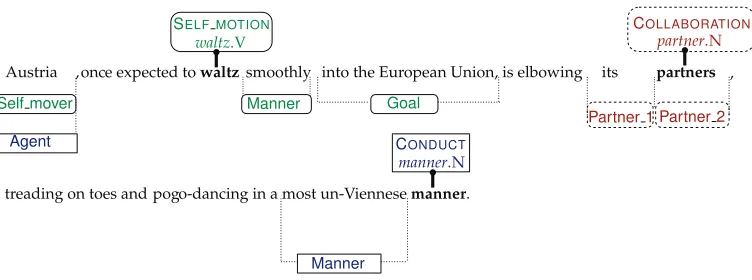
In this article, we present a computational and statistical model for frame-semantic parsing, the problem of extracting from text semantic predicate-argument structures such as those shown in Figure 1. We aim to predict a frame-semantic representation with two statistical models rather than a collection of local classifiers, unlike earlier ap-proaches (Baker, Ellsworth, and Erk 2007). We use a probabilistic framework that cleanly integrates the FrameNet lexicon and limited available training data. The probabilistic framework we adopt is highly amenable to future extension through new features, more relaxed independence assumptions, and additional semi-supervised models.
[image:2.486.54.430.436.576.2]Carefully constructed lexical resources and annotated data sets from FrameNet, detailed in Section 3, form the basis of the frame structure prediction task. We de-compose this task into three subproblems: target identification (Section 4), in which frame-evoking predicates are marked in the sentence; frame identification (Section 5), in which the evoked frame is selected for each predicate; and argument identification (Section 6), in which arguments to each frame are identified and labeled with a role from that frame. Experiments demonstrating favorable performance to the previous state of the art on SemEval 2007 and FrameNet data sets are described in each section. Some novel aspects of our approach include a latent-variable model (Section 5.2) and a semi-supervised extension of the predicate lexicon (Section 5.5) to facilitate disambiguation of words not in the FrameNet lexicon; a unified model for finding and labeling arguments
Figure 1
(Section 6) that diverges from prior work in semantic role labeling; and an exact dual decomposition algorithm (Section 7) that collectively predicts all the arguments of a frame together, thereby incorporating linguistic constraints in a principled fashion.
Our open-source parser, named SEMAFOR (Semantic Analyzer of Frame Represen-tations)1achieves the best published results to date on the SemEval 2007 frame-semantic structure extraction task (Baker, Ellsworth, and Erk 2007). Herein, we also present results on newly released data with FrameNet 1.5, the latest edition of the lexicon. Some of the material presented in this article has appeared in previously published conference papers: Das et al. (2010) presented the basic model, Das and Smith (2011) described semi-supervised lexicon expansion, Das and Smith (2012) demonstrated a sparse variant of lexicon expansion, and Das, Martins, and Smith (2012) presented the dual decomposition algorithm for constrained joint argument identification. We present here a synthesis of those results and several additional details:
1. The set of features used in the two statistical models for frame identification and argument identification.
2. Details of a greedy beam search algorithm for argument identification that avoids illegal argument overlap.
3. Error analysis pertaining to the dual decomposition argument identification algo-rithm, in contrast with the beam search algorithm.
4. Results on full frame-semantic parsing using graph-based semi-supervised learn-ing with sparsity-induclearn-ing penalties; this expands the small FrameNet predicate lexicon, enabling us to handle unknown predicates.
Our primary contributions are the use of efficient structured prediction tech-niques suited to shallow semantic parsing problems, novel methods in semi-supervised learning that improve the lexical coverage of our parser, and making frame-semantic structures a viable computational semantic representation usable in other language technologies. To set the stage, we next consider related work in the automatic prediction of predicate-argument semantic structures.
2. Related Work
In this section, we will focus on previous scientific work relevant to the problem of frame-semantic parsing. First, we will briefly discuss work done on PropBank-style semantic role labeling, following which we will concentrate on the more relevant prob-lem of frame-semantic structure extraction. Next, we review previous work that has used semi-supervised learning for shallow semantic parsing. Finally, we discuss prior work on joint structure prediction relevant to frame-semantic parsing.
2.1 Semantic Role Labeling
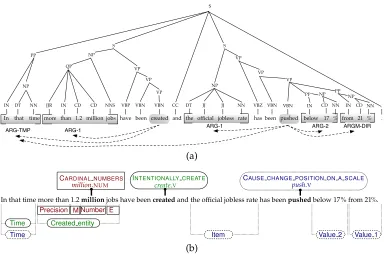
Since Gildea and Jurafsky (2002) pioneered statistical semantic role labeling, there has been a great deal of computational work using predicate-argument structures for semantics. The development of PropBank (Kingsbury and Palmer 2002), followed by CoNLL shared tasks on semantic role labeling (Carreras and M`arquez 2004, 2005) boosted research in this area. Figure 2(a) shows an annotation from PropBank. PropBank annotations are closely tied to syntax, because the data set consists of the
(a)
[image:4.486.49.433.60.314.2](b) Figure 2
(a) A phrase-structure tree taken from the Penn Treebank and annotated with PropBank predicate-argument structures. The verbscreatedandpushedserve as predicates in this
sentence. Dotted arrows connect each predicate to its semantic arguments (bracketed phrases). (b) A partial depiction of frame-semantic structures for the same sentence. The words in bold aretargets, which instantiate a (lemmatized and part-of-speech–tagged)lexical unitand evoke a semantic frame. Every frame annotation is shown enclosed in a distint shape or border style, and its argument labels are shown together on the same vertical tier below the sentence. See text for explanation of abbreviations.
phrase-structure syntax trees from theWall Street Journalsection of the Penn Treebank (Marcus, Marcinkiewicz, and Santorini 1993) annotated with predicate-argument structures for verbs. In Figure 2(a), the syntax tree for the sentence is marked with various semantic roles. The two main verbs in the sentence, created and pushed, are the predicates. For the former, the constituent more than 1.2 million jobsserves as the semantic roleARG1and the constituentIn that timeserves as the roleARGM-TMP. Similarly for the latter verb, rolesARG1,ARG2,ARGM-DIR, andARGM-TMPare shown in the figure. PropBank definescore rolesARG0throughARG5, which receive different interpretations for different predicates. Additionalmodifier rolesARGM-*includeARGM-TMP(temporal) and ARGM-DIR (directional), as shown in Figure 2(a). The PropBank representation therefore has a small number of roles, and the training data set comprises some 40,000 sentences, thus making the semantic role labeling task an attractive one from the perspective of machine learning.
suited predicate-argument structures. Joint modeling for semantic role labeling with discriminative log-linear models is presented by Toutanova, Haghighi, and Manning (2005), where global features looking at all arguments of a particular verb together are incorporated into a dynamic programming and reranking framework. The
Computa-tional Linguisticsspecial issue on semantic role labeling (M`arquez et al. 2008) includes
other interesting papers on the topic, leveraging the PropBank conventions for labeling shallow semantic structures. Recently, there have been initiatives to predict syntactic dependencies as well as PropBank-style predicate-argument structures together using one joint model (Surdeanu et al. 2008; Hajiˇc et al. 2009).
Here, we focus on the related problem of frame-semantic parsing. Note from the annotated semantic roles for the two verbs in the sentence of Figure 2(a) that it is unclear what the core rolesARG1orARG2represent linguistically. To better understand the roles’ meaning for a given verb, one has to refer to a verb-specific file provided along with the PropBank corpus. Although collapsing these verb-specific core roles into tags ARG0-ARG5leads to a small set of classes to be learned from a reasonable sized corpus, analysis shows that the rolesARG2–ARG5 serve many different purposes for different verbs. Yi, Loper, and Palmer (2007) point out that these four roles are highly overloaded and inconsistent, and they mapped them to VerbNet (Schuler 2005) thematic roles to get improvements on the SRL task. Recently, Bauer and Rambow (2011) presented a method to improve the syntactic subcategorization patterns for FrameNet lexical units using VerbNet. Instead of working with PropBank, we focus on shallow semantic parsing of sentences in the paradigm of frame semantics (Fillmore 1982), to which we turn next.
2.2 Frame-Semantic Parsing
The FrameNet lexicon (Fillmore, Johnson, and Petruck 2003) contains rich linguistic information about lexical items and predicate-argument structures. A semantic frame present in this lexicon includes a list of lexical units, which are associated words and phrases that can potentially evoke it in a natural language utterance. Each frame in the lexicon also enumerates several roles corresponding to facets of the scenario represented by the frame. In a frame-analyzed sentence, predicates evoking frames are known astargets, and a word or phrase filling a role is known as an argument. Figure 2(b) shows frame-semantic annotations for the same sentence as in Figure 2(a). (In the figure, for example, theCARDINAL NUMBERS frame, “M” denotes the roleMultiplier and “E” denotes the roleEntity.) Note that the verbscreatedandpushedevoke the frames INTENTIONALLY CREATEandCAUSE CHANGE POSITION ON A SCALE, respectively. The
correspond-ing lexical units2 from the FrameNet lexicon, create.V and push.V, are also shown. The PropBank analysis in Figure 2(a) also has annotations for these two verbs. While PropBank labels the roles of these verbs with its limited set of tags, the frame-semantic parse labels each frame’s arguments with frame-specific roles shown in the figure, making it immediately clear what those arguments mean. For example, for the INTENTIONALLY CREATEframe,more than 1.2 million jobsis theCreated entity, andIn that timeis theTimewhen the jobs were created. FrameNet also allowsnon-verbalwords and phrases to evoke semantic frames: in this sentence,millionevokes the frame CARDINAL NUMBERS
and doubles as itsNumberargument, with1.2asMultiplier,jobsas theEntitybeing quantified,
andmore thanas thePrecisionof the quantity expression.
EVENT
Place
Time Event
TRANSITIVE_ACTION
Agent
Patient Event
Cause Place
Time OBJECTIVE_INFLUENCE
Dependent_entity uencing_situation
Place
Time
uencing_entity
CAUSE_TO_MAKE_NOISE
Agent
Sound_maker Cause
Place
Time
MAKE_NOISE
Noisy_event Sound
Sound_source Place
Time
cough.v, gobble.v, hiss.v, ring.v, yodel.v, ... blare.v, honk.v, play.v,
ring.v, toot.v, ... —
affect.v, effect.n, impact.n, impact.v, ...
event.n, happen.v, occur.v, take place.v, ...
Inheritance relation Causative_of relation
Excludes relation
[image:6.486.49.432.62.235.2]Purpose
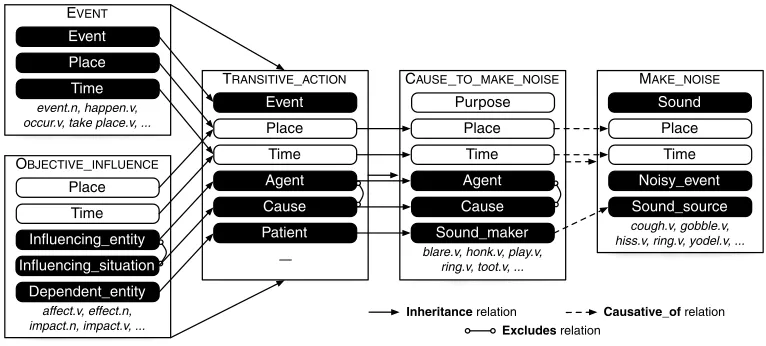
Figure 3
Partial illustration of frames, roles, and lexical units related to theCAUSE TO MAKE NOISEframe, from the FrameNet lexicon. Core roles are filled bars. Non-core roles (such asPlaceandTime) are unfilled bars. No particular significance is ascribed to the ordering of a frame’s roles in its lexicon entry (the selection and ordering of roles above is for illustrative convenience).
CAUSE TO MAKE NOISEdefines a total of 14 roles, many of them not shown here.
Whereas PropBank contains verbal predicates and NomBank (Meyers et al. 2004) con-tains nominal predicates, FrameNet counts these as well as allowing adjectives, adverbs, and prepositions among its lexical units. Finally, FrameNet frames organize predicates according to semantic principles, both by allowing related terms to evoke a common frame (e.g., push.V, raise.V, and growth.N for CAUSE CHANGE POSITION ON A SCALE) and by
defining frames and their roles within a hierarchy (see Figure 3). PropBank does not explicitly encode relationships among predicates.
Most early work on frame-semantic parsing has made use of theexemplarsentences in the FrameNet corpus (see Section 3.1), each of which is annotated for a single frame and its arguments. Gildea and Jurafsky (2002) presented a discriminative model for arguments given the frame; Thompson, Levy, and Manning (2003) used a generative model for both the frame and its arguments. Fleischman, Kwon, and Hovy (2003) first used maximum entropy models to find and label arguments given the frame. Shi and Mihalcea (2004) developed a rule-based system to predict frames and their arguments in text, and Erk and Pad ´o (2006) introduced the Shalmaneser tool, which uses naive Bayes classifiers to do the same. Other FrameNet SRL systems (Giuglea and Moschitti 2006, for instance) have used SVMs. Most of this work was done on an older, smaller version of FrameNet, containing around 300 frames and fewer than 500 unique semantic roles. Unlike this body of work, we experimented with the larger SemEval 2007 shared task data set, and also the newer FrameNet 1.5,3 which lists 877 frames and 1,068 role types—thus handling many more labels, and resulting in richer frame-semantic parses. Recent work in frame-semantic parsing—in which sentences may contain multiple frames which need to be recognized along with their arguments—was undertaken as the SemEval 2007 task 19 of frame-semantic structure extraction (Baker, Ellsworth, and Erk 2007). This task leveraged FrameNet 1.3, and also released a small corpus
containing a little more than 2,000 sentences with full text annotations. The LTH system of Johansson and Nugues (2007), which we use as our baseline (Section 3.4), had the best performance in the SemEval 2007 task in terms of full frame-semantic parsing. Johansson and Nugues broke down the task as identifying targets that could evoke frames in a sentence, identifying the correct semantic frame for a target, and finally determining the arguments that fill the semantic roles of a frame. They used a series of SVMs to classify the frames for a given target, associating unseen lexical items to frames and identifying and classifying token spans as various semantic roles. Both the full text annotation corpus as well as the FrameNet exemplar sentences were used to train their models. Unlike Johansson and Nugues, we use onlythe full text annotated sentences as training data, model the whole problem with only two statis-tical models, and obtain significantly better overall parsing scores. We also model the argument identification problem using a joint structure prediction model and use semi-supervised learning to improve predicate coverage. We also present experiments on recently released FrameNet 1.5 data.
In other work based on FrameNet, Matsubayashi, Okazaki, and Tsujii (2009) in-vestigated various uses of FrameNet’s taxonomic relations for learning generalizations over roles; they trained a log-linear model on the SemEval 2007 data to evaluate features for the subtask of argument identification. Another line of work has sought to extend the coverage of FrameNet by exploiting VerbNet and WordNet (Shi and Mihalcea 2005; Giuglea and Moschitti 2006; Pennacchiotti et al. 2008) and by projecting entries and annotations within and across languages (Boas 2002; Fung and Chen 2004; Pado and Lapata 2005; F ¨urstenau and Lapata 2009b). Others have explored the application of frame-semantic structures to tasks such as information extraction (Moschitti, Morarescu, and Harabagiu 2003; Surdeanu et al. 2003), textual entailment (Burchardt and Frank 2006; Burchardt et al. 2009), question answering (Narayanan and Harabagiu 2004; Shen and Lapata 2007), and paraphrase recognition (Pad ´o and Erk 2005).
2.3 Semi-Supervised Methods
Although there has been a significant amount of work in supervised shallow semantic parsing using both PropBank- and FrameNet-style representations, a few improve-ments over vanilla supervised methods using unlabeled data are notable. F ¨urstenau and Lapata (2009b) present a method of projecting predicate-argument structures from some seed examples to unlabeled sentences, and use a linear program formulation to find the best alignment explaining the projection. Next, the projected information as well as the seeds are used to train statistical model(s) for SRL. The authors ran experiments using a set of randomly chosen verbs from the exemplar sentences of FrameNet and found improvements over supervised methods. In an extension to this work, F ¨urstenau and Lapata (2009a) present a method for finding examples for unseen verbs using a graph alignment method; this method represents sentences and their syntactic analysis as graphs and graph alignment is used to project annotations from seed examples to unlabeled sentences. This alignment problem is again modeled as a linear program. F ¨urstenau and Lapata (2012) present an detailed expansion of the aforementioned papers. Although this line of work presents a novel direction in the area of SRL, the published approach does not yet deal with non-verbal predicates and does not evaluate the presented methods on the full text annotations of the FrameNet releases.
are estimated using standard unsupervised methods. Next, the latent information is used as features for an SRL model. Improvements over supervised SRL techniques are observed with the augmentation of these extra features. The authors also compare their method with the aforementioned two methods of F ¨urstenau and Lapata (2009a, 2009b) and show relative improvements. Experiments are performed on the CoNLL 2008 shared task data set (Surdeanu et al. 2008), which follows the PropBank conven-tions and only labels verbal and nominal predicates—in contrast to our work, which includes most lexicosyntactic categories. A similar approach is presented by Weston, Ratle, and Collobert (2008), who use neural embeddings of words, which are eventu-ally used for SRL; improvements over state-of-the-art PropBank-style SRL systems are observed.
Recently, there has been related work in unsupervised semantic role labeling (Lang and Lapata 2010, 2011; Titov and Klementiev 2012) that attempts to induce semantic roles automatically from unannotated data. This line of work may be useful in discov-ering new semantic frames and roles, but here we stick to the concrete representation provided in FrameNet, without seeking to expand its inventory of semantic types. We present a new semi-supervised technique to expand the set of lexical items with the potential semantic frames that they could evoke; we use a graph-based semi-supervised learning framework to achieve this goal (Section 5.5).
2.4 Joint Inference and Shallow Semantic Parsing
Most high-performance SRL systems that use conventions from PropBank (Kingsbury and Palmer 2002) and NomBank (Meyers et al. 2004) utilize joint inference for seman-tic role labeling (M`arquez et al. 2008). To our knowledge, the separate line of work investigating frame-semantic parsing has not previously dealt with joint inference. A common trait in prior work, both in PropBank and FrameNet conventions, has been the use of a two-stage model that identifies arguments first, then labels them, often using dynamic programming or integer linear programs (ILPs); we treat both problems together here.4
Recent work in natural language processing (NLP) problems has focused on ILP for-mulations for complex structure prediction tasks like dependency parsing (Riedel and Clarke 2006; Martins, Smith, and Xing 2009; Martins et al. 2010), sequence tagging (Roth and Yih 2004), as well as PropBank SRL (Punyakanok et al. 2004). Whereas early work in this area focused on declarative formulations tackled with off-the-shelf solvers, Rush et al. (2010) proposed subgradient-based dual decomposition (also called Lagrangian relaxation) as a way of exploiting the structure of the problem and existing combina-torial algorithms. The method allows the combination of models that are individually tractable, but not jointly tractable, by solving a relaxation of the original problem. Since then, dual decomposition has been used to build more accurate models for dependency parsing (Koo et al. 2010), combinatory categorical grammar supertagging and parsing (Auli and Lopez 2011), and machine translation (Chang and Collins 2011; DeNero and Macherey 2011; Rush and Collins 2011).
Recently, Martins et al. (2011b) showed that the success of subgradient-based dual decomposition strongly relies on breaking down the original problem into a “good”
decomposition, that is, one with few overlapping components. This leaves out many declarative constrained problems, for which such a good decomposition is not readily available. For those, Martins et al. proposed theAlternating Directions Dual Decom-position(AD3) algorithm, which retains the modularity of previous methods, but can handle thousands of small overlapping components. We adopt that algorithm as it perfectly suits the problem of argument identification, as we observe in Section 7.5 We also contribute an exact branch-and-bound technique wrapped around AD3.
Before delving into the details of our modeling framework, we describe in detail the structure of the FrameNet lexicon and the data sets used to train our models.
3. Resources and Task
We consider frame-semantic parsing resources consisting of a lexicon and annotated sentences with frame-semantic structures, evaluation strategies, and previous baselines.
3.1 FrameNet Lexicon
The FrameNet lexicon is a taxonomy of manually identified general-purpose semantic
framesfor English.6 Listed in the lexicon with each frame are a set of lemmas (with parts of speech) that can denote the frame or some aspect of it—these are calledlexical units(LUs). In a sentence, word or phrase tokens that evoke a frame are known as
targets. The set of LUs listed for a frame in FrameNet may not be exhaustive; we may see a target in new data that does not correspond to an LU for the frame it evokes. Each frame definition also includes a set of frame elements, or roles, corresponding to different aspects of the concept represented by the frame, such as participants, props, and attributes. We use the termargumentto refer to a sequence of word tokens annotated as filling a frame role. Figure 1 shows an example sentence from the training data with annotated targets, LUs, frames, and role-argument pairs. The FrameNet lexicon also provides information about relations between frames and between roles (e.g.,INHERITANCE). Figure 3 shows a subset of the relations between five frames and their roles.
Accompanying most frame definitions in the FrameNet lexicon is a set of lexico-graphic exemplar sentences (primarily from the British National Corpus) annotated for that frame. Typically chosen to illustrate variation in argument realization pat-terns for the frame in question, these sentences only contain annotations for a single frame.
In preliminary experiments, we found that using exemplar sentences directly to train our models hurt performance as evaluated on SemEval 2007 data, which formed a benchmark for comparison with previous state of the art. This was a noteworthy observation, given that the number of exemplar sentences is an order of magnitude larger than the number of sentences in training data that we consider in our experiments (Section 3.2). This is presumably because the exemplars are not representative as a sample, do not have complete annotations, and are not from a domain similar to the
5 AD3was previously referred to as “DD-ADMM,” in reference to the use of dual decomposition with the alternating directions method of multipliers.
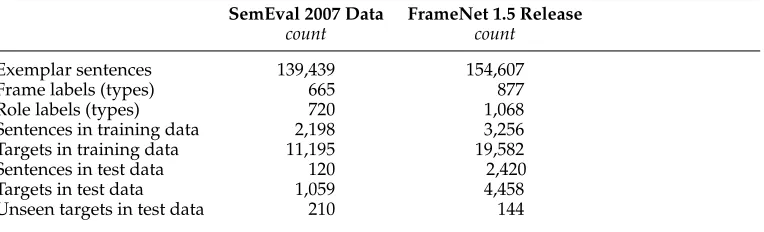
Table 1
Salient statistics of the data sets used in our experiments. There is a significant overlap between the two data sets.
SemEval 2007 Data FrameNet 1.5 Release
count count
Exemplar sentences 139,439 154,607
Frame labels (types) 665 877
Role labels (types) 720 1,068
Sentences in training data 2,198 3,256
Targets in training data 11,195 19,582
Sentences in test data 120 2,420
Targets in test data 1,059 4,458
Unseen targets in test data 210 144
test data. Instead, we make use of these exemplars in the construction of features (Section 5.2).
3.2 Data
In our experiments on frame-semantic parsing, we use two sets of data:
1. SemEval 2007 data: In benchmark experiments for comparison with previous state of the art, we use a data set that was released as part of theSemEval 2007
shared taskon frame-semantic structure extraction (Baker, Ellsworth, and Erk 2007).
Full text annotations in this data set consisted of a few thousand sentences con-taining multiple targets, each annotated with a frame and its arguments. The then-current version of the lexicon (FrameNet 1.3) was used for the shared task as the inventory of frames, roles, and lexical units (Figure 3 illustrates a small portion of the lexicon). In addition to the frame hierarchy, FrameNet 1.3 also contained 139,439 exemplar sentences containing one target each. Statistics of the data used for the SemEval 2007 shared task are given in the first column of Table 1. A total of 665 frame types and 720 role types appear in the exemplars and the training portion of the data. We adopted the same training and test split as the SemEval 2007 shared task; however, we removed four documents from the training set7for development. Table 2 shows some additional information about the SemEval data set; the variety of lexicosyntactic categories of targets stands in marked contrast with the PropBank-style SRL data and task.
2. FrameNet 1.5 release:A more recent version of the FrameNet lexicon was released in 2010.8 We also test our statistical models (only frame identification and argu-ment identification) on this data set to get an estimate of how much improveargu-ment additional data can provide. Details of this data set are shown in the second col-umn of Table 1. Of the 78 documents in this release with full text annotations, we selected 55 (19,582 targets) for training and held out the remaining 23 (4,458 tar-gets) for testing. There are fewer target annotations per sentence in the test set than
7 These were: StephanopoulousCrimes, Iran Biological, NorthKorea Introduction, and WMDNews 042106. 8 Released on 15 September 2010, and downloadable fromhttp://framenet.icsi.berkeley.eduas of
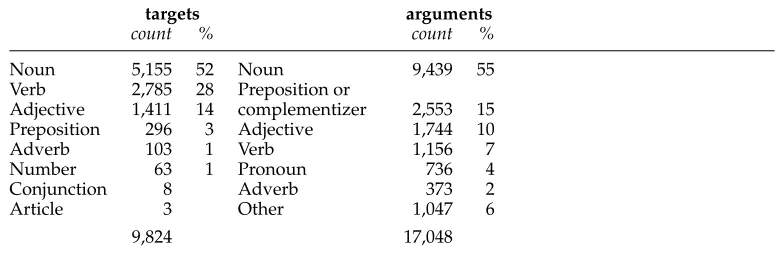
Table 2
Breakdown of targets and arguments in the SemEval 2007 training set in terms of part of speech. The target POS is based on the LU annotation for the frame instance. For arguments, this reflects the part of speech of the head word (estimated from an automatic dependency parse); the percentage is out of all overt arguments.
targets arguments
count % count %
Noun 5,155 52 Noun 9,439 55
Verb 2,785 28 Preposition or complementizer
Adjective 1,411 14 2,553 15
Preposition 296 3 Adjective 1,744 10
Adverb 103 1 Verb 1,156 7
Number 63 1 Pronoun 736 4
Conjunction 8 Adverb 373 2
Article 3 Other 1,047 6
9,824 17,048
the training set.9 Das and Smith (2011, supplementary material) give the names of the test documents for fair replication of our work. We also randomly selected 4,462 targets from the training data for development of the argument identification model (Section 6.1).
Preprocessing.We preprocessed sentences in our data set with a standard set of anno-tations: POS tags from MXPOST (Ratnaparkhi 1996) and dependency parses from the MST parser (McDonald, Crammer, and Pereira 2005); manual syntactic parses are not available for most of the FrameNet-annotated documents. We used WordNet (Fellbaum 1998) for lemmatization. Our models treat these pieces of information as observations. We also labeled each verb in the data as havingACTIVEor PASSIVEvoice, using code from the SRL system described by Johansson and Nugues (2008).
3.3 Task and Evaluation Methodology
Automatic annotations of frame-semantic structure can be broken into three parts:
(1) targets, the words or phrases that evoke frames; (2) theframe type, defined in the
lexicon, evoked by each target; and (3) thearguments, or spans of words that serve to fill roles defined by each evoked frame. These correspond to the three subtasks in our parser, each described and evaluated in turn: target identification (Section 4), frame identification (Section 5, not unlike word-sense disambiguation), and argument identification (Section 6, essentially the same as semantic role labeling).
The standard evaluation script from the SemEval 2007 shared task calculates pre-cision, recall, and F1-measure for frames and arguments; it also provides a score that gives partial credit for hypothesizing a frame related to the correct one. We present
precision, recall, and F1-measure microaveraged across the test documents, report labels-onlymatching scores (spans must match exactly), and do not use named entity labels.10 More details can be found in the task description paper from SemEval 2007 (Baker, Ellsworth, and Erk 2007). For our experiments, statistical significance is measured using a reimplementation of Dan Bikel’s randomized parsing evaluation comparator, a strat-ified shuffling test whose original implementation11 is accompanied by the following description (quoted verbatim, with explanations of our use of the test given in square brackets):
The null hypothesis is that the two models that produced the observed results are the same, such that for each test instance [here, a set of predicate-argument structures for a sentence], the two observed scores are equally likely. This null hypothesis is tested by randomly shuffling individual sentences’ scores between the two models and then re-computing the evaluation metrics [precision, recall or F1score in our case]. If the
difference in a particular metric after a shuffling is equal to or greater than the original observed difference in that metric, then a counter for that metric is incremented. Ideally, one would perform all 2nshuffles, wherenis the number of test cases (sentences), but given that this is often prohibitively expensive, the default number of iterations is 10,000 [we use independently sampled 10,000 shuffles]. After all iterations, the likelihood of incorrectly rejecting the null [hypothesis, i.e., thep-value] is simply (nc+1)/(nt+1), wherencis the number of random differences greater than the original observed difference, andntis the total number of iterations.
3.4 Baseline
A strong baseline for frame-semantic parsing is the system presented by Johansson and Nugues (2007, hereafter J&N’07), the best system in the SemEval 2007 shared task. That system is based on a collection of SVMs. They used a set of rules for target identification which we describe in Appendix A. For frame identification, they used an SVM classifier to disambiguate frames for known frame-evoking words. They used WordNet synsets to extend the vocabulary of frame-evoking words to cover unknown words, and then used a collection of separate SVM classifiers—one for each frame—to predict a single evoked frame for each occurrence of a word in the extended set.
J&N’07 followed Xue and Palmer (2004) in dividing the argument identification problem into two subtasks: First, they classified candidate spans as to whether they were arguments or not; then they assigned roles to those that were identified as ar-guments. Both phases used SVMs. Thus, their formulation of the problem involves a multitude of independently trained classifiers that share no information—whereas ours uses two log-linear models, each with a single set of parameters shared across all contexts, to find a full frame-semantic parse.
We compare our models with J&N’07 using the benchmark data set from SemEval 2007. However, because we are not aware of any other work using the FrameNet 1.5 full text annotations, we report our results on that data set without comparison to any other system.
10 For microaveraging, we concatenated all sentences of the test documents and measured precision and recall over the concatenation. Macroaveraging, on the other hand, would mean calculating these metrics for each document, then averaging them. Microaveraging treats every frame or argument as a unit, regardless of the length of the document in which it occurs.
4. Target Identification
Target identification is the problem of deciding which word tokens (or word token sequences) evoke frames in a given sentence. In other semantic role labeling schemes (e.g., PropBank), simple part-of-speech criteria typically distinguish targets from non-targets. But in frame semantics, verbs, nouns, adjectives, and even prepositions can evoke frames under certain conditions. One complication is that semantically impov-erishedsupport predicates(such asmakeinmake a request) do not evoke frames in the context of a frame-evoking, syntactically dependent noun (request). Furthermore, only temporal, locative, and directional senses of prepositions evoke frames.12
Preliminary experiments using a statistical method for target identification gave unsatisfactory results; instead, we followed J&N’07 in using a small set of rules to identify targets. First, we created a master list of all the morphological variants of targets that appear in the exemplar sentences and a given training set. For a sentence in new data, we considered as candidate targets only those substrings that appear in this master list. We also did not attempt to capture discontinuous frame targets: for example, we treatthere would have been as a single span even though the corresponding LU is
there be.V.13
Next, we pruned the candidate target set by applying a series of rules identical to the ones described by Johansson and Nugues (2007, see Appendix A), with two exceptions. First, they identified locative, temporal, and directional prepositions using a dependency parser so as to retain them as valid LUs. In contrast, we pruned all types of prepositions because we found them to hurt our performance on the development set due to errors in syntactic parsing. In a second departure from their target extraction rules, we did not remove the candidate targets that had been tagged as support verbs for some other target. Note that we used a conservative white list that filters out targets whose morphological variants were not seen either in the lexicon or the training data.14 Therefore, when this conservative process of automatic target identification is used, our system loses the capability to predict frames for completely unseen LUs, despite the fact that our powerful frame identification model (Section 5) can accurately label frames for new LUs.15
Results.Table 3 shows results on target identification tested on the SemEval 2007 test
set; our system gains 3 F1 points over the baseline. This is statistically significant with p<0.01. Our results are also significant in terms of precision (p<0.05) and recall (p<
0.01). There are 85 distinct LUs for which the baseline fails to identify the correct target while our system succeeds. A considerable proportion of these units have more than
12 Note that there have been dedicated shared tasks to determine relationships between nominals (Girju et al. 2007) and word-sense disambiguation of prepositions (Litkowski and Hargraves 2007), but we do not build specific models for predicates of these categories.
13 There are 629 multiword LUs in the lexicon, and they correspond to 4.8% of the targets in the training set; among them arescrew up.V,shoot the breeze.V, andweapon of mass destruction.N. In the SemEval 2007 training data, there are just 99 discontinuous multiword targets (1% of all targets).
14 This conservative approach violates theoretical linguistic assumptions about frame-evoking targets as governed by frame semantics. It also goes against the spirit of using linguistic constraints to improve the separate subtask of argument identification (see Section 7); however, due to varying distributions of target annotations, high empirical error in identifying locative, temporal, and directional prepositions, and support verbs, we resorted to this aggressive filtering heuristic to avoid making too many target identification mistakes.
Table 3
Target identification results for our system and the baseline on the SemEval’07 data set. Scores in bolddenote significant improvements over the baseline (p<0.05).
TARGETIDENTIFICATION P R F1
Our technique (§4) 89.92 70.79 79.21 Baseline: J&N’07 87.87 67.11 76.10
one token (e.g.,chemical and biological weapon.N,ballistic missile.N), which J&N’07 do not model. The baseline also does not label variants ofthere be.V(e.g.,there areandthere has been), which we correctly label as targets. Some examples of other single token LUs that the baseline fails to identify are names of months, LUs that belong to the ORIGINframe
(e.g.,iranian.A), and directions (e.g.,north.Aornorth-south.A).16
5. Frame Identification
Given targets, our parser next identifies their frames, using a statistical model.
5.1 Lexical Units
FrameNet specifies a great deal of structural information both within and among frames. For frame identification we make use of frame-evoking lexical units, the (lem-matized and POS-tagged) words and phrases listed in the lexicon as referring to specific frames. For example, listed with the BRAGGING frame are 10 LUs, including boast.N,
boast.V,boastful.A,brag.V, andbraggart.N. Of course, due to polysemy and homonymy,
the same LU may be associated with multiple frames; for example, gobble.V is listed under both theINGESTIONandMAKE NOISEframes. We thus termgobble.Vanambiguous
LU. All targets in the exemplar sentences, our training data, and most in our test data, correspond to known LUs. (See Section 5.4 for statistics of unknown LUs in the test sets.) To incorporate frame-evoking expressions found in the training data but not the lexicon—and to avoid the possibility of lemmatization errors—our frame identification model will incorporate, via a latent variable, features based directly on exemplar and training targets rather than LUs. Let L be the set of (unlemmatized and automati-cally POS-tagged) targets found in the exemplar sentences of the lexicon and/or the sentences in our training set. Let Lf ⊆L be the subset of these targets annotated as evoking a particular framef.17LetLlandLl
f denote the lemmatized versions ofLand
Lf, respectively. Then, we writeboasted.VBD∈LBRAGGINGandboast.VBD∈LlBRAGGINGto
indicate that this inflected verbboastedand its lemmaboasthave been seen to evoke the BRAGGINGframe. Significantly, however, another target, such astoot your own horn, might
be used elsewhere to evoke this frame. We thus face the additional hurdle of predicting frames for unknown words.
16 We do not evaluate the target identification module on the FrameNet 1.5 data set; we instead ran controlled experiments on those data to measure performance of the statistical frame identification and argument identification subtasks, assuming that the correct targets were given. Moreover, as discussed in Section 3.2, the target annotations on the FrameNet 1.5 test set were fewer in number in comparison to the training set, resulting in a mismatch of target distributions between train and test settings. 17 For example, on average, there are 34 targets per frame in the SemEval 2007 data set; the average frame
In producing full text annotations for the SemEval 2007 data set, annotators created several domain-critical frames that were not already present in version 1.3 of the lexicon. For our experiments we omit frames attested in neither the training data nor the exem-plar sentences from the lexicon.18This leaves a total of 665 frames for the SemEval 2007 data set and a total of 877 frames for the FrameNet 1.5 data set.
5.2 Model
For a given sentence x with frame-evoking targets t, lettidenote theith target (a word sequence).19 Let tl
i denote its lemma. We seek a list f=f1,. . .,fmof frames, one per target. In our model, the set of candidate frames fortiis defined to include every frame f such thattli∈Lfl—or iftli∈Ll, then every known frame (the latter condition applies for 4.7% of the annotated targets in the SemEval 2007 development set). In both cases, we letFibe the set of candidate frames for theith target in x. We denote the entire set of frames in the lexicon asF.
To allow frame identification for targets whose lemmas were seen in neither the exemplars nor the training data, our model includes an additional variable,i. This variable ranges over the seen targets in Lfi, which can be thought of as prototypes for the expression of the frame. Importantly, frames arepredicted, but prototypes are summed over via the latent variable. The prediction rule requires a probabilistic model over frames for a target:
fi←argmax f∈Fi
∈Lf
pθ(f,|ti, x) (1)
We model the probability of a framef and the prototype unit, given the target and the sentence x as:
pθ(f,|ti, x)=
expθg(f,,ti, x)
f∈F
∈Lf
expθg(f,,ti, x)
(2)
This is a conditional log-linear model: for f ∈Fi and ∈Lf, where θ are the model weights, andg is a vector-valued feature function. This discriminative formulation is very flexible, allowing for a variety of (possibly overlapping) features; for example, a feature might relate a frame type to a prototype, represent a lexical-semantic relation-ship between a prototype and a target, or encode part of the syntax of the sentence.
Previous work has exploited WordNet for better coverage during frame identifica-tion (Burchardt, Erk, and Frank 2005; Johansson and Nugues 2007, e.g., by expanding the set of targets using synsets), and others have sought to extend the lexicon itself. We differ in our use of a latent variable to incorporate lexical-semantic features in a discriminative model, relating known lexical units to unknown words that may evoke frames. Here we are able to take advantage of the large inventory of partially annotated
18 Automatically predicting new frames is a challenge not yet attempted to our knowledge (including here). Note that the scoring metric (Section 3.3) gives partial credit forrelatedframes (e.g., a more general frame from the lexicon).
Table 4
Features used for frame identification (Equation (2)). All also incorporatef, the frame being scored.=w,πconsists of the words and POS tags20of a target seen in an exemplar or
training sentence as evokingf. The features with starred bullets were also used by Johansson and Nugues (2007).
• the POS of the parent of the head word ofti
•∗the set of syntactic dependencies of the head word21oft
i •∗if the head word oft
iis a verb, then the set of dependency labels of its children • the dependency label on the edge connecting the head oftiand its parent • the sequence of words in the prototype, w
• the lemmatized sequence of words in the prototype
• the lemmatized sequence of words in the prototype and their part-of-speech tagsπ
• WordNet relation22ρholds betweenandt
i • WordNet relation22ρholds betweenandt
i, and the prototype is • WordNet relation22ρholds betweenandt
i, the POS tag sequence ofisπ, and the POS
tag sequence oftiisπt
exemplar sentences. Note that this model makes an independence assumption: Each frame is predicted independently of all others in the document. In this way the model is similar to J&N’07. However, ours is a single conditional model that shares features and weights across all targets, frames, and prototypes, whereas the approach of J&N’07 consists of many separately trained models. Moreover, our model is unique in that it uses a latent variable to smooth over frames for unknown or ambiguous LUs.
Frame identification features depend on the preprocessed sentence x, the prototype
and its WordNet lexical-semantic relationship with the target ti, and of course the framef. Our model uses binary features, which are detailed in Table 4.
5.3 Parameter Estimation
Given a training data set (either SemEval 2007 data set or the FrameNet 1.5 full text annotations), which is of the formx(j), t(j), f(j),A(j)Nj=1, we discriminatively train the frame identification model by maximizing the training data log-likelihood:23
max θ
N
j=1 mj
i=1
log
∈L fi(j)
pθ(fi(j),|t(ij), x(j)) (3)
In Equation (3), mj denotes the number of frames in a sentence indexed byj. Note that the training problem is non-convex because of the summed-out prototype latent
20 POS tags are found automatically during preprocessing.
21 If the target is not a subtree in the parse, we consider the words that have parents outside the span, and apply three heuristic rules to select the head: (1) choose the first word if it is a verb; (2) choose the last word if the first word is an adjective; (3) if the target contains the wordof, and the first word is a noun, we choose it. If none of these hold, choose the last word with an external parent to be the head. 22 These are: IDENTICAL-WORD, SYNONYM, ANTONYM (including extended and indirect antonyms),
HYPERNYM, HYPONYM, DERIVED FORM, MORPHOLOGICAL VARIANT (e.g., plural form), VERB GROUP, ENTAILMENT, ENTAILED-BY, SEE-ALSO, CAUSAL RELATION, and NO RELATION. 23 We found no benefit on either development data set from using anL2regularizer (zero-mean
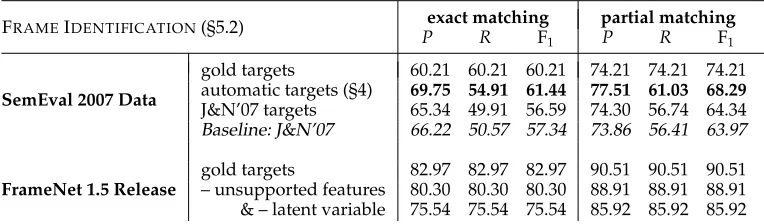
Table 5
Frame identification results on both the SemEval 2007 data set and the FrameNet 1.5 release. Precision, recall, and F1were evaluated under exact and partial frame matching; see Section 3.3.
Boldindicates best results on the SemEval 2007 data, which are also statistically significant with respect to the baseline (p<0.05).
FRAMEIDENTIFICATION(§5.2) exact matching partial matching
P R F1 P R F1
SemEval 2007 Data
gold targets 60.21 60.21 60.21 74.21 74.21 74.21 automatic targets (§4) 69.75 54.91 61.44 77.51 61.03 68.29 J&N’07 targets 65.34 49.91 56.59 74.30 56.74 64.34 Baseline: J&N’07 66.22 50.57 57.34 73.86 56.41 63.97
FrameNet 1.5 Release
gold targets 82.97 82.97 82.97 90.51 90.51 90.51 – unsupported features 80.30 80.30 80.30 88.91 88.91 88.91 & – latent variable 75.54 75.54 75.54 85.92 85.92 85.92
variablefor each frame. To calculate the objective function, we need to cope with a sum over frames and prototypes for each target (see Equation (2)), often an expensive operation. We locally optimize the function using a distributed implementation of L-BFGS.24 This is the most expensive model that we train: With 100 parallelized CPUs using MapReduce (Dean and Ghemawat 2008), training takes several hours.25Decoding takes only a few minutes on one CPU for the test set.
5.4 Supervised Results
SemEval 2007 Data. On the SemEval 2007 data set, we evaluate the performance of our frame identification model given gold-standard targets and automatically identified targets (Section 4); see Table 5. Together, our target and frame identification outperform the baseline by 4 F1points. To compare the frame identification stage in isolation with that of J&N’07, we ran our frame identification model with the targets identified by their system as input. With partial matching, our model achieves a relative improvement of 0.6% F1over J&N’07, as shown in the third row of Table 5 (though this is not significant). Note that for exact matching, the F1score of the automatic targets setting is better than the gold target setting. This is due to the fact that there are many unseen predicates in the test set on which the frame identification model performs poorly; however, for the automatic targets that are mostly seen in the lexicon and training data, the model gets high precision, resulting in better overall F1score.
Our frame identification model thus performs on par with the previous state of the art for this task, and offers several advantages over J&N’s formulation of the problem: It requires only a single model, learns lexical-semantic features as part of that model rather than requiring a preprocessing step to expand the vocabulary of frame-evoking words, and is probabilistic, which can facilitate global reasoning.
24 We do not experiment with the initialization of model parameters during this non-convex optimization process; all parameters are initialized to 0.0 before running the optimizer. However, in future work, experiments can be conducted with different random initialization points to seek non-local optima. 25 In later experiments, we used another implementation with 128 parallel cores in a multi-core MPI setup
In the SemEval 2007 data set, for gold-standard targets, 210 out of 1,059 lemmas were not present in the white list that we used for target identification (see Section 4). Our model correctly identifies the frames for 4 of these 210 lemmas. For 44 of these lemmas, the evaluation script assigns a score of 0.5 or more, suggesting that our model predicts a closely related frame. Finally, for 190 of the 210 lemmas, a positive score is assigned by the evaluation script. This suggests that the hidden variable model helps in identifying related (but rarely exact) frames for unseen targets, and explains why under exact—but not partial—frame matching, the F1 score using automatic targets is commensurate with the score for oracle targets.26
For automatically identified targets, the F1 score falls because the model fails to predict frames for unseen lemmas. However, our model outperforms J&N’07 by 4 F1 points. The partial frame matching F1 score of our model represents a significant improvement over the baseline (p<0.01). The precision and recall measures are significant as well (p<0.05 and p<0.01, respectively). However, because targets identified by J&N’07 and frames classified by our frame identification model resulted in scores on par with the baseline, we note that the significant results follow due to better target identification. Note from the results that the automatic target identification model shows an increase in precision, at the expense of recall. This is because the white list for target identification restricts the model to predict frames only for known LUs. If we label the subset of test set with already seen LUs (seen only in the training set, excluding the exemplars) with their corresponding most frequent frame, we achieve an exact match accuracy between 52.9% and 91.2%, depending on the accuracy of the unseen LUs (these bounds assume, respectively, that they are all incorrectly labeled or all correctly labeled).
FrameNet 1.5 Release.The bottom three rows of Table 5 show results on the full text annotation test set of the FrameNet 1.5 release. Because the number of annotations nearly doubled, we see large improvements in frame identification accuracy. Note that we only evaluate with gold targets as input to frame identification. (As mentioned in Section 3.2, some documents in the test set have not been annotated for all targets, so evaluating automatic target identification would not be informative.) We found that 50.1% of the targets in the test set were ambiguous (i.e., they associated with more than one frame either in FrameNet or our training data). On these targets, the exact frame identification accuracy is 73.10% and the partial accuracy is 85.77%, which indicates that the frame identification model is robust to target ambiguity. On this data set, the most frequent frame baseline achieves an exact match accuracy between 74.0% and 88.1%, depending on the accuracy of the unseen LUs.
We conducted further experiments with ablation of the latent variable in our frame identification model. Recall that the decoding objective used to choose a frame by marginalizing over a latent variable , whose values range over targets known to associate with the framef being considered (see Equations (1) and (2)) in training. How much do the prototypes, captured by the latent variable, contribute to performance? Instead of treatingas a marginalized latent variable, we can fix its value to the observed target.
An immediate effect of this choice is a blow-up in the number of features; we must instantiate features (see Table 4) for all 4,194 unique targets observed in training. Because each of these features needs to be associated with all 877 frames in the partition function of Equation (2), the result is an 80-fold blowup of the feature space (the latent variable model had 465,317 features). Such a model is not computationally feasible in our engineering framework, so we considered a model using only features observed to fire at some point in the training data (called “supported” features),27resulting in only 72,058 supported features. In Table 5, we see a significant performance drop (on both exact and partial matching accuracy) with this latent variable–free model, compared both with our latent variable model with all features and with only supported features (of which there are 165,200). This establishes that the latent variable in our frame identification model helps in terms of accuracy, and lets us use a moderately sized feature set incorporating helpful unsupported features.
Finally, in our test set, we found that 144 out of the 4,458 annotated targets were un-seen, and our full frame identification model only labeled 23.1% of the frames correctly for those unseen targets; in terms of partial match accuracy, the model achieved a score of 46.6%. This, along with the results on the SemEval 2007 unseen targets, shows that there is substantial opportunity for improvement when unseen targets are presented to the system. We address this issue next.
5.5 Semi-Supervised Lexicon Expansion
We next address the poor performance of our frame identification model on targets that were unseen as LUs in FrameNet or as instances in training data, and briefly describe a technique for expanding the set of lexical units with potential semantic frames that they can associate with. These experiments were carried out on the FrameNet 1.5 data only. We use a semi-supervised learning (SSL) technique that uses a graph constructed from labeled and unlabeled data. The widely usedgraph-based SSLframework—see Bengio, Delalleau, and Le Roux (2006) and Zhu (2008) for introductory material on this topic—has been shown to perform better than several other semi-supervised algorithms on benchmark data sets (Chapelle, Sch ¨olkopf, and Zien 2006, chapter 21). The method constructs a graph where a small portion of vertices correspond to labeled instances, and the rest are unlabeled. Pairs of vertices are connected by weighted edges denoting the similarity between the pair. Traditionally, Markov random walks (Szummer and Jaakkola 2001; Baluja et al. 2008) or optimization of a loss function based on smoothness properties of the graph (e.g., Corduneanu and Jaakkola 2003; Zhu, Ghahramani, and Lafferty 2003; Subramanya and Bilmes 2008) are performed to propagate labels from the labeled vertices to the unlabeled ones. In our work, we are interested in multi-class generalizations of graph-propagation algorithms suitable for NLP applications, where each graph vertex can assume oneor moreout of many possible labels (Subramanya and Bilmes 2008, 2009; Talukdar and Crammer 2009). For us, graph vertices correspond to natural languagetypes(not tokens) and undirected edges between them are weighted using a similarity metric. Recently, this set-up has been used to learn soft labels on natural language types (say, wordn-grams or in our case, syntactically disambiguated
predicates) from seed data, resulting in large but noisy lexicons, which are used to constrain structured prediction models. Applications have ranged from domain adap-tation of sequence models (Subramanya, Petrov, and Pereira 2010) to unsupervised learning of POS taggers by using bilingual graph-based projections (Das and Petrov 2011).
We describe our approach to graph construction, propagation for lexicon expansion, and the use of the result to impose constraints on frame identification.
5.5.1 Graph Construction.We construct a graph with lexical units as vertices. Thus, each
vertex corresponds to a lemmatized word or phrase appended with a coarse POS tag. We use two resources for graph construction. First, we take all the words and phrases present in a dependency-based thesaurus constructed using syntactic cooccurrence statistics (Lin 1998), and aggregate words and phrases that share the same lemma and coarse POS tag. To construct this resource, Lin used a corpus containing 64 million words that was parsed with a fast dependency parser (Lin 1993, 1994), and syntactic contexts were used to find similar lexical items for a given word or phrase. Lin sepa-rately treated nouns, verbs, and adjectives/adverbs, so these form the three parts of the thesaurus. This resource gave us a list of possible LUs, much larger in size than the LUs present in FrameNet data.
The second component of graph construction comes from FrameNet itself. We scanned the exemplar sentences in FrameNet 1.5 and the training section of the full text annotations and gathered a distribution over frames for each LU appearing in FrameNet data. For a pair of LUs, we measured the Euclidean distance between their frame distributions. This distance was next converted to a similarity score and inter-polated with the similarity score from Lin’s dependency thesaurus. We omit further details about the interpolation and refer the reader to full details given in Das and Smith (2011).
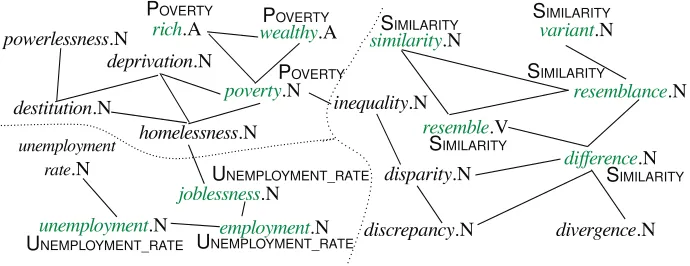
[image:20.486.50.395.469.602.2]For each LU, we create a vertex and link it to theKnearest neighbor LUs under the interpolated similarity metric. The resulting graph has 64,480 vertices, 9,263 of which are labeled seeds from FrameNet 1.5 and 55,217 of which are unlabeled. Each vertex has a possible set of labels corresponding to the 877 frames defined in the lexicon. Figure 4 shows an excerpt from the constructed graph.
Figure 4
5.5.2 Propagation by Optimization.Once the graph is constructed, the 9,263 seed ver-tices with supervised frame distributions are used to propagate the semantic frame information via their nearest neighbors to all vertices. Here we discuss two graph-based SSL objective functions. Das and Smith (2012) compare several other graph-graph-based SSL algorithms for this problem; we refer the interested reader to that paper. LetV denote the set of all vertices in our graph, ˆV⊂V be the set of seed vertices, andF denote the set of all frames. LetN(v) denote the set of neighbors of vertexv∈V. Let q={q1,q2,. . .,q|V|} be the set of frame distributions, one per vertex. For each seed
vertexv∈V, we have a supervised frame distribution ˆˆ qv. All edges in the graph are weighted according to the aforementioned interpolated similarity score, denotedwuv for the edge adjacent to verticesuandv. We findqby solving:
NGF-2 : arg min q, s.t.q≥0, ∀v∈V, qv 1=1
v∈Vˆ
qˆv−qv22+μ
v∈V,u∈N(v)
wuvqv−qu22+ν
v∈V
qv−|F|1 22
(4)
We call the objective in Equation (4)NGF-2because it usesnormalizedprobability dis-tributions at each vertex and is aGaussian field; it also utilizes a uniform2penalty—the third term in the objective function. This is a multiclass generalization of the quadratic cost criterion (Bengio, Delalleau, and Le Roux 2006), also used by Subramanya, Petrov, and Pereira (2010) and Das and Petrov (2011). Our second graph objective function is as follows:
UJSF-1,2: arg min q, s.t.q≥0
v∈Vˆ
DJS( ˆqvqv)+μ
v∈V,u∈N(v)
wuvDJS(qvqu)+ν
v∈V
qv21 (5)
We call itUJSF-1,2 because it uses unnormalized probability measures at each vertex and is aJensen-Shannon field, utilizing pairwise Jensen-Shannon divergences (Lin 1991; Burbea and Rao 2006) and a sparse1,2 penalty (Kowalski and Torr´esani 2009) as the third term. Das and Smith (2012) proposed the objective function in Equation (5). It seeks at each graph vertex a sparse measure, as we expect in a lexicon (i.e., few frames have nonzero probability for a given target). These two graph objectives can be optimized by iterative updates, whose details we omit in this article; more information about the motivation behind using the 1,2 penalty in theUJSF-1,2 objective, the optimization procedure, and an empirical comparison of these and other objectives on another NLP task can be found in Das and Smith (2012).
5.5.3 Constraints for Frame Identification.Once a graph-based SSL objective function is
minimized, we arrive at the optimal set of frame distributions q∗, which we use to constrain our frame identification inference rule, expressed in Equation (1). In that rule,ti is theith target in a sentence x, and fi is the corresponding evoked frame. We now add a constraint to that rule. Recall from Section 5.2 that for targets with known lemmatized forms,Fiwas defined to be the set of frames that associate with lemmatli in the supervised data. For unknown lemmas,Fiwas defined to be all the frames in the lexicon. If the LU corresponding totiis present in the graph, let it be the vertexvi. For such targetsticovered by the graph, we redefineFias:
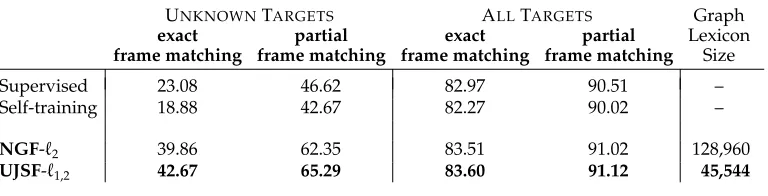
Table 6
[image:22.486.50.434.160.258.2]Exact and partial frame identification accuracy on the FrameNet 1.5 data set with the size of lexicon (in terms of non-zero frame components in the truncated frame distributions) used for frame identification, givengoldtargets. The supervised model is compared with alternatives in Table 5.Boldindicates best results.UJSF-1,2produces statistically significant results (p<0.001)
for all metrics with respect to the supervised baseline for both the unseen LUs as well as the whole test set. Although theNGF-2andUJSF-1,2models are statistically indistinguishable,
it is noteworthy that theUJSF-1,2objective produces a much smaller lexicon.
UNKNOWNTARGETS ALLTARGETS Graph
exact partial exact partial Lexicon
frame matching frame matching frame matching frame matching Size
Supervised 23.08 46.62 82.97 90.51 –
Self-training 18.88 42.67 82.27 90.02 –
NGF-2 39.86 62.35 83.51 91.02 128,960
UJSF-1,2 42.67 65.29 83.60 91.12 45,544
For targets ti in test data whose LUs are not present in the graph (and hence in supervised data),Fiis the set of all frames. Note that in this semi-supervised extension of our frame identification inference procedure, we introduced several hyperparam-eters, namely, μ, ν, K (the number of nearest neighbors for each vertex included in the graph) and M(the number of highest scoring frames per vertex according to the induced frame distribution). We choose these hyperparameters using cross-validation by tuning the frame identification accuracy on unseen targets. (Different values of the first three hyperparameters were chosen for the different graph objectives and we omit their values here for brevity;Mturned out to be 2 for all models.)
Table 6 shows frame identification accuracy, both using exact match as well as partial match. Performance is shown on the portion of the test set containing unknown LUs, as well as the whole test set. The final column presents lexicon size in terms of the set of truncated frame distributions (filtered according to the top M frames in qv for a vertexv) for all the LUs in a graph. For comparison with a semi-supervised baseline, we consider a self-trained system. For this system, we used the supervised frame identification system to label 70,000 sentences from the English Gigaword corpus with frame-semantic parses. For finding targets in a raw sentence, we used a relaxed target identification scheme, where we marked as potential frame-evoking units all targets seen in the lexicon and all other words which were not prepositions, particles, proper nouns, foreign words, or WH-words. We appended these automatic annotations to the training data, resulting in 711,401 frame annotations, more than 36 times the annotated data. These data were next used to train a frame identification model.28 This set-up is very similar to that of Bejan (2009) who used self-training to improve frame identification. In our setting, however, self-training hurts relative to the fully supervised approach (Table 6).
Note that for the unknown part of the test set the graph-based objectives outperform both the supervised model as well as the self-training baseline by a margin of ∼20%
absolute. The best model isUJSF-1,2, and its performance is significantly better than the supervised model (p<0.01). It also produces a smaller lexicon (using the sparsity-inducing penalty) than NGF-2, requiring less memory during frame identification inference. The small footprint can be attributed to the removal of LUs for which all frame components were zero (qi=0). The improvements of the graph-based objectives over the supervised and the self-trained models are modest for the whole test set, but the best model still has statistically significant improvements over the supervised model (p<0.01).
6. Argument Identification
Given a sentence x=x1,. . .,xn, the set of targets t=t1,. . .,tm, and a list of evoked frames f=f1,. . .,fmcorresponding to each target, argument identification is the task of choosing which of eachfi’s roles are filled, and by which parts of x. This task is most similar to the problem of semantic role labeling, but uses a richer set of frame-specific labels than PropBank annotations.
6.1 Model
LetRfi ={r1,. . .,r|Rfi|}denote framefi’sroles(named frame element types) observed in an exemplar sentence and/or our training set. A subset of each frame’s roles are marked as coreroles; these roles are conceptually and/or syntactically necessary for any given use of the frame, though they need not be overt in every sentence involving the frame. These are roughly analogous to the core argumentsARG0–ARG5in PropBank. Non-core roles—analogous to the variousARGM-*in PropBank—loosely correspond to syntactic adjuncts, and carry broadly applicable information such as the time, place, or purpose of an event. The lexicon imposes some additional structure on roles, in-cluding relations to other roles in the same or related frames, and semantic types with respect to a small ontology (marking, for instance, that the entity filling the protag-onist role must be sentient for frames of cognition). Figure 3 illustrates some of the structural elements comprising the frame lexicon by considering theCAUSE TO MAKE NOISE
frame.
We identify a set S of spans that are candidates for filling any role r∈Rfi. In principle, S could contain any subsequence of x, but in this work we only consider the set of contiguous spans that (a) contain a single word or (b) comprise a valid subtree of a word and all its descendants in the dependency parse produced by the MST parser. This covers approximately 80% of arguments in the development data for both data sets.
The empty span, denoted∅, is also included inS, since some roles are not explicitly filled; in the SemEval 2007 development data, the average number of roles an evoked frame defines is 6.7, but the average number of overt arguments is only 1.7.29 In