Authors: 1Simon Jones, 1Lynne Eagle, 1Gill Kemp, Katy Scammell2, Lisa Naumann2,
Sara Hiom2,
Affiliations:1 Bristol Social Marketing Centre, University of the West of England,
Cancer Research UK
Corresponding Author: Gillian Kemp
Mailing address: Bristol Social Marketing Centre, University of the West of England, Frenchay Campus, Coldharbour Lane Bristol BS16 1QY
Telephone +44 (0) 117 32 83433 Fax +44 (0) 117 32 82289 Email: [email protected]
Title of Paper: Segmentation Strategies for Strengthening Sun Protection Behaviours within the UK
Format: seminar presentation
General subject area: Public health
Method: Survey research
Reviewers: All authors are prepared to act as reviewers
Abstract:
Skin cancer rates in the UK have risen steadily, doubling in the past decade resulting
in significant public and personal costs. Cancer Research UK has run the national
SunSmart awareness programme since 2003, but budget restrictions have prohibited
the use of large scale mass media interventions. A behavioural segmentation
approach based on situations and locations where sunburn has occurred may offer the
foundations for specifically targeted interventions. We therefore report on a
large-scale national telephone survey of the general population regarding the circumstances
and sun protective behaviours where sun exposure had led to sunburn. The data
indicates a range of attitudinal, behavioural and knowledge factors that should be
addressed in developing future interventions. A cluster analysis shows clear
behavioural differences across different population segments. Recommendations for
interventions targeting each of the main segments identified are provided for each
Introduction
Skin cancer is the most common cancer in the United Kingdom, with estimates of
nearly 82,000 cases of non-melanoma and 10,400 cases of melanoma registered in
2006 (Garside et al., 2010). Skin cancer rates have risen steadily in the United
Kingdom, doubling in the past decade and continue to increase at some 8% per year,
faster than any other cancer (NICE, 2006). More Britons die of melanoma each year
than in Australia which has four times the UK rate of skin cancer diagnosis. The
difference in mortality rates can be attributed to earlier detection and higher levels of
effective sun protection strategies in Australia (Miranda, 2008).
Mass media campaigns, coupled with interventions targeted at specific population
segments have significantly reduced sunburn rates in Australia (Sinclair & Foley,
2009). Activity in the UK has been limited due to budgetary constraints, and centres
primarily on website and school-based activity. A recent study showed that prompted
awareness of SunSmart increased from 6.5% in 2003 to 17.5% in 2009 (Jones, 2010).
This indicates growing awareness of SunSmart, key messages are not reaching the
population as quickly as mass media-supported interventions would permit.
Information about sun protection and skin cancer is largely passively acquired (Eadie
& MacAskill, 2007), therefore in the absence of mass media initiatives, consideration
should be given to taking sun protective messages to specific segments of the
population where behaviour that has resulted in sunburn in the past is occurring.
Research Methodology
A Cancer Research UK- sponsored telephone survey of 5,034 people aged 16+ years,
As most skin cancers are related to sun exposure (Falk & Anderson, 2008; Murphy,
2002), questions centred on the incidence of self-reported sunburn, the situations in
which the sunburn occurred and sun protective behaviours at the time.
Potential Interventions Based on Segmentation
Segmenting the population on the basis of key behaviours would enable interventions
to be targeted at specific segments, drawing on the collaboration and resources of
potential partners. A segmentation strategy based on four clusters is presented. A
two-step cluster analysis was undertaken on responses from survey respondents who
had indicated that they had been sunburnt within the current year. The filtering of the
data file for the respondents that had reported burning resulted in a sample size of
1606 (31.9%), selected from the main data file of 5034 records. The clustering
process was exploratory and automatically determined with a maximum 15 cluster
allowed within the calculations. The clustering criterion used was Schwarz’s Bayesian
Criteria (BIC), BIC ratio of change and ratio of distance measures (Fraley & Raftery,
1998) using a combination of categorical and continuous variables. Cluster
memberships were created, added to the file and group membership to these clusters
was allocated to the individual respondents. A total of four clusters (segments) were
identified during the two-step analysis. The clusters were reported at the 95%
confidence level with non-significant variables being automatically omitted from the
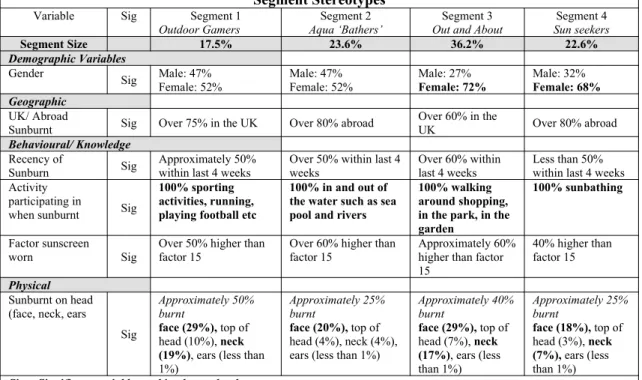
model. Within Table 1, the significant variables from the cluster analysis are detailed
for the segments. Cross-tabulations with non-significant descriptor variables have
Table 1: Sub-sample - Respondents who indicated that they had burnt within the current year – Segment Stereotypes
Variable Sig Segment 1
Outdoor Gamers
Segment 2 Aqua ‘Bathers’
Segment 3 Out and About
Segment 4 Sun seekers
Segment Size 17.5% 23.6% 36.2% 22.6%
Demographic Variables
Gender Sig Male: 47%
Female: 52% Male: 47% Female: 52% Male: 27% Female: 72% Male: 32% Female: 68% Geographic UK/ Abroad
Sunburnt Sig Over 75% in the UK Over 80% abroad
Over 60% in the
UK Over 80% abroad
Behavioural/ Knowledge
Recency of
Sunburn Sig
Approximately 50% within last 4 weeks
Over 50% within last 4 weeks
Over 60% within last 4 weeks
Less than 50% within last 4 weeks Activity
participating in
when sunburnt Sig
100% sporting activities, running, playing football etc
100% in and out of the water such as sea pool and rivers
100% walking around shopping, in the park, in the garden
100% sunbathing
Factor sunscreen
worn Sig
Over 50% higher than factor 15
Over 60% higher than factor 15
Approximately 60% higher than factor 15
40% higher than factor 15
Physical
Sunburnt on head (face, neck, ears
Sig
Approximately 50% burnt
face (29%), top of head (10%), neck (19%), ears (less than 1%)
Approximately 25% burnt
face (20%), top of head (4%), neck (4%), ears (less than 1%)
Approximately 40% burnt
face (29%), top of head (7%), neck (17%), ears (less than 1%)
Approximately 25% burnt
face (18%), top of head (3%), neck (7%), ears (less than 1%)
Sig = Significant variable used in cluster development
Segment 1 – Outdoor gamers: The smallest of the four segments (17.5%) is divided
between male (47%) and female (52%) members. Over 75% of this segment reported
being sunburnt while within the United Kingdom and 50% of those reporting that it
had occurred within the four weeks preceding the survey. All respondents obtained
their sunburn by participating in sporting activities with 80% reporting that exposure
was over two hours. Although a sunscreen factor-15 was used by more than 50% of
the segments members, over 60% reapplied the sunscreen less than once in every two
hours.
Interventions appropriate for this segment should focus on addressing self efficacy
and social norms. Integration of activity with recreational facility providers should be
investigated (e.g. parks and recreation centres) regarding signage and other ways of
raising awareness. Sports governing bodies or associations, and sports coaches could
model effective sun protection behaviours and to address the social acceptability of
behaviour change (Dadlani et al., 2008).
Segment 2 – Aqua-‘bathers’: The second largest of the four segments (23.6%) is
divided between male (47%) and female (52%) members. Over 80% reported being
sunburnt while abroad, and 50% of those reporting that it had occurred within the four
weeks preceding the survey. Respondents obtained their sunburn by participating in
water activities with 70% reporting that their exposure was over two hours. Although
a sunscreen factor-15 was used by more than 60% of the segments members,
approximately 40% reapplied the sunscreen less than once in every two hours. A key
challenge with this segment is that the majority of sun burn occurs outside the UK.
Strategies that could be considered would be to integrate activity with travel agents,
airlines, hotel chains etc, placing information on websites and possibly providing
practical tips and information with airline tickets and hotel reservations.
Segment 3 – Out and About: The largest of the four segments (36.2%) is dominated
by female members (72%). It has the highest proportion of 55-64 (20%), 65+ (11%)
when compared to the other segments, possible due to the more sedentary type of
activities involved. Over 60% reported being sunburnt while within the UK. All
respondents obtained their sunburn by participating in ‘walking around shopping’, in
the park and in the garden, with 60% reporting that their duration of exposure was
over two hours. Although a sunscreen factor-15 was used by more than 60%,
approximately 60% of these reapplied the sunscreen less than once in every two
hours. This segment has a clear educational need as regard to the strength of the UK
such as pharmacy windows and Tourist Information Centres and collaborative
promotional activity both with retailers and commercial sunscreen manufacturers.
Segment 4 – Sun seekers: The third largest of the four segments (22.6%) is dominated
by female members (68%). This segment does have the highest proportion of 16-24
yrs (20%), and the smallest 25-34 yrs (13%), when compared to the other segments.
Over 80% of this segment reported being sunburnt while abroad, and less than 50% of
those reporting that it had occurred within the four weeks preceding the survey.
All respondents obtained their sunburn by participating in sunbathing, with
approximately 70% reporting that their exposure was over two hours. Although a
sunscreen factor-15 was used by more than 40% of the segments members, less than
40% reapplied the sunscreen less than once in every two hours. To change behaviours
will be a challenge as it will involve influencing social norms, a known significant
influence on behaviour (Fishbein & Capella, 2006). Competition comes from
messages counter to recommended sun protection strategies which are regularly
shown in consumer media, including glamorising sun tans and showing celebrities
with poor sun-protective behaviours (Dixon, 2007).
Recommendations for Future Research
The segmentation analysis identifies four key behaviourally-based segments and
raises the possibility of intervention strategies that could usefully supplement those
currently in use. The segmentation analysis also illustrates the possibility for greater
partnership collaboration in order to effectively reach the members of each segment
References
Dadlani, C., & Orlow, S. J. (2008). Planning for a brighter future: a review of sun protection and barriers to behavioral change in children and adolescents. Dermatology Online Journal, 14(9). Online edition.
Dixon, H., Dobbinson, S., Wakefield, M., Jamsen, K., & McLeod, K. (2007). Portrayal of Tanning, Clothing Fashion and Shade Use in Australian Women's Magazines, 1987 2005. Health Education Research, 23(5), 791 - 802.
Eadie, D., & MacAskill, S. (2007). Consumer attitudes towards self-referral with early signs of cancer: Implications for symptom awareness campaigns. International Journal of Nonprofit & Voluntary Sector Marketing, 12(4), 338-349.
Falk, M., & Anderson, C. (2008). Prevention of skin cancer in primary healthcare: an evaluation of three different prevention effort levels and the applicability of a
phototest. European Journal of General Practice, 14(2), 68-75.
Fishbein, M., & Cappella, J. (2006). The Role of Theory in Developing Effective Health Communications. Journal of Communication, 56(August Supplement), S1 - S17.
Fraley, C. &. Raftery, A.E. (1998) How Many Clusters? Which Clustering
Method?Answers Via Model-Based Cluster Analysis. The Computer Journal, 41(8), 578-588;
Garside, R., Pearson, M., & Moxham, T. (2010). What influences the uptake of information to prevent skin cancer? A systematic review and synthesis of qualitative research. Health Education Research, 25(1), 162-182.
Hedges, T., & Scriven, A. (2008). Sun safety: what are the health messages? Journal of The Royal Society for the Promotion of Health, 128(4), 164-169.
Jones, S., Eagle, L., Scammell, K., Naumann, L., Hiom, S., (2010). “Trends in Skin Cancer Awareness – Implications for Intervention Development”. Report compiled for Cancer Research UK.
Miranda, C. (2008) Poms Topple Aussies in Melanoma Deaths, Herald Sun, online edition, December 20. Accessed 12 January 2009 from
http://www.news.com.au/heraldsun/story/0,21985,24824277-663,00.html
Murphy, G. M. (2002). Photoprotection: public campaigns in Ireland and the U.K.
The British Journal Of Dermatology, 146 Suppl 61, 31-33.
National Institute for Health and Clinical Excellence, (2006) Press Release: NICE issues guidance to improve healthcare services for skin cancers, 21st February 2006