R E S E A R C H
Open Access
Distributed transform coding via source-splitting
Pradeepa Yahampath
Abstract
Transform coding (TC) is one of the best known practical methods for quantizing high-dimensional vectors. In this article, a practical approach to distributed TC of jointly Gaussian vectors is presented. This approach, referred to as source-split distributed transform coding(SP-DTC), can be used to easily implement two terminal transform codes for any given rate-pair. The main idea is to applysource-splitting using orthogonal-transforms, so that only Wyner-Ziv (WZ) quantizers are required for compression of transform coefficients. This approach however requires optimizing the bit allocation among dependent sets of WZ quantizers. In order to solve this problem, a low-complexity tree-search algorithm based on analytical models for transform coefficient quantization is developed. A rate-distortion (RD) analysis of SP-DTCs for jointly Gaussian sources is presented, which indicates that these codes can significantly outperform the practical alternative of independent TC of each source, whenever there is a strong correlation between the sources. For practical implementation of SP-DTCs, the idea of usingconditional entropy constrained (CEC) quantizers followed by Slepian-Wolf coding is explored. Experimental results obtained with SP-DTC designs based on both CEC scalar quantizers and CEC trellis-coded quantizers demonstrate that actual implementations of SP-DTCs can achieve RD performance close to the analytically predicted limits.
Keywords:distributed transform coding, Wyner-Ziv quantization, multi-terminal quantization, Karhunen-Loéve transform (KLT), optimal bit-allocation
1 Introduction
Many new applications such as multi-camera imaging systems rely on networks of distributed wireless sensors to acquire signals in the form of high-dimensional vec-tors [1]. In such situations, an encoder in each sensor quantizes a vector of observation variables (without exchanging any information with other sensors) and transmits its output to a central processor which jointly decodes all the sources. The strong statistical dependen-cies among the signals observed by different sensors can be exploited in the decoder to reduce the transmission bit-rate of each sensor. This problem, in general, is referred to as distributed (or multiterminal) vector quantization (VQ). The design of a distributed VQ for a large number of source variables is a difficult task. A practically simpler, yet very effective approach to quan-tizing a large number of correlated variables by using a bank of single variable quantizers is transform coding (TC) [2-4]. Clearly, TC can be used for distributed VQ when separately observed vectors have both inter-vector
and intra-vector statistical dependencies, a situation typical in applications such as camera networks. Most of the previous work [5-7] studies Wyner-Ziv (WZ) trans-form coding (WZ-TC), which is a special case of more general multiterminal transform coding (MT-TC) [8]. In WZ-TC, a single source is quantized given that the decoder has access to side information about the source. Information-theoretic studies of distributed transform coding (DTC) can be found in [5,8]. In [8], the optimal lin-ear transform for Gaussian WZ-TC under the mean square-error (MSE) criterion is shown to be the condi-tional Karhunen-Loéve transform (CKLT), which is a nat-ural extension of the result in [2]. This result is based on the assumption that each transform coefficient is com-pressed by a rate-distortion (RD) optimal WZ quantizer and hence describes the optimal performance theoretically attainable (OPTA) in Gaussian WZ-TC. However, the optimal solution to the more general MT-TC problem remains unsolved, even for the Gaussian case. In [8], an iterative descent algorithm for determining the OPTA of Gaussian MT-TC problem is given. It is shown that, while this algorithm [referred to as the distributed KLT (DKLT)] always converges to a solution, the final solution is not necessarily the global optimum. In any case, the practical
Correspondence: [email protected]
Department of Electrical and Computer Engineering, University of Manitoba, Winnipeg, Manitoba R3T 5V6, Canada
implementation of distributed quantizers implied by the DKLT remains an open problem. In [5] WZ-TC based on high-rate scalar quantization and ideal Slepian-Wolf (SW) coding [9] is studied. In particular, it is shown that, for jointly Gaussian vectors, CKLT followed by uniform scalar quantization is asymptotically optimal, a natural extension of the result in [10] for entropy-coded quantization at high-rate. More importantly, the bit-allocations and quan-tizer-step sizes found in [5] can be used for practical design of WZ-transform codes as long as high-rate approximations hold. However, we note that, even when scalar quantizers are used, achieving good performance with this approach still requires the use of a subsequent block-based SW coding method (e.g., Turbo codes or LDPC codes). Other previous studies on WZ-TC can be found in [6,7]. However, they rely on WZ scalar quantiza-tion of transform coefficients. Such methods are therefore most suitable for applications requiring low coding delay as their performance is strictly inferior to block-based quantization.
In contrast to WZ-TC, we consider in this article the practical design of two-terminal transform codes for jointly Gaussian vectors in which arbitrary transmission rates can be assigned to each terminal. Our approach is based on the idea of source-splitting [11,12] to convert the two-terminal TC problem into two WZ-TC pro-blems. Since transform codes quantize linear projec-tions, we perform source splitting in terms of optimal linear approximations, i.e., a linear approximation of one source is provided as decoder side-information for the other source. The proposed source-split DTC (SP-DTC) approach only requires the design of two-sets of WZ quantizers sequentially, and avoids having to itera-tively optimize two sets of WZ quantizers to each other as in [8]. However, this approach requires the solution of a bit allocation problem involving dependent WZ quantizers. To solve this problem for Gaussian sources, we propose an efficient tree-search algorithm, which can be used to find the a good SP-DTC under different models for quantization of transform coefficients. When used with the RD-optimal WZ quantization model [8], this algorithm can potentially locate the optimal SP-DTC for Gaussian sources. In practice, with constraints imposed on tree-search complexity, the algorithm yields a near-optimal solution. We refer to the optimal solu-tion to the Gaussian problem as the source-split DKLT (SP-DKLT). Using this algorithm, we numerically com-pute the rate-region achievable with a SP-DKLT code for two examples of jointly Gaussian vector sources. This study shows that, when there is sufficient inter-source correlation, optimal SP-DKLT codes can achieve substantially better performance than independent transform codes for the two sources. However, we find
that the rates achievable with SP-DKLT codes are strictly inside the optimal achievable rate-region pre-dicted by the DKLT algorithm of [8]. In order to approach the performance predicted by the optimal SP-DKLT in practice, block WZ quantization of transform coefficients is required. For implementation of block WZ quantizers, we consider the use of trellis-coded quantization (TCQ) followed by SW coding. This two stage approach is known to achieve the RD function of Gaussian WZ coding [13]. In order practically imple-ment this approach, we introduce the idea of designing conditional entropy constrained TCQ (CEC-TCQ) based on analytically found bit-allocations. We present experi-mental results to demonstrate that practical implemen-tations of SP-DTCs for Gaussian sources can closely approach the performance limits indicated by the opti-mal SP-DKLT. On the other hand when SW coded high-rate scalar quantization model [5] is assumed for encoding transform coefficients, the tree-search algo-rithm proposed in this article can also be used to find asymptotically good SP-DTC codes for scalar quantiza-tion based implementaquantiza-tions. These codes can be readily implemented using CEC scalar quantizers (CEC-SQ) as demonstrated by experimental studies presented in this article. In our experimental study, we also investigate the design of good SP-DTCs based on widely used dis-crete cosine transform (DCT).
This article is organized as follows. Section 2 presents a review of WZ-TC of Gaussian vectors and motivates the particular approach introduced in this article. Sec-tion 3 presents the idea of SP-DTC and develops the tree-search algorithm for finding the optimal transforms and the bit-allocation for SP-DKLT codes. Section 4 computes the achievable rate region of SP-DKLT codes for two example Gaussian source models, and presents experimental results obtained by designing SP-DTCs based on both KLT and DCT. Finally, some concluding remarks are given in Section 5.
Notation: As usual, bold letters denote vectors and matrices, upper case denotes random variables, and lower case denotes realizations.ΣXdenotes the
auto-cov-ariance matrix of the vectorX.ΣXYandΣX|Y, respectively
denote the joint covariance matrix of (X,Y) and the con-ditional covariance matrix ofXgivenY. The eigenvalues l1, . . ., lM of aM × Mcovariance matrix are always
indexed such thatl1≥l2. . .≥lM, and the
correspond-ing KLT matrix has the structure T= (uT
1,. . .,uTM),
whereumis the eigenvector associatedlm.
2 WZ-TC of Gaussian vectors
Consider encoding of a Gaussian vector X∈RM1 using
vectors have zero mean, and let the auto-covariance matrix ofXbe ΣX=E{XXT}. In WZ-TC, a linear
trans-form is first applied to X and each component of the transform coefficient vectorU=TTX is separately com-pressed by a WZ quantizer, consideringY as decoder side-information, whereTis a M1 ×M1 unitary matrix.
Let Û be the quantized value of U. The decoder then estimates the source vector based onÛand Y. We wish to find the optimal transform and the allocation of B bits amongM1 transform coefficients, which minimize
the quantization MSE E
X− ˆX2
, where
ˆ
X=E{X| ˆU,Y} is the optimal estimate (at the decoder) of the source vector. The solution of this problem requires an analytical model for coefficient quantization. To this end, [8] considers RD optimal WZ quantization (RD-WZQ) model, the solution based on which is appropri-ate for practical block quantization techniques such as TCQ. On the other hand [5] considers SW-coded high-rate scalar quantization (SWCHRSQ) model.
Let the eigenvalues of the conditional covariance matrix ΣX|Y = E{XXT|Y} be λ=λ1,. . .,λM1
T
. The CKLT of X givenY is defined as θ =TTX, where Tis M1×M1 unitary matrix such thatΣX|Y=TΛTT, where = diagλ1,λ2, ...,λM1
[8]. It is easy to verify that E {θθT|Y} = Λ, i.e., the components ofθare conditionally uncorrelated, givenY. For convenience, define
d∗(λ,B,N)
N
m=1λ
m 1
N
2− 2B
N ,
whereN≤M1is a positive integer.
2.1 RD-WZQ model
When RD-WZQ model is used, the quantization MSE forUmis given by [14]
dRDm −WZQ =λm2−2rm, (1)
where lm= var(Um|Y) and var(·|·) denotes the
condi-tional variance. The optimal solution to the WZ-TC problem under RD-WZQ model is given by the follow-ing theorem.
Theorem 1 Given jointly Gaussian X and Y as defined above, and a total bit budget of B bits, if each transform coefficient Um, m = 1, . . ., M1, whereU =
TTX
, is quantized by an RD optimal WZ quantizer which uses Y as decoder side-information, then the
transformTwhich minimizes EX− ˆX2 is the CKLT of X givenY,and the number of bits allocated to quantiz-ing Umis
ρm(λ,B,N) =
1
2log2
λm
d∗(λ,B,N)
m= 1,. . .,N
0 m=N+ 1,. . .,M
(2)
where N≤ M is the largest integer for whichlm≥ d*
(l, B, N), m = 1, . . .,N. The quantization MSE of the mth coefficient is
dm=λm2−2ρm
=
d∗(λ,B,N),m= 1,. . .,N λm, m=N+ 1,. . .,M
(3)
and the overall MSE is
E
X− ˆX2
=Nd∗(λ,B,N) + M1
m=N+1
λm. (4)
Proof 1Directly follows from[[8], Section III-B]. Note that RD-WZQ model implies infinite-dimen-sional VQ of each coefficient and hence the above MSE is the OPTA in the Gaussian WZ-TC problem.
2.2 SWC-HRSQ model
The asymptotically (in rate) optimal solution to the WZ-TC problem under SWC-HRSQ model is given by the following theorem.
Theorem 2 Let X, Y, and B be as inTheorem 1. If each transform coefficient Um, m= 1, . . ., M1, whereU
=TTX, is quantized by a high-rate scalar quantizer and the quantizer output is encoded by a SW code which usesYas decoder side-information, then the transformT
which asymptotically minimizes EX− ˆX2is the CKLT
of X given Y and the bit allocation is given by (2). Furthermore, the asymptotically optimal quantizer for Um, m = 1, . . .,N is a uniform quantizer with step-size =(2πe)d∗(λ,B,N). The resulting quantization MSE is
E
X− ˆX2
=
πe
6
Nd∗(λ,B,N) + M1
m=N+1λ
m. (5)
Proof 2See Section “Proof of Theorem2“ in Appendix 1.
2.3 Sufficiency of scalar side-information
Furthermore, [[5], Section 6] shows that this result applies in asymptotic sense to the SWC-HRSQ model as well.
Theorem 3 Let the mean-zero vectors X∈RM1and
Y∈RM2be jointly Gaussian, and letTbe the CKLT ofX
given Y.Suppose that transform coefficients Um, m = 1,
. . .,M1,whereU=TTX,are each compressed by an RD
optimal WZ quantizer relative to decoder side-informa-tionY. Then, the minimum MSE (MMSE) estimate ũm
(y) = E{Um|y}of Um givenY =yis a sufficient statistic
for decoder side-information for quantizing Um.
Proof 3See Section“Proof of Theorem3“in Appendix1. Wyner-Ziv transform coding is a special case of more general MT-TC where two or more terminals apply TC to their respective inputs and transmit the quantized outputs to a single decoder which exploits the inter-source correlation to jointly reconstruct all the inter-sources. In this case, the problem is to optimally allocate a given bit budget among all the terminals such that the total MSE is minimized. However, the closed-from solution to this problem appears difficult, due to the inter-depen-dence of the encoders in different terminals. An iterative descent algorithm is given in [8] for solving the Gaus-sian MT-TC problem. Given a total budget, the bit-rate of the system is incremented by a small amount in each iteration, and the optimal WZ-TC for each term-inal is determined by fixing the encoders of all other terminals and considering their outputs as decoder-side information. The solution that gives the MMSE is accepted and the iterations are repeated until the total bit-budget is exhausted. While this algorithm, referred to as the DKLT algorithm, is guaranteed to converge to at least a locally optimal solution, there is no tractable way to implement the quantizers implied by the final solution since it is not practical to optimize a set of near-optimal WZ quantizers in each iteration of this algorithm. Note also that, DKLT requires joint decoding of two vector sources.
3 Source-splitting based distributed TC
In general, designing a multi-terminal VQ is more diffi-cult than designing a WZ-VQ, due to the mutual depen-dence among the encoders. However, one could use WZ-VQs to realize a multi-terminal VQ by using source-splitting [12]. It is known that in the quadratic-Gaussian case, source-splitting can be used to realize any rate-pair in the achievable rate-region by only using ideal WZ-VQs which correspond to the corner-points of the achievable rate-region [[12], Section V-C], [15]. While the same optimality properties cannot be claimed for source-splitting by linear transforms, the aforemen-tioned observation still provides us the motivation to take a similar approach in practically realizing the DTCs
which can operate at arbitrary rates, by using only WZ quantizers.
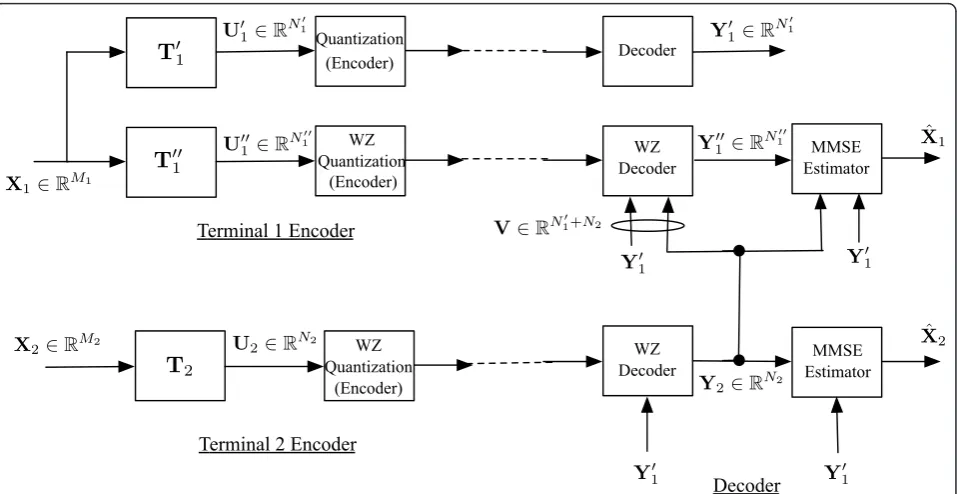
A block diagram of the SP-DTC system is shown in Figure 1. Let the total number of bits available for encoding two jointly Gaussian vectors X1∈RM1 and X2∈RM2 be B bits. The terminal 1 performs source splitting by providing an approximation Y1∈RN1 of
X1 at the rate B1(<B) bits/vector as decoder side-information for WZ coding of terminal 2, where
N1≤M1. In a TC framework, the goal is to provide the best (in MMSE sense) linear approximation of X1
as the decoder side-information. Therefore, Y1 is the
B1-bit approximation of a linear projection U1=T1TX1, where T1 is a M1 × M1 unitary matrix.
Given the side-information Y1 at the decoder, the terminal 2 quantizes a linear projection U2=TT2X2 of X2 using B2(<B−B1) bits/vector, whereT2 is aM2 ×
M2 unitary matrix. Let Y2∈RN2, be the quantized value of U2, whereN2 ≤M2. Then, given the quantized
linear projections of both X1 and X2 available at the
decoder, the terminal 1 quantizes the a linear projec-tion U1=T1TX1 of X1 using B1=B−B1−B2 bits/vec-tor, where T1 is a M1 × M1 unitary matrix. Let
Y1∈RN1 be the quantized value of U
1, where N1≤M1. In the receiver, each source vector is structed by a WZ decoder. The MMSE optimal recon-structions for X1 and X2 are, respectively given by
ˆ X1=E
X1|Y1,V
and Xˆ2=E{X2|V}, where
V=Y1Y2
T
. The total transmission rate for sourceX1
is thus B1=B1+B1 bits/vector. The rates used by terminals 1 and 2 in bits/sample are given by R1 =B1/
M1andR2 =B2/M2, respectively.
Let U1=U1,1 ,. . .,U1,M1T, U1=U1,1,. . .,U1,M1T
and U2=
U2,1,. . .,U2,M2 T
. Also, let the bit-rates allo-cated to quantizing these transform coefficients be r1=r1,1,. . .,r1,M1T, r1=r1,1 ,. . .,r1,M1T, and r2=
r2,1,. . .,r2,M2 T
respectively, and define
r=r1,r1,r2
T
. Given a total of B bits for encoding bothX1and X2, the design of a SP-DTC involves
deter-mining the values of the transforms T1, T1, and T2, and a bit allocation among the transform coefficients U=U1,U1,U2
T such that the total MSE
D(r)=E
X1− ˆX1 2
+X2− ˆX2 2
is minimized. By writing the quantization MSEs of U1,i
andU2,jas d1,i
r1,i,r1,r2
, and d2,j
r2,j,r1
, respectively, i = 1, . . ., M1, j = 1, . . .,M2, the total MSE can be
expressed as
D(r) = M1
i=1
d1,ir1,i,r1,r2
+ M2
j=1 d2,j
r2,j,r1
. (7)
The bit allocation problem can now be stated as follows:
Given a total bit-budget ofBbits
min
r D(r) (8)
subject to
2M1+M2
m=1
rm ≤B,
rm ≥0, m= 1,. . ., 2M1+M2,
where r=r1,. . .,r2M1+M2 T
. The explicit solution of this minimization problem is unfortunately intractable due to the inter-dependence of the three transform codes involved.
However, an explicit solution can be found for a variant of this problem obtained by fixing B1, B1andB2, so that
the number of bits allocated to each transform code is fixed and it is only required to optimize the bit allocation
among the quantizers within each transform code. For simplicity, we refer to this problem as theconstrained bit-allocation problem. In the following, an explicit solu-tion to this problem is derived. Based on the result, we then present a tree-search algorithm to solve the uncon-strainedproblem (8). Under both RD-WZQ and SWC-HRSQ models, the optimal transforms for Gaussian sources are CKLTs. Therefore, we refer to the solution to problem (8) as the SP-DKLT.
3.1 Solution to the constrained bit-allocation problem 3.1.1 RD optimal quantization
Let B1,B1, andB2be fixed in Figure 1 and let the
coeffi-cient quantization be represented by the RD-WZQ model (for components ofU1, this reduces to the non-distribu-ted RD-optimal quantization). FromTheorem1, it follows that the MMSE optimal transform (in the sense of provid-ing the best linear approximation as decoder side informa-tion for terminal 2) T1 is the KLT of X1. Let the
eigenvalues ofX1 beλ
1=
λ
1,1,. . .,λ1,M1
. Then, using (2), the optimal bit allocation forU1,m can be given by
r1,m=ρm
λ 1,B1,N1
, m= 1,. . .,M1. (9)
for some N1≤M1. Let the quantized value ofU1,m be
ˆ
U1,m. We note thatEU2
1,m=λ1,m form= 1, . . .,M1and
E
U1,m− ˆU1,m
2
=d∗λ1,B1,N1 for m= 1,. . .,N1. In
T
2WZ Quantization
X2∈RM2 U2∈RN2
Terminal 2 Encoder
(Encoder)
Y 1∈RN
1 Decoder
Y2∈RN2
Decoder
WZ Decoder
Y 1
Y 1
MMSE Estimator
T
1
T
1
Quantization
WZ Quantization
X1∈RM1
U 1∈RN
1
U 1∈RN
1
Terminal 1 Encoder
(Encoder)
(Encoder)
ˆ
X1
ˆ
X2
Y 1 ∈RN
1 WZ
Decoder
MMSE Estimator
Y
1 Y1
V∈RN1+ N
2
RD theoretic sense, the quantized value (up to a scaling factor) of the mean-zero Gaussian variable U1,m can be given by Y1,m=U1,m+Z1,m, m= 1,. . .,N1, where Z1,m
is a mean-zero Gaussian random-variable independent of
U1,m such that
EZ1,2m= λ
1,md∗
λ 1,B1,N1
λ 1,m−d∗
λ 1,B1,N1
, (10)
see [[16], Section 10.3.2]. Therefore, we can write
Y1=K(N1)T
1 X1+Z1, (11)
where K(N1)
1 denotes the M1×N
1 matrix consisting of first N1 columns of K1. The covariance matrix of
“quantization noise” vector Z1=Z1,1 ,. . .,Z1,N
1 T
is
given by Z
1 = diag
Z1,1,. . .,Z1,N
1
. According to
(11), Y1 andX1 are jointly Gaussian, and it follows that
Y1 =K
(N1)T
1
X1K
(N1)
1 +
Z1. (12)
Furthermore,X2and Y1 are jointly Gaussian with the conditional covariance matrix
X2|Y1 =
X2− T
X1X2K
(N1)
1
−1
Y1 K
(N1)T
1
X1X2. (13)
Next consider TCX2given Y1 as decoder side-infor-mation. From Theorem 1, it follows that the
EX2− ˆX2 2
is minimized by choosing T2as the CKLT
ofX2 given Y1 and by applying RD optimal WZ quanti-zation to each element of U2=TT2X2 given decoder side information Y1 based on a bit-allocation specified by the eigenvalues of X2|Y1, λ2=
λ2,1,. . .,λ2,M2
. The optimal bit allocation forU2,mis given by
r2,m=ρm(λ2,B2,N2), m= 1,. . .,M2, (14)
for someN2≤M2. The resulting MSE is given by
D2
B1,B2
=EX2− ˆX2 2
=N2d∗(λ2,B2,N2)+ M2
m=N2+1
λ2,m. (15)
As before, the quantized value of U2 up to a scaling
factor, can be represented by [[8], Theorem 3],
Y2=K2(N2)TX2+Z2, (16) where K(N2)
2 denotes theM2×N2 matrix consisting of
first N2 columns of K2 and the quantization noise
Z2 = diag
Z2,1,. . .,Z2,N2
is a mean zero iid Gaussian
vector independent of X2. The covariance matrix of Z2
is given by Z2 = diag
Z2,1,. . .,Z2,N2
, where EZ2,2m, m= 1, . . .,N2are given by
EZ2,2m= λ2,md
∗(λ
2,B2,N2) λ2,m−d∗(λ2,B2,N2)
. (17)
The covariance matrix ofY2is
Y2=K
(N2)T
2
X2K
(N2)
2 +
Z2. (18)
Therefore X1 and V=Y1Y2
T
are jointly Gaussian with the cross-covariance matrix
X1|V=
X1− T
V X1 −1
V
V X1, (19)
where
V X1 =
K(N1)
1 X1 X2
X2X1
and
V=
⎛
⎝Y1 K
(N1)
1
X1X2 T
X2
X2
X2X1K
(N1)T
1
Y2
⎞ ⎠.
Finally, consider quantizing X1, given
V=Y1Y2
T
∈RN1+N2 as the decoder side-information.
As before, EX1− ˆX1 2
is minimized by choosing T1 as
the CKLT ofX2 givenV, and RD optimal WZ
quantiza-tion of each element of U1=T1TX1 givenV, based on a
bit-allocation specified by the eigenvalues of X
1|V,
λ 1=
λ
1,m,. . .,λM1 T
. The bit rate allocated to
quantiz-ing U1,m given by
r1,m=ρm
λ 1,B1,N1
, m= 1,. . .,M1, (20)
for some N1≤M1 and the resulting MSE is
D1
B1,B1,B2
=EX1− ˆX1 2
=N1d∗
λ
1,B1,N1
+
M1
m=N
1+1 λ
1,m. (21) Given a rate tuple B1,B1,B2
, the MMSE achievable with a SP-DKLT code for two jointly Gaussian vectors is given by
DB1,B1,B2
=D1
B1,B1,B2
+D2
B1,B2
. (22)
model as well. However, the resulting MSE and hence the quantization noise variances are different to those of the RD-WZQ model. More specifically, since the decoder side-information in a SP-DTC depends on quantization noise of the other terminals, the optimal transformsT2 and T1 and the associated bit allocations obtained with the SWC-HRSQ model are different to those obtained with the RD-WZQ model. In order to make the problem tractable, we assume that the quan-tization noise of SWC-HRSQ model also follows (11) and (16) (for a discussion on the validity of this assumption, see [17]). This assumption essentially allows us to compute the conditional covariance
matrices X2|Y1 and
X1|V as in the previous case,
and then apply (9), (14) and (20) to find the optimal transforms and the bit-allocations. However, due to (27), the quantization noise variance in (10) in this case is given by
EZ1,2m=
πe/6λ1,md∗λ1,B1,N1 λ
1,m−
πe/6d∗λ1,B1,N1. (23)
A similar expression exists for the quantization noise variance in (17).
3.2 A tree-search solution to the unconstrained bit-allocation problem
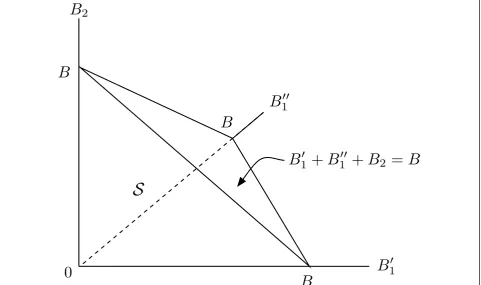
We note that the optimal solution to the unconstrained problem defined in (8) corresponds to the MMSE solu-tion of the constrained problem over the set of rate-tuples S=B1,B1,B2
:B1∈(0,B),B1∈(0,B),B2∈(0,B),B1+B1+B2≤B
. This set is shown in Figure 2. One approach to locating the MMSE solution is to search over an appropriately dis-cretized grid of points inside S. As we will see, even though an exhaustive search on a fine grid can be prohi-bitively complex, a much simpler constrained tree-search algorithm exists which can be used to locate the required solution with a very high probability.
The proposed algorithm is a generalization of a class of bit-allocation algorithms in which a small fractionΔB of the total bit-budgetBis allocated to the“most deser-ving” quantizer among a set of quantizers in an incre-mental fashion, until the entire bit-budget is exhausted [[4], Section 8.4]. Unfortunately, this type of a greedy search cannot guarantee that the final solution is overall optimal and can yield poor results in our problem where the bit allocation among three sets of dependent quantizers must be achieved. On the other hand, if the increment ΔBis chosen small enough, a near-optimal solution can be found by resorting to a tree-search.
S
B
1
B
1
B
2
B
B
B
0
B
1
+
B
1
+
B
2
=
B
Even though a full tree-search is intractable, a simple algorithm referred to as the (M, L)-algorithm[18] exists for detecting the minimum cost path in the tree with a high probability. We use this insight to formulate a tree-search algorithm for solving the unconstrained bit allo-cation problem, in which a set of constrained bit alloca-tion problems are solved in each iteraalloca-tion.
In order to describe the proposed tree-search algo-rithm in detail, let ΔB be the incremental amount of bits to be allocated in each step of the search, where 0 <ΔB ≪ B. The algorithm is initialized by setting
B1,B1,B2
=(0, 0, 0), i.e., the origin in Figure 2. Now if we are to allocate ΔB bits to only one of the three transform codes T1, T1 orT2, then there are three
pos-sible choices for the rate-tuple B1,B1,B2
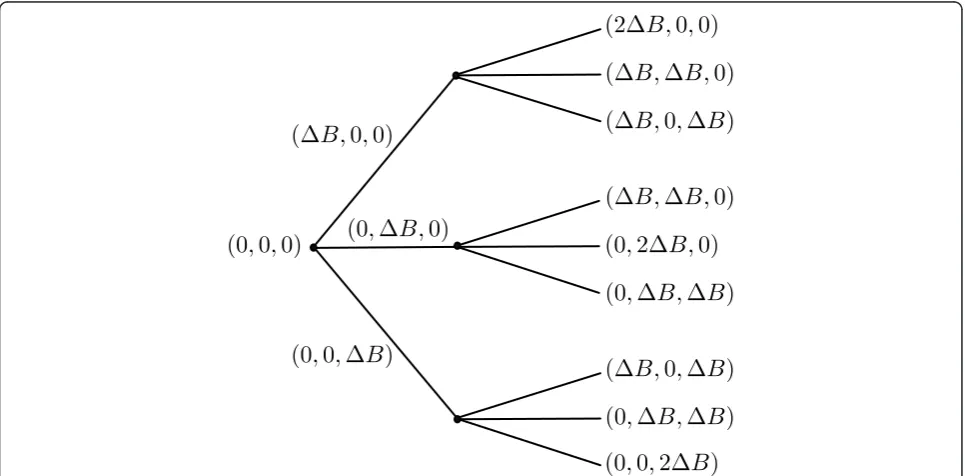
, namely (ΔB, 0, 0), (0, ΔB, 0), and (0, 0, ΔB). For each of these choices, we can explicitly solve the constrained bit allo-cation problem as described in the previous section and find the MMSE solution. Each of these candidate solu-tions can be viewed as a node in a tree as shown in Fig-ure 3. The root node of the tree corresponds to a SP-DTC of rate 0, and a node in the first level of nodes obtained in the first iteration of the algorithm corre-sponds to a SP-DTC of rate of ΔBbits per source pair (X1, X2). In the second iteration of the algorithm, we
allocateΔBmore bits to each of the three candidate SP-DTCs (but to one of the SP-SP-DTCs at a time) in the first level of nodes. Note that, for each SP-DTC we can allo-cateΔBbits in three different ways, i.e.,ΔBbits can be added to either B1, B1, orB2. This requires the solution
of three constrained bit allocations problems for each of the 3 nodes in the first-level. As a result, the tree will be extended to a second level of 32 nodes, in which each node corresponds to a SP-DTC of 2ΔBbits per source-pair, as shown in Figure 3. We can repeat this proce-dure, allocating ΔBbits to each of terminal node of the tree in a given iteration, until all Bbits are exhausted. After the final iteration, the tree would consist of L=
⌈B/ΔB⌉levels with 3L nodes in the last level (terminal nodes). Each terminal node corresponds to a candidate SP-DTC of rateB, and rate-tuples of these SP-DTCs lie on the plane B1+B1+B2=B in Figure 2. The MMSE terminal node of the tree is the optimal solution to the unconstrained bit allocation problem, provided that the latter solution is on the search-grid. If ΔB is chosen small enough, then we can ensure that the optimal solu-tion is nearly on the search-grid. Suppose that, in each iteration, the algorithm saves the MSE of the solution to the constrained bit-allocation problem associated with each node. In theory, the optimal solution can be found by an exhaustive tree-search, using the MSE of a node [given by (22)] as the path-cost. In order to practically implement the tree-search, we use the (M, L)-algorithm, in which the parameterM can be chosen to reduce the complexity at the expense of decreased accuracy (i.e., the probability of detecting the lowest cost path in the tree). In the (M, L) algorithm [[18], p. 216] for a tree of depth L, one only retains the M best (lowest MSE) nodes in each iteration. WhenM = 1 we have a comple-tely greedy search. On the other hand whenMn= 3nin
(0
,
0
,
0)
(Δ
B,
0
,
0)
(2Δ
B,
0
,
0)
(Δ
B,
Δ
B,
0)
(Δ
B,
0
,
Δ
B
)
(0
,
Δ
B,
0)
(0
,
0
,
Δ
B
)
(Δ
B,
0
,
Δ
B
)
(0
,
Δ
B,
Δ
B
)
(0
,
0
,
2Δ
B
)
(Δ
B,
Δ
B,
0)
(0
,
Δ
B,
Δ
B
)
(0
,
2Δ
B,
0)
Figure 3Bit allocation tree with the values of the rate-tupleB1,B1,B2
the nth iteration, we have a full-tree search which has a complexity that grows exponentially with the iteration number. WhenM(1≤M≤3L) is a prescribed constant, the complexity is linear inM, independent of the num-ber of iterations. In obtaining the simulation results pre-sented in Section 4, M = 27 and L = 135 (ΔB = 0.2) were found to be sufficient to obtain near optimal results. For example, it was observed that even for M= 81 andL= 405, nearly the same result was obtained.
4 Numerical results and discussion
Source model A: Let the components ofX1be M1
con-secutive samples of a first-order Gauss-Markov process with a unit-variance and the correlation coefficient|r|< 1, i.e.,X1,m=rX1,(m-1)+Zm, m= 2, . . .,M1, whereZm,
m = 1, . . ., M1 are mean-zero iid Gaussian variables
such that EZ2
m= 1−ρ2. The auto-covariance matrix
X1 is a Teoplitz matrix with the first row
1,ρ,ρ2,. . .,ρM1−1. Now define the components ofX
2
to be noisy observations of the components of X1, i.e.,
X2,m=gX1,m +Wm, where |g| < 1 and Wm is a
mean-zero, iid Gaussian variable with EW2
m= 1−γ2,m= 1, .
. ., M1 (M2 =M1). It follows that,
X2 is a Teoplitz
matrix with the first row 1,γ2ρ,γ2ρ2,. . .,γ2ρM1−1.
Furthermore, the cross-covariance matrix
X1X2
=γ2
X1. Note thatX1 andX2are not
statisti-cally similar and the components ofX1 are more
corre-lated than those ofX2.
Source model B: Consider a spatial Gaussian random field in which the correlation function decays with dis-tance d according to the squared exponential model [19]. We define the random vectors X1 and X2 to be
observations picked-up by a pair of sensor arrays placed in this random filed. In this case, the auto-covariance
matrix of X1 is given by
X1
ij= exp
−αdij
2 ,
whereais a constant anddijis the distance betweenX1,
i andX1,j. The auto-covariance matrix of X2 also has a
similar form. For simplicity assume that the sensors in each array are placed on a M × Msquare grid of unit spacing (i.e.,M1 =M2=M2), the two arrays are on
par-allel planes separated by a distancer, and the two grids are aligned so that the distance betweenX1iandX2iisr
for alli. With this setup, the distance betweenX1i and
X2jis
d2
ij+r2, and the cross-covariance matrix is given
by X1X2ij=θexp
−αdij
2
, where θ = exp {- (ar)
2
}. This sensor structure ensures thatX1and X2 are
sta-tistically similar. However,
X1X2 can be chosen
independently (by choosing array separation r) of X1
and
X2.
4.1 RD performance
We compute the rate-pairs (R1, R2) achievable with a
SP-DKLT code for a given a total MSED, by fixingR1
(or R2) and then searching for minimum R2 (or R1)
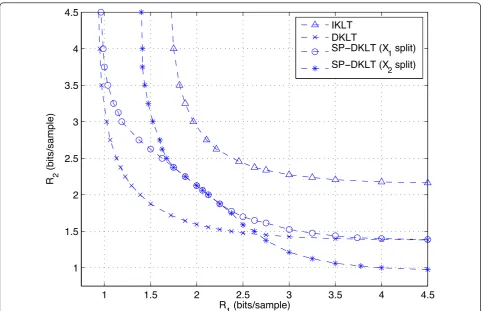
required to achieve the MSE D [given by (6)]. The rate-pairs achievable for D= 0.01 with SP-DKLT cod-ing of vectors from source model A with r = 0.9,g = 0.9, are plotted in Figure 4. These values of r and g result in a source cross-covariance matrix with the lar-gest element 0.9. In Figure 4, the curve “SP-DKLT (X1
split)” corresponds to a system in which the input to terminal 1 (which applies source splitting) is X1 as
shown in Figure 1. The curve “SP-DKLT (X2 split)”
corresponds to a system in which the input to the terminal 1 is X2. Note that the two curves are not
symmetric in rates and they coincide if R1 and R2 are
inter-changed in one of the curves. This is because X1
and X2 have different auto-covariance matrices, and
hence changing the rates is equivalent to inter-changing the terminals. Importantly, this result indi-cates that when the two sources are not statistically identical, which source is chosen for splitting does not affect the SP-DKLT performance. Table 1 lists the best bit allocations found by the tree-search algorithm for SP-DKLT codes shown in Figure 4. Note that, for the same (B1, B2), the rate-split between B1 and B2 when X1 is applied to the terminal 1 is not identical to that
when X2 is applied to the terminal 1.
Figure 4 also shows the rate region achievable if each source is independently compressed using the KLT (i.e., only intra-vector correlation is utilized), labeled IKLT, and the OPTA lower bound for distributed TC pre-dicted by the iterative DKLT algorithm [8]. The perfor-mance of both distributed and non-distributed TC of source model A degrades as r decreases, since both auto- and cross-covariance matrices of X1 and X2 are
allocation does not depend on which source is chosen for splitting.
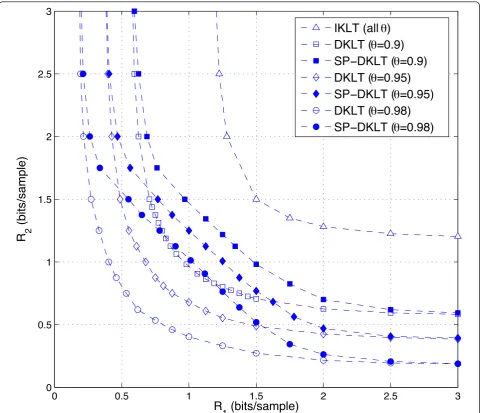
The RD performance in Figures 4 and 5 indicate that SP-DKLT codes can significantly outperform IKLT codes at all rates when there is sufficient correlation between the two distributed sources. The performance of SP-DKLT coding necessarily approaches OPTA (DKLT) bound when eitherR1orR2 is sufficiently high.
That is, the terminal with the higher bit rate can inde-pendently transform code its input with negligible dis-tortion, and the other terminal can then apply WZ-TC at the minimum rate achievable with “almost unquan-tized” decoder side-information. However, for both models the rate-region achievable with source-splitting is strictly inside that of DKLT. In other words, there are some rate-pairs inside the DKLT rate-region for a given MSED, which cannot to be achieved by a SP-DKLT code. A closely related issue is that, for a range of values of (R1, R2), the sumrateR1 +R2 of
SP-DKLT codes remains constant and reaches its mini-mum. For example, it can be seen from Figure 4 and Table 1 that the sum-rate is about 4.125 bits when the rate of X1 is in the range 1.375 - 2.5 bits/sample. From
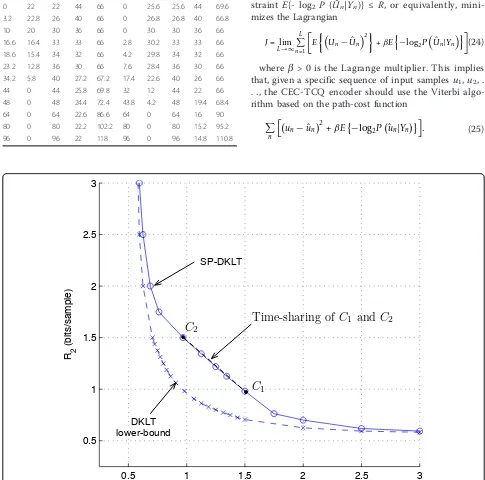
Table 1, it can be seen that when the sum-rate is greater than its minimum value, the optimal SP-DKLT code approaches a WZ transform code, i.e., no source-split-ting occurs. This situation, which also exists in Figure 5, suggests that optimal SP-DKLT codes for the sum-rate at which a given Dcan be achieved, are equivalent to time-sharing [12] of two“corner points”. Figure 6 illus-trates this situation for optimal SP-DKLT codes atD= 0.005 for source model B(θ= 0.9 in Figure 5). It should however be noted that, unlike source-splitting, time-sharing between the two terminals requires synchroniza-tion of their encoders [11].
4.2 Design examples
In this section, we focus on the practical design of SP-DKLT codes for a given pair of rates (R1, R2) based on
both scalar and block-quantization. RD-WZQ model used in Section 3.1.1 implies infinite block-length WZ-VQ of each coefficient. A practically realizable approach to block WZ quantization is SWC-TCQ [20]. Experi-mental results obtained with LDPC codes of block length up to 106 bits and TCQs up to 8,192 states are presented in [20] for quadratic Gaussian WZ
Figure 4Comparison of rate-regions achievable with different TC approaches in quantizing 16-dimensional vectors (M1=M2= 16) of
quantization, which indicate that performance very close to the theoretical limit can be achieved with SWC-TCQ. Motivated by these results, we aim to implement SP-DTCs which can approach theoretical performance pre-dicted in Section 3.1.1 using TCQ and SW coding for encoding transform coefficients. However, the SWC-TCQ design procedure followed in [20] is to first design a TCQ whose MSE satisfies a constraint (by choosing a sufficiently high rate) and then to estimate the output conditional entropy (which is the target rate of the SW code) of the resulting TCQ. This is sufficient for verify-ing the achievable rate pairs for a given MSE which is the goal of [20]. Our problem is different in that the rate of the SW code is specified by the solution to the bit-allocation problem and our goal is to design a TCQ
which minimizes the MSE, subject to a constraint on the output conditional entropy. This requires an alterna-tive formulation of the design procedure, which we refer to as CEC-TCQ. In previous work on non-distributed quantization, entropy constrained TCQ (EC-TCQ) has been investigated in [21-24]. CEC-TCQ is a modification of EC-TCQ in [21,22] to accommodate block SW-cod-ing of the TCQ output relative to a decoder side-infor-mation sequence. Our formulation of CEC-TCQ follows thesupersetentropyformulation of EC-TCQ in [22].
Suppose that a sequence of source samples {UnÎℝ}
has to be quantized, given that the sequence {YnÎℝ}, is
available at the decoder as side-information, wheren= 1, 2, . . . denotes the discrete-time. Similar to an ordin-ary TCQ [25], a CEC-TCQ uses a size 2RTCQ+1 scalar
Figure 5Comparison of rate-regions achievable with different TC approaches in quantizing 16-dimensional vectors (M1=M2= 16) of
codebook to quantize the input sequence U1,U2, . . .,
into a RTCQbits/sample output sequence Û1, Û2, . . . .
However, CEC-TCQ output satisfies the additional property that the conditional entropyH (Ûn|Yn) =
E{-log2 P (Ûn|Yn)}≤ R for some givenR. It follows from
[9] that if the CEC-TCQ output is SW-coded relative to the decoder side-information sequence {Yn} thenLRbits
are sufficient to (almost) losslessly transmit a sequence of Lsource samples as L®∞. The optimal CEC-TCQ minimizes the MSE E{(Un- Ûn)2}, subject to the
con-straint E{- log2 P (Ûn|Yn)}≤ R, or equivalently,
mini-mizes the Lagrangian
J= lim L→∞
L n=1
EUn− ˆUn 2
+βE−log2P
ˆ
Un|Yn (24)
where b> 0 is the Lagrange multiplier. This implies that, given a specific sequence of input samplesu1, u2, .
. ., the CEC-TCQ encoder should use the Viterbi algo-rithm based on the path-cost function
n
un− ˆun
2
+βE−log2Puˆn|Yn
. (25)
0.5 1 1.5 2 2.5 3
0.5 1 1.5 2 2.5 3
R
1 (bits/sample)
R 2
(
bits/sample
)
SP-DKLT
DKLT lower-bound
C
1C
2Time-sharing of
C
1and
C
2Figure 6The optimal SP-DKLT codes atD= 0.005 forsource model Bwitha= 0.32 andθ= 0.9. The minimum sum-rate is 2.5 bits/ sample, which can also be achieved by time sharing of codesC1andC2.
Table 1 Bit allocations found by the tree-search algorithm for 16-dimensional SP-DKLT coding ofsource model A(r= 0.9,g= 0.9)
X1Split X2Split
X1 X2 X2 X1
B’1 B”1 B1 B2 B B’1 B”1 B1 B2 B
0 14.8 14.8 96 110.8 0 22 22 96 118
0 15 15 80 95 0 22.4 22.4 80 102.4
0 15.8 15.8 64 79.8 0 22.6 22.6 64 86.6
0 19 19 48 67 0 24.4 24.4 48 72.4
0 22 22 44 66 0 25.6 25.6 44 69.6
3.2 22.8 26 40 66 0 26.8 26.8 40 66.8
10 20 30 36 66 0 30 30 36 66
16.6 16.4 33 33 66 2.8 30.2 33 33 66
18.6 15.4 34 32 66 4.2 29.8 34 32 66
23.2 12.8 36 30 66 7.6 28.4 36 30 66
34.2 5.8 40 27.2 67.2 17.4 22.6 40 26 66
44 0 44 25.8 69.8 32 12 44 22 66
48 0 48 24.4 72.4 43.8 4.2 48 19.4 68.4
64 0 64 22.6 86.6 64 0 64 16 90
80 0 80 22.2 102.2 80 0 80 15.2 95.2
In a rate RTCQ TCQ, each codeword ck , k= 1,. . ., 2RTCQ+1, in the codebook is labeled with
RTCQ-bit binary string [25]. Let bi , i= 1,. . ., 2RTCQ be
these binary labels. Then, to compute (25), the cost bE{-log2P (bi|Y)} must also be stored for each binary label,
whereYis the random variable representing the decoder side-information. For a fixed value of b, we can use a slight modification of the algorithm in [21] for optimiz-ing the CEC-TCQ codebook, by replacoptimiz-ing the codeword entropies E{- log2P(bi)} by the conditional entropies
E{-log2 P (bi|Y)}, and by using a training sequence of (Un,
Yn) pairs. In order to approximate the expectations by
sample averages computed from training data, the side-information variableYis discretized to Yˆ ∈ {η1,. . . ηY}, where Y is a large enough positive integer. Then E{-log2 P(B=bi|Y)} can be approximated by
ˆ
H(bi)=−Y k=1
log2
P
B=bi| ˆY=ηk
P
ˆ
Y=ηk|B=bi
(26)
where B∈b1,. . .,b2RTCQ
is the binary-labeled output of the TCQ. Given a TCQ code-book, the probabilities P(B=bi|Ŷ=hk) andP(Ŷ=hk|B =bi) can be estimated
using the training set [it is sufficient to estimatepi, k=
P(B = bi, Ŷ = hk), k= 1,. . .Y,i= 1,. . .,N]. To
com-plete the design, it is necessary to search for the value ofbfor which E{- log2 P(Ûn|Yn)} ≈ Rby repeating the
codebook optimization for an appropriately chosen sequence ofbvalues.
For block WZ-code designs, the transforms and the bit allocations are found by RD-WZQ model (Section 3.1.1) and WZ quantizers are implemented using CEC-TCQ followed by binary SW coding. More specifically, the rate found by the bit allocation algorithm for each transform coefficient is used as the conditional entropy constraint in the design of a CEC-TCQ for that coeffi-cient. As described in Section 2.3, the CEC-TCQ designs are based on scalar-side information obtained by a linear transform of the vector side-information at the decoder, seeTheorem3. All CEC-TCQ designs are based on the 8-state trellis used in JPEG2000 [[26], Figure 3.16]. For trellis encoding and decoding, a sequence length of 256 source samples has been used. For design and testing quantizers, sample sequences of length 5 × 10⁵ have been used. Since, the main focus this paper is the design of transforms and the quantizers, we assume ideal SW coding of the binary output of each CEC-TCQ, so that our results do not depend on any particular SW coding method. In a practical implementation (e.g., [20]), near optimal performance can be obtained by employing a sufficiently long SW code (note that sequence length for SW-coding can be chosen arbitrary larger than the sequence length used for TCQ encoding). This type of coding is well suited for applications such as distributed
image compression, where the coding is inherently block-based.
We also consider SP-DKLT code designs based on scalar quantization. In this case, the transforms and bit allocations are found by using the SWC-HRSQ model (Section 3.1.2). While it is possible to use the step-size predicted by SWC-HRSQ model to design uniform quantizers, we found that such quantizers in reality do not satisfy the required entropy constraint at lower rates. We instead use conditional entropy constrained scalar quantizers (CEC-SQ), designed by modifying the algorithm in [27] to accommodate a conditional entropy constraint similar to CEC-TCQ approach above.
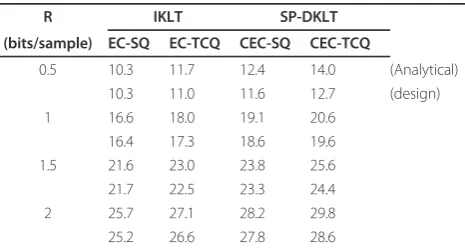
The reconstruction signal-to-noise ratio (RSNR) [with MSE as given by (6)] of SP-DKLT code designs for source model Bis shown in the rows labeled Design in Table 2 where SP-DKLT/CECSQ and SP-DKLT/ CECTCQ refer to scalar quantization and TCQ based designs respectively. The rows labeledAnalytical show the performance predicted by the SWC-HRSQ and RD-WZQ models upon which the transforms and bit-alloca-tions are based (note however that the performance pre-dicted by SWC-HRSQ model is not necessarily an upper-bound for CEC-SQ designs which are not con-strained to be uniform quantizers). We compare the performance of our SP-DKLT code designs with IKLT codes for which the bit-allocations are obtained by using either entropy coded high-rate quantization model (for scalar quantizer design) [[4], Section 9.9] or RD-optimal quantization model (for block quantizer design) [[16], Section 10.3.3] for Gaussian variables. The IKLT codes with scalar quantization have been implemented by using entropy constrained scalar quantizers (EC-SQ) while those with block quantizers have been implemen-ted by using EC-TCQ [23], where we assume ideal entropy coding of the quantizer outputs. In Table 2,
Table 2 RSNR (in dB) of KLT-based transform code designs for quantizing 16-dimensional vectors (M1=M2
= 16) ofsource model B(a= 0.32,θ= 0.9) atR1=R2=R
bits/sample
R IKLT SP-DKLT
(bits/sample) EC-SQ EC-TCQ CEC-SQ CEC-TCQ
0.5 10.3 11.7 12.4 14.0 (Analytical)
10.3 11.0 11.6 12.7 (design)
1 16.6 18.0 19.1 20.6
16.4 17.3 18.6 19.6
1.5 21.6 23.0 23.8 25.6
21.7 22.5 23.3 24.4
2 25.7 27.1 28.2 29.8
25.2 26.6 27.8 28.6
IKLT/ECSQ and IKLT/ECTCQ respectively refer to these designs.
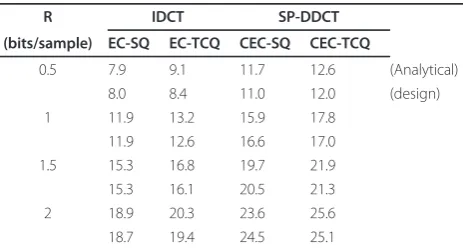
From a practical view point, the use of DCT instead of KLT is interesting [26]. We therefore consider the design of SP-DTCs based on the DCT, referred to as source-split distributed DCT (SP-DDCT) codes. Since DCT is a fixed transform, we only need to optimize the bit allocations. To do this, we assume that DCT is approximately a decorrelating transform for Gaussian vectors [4]. Then, the bit-allocations given by (9), (14), and (20) are still valid provided that the eigenvalues in these expressions are replaced by the variances of the corresponding DCT coefficients. The rest of the design procedure is the same as that with SP-DKLT. The RSNR of DCT based designs are presented in Table 3 (again, the performance predicted by SWC-HRSQ model is not an upper bound for corresponding practi-cal codes). The results show that, for this particular source model, even the scalar quantization based SP-DDCT codes outperform TCQ-based IDCT codes.
5 Concluding remarks
Rate-distortion analysis and experimental results demonstrate that SP-DTC is a promising practical approach to implementing distributed VQ of high-dimensional correlated vectors. The comparisons shown in Table 2, as well as similar comparisons for source model Aand the source model in [[8], Example 6], indi-cate that these codes can substantially outperform the independent transform codes, when there is sufficient inter-vector correlation. This approach has also been demonstrated to be effective for DCT-based systems. Therefore, the proposed approach can be potentially used in applications such as stereo image compression when inter-camera communication is impractical. Our RD analysis however indicates that the achievable rate-region of SP-DKLT codes for jointly Gaussian sources is
strictly inside that predicted by the DKLT of [8]. An interesting avenue of future work is to find implementa-ble distributed transforms codes which can achieve the rate-pairs below the “time-sharing” line in Figure 6. Another issue is the extension of the proposed approach to more than two vector sources. In principle, source-splitting can be easily applied to more than two sources. However, with more than two vector sources, the com-plexity of the bit-allocation will be significantly higher.
1 Appendix
1.1 Proof of Theorem 2
The optimality of CKLT is proved in [5]. To prove the optimality of the bit allocation, consider high-rate scalar quantization of the transform coefficient Um and ideal
SW coding of the quantizer outputÛmat the rate rm=
H (Ûm |Y) bits/sample, m = 1, . . ., M1, where H(·|·)
denotes the conditional entropy [16]. In this case, the asymptotically optimal scalar quantizer for each coeffi-cient is known to be uniform [5]. For high-rate uniform quantization,H(Ûm|Y)≈ h(Um|Y) - log2(Δm), whereΔm
is the quantizer step-size andh(·|·) is the conditional dif-ferential entropy [[16], Section 8.3]. Since the condi-tional variance of the transform coefficientUm, given
the side-information Y is EU2
m|Y
=λm, and (Um, Y)
are jointly Gaussian, it follows thath(Um|Y) = (1/2) log2
(2πelm) [16], and hence m=√2πeλm2−rm. Therefore,
the MSE of high-rate uniform quantization followed by ideal SW coding ofUmis
dSWCm −HRSQ=
2
m
12 =
πe
6
λm2−2rm. (27)
Since (27) and (1) are the same within a constant fac-tor of πe/6 (which is identical for all transform coeffi-cients), it is easy to verify that the optimal bit-allocation solution under SWC-HRSQ model is also given by (2). However, the MSE ofmth coefficient in this case is
dm=
πe
6
λm2−2ρm
= π
e
6
d∗(λ,B,N),m= 1,. . .,N λm, m=N+ 1,. . .,M
(28)
and hence the overall MSE is given by (5). Further-more,
m==
(2πe)d∗(λ,B,N)
form= 1, . . .,N.
1.2 Proof of Theorem 3
For jointly Gaussian and mean-zero X and Y, there exists a matrix Aand a mean-zero Gaussian vectorW1
independent of Y such that X = AY + W1, where
Table 3 SNR (in dB) of DCT-based transform code designs for quantizing 16-dimensional vectors (M1=M2= 16) of
source model B(a= 0.32,θ= 0.9) atR1=R2=Rbits/
sample
R IDCT SP-DDCT
(bits/sample) EC-SQ EC-TCQ CEC-SQ CEC-TCQ
0.5 7.9 9.1 11.7 12.6 (Analytical)
8.0 8.4 11.0 12.0 (design)
1 11.9 13.2 15.9 17.8
11.9 12.6 16.6 17.0
1.5 15.3 16.8 19.7 21.9
15.3 16.1 20.5 21.3
2 18.9 20.3 23.6 25.6
18.7 19.4 24.5 25.1
W1=
X|Y=TTT,
W1=
X|Y =TTT, and Λ is
the diagonal matrix of eigenvalues of∑X|Y. Furthermore
U =TTAY +W2, where W2 =TT W1 is an
uncorre-lated Gaussian vector since W2 =TTW1T= (note that for CKLT, T-1 = T). Therefore ∑U|Y = Λ. The
MMSE estimate ofU givenY is Ũ=E{U|Y} =TTE{X| Y} = TTAY. Thus, U= Ũ+ W2 and ∑U|Ũ =Λ, and it
follows thatUiis independent of Ũj ifj≠i and var(Ui|
Ũi) = var(Ui |Y), where var(·|·) denotes the conditional
variance. Now, sinceh(Ui|Y) = h(Ui|Ũi), we conclude
that Ũi is a sufficient statistic [16] for decoder
side-informationY in WZ quantization ofUi.
Competing interests
The author declares that they have no competing interests.
Received: 21 October 2011 Accepted: 5 April 2012 Published: 5 April 2012
References
1. Z Xiong, AD Liveris, S Cheng, Distributed source coding for sensor networks. IEEE Signal Process Mag.21(5), 80–94 (2004)
2. JY Huang, P Schultheiss, Block quantization of correlated random vectors. IEEE Trans Commun.11(9), 289–296 (1963)
3. V Goyal, Theoretical foundations of transform coding. IEEE Signal Process Mag.18(5), 9–21 (2001)
4. A Gersho, RM Gray,Vector Quantization and Signal Compression, (Kluwer Academic Publishers, Norwell MA, USA, 1992)
5. D Rebollo-Monedero, S Rane, A Aaron, B Girod, High-rate quantization and transform coding with side information at the decoder. Signal Process.
88(11), 3160–3179 (2006)
6. A Vosoughi, A Scaglione, Precoding and decoding paradigms for distributed vector data compression. IEEE Trans Signal Process.55(4), 1445–1459 (2007)
7. X Chen, E Tuncel, Low-delay prediction and transform-based Wyner-Ziv coding. IEEE Trans Signal Process.59(2), 653–666 (2011)
8. M Gastpar, PL Dragotti, M Vetterli, The distributed Karhunen-Loéve transform. IEEE Trans Inf Theory.52, 5177–5196 (2006)
9. D Slepian, JK Wolf, Noiseless coding of correlated information sources. IEEE Trans Inf Theory.19(4), 471–480 (1973)
10. H Gish, JP Peirce, Asymptotically efficient quantizing. IEEE Trans Inf Theory.
14, 676–683 (1968)
11. B Rimoldi, R Urbanke, Asynchronous Slepian-Wolf coding via source-splitting, inIEEE Int Symp Inform Theory (ISIT), Ulm, Germany, p. 271 (1997) 12. R Zamir, S Shamai, U Erez, Nested linear/lattice codes for structured
multiterminal bining. IEEE Trans Inf Theory.48(6), 1250–1276 (2002) 13. AB Wagner, S Tavildar, P Viswanath, Rate region of the quadratic Gaussian
two-encoder source-coding problem. IEEE Trans Inf Theory.54(5), 1938–1961 (2008)
14. AD Wyner, J Ziv, The rate-distortion function for source coding with side information. IEEE Trans Inf Theory.22, 1–10 (1976)
15. Y Yang, V Stankovic, Z Xiong, W Zhao, On multiterminal source code design. IEEE Trans Inf Theory.54(5), 2278–2302 (2008)
16. TM Cover, JA Thomas,Elements of Information Theory, (John Wiley, New York, USA, 1991)
17. D Marco, DL Neuhoff, The validity of additive noise model for uniform scalar quantizers. IEEE Trans Inf Theory.51(5), 1739–1755 (2005)
18. T Berger,Rate Distortion Theory: A Mathematical Basis for Data Compression, (Prentice-Hall, Englewood Cliffs NJ, USA, 1971)
19. MC Vuran, OB Akan, IF Akylidz, Spatio-temporal correlation: theory and applications for wireless networks. Comput Netw.45, 245–259 (2004) 20. Y Yang, S Cheng, Z Xiong, W Zhao, Wyner-Ziv coding based on TCQ and
LDPC codes. IEEE Trans Commun.57(2), 376–387 (2009)
21. TR Fischer, M Wang, Entropy-cosntrianed trellis-coded quantization. IEEE Trans Inf Theory.38(2), 415–426 (1992)
22. MW Marcellin, On entropy-cosntrianed trellis-coded quantization. IEEE Trans Commun.42, 14–16 (1994)
23. MW Marcellin, Transform coding of images using trellis-coded quantization, inProc ICASSP, Albuquerque NM, USA, pp. 2241–2244 (1990)
24. N Farvardin, X Ran, CC Lee, Adaptive DCT coding of images using entropy-cosntrianed trellis-coded quantization, inProc ICASSP, (Minneapolis MN, USA, 1993), pp. 397–400
25. MW Marcellin, TR Fischer, Trellis coded quantization memoryless and Gauss-Markov sources. IEEE Trans Commun.38, 82–93 (1990)
26. DS Taubman, MW Marcellin,JPEG 2000: Image Compression Fundamentals, Standrads and Practice, (Kluwer Academic Publishers, Norvell MA, USA, 2004) 27. P Chou, T Lookabaugh, RM Gray, Entropy-constrained vector quantization.
IEEE Trans Acoust Speech Signal Process.37, 31–42 (1989)
doi:10.1186/1687-6180-2012-78
Cite this article as:Yahampath:Distributed transform coding via source-splitting.EURASIP Journal on Advances in Signal Processing20122012:78.
Submit your manuscript to a
journal and benefi t from:
7Convenient online submission 7 Rigorous peer review
7Immediate publication on acceptance 7 Open access: articles freely available online 7High visibility within the fi eld
7 Retaining the copyright to your article