Volume 2007, Article ID 31415,8pages doi:10.1155/2007/31415
Research Article
A New Method for Identifying the Life Parameters via Radar
Wang Jianqi,1, 2Zheng Chongxun,1Lu Guohua,2and Jing Xijing2
1The Key Laboratory of Education, Ministry of China, Xi’an Jiaotong University, Xi’an 710049, China 2Department of Biomedical Engineering, The Fourth Military Medical University, Xi’an 710032, China
Received 10 January 2006; Revised 22 September 2006; Accepted 6 October 2006
Recommended by Ulrich Heute
It has been proved that the vital signs can be detected via radar. To better identify the life parameters such as respiration and heartbeat, a novel method combined with several signal processing techniques is presented. Firstly, to improve the signal-to-noise ratio (SNR) of the life signals, the signal accumulation technique by FFT is used. Then, to restrain the interferences produced by moving objects, a dual filtering algorithm (DFA) which is able to remove the interferences by tracing the interfering spectral peaks is proposed. Finally, the wavelet transform is applied to separate the heartbeat from the respiration signal. The method cannot only
help to automatically detect the existence of human beings effectively, but also identifying the parameters like respiration,
heart-beat, and body-moving signals significantly. Experimental results demonstrated that the method is very promising in identifying the life parameters via radar.
Copyright © 2007 Wang Jianqi et al. This is an open access article distributed under the Creative Commons Attribution License, which permits unrestricted use, distribution, and reproduction in any medium, provided the original work is properly cited.
1. INTRODUCTION
The life-detection system can be used to search living objects after the earthquake and building collapse, also to monitor patients in clinic without contacting the subjects. In addi-tion, it can be used by law-enforcement services to search criminals hiding behind various covers. The life detection based on radar techniques has been attracting more atten-tion these years. The continuous-wave (CW) radar is widely used to detect the life parameters because of its simple
struc-ture and high sensitivity [1–5]. The frequency-modulated
continuous-wave (FM-CW) radar is also used [6]. They can
detect the life parameters of human noncontact, even behind the barrier such as the brick walls, debris, and clothes. The radar detector radiates electromagnetic waves to human sub-jects and receives echo waves modulated by the body surface jiggle caused by their physiological activities. The life param-eters such as respiration and heartbeat can be extracted ac-cording to the frequency or phased variations of the echo waves.
For all the life-detection systems via radar, it is difficult
to detect the weak life signals from the strong echo waves
of background. There exist two problems ineffectively
solved in common: how to improve the SNR and how to re-strain the strong randomness, time variability and sensitivity to the interferences produced by the moving objects further
aggravate the situation, especially for the strong interferences produced by the people walking around the life-detection system, of which the amplitude is much stronger than the
body surface jiggle caused by their physiological activities [2].
Hence, it is of great importance to restrain the strong in-terferences. Using physiological amplifiers with higher pcision could improve the SNR, but they are not good to re-move the interferences. Some methods for stationary signal processing, including FFT and high-order linear narrowband
filtering [7] can also improve the SNR. They may be effective
in good circumstances, but may not work in complex situa-tions. Using two antennas, the interferences produced by the
moving objects may be partly restrained [8], but the
com-plexity and cost may limit its practical use. The preliminary experimental results showed that the heartbeat signal could be well detected when the human subjects held their breath.
However the heartbeat cannot be extracted effectively from
the overlapped signals as the breath exists, since the minute chest movement caused by the respiration is stronger than the chest inching caused by the heartbeat, therefore it is dif-ficult to separate the latter from the overlapped signals.
To effectively resolve the problems described above, a
technique by FFT is used, which does not need the a priori knowledge of signal and the period alignment. To restrain the interferences produced by moving objects, a dual filtering algorithm (DFA) is proposed, including two filters and one algorithm by tracing the interference spectral peaks. To sepa-rate the heartbeat from respiration signal, the wavelet trans-form with symmlet mother wavelet is applied. Experimental results demonstrated that the method integrating with the three signal processing techniques above is very promising in identifying the life parameters via radar.
2. METHODS
2.1. Description of the system
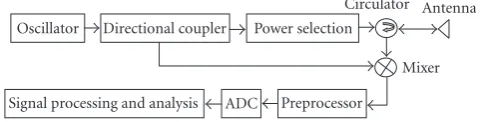
The block scheme of the life-detection system and the real
system proposed are shown inFigure 1. The electromagnetic
wave is generated by the oscillator via a directional coupler. Then it is radiated by the antenna via a circulator. The
os-cillator operates at 10.525 GHz, and the transmission power
is 30 mW. Hence GaAs Gunn diode oscillator is chosen to meet the demands of low noise and low cost, which also can provide linear continuous waves. The system works with only one antenna and the circulator isolates the transmission from the reception. The gain of the antenna is 17 dB, and the beam
width is 9◦in both the horizontal and vertical directions.
An-other signal from the directional coupler acts as a local oscil-latory signal for the receiver. The echo signal is received by the same antenna and then passes through the circulator to get into the mixer where it is mixed with the local oscillatory signal. The output signal of the mixer contains both the res-piration and heartbeat signals with serious noises. It is sent to a preprocessor, where the 50 Hz interference is removed by a band-stop filter, and digitized by A/D converter. Finally, the signals are processed with the proposed techniques and displayed on the monitor.
The signal processing techniques are illustrated in
Figure 2. Firstly, the signals are accumulated by FFT to im-prove the SNR. Then the dual filtering algorithm (DFA) is applied to restrain the interferences produced by the mov-ing objects. Finally, the heartbeat and respiration signals are separated by using the wavelet transform. In the following sections, the signal processing techniques will be discussed in detail.
2.2. Improving SNR by signal accumulation in frequency domain
For the biomedical signals, the processing method usually used to improve the SNR is the signal accumulation in time domain. It needs to know the a priori knowledge of signal such as period, otherwise the signal accumulation in time
do-main will be difficult. Considering the advantage that the
pe-riod alignment of a signal is not needed, the signal accumu-lation in frequency domain has been widely used. The useful signal spectra will be quickly increased by the signal accumu-lation in frequency domain, while the noise spectra will be increased slowly since the noise is random and its spectrum is
Oscillator Directional coupler Power selection
Circulator Antenna
Signal processing and analysis ADC Preprocessor
Mixer
Figure1: The block scheme of the life-detection system.
distributed over a wide frequency range. Therefore, the SNR will be greatly improved through signal accumulation.
Letx(k) be the sequence to be processed, and the length
of the sequence isN=M×L, whereMis time of
accumula-tion andLis the number of the FFT points. The
frequency-domain accumulation can be computed by
X(k)=
M
m=1
L−1
l=0
xm(l)e−j(2π/L)lk
=
M
m=1
L−1
l=0
xm(l)WLlk, k=0, 1, 2,. . .,N−1.
(1)
2.3. Restraining the interferences using DFA
Generally, the respiration signal is an important life param-eter with a narrow frequency bandwidth, which is easily in-fluenced by the interferences produced by the people walking
around the life-detection system. So it is difficult to detect the
respiration signal from the strong interferences. Using two antennas, the interferences can be partly restrained, but the complexity and cost cannot satisfy the life-detection system
[8]. Thus the method named DFA is proposed to restrain the
interferences produced by the people walking around the sys-tem, which includes two filters and one algorithm. Consider-ing that the respiration signal varies from individual to indi-vidual and in abnormal status such as coma or being injured
grievously [1], the bandwidth of the first filter is designed
wider than that of the normal respiration signal. Then the algorithm is used to identify the spectral peak of the respira-tion signal and the interference by power-spectrum
estima-tion and cross-correlaestima-tion coefficient computation after the
first filter. Finally the second filter is designed as a notch filter to restrain the spectral peak of the interferences. The DFA is described as follows.
Our study showed that the respiration signal spectral
peaks between different individuals have better coherence
than that of between the interferences signal spectral peak and the respiration signal spectral peak when the bandwidth is certain. So if the spectral peaks of respiration signal and the interferences can be estimated by using the power-spectrum estimation (PSE) and coherence characteristics of the spec-tral peaks can be computed, the interference signals and the respiration signals will be identified after the first filtering.
From A/D
converter Improving the SNR
Restraining the moving interferences
Extracting the respiration and heartbeat signal
Figure2: The basic flowchart of the signal processing.
the nonparametric ones, but the advantage of the paramet-ric estimator is that when applicable, it yields a more accu-rate spectral estimation without having to increase the data record length. Because of nonstationarity of the respiration signal and more accurate spectral estimation of the spectral peak, the Yule-Walker autoregression (AR) estimator is used to estimate the power spectrum by computing the autocorre-lation function recursively. Let the respiration signal detected by life-detection system in no interferences condition be the reference signal which has better coherence with the practical respiration signal detected by the system than the synthetic oscillatory signal. Assume that the reference respiration
sig-nalx(n) has a main spectral peak fx, and the original signal
is y(n) with a spectral peak fy. The main spectral peak of
the reference respiration signal and the original signal can be moved by interpolating in time domain. The formula of the alignment of the spectral peak can be expressed as follows:
if fx≥fy, thenx(n)=x
nffy
x
n=0, 1,. . .,N1−1
elsey(n)=y
nfx fy
n=0, 1,. . .,N1−1,
(2)
whereN1is the total number of the sampling data points, [·]
represents the truncation operation, andx(n) ory(n) is the
interpolating point.
Although the spectral peaks of respiration signal and the interferences could be estimated by using the autoregres-sion power-spectrum estimation (ARPSE), the spectral peaks could not be identified correctly. The study has shown that
the respiration signal spectral peaks between different
indi-viduals have better coherence than that between the inter-ferences signal spectral peak and the respiration signal
spec-tral peak, so the cross-correlation coefficientρof the
refer-ence respiration signal spectral peak with each spectral peak is computed by alignment of the peaks of the main frequency
spectrum. Theρindicated the similarity between the spectral
peak and the reference respiration signal spectral peak.
The normalized cross-correlation coefficientρ(m) can be
calculated by
ρ(m)=
N−1
n=0x(n)y(n+m)
N−1
n=0 x2(n) nN=−01y2(n)
, (3)
whereNis the length of the analyzing window andmranges
from−(N−1) to (N+ 1). The maximum valueρmaxofρ(m)
indicates the similarity betweenx(n) and y(n). Comparing
each of ρmax, if the ρmax is the least, the possibility of this
spectral peak being interferences spectral peak would be the
most. Then the spectral peaks with the least ρmax could be
removed by the second dynamic notch filter with the narrow
bandwidth. Suppose there are two spectrum peaks fy1 and
fy2with a common bandwidthΔB, then one peak should be
the spectral peak of respiration signal and the other should be
the interference signal. Theρis computed by (3). Let assume
the maximum cross-correlation coefficients of fy1and fxbe
ρmax 1 and let that of fy2and fx beρmax 2. Ifρmax 1 > ρmax 2,
then the possibility of fy2 being interferences spectral peak
would be the most, and vice versa.
After tracing the main spectral peak of the interferences by the algorithm described above, the spectral peak of the interferences and the respiration signal can be identified
cor-rectly. So the second dynamic notch filter that traces fy2with
bandwidthΔBis then designed to restrain this spectral peak.
2.4. Separating the heartbeat from respiration signal by wavelet transform
Though the SNR could be improved and the interferences produced by the moving human subjects around the system could be restrained, the principal component of the signal detected by the system is respiration. However, it is necessary to separate the heartbeat signal from the respiration signal when the system is used to monitor the patients in clinical application and so on. Since the minute chest movement is caused by both the respiration and the heartbeat, the possi-ble biological ranges for heartbeat and respiratory frequen-cies are not well separated and higher-order harmonic com-ponents of the lower-frequency respiratory signal can overlap
the heartbeat spectrum. Consequently, it is difficult to
sepa-rate the heartbeat from respiration signal by using linear
fil-ters and the power-spectrum estimation [5].
FIR digital filter and adaptive filter had been performed in our experiment, which could not produce the ideal results
[1,2]. The frequency variation in the echo wave modulated
by body surface jiggle caused by respiration and heartbeat
is very low from 0.03 Hz to 3.3 Hz [1]. Because of the
over-lapped spectrum of the respiratory and the heartbeat signals, the signal processing methods used are expected to be very sensitive to the frequency variation with higher resolution in time domain. According to the requests of the signal process-ing described above, the wavelet transform may be used to
separate the heartbeat from the respiration signal [9].
The wavelet transform (WT) is a time-scale represen-tation technique with a function of mother wavelet. WT can localize the information of the signal in limited number
transform given below:
Cj,k=
n∈Z
x(n)gj,k(n), (4)
where Cj,k are the wavelet coefficients, and gj,k(n) =
2−j/2g(2−jn−k) is the scaling function.
In the lower frequency band, the wavelet transform has lower time resolution, but higher frequency resolution, and vice versa. This characteristic makes it easier to separate the heartbeat signal from the respiration by wavelet trans-form. With multiscale decomposition of wavelet, the high-frequency noise and the low-high-frequency respiration signal could be removed, and the heartbeat signal can be extracted. On basis of the frequency ranges of the heartbeat and the
respiration signal computed by Sections2.2and2.3, the
al-gorithm of discrete wavelet transform is outlined below:
(1) apply wavelet transform to the signal with symmlet mother wavelet;
(2) eliminate high-frequency and low-frequency noises by
setting the corresponding wavelet coefficients to zero;
(3) threshold the coefficients depending on the breath
sig-nal variance and the number of samples of the data; (4) perform inverse wavelet transformation to obtain the
heartbeat signal.
3. EXPERIMENTS AND ANALYSIS
There are 15 healthy volunteers who participated in the ex-periments including 8 males and 7 females. Their ages ranged from 18 to 50 years old, height from 160 to 178 cm, and weight from 48 to 70 kg. The distance between the antenna and the human subject ranges from 2 m to 8 m. All the exper-iments described below are in terms of that the subjects’ con-sent was obtained by signing the informed concon-sent form ac-cording to the Declaration of Helsinki (BMJ 1991; 302: 1194) and that the Ethical Committee of our university in which the work was performed has approved it. Each of the volun-teers is sampled for 20 times under the same experimental condition and there are 4 kinds of conditions. So our total experimental sample size is 1200.
3.1. Improvement of the SNR using signal accumulation
In practice, the noise produced from the radar waves re-flected by the wall and ruins is very strong and leads to a low SNR of the weak life parameters, which produces very strong influence. The experiment in this part was proposed to improve the SNR of the life parameters.
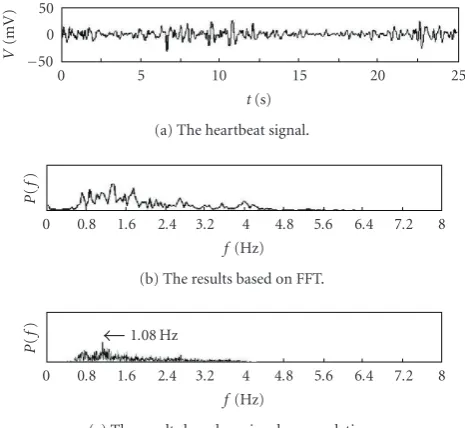
The experiments show that the SNR of the life pa-rameters can be improved. One of the volunteers was a healthy man of 25 years old, 171 cm in height, and 65.5 kg in weight. He sat 2 m away from the antenna and breathed calmly. His pulse rate was around 67 beats per minute. Considering the normal heart rate of the human ranges from 60 to 100 beats per minute, the signal was sampled at 40 Hz for 25 seconds. The representative result is shown in
Figure 3.Figure 3(a)shows the time-domain signal detected
0 5 10 15 20 25
t(s)
−50 0 50
V
(mV
)
(a) The heartbeat signal.
0 0.8 1.6 2.4 3.2 4 4.8 5.6 6.4 7.2 8
f(Hz)
P
(
f
)
(b) The results based on FFT.
0 0.8 1.6 2.4 3.2 4 4.8 5.6 6.4 7.2 8
f(Hz)
P
(
f
)
1.08 Hz
(c) The results based on signal accumulation.
Figure3: The results using the signal accumulation by FFT.
by system.Figure 3(b)shows the frequency spectrum by FFT
of 1024 points.Figure 3(c)shows the results of the signal
ac-cumulation by FFT with 8192 points. It is clearly seen that the frequency at 1.08 Hz is strengthened and the SNR is
im-proved fromFigure 3(c). Note that 1.08 Hz is in good
accor-dance with 67 beats per minute pulse rate of the subject.
3.2. Interferences suppression by DFA
In practice, the radar waves reflected by the wall and ruins are very strong and lead to a complicated electromagnetic environment around the life-detection system. People walk-ing around the system also produce very strong influence to the detection. The experiment in this part was proposed to restrain the interference mentioned above.
One of the volunteers was a healthy man of 25 years old, 171 cm height, and 65.5 kg weight. He sat 8 m away from the antenna and breathed calmly, this distance is maximal where we can detect the heartbeat and respiration signal. His res-piration signal was detected in no interferences condition as
the reference respiration signalx(n). The signal was sampled
at 40 Hz for 25 seconds. To simulate most of the interference sources produced by moving objects ranging from 2 m to 8 m
behind the antenna [1,2], another volunteer was behind the
antenna 5 m away and walked around the system with the
velocity less than 2 m/s in the distance from−3 to +3 m. All
of the 15 volunteers sitting 8 m away from the antenna were detected, respectively, by the system under the same
condi-tion. Their respiration signals were recorded asym(n) andm
ranged from 1 to 15. One of the representative experiments is described below. The subject was 22 years old, 172 cm height and, 62 kg weight. His respiration signal was recorded as the
y(n) in interferences condition. The walking man moved at
0 1 2 3 4
f(Hz)
0 0.2 0.4 0.6 0.8 1 No rm al iz ed p o w er sp ect rum
0.16 Hz 0.36 Hz
(a) Spectrum estimation by ARPSE not us-ing DFA.
0 1 2 3 4
f(Hz)
0 0.2 0.4 0.6 0.8 1 No rm al iz ed p o w er sp ect rum
0.36 Hz
0.16 Hz
(b) Spectrum estimation by ARPSE using DFA.
0 1 2 3 4
f(Hz)
0 0.2 0.4 0.6 0.8 1 No rm al iz ed p o w er sp ect rum
0.16 Hz
(c) Spectrum estimation by ARPSE using DFA.
Figure4: The signals processed by DFA.
0 2 4 6 8 10 12 14 16
Subjects 0
0.2 0.4 0.6 0.8 1 C ross-c o rr elation co e ffi cient ρmax Respiration signal Moving objects
Figure5: The distribution of the normalized cross-correlation
co-efficientρmax.
+3 m. The spectral peaks ofx(n) andy(n) were estimated by
ARPSE after the first filtering. All the spectral peaks with uni-tary power-spectrum density (PSD) bigger than the
thresh-old 0.5 were analyzed. The signaly(n) has two spectral peaks
at 0.16 Hz and 0.36 Hz, as shown inFigure 4(a), in which the
interference spectral peak cannot be distinguished clearly.
It is suitable to select the bandwidthΔBas 0.1 Hz
accord-ing to the results estimated by ARPSE. The maximal
cross-correlation coefficient ρmax 1 of x(n) and the spectral peak
at 0.36 Hz is 0.6246. The spectral peak processed by DFA is
shown inFigure 4(b). The maximal cross-correlation coeffi
-cientρmax 2ofx(n) and the spectral peak at 0.16 Hz is 0.4174.
The spectral peak processed by DFA is shown inFigure 4(c).
The f1at 0.16 Hz is regarded as the interference spectral peak
becauseρmax 1> ρmax 2, and is restrained by the digital notch
filter with bandwidth 0.1 Hz. After the second filtering, the remaining spectrum with peak at 0.36 Hz is regarded as that of the respiration signal, which is in good accordance with the subject’s respiration rate of 20 per minute.
Theym(n) of each subject has two spectral peaks, one is
the spectral peak of respiration signal and the other is the spectral peak of interference signal. The normalized
max-imal cross-correlation coefficients ρmax of 15 subjects are
shown in Figure 5. Compared with the actual respiration
rate, the symbol “+” indicates the maximal cross-correlation
coefficientρmax + ofx(n) and the spectral peak of the
respi-ration signal. The symbol “O” indicates the maximal
cross-correlation coefficientρmaxO ofx(n) and the spectral peak
of the interference caused by moving objects. According to DFA, the subject 6 is a man of 50 years old and the subject 9 is a woman of 25 years old, the respiration signals are regarded
as interference signals mistakenly because ρmax + < ρmaxO.
The reason is possibly that the interference signals have good similarity to the reference respiration signal, while the res-piration signal patterns of the subjects have poor similarity to the reference respiration signal. The detection correctness ratio is 86.67%.
3.3. Extraction of the heartbeat signal by symmlets wavelet
The symmlets wavelet has been found to be optimal in terms of its general characteristics, such as compact support, or-thogonality and symmetry. The preliminary experimental re-sults also showed that the symmlet mother wavelet of order 8 to be the optimal compared to other wavelet basis functions such as Harr and Daubechies wavelet in our application.
The one-dimensional wavelet decomposition based on 8-order symmlets wavelet is decomposed for 10 scales. In 8-order to compare it with the ECG signal of the same subject si-multaneously, the two-channel physiological recorder LMS-2B is used to collect the ECG signal. The frequency band-width of recorded signals is from 0.05 Hz to 100 Hz, sampled at 1000 Hz.
If the bandwidth of original signal detected by the sys-tem estimated by ARPSE under the same condition as in
Section 2.3is [0,Ω], it can be divided into the lower
half-band from 0 toΩ/2 and the higher half-band fromΩ/2 toΩ
for every wavelet decomposition scales. In this part, the
sig-nal is decomposed into different frequency components by
symmlets wavelet in different scales. We use soft
threshold-ing method to eliminate noise from the wavelet coefficients
by replacing the coefficients that are in the range of [−δ,δ]
thresholdδproposed by Donoho [10] is
δ=2 log(N)σ2, (5)
whereσ2is the estimation of the respiration and noise
vari-ance andNis the data length.
The higher half-band WDC of the first, fourth, fifth, and sixth scales lower than the given threshold is quanti-fied as higher frequency noise, while the lower half-band WDC of scales left lower than the given threshold was quan-tified as lower frequency noise. Total 25000 points of
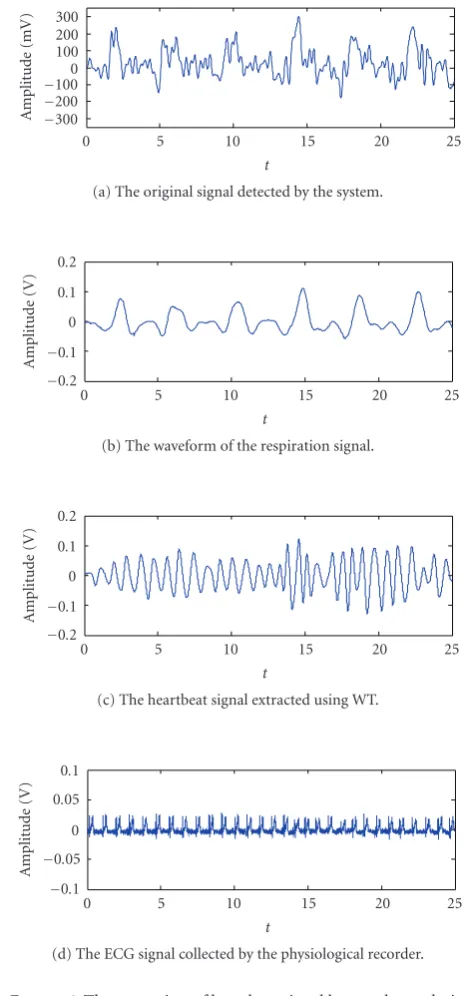
sig-nal data are asig-nalyzed. The results are shown in Figure 6.
Figure 6(a)is the original signal, where the respiration signal
is a dominant component and the heartbeat signal is difficult
to identify.Figure 6(b)is the profile of the respiration signal
in time domain extracted by the digital filter proposed, while
Figure 6(c)shows the profile of the heartbeat signal extracted
by WT.Figure 6(d)is the ECG signal collected by the
phys-iological recorder. ComparingFigure 6(c)withFigure 6(d),
we can see that the rhythm of the heartbeat signal waveform detected by the life-detection system and that of ECG signal detected by the physiological recorder are quite identical. It
suggests that heartbeat signal could be extracted effectively
form the respiration signal detected by the life-detection sys-tem, even with strong background noise.
4. DISCUSSION AND CONCLUSION
In remote life-detection system, one of the key problems is to improve the SNR. The signal accumulation with FFT en-hances SNR obviously without the envelope alignment and
the period alignment. The number of FFT pointsLdefines
the resolving power in frequency. Increasing L would
im-prove frequency resolution and increase the effectiveness of
the signal accumulation.
The other key problem is the suppression of interferences produced by moving objects, especially for the interferences from objects walking around the life-detection system. In this study, the DFA algorithm is used to track the spectra of in-terferences signal dynamically and restrain the inin-terferences without adding any assistant hardware. At the same time, our
study shows that the notching bandwidthΔBof the second
filter has effect on the performance of the DFA algorithm. If
the bandwidthΔBis too wide, the useful information would
be also restrained. To avoid it, the threshold value for the spectral peaks should be adjusted according to the practi-cal situation. The limitation of the DFA algorithm is that it can only be used to track two interference spectral peaks and the interferences similar to the standard respiration signal
cannot be restrained effectively. If the number of the
inter-ference spectral peaks is greater than 3, the complexity will increase greatly and the operational speed will be very slow.
In good conditions, respiration signal could be extracted by linear filters. However, the extraction of the heartbeat
sig-nal is very difficult due to the effects of breathing and body
surface involuntary inching of subjects. FIR digital filter and adaptive filter had been performed in our experiment, which
0 5 10 15 20 25
t −300
−200 −100 0 100 200 300
A
m
plitude
(mV
)
(a) The original signal detected by the system.
0 5 10 15 20 25
t −0.2
−0.1 0 0.1 0.2
A
m
plitude
(V
)
(b) The waveform of the respiration signal.
0 5 10 15 20 25
t −0.2
−0.1 0 0.1 0.2
A
m
plitude
(V
)
(c) The heartbeat signal extracted using WT.
0 5 10 15 20 25
t −0.1
−0.05 0 0.05 0.1
A
m
plitude
(V
)
(d) The ECG signal collected by the physiological recorder. Figure6: The extraction of heartbeat signal by wavelet analysis.
could not produce the ideal results. The wavelet transform technique is very sensitive to the frequency variation with higher resolution in time domain. With one-dimensional wavelet transform technique, the respiration signal and noise
could be filtered efficiently, and heartbeat signal can be
It is quite difficult to detect the life parameters noncon-tact. Our study shows that integration of sensitive system
based on radar with signal processing techniques is an eff
ec-tive solution. By this way, we can detect some life parameters such as heartbeat, respiration, and body movement without contacting the subject in distance less than 8 m. The possible shortcoming of this method is that interferences similar to
the respiration signal cannot be restrained effectively. A
so-phisticated signal processing scheme with the nonlinear joint phase space may further improve the system performance.
5. SAFETY
The electromagnetic radiation from the life-detection system poses no safety threat. The use of continuous wave radar and relatively short operating ranges allows for very low power levels. The power density level for human exposure can be computed according to the following formula:
SmW/cm2= p·G
40π·r2, (6)
wherep(W) is the average radiating power,G(dB) is the gain
of the antenna,r(m) is the distance between the antenna and
the human subject.
In our life-detection system, the radiating power is 30 mW and the gain of the antenna is 17 dB. If the mini-mum distance between the human subject and the antenna
is 10 cm, the maximumSis 0.406 mW/cm2, which is great
lower than the accepted safe power density level for
hu-man exposure that is 10 mW/cm2at frequencies from 10 to
300 GHz [11]. In practice the distance between the human
subject and the antenna will be further; the power density would be lower.
ACKNOWLEDGMENT
This work was supported by the National Natural Science Foundation of China (NSFC) 60571046.
REFERENCES
[1] W. Jianqi, H. B. Wang, J. Xijing, et al., “The study on non-contact detection of breathing and heartbeat based on
radar principles,”Chinese Journal of Medical Instrumentation,
vol. 25, no. 3, pp. 132–135, 2001.
[2] W. Jianqi, Z. Chongxun, J. Xijing, L. Guohua, H.-B. Wang, and A.-S. Ni, “Study on a non-contact life parameter detection
sys-tem using millimeter wave,”Space Medicine and Medical
Engi-neering, vol. 17, no. 3, p. 157, 2004.
[3] A. Droitcour, O. Boric-Lubecke, V. Lubecke, and J. Lin, “0.25mm CMOS and BiCMOS single chip direct conversion
Doppler radars for remote sensing of vital signs,” in
Pro-ceedings of IEEE International Solid State Circuits Conference (ISSCC ’02), pp. 348–349, San Francisco, Calif, USA, February 2002.
[4] A. Droitcour, O. Boric-Lubecke, V. Lubecke, J. Lin, and G.
Ko-vacs, “Range correlation effect on ISM band I/Q CMOS radar
for non-contact vital signs sensing,” in Proceedings of IEEE
MTT-S International Microwave Symposium Digest (IMS ’03), vol. 3, pp. 1945–1948, Philadelphia, Pa, USA, June 2003. [5] K.-M. Chen, Y. Huang, J. Zhang, and A. Norman, “Microwave
life-detection systems for searching human subjects under
earthquake rubble or behind barrier,”IEEE Transactions on
Biomedical Engineering, vol. 47, no. 1, pp. 105–114, 2000. [6] G. Matthews, B. Sudduth, and M. Burrow, “A non-contact
vi-tal signs monitor,”Critical Reviews in Biomedical Engineering,
vol. 28, no. 1-2, pp. 173–178, 2000.
[7] H.-R. Chuang, Y. F. Chen, and K. M. Chen, “Automatic
clutter-canceller for microwave life-detection systems,”IEEE
Transac-tions on Instrumentation and Measurement, vol. 40, no. 4, pp. 747–750, 1991.
[8] K. M. Chen, D. Misra, H. Wang, H.-R. Chuang, and E. Postow,
“An X-band microwave life-detection system,”IEEE
Transac-tions on Biomedical Engineering, vol. 33, no. 7, pp. 697–701, 1986.
[9] L. Xuehong, W. Aipin, and W. Liye, “Restraining the respira-tion interferences in ECG signal based on wavelet transform,”
Journal of Biomedical Engineering and Clinical of China, vol. 6, no. 7, pp. 78–82, 2003.
[10] D. L. Donoho, “De-noising by soft-thresholding,”IEEE
Trans-actions on Information Theory, vol. 41, no. 3, pp. 613–627, 1995.
[11] E. R. Adair and O. P. Gandhi, “Subcommittee co-chairs, IEEE Standard for Safety Levels with Respect to Human Expo-sure to Radio frequency Electromagnetic Field, 3kHz to 300 GHz(IEEE c95.1-1991),” 1994, IEEE, New York, NY, USA.
Wang Jianqi was born in April, in 1962, China. He received the diploma in infor-mation and control engineering from Xi’an Jiaotong University (XJTU), China, in 1984. From 2002 to 2006, he was the doctor stu-dent of the Key Laboratory of Education Ministry of China, Xi’an Jiaotong Univer-sity. From 1996 to 2006, he was teaching in the Faculty of Biomedical Engineering, FMMU. Until 1996, he served as an
Asso-ciate Professor and then a Professor (since 2001). He is currently serving as Professor and Vice Director of the Faculty of Biomedical Engineering at the same university. His research interest is biomed-ical signal noncontact detecting and processing. His phone and fax is +86-029-84774395; his email address is [email protected].
Zheng Chongxun was born in 1939 in China. He received the diploma in electrical engineering from Xi’an Jiaotong University (XJTU), China, in 1962. From 1962 to 1981, he was teaching in the Department of Elec-trical Engineering. Then he joined the De-partment of Information and Control En-gineering, XJTU. Until 1991, he served as an Associate Professor and then a Profes-sor (since 1988). He is currently serving as
Lu Guohua was born in February, 1976, in China. He received the diploma in biomedical engineering from Fourth Mil-itary Medical University (FMMU), China, in 1999. From 2002 to 2006, he was teach-ing in the Faculty of Biomedical Engi-neering of FMMU. He is currently serv-ing as Lecturer and Doctor of the Fac-ulty of Biomedical Engineering at the same university. His research interests include
biomedical signal detecting and processing. His email address is [email protected].