R E S E A R C H
Open Access
Task scheduling algorithm based on
fireworks algorithm
Jingmei Li
1, Qiao Tian
1*, Guoyin Zhang
1, Weifei Wu
1, Di Xue
1, Lanting Li
1, Jiaxiang Wang
1and Lei Chen
2Abstract
To give full play to the high efficiency and parallelism of multi-processor systems, the fireworks algorithm (FWA) is improved, and a multi-processor task scheduling algorithm based on improved FWA, named IMFWA, is proposed. IMFWA maps continuous space to discrete space by designing the fireworks location coding method, improves the Gaussian mutation process, and sets adaptive dimensions to accelerate the convergence speed of the algorithm. At the same time, in order to reduce the time complexity of the algorithm and shorten the time finding the optimal task scheduling sequence, the fitness-based tournament selection strategy is used instead of the rule based on Euclidean distance. Finally, IMFWA is compared with the basic fireworks algorithm and the genetic algorithms on the Matlab platform for performance analysis. The results show that the IMFWA has advantages in the convergence speed, and the negative impact of the number of tasks is also lower than the fireworks algorithm and genetic algorithm.
Keywords: Task scheduling, Fireworks algorithm, Gaussian mutation, Adaptive
1 Introduction
The task scheduling problem belongs to the combinato-rial optimization problem and cannot be solved within the polynomial time complexity [1]. It has been proved to be an NP-hard problem [2,3]. It is easy for multiple inde-pendent tasks to be scheduled on homogeneous multi-processors, by only scheduling the task with the shortest completion time to the processor. The representative task scheduling scheme on heterogeneous multi-processors is more complex. The performance parameters, such as exe-cution efficiency and total time of completion, need to be considered [4–7]. Research on task scheduling strate-gies for heterogeneous multi-processors has drawn much attention in recent years [8–10]. At present, the com-bination optimization algorithm, which is widely used in task scheduling problem, is genetic algorithm (GA) [11–13]. Nevertheless, the parameters of genetic algo-rithm are complicated to configure, and the effective-ness of the crossover and mutation operations decreases when the number of tasks increases, and the “premature” phenomenon can be easily triggered by the population initialization of the individuals [12,14–18].
*Correspondence:[email protected]
1College of Computer Science and Technology, Harbin Engineering University,
Harbin, China
Full list of author information is available at the end of the article
The fireworks algorithm (FWA) is a swarm intelligence optimization algorithm based on non-living population proposed by Ying Tan in 2010 [1, 19, 20]. The fire-works algorithm can provide the global optimal solution for complex problems [1, 20, 21] and has low defini-tion for solving the problem. Since proposed, it has been widely applied to non-negative matrix factorization cal-culation, directional characteristic matrix measure, group robot multi-target search, fertilization problem, traveling salesman, among others [20].
Based on the above literature and background, a het-erogeneous multi-processor task scheduling algorithm, IMFWA, is proposed, for making the fireworks algorithm suitable for the discrete multi-processor task scheduling problem and for efficiently and quickly obtaining the opti-mal task scheduling sequence. Compared with the basic fireworks and genetic algorithm on the Matlab simulation platform, it is proved that IMFWA has noticeable advan-tages in convergence speed, and the impact on the number of tasks is also significantly lower than genetic algorithm.
The paper is organized as follows: Section 1 intro-duces the research background for the problem. Section2
describes the basic task scheduling problem. Section 3
presents the fireworks algorithm and its improve-ment strategy. The proposed algorithm is presented in
Section4. Section5provides the experiment results and analysis, and Section6concludes this paper.
2 Description of task scheduling problem
Task scheduling is to obtain the optimal solution of the task sequence according to an algorithm, and tasks are assigned to the corresponding multi-processor according to the optimal solution order, so that the task completion time is the shortest [22–24]. For convenience, the sys-tem containsnheterogeneous multi-processors, denoted by P = {P1,P2,. . .,Pn}. Divide any application into m
independent tasks, represented byT = {T1,T2,. . .,Tm}.
n ≥ m means there are more processors than tasks to be scheduled. The next task is scheduled to an idle pro-cessor which has the shortest execution time according to the first-come-first-service mechanism. Whenn≺m, the number of processors is smaller than the number of tasks, and the tasks need to be assigned following the schedul-ing scheme. This paper only considers the case ofn≺m. exetijis the execution time of taskTion processorPj. The
execution time of all tasks under the scheduling scheme isCP(s). min(CP(s)) indicates the time used to execute all tasks under the optimal scheduling schemef. The task scheduling problem can be expressed as Eq. (1).
CP(f)=min(CP(s)) (1)
3 Fireworks algorithm and its improvement 3.1 The fireworks algorithm
The fireworks algorithm is a parallel explosive optimiza-tion algorithm proposed by Tan Ying, inspired by the natural fireworks exploding behavior [20]. In the fire-works algorithm, the sparks generated by firefire-works and their explosions and mutations resemble feasible solu-tions, and the explosion process simulates the process of optimizing in the current feasible solution domain [25,26]. In nature, high-quality fireworks explosions pro-duce more and more sparks, while the inferior fireworks explosions produce much fewer sparks. The fireworks algorithm follows the natural rules: the fitness value is good, the fireworks quality is excellent, the explosion range is small, and the sparks generated are in large quan-tity. On the other hand, when the fitness value is not good, the fireworks quality is inferior, the explosion range is large, and the sparks generated are limited [1,20,21,27]. The fireworks algorithm includes explosive sparks, muta-tion sparks, mapping rules, selecmuta-tion strategies, and other elements [20].
The explosion operator produces explosion sparks, which play a key role in the fireworks algorithm, whose metrics include explosion intensity, explosion amplitude, and displacement operation [28,29]. The explosion inten-sity is the core of the explosion operator, indicating the quantity of sparks generated during the explosion [30,31].
The fireworks based on better fitness value can produce more sparks and avoid them swinging around the optimal value during optimization. The calculation method for the number of sparks is shown in Eq. (2).
Siindicates the number of subgeneration sparks in theith
fireworks. S represents the maximum number of sparks in the fireworks subgeneration.Fmax indicates the worst
fitness value of this generation.f(Xi) represents the fit-ness value of the ith fireworks. is a minimal constant, avoiding the divide-by-zero error.
In order to control the number of subgeneration sparks of high quality fireworks and inferior fireworks, fireworks iis limited, as shown in Eq. (3).
aandbare given constants. round is the integral function, following the principle of rounding.
The explosion amplitude is set to explore the optimum value within a certain range around this generation of fireworks [32,33]. The fireworks with poor fitness value can produce sparks in a wider range and avoid “prema-ture” phenomenon [34, 35]. The calculation method of explosion amplitude is shown in Eq. (4).
Ri =R·
Ri indicates the range of the explosion amplitude of the
ith fireworks.R shows the maximum range of the fire-works explosion.Fminrepresents the best fitness value of
the current generation of fireworks.
The displacement operation is performed on each dimension of the fireworksi according to the explosion intensity and the explosion amplitude [36,37], as shown in Eq. (5).
Xik=Xki +rand(0,Ri) (5)
Xikindicates the value of the location vector of fireworks i in thekth dimension.Xik represents the value of the location vector of the sparks generated by fireworks i explosion in thekth dimension. rand(0,Ri)indicates the random number between 0 andRi.
∇Xik =Xik·n (6) ∇Xikindicates the value of the location vector of the sparks produced by fireworksiGauss mutation in thekth dimen-sion.nobeys the Gauss distribution of the mean value of 1 and the variance of 1, as shown in Eq. (7).
n∼N(1, 1) (7)
If fireworks i is near the boundary of the feasible domain, it may produce sparks across the boundary. Therefore, we use the rule of modular operation to map it back to the feasible domain, as shown in Eq. (8).
Xik=Xmink +Xikmod Xkmax−Xmink
(8)
Xkmax andXmink indicate the upper and lower bounds of the location vector of fireworks i in thekth dimension, respectively.
According to the explosion operator and Gauss muta-tion operator, the current populamuta-tion contains this gen-eration of fireworks, the explosion sparks, and the Gauss mutation sparks. The individuals with the best fitness val-ues are retained to the next generation with probability 1. Then, the restN−1 individuals are selected according to the Roulette rule with the probability in Eq. (9).
Pi=
Pi indicates the probability that fireworksiis selected.K
is a set of fireworks, explosion sparks, and Gauss muta-tion sparks.Dijrepresents the Euclidean distance between
fireworksiand fireworksj, as shown in Eq. (10):
3.2 The process of adaptive Gaussian mutation
The basic fireworks algorithm increases the diversity of the population through Gauss mutation and uses Gauss distribution to mutate any of the multiple dimen-sions of the fireworks in the population [20]. The actual effect of Gauss mutation can be easily influenced by the selected Gauss mutation fireworks and mutation dimen-sions. Therefore, for having a good fireworks population diversity and short convergence time, the process of Gauss mutation is redesigned.
With a poor fitness value of Gauss mutation, the contri-bution of the poor fireworks to the mutant becomes too large, thereby reducing the convergence speed of the algo-rithm. According to Pareto’s rule, the most important part of anything is only 20%, and the remaining 80% are sec-ondary, although they are the majority [41]. Therefore, in order to ensure that the algorithm has a fast convergence speed, the improved fireworks algorithm randomly selects
one of the fireworks for Gauss mutation among the top 20% of the fitness value.
When the fireworks with better fitness value are selected for Gauss mutation, if the mutation dimension constantly remains large, despite the improved diversity of the fireworks population, the contribution of fireworks with better fitness value to the population is reduced, thereby slowing down the convergence speed of the algo-rithm. In contrast, if the mutation dimension constantly remains small, although the information of the fireworks with better fitness value is retained, the diversity of the fireworks population is also reduced and consequently makes the algorithm fall into the local optimum. There-fore, to guarantee a fast convergence speed while not falling into the local optimal, the adaptive Gauss muta-tion dimension is presented. The value of the dimension is shown in the Eq. (11).
z(t+1)= w(t)×z(t) (11)
wis a nonlinear function that decreases by the iterationst, as shown in Eq. (12). Considering that the value of Gauss mutation dimension should be a positive integer, the value ofz(t+1)is rounded up tow(t)×z(t).
w(t)=e−t (12)
At the beginning of iteration,wis relatively large, and the corresponding mutation dimension z is also large, which helps improve the diversity of fireworks popula-tion and enhances the algorithm with global search. In the later stage of the iteration, the value ofwdecreases gradu-ally along with the iterations. The corresponding mutation dimension z decreases, the Gauss mutation dimension decreases gradually, and the information of the fireworks with better fitness value is preserved, so that the algo-rithm achieves optimization in the later stage of the iter-ations. The improved fireworks algorithm fully plays the role of Gauss mutation, avoiding the waste of resources caused by improper selection of the mutation fireworks and the improper determination of the mutation dimen-sion. Meanwhile, the algorithm improves the ability of global search and convergence speed.
4 IMFWA task scheduling algorithm 4.1 Coding strategy
Fireworks algorithm is an explosive optimization algo-rithm for continuous space, and task scheduling is a discrete problem. Therefore, according to the character-istics of heterogeneous multi-processor task scheduling, IMFWA encodes every generation of fireworks and maps the continuous search space to the discrete search space, so that fireworks algorithm can be applied to the task scheduling problem.
tasks are numbered respectively: the processor numbers are 1, 2,. . .,n, and the task numbers are 1, 2,. . .,m. Let the location vector of fireworks or sparks be an m -dimensional vectorXi, as shown in Eq. (13).
Xi=
x1,x2,. . .,xj,. . .,xm
,xj=rand(1,n) (13)
j = {1, 2, 3,. . .,m}, and rand(1,n)indicates a random value between 1 andn, then:
(1) Thej th task is distributed to thexjprocessor. (2) The requirements of task scheduling for
heterogeneous multi-processors are met. (3) Each task can and can only be executed by one
processor.
(4) Each processor can execute multiple tasks.
In this coding scheme, the fireworks or spark location vector is retained as a multi-dimensional vector, and only the meaning and value represented by each dimension are limited. In order to apply the coding scheme to the heterogeneous multi-processor task scheduling problem, the displacement operation formula Eq. (5) is updated to Eq. (14).
Xj=Xj+rand(0,Ri) (14)
When applying Eq. (14) to the execution of displace-ment operation, the value ofxjmay be beyond the range,
and the mapping rule Eq. (8) needs to be updated to Eq. (15).
Xj=1+ |Xj|mod(n−1) (15)
The coding scheme has four features and, therefore, is suitable for heterogeneous multi-processor task schedul-ing:
(1) The encoded mode is simple and clear and easy to understand and implement.
(2) The requirements of task scheduling for heterogeneous multi-processors are met. (3) Contains all possible task scheduling schemes. (4) The unique mapping of location vector and task
scheduling sequence for fireworks or sparks.
4.2 Fitness value
In the fireworks algorithm, the quality of each generation of fireworks and their offspring is evaluated by the fitness value. IMFWA uses CP(s), the time used to execute all tasks under the task scheduling sequences, as the fitness evaluation standard. A smaller value of CP(s) indicates faster task execution, and a smaller fitness value presents better quality of the fireworks or sparks. On the contrary, a larger value ofCP(s)indicates slower task execution, and a higher fitness value presents worse quality of the fireworks or sparks. According to the coding scheme,CP(Xi)is the
completion time of the task scheduling sequence corre-sponding to fireworks i or spark, and the fitness value calculation method is as shown in Eq. (16).
f(Xi)=CP(Xi) (16)
CP(Xi)is calculated via Eq. (17).
CP(Xi)=
m
j=1
exetxj (17)
The fitness value calculation method is shown in Eq. (18).
f(Xi)=
m
j=1
exetxj (18)
4.3 Tournament selection strategy
The basic fireworks algorithm uses the Roulette rules based on Euclidean distance to select the next genera-tion of fireworks; the higher the distance from the other fireworks or sparks, the higher the probability of being selected. Although this selection strategy allows the algo-rithm to avoid the local optimal solution, the time over-head increases greatly when the dimension of the location vector Xi of the fireworks increases. This leads to long
execution time of the algorithm in actual applications [1]. Therefore, IMFWA improves the basic fireworks algo-rithm and adopts the fitness-based tournament selection strategy instead of the Roulette rule based on Euclidean distance [1,20,21]. This reduces the time cost of the algo-rithm on the basis of ensuring the population diversity.
Fitness-based tournament selection strategy first selects a certain number of fireworks or sparks from the popula-tion to form the next generapopula-tion fireworks candidate set in each iteration. Then, it chooses the best fireworks or sparks in the candidate set to enter the next generation according to the fitness value. The specific process is as follows:
(1) To determine the percentage of fireworks or sparks in the next generation of fireworks candidates out of the total number of fireworks or sparks in the contemporary population.
(2) In accordance with the percentage determined in (1), the contemporary fireworks population is randomly selected to form the next generation of fireworks candidates set.
(3) According to fitness values, the best fireworks or sparks are retained in the next generation within the candidate set determined in (2).
according to the fitness-based tournament strategy. The probability of each fireworks or spark being selected is shown in Eq. (19).
Pi=
r Fmax −f(Xi)
i∈Q
Fmax −f(Xi) (19)
Qrepresents the next generation of fireworks candidates selected according to a certain percentage ofr.Fmax
indi-cates the maximum fitness value of an individual in setQ. IMFWA adopts this fitness-based tournament selection strategy to reduce the computational cost of selecting each generation of fireworks and shorten the actual execution time of the algorithm.
4.4 The process of IMFWA
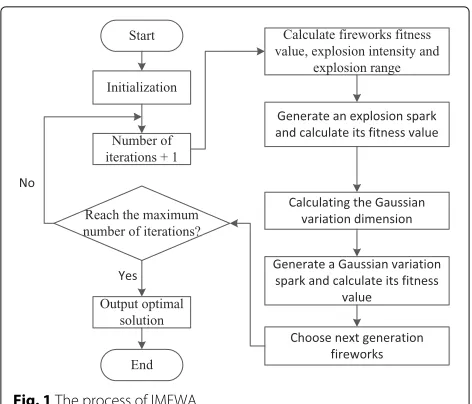
The process of the IMFWA scheduling algorithm is as follows:
(1) Initialize the number of fireworksN, the basic explosion spark numberS, the basic explosion amplitudeR, the number of tasks m, the multi-processors numbern, and the maximum iteration numberI.
(2) Initialize the fireworks location and convert the fireworks location into a task scheduling sequence according to the encoding scheme in Section4.1. (3) Calculate the fitness value, explosion intensity, and
explosion range of the fireworks.
(4) Start the explosion, generate ordinary sparks, and calculate the fitness value.
(5) Calculate the Gaussian mutation dimension according to Section3.2, generate the Gaussian mutation spark, and calculate its fitness value. (6) Select the next generation of fireworks according to
the tournament selection strategy in Section4.3. (7) Determine if the maximum number of iterations has
been reached. If yes, the algorithm stops and outputs the task scheduling sequence corresponding to the fireworks or sparks with the smallest the fitness value. Otherwise, the algorithm returns to step 3, and the algorithm continues to execute.
The flow of algorithm is shown in Fig.1.
5 Experiment results and analysis
5.1 Experimental methods
For evaluating the performance of IMFWA algorithm, this research designed the comparative experiments with the basic fireworks algorithm and genetic algorithm which is widely used in task scheduling. The fireworks algo-rithm is distributed and parallel. Compared with the chromosome information sharing mechanism of genetic algorithm, the fireworks algorithm adopts a distributed information sharing mechanism. The population is not
Fig. 1The process of IMFWA
uniformly to the optimal region, but the explosion and sparks are determined according to the fitness value of the fireworks distributed in different regions. Although the selection strategy of fireworks algorithm and genetic algo-rithm both introduce the idea of immune concentration, the fireworks algorithm has more mechanisms to avoid falling into the local optimal solution.
The experimental platform is Matlab R2014b and the operating system is Windows 10. In order to objectively analyze the performance of the algorithms, several com-parative experiments are set up to test the performance of the three algorithms under the conditions of eight processors and 50, 100, 150, 200, and 250 tasks.
To eliminate the contingency of random data, the total task completion time obtained is the average of 20 exper-iments. The specific parameter settings of IMFWA, GA, and FWA are shown in Table1. ParameterNindicates the initial quantity of fireworks per generation of the popula-tion in IMFWA and FWA. In GA, it indicates the quantity
Table 1Parameter settings of three algorithms
Algorithm Parameter Value
Number of fireworksN 100
Basic explosion spark numberS 80 Basic explosive amplitudeR 300 IMFWA, FWA Maximum number of iterationsI 500
Constanta 0.80
Constantb 0.04
Individual numberN 100
GA Cross probability 0.80
Mutation probability 0.04
of initial individuals per generation with the value of 100. The maximum number of iterationsIis 500.
5.2 Results and discussion
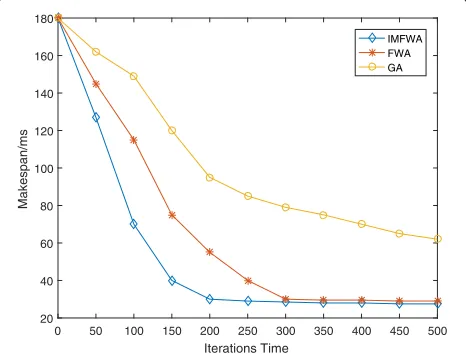
Figure2shows the scenario whenm = 200 andn = 8, where the average performance curve of all task com-pletion time-iteration times after 200 tasks are executed on eight heterogeneous processors. In Fig.2, among the three algorithms, IMFWA has the least number of itera-tions and the fastest convergence speed. As the number of iterations increases, the task completion time of IMFWA is consistently shorter than that of FWA and GA. It can be seen that the accuracy of IMFWA and FWA is supe-rior to that of the genetic algorithm. This is because the crossover and mutation operations of genetic algorithm increase the time complexity of the algorithm, and it tends to miss the optimal solution. While the iterative process of IMFWA is relatively simple, the search speed is faster and the precision is higher.
Figure3shows the algorithm execution time-task num-ber curve for different task numnum-bers when there are eight processors. In Fig.3, with the increased number of tasks, IMFWA still maintains lower task execution time when compared with FWA and genetic algorithm. It can be seen that IMFWA is less affected by the number of tasks than FWA, and both algorithms are less affected by the num-ber of tasks than genetic algorithm. This is because the cross-mutation operation of genetic algorithm reduces its effectiveness in large dimensions and is most affected by the dimension. IMFWA reduces the time complexity of the algorithm by improving the Gauss mutation and the selection strategy.
The experimental results and analysis show that IMFWA has the feasibility and efficiency in solving the task scheduling problem. It retains the characteristics of
Fig. 2Performance comparison results of the three algorithms
Fig. 3Execution results of the three algorithms
the basic fireworks algorithm’s accuracy in finding the optimal or suboptimal task scheduling sequence. Mean-while, it shortens the overall completion time of tasks on multi-processor, where its parallelism and heterogeneity can be fully utilized.
6 Conclusions
To exploit the parallelism and efficiency of heterogeneous multi-processor systems, a task scheduling algorithm based on improved fireworks algorithm is proposed. By setting the coding method of the fireworks location, the solution space of the fireworks algorithm is converted from continuous to discrete, so that it is suitable for task scheduling problem. At the same time, IMFWA improves the Gauss mutation process of the basic fireworks algo-rithm, effectively accelerating the convergence speed of the algorithm. The algorithm introduces a fitness-based tournament selection strategy, which reduces the time complexity of the algorithm. On the Matlab simulation platform, compared with the basic fireworks algorithm and genetic algorithm applied to the task scheduling prob-lem, it is proved that IMFWA can find the optimal solu-tion within fewer iterasolu-tion times. The convergence speed is faster, and the execution time of the algorithm is also shorter. When the number of tasks increases, IMFWA can still maintain a good optimization speed and solution accuracy.
Abbreviations
FWA: Fireworks algorithm; GA: Genetic algorithm; IMFWA: Improved fireworks algorithm; NP: Non-deterministic polynomial
Funding
This work was supported by the National Key Research and Development Plan of China (No.2016YFB0801004).
Availability of data and materials
Authors’ contributions
The contributions of all authors are equal in this manuscript, and all authors read and approved the final manuscript.
Authors’ information
Jingmei Li received her M.S. degree and Ph.D. degree from Harbin Engineering University, Harbin, China. She is currently a professor working in College of Computer Science and Technology, Harbin Engineering University. Her research focuses on Computer Architecture Performance Optimization, Big Data and Cloud Computing, Network and Information Security and Embedded Technology (E-mail:[email protected]).
Qiao Tian is currently a Ph.D. student at College of Computer Science and Technology, Harbin Engineering University. Her main research includes System Parallel Optimization and Computer Architecture
(E-mail:[email protected]).
Guoyin Zhang received his Ph.D. degree from Harbin Engineering University. He is currently a professor and Ph.D. supervisor at College of Computer Science and Technology, Harbin Engineering University. His current interests include Embedded System, Network Technology and Information Security (E-mail:[email protected]).
Weifei Wu received his M.S. degree at College of Computer Science and Technology, Harbin Engineering University. He is currently studying for his Ph.D. degree at the same institution (E-mail:[email protected]). Di Xue is currently a Ph.D. student at College of Computer Science and Technology, Harbin Engineering University (E-mail:[email protected]). Lanting Li is currently a Master studying at College of Computer Science and Technology, Harbin Engineering University.
Jiaxiang Wang is currently a professor at College of Computer Science and Technology, Harbin Engineering University.
Lei Chen is currently a professor of Georgia Southern University, USA.
Competing interests
The authors declare that they have no competing interests.
Publisher’s Note
Springer Nature remains neutral with regard to jurisdictional claims in published maps and institutional affiliations.
Author details
1College of Computer Science and Technology, Harbin Engineering University,
Harbin, China.2Georgia Southern University, Georgia, USA.
Received: 25 July 2018 Accepted: 28 September 2018
References
1. N. Bacanin, M. Tuba, inIEEE Congress on Evolutionary Computation, CEC 2015. Fireworks algorithm applied to constrained portfolio optimization problem (IEEE, New York, 2015), pp. 1242–1249.https://doi.org/10.1109/ CEC.2015.7257031
2. J.D. Ullman, Np-complete scheduling problems. J. Comput. Syst. Sci.
10(3), 384–393 (1975).https://doi.org/10.1016/S0022-0000(75)80008-0
3. C.H. Papadimitriou, M. Yannakakis, Towards an architecture-independent analysis of parallel algorithms. SIAM J. Comput.19(2), 322–328 (1990).
https://doi.org/10.1137/0219021
4. d.e.O.liveira. L.L., F.reitas. A.A., T.inós. R., Multi-objective genetic algorithms in the study of the genetic code’s adaptability. Inf. Sci.425, 48–61 (2018).
https://doi.org/10.1016/j.ins.2017.10.022
5. A.S. Pillai, K. Singh, V. Saravanan, A. Anpalagan, I. Woungang, L. Barolli, A genetic algorithm-based method for optimizing the energy consumption and performance of multiprocessor systems. Soft Comput.22(10), 3271–3285 (2018).https://doi.org/10.1007/s00500-017-2789-y
6. H. Topcuoglu, S. Hariri, M. Wu, Performance-effective and low-complexity task scheduling for heterogeneous computing. IEEE Trans. Parallel Distrib. Syst.13(3), 260–274 (2002).https://doi.org/10.1109/71.993206
7. G. Park, B.A. Shirazi, J. Marquis, inSolving Irregularly Structured Problems in Parallel, 4th International Symposium, IRREGULAR ’97. Comparative study of static scheduling with task duplication for distributed systems (Springer, Berlin, 1997), pp. 123–133.https://doi.org/10.1007/3-540-63138-0_12
8. Z. Zheng, N. Saxena, K.K. Mishra, A.K. Sangaiah, Guided dynamic particle swarm optimization for optimizing digital image watermarking in
industry applications. Futur. Gener. Comput. Syst. (2018).https://doi.org/ 10.1016/j.future.2018.05.027
9. X. Shi, Z. Zheng, Y. Zhou, H. Jin, L. He, B. Liu, Q.S. Hua, Graph processing on GPUs: a survey. ACM Comput. Surv.50(6), 1–35 (2018)
10. M.A. Al-Mouhamed, Lower bound on the number of processors and time for scheduling precedence graphs with communication costs. IEEE Trans. Softw. Eng.16(12), 1390–1401 (1990).https://doi.org/10.1109/32.62447
11. N. Zhang, X. Yang, M. Zhang, Y. Sun, K. Long, A genetic algorithm-based task scheduling for cloud resource crowd-funding model. Int. J. Commun. Syst.31(1) (2018).https://doi.org/10.1002/dac.3394
12. F.A. Omara, M.M. Arafa, Genetic algorithms for task scheduling problem. J. Parallel Distrib. Comput.70(1), 13–22 (2010).https://doi.org/10.1016/j. jpdc.2009.09.009
13. Z. Dou, C. Shi, Y. Lin, W. Li, Modeling of non-Gaussian colored noise and application in CR multi-sensor networks. EURASIP J. Wirel. Comm. Netw.
2017, 192 (2017).https://doi.org/10.1186/s13638-017-0983-3
14. A.S.A. Beegom, M.S. Rajasree, inDistributed Computing and Internet Technology - 11th International Conference, ICDCIT 2015. Genetic algorithm framework for bi-objective task scheduling in cloud computing systems (Springer-Verlag, Berlin, 2015), pp. 356–359. https://doi.org/10.1007/978-3-319-14977-6_38
15. S.G. Ahmad, C.S. Liew, E.U. Munir, T.F. Ang, S.U. Khan, A hybrid genetic algorithm for optimization of scheduling workflow applications in heterogeneous computing systems. J. Parallel Distrib. Comput.87, 80–90 (2016).https://doi.org/10.1016/j.jpdc.2015.10.001
16. Z. Li, inInternational Conference on Information Science and Engineering. Optimization for the parallel test task scheduling based on GA (IEEE, 2010), pp. 5223–5226.https://doi.org/10.1109/ICISE.2010.5689193
17. B. Kruatrachue, T. Lewis, Grain size determination for parallel processing. IEEE Softw.5(1), 23–32 (1988).https://doi.org/10.1109/52.1991
18. I. Ahmad, Y. Kwok, On exploiting task duplication in parallel program scheduling. IEEE Trans. Parallel Distrib. Syst.9(9), 872–892 (1998).https:// doi.org/10.1109/71.722221
19. K. Ding, S. Zheng, Y. Tan, inGenetic and Evolutionary Computation Conference, GECCO ’13, Amsterdam, The Netherlands, July 6-10, 2013. A GPU-based parallel fireworks algorithm for optimization, (2013), pp. 9–16.
https://doi.org/10.1145/2463372.2463377
20. Y. Tan, Y. Zhu, inAdvances in Swarm Intelligence, First International Conference, ICSI 2010, June 12-15, 2010, Proceedings, Part I. Fireworks algorithm for optimization (Springer, Beijing, 2010), pp. 355–364.https:// doi.org/10.1007/978-3-642-13495-1_44
21. S. Zheng, A. Janecek, Y. Tan, inProceedings of the IEEE Congress on Evolutionary Computation, CEC 2013, June 20-23. Enhanced fireworks algorithm (IEEE, 2013), pp. 2069–2077.https://doi.org/10.1109/CEC.2013. 6557813
22. T. Yang, A. Gerasoulis, DSC: scheduling parallel tasks on an unbounded number of processors. IEEE Trans. Parallel Distrib. Syst.5(9), 951–967 (1994).https://doi.org/10.1109/71.308533
23. B. Cirou, E. Jeannot, in30th International Workshops on Parallel Processing (ICPP 2001 Workshops), 3-7 September 2001. Triplet: a clustering scheduling algorithm for heterogeneous systems (IEEE, Valencia, 2001), pp. 231–236.
https://doi.org/10.1109/ICPPW.2001.951956
24. A. Gerasoulis, T. Yang, A comparison of clustering heuristics for scheduling directed acyclic graphs on multiprocessors. J. Parallel Distrib. Comput.
16, 276–291 (1992). Elsevier.https://doi.org/10.1016/0743-7315(92) 90012-C
25. S. Kim, J. Browne, inProceedings of the International Conference on Parallel Processing. General approach to mapping of parallel computations upon multiprocessor architectures, vol. 3, (1988), pp. 1–8
26. A. Dogan, F. Özgüner, in31st International Conference on Parallel Processing (ICPP 2002), 20-23 August 2002. LDBS: a duplication based scheduling algorithm for heterogeneous computing systems (IEEE, Vancouver, 2002), pp. 352–359.https://doi.org/10.1109/ICPP.2002.1040891
27. B. Zhang, M. Zhang, Y. Zheng, inAdvances in Swarm Intelligence - 5th International Conference, ICSI 2014, October 17-20, 2014, Proceedings, Part I. Improving enhanced fireworks algorithm with new Gaussian explosion and population selection strategies (Springer, Cham, 2014), pp. 53–63.
https://doi.org/10.1007/978-3-319-11857-4_7
29. Z. Zheng, A.K. Sangaiah, T. Wang, Adaptive communication protocols in flying ad hoc network. IEEE Commun. Mag.56(1), 136–142 (2018).https:// doi.org/10.1109/MCOM.2017.1700323
30. Y. Tu, Y. Lin, J. Wang, Semi-supervised learning with generative adversarial networks on digital signal modulation classification. CMC-Comput. Mater. Continua.55(2), 243–254 (2018)
31. J.T. Zhou, H. Zhao, X. Peng, M. Fang, Z. Qin, R.S.M. Goh, Transfer hashing: from shallow to deep. IEEE Trans. Neural Netw. Learn. Syst.PP(99), 1–11 (2018).https://doi.org/10.1109/TNNLS.2018.2827036
32. Y. Lin, X. Zhu, Z. Zheng, The individual identification method of wireless device based on dimensionality reduction and machine learning. J. Supercomput.5, 1–18 (2017).https://doi.org/10.1007/s11227-017-2216-2
33. C. Shi, Z. Dou, Y. Lin, W. Li, Dynamic threshold-setting for RF-powered cognitive radio networks in non-Gaussian noise. Phys. Commun.27, 99–105 (2018).https://doi.org/10.1016/j.phycom.2018.02.001
34. J. Sun, W. Wang, L. Kou, Y. Lin, L. Zhang, Q. Da, L. Chen, A data authentication scheme for uav ad hoc network communication. J. Supercomput.8, 1–16 (2017).https://doi.org/10.1007/s11227-017-2179-3
35. Y. Lin, C. Wang, J. Wang, Z. Dou, A novel dynamic spectrum access framework based on reinforcement learning for cognitive radio sensor networks. Sensors.16(10), 1675 (2016).https://doi.org/10.3390/s16101675
36. Y. Lin, C. Wang, C. Ma, Z. Dou, X. Ma, A new combination method for multisensor conflict information. J. Supercomput.72(7), 2874–2890 (2016).https://doi.org/10.1007/s11227-016-1681-3
37. Q. Wu, Y. Li, Y. Lin, The application of nonlocal total variation in image denoising for mobile transmission. Multimedia Tools Appl.76(16), 17179–17191 (2017).https://doi.org/10.1007/s11042-016-3760-0
38. H. Wang, L.I. Jingchao, L. Guo, Z. Dou, Y. Lin, R. Zhou, Fractal
complexity-based feature extraction algorithm of communication signals. Fractals-Compl. Geom. Patterns Scaling Nat. Soc.25(5), 1740008 (2017).
https://doi.org/10.1142/S0218348X17400084
39. T. Liu, Y. Guan, Y. Lin, Research on modulation recognition with ensemble learning. EURASIP J. Wirel. Comm. Networking.2017, 179 (2017).https:// doi.org/10.1186/s13638-017-0949-5
40. M.A. Khan, Scheduling for heterogeneous systems using constrained critical paths. Parallel Comput.38(4-5), 175–193 (2012).https://doi.org/10. 1016/j.parco.2012.01.001