MD simulation for H
2formation on amorphous ice
Junko Takahashi1,2,3∗
1National Astronomical Observatory, 2-21-1, Osawa, Mitaka, Tokyo 181-8588, Japan 2Institute for Fundamental Chemistry, 34-4, Takano-Nishihiraki-cho, Sakyo-ku, Kyoto 606-8103, Japan 3Department of Physics and Astronomy, University College London, Gower Street, London WC1E 6BT, U.K.
(Received November 24, 1998; Revised April 23, 1999; Accepted May 7, 1999)
Recent advances in a series of studies based on the molecular dynamics (MD) computer simulation that was performed to investigate the whole of H2formation process on the surface of dust grains throughout within a single model are reviewed. Amorphous water ice slabs were generated at 10 K and 70 K as a model surface of dust grains, and then the first and second incident H atoms were thrown onto the surface. The following fundamental processes of H2formation via two H atoms’ recombination, H+H→H2, were studied in detail; 1) the sticking of H atom onto the surface, 2) the diffusion of H atom on the surface, 3) the reaction of two H atoms on the surface, 4) the ejection of H2from the ice surface. The sticking probability, the mobility, the reaction probability, and the ejection lifetime were selfconsistantly obtained for the above processes. The product energy distribution of H2molecules formed on icy mantles of dust grains was also studied, and it was found that H2molecules can be highly vibrationally excited by formation pumping mechanism.
1.
Introduction
It is widely accepted that formation of interstellar molecu-lar hydrogens ought to occur predominantly on the surface of dust grains. The dust grains generally have icy mantles with amorphous structure, predominantly of H2O, which accumu-late on solid particles inside dark clouds (see, e.g., Williams, 1993; Herbst, 1995).
The fundamental processes of H2 formation via two H atoms’ recombination, H+H→H2, on the surface of dust grains are considered as follows; 1) sticking of incident H atoms onto the dust surface, 2) diffusion of H atoms over the surface, 3) reaction of two H atoms on the surface, and 4) ejection of product H2molecule from the surface back into the gas phase (see, e.g., Williams, 1993; Herbst, 1995). In order to know chemical evolution in various interstellar re-gions, it is very important to determine the rate constant for H2formation on dust grains. For this purpose, the formation mechanism of H2on the grain surface should be investigated from an overall point of view, and the sticking probabil-ity, diffusion constant, reaction probabilprobabil-ity, and ejection rate should be obtained.
It has been considered that there are two sources of exci-tation contributing to the rovibrational emission spectrum of interstellar H2, UV pumping and collisional excitation. How-ever, recent astronomical observations have required the third excitation source by formation pumping (see, e.g., Usuda, 1996). In order to determine the effect of the formation pumping, it is also very important to study the energy
dis-∗Present address: National Astronomical Observatory.
Copy right cThe Society of Geomagnetism and Earth, Planetary and Space Sciences (SGEPSS); The Seismological Society of Japan; The Volcanological Society of Japan; The Geodetic Society of Japan; The Japanese Society for Planetary Sciences.
tribution in the H2formation process on the surface of dust grains (see, e.g., Duley, 1986, 1993).
Several authors have previously studied on one of funda-mental processes of H2formation on dust grains or the prod-uct energy distribution of H2(Hollenbach and Salpeter, 1970; Hunter and Watson, 1978; Leitch-Devlin and Williams, 1985; Duley and Williams, 1986, 1993; Buch, 1990; Zhang and Buch, 1990; Buch and Zhang, 1991; Buch and Devlin, 1993, 1994). However, there have been no studies according to the policy that the sticking probability, diffusion constant, reaction probability, ejection rate, and product energy dis-tribution should be obtained selfconsistantly within a single model. Therefore, recent studies by Masuda and Takahashi (1997), Masudaet al.(1998), and Takahashiet al.(1999a,b) have been performed to carry out this policy by using molec-ular dynamics (MD) computer simulation. This review fo-cuses on collecting these studies into an article showing ad-vances in this method.
In this model, the slab-shaped amorphous water ice was produced by MD simulation, as a realistic model surface of icy mantles of dust grains. Then, two H atoms were succes-sively thrown onto the surface, and their dynamical behaviers were investigated by MD simulation. All of the fundamen-tal processes of H2formation on the surface of dust grains, sticking, diffusion, reaction, and ejection, were studied in detail. The product energy distribution of H2formed on the ice surface was also studied. In Section 2, the methods of MD simulation, computational details, and energy analysis are described. The results and discussions about amorphous water ice, sticking process, diffusion process, reaction pro-cess, ejection propro-cess, and product energy distribution are presented in Section 3. The conclusions are summarized in Section 4.
2.
Methods
2.1 MD simulationClassical MD simulation is a well established technique for studying molecular processes in thefield of physical chem-istry. In this technique, positions, velocities, and forces of the molecules are obtained as functions of time by solving numerical Newtonian equations of motion for the many-body system. The total potential of the system is generally given as a sum of pair potentials.
Despite the limitation of the classical treatment of motions, it has provided us with much realistic information about the molecular processes when they are dominated by the ther-mal dynamics (see, e.g., Hansen and McDonald, 1986). Our model, where the hydrogen atom or molecule is physisorbed on the surface of icy mantles and have excess thermal en-ergy during most of the processes, could be well treated by this technique (Masuda and Takahashi, 1997; Masudaet al., 1998). The quantum treatment should be especially em-ployed for the diffusion process of the H atom after it loses the excess thermal energy and becomes trapped on the sur-face of dust grains (Takahashiet al., 1998).
2.2 Computational details
For thefirst stage of our MD simulation, the slab-shaped amorphous water ice was generated under periodic boundary conditions. As the initial conditions, 1000 water molecules were placed randomly in the unit cell, and an equilibrium structure of amorphous water ice slab was obtained after 10 ps (picoseconds) (1 ps=10−12s) run, where the time step was taken to be 1 fs (femtosecond) (1 fs=10−15s). The volume of the slab in the unit cell was about 40A˚ ×40A˚ ×20A.˚ For the second stage, we performed MD simulation for the system consisting of both the amorphous water ice slab and thefirst incident H atom thrown onto the surface. For the third stage, the second incident H atom was thrown onto the above system. The time steps and time durations for the second and third stages were taken to be 0.1 fs and 5 ps, respectively. The temperatures of the amorphous water ice slabs were kept at 10 K and 70 K. Initial kinetic temperatures of incident H atoms were set at 10 K and 70 K, respectively, for 10 K and 70 K ice slabs. In these simulations, the full dynamics was treated for all of the atoms and molecules in the system, and thus the energy transfer from H atoms and H2
to the amorphous water ice was taken into account directly. The potential model used for a pair of H2O molecules was
TIPS2 (Transferable Intermolecular Potential of the second version) by Jorgensen (1982):
In this equation, thefirst and second terms are the Lennard-Jones parts and the third is the Coulomb part, where two positive charges are located on H atoms (qH) and one negative charge is at a distance of 0.15A from the oxygen atom on˚ the bisector of the H–O–H angle (qM);i and j indicate the positions of three charges of H2O and H2O’, respectively;
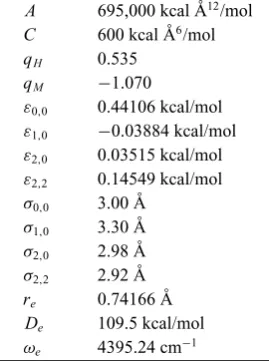
rO Ois the distance between the two oxygen atoms;ri jis the distance between the positionsi and j;eis the unit electric charge; A, C, qH, and qM are empirical parameters (see Table 1). This potential function was modelled for the rigid water molecules.
Table 1. Parameters in Eqs. (1)–(4) (after Herzberg 1950; Jorgensen 1982; Zhanget al.1991).
For the pair potential between an H atom and an H2O
molecule, the potential model by Zhanget al.(1991) was employed: This potential function is made of the Lennard-Jones part and the spherical harmonicsYl,m(θ, φ). The origin is placed on the oxygen atom of H2O,r is the distance between the
incident H atom and the oxygen atom, andθ andφare the spherical angles. The potential parameters, εl,m andσl,m, were prepared using the results of ab initio molecular orbital calculations (see Table 1).
The Morse-type potential function with experimental pa-rameters for an H2molecule (Herzberg, 1950) was used as
the interaction potential between the two H atoms:
VH−H =De
wherer is the distance between the two H atoms; μis the reduced mass of an H2molecule;reis its equilibrium value;
Deis the dissociation energy;ωeis the harmonic frequency (see Table 1).
In the present MD simulation, H2O molecules were treated
as rigid and the SHAKE-Verlet algorithm was used for nu-merical integration with the quaternion’s formalism. This model includes only intermolecular modes (translational vi-brations) of H2O, while librational (hindered rotational) and
intramolecular vibrational modes of H2O are neglected. This
approximation might reduce the interaction between the product H2 molecule and the neibouring H2O molecules.
However, it is known that intramolecular vibrational frequen-cies (1650–3380 cm−1 in the pure H
2O ice) and librational
frequencies (about 500–1000 cm−1) are so high that their
is a good approximation to consider intermolecular frequen-cies (below about 500 cm−1) for the energy transmission in
the H2O ice at 10 K and 70 K.
The temperatures of the amorphous water ice slab were kept at 10 K and 70 K by rescaling velocities of H2O
mole-cules at every time step. This procedure was done to mimic the canonical ensemble at a given thermodynamical temper-ature for H2O molecules. When the temperature rescaling
was switched off, the background temperatures of the amor-phous water ice were still kept at 10 K and 70 K within a temperaturefluctuation of 1%. Thus, it was found that there is little error in numerical integrations for the present system. 2.3 Product energy analysis
The energy analysis of an H2 molecule formed on the
amorphous water ice surface was performed. The total ki-netic energy (Ttotal) was numerically separated into the vi-brational kinetic energy (Tvi b), the rotational kinetic energy (Tr ot), and the translational kinetic energy (Ttr ans) at each time step.
The total energy Etotal of the product H2was defined as
the time average of the sum ofTtotal and potential energies including the Morse-type H–H potential energy (VH−H) and the interaction energy between H2and amorphous water ice
after H2 was ejected from the ice surface. The vibrational
energy Evi b was defined as the time average of the sum of
Tvi bandVH−Hafter H2was ejected. The translational energy
Etr answas defined as the time average ofTtr ansafter H2was
ejected. The rotational energyEr ot was defined byEtotal−
Etr ans−Evi b.
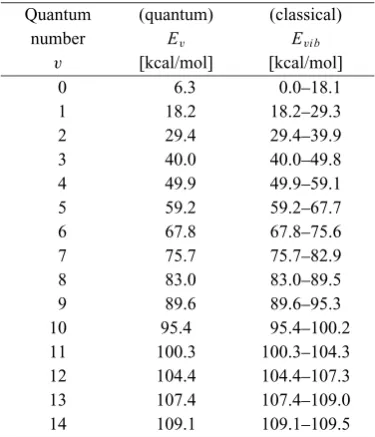
Although the energies obtained in this simulation are clas-sical, it is possible to make them correspond approximately to the quantum vibrational energy levels (v=0–14). In the present work, we regarded classical energy between the en-ergy levelsvandv+1 as being at the levelv(see Table 2). The evaluated maximum error in this approximation is con-sidered to be the extent of energy between one vibrational
Table 2. Quantum vibrational energy levels of H2and classical vibrational
energies corresponding to them.
Quantum (quantum) (classical)
number Ev Evi b
v [kcal/mol] [kcal/mol]
0 6.3 0.0–18.1
1 18.2 18.2–29.3
2 29.4 29.4–39.9
3 40.0 40.0–49.8
4 49.9 49.9–59.1
5 59.2 59.2–67.7
6 67.8 67.8–75.6
7 75.7 75.7–82.9
8 83.0 83.0–89.5
9 89.6 89.6–95.3
10 95.4 95.4–100.2
11 100.3 100.3–104.3 12 104.4 104.4–107.3 13 107.4 107.4–109.0 14 109.1 109.1–109.5
energy level and the adjacent one.
3.
Results and Discussion
3.1 Amorphous water iceIt is considered that the amorphous water ice has a high-density structure (about 1.1 g/cm3) below 38 K and a low-density structure (about 0.94 g/cm3) above 68 K (Jenniskens
and Blake, 1994; Jenniskenset al., 1995). The amorphous water ice slabs generated at 10 K and 70 K by our MD simu-lation are shown in Fig. 1 (after Masudaet al., 1998). Their densities were found to be about 1.07 g/cm3and about 0.93
g/cm3, respectively. As was discussed previously, the O–O
distance radial distribution functions at 10 K and 70 K were also found to be in good agreement with those of high-density and low-density amorphous water ice produced experimen-tally. Thus, we consider that the present amorphous water ice slabs are good models for the surface of icy mantles of dust grains (Masuda and Takahashi, 1997; Masudaet al., 1998). 3.2 Sticking process of a hydrogen atom
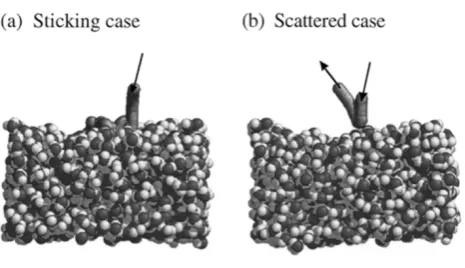
The sticking process of the H atom onto the icy surface of dust grains was studied by the second stage of our MD simulation (Masudaet al., 1998). The behaviours of the H atom thrown onto the amorphous water ice are classified into the sticking case and the scattered one, as are shown in Fig. 2 (after Masudaet al., 1998). In the scattered case, the inci-dent H atom went back to the initial height within 5 ps after hopping several times on the ice surface. On the other hand, in the sticking case, it was found that it took about 3 ps until the temperature of adsorbed H atoms became in equilibrium with the slab temperature. Therefore, we considered that 5 ps of the simulation period was adequate.
The sticking probabilities for incident H atoms with
Fig. 2. The 2nd stage of MD simulation—two cases in the sticking process of an incident H atom onto the amorphous water ice (after Masudaet al., 1998).
Table 3. Sticking probability of an incident H atom on the amorphous water ice (after Masudaet al., 1998).
Temperature Number of simulations Sticking Ice H atom Sticking Scattered Total probability
10 K 10 K 59 0 59 1.00
tial kinetic temperatures of 10–350 K were examined. The results are shown in Table 3 (after Masuda et al., 1998). There is seen a clear tendency that the sticking probability becomes smaller as the kinetic temperature of the incident H atom becomes higher. Since the present amorphous water ice is a slab-shaped one with infinite area, the value of stick-ing probability for it is considered to be larger than that for small ice clusters (Masudaet al., 1998).
3.3 Diffusion process of a hydrogen atom
The diffusion process of the H atom on the icy surface of dust grains was studied also by the second stage of our MD simulation (Masudaet al., 1998). In the sticking cases, the incident H atoms initially diffused on the surface of amor-phous water ice via thermal hopping mechanism for 1–3 ps and then became trapped in one of the stable sites. The aver-age total energy of an impinging H atom gradually decreased, because a part of energy was absorbed by amorphous water ice during an H atom’s hopping process. When the average total energy of the incident H atom became smaller than the potential energy barrier of a site, it was trapped there. Once an incident H atom was trapped, none was found to restart diffusing within the time duration in our MD simulation (5–
10 ps).
The mobilities in the diffusion process of the H atom are classified into the onebeforetrapped and thataftertrapped. The average migration length and time of the impinging H atom during the surface hopping process were calculated as the measure of the mobilitybeforetrapped, which were found to depend just on the temperature of the icy surface of dust grains. On the other hand, the time-scale for the H atom’s movement from the trapping site to a neighboring site via
thermal hopping mechanism was estimated as the measure of the mobilityaftertrapped. The results are shown in Table 4 (after Masudaet al., 1998).
Naturally, under such low temperatures as 10 K and 70 K, the quantum mechanical tunneling effect might be large in the diffusion process of the H atom. In order to estimate this effect, a new formalism by using the differential diffusion constant was recently developed (Takahashiet al., 1998). In future work, the diffusion constant including both thermal hopping and quantum tunneling mechanisms will be calcu-lated.
3.4 Reaction process of two hydrogen atoms
The reaction process of two hydrogen atoms on the icy surface of dust grains was studied by the third stage of our MD simulation (Takahashiet al., 1999a). Two reaction cases were observed in which H2molecules are produced on the
dust surface (see, e.g., Williams, 1993; Herbst, 1995). The
first is the Langmuir-Hinshelwood case, in which the second incident H atom sticks on the grain surface and then diffuses into the vicinity of the site where thefirst H atom is trapped (Case (a), see Fig. 3(a)). The second is the Eley-Rideal case, in which the second H atom in the gas phase strikes directly thefirst H atom adsorbed on the dust surface (Case (b), see Fig. 3(b)). The third reaction case was also observed in our MD simulation, where two H atoms met and reacted but were almost elastically scattered each other without H2being
stabilized (Case (c), see Fig. 3(c)).
There were many other MD trajectories where two H atoms could not react during the limited simulation time. It was found that they recombined when they approached each other within about 3.5 A, while they could not encounter each˚ other and diffused away if the minimum distance between them was more than the critical distance. Thus, the effective reactive cross-section was evaluated at about 40A˚2.
The excess energy released when H2molecule is formed
via two H atoms’recombination is about 109.5 kcal/mol, which is very large, compared with the interaction energy between two H2O molecules being 6 kcal/mol and that
be-tween H and H2O being 0.3 kcal/mol. In our MD simulation,
the excess energy by H2 formation can be absorbed by the
amorphous water ice through the coupling of the H2–H2O
libration with the intermolecular vibrational modes of H2O
molecules in the ice. When a part of excess energy was effec-tively absorbed by the amorphous water ice during the two H atoms’reacting process, H2 could be formed (Cases (a)
and (b)). When not, almost elastic collision of two H atoms occured (Case (c)).
Because of limitation of run time in the present MD sim-ulation, the second H atom was intentionally thrown into the vicinity of thefirst H atom. Therefore, case (b) occured more frequently, and there is little significance in the ratios of cases (a) and (b). The reaction probability of the incident two H atoms on the amorphous water ice is defined as the sum of probabilities of cases (a) and (b). The present definition of the reaction probability is not a global one, but a microscopic one. The results are shown in Table 5 (after Takahashiet al., 1999a) and they are found to be almost unity.
3.5 Ejection process of a molecular hydrogen
Table 4. Mobility of an incident H atom on the amorphous water ice (after Masudaet al., 1998).
Temperature Mobilitybeforetrapped Mobilityaftertrapped Ice H atom Migration length Migration time Time-scale for removing
10 K 10 K 60A˚ 1682 fs 1034years
70 K 70 K 140A˚ 2688 fs 10−5seconds
Fig. 3. The 3rd stage of MD simulation—three cases in the reaction process of two H atoms on the amorphous water ice (after Takahashiet al., 1999a).
our MD simulation (Takahashiet al., 1999a). It was found that the ejection process of the product H2 via the direct
ejection mechanism occurred subsequently after the two H atoms’reaction process. In this mechanism, a part of the excess energy derived from the H2formation was absorbed
by the ice, and then a part of the remaining excess energy was used for the product H2to be ejected from the ice surface.
The ejection rate would be evaluated from the lifetime for the H2molecule to escape from the dust surface. The
life-times of ejection were measured for cases (a) and (b). The
re-Table 5. Reaction probability of two H atoms on the amorphous water ice (after Takahashiet al., 1999a).
Temperature Number of simulations Reaction Ice H atom (a) (b) (c) Total probability
10 K 10 K 31 58 5 94 0.95
70 K 70 K 34 56 6 96 0.94
Table 6. Time-scale for the product H2ejected from the amorphous water
ice (after Takahashiet al., 1999a).
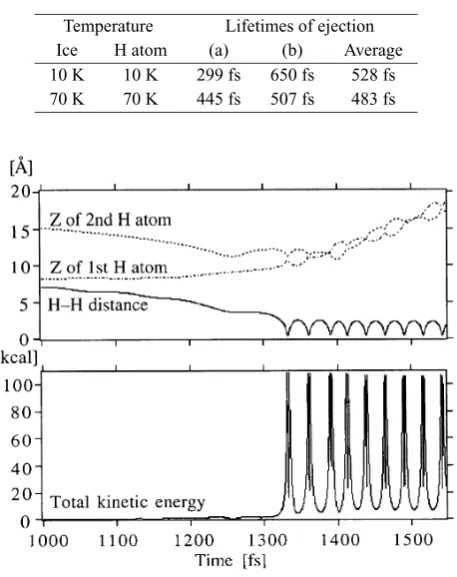
Temperature Lifetimes of ejection Ice H atom (a) (b) Average 10 K 10 K 299 fs 650 fs 528 fs 70 K 70 K 445 fs 507 fs 483 fs
Fig. 4. Time dependences of the H–H distance, the height Z of each H atom, and the sum of total kinetic energies of two H atoms (after Takahashiet al., 1999b).
sults are shown in Table 6 (after Takahashiet al., 1999a). The temperature dependence and the difference between cases (a) and (b) cannot be discussed clearly, because of the small number of trajectories. The average lifetime as a whole is very short, only about 400–500 fs.
3.6 Product energy distribution
The product energy distribution of H2molecules formed
Fig. 5. Vibrational energy population of H2formed on the surface of amorphous water ice (after Takahashiet al., 1999b).
Fig. 6. Total, rotational, and translational energies for each vibrational energy level of H2.
ice (after Takahashiet al., 1999b). The time dependences of the H–H distance and the height of each H atom are shown in the upper graph. The time origin was taken at the time when the second H atom was thrown onto the surface. The time dependence of the sum of total kinetic energies of two H atoms is shown in the lower graph. The intense oscillation of the H–H distance and the total kinetic energy represents the product H2molecule in the vibrationally excited state.
The vibrational energy population for the 10 K and 70 K systems are shown in Fig. 5 (after Takahashiet al., 1999b). It has become clear that H2molecules formed on the
amor-phous water ice are in highly vibrationally excited states. The vibrational energy levels with high populations are around
v = 6–10. It was found that the vibrational energy popu-lation for 70 K is more broadly spread than that for 10 K. It is understood because the surface of the 70 K ice is more random than that of the 10 K ice and that the excess energy released from H2formation could be transferred in various
ways into the kinetic energies of H2on the surface.
The average classical total kinetic, rotational, and transla-tional energies for each vibratransla-tional energy level are shown in Fig. 6. It was found that the average total energies are only slightly dependent on the vibrational energy levels. There was found a tendency that the rotational and translational energies decrease as the vibrational energy increases.
The totally averaged vibrational, rotational, translational, and total energies of H2formed on the amorphous water ice
are shown in Table 7 (after Takahashi et al., 1999b). The results show that the largest part of the H2formation energy
resides in the vibrational energy of H2, and the second largest
part and the third transfer into rotational and translational energies of H2, respectively. The average vibrational energy
approximately correspond to that forv =8. The evaluated rotational and translational temperatures were, respectively, 5,000–6,000 K and 4,000–5,000 K. It has become clear that the H2 molecule formed on the amorphous water ice
should be in highly excited states not only vibrationally but also rotationally and translationally. The energy absorbed by ice is also shown in Table 7, which was evaluated from the difference between the total energy of the ejected H2and
the H2formation energy, 109.5 kcal/mol. It was found that
only a small part of H2 formation energy was absorbed by
the amorphous water ice.
In the present model where H2O molecules are treated
rigid, it is considered that the vibrational energy population is spread over the region of the more highly excited states than in another model where intramolecular modes of H2O
molecules are taken into account. When H2O molecules
have only intermolecular modes, the transfer of the H2
Table 7. Average product energy distribution of H2formed on 10 K and 70 K ice. The numbers in parentheses are the percentages divided by the H2
formation energy, 109.5 kcal/mol (after Takahashiet al., 1999b).
Temperature Average product energies of H2formed on ice Energy absorbed
Ice H atom Evi b Er ot Etr ans Etotal by ice
[K] [K] [kcal/mol] (%) [kcal/mol] (%) [kcal/mol] (%) [kcal/mol] (%) [kcal/mol] (%)
10 10 86.0 (78.5) 10.9 (9.9) 8.1 (7.4) 105.1 (96.0) 4.4 (4.0)
70 70 84.0 (76.7) 11.9 (10.7) 9.3 (8.5) 105.2 (96.1) 4.3 (3.9)
of H2will become less easy, and the H2formation energy is
more likely to reside in the vibrational energy of H2. On the
other hand, when H2O molecules have both intermolecular
and intramolecular modes, the H2formation energy can be
transferred into rotational and translational energies of H2
more easily (Takahashiet al., 1999b).
As a result of classical MD simulation, the vibrational energy of H2 obtained here might be overestimated while
rotational and translational energies underestimated. If the system is treated quantum mechamically, the extra energy corresponding to the difference between the classical vibra-tional energy and the nearest lower quantum vibravibra-tional en-ergy level would be transferred into rotational and transla-tional energies. The evaluated maximum error is considered to be the extent of energy between one vibrational energy level and the adjacent one. On the other hand, it is consid-ered that the vibrational energy population shown in Fig. 5 is realistic, since we regarded classical vibrational energy between the energy levelsvandv+1 as being at the levelv.
4.
Conclusions
The aim of the present work exists in studying the whole formation process of H2 on the surface of icy mantles of
interstellar dust grains and the resulting product energy dis-tribution of H2by using a single model. We performed
clas-sical molecular dynamics (MD) computer simulation, where the amorphous water ice slab was generated under periodic boundary conditions as a model surface for icy mantles of dust grains and then thefirst and the second incident H atoms were thrown onto the surface. In this simulation, the dynam-ics of all of the atoms and molecules in the system was con-sidered, and thus the energy transfer from H atoms and H2to
the amorphous ice surface was explicitly taken into account. The amorphous water ice slabs generated by our MD sim-ulation were compared with those produced experimentally, and we conclude that they are good models for the surface of icy mantles of dust grains. The following fundamental pro-cesses of H2formation on the icy surface of dust grains were
investigated in detail; 1) sticking of incident H atoms onto the dust surface, 2) diffusion of H atoms over the surface, 3) reaction of two H atoms on the surface, and 4) ejection of product H2 molecule from the surface back into the gas
phase. The sticking probability, the mobility before and after H atom is trapped on the surface, reaction probability, and ejection lifetime were obtained for the above processes.
The product energy analysis of H2formed on the surface
of icy mantles of dust grains was performed based on results of the present MD simulation. It has become clear that the H2molecules formed on the icy surface are in highly
vibra-tionally excited states. It was also found that they are in
highly excited states rotationally and translationally. Since the present model is based on a classical MD simulation and a rigid H2O approximation, the vibrational energy of H2
ob-tained here might be slightly overestimated. The influence on the Langmuir-Hinshelwood reaction case by a thermal hopping or tunneling of H atoms after they are once trapped on the ice surface are also neglected here. In spite of these limitation, it is considered that this result reveals the impor-tance of the formation pumping mechanism in the detection of highly excitated H2molecules. It might be suggested that
the rovibrational emission would be detectable even in dark clouds or in regions without a source of UV pumping or collisional excitation (Duley and Williams, 1986, 1993).
Acknowledgments. The author thanks Dr. Atto Laaksonen at IBM Corp. for his code in the CCP5 program library in the computer cen-ter of Kyoto University, which was utilized as a part of our code. The author is grateful to coworkers, Dr. Koichi Masuda at IBM Corp., Prof. Masataka Nagaoka at Nagoya University, and Prof. Tadashi Mukai at Kobe University. The author is also grateful to Prof. D. A. Williams at University College London for helpful discussions. This work was partially supported by Research Fellowships of the Japan Society for the Promotion of Science for Young Scientists and by Hayashi Memorial Foundation for Female Natural Scien-tists. The computational simulations were carried out on NEC SX-4/1C supercomputer at Institute for Fundamental Chemistry and on NEC SX-3/34R at the Computer Center of Institute for Molecular Science. A part of calculations were carried out at the Astronomical Data Analysis Center, National Astronomical Observatory.
References
Buch, V., Identification of two distinct structual and dynamical domains in an amorphous water cluster,J. Chem. Phys.,93, 2631–2639, 1990. Buch, V. and J. P. Devlin, Preferential adsorption of ortho-H2with respect
to para-H2on the amorphous ice surface,J. Chem. Phys.,98, 4195–4206,
1993.
Buch, V. and J. P. Devlin, Interpretation of the 4141 inverse centimeters (2.415 microns) interstellar infrared absorption feature,Astrophys. J.,
431, L135–L138, 1994.
Buch, V. and Q. Zhang, Sticking probability of H and D atoms on amorphous ice: computational study,Astrophys. J.,379, 647–652, 1991.
Duley, W. W. and D. A. Williams, The formation of interstellar H2 on
amorphous silicate grains,Mon. Not. R. Astron. Soc.,223, 177–182, 1986. Duley, W. W. and D. A. Williams, The formation of H2on interstellar dust,
Mon. Not. R. Astron. Soc.,260, 37–42, 1993.
Fletcher, N. H.,The Chemical Physics of Ice, 264 pp., Cambridge University Press, London, 1970.
Flubacher, P., A. J. Leadbetter, and J. A. Morrison, Heat capacity of ice at low temperatures,J. Chem. Phys.,33, 1751–1755, 1960.
Hansen, J. P. and I. R. McDonald,Theory of Simple Liquids(2nd edition), 547 pp., Academic Press, New York, 1986.
Herbst, E., Chemistry in the interstellar medium,Annu. Rev. Phys. Chem.,
46, 27–53, 1995.
Herzberg, G.,Molecular Spectra and Molecular Structure I. Spectra of Diatomic Molecules(2nd edition), 620 pp., Van Nostrand, New York, 1950.
Hunter, D. A. and W. D. Watson, The translational and rotational energy of hydrogen molecules after recombination on interstellar grains,Astrophys. J.,226, 477–482, 1978.
Jenniskens, P. and D. F. Blake, Structual transitions in amorphous water ice and astrophysical implications,Science,265, 753–756, 1994.
Jenniskens, P., D. F. Blake, M. A. Wilson, and A. Pohorille, High-density amorphous ice, the frost on interstellar grains,Astrophys. J.,455, 389–
401, 1995.
Jorgensen, W. L., The revised TIPS for simulations of liquid water and aqueous solutions,J. Chem. Phys.,77, 4156–4163, 1982.
Leitch-Devlin, M. A. and D. A. Williams, Sticking coefficients for atoms and molecules at the surfaces of interstellar dust grains,Mon. Not. R. Astron. Soc.,213, 295–306, 1985.
Masuda, K. and J. Takahashi, The sticking probability of a hydrogen atom onicy mantle,Adv. Space Res.,19, 1019–1022, 1997.
Masuda, K., J. Takahashi, and T. Mukai, Sticking probability and mobility of a hydrogen atom on icy mantle of dust grains,Astron. Astrophys.,330, 773–781, 1998.
Takahashi, J., M. Nagaoka, and K. Masuda, Quantum mechanical treatment for the diffusion process of a hydrogen atom on the amorphous water ice
surface,Int. J. Quantum Chem.,70, 379–385, 1998.
Takahashi, J., K. Masuda, and M. Nagaoka, The formation mechanism of molecular hydrogen on icy mantles of interstellar dust,Mon. Not. R. Astron. Soc.,306, 22–30, 1999a.
Takahashi, J., K. Masuda, and M. Nagaoka, Product energy distribution of molecular hydrogen formed on icy mantles of interstellar dust,Astrophys. J.,520, 724–731, 1999b.
Usuda, T., Ph.D. Thesis, Univ. Tokyo, Japan, 1996.
Williams, D. A., Physical and chemical processes on dust, inDust and Chem-istry in Astronomy, edited by T. J. Millar and D. A. Williams, Institute of Physics Publishing, Philadelphia, pp. 143–170, 1993.
Zhang, Q. and V. Buch, Computational study of formation dynamics and structure of amorphous ice condensates,J. Chem. Phys.,92, 5004–5016, 1990.
Zhang, Q., N. Sabelli, and V. Buch, Potential energy surface of H—H2O,J. Chem. Phys.,95, 1080–1085, 1991.