R E S E A R C H
Open Access
Distributed piecewise
H
∞
filtering design
for large-scale networked nonlinear systems
Zhenhua Shao
*and Tianxiang Chen
Abstract
This paper investigates the problem of distributed piecewiseH∞filtering for discrete-time large-scale nonlinear systems. The considered large-scale system is composed of a number of nonlinear subsystems and exchanges its information through communication network. Each nonlinear subsystem is described by a Takagi-Sugeno (T-S) model, and data-packet dropouts happen intermittently in communication network, and its stochastic variables are assumed to satisfy the Bernoulli random-binary distribution. Our objective is to design a distributed piecewise filter such that the filtering error system is stochastically stable with anH∞performance. Based on a piecewise Lyapunov function and some convexifying techniques, less conservative results are developed for the distributed piecewiseH∞ filtering design of the considered system in the form of linear matrix inequalities (LMIs). The effectiveness of the proposed method is validated by two examples.
Keywords: Large-scale fuzzy systems, DistributedH∞filter, Piecewise Lyapunov function
1 Introduction
In practical application, some complex systems, such as transportation systems, power systems, communication networks, and industrial processes, are referred to as large-scale systems [1, 2]. Due to strong interconnection and high dimensionality, large-scale systems lead to severe difficulties for their analysis and control synthesis. To date, three main control approaches, centralized, decen-tralized, and distributed control, have been proposed for large-scale systems with interconnection. Since the cen-tralized control suffers from the excessive information processing and heavy computational burdens, there has been recently an increasing interest in the use of tralized control for large-scale systems [3]. The decen-tralized control is firstly to partition the overall control problem of a large-scale system into several indepen-dent or almost indepenindepen-dent subproblems. Then, instead of a single controller, a set of independent controllers can be designed to achieve the overall control of large-scale system [4]. However, the decentralized control strategy appears weaker stability margins and performance, espe-cially when the interconnections among subsystems are
*Correspondence: [email protected]
High-voltage Key Laboratory of Fujian Province, Xiamen University of Technology, Xiamen 361024, People’s Republic of China
strong [5]. In the distributed control, the supplemen-tal feedbacks with the interconnected information are provided for the local controllers to enhance the require-ments of stability and performance. As a result, the dis-tributed control avoids those shortages appearing in both centralized and decentralized controls [6, 7].
On the other hand, an important issue is to consider the control problems of nonlinear systems because most control plants are nonlinear. Recently, Takagi-Sugeno (T-S) model has been proved to be a powerful solu-tion to represent any smooth nonlinear funcsolu-tions at any preciseness [8, 9]. The T-S model employs a group of IF-THEN fuzzy rules to describe the global behavior of the nonlinear system in which a number of linear mod-els are connected smoothly by fuzzy membership func-tions. T-S fuzzy approach combining the merits of both fuzzy logic theory and linear system theory is success-fully implemented in embedded microprocessors and is widely applied in a variety of engineering fields [10–13]. During the past few years, a great number of results on function approximation, systematic stability analysis, con-troller and filtering design for T-S fuzzy systems have been reported in the open literature [14–19].
With the rapid development of digital technology, in the feedback loops, communication networks are often used instead of point-to-point connections due
to their great advantages, such as simple maintenance and installation, and low cost [20–24]. Unfortunately, the network-induced imperfections, such as quantization errors, packet dropouts, and time delays, can degrade significantly the performance of control systems and may even lead to instability [25–29]. Recently, based on fuzzy/piecewise Lyapunov functions, some results on stability analysis and controller synthesis of fuzzy sys-tems have been presented. It has been demonstrated that the inherently conservatism in common Lyapunov function can be relaxed by using piecewise/fuzzy Lya-punov functions. More recently, T-S fuzzy control has been developed to investigate large-scale nonlinear sys-tems [30–35]. To mention a few, some results on anal-ysis and synthesis methods for decentralized control of large-scale systems have been presented in [30–32]. In [33, 34], the decentralized H∞ filtering problem was studied for the discrete-time large-scale system with time-varying delay. To the best knowledge of the authors, few results on the distributed H∞ filtering design have been given for large-scale networked T-S fuzzy systems by using piecewise Lyapunov function, which motivates us for the research presented in this paper.
This paper will deal with the distributed H∞ fil-tering problem for discrete-time large-scale nonlinear systems. The large-scale system is composed of sev-eral nonlinear subsystems and exchanges its information through communication network. Each nonlinear sub-system is described by a T-S model, and data-packet dropouts occur intermittently in communication net-work, and its stochastic variables satisfy the Bernoulli random-binary distribution. Based on a piecewise Lya-punov functional (PLF) and some convexifying tech-niques, the distributed H∞ filtering design result will be proposed. It will be shown that the filtering error system is stochastically stable with an H∞ perfor-mance, and the filtering gains can be given by the form of LMIs. Two simulation examples will be pre-sented to demonstrate the advantage of the proposed methods.
Notations.n×m is then-dimensional Euclidean space andn×mdenotes the set ofn×mmatrices.P >0(≥0) means that matrixPis positive definite (positive semidef-inite). Sym{A} denotesA+AT.I
nand 0m×nare then×n identity matrix andm×nzero matrix, respectively. The subscriptsnandm×nare omitted when the size is irrele-vant or can be determined from the context. For matrices
A ∈ n×n, A−1 and AT denote the inverse and trans-pose of the matrixA, respectively.l2[ 0,∞)is the space of square-summable infinite vector sequences over [ 0,∞). diag{· · ·} is a block-diagonal matrix. The notation · denotes the Euclidean vector norm, and·2is the usual
l2[ 0,∞) norm. E{·}denotes the mathematical expecta-tion. The notationdenotes the symmetric terms.
2 Model description and problem formulation
This paper considers a class of discrete-time large-scale systems, which consist of N nonlinear subsystems, the
ith nonlinear subsystem is described by the T-S model as below.
Plant ruleRil:IFζi1(t)isFil1andζi2(t)isFil2and· · · andζig(t)isFigl,THEN
⎧ ⎪ ⎪ ⎪ ⎨ ⎪ ⎪ ⎪ ⎩
xi(t+1)=Ailxi(t)+ N
k=1 k=i ¯
Aiklxk(t)+Bilwi(t)
yi(t)=Cilxi(t)+Dilwi(t)
zi(t)=Lilxi(t),l∈Li := {1, 2,. . .,ri}
(1)
where i ∈ N := {1, 2,. . .,N}; Ril denotes the lth fuzzy inference rule; ri is the number of fuzzy infer-ence rules; Filφφ =1, 2,. . .,g are fuzzy sets; xi(t) ∈ nxi,y
i(t)∈ nyi, andzi(t)∈ nziare the system state, the measured output, and the estimated signal, respectively;
wi(t) ∈ nwi is the disturbance input, which belongs to
l2[ 0,∞);ζi(t) :=[ζi1(t),ζi2(t),. . .,ζig(t)] are some mea-surable variables of theith subsystem;(Ail,Bil,Cil,Dil,Lil) denotes the lth local model for the ith subsystem; A¯ikl is the interconnection matrix between the ith and kth subsystems.
Let us defineμil[ζi(t)] as the normalized membership function of the inferred fuzzy set Fil := gφ=1Filφ; it yields
μil[ζi(t)] := g
φ=1μilφ
ζiφ(t)
ri
ς=1 g
φ=1μiςφ
ζiφ(t)
≥0,
ri
l=1
μil[ζi(t)]=1
(2)
where μilφζiφ(t)
denotes the grade of membership of
ζiφ(t)inFilφ. For convenience, in the sequel, the argument of μil[ζi(t)] will be dropped for the situations without ambiguity, i.e., we denoteμil :=μil[ζi(t)] .
By using a standard fuzzy inference, we obtain theith global T-S fuzzy subsystem as below:
⎧ ⎪ ⎪ ⎪ ⎪ ⎨ ⎪ ⎪ ⎪ ⎪ ⎩
xi(t+1)=Ai(μi)xi(t)+ N
k=1 k=i ¯
Aik(μi)xk(t)+Bi(μi)wi(t)
yi(t)=Ci(μi)xi(t)+Di(μi)wi(t)
zi(t)=Li(μi)xi(t),i∈N
where
⎧ ⎪ ⎪ ⎨ ⎪ ⎪ ⎩
Ai(μi):= ri
l=1μilAil, ¯
Aik(μi):= ri
l=1μilAikl, Bi(μi):= ri
l=1μilBil
Ci(μi):= ri
l=1μilCil, Di(μi):= ri
l=1μilDil Li(μi):= ri
l=1μilLil. (4)
In this paper, we will address the distributedH∞ filter-ing design problem of the discrete-time large-scale fuzzy system in (3) based on a piecewise Lyapunov functional (PLF). For each nonlinear subsystem i ∈ N, we fol-low the idea proposed in [36, 37], where the premise variable space is partitioned into two different kinds of regions: fuzzy regions and crisp regions. The region with 0 < μil[ζi(t)] < 1 is defined as the fuzzy region, where the system dynamics are governed by a convex combination of several local models dropped into that region. In addition, the crisp region is the region where
μil[ζi(t)] = 1 for some rulesl, and the rest of member-ship functions equal to zero. The system dynamics in crisp region are governed by thel-th local model within that region.
LetSij
j∈Jibe the premise variable space partition for the ith subsystem, and Ji be the set of region indices. Based on the partition policy, the global T-S fuzzy system in (3) can be rewritten as
⎧ ⎪ ⎪ ⎪ ⎪ ⎨ ⎪ ⎪ ⎪ ⎪ ⎩
xi(t+1)=Aijxi(t)+ N
k=1 k=i
¯
Aikjxk(t)+Bijwi(t)
yi(t)=Cijxi(t)+Dijwi(t)
zi(t)=Lijxi(t),ζi(t)∈Sij,j∈Ji,i∈N
(5)
where
⎧ ⎪ ⎪ ⎨ ⎪ ⎪ ⎩
Aij:= m∈Ii(j)
μimAim, Bij:= m∈Ii(j)
μimBim A¯ikj:= m∈Ii(j)
μimAikm
Cij:= m∈Ii(j)
μimCim, Dij:= m∈Ii(j)
μimDim Lij:= m∈Ii(j)
μimLim
(6)
with 0 < μim[ζi(t)] < 1,m∈Ii(j) μim[ζi(t)] = 1. For each local region Sij,Ii
j contains the matrix indices used in that region. For a crisp region,Ii
jcontains a single index.
For convenience, we denote a new seti, which repre-sents all possible region transitions for theith subsystem:
i:=
(j,s)|ζi(t)∈Sij,ζi(t+1)∈Sis,
j,s∈Ji
(7)
wherej=swhenζi(t)transits from the regionSijtoSis, andj=swhenζi(t)stays in the same regionSij.
Given the large-scale fuzzy system (5) with the premise variable space partition, we propose a distributed piece-wise filter of the following form:
⎧ ⎪ ⎪ ⎨ ⎪ ⎪ ⎩
xFi(t+1)=AFijxFi(t)+BFijyFi(t)+ N
k=1 k=i
BFikjyFk(t)
zFi(t)=CFijxFi(t),j∈Ji,i∈N
(8)
where xFi(t) ∈ nfi is the filter state, zFi(t) ∈ nzi is an estimation of zi(t),yFi(t) is the measured out-put applied to filter, and (AFij,BFij,BFikj, CFij) are filter gains to be designed, where nfi = nxi for the full-order filter, and 1 ≤ nfi < nxi for the reduced-order one.
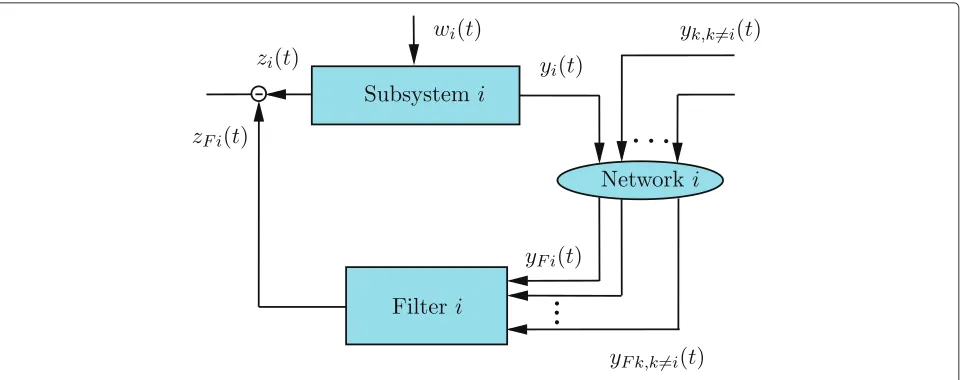
Here, we assume that the data loss happens in the com-munication links between the filter and physical plain, the measured output yi(t) is no longer equivalent to yFi(t). The ith filtering subsystem with unreliable communica-tion network is shown in Fig. 1, where theith filter takes all measured outputs via unreliable communication links. This paper models the data-loss condition based on a stochastic approach, thus, it yields [38]:
yFi(t)=αi(t)yi(t),i∈N (9)
whereαi(t)is the independent Bernoulli processes, which represent the unreliable condition of the links from the sensor to the filter. Specifically,αi(t) ≡ 0 when the link fails, i.e., data are lost, andαi(t)≡1 represents successful transmission, andαi(t)is supposed to be given by
Prob{αi(t)=1} =E{αi(t)} = ¯αi, Prob{αi(t)=0} =1− ¯αi. (10)
In addition, let us define
˜
αi(t)=αi(t)− ¯αi. (11)
It is easy to see from (11) that
E{ ˜αi(t)} =0,E{ ˜αi(t)α˜i(t)} = ¯αi(1− ¯αi). (12)
By definingx¯i(t)=
xT
i (t)xTFi(t)
T
Fig. 1Theith subsystem with unreliable communication network
⎧ ⎪ ⎪ ⎨ ⎪ ⎪ ⎩ ¯
xi(t+1)=Aijx¯i(t)+ N
k=1 k=i ¯
Aikjxk(t)+Bijwi(t)+ N
k=1 k=i ¯ Bikjwk(t)
¯
zi(t)=Cijx¯i(t),ζi(t)∈Sij,j∈Ji,i∈N
(13)
where
⎧ ⎪ ⎪ ⎪ ⎪ ⎪ ⎪ ⎪ ⎪ ⎪ ⎪ ⎪ ⎪ ⎪ ⎪ ⎪ ⎪ ⎪ ⎪ ⎨ ⎪ ⎪ ⎪ ⎪ ⎪ ⎪ ⎪ ⎪ ⎪ ⎪ ⎪ ⎪ ⎪ ⎪ ⎪ ⎪ ⎪ ⎪ ⎩
Aij=Aij(1)+ ˜αi(t)Aij(2),A¯ikj= ¯Aikj(1)+ ˜αi(t)A¯
(2)
ikj ,
Bij=B(ij1)+ ˜αi(t)B(ij2),B¯ikj=E
¯
αiBFikjDkj+ ˜αi(t)BFikjDkj
,
A(1)
ij =
Aij 0 ¯
αiBFijCij AFij
,Aij(2)=
0 0 BFijCij 0
,
¯
A(1) ikj =
¯ Aikj ¯
αiBFikjCkj
,A¯ikj(2)=
0 BFikjCkj
,E=
0
I
,
B(1)
ij =
Bij ¯
αiBFijDij
,Bij(2)=
Bij
BFijDij
,Cij=
Lij −CFij
.
(14)
Definition 1.Let x˜(t) = x¯T1(t) x¯T2(t) · · · ¯xTN(t)T andw˜(t)=wT1(t) wT2(t) · · · wTN(t)T.Then, the filter-ing error system in (13) is stochastically stable in the mean square if there exists matrix W >0such that
E
∞
t=0
x˜(t)2 x˜(0)
<x˜T(0)Wx˜(0) (15)
for any initial conditionx˜(0)whenw˜(t)≡0.
Now, we formulate the distributed piecewiseH∞ filter-ing problem as below.
Given the fuzzy filtering system shown in Fig. 1, assume that the communication link parameter α¯i is available. Given a prescribed scalar γ > 0, design a distributed piecewise filter in the form of (8) such that the following two conditions are satisfied simultaneously.
1) The filtering error system in (13) is stochastically stable in the sense of Definition 1;
2) Under zero-initial conditions, the estimated error ˜
z(t)satisfies
˜zE≤γw˜2, (16)
where˜zE:=E
∞
t=0
˜z(t)2
.
If both the conditions are satisfied, then the filtering error system in (13) is stochastically stable with anH∞
performanceγ.
3 Main results
In this section, based on a piecewise Lyapunov functional (PLF), the performance analysis and design of the dis-tributed piecewise H∞ filter will be developed for the considered system in (3). The filter gains will be given for both full-order and reduced-order filters by solving a number of LMIs.
Lemma 1.Given the fuzzy system in (3) and dis-tributed piecewise filter in (8), then the filtering error system in (13) is stochastically stable with an H∞ per-formance γ, if there exist matrices 0 < Pij = PTij ∈
Proof.Choose the following piecewise Lyapunov
func-tional (PLF): definite symmetric Lyapunov matrices.
DefineVi(t)=Vi(t+1)−Vi(t), one has
Vi(t)= ¯xTi (t+1)Pisx¯i(t+1) − ¯xTi (t)Pijx¯i(t),(j,s)∈i.
(20)
It follows from the error system in (13) that
Define the matrix multipliers Gi ∈
the “Appendix” section that
2
Given the following index
J(t)=E
It follows from (19)–(21) and (23)–(25) that
J(t)≤E{J(t)+V(∞)−V(0)}
are given by (18).
By using Schur complement lemma on (17), it is easy to see from (26) that the inequality (17) impliesE{V(t)}<
According to Definition 1, it is easy to see that the fil-tering error system is stochastically stable in the mean square. Then, considering E{V(t)} > 0 for all t ≥ 0, under zero-initial conditions it yields
E
3.2 DistributedH∞filtering design
In this subsection, we will consider the distributedH∞
filtering design for the system in (5). Based on Lemma 1, and by specifying the multiplierGi, the nonlinear matrix inequalities are formulated into the linear ones, the corre-sponding result is summarized as below.
⎧
Furthermore, a distributed piecewise filter in the form of (8) is given by
AFij=Gij(2)−1A¯Fij,BFij=Gij(2)−1B¯Fij,
BFikj=Gij(2)−1B¯Fikj,CFij= ¯CFij,j∈Ji,i∈N. (32)
Proof.For matrix inequality linearization purpose, the multipliersGi,i∈N are firstly specified by
Gi=
, and performing a congruence transforma-tion to Thus, we can directly specify the multipliersGias
It is noted that the first block-row ofAij,A¯ikj,Bij,B¯ikj
does not involve in the filter gain variables. Thus, the multipliersGi,i∈N is finally specified as below,
Gi=
Then, substituting (38) into (17), and by extracting the fuzzy basis functions, the inequality (30) can be obtained.
In addition, the inequality in (17) imply that
Pis+Sym which means that the matrix variableGij(2)are nonsingu-lar. Thus, the filtering gains AFij,BFij,BFikj,CFij
can be obtained by (32) and completing this proof.
4 Simulation examples
In the following, let us consider two examples to illustrate the result proposed in this paper.
Example 1.Consider a discrete-time large-scale T-S model with three fuzzy rules as below:
Plant ruleRil:IFxi1(t)isFil,THEN
0.98 0.01 0.87 0.02 0.95 0.01
−0.18 0.74 −0.12 0.83 −0.16 0.86
0.28 0.25 0.21
,
C11=[1.03 0] ,C12=[0.95 0] ,C13=[0.89 0] ,
D11=0.74,D12=0.69,D13=0.58,L11=0.85,L12=0.97,L13=1.04
for the first subsystem, and
[A21 A22 A23]=
0.75 0.02 0.83 0.01 0.92 0.02
−0.20 0.82 −0.15 0.88 −0.17 0.75
0.21 0.28 0.23
for the second subsystem.
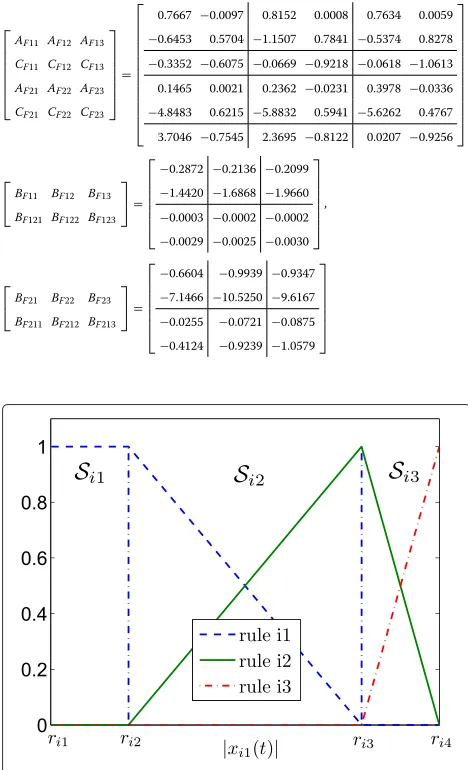
Figure 2 shows the membership functions. According to the premise variable space partition, there are three subspaces for each subsystem:
Si1= {xi1(t)|ri1≤ |xi1(t)| ≤ri2}
Here, we consider the case of a full-order filter with
ai = 0.6. It is noted that the common Lyapunov function proposed in [40] is not applicable to the distributedH∞
filtering design for this case in this example. However, by applying Theorem 1, the feasible solutions ofγmin = 3.9555 for the full-order filter andγmin = 6.5599 for the reduced-order filter are obtained, and the corresponding filter gains are
⎡
0.7667−0.0097 0.8152 0.0008 0.7634 0.0059 −0.6453 0.5704 −1.1507 0.7841 −0.5374 0.8278 −0.3352−0.6075 −0.0669 −0.9218 −0.0618−1.0613 0.1465 0.0021 0.2362 −0.0231 0.3978−0.0336 −4.8483 0.6215 −5.8832 0.5941 −5.6262 0.4767
3.7046−0.7545 2.3695 −0.8122 0.0207−0.9256 ⎤
−0.2872 −0.2136 −0.2099 −1.4420 −1.6868 −1.9660 −0.0003 −0.0002 −0.0002 −0.0029 −0.0025 −0.0030 ⎤
−0.6604 −0.9939 −0.9347 −7.1466 −10.5250 −9.6167 −0.0255 −0.0721 −0.0875 −0.4124 −0.9239 −1.0579 ⎤
for full-order filter and
⎡ ⎢ ⎢ ⎢ ⎢ ⎢ ⎢ ⎢ ⎢ ⎢ ⎢ ⎣
AF11 AF12 AF13
CF11 CF12 CF13
AF21 AF22 AF23
CF21 CF22 CF23
BF11 BF12 BF13
BF121 BF122 BF123
BF21 BF22 BF23
BF211 BF212 BF213
⎤ ⎥ ⎥ ⎥ ⎥ ⎥ ⎥ ⎥ ⎥ ⎥ ⎥ ⎦
=
⎡ ⎢ ⎢ ⎢ ⎢ ⎢ ⎢ ⎢ ⎢ ⎢ ⎢ ⎣
0.6646 0.7019 0.6069
−1.1355 −1.3025 −7.8639 0.3419 0.2325 0.6842
−2.8731 −6.5894 −3.2918
−0.4212 −0.3742 −0.5079
−0.0007 −0.0009 −0.0014
−0.4754 −0.6358 −0.5075
−0.0001 −0.0003 −0.0004
⎤ ⎥ ⎥ ⎥ ⎥ ⎥ ⎥ ⎥ ⎥ ⎥ ⎥ ⎦
for the reduced-order case.
Example 2.Consider a modified double-inverted pen-dulum, which is connected by a spring [34]. The motional equations of the interconnected pendulum are given by
⎧ ⎪ ⎪ ⎪ ⎪ ⎨ ⎪ ⎪ ⎪ ⎪ ⎩
˙ xi1=xi2
˙
xi2= 1001Jiui− kr 2 4Jixi1+
m
igr Ji −
kr2 4Jixi2
sin(xi1)
+1 Jixi2+
2
k=1 k=i
3kr2
Jk xk1,i= {1, 2}
wherexi1andxi2denote the angle from the vertical and the angular velocity, respectively.
In this simulation, the moments of inertia areJ1=2 kg andJ2 = 2.5 kg; the masses of two pendulums are cho-sen as m1 = 2 kg and m2 = 2.5 kg; the constant of the connecting torsional spring is k = 8 N·m/rad; the length of the pendulum isr = 1 m; the gravity constant isg = 9.8 m/s2. Here, the interconnected pendulum is linearized around the origin,xi1 = (±80◦, 0) andxi1 =
(±88◦, 0); each pendulum is described by the T-S model with three fuzzy rules. Givenu1 = −18x11−16x12 and
u2 = −20x21− 14x22, it can be known that these two closed-loop T-S fuzzy subsystems are stable. Then, by dis-cretizing the T-S fuzzy systems with sampling periodT=
0.01 s, the discrete-time interconnected T-S fuzzy system can be obtained as below:
Plant ruleRil:IF|xi1(t)|isFil,THEN
⎧ ⎪ ⎪ ⎪ ⎨ ⎪ ⎪ ⎪ ⎩
xi(t+1)=Ailxi(t)+ 2
k=1 k=i ¯
Aikxk(t)+Bilwi(t)
yi(t)=Cilxi(t)+Dilwi(t)
zi(t)=Lilxi(t),l= {1, 2, 3},i= {1, 2}
where
[A11 A12 A13]=
⎡
⎣ 1 0.0120 1 0.0120 1 0.0120 −1.3200 −0.1540 −1.1818 −0.1658 −1.3760 −0.0352 ⎤ ⎦,
¯ A12=
⎡ ⎣ 0 0
0.12 0 ⎤ ⎦,B1l=
⎡ ⎣ 0
0.5 ⎤ ⎦,C1l=
1 0
,D1l=1,L1l=
0 1
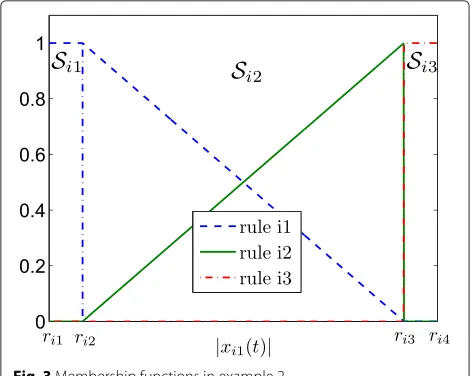
Fig. 3Membership functions in example 2
for the first subsystem and
[A21 A22 A23]=
⎡
⎣ 1 0.0120 1 0.0120 1 0.0120 −1.3760 −0.0352 −1.2378 −0.0447 −1.2485 −0.0448 ⎤ ⎦,
¯ A21=
⎡ ⎣ 0 0
0.096 0 ⎤ ⎦,B2l=
⎡ ⎣ 0
0.4 ⎤ ⎦,C2l=
1 0
,D2l=1,L2l=
0 1
for the second subsystem.
Figure 3 shows the membership functions. Based on the premise variable space partition, it can be known that there exist three subspaces for each subsystem:
Si1= {xi1(t)|ri1<|xi1(t)| ≤ri2} Si2= {xi1(t)|ri2<|xi1(t)| ≤ri3} Si3= {xi1(t)|ri3<|xi1(t)|<ri4}
Fig. 5Responses ofz2(t)andzF2(t)
where ri1 = 0,ri2 = 8◦,ri3 = 80◦, andri4 = 88◦. It is shown that bothSi1andSi3are crisp regions andSi2is a fuzzy region. The region index set isJi= {1, 2, 3}.
Now, considering the case of full-order filter withai = 0.9, the common Lyapunov function proposed in [40] is not applicable to the distributedH∞ filtering design for this case in this example. However, by applying Theorem 1, the H∞ filtering performance γmin = 3.3755 is obtained, and the obtained filter gains are
[AF11 AF12 AF13]= ⎡
⎣ 0.9530 0.0064 0.9645 0.0061 0.9645 0.0060 −0.8230 0.8049 −0.7860 0.7924 −0.7696 0.7620 ⎤ ⎦,
[BF11 BF12 BF13]= ⎡
⎣−0.0462 −0.0357 −0.0356 −0.6725 −0.7136 −0.7026 ⎤ ⎦,
[BF121 BF122 BF123]= ⎡
⎣−0.0009 −0.0009 −0.0009 −0.1312 −0.1346 −0.1314 ⎤ ⎦,
[CF11 CF12 CF13]=
0.0324 −0.9570 0 −1.0475 −0.0006 −1.0285
,
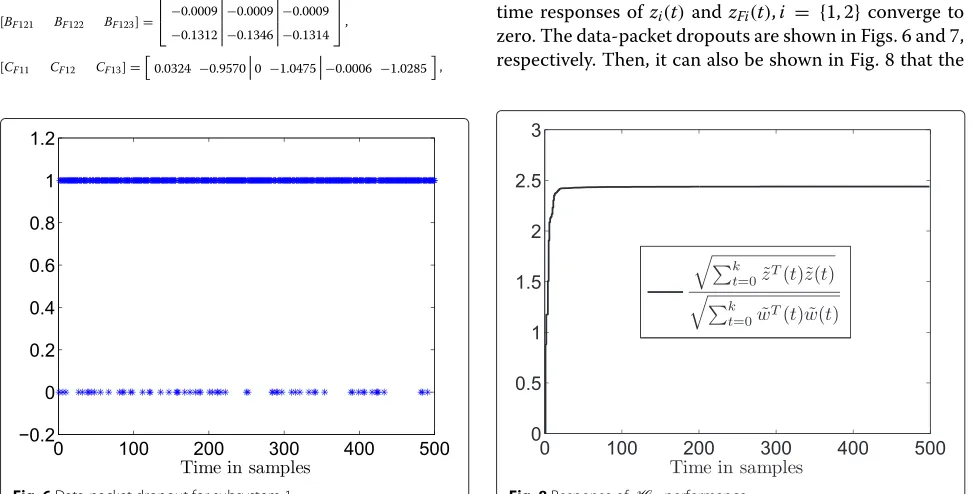
Fig. 6Data-packet dropout for subsystem 1
Fig. 7Data-packet dropout for subsystem 2
and
[AF21 AF22 AF23]= ⎡
⎣ 0.9626 0.0062 0.9634 0.0064 0.9634 0.0063 −0.7417 0.8157 −0.6866 0.8275 −0.6732 0.8048 ⎤ ⎦,
[BF21 BF22 BF23]= ⎡
⎣−0.0360 −0.0361 −0.0361 −0.5731 −0.5792 −0.5732 ⎤ ⎦,
[BF211 BF212 BF213]= ⎡
⎣−0.0009 −0.0010 −0.0009 −0.1094 −0.1103 −0.1085 ⎤ ⎦,
[CF21 CF22 CF23]=
0.0132 −1.0074 0 −1.0111 0.0004 −1.0007.
Given the initial conditionsx1(0) =[ 1.3, 0]T,x2(0) = [ 1.1, 0]T, and assume that the external disturbances sat-isfyw1(t) = 5e−0.02tsin(t)andw2(t) = 5e−0.02tcos(t), it is easy to see from Figs. 4 and 5 that the responses of he time responses ofzi(t) andzFi(t),i = {1, 2} converge to zero. The data-packet dropouts are shown in Figs. 6 and 7, respectively. Then, it can also be shown in Fig. 8 that the
H∞ performance is satisfactory under zero-initial
con-ditions thus verifying the effectiveness of the distributed
H∞filtering design.
5 Conclusions
This paper has investigated the distributed H∞ filter-ing design for discrete-time large-scale T-S fuzzy systems, which exchange their information through unreliable communication network. Based on a piecewise Lyapunov function and some convexifying techniques, less conser-vative results on the distributed piecewiseH∞ filtering design were derived for the considered system in terms of LMIs. The effectiveness of the method proposed in this paper was validated by using two examples.
Appendix
Lemma A1.[41]Given matrix0 <W =WT ∈ n×n,
two positive integers d2and d1satisfy d2≥d1 ≥1.Then,
it yields
⎛ ⎝d2
n=d1
xT(n)
⎞ ⎠
T
W ⎛ ⎝d2
n=d1
x(n) ⎞ ⎠≤ ¯d
d2
n=d1
xT(n)Wx(n)
whered¯=d2−d1+1.
Competing interests
The authors declare that they have no competing interests.
Acknowledgements
The authors wish to thank the Editor-in-Chief, Associate Editor, and anonymous reviewers for their helpful comments which have improved the paper. The work was supported in part by the Natural Science Foundation of Fujian Province(2016J01267), and by the Fujian Provincial Major Scientific and Technological Projects (2014H6028), and by the Scientific Research Items of XMUT (XYK201401), and by the Advanced Research Project of XUMT (YKJ12010R).
Received: 4 January 2016 Accepted: 12 April 2016
References
1. D Siljak,Large-Scale Dynamic Systems: Stability and Structure. (Elsevier/North-Holland, New York, 1978)
2. D Penkin, G Janssen, A Yarovoy, Source positioning in a large-scale tiny-sensor network of arbitrary topology. EURASIP J. Adv. Sig. Process.57, 1–11 (2014)
3. Z Hu, C Feng, T Zhang, Q Niu, Y Chen, Nonlinear joint transmit-receive processing for coordinated multi-cell systems: centralized and decentralized. EURASIP J. Adv. Sig. Process.10, 1–14 (2015)
4. L Bakule, Decentralized control: status and outlook. Annu. Rev. Control. 38(1), 71–80 (2014)
5. F Kazempour, J Ghaisari, Stability analysis of model-based networked distributed control systems. J. Process Control.23(3), 444–452 (2013) 6. I Guerreiro, D Hui, C Cavalcante, A distributed approach to precoder
selection using factor graphs for wireless communication networks. EURASIP J. Adv. Sig. Process.83, 1–18 (2013)
7. H Maa, H Cakmak, F Bach, R Mikut, et al., Data processing of high-rate low-voltage distribution grid recordings for smart grid monitoring and analysis. EURASIP J. Adv. Sig. Process.14, 1–21 (2015)
8. T Tanaka, HO Wang,Fuzzy Control Systems Design and Analysis: A Linear Matrix Inequality Approach. (Wiley, New York, 2001)
9. J Qiu, H Tian, Q Lu, H Gao, Nonsynchronized robust filtering design for continuous-time T-S fuzzy affine dynamic systems based on piecewise Lyapunov functions. IEEE Trans. Cybern.43(6), 1755–1766 (2013) 10. L Li, SX Ding, J Qiu, Y Yang, Y Zhang, Weighted fuzzy observer-based fault
detection approach for discrete-time nonlinear systems via piecewise-fuzzy Lyapunov functions. IEEE Trans. Fuzzy Syst. doi:10.1109/TFUZZ.2016.2514371
11. L Li, SX Ding, J Qiu, Y Yang, Real-time fault detection approach for nonlinear systems and its asynchronous T-S fuzzy observer-based implementation. IEEE Trans. Cybern. doi:10.1109/TCYB.2015.2513438 12. M Wang, J Qiu, M Chadli, M Wang, A switched system approach to
exponential stabilization of sampled-data T-S fuzzy systems with packet dropouts. IEEE Trans. Cybern. doi:10.1109/TCYB.2015.2498522 13. J Qiu, SX Ding, H Gao, S Yin, Fuzzy-model-based reliable static output
feedbackH∞control of nonlinear hyperbolic PDE systems. IEEE Trans. Fuzzy Syst (2015). doi:10.1109/TFUZZ.2015.2457934
14. G Feng, A survey on analysis and design of model-based fuzzy control systems. IEEE Trans. Fuzzy Syst.14(5), 676–697 (2006)
15. J Qiu, H Gao, S Ding, Recent advances on fuzzy-model-based nonlinear networked control systems: a survey. IEEE Trans. Ind. Electron (2015). doi:10.1109/TIE.2015.2504351
16. J Qiu, G Feng, H Gao, Nonsynchronized-state estimation of multichannel networked nonlinear systems with multiple packet dropouts via T-S fuzzy-affine dynamic models. IEEE Trans. Fuzzy Syst.19(1), 75–90 (2011) 17. C Zhang, G Feng, J Qiu, W Zhang, T-S fuzzy-model-based piecewiseH∞
output feedback controller design for networked nonlinear systems with medium access constraint. Fuzzy Sets Syst.248(1), 86–105 (2014) 18. M Chadli, T Guerra, LMI solution for robust static output feedback control
of discrete Takagi-Sugeno fuzzy models. IEEE Trans. Fuzzy Syst.20(6), 1160–1165 (2012)
19. T Wang, H Gao, J Qiu, A combined adaptive neural network and nonlinear model predictive control for multirate networked industrial process control. IEEE Trans. Neural Netw. Learn. Syst (2015).
doi:10.1109/TNNLS.2015.2411671
20. Y Shi, B Yu, Output feedback stabilization of networked control systems with random delays modeled by Markov chains. IEEE Trans. Autom. Control.54(7), 1668–1674 (2009)
21. Y Zhu, L Zhang, W Zheng, DistributedH∞filtering for a class of discrete-time Markov jump Lure systems with redundant channels. IEEE Trans. Ind. Electron (2015). doi:10.1109/TIE.2015.2499169
22. J Qiu, G Feng, H Gao, Observer-based piecewise affine output feedback controller synthesis of continuous-time T-S fuzzy affine dynamic systems using quantized measurements. IEEE Trans. Fuzzy Syst.20(6), 1046–1062 (2012)
23. Y Wei, J Qiu, HR Karimi, M Wang, A new design ofH∞filtering for continuous-time Markovian jump systems with time-varying delay and partially accessible mode information. Signal Process.93(9), 2392–2407 (2013)
24. C Zhang, G Feng, J Qiu, Y Shen, Control synthesis for a class of linear network-based systems with communication constraints. IEEE Trans. Ind. Electron.60(8), 3339–3348 (2013)
25. C Zhang, G Feng, H Gao, J Qiu,H∞filtering for nonlinear discrete-time systems subject to quantization and packet dropouts. Fuzzy Sets Syst. 19(2), 353–365 (2011)
26. J Qiu, Y Wei, HR Karimi, New approach to delay-dependentH∞control for continuous-time Markovian jump systems with time-varying delay and deficient transition descriptions. J. Frankl. Inst.352(1), 189–215 (2015) 27. Y Zhu, Q Zhang, Z Wei, L Zhang, Robust stability analysis of Markov jump
standard genetic regulatory networks with mixed time delays and uncertainties. Neurocomputing.110(13), 44–50 (2013)
28. Y Shi, T Chen, Optimal design of multichannel transmultiplexers with stopband energy and passband magnitude constraints. IEEE Trans. Circ. Syst. II Analog Digit. Signal Process.50(9), 659–662 (2003)
29. Y Wei, J Qiu, HR Karimi, M Wang, New approach to delay-dependentH∞ filtering for discrete-time Markovian jump systems with time-varying delay and incomplete transition descriptions. Iet Control. Theory Appl. 7(5), 684–696 (2013)
31. C Hua, S Ding, Decentralized networked control system design using T-S fuzzy approach. IEEE Trans. Fuzzy Syst.20(1), 9–21 (2012)
32. Z Zhong, J Yu, Y He, T Hayat, F Alsaadi, Fuzzy-model-based decentralized dynamic-output-feedbackH∞control for large-scale nonlinear systems with time-varying delays. Neurocomputing (2015).
doi:10.1016/j.neucom.2015.08.062
33. Z Zhong, S Fu, T Hayat, F Alsaadi, G Sun, Decentralized piecewiseH∞ fuzzy filtering design for discrete-time large-scale nonlinear systems with time-varying delay. J. Frankl. Inst.352(9), 3782–3807 (2015)
34. H Zhang, H Zhong, C Dang, Delay-dependent decentralized filtering for discrete-time nonlinear interconnected systems with time-varying delay based on the T-S fuzzy model. IEEE Trans. Fuzzy Syst.20(3), 431–443 (2012) 35. Z Zhong, S Fu, T Hayat, F Alsaadi, G Sun, New results on decentralizedH∞ fuzzy filtering design for continuous-time large-scale nonlinear systems with time-varying delay. Circ. Syst. Signal Process.35(2), 527–552 (2016) 36. M Johansson, A Rantzer, K-E Å rzén, Piecewise quadratic stability of fuzzy
systems. IEEE Trans. Fuzzy Syst.7(6), 713–722 (1999) 37. J Qiu, G Feng, H Gao, Static output feedbackH∞control of
continuous-time T-S fuzzy affine systems via piecewise Lyapunov functions. IEEE Trans. Fuzzy Syst.21(2), 245–261 (2013) 38. J Qiu, G Feng, H Gao, Fuzzy-model-based piecewiseH∞
static-output-feedback controller design for networked nonlinear systems. IEEE Trans. Fuzzy Syst.18(5), 919–934 (2010)
39. J Qiu, G Feng, J Yang, A new design of delay-dependent robustH∞ filtering for discrete-time T-S fuzzy systems with time-varying delay. IEEE Trans. Fuzzy Syst.17(5), 1044–1058 (2009)
40. H Zhang, S Liu, D Liu, FuzzyH∞filter design for a class of nonlinear discrete-time systems with multiple time delays. IEEE Trans. Fuzzy Syst. 15(3), 453–469 (2007)
41. X Jiang, Q Han, X Yu, inProceedings of the 2005 IEEE Conference on American Control. Stability criteria for linear discrete-time systems with interval-like time-varying delay, vol. 4, (2005), pp. 2817–2822. doi:10.1109/ACC.2005.1470396
Submit your manuscript to a
journal and benefi t from:
7Convenient online submission
7Rigorous peer review
7Immediate publication on acceptance
7Open access: articles freely available online
7High visibility within the fi eld
7Retaining the copyright to your article