EVALution-MAN: A Chinese Dataset for the Training and Evaluation of DSMs
Hongchao Liu, Karl Neergaard, Enrico Santus, Chu-Ren Huang
CBS, The Hong Kong Polytechnic University11 Yuk Choi Rd. Hunghom, Hong Kong
[email protected], {karlneergaard, esantus}@gmail.com, [email protected]
Abstract
Distributional semantic models (DSMs) are currently being used in the measurement of word relatedness and word similarity. One shortcoming of DSMs is that they do not provide a principled way to discriminate different semantic relations. Several approaches have been adopted that rely on annotated data either in the training of the model or later in its evaluation. In this paper, we introduce a dataset for training and evaluating DSMs on semantic relations discrimination between words, in Mandarin, Chinese. The construction of the dataset followed EVALution 1.0, which is an English dataset for the training and evaluating of DSMs. The dataset contains 360 relation pairs, distributed in five different semantic relations, including antonymy, synonymy, hypernymy, meronymy and nearsynonymy. All relation pairs were checked manually to estimate their quality. In the 360 word relation pairs, there are 373 relata. They were all extracted and subsequently manually tagged according to their semantic type. The relatas’frequency was calculated in a combined corpus of Sinica and Chinese Gigaword. To the best of our knowledge, EVALution-MAN is the first of its kind for Mandarin, Chinese.
Keywords:Dataset, Distributioanl Semantic Models, Tarining, Evaluating
1.
Introduction
Distributional semantic models (DSMs) have been applied to both the measurement of semantic similarity and relat-edness, and are of paramount importance for tasks such as word sense disambiguation, lexical replacement, dictio-nary construction, and entailment understanding, to name a few (Sun, 2014). DSMs are founded on the assumption that the lexical similarity between words depends on their distributed context. According to the Distributional Hy-pothesis, if compared concepts or words have similar dis-tributional features (hence, context), they are likely to have higher semantic similarity (Harris, 1954). One major short-coming of current DSMs is that they cannot be used for dis-crimination among different relationships between words (Santus et al., 2014c).
In recent years, DSMs have been adopted in several se-mantic tasks, including the identification of sese-mantic relat-edness and similarity. The former task is concerned with whether two words are related or not, independently from their paradigmatic similarity. The identification of seman-tic similarity, instead, is a more specific task and it consists in identifying words that are paradigmatically related (Sun, 2014; Murphy, 2003). DSMs have successfully addressed these two tasks by using vector cosine as a measure of sim-ilarity (Agirre et al., 2009).
Unfortunately, however, DSMs are not yet able to discrimi-nate the several semantic relations that exist between words (Santus et al., 2014c). For example, a word such as⿓(long, dragon) can be in relation with several other words:
1. Antonymy:⿓(long, dragon) vs.鳳1(feng, phoenix)
2. Hypernymy: ⿓ (long, dragon) vs. ⽔ 中 ⽣ 物
(shuizhongshengwu, aquatic life)
3. Nearsynonymy2:⿓(long, dragon) vs兔(tu, rabbit) 1In Chinese culture, dragon and phoenix roughly mean male
and female, or king and queen.
2This term, defined in Chinese WordNet, implies relatedness
4. Synonymy: 不 能 (buneng, cannot) vs. 不 可 以
(bukeyi, cannot/not able to)
5. Meronymy: 墻 (jianzhuwu, wall) vs. 建 築 物
(jianzhuwu, building)
A DSM might be able to identify these words as simi-lar/related, but it will struggle to to discriminate the paradig-matic relations they hold. While this is indeed still a chal-lenging task, the NLP community has adopted several ap-proaches (Jia et al., 2014). The new apap-proaches can be classified according to the need of annotated resources to achieve their goal of identifying multiple relations between given word pairs:supervised, which is a method of discrim-ination that relies on large scale datasets to train the models (Girju et al., 2006; Van Hage et al., 2006);semi-supervised, which uses a small dataset that acts as a seed to extract more relation instances and patterns iteratively (Pantel and Pen-nacchiotti, 2006); andunsupervisedwhich does not require any manually annotated dataset to train the model (Jia et al., 2014; Santus et al., 2014a; Santus et al., 2014b; Santus et al., 2014c).
While a dataset is necessary for training the former two ap-proaches, the third approach will also need a dataset for test-ing. Because of this necessity, several banchmarks have been constructued for English. To meet the demand, sev-eral benchmarks have been constructed for EnglishTOEFL
(Landauer and Dumais, 1997),BLESS(Baroni and Lenci, 2011), LENCI/Benotto (Benotto, 2015)and
EVALution 1.0(Santus et al., 2015). However, to date there is no dataset especially designed for DSMs in Mandarin, Chinese.
In this paper, we describeEVALution-MAN, a new resource for training and evaluating Mandarin DSMs. EVALution-MAN is a traditional Chinese version of the English EVA-Lution 1.0(Santus et al., 2015), as it was built following a very similar methodology.
2.
Related Work
2.1.
Datasets for DSMs
For the training and evaluation of DSMs, several datasets have been widely used. While general-purpose datasets are still being made use of, a recent trend in the creation of benchmarks for the training of DSMs has been their con-struction from data derived from specific tasks performed by human participants (Hill et al., 2015).
The general purpose resources used for the training and evaluation of DSMs have followed the model laid out by WordNet (Fellbaum, 1998). For Mandarin, Chinese, there is Chinese WordNet (CWN: (Huang et al., 2010)) and How-Net (Liu and Li, 2002). CWN consists of more than 50,000 word relation pairs covering the rela-tionships of antonymy, synonymy, hyponymy/hypernymy, meronymy/holonymy, paranymy, nearsynonymy and vari-ant. Paranymy in this context refers to co-hyponymy, i.e., lexical items that share hypernym pairs, while variant refers to pairs that are identical in meaning and use but differ in or-thography (Huang et al., 2010). Nearsynonymy here refers to two words are related instead of similar. Because CWN was constructed using WordNet, it carries all its limitations (e.g. arbitrariness). This recently has been criticized, as it does not carry any information about human judgments (Santus et al., 2015).
How-Net (Liu and Li, 2002) is constructed as an intercon-nected graph of relations that span synonymy, antonymy, hypernymy/hyponymy, and semantic argument information such as agent, event, patient, location, etc. While struc-turally distinct from WordNet, the relation pairs that can be extracted from its graph structure also have not been evalu-ated against human judgment.
A well-known benchmark for the evaluation of DSM is the set of eighty multiple choice synonym questions from the Test of English as a Foreign Language (TOEFL). This dataset was introduced for the first time by (Landauer and Dumais, 1997) and it allowed for the comparision of computer performance (and other computational models) against that of the performance of college applicants. (Mo-hammad et al., 2008) used a similar paradigm for their dataset, built from 162 questions from the Graduate Record Examination (GRE) that targeted antonymy. Both datasets address only one semantic relation. Their sizes and focus on single relations make them inappropriate for an exten-sive evaluation of DSMs.
BLESS(Baroni andLenciEvaluation ofSemanticSpaces) was the first English dataset especially designed for the evaluation of multiple semantic word relations. It features 200 basic target concepts instantiated by 26,554 relata. It contains five different word relations: co-hypernymy, hy-pernymy, meronymy, attribute, and event. The structure of the dataset is in the form of“concept-relation-word”tuples. For each concept, BLESS also features semantically unre-lated words. The shortcoming ofBLESS, however, is that the dataset didn’t take synonymy and antonymy into con-sideration.
Benotto (2015) constructed an English dataset targeting hy-pernymy, synonymy, and antonymy through elicitation ex-periments following the method introduced by (Paradis et
al., 2009). Target words were firstly selected from sources such as WordNet and GermaNet (Hamp et al., 1997). An elicitation experiment was then conducted through Ama-zon Mechanical Turk to ask every participant to produce antonyms, synonyms and hyponyms of each word. In this way, 8,910 word relation pairs were collected.
A DSMs-oriented resource that overcomes the shortcom-ings of the above datasets for English is EVALution 1.0 (Santus et al., 2015). It consists of 7,429 word lation tuples including 1,829 relata. It contains seven re-lation types including hyponymy, antonymy, synonymy, meronymy, entailment (if X is true, Y is true), possession (has a) and attribute. Each word relation pair was validated manually in a sentence judgment task by 5 participants us-ing crowdsourcus-ing website Crowdflower. The relata were then tagged in a second task that asked the subjects to tag each words’semantic context/domain; for example, whether the word could be described as an event, space, an object, emotion, food, etc.
2.2.
Mandarin Chinese Word Relation Studies
Two approaches have been adopted for the measurement of word similarity in Mandarin, Chinese: knowledge-based methods and those implementing corpora.Wang (1999) measured word similarity according to the dis-tance between word pairs constructed according to a the-saurus (Mei et al., 1983), wherein distance refers to the number of nodes (words within the tree structure) that must be traversed along the path between each target word. The difficulty with such a method is whether there is any reli-ability to the conceit that the less nodes the path traverses, the more similar two words are (Sun, 2014). Meanwhile, Liu and Li (2002) used How-Net as the dataset for their measurement of word similarity. As mentioned previously, How-Net is not constructed in the same way as CWN or WordNet. All of the words in How-Net are described by the 1,500 basic sememes (semantic features). There are no direct relations between words, and relations only exist between basic semantic elements. This makes the calcula-tion of word similarity as done by Wang (1999) not directly translatable. Thus Liu and Li (2002) calculated word sim-ilarity based on sememe simsim-ilarity. There are two possi-ble propossi-blems with this study. Firstly, the study only con-sidered a single relation: hyponymy. Secondly, relations between sememes might not be equivalent to relations be-tween words.
In a final study that implemented unsupervised methods Jia et al. (2014) tried to acquire the part-whole relation (i.e., meronymy). The paper especially pointed out that there is currently no dataset detailing part-whole relations that can be used for the evaluation of their methodology for Man-darin. The current paper addresses the necessity and im-portance of the construction of a practical dataset for the training and evaluation of DSMs.
3.
Construction of Dataset
sense examples and lexical semantic relations came from Sinica Corpus (Chen et al., 1996). We extracted pairs holding the following relations: synonymy (i.e. words belonging to the same CWN synset); antonymy (i.e. words that have the opposite synset in CWN); hyponymy (i.e. one word’s CWN synset is the subordinate of another’s); meronymy (i.e. one word’s CWN synset is a part, member or substance of another’s); nearsynonymy (i.e. words sharing in relatedness rather than within the same synset).
3.1.
Data Collection
In order to include only prototypical pairs in EVALution-MAN, we filtered the CWN pairs and then further assessed them through manual annotation through both rating and tagging methods. The original number of word relation pairs from CWN stood at 50,000 entries. We excluded null or repeated word pairs, including instances of reversed order, i.e.,⿊(hei, black) vs. ⽩(bai, white), and⽩(bai, white) vs. ⿊ (hei, black). This first step of exclusion gave us a total of 10,000 word pairs. In order to maintain a balanced distribution of relata across the five relations types (snyonymy, antonymy, hyponymy, meronymy, and nearsynonymy) we included words that had a minimum of four other related words. This brought our total to 492 word pairs (376 relata).
We accordingly found that numerous pairs were not considered appropriate by our raters. For example,鐵娘 ⼦(tie niangzi, iron lady) vs. 鐵(tie, iron) was not seen as related by our raters, yet seen as a hyponym pair in CWN;
如 果 说 (ruguoshuo: if we say), a modern variant of 果
(guo: if so), were deemed unrelated by our raters, yet seen a synonyms by CWN;蘇(su), a family name, was viewed as having a synonymy relation by CWN with蘇東坡(Su Dongpo)3, however our raters rejected such a relation.
Another relevant issue we encountered was related to vari-ances in Chinese, and in particular to its geography. Sinica Corpus – which is the base of CWN – was constructed from Taiwanese Mandarin language sources. Thus, variances in terminology such as,北市(beishi, North city) vs. 台北市
(taibei shi, Taipei city) did not fit the background of our raters, whom were all from Mainland China.
3.2.
Reliability Check
The next step in constructing the dataset involved the rat-ing of relatedness between word pairs. We divided the 494 word relation pairs extracted from CWN into two groups equalling 250 and 244 word relation pairs. Each word re-lation pair was placed in carrier sentences that represented a specific relation type. For example, while⿓和鳳相關 (long he feng xiangguan,“Dragon and phoenix are related to each other.”) represented the relation type of near syn-onymy,兔⼦和兔的意思相近(tuzi he tu de yisi xiangjin, ”
兔⼦(tuzi, rabbit) is simillar to兔(tu, rabbit)”) represented the relation type of synonymy. Two documents were then constructed from the two groups of statements, each along-side a rating criterion:‘totally agree’,‘agree’,‘don’t know’,
3蘇東坡
(Su Dongpo) is the name of a Chinese poet of the Song Dynasty
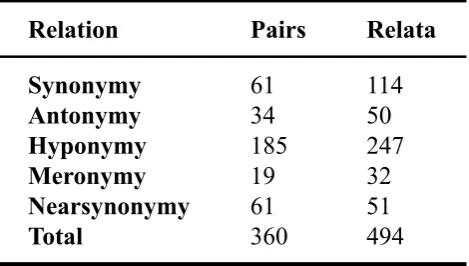
Table 1: Numbers of Checking results
Relation
Pairs
Relata
Synonymy
61
114
Antonymy
34
50
Hyponymy
185
247
Meronymy
19
32
Nearsynonymy
61
51
Total
360
494
‘don’t agree’and‘totally disagree’. Ten linguistics Ph.D. stu-dents (5 for each list of statements) were asked to rate the statements according to the abovementioned criterion. We also added‘don’t know X’and‘don’t know Y’tags in case a rater was not familiar with a given word.
Only pairs that had at least three positive ratings (“totally agree”, and“agree”) were included into the positive results. The rest were labeled as negative results. The results of the rating procedure revealed that of the initial 492 word pairs there were 360 positive word pairs and 132 negative pairs. Table 1 details the number of positive pairs and relata per relation type. Note that the number of relata (494) is the to-tal number across all relation types. After extracting all the words in the positive pairs (hence, the relata and relatum), and filtering out repeated words, we arrived at 376 relata from the 360 positive word pairs.
3.3.
Semantic Tagging
As a further step in describing the dataset, we identified the semantic type information of the positive pairs. For the 376 relata, their total frequency and PoS distribution were calculated in a combined corpus that included Sinica Corpus (Huang et al., 2004) and Chinese GigaWord (Huang et al., 2010).
An additional three Ph.D. students were then asked to tag these relata according to their semantic types:
1. Basic/Subordinate/Superordinate:研討會(yantaohui, seminar) can be tagged as ”Basic” while會議(huiyi, meeting) can be tagged as ”Superodinate”;
2. General/Specific:台北(Taipei, Taipei) can be tagged as ”Specific” while城市(chengshi, city) can be tagged as ”General”;
3. Abstract/Concrete:玫瑰(meigui, rose) can be tagged as ”Concrete” while概念(gainian, concept) can be tagged as ”Abstract”;
4. Event/Action/Time/Space/Object/Animal
/Plant/Food/Color/People/Attribute: such as 轉變成 (zhuanbiancheng, transform into) can be tagged as ”Action”.
set of semantically tagged relata at 373. Meanwhile, fre-quency information was calculated in a combined corpus of Chen et al. (1996) and Hong and Huang (2006).
4.
Conclusion and Future Work
EVALution-MAN is a dataset of Mandarin word relation pairs in Traditional Chinese for training and evaluation of DSMs or other applications. It has been manually rated ac-cording to relation pairs, and tagged for semantic type by native Mandarin speakers. It is freely available online at ”https://github.com/LHongchao/EVALution_MAN”. Fu-ture work will focus on extending the number of manu-ally tagged relation pairs through extracting existing pairs through other ontology resources and/or through the use of behavioral methods that elicit semantic types of given words. A second goal of future work will be to provide a dataset for Mandarin in simplified Chinese.
5.
Acknowledgements
This work is partially funded by the Hong Kong PhD Fel-lowship Scheme for Enrico Santus under PF12-13656.
6.
Bibliographical References
Agirre, E., Alfonseca, E., Hall, K., Kravalova, J., Paşca, M., and Soroa, A. (2009). A study on similarity and related-ness using distributional and wordnet-based approaches. InProceedings of Human Language Technologies: The 2009 Annual Conference of the North American Chapter of the Association for Computational Linguistics, pages 19–27. Association for Computational Linguistics. Benotto, G. (2015). Distributional models for semantic
re-lations: A sudy on hyponymy and antonymy.
Chen, K.-J., Huang, C.-R., Chang, L.-P., and Hsu, H.-L. (1996). Sinica corpus: Design methodology for balanced corpora. Language, 167:176.
Fellbaum, C. (1998).WordNet. Wiley Online Library. Girju, R., Badulescu, A., and Moldovan, D. (2006).
Auto-matic discovery of part-whole relations. Computational Linguistics, 32(1):83–135.
Hamp, B., Feldweg, H., et al. (1997). Germanet-a lexical-semantic net for german. InProceedings of ACL work-shop Automatic Information Extraction and Building of Lexical Semantic Resources for NLP Applications, pages 9–15. Citeseer.
Harris, Z. S. (1954). Distributional structure. Word, 10(2-3):146–162.
Hill, F., Reichart, R., and Korhonen, A. (2015). Simlex-999: Evaluating semantic models with (genuine) simi-larity estimation. Computational Linguistics.
Hong, J.-F. and Huang, C.-R. (2006). Using chinese gigaword corpus and chinese word sketch in linguis-tic research. In The 20th Pacific Asia Conference on Language, Information and Computation (PACLIC-20). November, pages 1–3.
Huang, C.-R., Chang, R.-Y., and Lee, H.-P. (2004). Sinica bow (bilingual ontological wordnet): Integration of bilin-gual wordnet and sumo. InLREC.
Huang, J., Hsieh, S.-K., Hong, J.-F., Chen, Y.-Z., Su, I.-L., Chen, Y.-X., and Huang, S.-W. (2010). Chinese
wordnet: Design, implementation, and application of an infrastructure for cross-lingual knowledge processing.
Journal of Chinese Information Processing, 24(2):14– 23.
Jia, Z., He, D., Yin, H., and Li, T. (2014). Acquisition of part-whole relations based on unsupervised learning.
Journal of Southwest Jiaotong University, 49(4):590– 596.
Landauer, T. K. and Dumais, S. T. (1997). A solution to plato’s problem: The latent semantic analysis theory of acquisition, induction, and representation of knowledge.
Psychological review, 104(2):211.
Liu, Q. and Li, S. (2002). Word similarity computing based on how-net. Computational Linguistics and Chi-nese Language Processing, 7(2):59–76.
Mei, J., Zhu, Y., Gao, Y., and Yin, H. (1983). Cilin-Chinese thesaurus. Shanghai Lexicographical Publishing House. Mohammad, S., Dorr, B., and Hirst, G. (2008). Computing word-pair antonymy. InProceedings of the Conference on Empirical Methods in Natural Language Processing, pages 982–991. Association for Computational Linguis-tics.
Murphy, M. L. (2003).Semantic relations and the lexicon: antonymy, synonymy and other paradigms. Cambridge University Press.
Pantel, P. and Pennacchiotti, M. (2006). Espresso: Lever-aging generic patterns for automatically harvesting se-mantic relations. In Proceedings of the 21st Interna-tional Conference on ComputaInterna-tional Linguistics and the 44th annual meeting of the Association for Computa-tional Linguistics, pages 113–120. Association for Com-putational Linguistics.
Paradis, C., Willners, C., and Jones, S. (2009). Good and bad opposites using textual and experimental techniques to measure antonym canonicity. The Mental Lexicon, 4(3):380–429.
Santus, E., Lenci, A., Lu, Q., and Im Walde, S. S. (2014a). Chasing hypernyms in vector spaces with entropy. In
EACL, pages 38–42.
Santus, E., Lu, Q., Lenci, A., and Huang, C.-R. (2014b). Taking antonymy mask off in vector space. In Proceed-ings of PACLIC, pages 135–144.
Santus, E., Lu, Q., Lenci, A., and Huang, C. (2014c). Un-supervised antonym-synonym discrimination in vector space.
Santus, E., Yung, F., Lenci, A., and Huang, C.-R. (2015). Evalution 1.0: an evolving semantic dataset for training and evaluation of distributional semantic models. ACL-IJCNLP 2015, page 64.
Sun, S. (2014).Research on statistical word-level semantic relatedness computation. Ph.D. thesis, Harbin Institute of Technology.
Van Hage, W. R., Kolb, H., and Schreiber, G. (2006). A method for learning part-whole relations. InThe Seman-tic Web-ISWC 2006, pages 723–735. Springer.
7.
Language Resource References
Baroni, M. and Lenci, A. (2011). How we blesseddistribu-tional semantic evaluation. InProceedings of the GEMS 2011 Workshop on GEometrical Models of Natural Lan-guage Semantics, pages 1–10. Association for Computa-tional Linguistics.
Benotto, G. (2015). Distributional models for semantic re-lations: A sudy on hyponymy and antonymy.
Huang, J., Hsieh, S.-K., Hong, J.-F., Chen, Y.-Z., Su, I.-L., Chen, Y.-X., and Huang, S.-W. (2010). Chinese wordnet: Design, implementation, and application of an infrastructure for cross-lingual knowledge processing.
Journal of Chinese Information Processing, 24(2):14– 23.
Landauer, T. K. and Dumais, S. T. (1997). A solution to plato’s problem: The latent semantic analysis theory of acquisition, induction, and representation of knowledge.
Psychological review, 104(2):211.
Liu, Q. and Li, S. (2002). Word similarity computing based on how-net. Computational Linguistics and Chi-nese Language Processing, 7(2):59–76.