A Proposal for a Part-of-Speech Tagset for the Albanian Language
Besim Kabashi, Thomas Proisl
Friedrich-Alexander-Universität Erlangen-NürnbergBismarckstraße 6, 91054 Erlangen, Germany
[email protected], [email protected]
Abstract
Part-of-speech tagging is a basic step in Natural Language Processing that is often essential. Labeling the word forms of a text with fine-grained word-class information adds new value to it and can be a prerequisite for downstream processes like a dependency parser. Corpus linguists and lexicographers also benefit greatly from the improved search options that are available with tagged data.
The Albanian language has some properties that pose difficulties for the creation of a part-of-speech tagset. In this paper, we discuss those difficulties and present a proposal for a part-of-speech tagset that can adequately represent the underlying linguistic phenomena.
Keywords:Albanian; Tagset; Morphosyntactic annotation
1.
Introduction
While there is no specification from EAGLE for Albanian, there are some works about morphological annotation and tagging for the Albanian language, cf. Trommer and Kallulli (2004), Kabashi (2004), Piton et al. (2007), Piton and Lagji (2008), Hasanaj (2012), Kadriu (2013) and Kabashi (2015). In the field of computational morphology, Trommer and Kallulli’s (2004) analyzer, which can be used as a kind of tagger, seems to cover the main Albanian inflection types. Its output format follows the EAGLE guide-lines standard (Leech and Wilson, 1999), i. e. tags con-sist of sets of attribute-value pairs, and looks either like this: [ cat:n case:nom num:sg def:+ gen: fem ] or, more compact, like this:[ n nom sg +def fem ]. Alter-natively, tags can be collapsed, e. g. the two tags tags [ n nom sg -def fem ]and[ n acc sg -def fem ]can be merged into[ n nom,acc sg -def fem ]. The tagset distinguishes between 17 broad word-class labels, seven of which are reserved for subtypes of pronouns, one for the preposed article, one for sentence equivalents, one for the participle form of the verb, and the rest for the traditional parts of speech, namely nouns, verbs, adjectives, adverbs, particles, prepositions, and conjunctions.
The goal of the tool by Piton, Lagji and Përnaska (2007; 2008), is to cover the inflection of Albanian. Their analysis also allows for preposed articles, if the word forms can have them, cf. the analysis of the adjective i artë, engl.
golden:i artë,A+FLX=Adj2+ei+m+s. It is not clear how many tags the tagset has or on how many major word-classes it is based, though it seems to cover at least the ten traditional parts of speech.
The part-of-speech tagging modell for Albanian presented by Hasanaj (2012) consists of a basic tagset with 16 tags and a large tagset with 326 tags. In the basic tagset, there are three tags for delimiters, two for special cases (short forms of pronouns), one for articles, and ten for the traditional parts of speech. The large tagset encodes the word-classes, e. g. JJ[=Adj.],NN[=Noun],VB[=Verb] orPR[=Pronoun], and additional features, e. g. Number (Sg. and Pl.). A tag from the large tagset could look like this:PRDFSE, which means PR. dem[onstrative]fem[inine]pl[ural]nom[inative]. Kadriu (2013) uses a tagset of 22 tags. Her tagger covers the morphological categories of orthographic word forms
(delimited by spaces or punctuation). In contrast to the traditional ten parts of speech, she distinguishes between feminine and masculine nouns, impersonal, reflexive and transitive verbs, personal and possesive pronouns, determin-ers, excl[amation], indecl[inable] and indef[inite] elements. Kabashi’s (2015) system extends the traditional parts of speech with additional tags, like abbreviation, e. g.
d.m.th, or punctuation, e. g. ? (question mark). For some word-classes, e. g. pronouns, more fine-grained subtypes are specified and have their own tags, e. g. neve: neve+PersPron+1P+Pl+Dat. The system can also handle the preposed articles or particles that can occur with some word-classes. Some adverbs, for ex-ample, can be preceded by the particle së. Depend-ing on whether the particle is present or not, the ad-verb pari, engl. firstly/in the first place, for exam-ple, is either analysed as pari: pari+Adv or as së pari: së pari+Adv+së.1
So, apart from Piton et al. (2007), Piton and Lagji (2008) and Kabashi (2015), the other tools only cover the word forms without consideration of their articles or particles, i. e. only single graphical tokens in the sense of Cloeren (1999) and Grefenstette (1999).
Word order in Albanian is fairly free, similar to German, which means that the same word forms occuring in different positions in the sentence will often have different gram-matical and/or semantic roles. These phenomena cannot be covered by a morphological component that processes word forms in isolation, disregarding their contexts and specifically their articles or particles. Especially the highly frequent “small words” like articles, particles, prepositions etc. have mostly more then one function, some of them even more than ten, e. g.të.
It is necessary to take the context into consideration, i. e. (1) to recognise and then to label the linguistic tokens, which can consist of more than one graphical token, and (2) to account for the position of a token in a sentence, i. e. its syn-tactic function. There is a need for an Albanian tagset that can adequately represent these morphosyntactic phenomena.
1There are, of course, other possible analyses ofpari, e. g.
2.
Multi-word units
In the context of part-of-speech tagging of Albanian texts, a big challenge is the treatment of multi-word units, i. e. two or more graphical tokens that together make up a single lin-guistic token. A frequent phenomenon are multi-word units having a preposed article or particle as their first part. These preposed articles or particles can also lead to word-class changes, e. g. from adverb (gjatë, engl.long) to adjective (e gjatë, engl.long).
Before Standard Albanian was regulated in 1972, these com-binations with preposed articles or particles were written as single graphical tokens by some authors, cf. for example Kristoforidhi (1904, p. 77)2 where we can find the form ε-γjάτε
¯-α[= romanised: e-gjatë-a] that stands fore gjatë (indefinite) ore gjata(definite). The reasoning behind this way of writing the multi-word units was probably to make them easier to read, i. e. to render words that belong together (linguistic tokens) as single graphical tokens.
In written Standard Albanian, there are a lot of cases of “small words”, i. e. articles, particles, determiners etc., that are separated from the words they belong to. There are even some grammatical functions that are realized with the help of separately written particles, e. g. graduation of adjectives:
i madh, engl.big,më i madh, engl.bigger,më i madhi, engl.
the biggest, cf. section 3.2.
3.
The tagset
Traditional grammars, e. g. Leonard Newmark and Prifti (1982), Buchholz and Fiedler (1987) or Demiraj et al. (1995), give ten parts of speech for Albanian: Nouns, verbs, adjectives, adverbs, pronouns, prepositions, conjunctions, numerals, particles and interjections. Part-of-speech tagsets for use in automatic tagging are usually much more fine-grained, cf. for example Santorini (1990). In the following sections we will discuss all traditional word-classes and will propose a refined tagset.
3.1.
Nouns
Nouns have the following morphological categories:
• Case(nominative,accusative,dative,genitiveand ab-lative): The inflectional suffixes for the dative, genitive and ablative forms are identical. The distinction be-tween them can only be made from context.
• Definiteness(indefiniteanddefinite): Indefinite forms like(një) djalë, engl.(one) boy, can be distinguished from definite forms likedjali, engl.(the) boy.
• Gender(feminineandmasculine): A lot of Albanian
nouns change gender in the plural form, cf. Demiraj et al. (1995) and Fiedler (2003). The wordart/arti, engl.
an art/the art, for example, is masculine in the singular and feminine in the plural (arte/artet, engl. arts/the arts). Fiedler (2003) calls themheterogeneous nouns. This phenomenon makes checking for congruence dif-ficult without a morphological component.
2Transcribed in Albanian letters and edited 1961 in Tirana by
A. Xhuvani.
• Number(singularandplural)
There are a couple of “complex” nouns that consist of either a preceding article combined with a noun, e. g.e hëna, engl.
saturday, as ine hëna është ditë pushimi, engl. saturday is a free day, or of a preceding article combined with an article-adjective, e. g.i madhi, engl. the bigger one, as in
i madhi është më i lirë se i vogli., engl. the bigger one is cheaper than the smaller.
A tagset must be able to differentiate between single-word nouns likehënë/hëna, engl.(a) moon/(the) moon, and “com-plex” or multi-word nouns likee hënë/e hëna, engl.a mon-day/the monday. Also, nouns derived from adjectives and/or verb participles can have a preposed article, e. g. the nouni pasuri, engl. the rich, which is derived from the adjective
i pasur, engl. the rich, which is in turn derived from the participle formpasurof the verbkam, engl.have.
Similarly, the participle formpyeturof the verbpyes, engl.
ask, when preceded by the articlei, becomes the adjective
i pyeturas inPersoni i pyetur foli gjatë, engl. The asked person spoke for long. If the suffixiis added to the adjective, it will become the nouni pyeturias inI pyeturi foli gjatë, engl. The asked [person] spoke for long. If it is preceded by the particlesëinstead of the articlei, it will become the adverbsë pyeturias inNë fund ai s’mbaroi së pyeturi, engl.
In the end he did’t stop asking.
Depending on the morphological analysis component or the morphological resource, processingheterogeneous nouns, e. g. lemmatising them or generating word forms from lem-mata, can be problematic. For this reason, there is an extra tag for them.
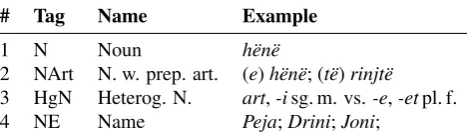
In the tagset we do not mark number (singular/plural), gen-der (masculine/feminine), definiteness (definite/indefinite) or case because the goal is not to include a full morpho-logical analysis of nouns but rather to mark those pieces of information that cannot be retrieved using a morphology component or morphological resource.
# Tag Name Example
1 N Noun hënë
2 NArt N. w. prep. art. (e)hënë; (të)rinjtë
[image:2.595.305.539.521.590.2]3 HgN Heterog. N. art,-isg. m. vs.-e,-etpl. f. 4 NE Name Peja;Drini;Joni;
Table 1: The proposed noun tags
As an example, consider the sentenceTë rinjtë janë nga Peja., engl. The youths are from Peja., which is anal-ysed asTë\Artrinjtë\NArtjanë\Vnga\PrepPeja\NE
.\Punct
3.2.
Adjectives
Apart from a few exceptional cases, adjectives have the same morphological categories as nouns. In addition, they have the following properties:
Some adjectives have a preposed article, others do not. Both need to be congruent to the noun they modify. This is marked in the inflectional suffixes and in the preposed article. There are also a few noninflected adjectives, e. g.blu, engl.blue.
• Graduation: Adjectives in Albanian have three grades,
positive,comparative, andsuperlative. Graduation is realized as a combination of the base word with the comparative particlemë, e. g. positivei mirëengl.good, comparativemë i mirëand superlativemë i miri. This particle has its own tag, cf. Section 3.10.
We propose five tags for describing adjectives in Albanian. There are separate tags for adjectives that occur before nouns, for adjectives with preposed articles, and for non-inflectional adjectives.
# Tag Name Example
5 Adj Adjective [djali]trim
6 PPAdj Preposed adj. trimi[djalë] 7 AdjPPArt Adj. w. art. [djali]i mirë
[image:3.595.305.541.142.294.2]8 PPAdjPPArt PPAdj. w. art. i miri[djalë] 9 AdjNIf Noninfl. adj. blu/neto
Table 2: The proposed adjective tags
The sentenceAta studiojnë artet e bukura në Akademinë e Arteve., engl. They study fine arts at the College of Arts., for example, is tagged as Ata\Pron studiojnë\V
artet\HgNe\Artbukura\AdjPPArtnë\Prep Akadem-inë\Ne\ArtArteve\N.\Punct.
3.3.
Numerals
Numerals in Albanian are subclassified in cardinal and ordi-nal numbers. Ordiordi-nal numbers have the same properties as adjectives, except graduation, and are always preceded by an article.
# Tag Name Example
10 NumC Cardinal number dy[fitore] 11 NumO Ordinal number [fitorja]e dytë
Table 3: The proposed numeral tags
As an example, consider the sentence Sot ishte fitorja e dytë e tij brenda një jave., engl. This was his sec-ond victory within one week., that is tagged as Sot\Adv
ishte\V fitorja\N e\Art dytë\NumO e\Art tij\PossP
brenda\Prepnjë\NumCjave\N.\Punc.
3.4.
Pronouns
Pronouns can be classified into subtypes according to their specificity. An interrogative pronoun or a personal pronoun is different from a relative pronoun.
We have an extra tag for each commonly distinguished type of pronouns. Similar to nouns or adjectives, some pronouns can be preceded by a preposed article. This can, for example, turn the interrogative pronouncili, engl. who/whichinto the
relative pronouni cili, engl. who/which. For this reason, article and pronoun need to be treated together.
Table 4 lists all proposed tags that decribe pronouns. As can be seen, there are four types of pronouns that are preceded by an article.
# Tag Name Example
12 PersP Personal pron. ti
13 DemP Demonstr. pron. ky/këta
14 DemPPPArt DemPron w. art. i tillë
15 PossP Possesive pron. im
16 PossPPPArt PossP w. prep. art. i tij/të vetën
17 IntP Interrogative pron. kush
18 IntPPPArt IntP w. art. i kujt/i cilit
19 RelP Relative pronoun që
20 RelPPPArt RelP w. art. i cili
21 IndefP Indefinite pron. dikush
22 ReflP Reflexive pron. (me)vete
Table 4: The proposed pronoun tags
3.5.
Verbs
Verbs have the greatest number of grammatical categories, cf. Leonard Newmark and Prifti (1982). They are as follows:
• person(1st,2nd,3rd)
• number(singularandplural)
• voice(activeandnon-active, i. e.passive,middle, re-flexiveorreciprocal)
• mood(indicative,subjunctive,optative,admirativeand
imperative)
• tense(present,past andfuture)
• aspect(common,perfect,progresive,inchorative, defi-niteandimperfect)
• finiteness(finiteandnon-finite, i. e.infinitive, partici-ple,gerundiveandabsolutive)
We will not go into further detail here and will only briefly discuss some properties that are important in the context of constructing a tagset, namely those forms that combine with particles liketëordo, cf. also Section 3.10.
• In the passive voice, in some cases, verbs are preceded by the articleu. This must be treated as an extra form, having its own tag(s).
• In Albanian, the verbal complex can also include pronominal clitics. The passive particle can be com-bined with these pronominal clitics, e. g.u+e→ua. This must also be treated as an extra form, with sep-arate tag(s). Some of these combinations are written with an apostrophe, e. g.m’u.
[image:3.595.53.287.280.363.2]Here are some examples:
In the sentenceLibri u botua., engl.The book is pub-lished., the verbal complex will be taggedu\PassP
botua\VpP.
In the sentenceAi do ta blejë librin., engl.He will bay the book., the verbal complex will be taggeddo\FutP
ta blejë\VSubjPPCl.
In the sentenceAi nuk do të na i kthejë neve librat sot., engl. He will not give back us the books today., the verbal complex including the negation particle will be tagged nuk\NegP do\FutPtë\SubjP na\PCl
i\PCl2kthejë\VSubjPPCl.
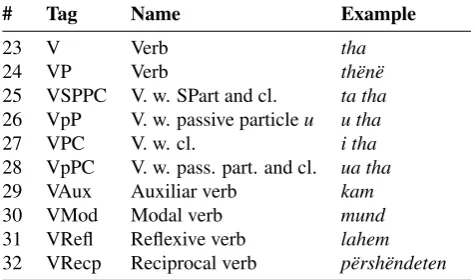
Furthemore we differentiate between auxiliar, modal, reflex-ive and reciprocal verbs as well as the participle form.
# Tag Name Example
23 V Verb tha
24 VP Verb thënë
25 VSPPC V. w. SPart and cl. ta tha
26 VpP V. w. passive particleu u tha
27 VPC V. w. cl. i tha
28 VpPC V. w. pass. part. and cl. ua tha
29 VAux Auxiliar verb kam
30 VMod Modal verb mund
31 VRefl Reflexive verb lahem
32 VRecp Reciprocal verb përshëndeten
Table 5: The proposed verb tags
3.6.
Adverbs
Some adverbs, like members of other word-classes men-tioned above, can occur with a preceding article, e. g.së voni, engl.last/late. There are also adverbs that consist of multiple graphical tokens, e. g.kohë pas kohe, engl. from time to time. All the individual graphical tokens of such multi-word adverbs will be tagged as parts of a multi-part adverb, e. g.kohë\AdvMPpas\AdvMPkohe\AdvMP. The graphical tokens that make up the adverb are adjacent, there-fore this approach is sufficient to infer that a sequence of AdvMP tags consitutes a single multi-word adverb.
# Tag Name Example
33 Adv Adverb mirë
34 AdvA Adverb w. prep. part. së shpejti
[image:4.595.303.540.103.174.2]35 AdvMP Multi-token Adverb kohë pas kohe
Table 6: The proposed adverb tags
3.7.
Conjunctions
In addition to coordinating and subordinating conjunctions, there are some two-part conjunctions where the two parts are in a non-contact position in the sentence, e. g.aq . . . sa
as inaq mirë sa ne u befasuam, engl.so good that we were suprised. In order to be able to identify those tokens as being
parts of a multi-word unit, we introduce separate tags for the first and the second part of such two-part conjunctions.
# Tag Name Example
36 CConj Coordinating conj. dhe
37 SConj Subordinating conj. që
38 ConjP1 Conj. part one edhe[P1]. . . edhe . . .
39 ConjP2 Conj. part two edhe . . . edhe[P2]. . .
Table 7: The proposed conjunction tags
3.8.
Prepositions
The members of this word-class could be subcategorized ac-cording to their grammatical and semantic roles, potentially benefitting downstream processes like parsers. However, we decided not to make any further distinctions as these are not always clear-cut.
# Tag Name Example
40 Prep Preposition me;pa;nga;për;
Table 8: The proposed preposition tag
3.9.
Interjections
Interjections are not inflected in Albanian. Since it is a closed word-class, its members can be listed in a lexicon.
# Tag Name Example
[image:4.595.51.289.285.425.2]41 Intj Interjection o;hm;uh;ii;
Table 9: The proposed interjection tag
3.10.
Particles
Some particles influence not only one or two words (local influence), but the whole sentence (global or sentence-level influence), e. g. negation particles likenuk, engl.not. The negation particles’occurs in amalgamated form with the word which it belongs to, e. g.s’punon, engl.it doesn’t work
as opposed topunon, engl.it works.
Negation in Albanian can be realized as double negation, as innuk fiton dotors’fiton dot, engl.he can not win (in any way). Compare this to simple negation:nuk fitonors’fiton, engl.he can not win. In contrast to words likeassesi, engl.
no way, which are adverbs and can replacedot, we propose to tag the latter asNegPartD because it is a semantically unspecified general negation in the role of double negation. In cases wheredotdoes not act as double negation marker, e. g. inE bën dot këtë punë?, engl.Can you really (= dot) do this job?, it will be tagged as an adverb.
The particledohas a separate status because it occurs in the verbal complex for building a future tense. We also propose a separate tag for the particlepoin its function as aspect marker, e. g.ai po punon, engl.he is workingvs.ai punon, engl.he works.3
3Pocannot only be an aspect marker but has several meanings
# Tag Name Example
42 Part Particle ja
43 AdjComPart Comp. part. më[i mirë]
44 FutP Future part. do
45 NegP Neg. part. nuk/mos/jo
46 ProhP Prohib. part. mos
47 NegPartS Neg. part.s’ s’[punon] 48 NegPartD Neg. part.dot [s’/nuk . . .]dot
49 SubjP Subj. part.të të
50 JusP Juss. part.le le
51 InfP Infin. part.për për
52 GerP Gerund. part.duke duke[punuar]
53 PartPa Part.pa pa[punuar]
54 QPA Question part. A/a A[punon]?
[image:5.595.51.289.69.284.2]55 CondP Cond. part.në/po në/po. . . 56 PartPCl Particle and clitic m’u[i. e.më+u] 57 Asp Progress. part.po po[lexon]
Table 10: The proposed particle tags
The “small words” are a challenge for the tagging process, because there is a lot of overlap and ambiguity both within the closed classes and between some function words and word forms from other word-classes. Here are some exam-ples for such syncretisms:
The word-formdois either a particle (FutP) or a form of the verbdua, engl. to wish(V);eis either a conjunction (CConj) or an article (Art).
The particlemoscan occur in the verbal complex as a nega-tion particle (NegP), e. g.për të mos thënë, engl.not to say, or it can be a prohibitive particle (ProhP) as inMos ecni shpejt!, engl.Do not walk so fast!
The word-formdukecan occur in the verbal complex as a gerundive particle (GerP), e. g.duke punuar, engl.(while) working, or it can be a finite passive form of the verbdukem
(VpP) as inU duke bukur!, engl.You looked beautiful!
The particlepërcan occur in the verbal complex, with the subjunctive particletë(SubjP) to constract an infinitive of an verb, e. g.për të thënë, engl.to sayas inNe kemi për të thënë diçka., engl.We will say something.
The particlelecan either occur with the subjunctive particle
të(SubjP) to construct the jussive mood of a verb, e. g.le të vrapojmë, engl.let’s walk.Lecan also occur as a finite form of the verblë(V) as inTi le librat atje., engl.You have left the books there.
3.11.
Articles and clitics
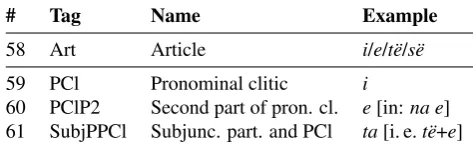
Preposed articles have their own tag,Art. This tag is used for all preposed articles of nouns, adjectives and pronouns. Similar to two-part conjunctions there are also pairs of clitics. However, the clitics that can make up the first part of a pair can also occur on their own. Therefore, we have separate tags for clitics that occur on their own or as the first part of a pair (PCl, e. g.Ai i\PClktheu librat., engl. He gave back the books.) and clitics that occur as the second part of a pair (PClP2, e. g.Ai na\PCli\PCl2ktheu neve librat., engl.
He gave us back the books.).
The tagSubjPPCl is used for words that are a blend of a subjunctive particle and a pronominal clitic, e. g. the word
te that is a blend of tëand e. As an example, consider the sentence Ai do ta lexojë librin., engl. He will read the book.. Here, the verbal complex is tagged do\FutP
ta\SubjPPCllexojë\VSubjPPCl.
# Tag Name Example
58 Art Article i/e/të/së
59 PCl Pronominal clitic i
[image:5.595.52.288.70.284.2]60 PClP2 Second part of pron. cl. e[in:na e] 61 SubjPPCl Subjunc. part. and PCl ta[i. e.të+e]
Table 11: The proposed article and clitic tags
3.12.
Abbreviations
All abbreviations are tagged with the tagAbbr.
# Tag Name Example
62 Abbr Abbreviation d.m.th.;etj.;km.;TVSH
Table 12: The proposed abbreviation tag
3.13.
Foreign words
Foreign words are to be marked with the symbolFW. Usu-ally, these are words which cannot be recognized by a mor-phology component or looked up in a lexical or morphologi-cal resource.
# Tag Name Example
63 FW Foreign word / Non-Alb. web
Table 13: The proposed tag for foreign words
3.14.
Punctuation
We distinguish between two groups of punctuation marks: (1) potentially sentence-ending punctuation like periods or exclamation marks, and (2) other punctuation.
# Tag Name Example
64 Punct Punctuation basic . ? !
65 Punct2 Punctuation extended , : ; - – . . .
Table 14: The proposed punctuation tags
3.15.
Non-linguistic elements
Non-linguistic elements like§or%also have their own tag. Usually, these are various kinds of symbols likeA+.
# Tag Name Example
66 NLE Non-linguistic element ·§ % . . .
[image:5.595.302.539.130.204.2] [image:5.595.305.540.289.321.2]3.16.
Emoticons
Emoticons are used in a wide variety of texts, e. g. e-mails or chats, to represent, for example, laughter, irony, or other emotions. We put all of them in one group and tag them as
EM. The primary goal is to separate those entities from the rest of text.
# Tag Name Example
67 EM Emoticon :-)
Table 16: The proposed emoticon tag
4.
Evaluation corpus
We are currently in the process of manually annotating a sample of approximately 2 000 sentences. Half of those sen-tences have been selected randomly from texts of different genres, the other half has been selected manually in order to allow for a wider variety of linguistic phenomena in the sample corpus.
Since the corpus has not been completely tagged, yet, the tagset might still be slightly revised or refined during the tagging process. Once the sample corpus is completely annotated, we will perform evaluation experiments with automatic part-of-speech taggers.
5.
Conclusions and future work
With regard to the morphological complexity of its inflec-tional system, Albanian is comparable to German. The tagset presented here consists of 67 tags and aims to ad-equately represent the morphosyntactic properties of the Albanian language. In particular, combinations of preposed articles or particles with words of other word-classes are treated in a linguistically sensible way. This should also benefit downstream processes like chunkers or parsers. A number of morphological properties of certain word-classes are not accounted for by the tagset, e. g. gender (nouns) or number (nouns, verbs). Those properties were left out on purpose, (1) because they would have dramati-cally increased that tagset, and (2) because they are readily available from morphological analyzers like Trommer and Kallulli (2004), Piton and Lagji (2008) or Kabashi (2015). We would like to stress once more that the evaluation corpus has not been fully annotated, yet, so the tagset presented here might still undergo some minor changes. We would also like to note that this tagset could also be extended to a larger version which further subclassifies adverbs, particles, prepositions and conjunctions.
Once the annotation of the sample corpus is completed, we will leverage automatic part-of-speech taggers and semi-automatically annotate a larger corpus of Albanian texts. That larger corpus might then be used to train reasonably good tagger models to allow for fully automatic tagging. Morphosyntactic part-of-speech tagging is an important building block of NLP tool chains and we hope that the tagset presented here will be useful in developing tools for more sophisticated analyses like syntactic parsers for Alba-nian.
6.
Bibliographical References
Buchholz, O. and Fiedler, W. (1987). Albanische Gram-matik. VEB Verlag Enzyklopädie, Leipzig.
Cloeren, J. (1999). Tagsets. In van Halteren (1999), pages 37–54.
Demiraj, Sh., Agalliu, F., Agoni, E., Dhrimo, A., Hysa, E., Lafe, E., and Likaj, E. (1995).Morfologjia, volume 1 of
Gramatika e Gjuhes Shqipe. Akademia e Shkencave e Republikës së Shqipërisë, Tiranë.
Fiedler, W. (2003). Albanisch. In Thorsten Roelcke, editor,
Variationstypologie / Variation Typology, pages 749–797. de Gruyter.
Grefenstette, G. (1999). Tokenization. In van Halteren (1999), pages 117–133.
van Halteren, H., editor. (1999). Syntactic Wordclass Tag-ging. Kluwer Academic Publishers, Dordrecht.
Hasanaj, B. (2012). A Part of Speech Tagging Model for Albanian. Lambert Academic Publishing, Saarbrücken. Kabashi, B. (2004). Analiza automatike e fjalëformave
të gjuhës shqipe. In Seminari XXIII Nërkombëtar për Gjuhën, Letërsinë dhe Kulturën Shqiptare, pages 129– 135. Universiti i Prishtinës, Prishtinë.
Kabashi, B. (2015). Automatische Verarbeitung der Mor-phologie des Albanischen. FAU University Press, Erlan-gen.
Kadriu, A. (2013). NLTK tagger for Albanian using itera-tive approach. InProceedings of the 35th International Conference on Information Technology Interfaces (ITI). Kristoforidhi, K. (1904). Λεξικόν της Αλβανικής
Γλώσ-σης(Fjalor shqip-greqisht; Albanian-Greek Dictionary). Sakellarios, Athens.
Leech, G. and Wilson, A. (1999). Standards for tagsets. In van Halteren (1999), pages 55–80.
Leonard Newmark, P. H. and Prifti, P. (1982). Standard Albanian – A Reference Grammar for Students. Stanford University Press, Stanford, CA.
Piton, O. and Lagji, K. (2008). Morphological study of Albanian words, and processing with NooJ. In Xavier Blanco et al., editors, Proceedings of the 2007 Inter-national NooJ Conference, pages 189–205. Cambridge Scholars Publishing.
Piton, O., Lagji, K., and Përnaska, R. (2007). Electronic dictionaries and transducers for automatic processing of the Albanian language. In Zoubida Kedad, et al., editors,
Proceedings of the 12th International Conference on Ap-plications of Natural Language to Information Systems, NLDB 2007, pages 407–413. Springer, Berlin, Heidel-berg.
Santorini, B. (1990). Part-of-speech tagging guidelines for the Penn Treebank Project.