R E S E A R C H
Open Access
Eigenvector-based initial ranging process for
OFDMA uplink systems
Sungeun Lee
*and Xiaoli Ma
Abstract
At the contention-based synchronization, e.g., initial ranging process, it is crucial to identify multiple users through ranging codes and estimate the corresponding parameters such as timing offset and frequency offset. This paper presents an improved parameter estimation and pairing algorithm for initial ranging process in orthogonal frequency-division multiple access (OFDMA) uplink systems by exploiting multidimensional harmonic retrieval (HR) technique. Unlike most existing techniques that estimate each parameters independently and associate the ranging codes with the estimated parameters manually, the proposed method estimates multiple user’s ranging code, timing and frequency offsets simultaneously, and pair up all the multiple parameters automatically. The simulation results confirm that the proposed technique not only improves the ranging code detection capability and adjusts the acquisition range of the estimators but also increases the maximum number of resolvable users for given samples.
Keywords: Initial ranging; Synchronization; Contention; OFDMA; Eigenvector; Harmonic retrieval; Random access; Uplink; Identifiability
1 Introduction
In general orthogonal frequency-division multiple access (OFDMA) uplink systems, to maintain the orthogonal-ity among multiple users, the signals from all active users should arrive at the base station (BS) synchronously [1]. In order to align the signals of multiple users, contention-based random access procedure, called as initial ranging process, should be performed in the beginning in order to identify multiple users as well as to estimate the corre-sponding timing and/or frequency offsets for the adjust-ment/alignment [2,3]. So, code identification as well as multiuser timing estimation are the main tasks of the BS in contention-based synchronization processes.
On the contention-based synchronization process, the same time/frequency resources are shared by multiple users, so the multiple access interference (MAI) limits the performance of ranging detectors. Consequently, it is essential to deal with MAI of ranging subscriber stations (RSSs) to achieve the reliable initial ranging performance. In the beginning, the existing ranging detection meth-ods simply treat the MAI as noise, which results in
*Correspondence: [email protected]
School of Electrical and Computer Engineering, Georgia Institute of Technology, 777 Atlantic Drive NW, Atlanta, GA 30332-0250, USA
the performance degradation as the number of RSSs increases due to the limitation by the amount of MAI [4-6]. To decrease the effect of the accumulated MAI on the ranging process, Ruan et al. [7] proposed a succes-sive multiuser detection (SMUD) algorithm which detects the channel paths of active ranging signals and can-cels their interference for further detection. In order to alleviate the high computational complexity of SMUD, the low-complexity method is proposed in [8], and in order to increase the resilience to MAI, a generalized likelihood ratio test (GLRT) approach is also exploited to derive a two-stage interference cancellation scheme [9]. However, it is shown that still SMUD and interfer-ence cancellation-based methods are vulnerable for MAI, and the code detection and parameter estimation perfor-mance are severely degraded as the number of active RSSs increases due to accumulated residual MAI [10].
In order to reduce the chance undergoing severe amount of MAI and exploiting the frequency selectivity of the fading channels, subchannel-based frame structure is proposed which allocate a smaller number of subcarriers to each ranging opportunity so that most of the RSSs are expected to transmit on disjoint sets of subcarriers with alleviated interference to each other [11-15].
With the improved parameter estimation capability, subspace decomposition-based approaches are exploited to accommodate the detection of multiple RSSs simulta-neously [14,15]. However, in order to achieve the code detection and parameter estimation at the same time, the allowable parameter estimation range is strictly limited. In order to bind the detected ranging codes with the esti-mated timing or frequency offsets, the methods either sacrifice the estimation performance by inserting the code sequence in the estimated parameters [14] or perform exhaustive full search by correlating all sets of ranging codes and offsets at the BS [11,15]. Bacci et al. introduced a game-theoretic approach to derive an energy-efficient method for contention-based synchronization problem [16]. The ranging process is formulated as a noncooper-ative game for each terminal to determine the transmit power and detection strategy in a selfish way to maxi-mize the detection probability with the minimum energy consumption.
The topic of multidimensional harmonic retrieval (HR) problems are encountered in a variety of signal process-ing applications includprocess-ing radar, sonar, seismology, com-munications, MIMO wireless channel, and the different types of schemes are utilized for the application [17-21]. Among these, principal-singular-vector utilization for modal analysis (PUMA) is used as the computationally attractive solution in HR [17]; however, it may not work properly when there are identical frequencies in one or more dimensions. On the other hand, the improved mul-tidimensional folding (IMDF) scheme, which uses eigen-vector instead of eigenvalue for estimating frequencies, can resolve identical frequency scenarios by introducing the randomness on the sample data [18,19]. These IMDF algorithms introduced more relaxed identifiability bound, i.e., increased number of resolvable frequencies for the given sample data [19]. In order to improve the perfor-mance, the approaches with the use of higher-order sin-gular value decomposition (HOSVD) and/or structured least squares technique are introduced in [20,21]. Instead of using stacking matrix form, the HOSVD method cap-tured the structure inherent in the received data at the expense of a high computational complexity [20,21]. It was shown in [20] that the general computational complexity of the tensor-based approach (HOSVD) is higher than that of the matrix based one (IMDF) even with the computationally efficient subspace estimation methods.
In order to improve the ranging process performance as well as to incorporate the superiority of HR technique with reasonable complexity, the preliminary design utiliz-ing IMDF approach was first introduced in [22]. However, since the single snapshot IMDF approach [18] is simply exploited in [22], the automatic pairing property and mul-tiple resource element utilization were not fully exploited
in [22], which results in the limited number of resolvable RSSs as well as the limited detection and estimation per-formance improvement without proper two-dimensional code design.
Since the multiple snapshot approach is quite well aligned with the inherent OFDMA subchannel allocation concept, we propose an improved ranging technique using IMDF with finite snapshots [19] for the initial ranging process. It enables for all the detected ranging codes, the estimated timing offsets and frequency offsets of multi-ple users to be automatically paired, so extra ranging code and offset association process, which usually requires high computational complexity, can be avoided.
Even though our approach is based on the IMDF algo-rithm, but it is not a trivial application of the IMDF algorithm to the ranging process. On the top of the IMDF methodology, our novel contribution is twofold.
First, we properly formulate initial ranging signals into finite snapshots such that automatic pairing property can be fully exploited during the procedure, which brings the improved performance as well as the reduced pairing complexity. Moreover, the maximum number of resolv-able RSSs that the BS can distinguish can be also increased by applying multidimensional folding (MDF) algorithm.
Next, with the virtue of the automatic paring prop-erty, two-dimensional ranging code is newly proposed. The new code index pair design, ranging code extrac-tion and detecextrac-tion procedure, decision boundary for the circular code index pair, and redefined detection events using the code index pair withmultisettheory are intro-duced. According to the new code index pair concept, the enlarged timing and/or frequency offset acquisition range is also derived.
The rest of this paper is organized as follows: Section 2 explains an OFDMA uplink system model in a contention-based synchronization (initial ranging) process. Section 3 explains the proposed harmonic retrieval algorithm with multidimensional folding for extracting the code, timing offset, and frequency offset of active RSSs. In addition, the proposed two-dimensional code design and code detec-tion/evaluation methodology is described. In Section 4, the statistical characteristics of the proposed algorithm, which utilizes IMDF method, is derived to show the iden-tifiability for the number of resolvable RSSs and to con-firm the acquisition range of the proposed algorithms on the timing offset and frequency offset. Section 5 evaluates the performance of the proposed method and investigates the comparison with the existing algorithms. Section 6 presents our conclusion.
(column-wise Kronecker) product [23], In for a n × n identify matrix,0m×nfor anm×nzero matrix, [a]nfor thenth ele-ment ofa, and [A]m,nfor the(m,n)th element ofA,D(a) for a diagonal matrix withaas its diagonal.
2 System model
2.1 Ranging process overview
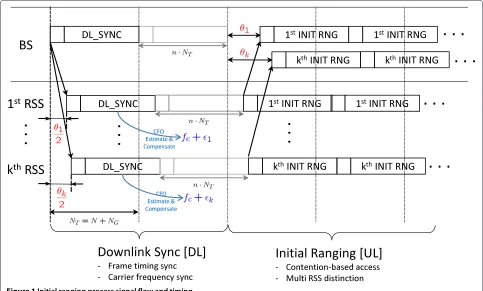
Figure 1 shows the brief signal flow on the initial rang-ing process. First of all, each RSS catches the downlink synchronization signal to detect its relative frame tim-ing position and to estimate its absolute carrier frequency offset. Since every RSS can compare and compensate its frequency to the reference one from the BS, the coarse frequency synchronization can be completed before the initial ranging trial is started. Therefore, the residual fre-quency offset error due to the imperfect estimation is only remained for each RSS as shown in Figure 1.
On the other hand, the absolute frame timing of BS is unknown to each RSS since the propagation delay is unknown to each RSS (refer Figure 1). Therefore, each RSS only estimates its relative downlink frame timing position at first. Next, each RSS transmits its own initial ranging sequence, which is locked on the estimated frame tim-ing, to the BS with the network access request. Once BS receives the sequences from multiple RSSs, the BS should identify multiple RSSs and estimate every RSS’s timing off-set and residual frequency offoff-set independently. Finally, from the given estimate, the BS provides the timing and
frequency feedback info to the identified RSSs with the network grant message. Consequently, it is crucial on the initial ranging process for BS to identify as many as RSSs and to estimate their timing and frequency offsets as accurate as possible.
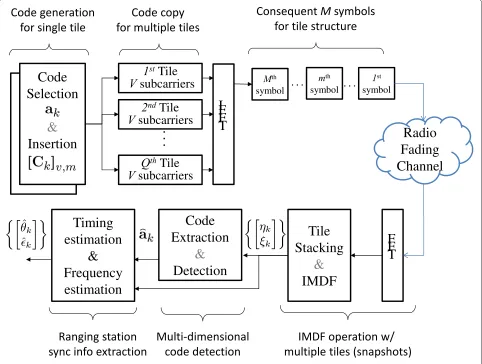
The whole transceiver block diagram of the ranging pro-cess is shown in Figure 2, and the detailed procedure on how to construct the ranging sequence with the code and to perform the code detection and timing/frequency estimation is described in the following.
2.2 Resource allocation for ranging process
Let us consider an OFDMA uplink system employingN
subcarriers. Among the whole subcarriers, virtual subcar-riers are placed at both edges of the spectrum to prevent the spectrum aliasing. Except the virtual subcarriers, the useful subcarriers are grouped by multiple subchannels, and these subchannels are assigned to multiple users (sub-scribers) for transmission. Typically, each subchannel is divided intoQsubbands composed of a set ofV adjacent subcarriers [14,15,24]. When one transmission block con-sists ofMconsecutive OFDMA symbols, let us define a bunch of consecutiveVsubcarriers (one subband) andM
OFDMA symbols as atile.
Now, among multiple subchannels, let us assume that each RSS only uses a set of R subchannels for ranging withMconsecutive OFDMA symbols, and then the total number of subcarriers used for ranging isNR=RQV.
Figure 2Transceiver block diagram of the initial ranging process.
After the fast Fourier transform (FFT) at the receiver, the received data at theqth tile of the ranging subchannel is written as:
Xqv,m= K
k=1
[Ck]v,mHk
iq+v−1
e−j2Nπ(iq+v−1)θke j2πNT
N (m−1)k
+ Wqv,m,
(1)
with∀q∈[1,Q] ,∀v∈[1,V] ,∀m∈[1,M]. In (1),Kis the number of active RSSs participating the ranging process, andvandmdenote the subcarrier and OFDMA symbol index within the tile, respectively.Hk[x] ,x∈[0,N−1] is the channel frequency response of thekth RSS on thexth subcarrier position.
Since there is no big frequency offset difference between stations after the coarse frequency offset synchronization, the inter-carrier-interference (ICI) term caused by the residual frequency offset is ignored for the simplicity in (1) whereas the accumulated phase rotation term caused by frequency offset is still included.
In (1), the length of one OFDMA symbol isNT = N+
NGwithNGguard interval for ranging symbols, andiqis the starting subcarrier index for theqth tile, andθk and
kdenote the timing and frequency offsets of thekth RSS, respectively.Wq
v,mis a complex additive white Gaussian noise (AWGN) with zero mean and varianceσw2.Ckis the code sequence matrix for thekth RSS.
Here, let us assume that θk ∈ [0,θmax] and k ∈ [−max,max] whereθmaxandmaxare defined as the max-imum allowable timing offset and and absolute frequency offset of the system, respectively.
2.3 Code design
Let us design the code sequence for thekth RSS user as:
[Ck]v,m=ej2πv·tk/CTej2πm·fk/CF. (2)
define ak = [tk fk]T as a two-tuple for the code index pair of thekth user wheretk ∈ [0,CT)is the code index at the timing offset domain and fk ∈ [0,CF) is the one at the frequency offset domain, respectively. The tuple ak is chosen from the whole code index pair set A, i.e., ak ∈A.
Since the subband size in one tile is designed to be smaller than the channel coherence bandwidth [14,15], Hk[x]≈ Hk[x + 1] within the tile. There-fore, by averaging V subcarriers, the received output can be expressed as an average channel response as follows:
k is the average of the phase-rotated channel response for thekth user at theqth tile written as:
absorbed into theeffectivetiming and frequency offsets as
ηk andξk, and thiseffectivetiming and frequency offsets of thekth user are given by:
3 MDF estimation using multiple tiles
In order to exploit automatic pairing property of HR, we formulate the received signal as a two-dimensional (2-D) mixture form and then apply MDF estimation method [18] for estimating timing and frequency offsets of RSSs as well as detecting RSSs codes simultaneously.
3.1 2-D mixture model
Let us recall the received symbols at theqth tile isXq ∈ CV×M. Given (3),Xqcan be written as 2-D mixture matrix form as:
Xq=TDhqFT+Wq, (6)
where T ∈ CV×K and F ∈ CM×K are the transpose of Vandermonde matrices with the common ratiosej2πηk
andej2πξk for each column to represent the timing and
frequency offsets ofKRSSs, respectively.
For simplicity, let us define the(v,m)th element of the matrixXqasxq,v,m, i.e.,xq,v,m = [Xq]v,m. Then, from the given Eq. 6, we can define the sample vector formxq ∈ CVM×1, which is: Wq. Since the received signal is formed as undamped 2-D exponentials for each tile, we can apply MDF algorithm [18] for each tile at the initial ranging process.
3.2 MDF algorithm using multiple tiles 3.2.1 Smoothing operation
As shown in (6) and (7), the observed symbols at each tile can be described as the special form of the multi-ple harmonic combinations. Based on this structure, we even applysmoothing operatorS(x)in order to fully uti-lize this special characteristics of the observed symbols and improve the estimation performance.
Let us define a set of two-dimensional selection matrices Jv2m2 ∈CV1M1×VMgiven by:
Using (7) and (8), let us definesmoothing operatorS(x) and the smoothed matrixX˙q,Sfor the sample vector as:
In the absence of noise, it is already verified in [18], Lemma 2 that (9) can be decomposed into harmonic matrices as follows:
Vandermonde matrices with the common ratiosej2πηkand ej2πξk.
For the noisy case, the perturbation analysis can be applied to derive the theoretical MSEs of one realization of timing and frequency offset estimation [19], Equations (33) to (47). However, since timing offsetθkand frequency offsetk are all unknown random variables in the rang-ing process, the theoretical performance analysis on the deterministic realization of ηk and ξk would be mean-ingless on the whole. Therefore, for the simplicity, the noiseless case is used on the derivation while the noisy case is revisited on the simulation experiment.
In (10), in order to further explore the data structure, we operate the backward smoothing as well as forward smoothing on the sample vectorxqin (7). Let us define a backward sample vectoryq = VM·x∗qwheren is an
n×nbackward permutation matrix. By using the property of harmonics, it is easily verified that:
yq=VM·(TF)∗h∗q same harmonic matrix form as (7), we can use both for-ward and backfor-ward sample vectors to estimate the phase. In the similar way like (9), Y˙q,S can be also obtained by
backward smoothing operation: ˙
Yq,S =Syq=G1D(hq˜ )GT2. (14)
3.2.2 Multiple tile combination
Let us define the forward and backward channel matrices as: uses each tile independently for the code detection and timing/frequency offset estimation, now all channel responses and signals from multiple tiles are stacked and utilized together to create just one augmented matrixX.˜
Therefore, it would be more robust for the noisy scenario due to multiple tile usage.
After calculating the smoothed matricesXq˙ ,S andYq˙ ,S
for each tile, we collect all the smoothed matrices in order to perform MDF algorithm [19]:
˜
Xis of rankKalmost surely. Therefore, the singular value decomposition (SVD) ofX˜ yields:
˜
X=UssVHs (20)
where Us has K columns that together span the col-umn space ofX. Since the same space is spanned by the˜ columns ofG1from (19), there existsK×Knonsingular matrixL−1such thatUs=G1L−1.
Uscan be partitioned into two submatricesU1andU2 (refer (46) and (47) in Appendix). Then,Lcan be obtained from the eigenvalue decomposition ofU†1U2up to column scaling and permutation ambiguity, i.e.,Lsp=Lwhere Lspis a practically obtained eigenvector including column scaling and permutation ambiguity, is a nonsingular diagonal column scaling matrix, andis a permutation matrix [18,19]. This part is maybe most computationally complex part of the whole calculation, and the major com-putational load complexity to acquireLspis calculated as
O(2ktV1M1V2M2K)[19-21].
Once we obtainLsp, we can retrieveP ∈ C(V1−1)M1×K
up to column scaling and permutation ambiguity as:
Psp=UsL=P, (21)
where αηk = ej2πηk and αξk = ej2πξk, i.e., [P]p,k =
ponents caused by timing offset and frequency offset appear in the same column of theP. In other words, for a fixedkth column,ej2πηk andej2πξkappear simultaneously
in the same column of P. Consequently, thanks to this combined structure, we can estimateKRSS’s timing offset and frequency offset at the same time by dividing suitably chosen elements of theP.
The detailed procedure on how to obtain the abovePsp andLspfromUsis described in Appendix.
3.3 Effective timing offset and frequency offset estimation
Even thoughPspcontains the column scaling ambiguity, it is immaterial for estimating the timing and frequency offset of each user. It is because the timing and frequency offset of each user is obtained by phase differential term. Therefore, the scaling effect on the matrix is diminished. In addition, each timing offset with frequency offset is even automatically paired without heavy computational search for the pairing.
The effective timing offset on the kth column can be estimated as:
and the effective timing offset from thekth column can be obtained by:
In the similar way, the effective frequency offset on the
kth column can be estimated as:
and the effective frequency offset from thekth column can be obtained by:
Note that still we have the the permutation ambigu-ity issue on the estimation, i.e., unknown . Since the user (column) identification along with timing and fre-quency estimation should be performed accordingly in the ranging process, therefore it is crucial to identify each col-umn correctly and to remove the permutation ambiguity clearly. This can be done by the proposed code extraction and code detection process.
3.4 Code extraction
Recall theeffectivetiming and frequency offsets are com-posed of the code index as well as actual timing and frequency offsets as shown in (4) and (5). Sinceηˆkandξˆk are automatically paired, the paired ranging code, timing offset, and frequency offset of thekth RSS can be detected and estimated simultaneously by using the effective tim-ing and frequency offsets.
Followed by (4) and (5), let us define the extracted code index pairbkas:
. Since the timing offsetθk only has the positive values, by introducing the biasT on the extracted code index pair, the disturbance due to timing offset can be spread out around the original code index point tk. Consequently, by observing bk, we can retrieve the code index pair(tk,fk)accordingly.
3.5 Code detection
Now, the new code detection methodology and the deci-sion boundary/criterion for the circularly repeated code index pair are introduced usingmultisettheory. In addi-tion, the code detection events are newly redefined for the multidimensional code, e.g.,phantom code,collided code,
missing code, false-alarmed code, and correctly detected codein this section.
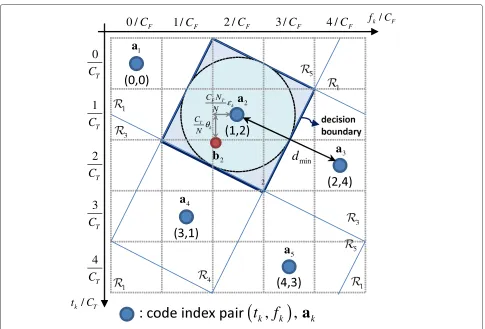
Figure 3 illustrates the example of code index pair set A, decision boundary, and decision region Rk for
CT = CF = 5. As discussed before, from the auto-matic pairing property of HR, it is possible to build up the two-dimensional code index pair.
From bk, the code index pair aˆk can be extracted as follows:
ˆ
ak=ai s.t.bk ∈Ri,∀i∈[1,|A|] , (30)
min
structure can be applied for extracting the code index pair as follows:
whereκ(k)is the detected code index for thekth received tuple (kth extracted column),Zis the set of all integers, andx22is the square of the two-norm. Once all ofKcode index pair is detected, and then, it should be investigated from the detected code index pairs whether or not it con-tains the phantom code index pair which means the index pair is duplicated more than one time.
In order to redefine the code detection events using code tuple, let us assume AT and AR as the transmit-ted and the detectransmit-ted code index pairmultisets(or bag), respectively, i.e.,ak ∈ AT andaˆk ∈ AR. In contrast to set concept, the members of the multiset are allowed to appear more than once. Here is an example to figure out the different events on the detection procedure:
AT = {a1, a1, a2, a3, a4, a5}, (33)
This illustrates the case that six active RSSs are par-ticipated on ranging process, and two of the RSSs pick up the same code index paira1 and transmit (AT), and the BS detects the six code index pairs from the received tuple (AR). The multiset indicator function of a subset of a multisetAis:
1A:x→Z+ (35)
3.5.1 Phantom code
Let us define phantom code that one code index pair is observed more than once at AR. The index set of the phantom code is defined as:
Gph=
κ(k)1AR(aˆk) >1,∀k∈[1,K]
, (37)
with κ(k) defined in (31). Since a1 anda2 are detected more than once in (34), here,Gph = {1, 2}. The phantom code can be detected at the receiver, so this code index can be opted out during the detection procedure.
3.5.2 Collided code
Collided code is defined such that one code index pair is utilized more than once at AT, which is the case when more than two RSSs choose the same code for the ranging. The index set of the collided code is defined as:
Gco= cally, it is hard to detect the collided code at the receiver side, but with the virtue of automatic pairing property in HR, if each RSS has different timing offsets and/or fre-quency offsets, it has a chance to remove this collided code as phantom code at the receiver side (like the example). Therefore, HR can avoid the false detection of the collided code effectively.
3.5.3 Missing code
Let us redefine missing code such that the transmitted code index pair is not detected at the receiver side except collided code, which is denoted as:
Gm=k1AT(ak)=1,1AT\AR(ak) >0,∀k∈[1,K]
. (39)
From the example, the missing code is shown asGm = {4, 5}.
3.5.4 False-alarmed code
False-alarmed code means that the wrong code index pair, which is never transmitted, is detected at the receiver side. There is no way to classify the false-alarmed code at the receiver, so it usually degrades the detection and estima-tion performance of the system. The false-alarmed code can be calculated as:
Gf =
3.5.5 Correctly detected code
After excluding the phantom code, all the remained codes are treated as detected codes including the false-alarmed code. However, in order for the accurate evaluation of
the code detection performance, let us newly define the correctly detected code which only counts the code truly transmitted and accurately received as:
Gd=
From the example, the correctly detected code is calcu-lated asGd= {3}.
On the whole, the index set of detected codes is described as{3}while the index multiset of misdetected codes including bothGco andGm is{1, 1, 2, 4, 5}. Finally, the index set of false-detected codes is defined as{6}. Note {1} appears twice on the misdetected multiset sinceAT already carries the two collided code.
3.6 Actual timing and frequency estimation
AmongK extracted code index pairs, the phantom code
Gph is firstly excluded, and only remaining code index pairs, aˆk∗ =
tk∗ fk∗
T
,∀κ(k∗) ∈ Gd ∪Gf, participate the actual timing and frequency estimation. So, the timing and frequency offsets are calculated only for theκ(k∗)th RSSs∀κ(k∗) ∈ Gd∪Gf. Based on (4) and (25), the esti-mated actual timing offset for theκ(k∗)th RSS from the
k∗th received tuple is given by:
ˆ
and it would be compared with θk∗ if it is successfully identified without false-alarm (k∗ ∈ Gd) and the offset is accurate estimated.
In the same way, the estimated actual frequency offset for thekth RSS is written by:
and it would be also compared withk∗if it is successfully identified without false-alarm (k∗∈Gd).
4 Statistical characteristics 4.1 Identifiability
When the estimator uses the timing offset dimension as a primary dimension, the maximum number of RSSs, which is almost surely uniquely identifiable, is derived as [19], Equation (31):
Kuid=min{(V1−1)M1, 2QV2M2}. (44)
Actually, (44) can be easily induced from (19) since the matrix size of G1 and Gˆ2 would determine the overall rank.
estimation performance can be improved as well asKuid can be increased.
4.2 Acquisition range
Basically, the transmitted code index pairak∗is twisted by the timing and frequency offsets. So, large timing and/or frequency offsets can cause the misdetection and/or false detection. Therefore, for the reliable code detection, it is essential to limit the allowable timing and/or frequency offset ranges.
In principle, once bk∗ resides on the correct decision region, i.e., bk∗ ∈ Rκ(k∗), the timing and frequency off-sets of theκ(k∗)th RSS can be successfully recovered from the k∗th received tuple, (refer Figure 3), and depending on the individualθk∗,ξk∗, andRκ(k∗), the maximum allow-able timing and frequency offset ranges, θmax andmax, can be changed. Meanwhile, from (4) and (5), the guar-anteed acquisition range not to make ambiguity at the code detection without any noise term can be derived as:
where θmax and max stand for the maximum allowable timing and frequency offsets, respectively. So, from the inequality, it is available to adjust the maximum ranges of timing offset and frequency offset accordingly by enlarg-ing one of the allowable ranges while shrinkenlarg-ing another ranges at the same time. Remark that even though the acquisition range is derived as a lower bound by tak-ing only a portion of the decision regionRin (45), the maximum allowable rangesθmaxandmaxare larger than the one introduced in MUSIC [15] and ESPRIT [14]. For example, with the same CT = CF = 5, the maximum ranges of MUSIC and ESPRIT were defined asθmax< CNT andmax < 2NNTCF while the ranges of the proposed HR
(whose range is enlarged by more than 10%) when we just treat the importance of both timing offset and fre-quency offset ranges equivalently withdmin =
√ 5 from the Figure 3.
5 Simulation results
The overall system model and simulation parameters are based on the IEEE 802.16m and 3GPP LTE environments in [2,3]. The total bandwidth is 10 MHz, andN = 1024. Let us assume that each ranging subchannel is composed ofQ =3 tiles withV = 6 consecutive subcarriers, while
M=5 OFDMA blocks are presented in ranging subchan-nels. In order to corporate with wide bandwidth, extended vehicular A (EVA) channel model is applied to evaluate the performance [25].
The timing and frequency offset ranges are designed for
θk ∈ [0, 114) and k ∈[−0.02, 0.02] which correspond to the system more than 1 km cell radius considering the round-trip delay, e.g., dense small cell, and 135 km/h Doppler frequency atfc=2.4 GHz. Note that all the sim-ulation results reflect the ICI caused by residual frequency offset even though it is neglected in (1) for the simplicity.
The code design parametersCTandCFare set asCT =
CF =7 for the proposed HR algorithm.
To verify the superiority of the proposed algorithm in terms of the code detection and offset estimation performance, the ranging algorithms using MUSIC [15] and ESPRIT [14] are also compared under a com-mon simulation setup. In addition, the ranging algo-rithm exploiting Zadoff-Chu sequence structure [2,26] is also compared as a reference under almost the same environment. Here, to evaluate the code detection per-formance solely, no collided code is assumed at the transmitter for all the algorithms, i.e., Gco = { } like [14,15], which means all transmitted code index pair is exclusive to each other. The overall simulation parameters and frame structure are shown in Table 1, Table 2, and Figure 4.
Table 1 Common parameters for the simulation, [2,3]
Parameters HR, MUSIC, ESPRIT Zadoff-Chu sequence
Sampling frequency 15.36 MHz 15.36 MHz
Total number of subcarriers 1,024 2,048
Number of OFDM symbols (M) 5 2
Each ranging symbol length TRPHR=75μs TRCPZC=100μs,TRPZC=133μs
Total ranging symbol length 5.675NT=425.625μs 5.5NT=412.5μs
Total number of ranging subchannels (R) 4 1
Number of tiles/ranging subchannel (Q) 3 1
Number of subcarriers/tile (V) 6 144
Total number of ranging subcarriers (RQV) 72 144
Timing offset range [0, 114] samples [0, 114] samples
Table 2 Contention-based initial ranging capability with the number of RSSs
Parameters MUSIC ESPRIT HR Zadoff-Chu sequence
Number of uniquely identifiable RSSs per subchannel,Kuid 4 4 16 N/A
Total number of uniquely identifiable RSSs,R·Kuid 16 16 64 64
Total number of code sequences for RSSs,R· |A| 16 16 28 28
Number of active RSSs per subchannel,K= |At| 3, 6 3, 6 3, 6 N/A
Total number of active RSSs,R·K 12, 24 12, 24 12, 24 12, 24
5.1 Smoothing factor decision and identifiability comparison
Let us recall that the smoothing operatorS(x)enlarges the observed data matrixXq ∈ CV×M to the smoothed data matrixX˙q,S ∈CV1M1×V2M2 by choosing appropriate
smoothing factorsV1,V2andM1,M2with the condition V1+V2 = V +1 andM1+M2 = M+1. Therefore, the size of smoothed data matrix Xq˙ ,S depends on the
smoothing factors. In fact, this smoothing factor could affect the code detection and offset estimation perfor-mance as well as the maximum number of distinguishable RSSs.
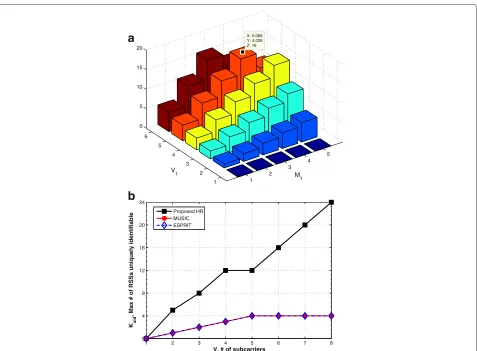
As shown in (44), Kuid is determined by (V1,V2) and (M1,M2) pair values, and Figure 5a shows the variation of thisKuidaccording toV1andM1for givenQ=3,V =6, andM=5. First, we investigated most popularly obtained number inKuiddistribution, which isKuid=12 as shown in Figure 5a. Then, from the given four cases withKuid= 12, i.e., {(V1,M1)|(4, 4),(5, 3),(6, 4),(5, 5)}, the smooth-ing factor combination which shows better performance on the whole is picked up, which is(V1,M1)=(4, 4).
In addition, Figure 5b shows the trend on the maximum number of identifiable RSSs according to the number of subcarriers for fixed number of OFDM symbolsM = 5. As seen in the figure, the maximum number of RSSs which MUSIC and/or ESPRIT can support is limited byM
even though we allocate more subcarriers for the ranging whereas the number of RSSs for HR can keep increas-ing without limitation. This addresses that the proposed HR technique can be popularly exploited on the scenarios such that high volume of users and/or devices should be separated at the same time at the dense small cell.
5.2 Misdetection probability
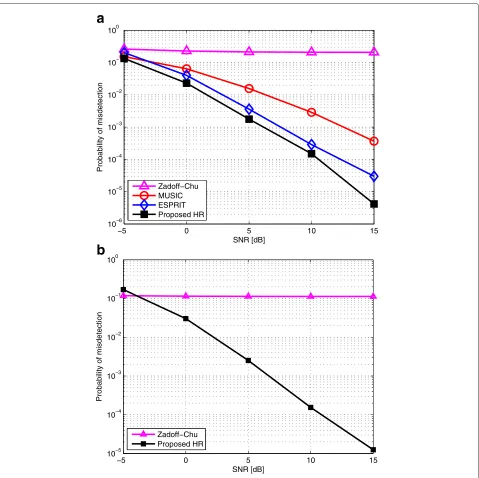
Figure 6 describes the misdetection probability for four code detection algorithms with respect to signal-to-noise ratio (SNR) with the number of active RSSsR·K = 12 and 24. The notation for each code detector and offset estimator is expressed in the Table 3.
As seen in the figures, the proposed HRCD shows good Pmiss performance. It is because automatic pair-ing property in HR improves the performance of code indices detection. Even though ESPRIT code detector (ECD) also exploits two independent estimates of the code indices to make a decision, the misdetection frequently occurs for ECD due to the discrepant code indices for two independent estimations. In addition, it is shown in Figure 6a,b that ZCCD has very poor performance regard-less of SNR. It is because the orthogonality property of Zadoff-Chu sequence can sustain only with small num-ber of RSSs. Different multipath fading channels as well as asynchronous timing/frequency offsets among multi-ple RSSs deteriorate the ZCCD detection performance dramatically.
Note that in Figure 6b, MUSIC and ESPRIT misdetec-tion performance cannot be evaluated forR·K =24 since it exceeds the maximum number of RSSs which MUSIC and/or ESPRIT can support, which is the limiting factor of MUSIC and ESPRIT algorithms.
5.3 False detection probability
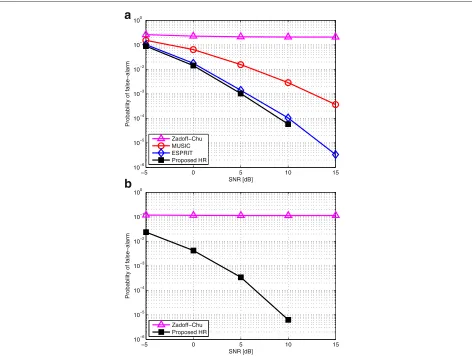
Figure 7 depicts the false detection probability of different algorithms with RSSsR·K=12 and 24. The performance trend is almost the same as the misdetection probability. Since the false detection probability of MCD and ZCCD
1 AAI subframe
Zadoff-Chu sequence
Harmonic Retrieval, MUSIC, ESPRIT
1 2 3 4 5 6
1 2
3 4
5 0
5 10 15 20
M
1 X: 5.068
Y: 4.028 Z: 16
V
1
1 2 3 4 5 6 7 8
0 4 8 12 16 20 24
b
a
V, # of subcarriers Kuid
, Max # of RSSs uniquely identifiable
Proposed HR MUSIC ESPRIT
Figure 5The number of identifiable RSSs,Kuidwith (a) different smoothing factor configuration or (b) different algorithms.
is very poor, we expect that the overall estimation per-formance can be also degraded by the false detection accordingly.
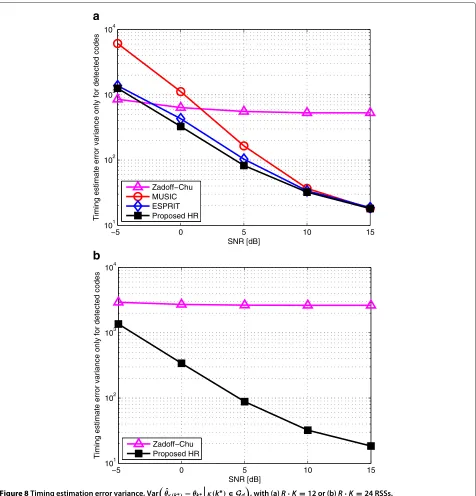
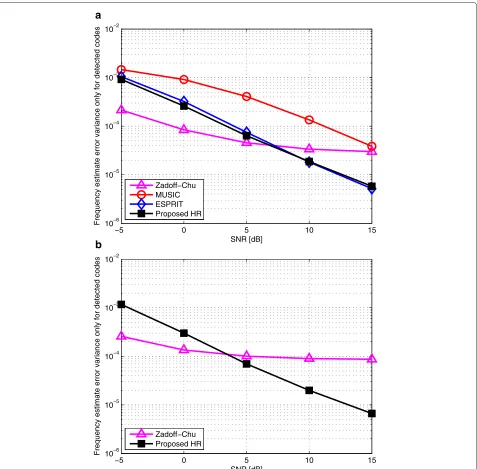
5.4 Timing and frequency offset estimation accuracy Figures 8 and 9 show the error variance performances of the timing and frequency offset estimation given the correctly detected codes, respectively, i.e., Varθˆκ(k∗)−
θk∗κ(k∗)∈Gd
and Varˆκ(k∗)−k∗κ(k∗)∈Gd
. The performance is evaluated with different numbers of active RSS users in the system. Note that the performance eval-uation on the timing and frequency estimation is only performed for the corrected detected code index pairs, i.e.,κ(k∗)∈Gd. Unlike other methods, the proposed algo-rithm with HR can link thek∗th received tuple to the code indexκ(k∗) directly without any brute-force code index search effort due to automatic pairing property.
As seen in the Figure 8, HRTE outperforms other tim-ing estimators over the whole SNR ranges regardless of the number of active users. Since it is crucial to obtain
the timing misalignment information of each RSS on the initial ranging process, these curve confirm that the pro-posed HRTE can sustain the great performance even with high contention volume.
In Figure 9, it is shown that HRFE outperforms MFE and EFE over the whole range, and HRFE becomes better than ZCFE with SNR increase. Even though HRFE shows worse performance on low SNR ranges compared to ZCFE, but please remark that this estimation error variance is only evaluated for the successfully corrected code sets, i.e., Varˆκ(k∗)−k∗κ(k∗)∈Gd. Therefore, if we consider the poor false-alarm and missing probability performance of ZCCD shown in Figure 7 (more than 10% of false-alarm and missing), the overall ZCFE performance will be severely degraded on the whole.
−5 0 5 10 15 10−6
10−5 10−4 10−3 10−2 10−1 100
Probability of misdetection
SNR [dB] Zadoff−Chu
MUSIC ESPRIT Proposed HR
−5 0 5 10 15
10−5 10−4 10−3 10−2 10−1 100
Probability of misdetection
SNR [dB] Zadoff−Chu
Proposed HR
a
b
Figure 6Misdetection probability,Pmisswith (a)R·K=12 or (b)R·K=24 RSSs.
Table 3 Code detection and offset estimation notation
Main algorithm Code detector (CD) Timing offset estimator (TE) Frequency offset estimator (FE)
Zadoff-Chu (ZC) ZCCD ZCTE ZCFE
MUSIC MCD AHTE (adhocTE) MFE
ESPRIT ECD ETE EFE
−5
b
a
0 5 10 15
10−6 10−5 10−4 10−3 10−2 10−1 100
Probability of false−alarm
SNR [dB] Zadoff−Chu
MUSIC ESPRIT Proposed HR
−5 0 5 10 15
10−6 10−5 10−4 10−3 10−2 10−1 100
Probability of false−alarm
SNR [dB] Zadoff−Chu
Proposed HR
Figure 7False detection probability,Pfalsewith (a)R·K=12 or (b)R·K=24 RSSs.
6 Conclusions
First, the proposed method utilizing IMDF scheme sup-ports the flexible subcarrier allocation usage. Basically, the proposed algorithm can be applied for the subcarrier allocation based on small tile and/or resource block structure whereas Zadoff-Chu sequence algorithm requires only the subband allocation, which should consist of consecutive subcarriers. Since the proposed algorithm also supports frequency noncontiguous com-bination of multiple tiles, actually it would even bring the performance improvement on the proposed scheme due to the enriched frequency diversity experience on the sample data. In addition,tileconcept is compliant to the state-of-the-art wireless cellular systems, e.g., IEEE 802.16m and 3GPP LTE-Advanced [2,3], so this scheme can be adopted directly to the practical system without any painful remedy on the frame and resource allocation structure.
Next, the proposed method using IMDF scheme fully utilizes the resources to distinguish multiple RSSs as many as possible. In the practical scenario which only a few
OFDMA symbols are utilized in the ranging process, the proposed HR algorithm can still increaseKuidby adjusting the number of tiles Qand the number of subcarriersV. Note that the number of RSSs in MUSIC and ESPRIT is easily restricted by the limited number of OFDMA sym-bols. Consequently, it confirms that the HR algorithm can smartly utilize the given data matrix to distinguish many RSSs simultaneously.
−5 0 5 10 15 101
102 103 104
Timing estimate error variance only for detected codes
SNR [dB] Zadoff−Chu
MUSIC ESPRIT Proposed HR
−5 0 5 10 15
101 102 103 104
Timing estimate error variance only for detected codes
SNR [dB] Zadoff−Chu
Proposed HR
a
b
Figure 8Timing estimation error variance, Varθˆκ(k∗)−θk∗κ(k∗)∈Gd
, with (a)R·K=12 or (b)R·K=24 RSSs.
Appendix
Let us define two selection matricesS1andS2as:
S1=SV1,1⊗IM1
S2=SV1,2⊗IM1
whereSV1,1=IV1−1 0V1−1
andSV1,2=0V1−1 IV1−1
. Then, for the givenUsfrom (20), we obtain two equal-sized matricesU1andU2by:
U1=S1Us, (46)
U2=S2Us. (47)
According to the property of Khatri-Rao product:(A⊗ B)(CD)=ACBD, by plugging (11) andUs=G1L−1 into (46) and (47), it can be verified that:
U1=PL−1,
−5 0 5 10 15 10−6
10−5 10−4 10−3 10−2
Frequency estimate error variance only for detected codes
SNR [dB] Zadoff−Chu
MUSIC ESPRIT Proposed HR
−5 0 5 10 15
10−6 10−5 10−4 10−3 10−2
Frequency estimate error variance only for detected codes
SNR [dB] Zadoff−Chu
Proposed HR
a
b
Figure 9Frequency estimation error variance, Varˆκ(k∗)−k∗κ(k∗)∈Gd, with (a)R·K=12 or (b)R·K=24 RSSs.
where P = T(V1−1) F(M1) and eη = ej2πη1,
ej2πη2,. . .,ej2πηKT. Assuming that the elements ofe ηare distinct,Lcan be obtained from the eigenvalue decom-position ofU†1U2up to column scaling and permutation ambiguity [18], i.e., the eigenvalue decomposition ofU†1U2 gives:
U†1U2=LspD(eη)L−sp1 (48)
whereLsp=Landis a nonsingular diagonal column scaling matrix andis a permutation matrix. Once we
obtain Lsp, we can retrieve P up to column scaling and permutation ambiguity:
Psp=UsL=P. (49)
Competing interests
The authors declare that they have no competing interests.
References
1. S Lee, H Yoo, M Park, B Park, D Hong, inProc. IEEE VTC 2005-Spring. Timing synchronization using phase difference between subcarriers for OFDMA uplink systems over frequency selective fading channels (Stockholm, Sweden, May 30–Jun. 1 2005), pp. 1258–1262
2. Air Interface for Broadband Wireless Access Systems Amendment 3: Advanced Air Interface. IEEE. Std. 802.16m-2011, (2011)
3. Physical channels and modulation, 3GPP Std. TS 36.211 V12.0.0, (2013) 4. DH Lee, inProc. IEEE and IFIP International Conference in central Asia on
Internet. OFDMA uplink ranging for IEEE 802.16e using modified generalized chirp-like polyphase sequences, (2005)
5. HA Mahmoud, H Arslan, MK Ozdemir, inProc. IEEE MILCOM 2006. Initial ranging for WiMAX (802.16e) OFDMA, (2006), pp. 1–7
6. X Fu, H Minn, inProc. IEEE GLOBECOM 2004,vol. 6. Initial uplink synchronization and power control (ranging process) for OFDMA systems, (2004), pp. 3999–4003
7. M Ruan, MC Reed, Z Shi, Successive multiuser detection and interference cancelation for contention based OFDMA ranging channel [transactions letters]. IEEE Trans. Wireless Commun.9(2), 481–487 (2010). [Online]. Available: http://ieeexplore.ieee.org/stamp/stamp.jsp?arnumber= 5403522
8. C-L Lin, S-L Su, inProc. WCSP 2011. A differential successive multiuser ranging detection for OFDMA systems, (2011), pp. 1–5
9. L Sanguinetti, M Morelli, An initial ranging scheme for the IEEE 802.16 OFDMA uplink. IEEE Trans. Wireless Commun.11(9), 3204–3215 (2012). [Online]. Available: http://ieeexplore.ieee.org/stamp/stamp.jsp? arnumber=6247449
10. X Yujie Xia, G Ren, Precoding-based initial ranging signal for SMUD algorithm in OFDMA systems. Electronics Lett.48(18), 1167–1168 (2012). [Online]. Available: http://ieeexplore.ieee.org/stamp/stamp.jsp? arnumber=6294580
11. X Fu, Y Li, H Minn, A new ranging method for OFDMA systems. IEEE Trans. Wireless Commun.6(2), 659–669 (2007)
12. XJ Zhuang, K Baum, V Nangia, M Cudak, Ranging improvement for 802.16e OFDMA PHY (2004). IEEE, Tech. Rep. IEEE C802.16e-04/143r1, 13. J Zeng, H Minn, A novel OFDMA ranging method exploiting multiuser
diversity. IEEE Trans. Commun.58(3), 945–955 (2010)
14. L Sanguinetti, M Morelli, HV Poor, An ESPRIT-based approach for initial ranging in OFDMA systems. IEEE Trans. Commun.57(11), 3225–3229 (2009)
15. M Morelli, L Sanguinetti, HV Poor, A robust ranging scheme for OFDMA-based networks. IEEE Trans Commun.57(8), 2441–2452 (2009) 16. G Bacci, L Sanguinetti, M Luise, HV Poor, A game-theoretic approach for
energy-efficient contention-based synchronization in OFDMA systems. IEEE Trans. Signal Process.61(5), 1258–1271 (2013). [Online]. Available:, http://ieeexplore.ieee.org/stamp/stamp.jsp?arnumber=6373741 17. W Sun, H So, Accurate and computationally efficient tensor-based
subspace approach for multidimensional harmonic retrieval. IEEE Trans. Signal Process.60(10), 5077–5088 (2012). [Online]. Available: http:// ieeexplore.ieee.org/stamp/stamp.jsp?arnumber=6222372 18. J Liu, X Liu, An eigenvector-based approach for multidimensional
frequency estimation with improved identifiability. IEEE Trans. Signal Process.54(12), 4543–4556 (2006)
19. J Liu, X Liu, X Ma, Multidimensional frequency estimation with finite snapshots in the presence of identical frequencies. IEEE Trans. Signal Process.55(11), 5179–5194 (2007)
20. M Haardt, F Roemer, G Del Galdo, Higher-order SVD-based subspace estimation to improve the parameter estimation accuracy in
multidimensional harmonic retrieval problems. IEEE Trans. Signal Process.
56(7), 3198–3213 (2008). [Online]. Available: http://ieeexplore.ieee.org/ stamp/stamp.jsp?arnumber=4545266
21. W Sun, H So, F Chan, L Huang, Tensor approach for eigenvector-based multi-dimensional harmonic retrieval. IEEE Trans. Signal Process.61(13), 3378–3388 (2013). [Online]. Available: http://ieeexplore.ieee.org/stamp/ stamp.jsp?arnumber=6506111
22. S Lee, X Ma, inProc. ASILOMAR 2010. An improved synchronization scheme for OFDMA systems with initial ranging transmissions (Pacific Grove, USA, Nov. 7–10 2010), pp. 150–154
23. CG Khatri, CR Rao, Solutions to some functional equations and their applications to characterization of probability distributions. Sankhy¯a: Ind. J. Stat. Series A.30(2), 167–180 (1968). [Online]. Available: http://www. jstor.org/stable/25049527
24. Air Interface for Fixed and Mobile Broadband Wireless Access Systems Amendment 2: Physical and Medium Access Control Layers for Combined Fixed and Mobile Operation in Licensed Bands and Corrigendum 1. IEEE Std. 802.16e-2005, (2006)
25. User equipment (UE) radio transmission and reception. 3GPP Std. TS 36.101 V12.2.0, (2013)
26. H Lee, JS Kwak, H Cho, Y-H Kwon, S Moon, X Wang, Y-S Choi, H Yoo, S-H Park, C-W Huang, P-H Kuo, Y-T Hsieh, P-A Ting, Z Yan-Xju, Proposed AWD text on the ranging structures for non-synchronized AMSs. IEEE, Tech. Rep. IEEE C802.16m-09/1092r3, (2009)
doi:10.1186/1687-6180-2015-1
Cite this article as:Lee and Ma:Eigenvector-based initial ranging process for OFDMA uplink systems.EURASIP Journal on Advances in Signal Processing
20152015:1.
Submit your manuscript to a
journal and benefi t from:
7 Convenient online submission 7 Rigorous peer review
7 Immediate publication on acceptance 7 Open access: articles freely available online 7 High visibility within the fi eld
7 Retaining the copyright to your article
![Table 1 Common parameters for the simulation, [2,3]](https://thumb-us.123doks.com/thumbv2/123dok_us/894171.1107677/10.595.58.539.562.735/table-common-parameters-for-the-simulation.webp)