R E S E A R C H
Open Access
Widely linear MMSE precoding and equalization
techniques for SC-FDE systems
Bruno S Chang
1*, Carlos AF da Rocha
2, Didier Le Ruyet
3and Daniel Roviras
3Abstract
Single-carrier systems using frequency-domain equalization (SC-FDE) systems were proposed to overcome the low robustness to carrier frequency offset (CFO) and high peak-to-average-power ratio (PAPR) inherent to regular orthogonal frequency-division multiplexing (OFDM) systems. Usually, linear minimum mean square error (MMSE) equalization is used to compensate the channel effect, since maximum likelihood (ML) detection is computationally impractical. However, if the transmitted signal comes from an improper constellation, widely linear processing can be used to take advantage of all the available second-order statistics from this transmitted signal, obtaining this way a performance gain when compared to the strictly linear case. In this paper, a SC-FDE system employing widely linear MMSE equalization is proposed in its regular and decision-feedback (DFE) versions. A SC-FDE system employing widely linear MMSE Tomlinson-Harashima precoding (THP) and equalization is also proposed. With
Tomlinson-Harashima precoding, the error propagation problem observed in systems using a decision-feedback equalizer vanishes, because the feedback processing is done at the transmitter. Simulation results show that together with the error performance gain, these systems have lower sensibility to the feedback filter length in systems using decision-feedback equalizers. In Tomlinson-Harashima precoded systems, the performance gain is observed even with channel estimation/channel state information errors.
Keywords: SC-FDE; Widely linear processing; Equalization; Tomlinson-Harashima precoding
1 Introduction
Single-carrier systems using frequency domain equalization (SC-FDE) [1,2] were proposed to reduce the compu-tational complexity required to equalize in the time-domain single-carrier transmissions through channels with a long impulse response. When compared to orthog-onal frequency-division multiplexing (OFDM) systems, they have lower peak-to-average-power ratio (PAPR) and higher robustness to carrier frequency offset (CFO) and to extreme subcarrier fading (since the decision on the sym-bol estimate is done in the time domain). SC-FDE-based systems were proposed for the uplink implementation in the 3GPP long-term evolution (LTE) standard.
Maximum likelihood (ML) decoding is computationally impractical for SC-FDE systems for commonly used block sizes; thus, minimum mean square error (MMSE)-based equalization is commonly used. SC-FDE systems can also
*Correspondence: [email protected]
1Electronics Department, Federal University of Technology - Paraná, Curitiba 80230-901, Brazil
Full list of author information is available at the end of the article
use a decision-feedback equalizer (DFE) to improve their error performance. A decision-feedback equalizer uses the previously detected symbols to reduce the postcur-sor intersymbol interference (ISI), which is left behind by the common MMSE equalizer. An efficient DFE struc-ture for SC-FDE systems, using a linear frequency-domain feedforward filter and a time-domain feedback filter, was proposed in [3]. Since the feedforward filter realizes its operations in the frequency domain, its computational complexity is lower when compared to a purely time-domain DFE. In SC-FDE systems using a DFE, the effect that the error propagation can cause is limited to one symbol block, since the equalizer operates on a per-block basis.
However, this possible error propagation in the decod-ing process hampers the utilization of decision-feedback equalizers in systems using channel coding [4]. An alter-native to avoid this problem is Tomlinson-Harashima precoding (THP) [5,6], which can be seen as the imple-mentation of the DFE receiver’s feedback filter at the
transmitter. The goal of Tomlinson-Harashima precod-ing is to cancel the interference before transmission. Since systems using Tomlinson-Harashima precoding do not suffer from error propagation, channel coding can be applied together with precoding with a gain in error performance. As a downside, Tomlinson-Harashima pre-coding requires full channel state information (CSI) at the transmitter, which may be hard to obtain precisely in wireless systems. SC-FDE systems using Tomlinson-Harashima precoding were proposed in [7,8].
These systems normally transmit symbols from a com-plex quadrature amplitude modulation (QAM) constel-lation. QAM symbols can be described as proper, that is, they have their second-order statistics completely described by their autocovariance, which for a com-plex random processw˜ with zero mean is expressed by Ew˜w˜H, where w˜ is a time-domain vector, E{.} is the expectance operator, and the superscript()Hdenotes the Hermitian operator. However, if w˜ comes from real or offset constellations (such as binary phase-shift keying (BPSK) and offset QAM (OQAM) ones), the autocovari-ance by itself is insufficient to describe its second-order statistics, since the pseudoautocorrelation ofw˜, given by Ew˜w˜T(where()Tis the transpose operator) is non-zero; this type of process is called improper [9]. Widely linear (WL) processing [10-12] was proposed to take advantage of this impropriety, by processing the signal together with its conjugate version to obtain a more precise estimate. In multicarrier systems, the use of widely linear equalization to make these systems resistant to narrowband interfer-ence was proposed in [13]. A widely linear equalizer for SC-FDE systems was proposed in [14].
In this paper, we propose widely linear MMSE Tomlinson-Harashima precoders and equalizers (includ-ing a decision-feedback one) for SC-FDE systems (Section 2). An expression for the signal-to-interference-plus-noise ratio (SINR) at the output of the receiver is pro-vided for every proposed system (Section 3). The use of widely linear MMSE-designed equalization and precod-ing brprecod-ings an error performance advantage with respect to strictly linear systems when improper constellations are transmitted, due to the complete use of the second-order statistics made available by these constellations. Widely linear systems are also less sensitive to the feedback fil-ter length (in systems using decision-feedback equalizers) and channel estimation/channel state information errors (in precoded systems) when compared to systems using strictly linear processing (see Section 4).
In this paper, vectors are represented by bold lower-case letters, while bold capital letters denote matrices. Time-domain elements have a tilde appended to them.. represents the largest integer less than or equal to a real number. The superscripts()∗,()T, and()Hdenote, respec-tively, conjugate, transpose, and Hermitian operations.
The ith element of the vector v is given byvi, and the
(i,j)th element of the matrixMis given byMi,j. The
iden-tity matrix of size N ×N is denoted byIN. Finally, the
expectance operator is given byE{.}.
2 System model
On the transmitter side, the block s˜ =[˜s1˜s2. . .˜sN]T
of size N is composed by symbols ˜si belonging to an
improper constellation (such asM-PAM orM2-OQAM). The transmitted signal will pass through a channel with an
impulse responseh˜ =
˜
h1h˜2. . .h˜Lh˜ T
of sizeLh˜. Thus, the cyclic prefix appended to the block˜sbefore transmis-sion must have a lengthLCP of at leastLh˜ −1, resulting ins˜CP of lengthN +LCP. Complex proper uncorrelated additional white Gaussian noise (AWGN) n˜ with zero mean and varianceσn2also contaminates the transmitted signal.
Due to the cyclic prefix, theN×N channel matrixH is circulant, with its first column containing the channel impulse responseh˜appended by (N−Lh˜) zeros. SinceH
is a circulant matrix, we can apply an eigendecomposition to this matrix to obtainW∗HW, whereWis the normal-ized discrete Fourier transform (DFT) matrix of sizeN×N andHis aN ×N diagonal matrix with its (k,k)th entry Hk,k corresponding to thekth coefficient of theN-sized
DFT of the channel impulse responseh˜.
The signalr˜=[r˜1˜r2 . . .r˜N+LCP]Twith lengthN+LCP at the entry of the receiver has its cyclic prefix removed and passes to the frequency domain through a fast Fourier transform (FFT), so that equalization can be done in the frequency domain. This will result in the signalrof length N, expressed as
r=Hs+n
=HWs˜+Wn˜, (1)
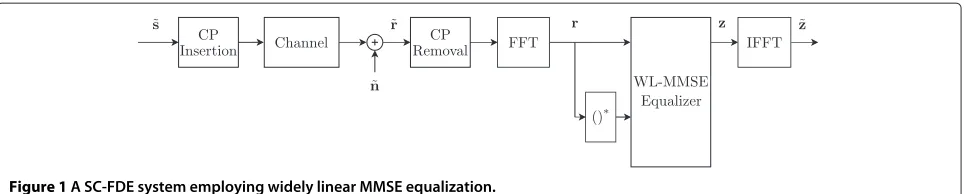
whereHcorresponds to the channel frequency response of a specific channel realization, s=Ws˜ is the trans-mitted signal in the frequency domain, and n=Wn˜ is the noise in the frequency domain. Equalization is per-formed by filters based on the MMSE criterion. How-ever, since the equalizer is dealing with a signal from an improper constellation (which has non-zero pseudo-correlation), it has to employ widely linear processing to use all the second-order statistics made available by the received signal. In order to do that, the original version of the received signal in the frequency domain together with its conjugate version should be processed by the equalizer.
2.1 WL-MMSE equalizer
Figure 1A SC-FDE system employing widely linear MMSE equalization.
The signal at the output of the equalizerz, with sizeN, is given by
The cost functionWLto derive the equalizerAbased on the WL-MMSE criterion is
WL=EAHt−s2
withUexpressed by
U= IN. We obtain the optimal equalizerAby differentiating
WL with respect to A and equalling the result to zero, resulting in
Using blockwise matrix inversion,C−1tt can be expressed
by
Analyzing (16), it is possible to see thatHmodis a diag-onal matrix with its diagdiag-onal equal to [ 2|H1|2, (|H2|2+ |HN|2), (|H3|2 + |HN−1|2),. . .2|HN/2+1|2,. . . (|H3|2 + |HN−1|2), (|H2|2+ |HN|2)].
This way, the widely linear equalizerAcan be expressed as
A1=
When transmitting proper signals, A is reduced to the strictly linear MMSE one, since with proper signals EssT = 0; thus, taking into account the conjugate ver-sion of the received signal in the equalization process does not lead to a performance improvement in this case. This process is very similar to the one done in [14], but better detailsA1andA2.
After equalization, an inverse fast Fourier transform (IFFT) is done onzso that the symbol decision is realized in the time domain, resulting inz˜(with sizeN). Due to the fact that widely linear processing is employed in the equal-izer, the estimated symbolsz˜at the output of the receiver will be purely real.
2.2 WL-MMSE DFE equalizer
When using a WL-MMSE DFE equalizer, the system model is described in Figure 2. This system employs a time-domain feedback filter in addition to a frequency-domain feedforward filter to obtain the symbol estimate.
Assuming that correct past decisions are passed along in the feedback filter, the frequency-domain representa-tionqof the symbol estimateq˜(both with sizeN) can be expressed as
q=BHt−(D−IN)s, (21)
where B is a 2N × N matrix corresponding to the
feedforward filter and D is a N × N matrix with its main diagonal being theN ×1-sized frequency-domain
representation of the real-valued time-domain feedback
filterd˜ =
Inq, the error (ISI plus noise) componenteWL-DFEis given by
eWL-DFE=BHt−Ds. (22)
Differentiating the autocorrelation matrix of this error vector with respect to the feedforward filterBand setting the derivative to zero, we obtain the optimal value ofB, expressed as
B=C−1tt CtsD
=AD. (23)
Replacing (23) in (22) and going to the time domain, we have
Thus, the error autocorrelation matrixCeecan be
calcu-lated as
Since our goal is to minimize the mean square error (MSE), the trace of the error covariance matrixCeeshould
be minimized. This trace is
tr(Cee)= σ
Using the feedback filterd˜in the time domain instead of its frequency domain versionDin (27), we have
tr(Cee)= σ
To minimizetr(Cee), we derive (28) with respect to the
feedback filter coefficientsd˜and equal it to zero, obtaining the following linear system:
Fd˜ = −g. (29)
TheLd˜ ×Ld˜ matrixFand theLd˜ ×1 column vectorg are expressed, respectively, as
[F]m,l= To initialize the feedback filter, the lastLd˜ symbols of ˜
sCP can be used. Onced˜ is determined,Bcan be calcu-lated by (23). The size of the feedback filterLd˜ should be equal to the channel lengthLh˜ to cancel all the ISI from the previous detected symbols.
2.3 WL-MMSE Tomlinson-Harashima precoder
A block diagram for the SC-FDE system using WL-MMSE Tomlinson-Harashima precoding is shown in Figure 3.
In this system model, we consider a single-carrier block transmission, with the block to be transmitted s˜ = belonging to an improper constellation (such asM-PAM or M2-OQAM) with unit energy. s˜ then goes to the Tomlinson-Harashima precoder, which consists of aLd˜ -sized filterd˜ =
and a modulo operator,
resulting inx˜. We recall that the task of the Tomlinson-Harashima precoderd˜is to use the available channel state information in the transmitter to cancel the interference caused by the channel before transmission. The modulo operator is present to reduce the transmitted signal to a prescribed range, since the precoding operation may increase a given constellation point to an out-of-range value.
The input to the modulo operator in the precoderm˜ is given by
This modulo operation tom˜ is done independently on the real and imaginary parts. The output of this modulo operationx˜is given by
If the real (imaginary) part ofm˜ is greater thanM, 2M is (repeatedly) subtracted from it until the result is less thanM. If this real (imaginary) part is less than−M, 2M is (repeatedly) added to it until the result is greater than or equal to−M. In other words,m˜ is reduced modulo 2M to the half-open interval [−M,M), limiting the effective dynamic range of the transmitted signal to this interval. This modulo operation is represented by the sequencea˜. After this operation,Lh˜ zeros are appended tox˜
to ini-tialize the state of the precoding filter, resulting in the
vectorx˜ =
˜
x1x˜2. . .x˜N T
of sizeN. More power is nec-essary to transmit the precoded symbols when compared to non-precoded ones [15]; however, this penalty becomes negligible with an increase in constellation size.
˜
x follows the same path of a SC-FDE WL-MMSE-DFE
up to the feedback filter (cyclic prefix insertion, channel, cyclic prefix removal, FFT, WL-MMSE equalization, and IFFT). The same modulo operation realized in the trans-mitter is done in the receiver toy˜to map the received data to the interval(−M,M], resulting in the symbol estimate ˆ
s. Only the firstN −Lh˜ elements ofˆs are used for the decision.
An equivalent linearized scheme of the system model presented in Figure 3 is shown in Figure 4, following the time-domain THP conversion process made in [16]. In this figure,K =[H H∗]T (with sizeN ×2N) andD is a N×Ndiagonal matrix with its main diagonal being the N-sized Fourier transform of the Tomlinson-Harashima precoderd˜.
Figure 4Equivalent system structure for the SC-FDE system employing WL-MMSE equalization and Tomlinson-Harashima precoding.
Figure 4 shows that the symbol estimateˆsof sizeN−Lh˜ is given by
ˆ
s = ˜sd+n+ ˜i, (34)
where˜sdis the desired symbol vector,nthe filtered noise, and the remaining interference is expressed by˜i, all of size N−Lh˜. This way, the error vectore˜ is
Using (35), we obtain the mean square errorE, given by
E =E|˜e|2 same as the ones in a SC-FDE system employing a MMSE-based decision-feedback equalizer together with widely linear processing. Thus, the coefficients of the Tomlinson-Harashima precoder d˜ = ˜d are given by (29), and the widely linear MMSE equalizerB =Bis given by (23).
3 Error performance analysis 3.1 SINR for the WL-MMSE receiver
We recall that after the FFT, the received signal and its conjugate version are grouped in the vectorR. Both ver-sions are processed together in the frequency domain by the WL-MMSE equalizerA. Thus, the symbol estimatez˜ is expressed by
is obtained after deprecoding the signalzat the output of the WL-MMSE equalizer by the IFFT matrixW−1.
We can rewrite (37) in the following way:
˜
SinceEeeHis a circulant matrix, its diagonal elements are all the same. Thus, the MSE for all the elements of ˜ MSEWLis much lower than the MSE given by the strictly linear equalizer, which is N1trW−1(HHH+σn2IN)−1W
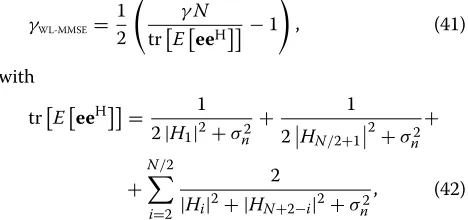
[17]. The effective SINR after deprecoding when using a WL-MMSE equalizerγWL-MMSEis
γWL-MMSE= 1
final symbol decision is only done on the real estimate [18]. Since [14] does not specify wellA1andA2, (41) clari-fies the calculation of the SINR for a SC-FDE system using widely linear MMSE equalization in the SISO case.
3.2 SINR for the WL-MMSE DFE receiver
For the SC-FDE system using WL-MMSE DFE equal-ization, its MSE can be expressed (using the method described in [19]) as
MSEWL-DFE=exp
again lower than the one obtained by the strictly linear solution, given by [20]
MSEDFE=exp
The SINR for the SC-FDE system using WL-MMSE DFE equalization is given by
γWL-DFE= 1
Again, we divide by 2 to obtain the effective SINR for the system using widely linear equalization.
3.3 SINR for the WL-MMSE-THP precoder
The MSE for the WL-MMSE-THP SC-FDE system can be expressed as from a WL-MMSE DFE one outside of a precoding loss factorηdependent on the constellation size [15].
Finally, to calculate the error probabilityPeconditional to a channel realization in each of the previous cases, the following equation is used:
Pe=αQ
βγ, (47)
where α and β are constellation-specific parameters [21]; γ can be γWL-MMSE, γWL-DFE, or γWL-THP; and Q(x) =
2 dt. The unconditional error probabil-ity is obtained by averaging over all the condi-tional error probabilities corresponding to the channel realizations.
4 Simulation results
Simulation results are presented in this section to vali-date the use of widely linear MMSE-based equalization and precoding to obtain an error performance improve-ment for different block sizes and channel models. For the simulations presented in this section, the cyclic pre-fix size used is the minimum sufficient to eliminate the interblock interference, and the power loss caused by the redundancy introduced by the cyclic prefix is taken into account in the SNR calculation. A sampling frequency of 10 MHz was used. To calculate the final bit error per-formance in the Monte Carlo simulations, a minimum of 400 errors were taken into account for each point; for the method presented in this paper, 5,000 independent chan-nel realizations were used to obtain the unconditional
error probability. Channel estimation in the receiver is assumed to be perfect (unless noted otherwise), chan-nel fading is considered to be quasistatic (time-invariant during each transmitted block), and other system imper-fections are not taken into account. For THP systems, the precoder size Ld˜ is equal to the channel lengthLh˜. In simulations using channel coding, a mother convolu-tional code withR =1/2,(171, 133)8code followed by a block interleaver is used at the transmitter; in the receiver, a block de-interleaver followed by a soft-decision Viterbi decoder is used. Higher code rates are obtained through puncturing.
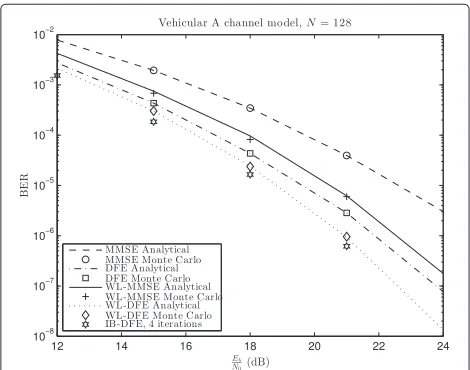
Figure 5 shows the uncoded Monte Carlo results for a SC-FDE system using WL-MMSE equalization compared to the results provided by (47) for transmission symbols drawn from a BPSK constellation (α = β = 1), a block sizeN =128 and the ITU-T Vehicular A channel model. For the systems employing a time-domain DFE, its length Ld˜ is equal to the channel lengthLh˜. For reference, the error performance of SC-FDE systems using strictly lin-ear MMSE equalization is also shown. It is possible to see that the use of the analysis presented in this paper gives consistent results when compared to the Monte Carlo simulation results throughout theEb/N0range. The utilization of the WL-MMSE equalizers brings a perfor-mance gain when compared to the strictly linear MMSE ones in the entireEb/N0range, due to the complete use of the second-order statistics made available by the improper signal. For reference, the error performance results of SC-FDE systems using linear iterative IB-DFE equalization [22] (with four iterations) are also presented. It can be seen that the error performance obtained by the WL-DFE system is close to the one obtained by iterative equaliza-tion, but without the added decision delay caused by the
iterative process. Results using a quadrature phase-shift keying (QPSK) constellation for the strictly linear receiver and an offset QPSK (OQPSK) constellation for the widely linear one will be the same as the ones presented in this figure.
Figure 6 presents uncoded results for N = 512, the ITU-T Pedestrian B channel model and again a BPSK con-stellation. The same conclusions made for the previous case can also be stated for this scenario. For highEb/N0 ratios, the Monte Carlo simulation can be very time-consuming for the WL-MMSE receiver, due to low BER values. Thus, the use of the analytical method presented in this paper allows us to derive the system performance in less time.
Results for the same scenario employed in Figure 5, but with 16-QAM/OQAM constellations in Figure 7 and 64-QAM/OQAM constellations in Figure 8, are shown. It is possible to see that the performance advantage between the widely linear equalizer and the strictly lin-ear one in the case where a time-domain DFE is not used increases when the constellation size grows. This can be explained by the fact that the WL-MMSE feedforward filter is more effective in eliminating the ISI when com-pared to the strictly linear MMSE feedforward filter. With a time-domain DFE, the advantage for the widely linear equalizer remains the same with the increase of the con-stellation size because the feedback filter cancels some of the residual ISI; thus, some of the performance advan-tage seen in the previous case is negated. It is interesting to note that the system with a WL-MMSE DFE transmit-ting symbols from a 64-OQAM constellation has better error performance that the system transmitting symbols from a 16-QAM constellation using regular linear MMSE equalization.
Figure 6Error performance for SC-FDE systems withN=512 and BPSK modulation.
Figure 7Error performance for SC-FDE systems withN=128 and 16-QAM/OQAM modulation.
In Figure 9, results for N = 128, a OQPSK
con-stellation, the Vehicular A channel model, but this time using convolutional coding, are presented. In this sce-nario, the performance gain from using the WL-MMSE equalizer is also observed, with its advantage growing with a weaker code ratio. This happens because the stronger code ratios help compensate some of the performance advantage which comes with the usage of the widely lin-ear equalizer. For systems using a feedback filter, coding is not directly applicable due to the effect of error prop-agation in the feedback filter, which causes a significant amount of burst errors in the Viterbi decoder [4]. Efforts to overcome this problem in decision-feedback equalizers have been discussed in [23,24].
Figure 9Error performance for SC-FDE systems withN=128 and BPSK modulation using convolutional coding.
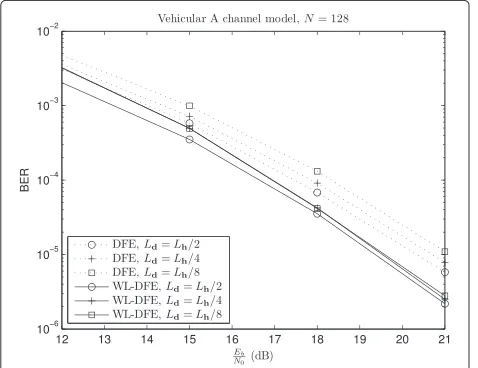
In the simulations made to obtain the previous results using decision-feedback equalizers, the length of the feed-back filter Ld˜ was always the length of the channel’s impulse responseLh˜. Figure 10 shows the effect of chang-ing this feedback filter lengthLd˜on the error performance of SC-FDE DFE systems. Feedback filter sizes of Lh˜/2, Lh˜/4, andLh˜/8 were considered. The system using widely
linear equalization has its error performance less sensitive to the error propagation effect caused by the smaller feed-back filters when compared to the system using strictly linear equalization due to the increased effectiveness of the feedforward filter in this case. With smaller feedback filters, the computational complexity needed to calculate their coefficients in (30) and (31) is reduced.
Figure 10Error performance for SC-FDE-DFE systems with
N=128, BPSK modulation and with differentLd˜sizes.
The error performance results of widely linear MMSE Tomlinson-Harashima precoding applied to a SC-FDE system compared to its strictly linear version for a BPSK constellation,N =128 and the ITU-T Vehicular A chan-nel model, are shown in Figure 11. In these simulations, the channel estimation in the receiver and channel state information in the transmitter are assumed to be perfect. It is possible to see that the system using widely lin-ear processing outperforms its strictly linlin-ear counterpart. This is again due to the complete use of the second-order statistics made available by the transmitted signal. As stated before, this error performance is the same as the one obtained by the widely linear systems employing a decision-feedback equalizer outside of a precoding loss factor. Since this precoding loss is smaller in higher-order constellations, the error performance results of SC-FDE systems using widely linear MMSE Tomlinson-Harashima precoding when using 16-OQAM and 64-OQAM constel-lations will be almost identical to the ones from WL-DFE systems presented in Figures 7 and 8.
As said before, the usage of channel coding in systems using Tomlinson-Harashima precoding is possible, unlike in systems employing non-modified decision-feedback equalizers. The results for Tomlinson-Harashima pre-coded systems using convolutional coding are presented in Figure 12. In this scenario, the performance gain from using widely linear-based precoding is also observed, with its advantage growing with a weaker code ratio.
The previous results when using Tomlinson-Harashima precoding assumed perfect channel estimation in the receiver and perfect channel state information at the transmitter; however, this is an unlikely scenario in real conditions because of channel variations. As stated before, Tomlinson-Harashima precoded systems rely on
Figure 11Error performance for THP SC-FDE systems with
Figure 12Error performance for SC-FDE-THP systems with
N=128 and BPSK modulation using convolutional coding.
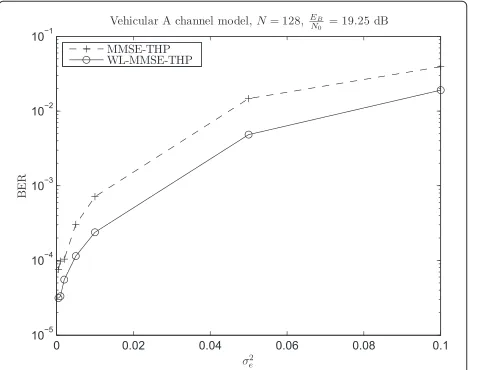
complete channel state information in the transmitter, which in turn needs perfect channel estimation in the receiver. A comparison on the impact of channel estima-tion errors and imperfect CSI in the error performance of MMSE-THP SC-FDE systems is presented in Figure 13 for
Eb
N0 = 19.25 dB,N = 128, and the Vehicular A channel model. The imperfect channel estimates can be expressed asHe = H+ EH, where EH is the channel estimation
error matrix, with its diagonal composed of zero-mean Gaussian distributed random variables with varianceσe2 [25]. This imperfect channel estimate is then passed to the transmitter, which will have erroneous CSI. Even with an increase of the error varianceσe2, the SC-FDEsystem using widely linear processing outperforms its strictly linear counterpart.
Figure 13The impact of channel estimation/CSI errors on the error performance.
5 Conclusions
This paper presented novel SC-FDE systems using widely
linear MMSE-based equalization, decision-feedback
equalization, and Tomlinson-Harashima precoding. The use of widely linear processing brings, when the trans-mitter uses improper constellations, a performance gain compared to when common strictly linear MMSE pro-cessing is used. With respect to SC-FDE systems using MMSE-DFE equalization, together with the performance gain, the use of widely linear processing also makes the error performance less sensitive to the feedback filter size. The error performance gain of Tomlinson-Harashima precoded systems using widely linear processing is also observed when there are channel estimation/CSI errors. Possibilities for future work include combining widely linear processing with the pragmatic frequency-domain equalization method for SC-FDE systems employing offset modulation and pulse shaping [26,27].
Competing interests
The authors declare that they have no competing interests.
Acknowledgements
This work has been partially sponsored by National Council for Scientific and Technological Development (CNPq) and CAPES/COFECUB project (544/07).
Author details
1Electronics Department, Federal University of Technology - Paraná, Curitiba 80230-901, Brazil.2Communications Research Group, Federal University of Santa Catarina, Florianópolis 88040-900, Brazil.3CEDRIC/LAETITIA Laboratory, Conservatoire National des Arts et Métiers, 75141 Paris Cédex 03, France.
Received: 7 October 2013 Accepted: 12 July 2014 Published: 7 August 2014
References
1. H Sari, G Karam, I Jeanclaude, Transmission techniques for digital terrestrial TV broadcasting. IEEE Commun. Mag.33(2), 100–109 (1995) 2. D Falconer, SL Ariyavisitakul, A Benyamin-Seeyar, B Eidson, Frequency
domain equalization for single-carrier broadband wireless systems. IEEE Commun. Mag.40(4), 58–66 (2002)
3. N Benvenuto, S Tomasin, On the comparison between OFDM and single carrier modulation with a DFE using a frequency-domain feedforward filter. IEEE Trans. Commun.50(6), 947–955 (2002)
4. G Huang, A Nix, S Armour, Decision feedback equalization in SC-FDMA, in
IEEE 19th International Symposium on Personal, Indoor and Mobile Radio
Communications(Cannes, 15–18 Sept. 2008)
5. M Tomlinson, New automatic equaliser employing modulo arithmetic. Electron. Lett.7, 138–139 (1971)
6. H Harashima, H Miyakawa, Matched-transmission technique for channels with intersymbol interference. IEEE Trans. Comm.20(4), 774–780 (1972) 7. Y Zhu, K Letaief, Frequency domain pre-equalization with transmit
precoding for MIMO broadcast wireless channels. IEEE J. Sel. Area. Comm. 26(2), 389–400 (2008)
8. M Noune, A Nix, Frequency-domain precoding for single carrier frequency-division multiple access. IEEE Comm. Mag.47(6), 68–74 (2009) 9. B Picinbono, On circularity. IEEE Trans. Signal Process.42(12), 3473–3482
(1994)
10. B Picinbono, P Chevalier, Widely linear estimation with complex data. IEEE Trans. Signal Process.43(8), 2030–2033 (1995)
11. PJ Schreier, LL Scharf, CT Mullis, Detection and estimation of improper complex random signals. IEEE Trans. Inform. Theor.51(1), 306–312 (2005) 12. P Chevalier, F Pipon, New insights into optimal widely linear array
13. D Darsena, G Gelli, F Verde, Universal linear precoding for NBI-proof widely linear equalization in MC systems. EURASIP J. Wireless Commun. Netw.2008, 1–14 (2008)
14. Z Lin, P Xiao, B Vucetic, M Sellathurai, Analysis of receiver algorithms for LTE SC-FDMA based uplink MIMO systems. IEEE Trans. Wireless Comm. 9(1), 60–65 (2010)
15. RFH Fischer,Precoding and Signal Shaping for Digital Transmission. (Wiley, New York, 2002)
16. RD Wesel, JM Cioffi, Achievable rates for Tomlinson-Harashima precoding. IEEE Trans. Inform. Theor.53(1), 824–831 (1998)
17. A Tajer, A Nosratinia, Diversity order in ISI channels with single-carrier frequency-domain equalizers. IEEE Trans. Wireless Comm.
9(3), 1022–1032 (2010)
18. A Mirbagheri, KN Plataniotis, S Pasupathy, An enhanced widely linear CDMA receiver with OQPSK modulation. IEEE Trans. Commun. 54(2), 261–272 (2006)
19. J Salz, Optimum mean-square decision feedback equalization. Bell Syst. Tech. J.52, 1341–1373 (1973)
20. C Panazio, A de Paula, An uncoded BER comparison between DFE-SCCP and OFDM using a convex analysis framework, inIEEE International
Symposium on Circuits and Systems - IEEE ISCAS 2011(Rio de Janeiro, 15–18
May, 2011)
21. JG Proakis,Digital Communications, 4th edn. (McGraw-Hill, Upper Saddle River, 2000)
22. N Benvenuto, S Tomasin, Iterative design and detection of a DFE in the frequency domain. IEEE Trans. Commun.53(11), 1867–1875 (2005) 23. MV Eyuboglu, Detection of coded modulation signals on linear, severely
distorted channels using decision-feedback noise prediction with interleaving. IEEE Trans. Commun.36(4), 401–409 (1988)
24. Y Zhu, KB Letaief, Single carrier frequency domain equalization with noise prediction for broadband wireless systems. GLOBECOM.5, 3098–3102 (2004). Dallas, 29 Nov.–3 Dec. 2004
25. J Maurer, J Jalden, G Matz, Multi-threshold TOP—full-diversity vector perturbation precoding with finite-rate feedforward, inProceedings of the
Asilomar Conference on Signals, Systems and Computers(Pacific Grove,
26–29 Oct. 2008), pp. 428–432
26. M Luzio, R Dinis, P Montezuma, SC-FDE for offset modulations: an efficient transmission technique for broadband wireless systems. IEEE Trans. Commun.60(7), 1851–1861 (2012)
27. M Luzio, R Dinis, P Montezuma, Pragmatic frequency domain equalization for single carrier with offset modulations. IEEE Trans. Wireless Commun. 12(9), 4496–4505 (2013)
doi:10.1186/1687-6180-2014-124
Cite this article as:Changet al.:Widely linear MMSE precoding and equalization techniques for SC-FDE systems.EURASIP Journal on Advances in Signal Processing20142014:124.
Submit your manuscript to a
journal and benefi t from:
7Convenient online submission
7 Rigorous peer review
7Immediate publication on acceptance
7 Open access: articles freely available online
7High visibility within the fi eld
7 Retaining the copyright to your article