Volume 2007, Article ID 26760,11pages doi:10.1155/2007/26760
Research Article
Throughput Analysis of Large Wireless Networks with
Regular Topologies
Kezhu Hong and Yingbo Hua
Department of Electrical Engineering, University of California, Riverside, CA 92521, USA
Received 2 September 2006; Revised 12 December 2006; Accepted 23 February 2007
Recommended by Weihua Zhuang
The throughput of large wireless networks with regular topologies is analyzed under two medium-access control schemes: syn-chronous array method (SAM) and slotted ALOHA. The regular topologies considered are square, hexagon, and triangle. Both nonfading channels and Rayleigh fading channels are examined. Furthermore, both omnidirectional antennas and directional an-tennas are considered. Our analysis shows that the SAM leads to a much higher network throughput than the slotted ALOHA. The network throughput in this paper is measured in either bits-hops per second per Hertz per node or bits-meters per second per Hertz per node. The exact connection between the two measures is shown for each topology. With these two fundamental units, the network throughput shown in this paper can serve as a reliable benchmark for future works on network throughput of large networks.
Copyright © 2007 K. Hong and Y. Hua. This is an open access article distributed under the Creative Commons Attribution License, which permits unrestricted use, distribution, and reproduction in any medium, provided the original work is properly cited.
1. INTRODUCTION
The maximum achievable throughput of a large wireless work has been a topic of great interest. A large wireless net-work can take many possible forms in practice, which in-clude large sensor networks, large ad hoc networks, and large mesh networks. A large mesh network may consist of a large number of wireless transceivers located (or approximately lo-cated) on a regular grid. Such a mesh network may serve as a virtual backbone for other mobile wireless clients. Since all nodes in the mesh network share the same wireless medium, the maximum network spectral efficiency (i.e., the maxi-mum achievable network throughput) is of paramount im-portance. This is particularly true if the network is operating under heavy loads.
Until the recent works [1,2], most of the research ac-tivities on maximum achievable throughput (i.e., capacity) of large wireless networks focus on scaling laws, for exam-ple, [3–5]. A capacity scaling law typically yields an upper bound on the maximum achievable throughput of the net-work, and the bound is often quite loose especially when applied to a given network topology. As argued in [1, 2], an exact and achievable throughput of a large network with a given topology is also of practical and theoretical impor-tance. The throughput of a large mesh network is such an
ex-ample. However, the throughput of a large network critically depends on medium-access control scheme.
In [2], a medium-access control scheme called syn-chronous array method (SAM) is proposed, and the net-work throughput of the SAM is analyzed under the nonfad-ing channel condition and the square network topology. The essence of the SAM is that all packet transmissions in the network are orthogonal in time and/or frequency and the distance between any two adjacent transceivers is optimized to maximize the network spectral efficiency. It is shown in [2] that the throughput of the SAM is about 2–4 times the throughput of a well-known random-access scheme called slotted ALOHA [6].
In this paper, we present a further analysis of the SAM. In this analysis, we consider not only the square topology, but also the hexagonal and triangular topologies. We also con-sider the Rayleigh fading channels. Both omnidirectional an-tennas and directional anan-tennas are treated in the analysis.
By network throughput we imply the maximum per-node uniform throughput under full load. By full load we imply that whenever a node is scheduled to transmit a packet in a given direction, there is at least one such packet available at the node.
node. The unit bits-hops/s/Hz/node measures the number of bits each node can transmit to its neighboring node in a given direction per second per Hertz. The unit bits-meters/s/Hz/node measures the number of bits transported over one-meter distance in an arbitrary direction (between source and destination) from each node per second per Hertz. The connection between the two units depends on the network topology, which will be shown under each of the three topologies to be considered.
A throughput analysis of the slotted ALOHA is shown in [1] where the throughput is expressed in packets/s/node. Although commonly used, this unit is not as fundamental as bits-hops/s/Hz/node or bits-meters/s/Hz/node as the lat-ter takes into account the spectral efficiency of each packet while the former does not. It will be seen that the spectral efficiency of each packet can also be used to maximize the network throughput. We believe that a network throughput in bits-hops/s/Hz/node or bits-meters/s/Hz/node can serve as a more reliable benchmark than a network throughput in packets/s/node.
Note that according to Shannon’s theory, the maximal spectral efficiency, that is, bits/s/Hz, that a packet can carry has the expression log2(1 + η), where η is the signal-to-interference-and-noise-ratio (SINR) threshold. When the ac-tual SINR is larger thanη, the packet is not detectible. When the actual SINR is less thanη, the packet is detectible pro-vided that the coding is perfect and the packet length is suffi -ciently long. By packet detection threshold we will refer toη. A good review of other existing works on throughput analysis of large networks with regular topologies is available in [1], which we will not repeat.
The rest of this paper is organized as follows. InSection 2, we analyze the network throughput under SAM and non-fading channels for each of the three topologies: square, hexagon, and triangle. Also shown is the connection be-tween bits-hops/s/Hz/node and bits-meters/s/Hz/node for each topology. The average source-destination (end-to-end) delay for each topology is also presented. In Section 3, we show the network throughput under SAM and fading chan-nels for all three topologies. InSection 4, we present the net-work throughput under slotted ALOHA and fading channels for all three topologies. (For convenience, slotted ALOHA will also be referred to as ALOHA. The network through-put under ALOHA and nonfading channels is discussed in [2] and will not be addressed in this paper.) A comparison between SAM and ALOHA is summarized inSection 5.
2. NETWORK THROUGHPUT UNDER SAM AND
NONFADING CHANNELS
The synchronous array method (SAM) schedules packet transmissions synchronously between arrays of nodes as summarized next. The network is partitioned into inter-leaved subsets (arrays) of nodes. During each time slot, a subset of nodes with a predetermined spacing is scheduled to transmit its packets towards its neighboring subset of nodes. Depending on the spacing of each subset of nodes, it takes several time slots for each node in the network to transmit a packet to its neighbor in a given direction. Depending on
qdsq
pdsq
pdsq
Figure1: A network on the square grid with the spacingdsq
me-ters between two adjacent nodes. Under the SAM, data packets are transmitted from the black nodes to their neighboring gray nodes during a time slot. The vertical spacing between two active transceivers ispdsqmeters, and the horizontal spacing between two active transceivers isqdsqmeters. The offset between two adjacent columns of active transceivers isp/2dsq.
the network topology and the desired destination of a packet, there are several directions to which the packet can be trans-mitted. For each direction, the above process is repeated. The time slots referred to above can be replaced by frequency slots without affecting the network spectral efficiency. More de-tails of the SAM will be revealed as we analyze the network throughput for three regular topologies.
2.1. A network with square topology
Although partially presented in [2], this subsection is useful for completeness of this paper. A network on square grid is il-lustrated inFigure 1where a subset of nodes is represented by the black nodes and its neighboring subset of nodes is repre-sented by the gray nodes. During a time slot, the black nodes are the transmitting nodes, and the gray nodes are the receiv-ing nodes. The sparseness (spacreceiv-ing) of the subset is deter-mined bypdsqandqdsq, wherepandqare integers anddsqis
the distance between two adjacent nodes. (The notationp denotes the largest integer less than p.) Both the sparseness and the geometry of each subset affect the network through-put. The geometry shown inFigure 1is expected to be ideal as the distance between any two pairs of transceivers is max-imum for any givenpandq.
To evaluate the network throughput, we first consider the signal-to-interference-and-noise ratio (SINR) at each receiv-ing node durreceiv-ing a time slot:
SINR= PT/dn0
each transmitting node,σ2is the noise variance,d
0is the
dis-tance between a receiver and its desired transmitter (d0=dsq
for the square topology),di is the distance between the re-ceiver and theith interfering transmitters,nis the path loss exponent, and δSAM,sq =
i∈Ssubd n
0/dni is referred to as the interference factor for the square grid,Ssub is the set of all
interfering nodes.
In this paper, we consider a virtually infinite network. When the network is finite, the throughput shown in this pa-per is equivalent to a lower bound on the actual achievable throughput. The numerical results shown later are all based on the throughput of a center node in a network of about 200×200 nodes. The center node receives the largest inter-ference, and hence governs a lower bound of the achievable (per node) network throughput.
If a directional antenna is used on each node, there is a power attenuation factorξ between a receiver and a trans-mitter, which is defined as follows.ξ = 1 if the transmitter and the receiver are pointing to each other.ξ =(<1) if the transmitter is pointing to the receiver but the receiver is not pointing to the transmitter (or if the receiver is pointing to the transmitter but the transmitter is not pointing to the receiver).ξ =2if none of the transmitter and the receiver
is pointing to the other. In this case, the interference factor becomesδSAM,sq=
i(d0/di)nξi, whereξimay be 1,, or2
depending on the relative orientation of the interferer. WhenPT is sufficiently large, SINR becomes saturated at its upper bound 1/δSAM,sq. For the case of nonfading
chan-nels, we will only consider the saturated SINR and the corre-sponding network throughput.
We consider all interferences to be desired signals for other nodes. Since the best encoded waveform is Gaussian according to Shannon theory, it is reasonable to assume that the interferences are all Gaussian. Assuming that the noise and the interferences are all Gaussian and the network is (vir-tually) infinite, the network capacity in bits-hops/s/Hz/node is therefore
whereGsq =pqis the number of time slots needed for each
of the nodes in the network to transmit once to its neigh-boring node in a given direction on the square grid. Note thatcSAM,sqis an upper bound of the network capacity and is
achievable whenPT is large. Here, each node is assumed to have a single antenna.
Based on the geometry of the subset of nodes as shown inFigure 1, one can verify that forp >1,
δSAM,sq=δsq,1+δsq,2+δsq,3+δsq,4+δsq,5, (3)
Table 1: The (p,q)-optimal network throughput in bits-hops/s/
Hz/node of a network on the square grid under the SAM and non-fading channels.
Referring to Figure 1, one can verify thatδsq,1corresponds
to all the interferences from the transmitters located on the first column, third column, fifth column, and so on, to the left and right of each desired pair of transmitter and receiver; δsq,2corresponds to all the interferences from the
transmit-ters located on the second column, fourth column, and so on, to the right of each desired pair of transmitter and receiver; δsq,3corresponds to all the interferences from the
transmit-ters located on the second column, fourth column, and so on, to the left (except those in the line of sight) of each desired pair of transmitter and receiver;δsq,4corresponds to all the
interferences from the transmitters to the left and in the line of sight of each desired pair of transmitter and receiver; and δsq,5is the interference from all the transmitters in the same
column of each desired pair of transmitter and receiver. Forp=1, one can similarly verify that
δSAM,sq=2
For each given pair ofnand, the throughputcSAM,sq
can be optimized over (p,q). Given inTable 1are samples of the (p,q)-optimalcSAM,sq(denoted byc∗SAM,sq) and the
qdhex
√ 3pdhex
Figure2: A network on the hexagonal grid with the spacingdhex
meters between two adjacent nodes. Under the SAM, data pack-ets are transmitted from the black nodes to their neighboring gray nodes during a time slot. The horizontal spacing between two ac-tive transceivers isqdhex, and the vertical spacing between two active transceivers is√3pdhex.
Table 2: The (p,q)-optimal network throughput in bits-hops/s/
Hz/node of a network on the hexagonal grid under the SAM and nonfading channels.
c∗SAM,hex, (p,q)∗ =1 =0.1 =0.01
n=3 0.2794, (1, 3) 2.1297, (1, 1.5) 2.7976, (1, 1.5)
n=4 0.5430, (1, 3) 2.5813, (1, 1.5) 3.8645, (1, 1.5)
n=5 0.8040, (1, 3) 2.7474, (1, 1.5) 4.8132, (1, 1.5)
2.2. A network with hexagonal topology
Following the same idea shown previously, we now consider a network on the hexagonal grid as illustrated in Figure 2
where a subset of transmission pairs during a time slot is denoted by the black and gray nodes. The vertical spacing between adjacent transmission pairs is denoted by√3pdhex,
and the horizontal spacing between adjacent transmission pairs isqdhex. Here, p takes all natural integers. But qcan
be eitherq =3morq =3m−1.5, wheremis any natural integer.
With the hexagonal topology, each node has three pos-sible directions for a packet transmission. In order for each node in the network to have one chance to transmit a packet to its neighbor in one of its three directions, we needGhex=
2p(2q/3) time slots ifq=3morGhex=2p[2(q−1.5)/3 + 1]
time slots ifq=3m−1.5. Then, the network throughput in bits-hops/s/Hz/node in one of three directions is given by
cSAM,hex= 1
where δSAM,hex is the interference factor for the hexagonal
topology. Following the geometry of the subset of nodes shown inFigure 2, one can verify that ifq=3mandp > 1,
Shown inTable 2are samples of the (p,q)-optimalcSAM,hex
and the corresponding optimal (p,q).
2.3. A network with triangle topology
qdtri
√ 3pdtri
Figure3: A network on the triangular grid with the spacingdtri
meters between two adjacent nodes. Under the SAM, data pack-ets are transmitted from the black nodes to their neighboring gray nodes during a time slot. The horizontal spacing between two ac-tive transceivers isqdtriand the vertical spacing between two active transceivers is√3pdtri.
Table3: The (p,q)-optimal throughput in bits-hops/s/Hz/node of
a network on the triangular grid under the SAM and nonfading channels.
c∗SAM,tri, (p,q)∗ =1 =0.1 =0.01
n=3 0.1863, (1, 3) 1.4198, (1, 1.5) 1.8651, (1, 1.5)
n=4 0.3620, (1, 3) 1.7209, (1, 1.5) 2.5763, (1, 1.5)
n=5 0.5360, (1, 3) 1.8316, (1, 1.5) 3.2088, (1, 1.5)
by black and gray nodes. The vertical spacing of transmis-sion pairs is √3pdtri, and the horizontal spacing is qdtri.
Here,ptakes any natural integers, butqcan be eithermor m−0.5, wheremis a natural integer. The number of time slots required for all nodes in the network to transmit once in one of six possible directions isGtri = 2pqifq = m, or
Gtri=p[2(q−0.5) + 1] ifq=m−0.5. The capacity in
bits-hops/s/Hz/node is therefore
cSAM,tri= 1
where δSAM,tri is the interference factor for the triangular
topology.
We see thatδSAM,tri(n) andδSAM,hex(n) have a similar
struc-ture. This is because if we add a node inside each hexagon of the network on the hexagonal grid, the network topology becomes triangular.
The (p,q)-optimalcSAM,tri and the corresponding
opti-mal (p,q) are illustrated inTable 3.
2.4. Throughput comparison
In the previous subsections, we have evaluated the network throughput cin bits-hops/s/Hz/node for each of the three topologies. But in order to compare the throughput of diff er-ent topologies fairly, we need to derive the network through-putαin bits-meters/s/Hz/node. Furthermore, we will fix the node densityρfor all topologies as well.
Let the smallest square area surrounded by four nodes in the square topology be denoted byAsq, the smallest
hexag-onal area surrounded by six nodes in the hexaghexag-onal topol-ogy byAhex, and the smallest triangular area defined by three
nodes in the triangular topology byAtri. Then, a simple
anal-ysis shows that for an infinite network, there is one node for every square on the square grid, 2 nodes for every hexagon on the hexagonal grid, and 0.5 node for every triangle on the triangular grid, that is,
Table4: Comparison of the network throughput in bits-meters/s/Hz/node underρ=1.
α∗SAM,sq,α∗SAM,hex,α∗SAM,tri =1 =0.1 =0.01
n=3 0.170 0.193 0.182 1.407 1.468 1.384 1.702 1.928 1.818
n=4 0.331 0.374 0.353 1.868 1.779 1.677 2.391 2.663 2.511
n=5 0.488 0.554 0.522 2.154 1.893 1.785 3.039 3.317 3.127
It is also easy to show that
Asq=dsq2, Ahex=3
On the square grid, the number of hops required for a packet to move over a long distanceD(withDdsq) in an
arbitrary directionθ∈[0,π/4] is given by
Nsq=
Dcos (π/4√ −θ) 2dsq
×2. (17)
Since the average number of hops in each of theπ/4-angle partitions of the interval 0≤θ <2πis the same, the average number of hops for anyθ∈[0, 2π) is
Similarly, we can show that for the hexagonal grid,
Nhex=D
For the triangular grid, we have
Ntri=
The throughputαin bits-meters/s/Hz/node is simply the throughputcin bits-hops/s/Hz/node multiplied by the
aver-age number of meters per hop, that is,
αSAM,sq= D
We see that the relationship between α and c is only weakly affected by the network topology.
Table 4illustrates the (p,q)-optimizedαSAM,sq,αSAM,hex,
and αSAM,tri underρ = 1. We can see that α∗SAM,hex is the
largest when = 1 or 1. When = 0.1,α∗SAM,sq
be-comes the largest for largen. Overall, the difference among α∗SAM,sq,α∗SAM,hex, andα∗SAM,triis not very large.
2.5. Delay analysis
The average source-to-destination or end-to-end delayTE2E
is also useful. We next evaluate TE2E for each of the three
topologies.
With the same node density ρ and the same source-destination distanceD, the average delayTE2Ein a network
can be expressed as
TE2E=KG∗NT, (24)
Table5: NormalizedTE2Efor networks on the square, hexagonal, and triangular grids.
E2E delay =1 =0.1, 0.01
TE2E,sq 96.00 32.00
TE2E,hex 54.71 27.35
TE2E,tri 116.05 58.03
One can verify that for the square grid,
TE2E,sq=16G∗sq
and for the hexagonal grid,
TE2E,hex=6
and for the triangular grid,
TE2E,tri=6
1. From this table, we observe thatTE2E,hexis the smallest for
both omnidirectional and directional antennas, andTE2E,triis
the largest.
3. NETWORK THROUGHPUT UNDER SAM AND
FADING CHANNELS
We now assume that all channels in the network are block Rayleigh fading channels. Then, the SINR at a receiving node is given by
SINR= r0
σ2+
i∈Ssubri
, (28)
wherer0is the received power of the desired signal,riis the
received power from theith interferer,σ2is the noise power,
andSsubdenotes the set of all interfering nodes in a subset of
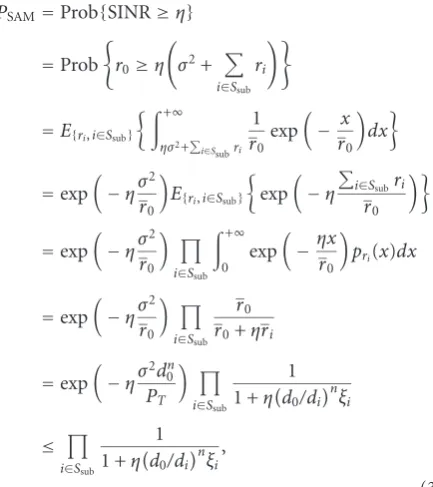
transmitting nodes under the SAM. With the Rayleigh fading model (on the amplitude of complex channel coefficients), the probability density function ofrifor anyiis given by the exponential function We also assume that each packet is encoded with the (ideal) spectral efficiencyR=log2(1 +η) in bits/s/Hz, where ηis the expected SINR. Then, similar to an analysis shown in
[1], the probability for a packet to be successfully received is
PSAM=Prob{SINR≥η} of random variables {ri,i ∈ Ssub}, and the independence
among {ri,i ∈ Ssub}is assumed. The last upper bound on
PSAMis achieved (approximately) as long asPTis sufficiently
large. Sincediandξiare topology-dependent, so isPSAM.
The network throughput in bits-hops/s/Hz/node under the SAM and the Rayleigh fading channels is given by
cSAM,fading= R
GPSAM, (31)
whereG is the number of the time slots required for each node to have a chance to transmit a packet, which is a topology-dependent function of the sparseness parameters pandqas shown before. LikecSAM,cSAM,fadingcan be
max-imized overpandqfor any givenη,n, and.
The network throughput αSAM,fading in bits-meters/s/
Hz/node for each topology can be obtained from the cor-respondingcSAM,fadingfrom one of the conversion equations
(23). For convenience, we will set ρ = 1 and SNR0 =
PT/σ2dn
0 =30 dB.
Figure 4 illustrates the optimized αSAM,fading,sq for the
square topology versus the detection thresholdη.
Figure 5 illustrates the optimized αSAM,fading,hex for the
hexagonal topology versus the detection thresholdη.
Figure 6illustrates the optimizedαSAM,fading,trifor the
tri-angular topology versus the detection thresholdη.
We see that the patterns of the network throughput for the three topologies are similar. The network throughput in-creases as the path loss exponentnincreases and/or the rel-ative attenuationof the directional antennas decreases. For any givennand, there is an optimal choice of the detection thresholdη. The optimalηis around 5 dB when =1. As
−10 −5 0 5 10 15 20 η(dB)
0 0.2 0.4 0.6 0.8 1 1.2 1.4 1.6 1.8
α
∗ SAM,fading
,sq
=0.01,n=3, 4, 5
=0.1,n=3, 4, 5
=1,n=3, 4, 5
Figure 4: The (p,q)-optimizedαSAM,fading,sqin bits-meters/s/Hz/
node versusηfor the square topology under SNR0 = 30 dB and ρ=1.
to the change of optimal sparseness parameters p andqat differentη. The optimalpandq(which are integers) “gen-erally” increase asη(which is real) increases. Comparing the peak value of each of the curves in Figures4,5, and6with a corresponding value inTable 4, we see a loss of network throughput in the case of fading channels, which is expected. Under the fading channels, a channel-aware opportunis-tic approach can be integrated into the SAM to improve the throughput, which is reported in [7]. We will not discuss this approach here. We next show an analysis of the slotted ALOHA under fading channels and compare its throughput with the results shown in this section. This comparison is im-portant for one to appreciate the throughput difference be-tween the SAM and the slotted ALOHA.
4. NETWORK THROUGHPUT UNDER ALOHA AND
FADING CHANNELS
In this section, we evaluate the network throughput under (slotted) ALOHA and fading channels. For convenience, the slotted ALOHA is referred to as ALOHA.
A generic description of ALOHA is as follows. During each time slot, each node in the network transmits a packet with the probability pt, or is ready to receive a packet with the probability 1−pt.
However, to prepare for our analysis, more descriptions of ALOHA are needed. When a node becomes a transmit-ting node, it does not know which of its neighboring nodes is receiving. We assume that the transmitting node randomly picks a desired receiver (and hence a corresponding packet for that receiver). If the desired node is not in its receiving mode (and even if an unintended neighboring node receives the packet), the packet is deemed lost. In the case of omni-directional antennas, a receiving node uses its received signal to decode each of all possible packets from its neighboring nodes. In the case of directional antennas, we assume that a receiving node uses (concurrently) four receiving anten-nas in the square topology, three receiving antenanten-nas in the
−10 −5 0 5 10 15 20
η(dB) 0
0.2 0.4 0.6 0.8 1 1.2 1.4 1.6 1.8 2
α
∗ SAM,fading
,he
x =
0.01,n=3, 4, 5
=0.1,n=3, 4, 5
=1,n=3, 4, 5
Figure 5: The (p,q)-optimizedαSAM,fading,hexin bits-meters/s/Hz/
node versusηfor the hexagonal topology under SNR0=30 dB and ρ=1.
−10 −5 0 5 10 15 20
η(dB) 0
0.2 0.4 0.6 0.8 1 1.2 1.4 1.6 1.8
α
∗ SAM,fading
,t
ri
=0.01,n=3, 4, 5
=0.1,n=3, 4, 5
=1,n=3, 4, 5
Figure 6: The (p,q)-optimizedαSAM,fading,triin bits-meters/s/Hz/
node versusηfor the triangular topology under SNR0=30 dB and ρ=1.
hexagonal topology, or six receiving antennas in the triangu-lar topology. All antennas on each node are pointing to dif-ferent directions, and the signal received by each antenna is processed independently. A packet transmitted from a node is always transmitted from a correct directional antenna. A packet is deemed lost unless the transmitting antenna and its desired receiving antenna are pointing to each other. If we do not assume multiple receiving antennas for a receiving node, the network throughput of ALOHA is reduced by a factor (four, three, or six) depending on the topology.
We can now start the throughput analysis with the square topology. In this topology, each packet from a transmitter is meant for one of four possible directions (or receivers), and each receiver has four possible neighboring transmitters. Let PALOHAbe the probability that a node receives a packet from
a specific neighbor given that these two nodes are a desired transceiver pair. The probability that a node becomes a re-ceiver and one specific neighbor becomes a transmitter and transmits a packet to the receiver is (1/4)(1−pt)pt. Consid-ering that there are four neighbors for each receiving node, the probability that an arbitrary node receives a packet from (any or all of) its neighbors is therefore (1−pt)ptPALOHA.
This simple expression holds for both omnidirectional an-tennas and directional anan-tennas.
With a similar analysis, one can verify that for the hexag-onal and triangular topologies, the probability that an arbi-trary node receives a packet from (any or all of) its neighbors is still given by the same expression (1−pt)ptPALOHA.
If each packet carriesR=log2(1 +η) bits/s/Hz, then the network throughput in bits-hops/s/Hz/node is
cALOHA,fading=
1−ptptPALOHAR, (32)
and the network throughput in bits/meters/s/Hz/node is
αALOHA,fading=
1−ptptPALOHARD
N, (33)
whereD/Nis the average number of meters per hop, which depends on the topology as shown before.
Although the above expressions are simple, the details of PALOHA are tedious (especially for directional antennas)
and dependent on the network topology. Next, we show how PALOHAcan be derived.
Let us now assume that the node 0 and the node 1 are two neighboring nodes, the node 0 is receiving from the node 1, and the node 1 is transmitting to the node 0. Then the SINR at the receiving node is given by
SINR= r0
σ2+
i /=0,1ξisiri
, (34)
wheresiis a binary random variable with Prob{si=1} =pt and Prob{si=0} =1−pt, andξiis a random power attenu-ation factor associated with directional antennas. As defined before,ξi=1 if the receiving antenna at node 0 and the trans-mitting antenna at (interfering) nodeiare pointing to each other,ξi=if the receiving antenna at node 0 is pointing to nodeiwho is however pointing away from node 0 or if node 0 is pointing away from nodeiwho is pointing to node 0, andξi=2if both node 0 and nodeiare pointing away from
each other. Since a transmitting node with directional an-tennas randomly picks a transmitting antenna,ξiis random. The probability distribution ofξi depends on the topology and the location of nodeirelative to the desired transceiver pair (i.e., node 0 and node 1).
Similar to (30), one can verify that for the square topol-ogy,
PALOHA=Prob{SINR≥η}
=Prob
r0≥η
σ2+
i /=0,1
ξisiri
=E{ξi,i /=0,1}E{si,i /=0,1}E{ri,i /=0,1}
× +∞
η(σ2+i /=0,1ξisiri) 1 r0
exp
− x r0
dx
=E{ξi,i /=0,1}E{si,i /=0,1}exp
−ησ
2dn
0
PT
× i /=0,1
1 1 +ηξisid0/di
n
=exp
−ησ
2dn
0
PT
× i /=0,1
1−pt+
4
j=1
pt/4 1 +ηxsq(i,j)d
0/di
n
,
(35)
wherexsq(i,j) takes a value from{0, 1, 2}, which depends on
the location of nodeiand the orientation of the transmitting antenna at nodei.
For the other two topologies, similar expressions of PALOHA follow from simple modifications in the last term
of (35). More specifically, for the hexagonal topology, the sum in the last expression of (35) should be replaced by
3
j=1((pt/3)/(1 + ηxhex(i,j)(d0/di)n)), where xhex(i,j) takes
a value from{0, 1, 2}. And for the triangular topology, the sum in the last expression of (35) should be replaced by
6
j=1((pt/6)/(1 +ηxtri(i,j)(d0/di)n)), wherextri(i,j) takes a
value from{0, 1, 2}.
The exact choices ofxsq(i,j),xhex(i,j), andxtri(i,j) are
somewhat tedious but have been written into a computer program which we omit from this paper.
The network throughput αALOHA,fading depends on the
transmission probability pt of each node and the detection thresholdηgoverned by the packet spectral efficiencyR. For each value ofη,αALOHA,fadingcan be maximized overpt.
Figure 7shows thept-optimalαALOHA,fading,sqversusηfor
different choices ofandnfor the square topology.
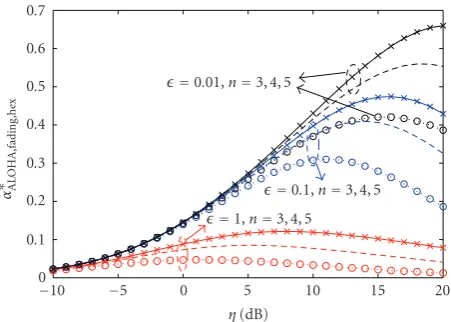
Figure 8shows the pt-optimal αALOHA,fading,hex versus η
for different choices ofandnfor the hexagonal topology.
Figure 9shows thept-optimalαALOHA,fading,triversusηfor
different choices ofandnfor the triangular topology. The pt-optimal αALOHA,fading can be further optimized
over η. The pattern of pt-optimal αALOHA,fading versusη is
similar to that of (p,q)-optimalαSAM,fadingversusη.
5. COMPARISON OF SAM AND ALOHA
−10 −5 0 5 10 15 20 η(dB)
0 0.1 0.2 0.3 0.4 0.5 0.6 0.7 0.8 0.9
α
∗ AL
OHA,fading
,sq
=0.01,n=3, 4, 5
=0.1,n=3, 4, 5
=1,n=3, 4, 5
Figure7: The pt-optimalαALOHA,fading,sq in bits-meters/s/Hz/node
versusηfor the square topology under SNR0=30 dB andρ=1.
−10 −5 0 5 10 15 20
η(dB) 0
0.1 0.2 0.3 0.4 0.5 0.6 0.7
α
∗ AL
OHA,fading
,he
x
=0.01,n=3, 4, 5
=0.1,n=3, 4, 5
=1,n=3, 4, 5
Figure8: Thept-optimalαALOHA,fading,hexin bits-meters/s/Hz/node
versusηfor the hexagonal topology under SNR0=30 dB andρ=1.
−10 −5 0 5 10 15 20
η(dB) 0
0.1 0.2 0.3 0.4 0.5 0.6 0.7 0.8
α
∗ AL
OHA,fading
,t
ri
=0.01,n=3, 4, 5
=0.1,n=3, 4, 5
=1,n=3, 4, 5
Figure9: The pt-optimalαALOHA,fading,triin bits-meters/s/Hz/node
versusηfor the triangular topology under SNR0=30 dB andρ=1.
The exact network topology is not necessary for the SAM as long as the actual topology can be approximately mapped to one of the regular topologies. Although the ALOHA does not need to know the topology since each node transmits a packet independently from other nodes, there is a signifi-cant routing overhead if the network topology is unknown to the nodes. For applications such as mesh networks, the nodes are relatively stationary and the network topology can be discovered in the initial stage of network setup. Once the network topology is known to all the nodes in the network, routing of packets is relatively easy. That is, when a packet needs to be transmitted from a node, the node first decides on the next-hop (neighboring) node based on the destina-tion of the packet. This type of informadestina-tion is “stamped” on all packets to be transmitted from any node so that the node that receives a packet can identify whether or not the packet is intended for it. After a packet arrives at an interme-diate (relay) node, a new stamp of the next hop replaces the old, and hence the packet size remains the same regardless of the source-destination distance of the packet. The through-put analysis of both the SAM and the ALOHA shown in this paper has been based on the above assumption.
Figure 10compares the (p,q)-optimalαSAM,fadingversusη
and thept-optimalαALOHA,fadingversusηfor each of the three
topologies under=1 (omnidirectional antennas) and= 0.01 (directional antennas), respectively. We see that whenη is optimally chosen, the throughput of the SAM is about 2 to 3 times the throughput of the ALOHA.
6. CONCLUSIONS
In this paper, we have analyzed the throughput of large wire-less networks with three regular topologies (square, hexag-onal, and triangular). Two medium-access control schemes have been considered: synchronous array method (SAM) and a random-access method called slotted ALOHA. We have found that the three topologies do not change the net-work throughput significantly although the hexagonal topol-ogy has the smallest delay and the triangular topoltopol-ogy has the largest delay. Our comparison between SAM and slotted ALOHA for fading channels shows that the SAM has a signif-icantly higher throughput than slotted ALOHA. This finding is similar to a previous comparison between SAM and slotted ALOHA for nonfading channels.
Future work should consider protocols such as carrier-sense multiple access with collision avoidance (CSMA/CA). This protocol has been analyzed for small-size networks [8]. It should be useful to evaluate its performance in the con-text of large networks. Using fundamental throughput units such as bits-hops/s/Hertz/node should allow a fair compari-son with SAM, ALOHA, as well as other schemes.
−10 −5 0 5 10 15 20 0
0.05 0.1 0.15 0.2
=1 Triangle
SAM
Slotted ALOHA
−10 −5 0 5 10 15 20
0 0.05 0.1 0.15 0.2
=1 Hexagon
−10 −5 0 5 10 15 20
0 0.05 0.1 0.15 0.2
=1 Square
−10 −5 0 5 10 15 20
0 0.5 1 1.5
Triangle
=0.01
SAM
Slotted ALOHA
−10 −5 0 5 10 15 20
0 0.5 1 0.2
Hexagon
=0.01
−10 −5 0 5 10 15 20
0 0.5 1 1.5
=0.01
Square
Figure10: The (p,q)-optimalαSAM,fadingversusηin dB and the pt-optimalαALOHA,fading versusηin dB for three topologies,n =4, and
SNR0 =30 dB. The left column of plots is for=1 (omnidirectional antennas). The right column of plots is for=0.01 (directional antennas).
ACKNOWLEDGMENTS
This work was supported in part by the US National Science Foundation under Grant no. TF-0514736, and the US Army Research Office under the MURI Grant no. W911NF-04-1-0224. Part of this work was presented at IEEE Workshop on Sensor Array and Multichannel Processing, Waltham, Mass, July 2006.
REFERENCES
[1] X. Liu and M. Haenggi, “Throughput analysis of fading sen-sor networks with regular and random topologies,”EURASIP Journal on Wireless Communications and Networking, vol. 2005, no. 4, pp. 554–564, 2005.
[2] Y. Hua, Y. Huang, and J. J. Garcia-Luna-Aceves, “Maximizing the throughput of large ad hoc wireless networks,”IEEE Signal Processing Magazine, vol. 23, no. 5, pp. 84–94, 2006.
[3] L.-L. Xie and P. R. Kumar, “A network information theory for wireless communication: scaling laws and optimal operation,”
IEEE Transactions on Information Theory, vol. 50, no. 5, pp. 748–767, 2004.
[4] F. Xue, L.-L. Xie, and P. R. Kumar, “The transport capacity of wireless networks over fading channels,”IEEE Transactions on Information Theory, vol. 51, no. 3, pp. 834–847, 2005.
[5] S. Yi, Y. Pei, and S. Kalyanaraman, “On the capacity improve-ment of ad hoc wireless networks using directional antennas,”
inProceedings of the the 4th ACM International Symposium on Mobile Ad Hoc Networking and Computing (MobiHoc ’03), pp. 108–116, Annapolis, Md, USA, June 2003.
[6] IEEE Transactions on Information Theory, vol. 31, no. 2, 1985, special issue on Random-Access Communications.
[7] B. Zhao and Y. Hua, “A distributed medium access control scheme for a large network of wireless routers,” submitted to
IEEE Transactions on Wireless Communications.
[8] G. Bianchi, “Performance analysis of the IEEE 802.11 dis-tributed coordination function,”IEEE Journal on Selected Areas in Communications, vol. 18, no. 3, pp. 535–547, 2000.