Volume 2007, Article ID 93421,9pages doi:10.1155/2007/93421
Research Article
Optimal Design of Nonuniform Linear Arrays in Cellular
Systems by Out-of-Cell Interference Minimization
S. Savazzi,1O. Simeone,2and U. Spagnolini1
1Dipartimento di Elettronica e Informazione, Politecnico di Milano, 20133 Milano, Italy
2Center for Wireless Communications and Signal Processing Research (CCSPR), New Jersey Institute of Technology,
University Heights, Newark, NJ 07102-1982, USA
Received 13 October 2006; Accepted 11 July 2007
Recommended by Monica Navarro
Optimal design of a linear antenna array with nonuniform interelement spacings is investigated for the uplink of a cellular system. The optimization criterion considered is based on the minimization of the average interference power at the output of a con-ventional beamformer (matched filter) and it is compared to the maximization of the ergodic capacity (throughput). Out-of-cell interference is modelled as spatially correlated Gaussian noise. The more analytically tractable problem of minimizing the inter-ference power is considered first, and a closed-form expression for this criterion is derived as a function of the antenna spacings. This analysis allows to get insight into the structure of the optimal array for different propagation conditions and cellular layouts. The optimal array deployments obtained according to this criterion are then shown, via numerical optimization, to maximize the ergodic capacity for the scenarios considered here. More importantly, it is verified that substantial performance gain with respect to conventionally designed linear antenna arrays (i.e., uniformλ/2 interelement spacing) can be harnessed by a nonuniform opti-mized linear array.
Copyright © 2007 S. Savazzi et al. This is an open access article distributed under the Creative Commons Attribution License, which permits unrestricted use, distribution, and reproduction in any medium, provided the original work is properly cited.
1. INTRODUCTION
Antenna arrays have emerged in the last decade as a power-ful technology in order to increase the link or system capac-ity in wireless systems. Basically, the deployment of multiple antennas at either the transmitter or the receiver side of a wireless link allows the exploitation of two contrasting ben-efits: diversity and beamforming. Diversity relies on fading uncorrelation among different antenna elements and pro-vides a powerful means to combat the impairments caused
by channel fluctuations. In [1] it has been shown that a
sig-nificant increase in system capacity can be achieved by the use of antenna diversity combined with optimum combin-ing schemes. Independence of fadcombin-ing gains associated to the antennas array can be guaranteed if the scattering environ-ment is rich enough and the antenna eleenviron-ments are sufficiently
spaced apart (at least 5–10λ, where λ denotes the carrier
wavelength) [2]. On the other hand, when fading is highly
correlated, as for sufficiently small antenna spacings, beam-forming techniques can be employed in order to mitigate the spatially correlated noise. Interference rejection through beamforming is conventionally performed by designing a uniform linear array with half wavelength interelement
spac-ings, so as to guarantee that the angle of arrivals can be potentially estimated free of aliasing. Moreover,
beamform-ing is effective in propagation environments where there is a
strong line-of-sight component and the system performance
is interference-limited [3].
In this paper, we consider the optimization of a linear nonuniform antenna array for the uplink of a cellular sys-tem. The study of nonuniform linear arrays dates back to
the seventies with the work of Saholos [4] on radiation
pat-tern and directivity. In [5] performance of linear and
cir-cular arrays with different topologies, number of elements, and propagation models is studied for the uplink of an inter-ference free system so as to optimize the network coverage. The idea of optimizing nonuniform-spaced antenna arrays to enhance the overall throughput of an interference-limited
system was firstly proposed in [6]. Therein, for flat fading
channels, it is shown that unequally spaced arrays
outper-form equally spaced array by 1.5–2 dB. Here, different from
[6], a more realistic approach that explicitly takes into
ac-count the cellular layout (depending on the reuse factor) and the propagation model (that ranges from line-of-sight
to richer scattering according to the ring model [7]) is
θ1 Setting A: reuse 3 Setting B: reuse 7
Interferer User
Figure1: Two cellular systems with hexagonal cells and trisectorial antennas at the base stations (reuse factorF =3, setting A, on the right andF=7, setting B, on the left). The array is equipped with
N =4 antennas. Shaded sectors denote the allowed areas for user and the three interferers belonging to the first ring of interference (dashed lines identify the cell clusters of frequency reuse).
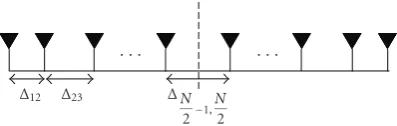
Δ12 Δ23 ΔN 2−1,
N 2 · · · · · ·
Figure2: Nonuniform symmetric array structure forNeven.
For illustration purposes, consider the interference
sce-narios sketched inFigure 1. Therein, we have two different
settings characterized by hexagonal cells and different reuse
factors (F=3 for setting A andF=7 for setting B, frequency
reuse clusters are denoted by dashed lines). The base station
is equipped with a symmetric antenna array1containing an
even numberNof directional antennas (N=4 in the
exam-ple) to cover an angular sector of 120 deg, other BS antenna
array design options are discussed in [8]. Each terminal is
provided with one omnidirectional antenna. On the consid-ered radio resource (e.g., time-slot, frequency band, or or-thogonal code), it is assumed there is only one active user in the cell, as for TDMA, FDMA, or orthogonal CDMA. The user of interest is located in the respective sector according to the reuse scheme. The contribution of out-of-cell inter-ferers is modelled as spatially correlated Gaussian noise. In
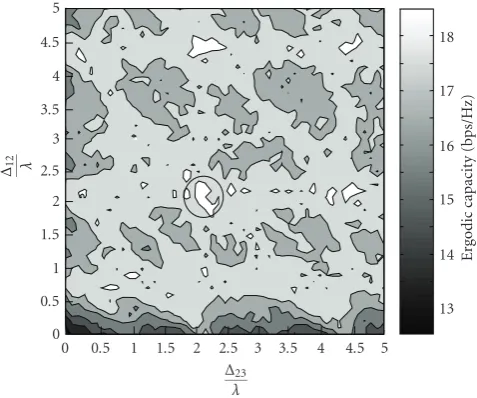
Figure 1, the first ring of interference is denoted by shaded cells. The problem we tackle is that of finding the antenna
spacings in vectorΔ=[Δ12Δ23]T(as shown in the example)
1The symmetric array assumption (as in the array structure ofFigure 2) has been made mainly for analytical convenience in order to simplify the optimization problem. However, it is expected that for a scenario with a symmetric layout of interference (such as setting A), the assumption of a symmetric array does not imply any loss of optimality, while, on the other hand, for an asymmetric layout (such as setting B), capacity gains could be in principle obtained by deploying an asymmetric array.
so as to optimize given performance metrics, as detailed be-low.
Two criteria are considered, namely, the minimization of the average interference power at the output of a conven-tional beamformer (matched filter) and the maximization of the ergodic capacity (throughput). Since in many appli-cations the position of users and interferers is not known a priori at the time of the antenna deployment or the in-cell/out-cell terminals are mobile, it is of interest to evaluate the optimal spacings not only for a fixed position of users and interferers but also by averaging the performance met-ric over the positions of user and interferers within their cells (seeSection 2).
Even if the ergodic capacity criterion has to be considered to be the most appropriate for array design in interference-limited scenario, the interference power minimization is ana-lytically tractable and highlights the justification for unequal spacings. Therefore, the problem of minimizing the inter-ference power is considered first and a closed-form expres-sion for this criterion is derived as a function of the antenna
spacings (Section 4). This analysis allows to get insight into
the structure of the optimal array for different propagation conditions and cellular layouts avoiding an extensive numer-ical maximization of the ergodic capacity. The optimal ar-ray deployments obtained according to the two criteria are shown via numerical optimization to coincide for the
con-sidered scenarios (Section 5). More importantly, it is
veri-fied that substantial performance gain with respect to
con-ventionally designed linear antenna arrays (i.e., uniformλ/2
interelement spacing) can be harnessed by an optimized
ar-ray (up to 2.5 bit/s/Hz for the scenarios inFigure 1).
2. PROBLEM FORMULATION
The signal received by theNantenna array at the base station
serving the user of interest can be written as
y=h0x0+
M
i=1
hixi+w, (1)
whereh0 is the N×1 vector describing the channel gains
between the user and the N antennas of the base
sta-tion,x0 is the signal transmitted by the user,hi andxi are
the corresponding quantities referred to the ith interferer
(i =1,. . .,M),wis the additive white Gaussian noise with
E[wwH]=σ2I. The channel vectorsh
0and{hi}Mi=1are
un-correlated among each other and assumed to be zero-mean complex Gaussian (Rayleigh fading) with spatial correlation
R0 = E[h0hH0] and {Ri = E[hihHi ]}Mi=1, respectively. The
correlation matrices are obtained according to a widely em-ployed geometrical model that assumes the scatterers as
dis-tributed along a ring around the terminal, seeFigure 3. This
model was thoroughly studied in [2,7] and a brief review
can be found inSection 3. According to this model, the
spa-tial correlation matrices of the fading channel depend on
(1) the set of N/2 antenna spacings (N is even) Δ =
[Δ12 Δ23 · · · ΔN/2,N/2+1]T, whereΔi j is the distance
Φ0
Figure3: Propagation model for user and interferers: the scatterers are distributed on a rings of radiiriaround the terminals.
array is assumed to be symmetric as shown inFigure 2,
extension to an odd number of antennasNis
straight-forward);
(2) the relative positions of user and interferers with re-spect to the base station of interest (these latter pa-rameters can be conveniently collected into the vector η=[ηT
0 ηT1 · · · ηTM]T, where, as detailed inFigure 3,
vectorη0 =[d0θ0]T parametrizes the geometrical
lo-cation of the in-cell user and vectorsηi=[diθi]T(i=
1,. . .,M) describe the location of the interferers (i = 1,. . .,M));
(3) the propagation environment is described by the angu-lar spread of the scattered signal received by the base
station (φ0for the user andφi(i = 1,. . .,M) for the
interferers); notice that for ideally φi →0 all
scatter-ers come from a unique direction so that line-of-sight (LOS) channel can be considered. Shadowing can be
possibly modelled as well, seeSection 3for further
dis-cussion.
2.1. Interference power minimization
From (1), the instantaneous total interference power at the
output of a conventional beamforming (matched filter) is [9]
Ph0,Δ,η
accounts for the spatial correlation matrix of the interferers
and for thermal noise with powerσ2. Notice that, for
clar-ity of notation, we explicitly highlighted that the interfer-ence correlation matrices depend on the terminals’ locations
η and the antenna spacingsΔ through nonlinear
relation-ships. The first problem we tackle is that of finding the set of
optimal spacingsΔthat minimizes the average (with respect
to fading) interference power,P(Δ,η) =Eh0[P(h0,Δ,η)],
that is,
(Problem-1) :Δ=arg min
Δ P(Δ,η) (4)
for a fixed given positionηof user and interferers. Problem
1 is relevant for fixed system with a known layout at the time of antenna deployment. Moreover, its solution will bring in-sight into the structure of the optimal array, which can be to some extent generalized to a mobile scenario. In fact, in mo-bile systems or in case the position of users and interferers is not known a priori at the time of the antenna deployment, it is more meaningful to minimize the average interference
power for any arbitrary position of in-cell user (η0) and
out-of-cells interferers (η1,η2,. . .,ηM). Denoting the averaging
operation with respect to users and interferers positions by
Eη[P(Δ,η)], the second problem (9) can be can be stated as
(Problem-2) :Δ=arg min
Δ Eη
P(Δ,η). (5)
2.2. Ergodic capacity maximization
The instantaneous capacity for the link between the user and
the BS reads [2]
and depends on both the antenna spacingsΔand the
termi-nals’ locationsη. For fast-varying fading channels (compared
to the length of the coded packet) or for delay-insensitive applications, the performance of the system from an infor-mation theoretic standpoint is ruled by the ergodic capacity C(Δ,η). The latter is defined as the ensemble average of the instantaneous capacity over the fading distribution,
CΔ,η=Eh0
Ch0,Δ,η
. (7)
According to the alternative performance criterion herein
proposed, the first problem (4) is recasted as
(Problem 1) :Δ=arg max
Δ C(Δ,η), (8)
and therefore requires the maximization of the ergodic
ca-pacity for a fixed given position η of user and interferers.
As before, denoting the averaging operation with respect to
users and interferers positions by Eη[C(Δ,η)], the second
problem (5) can be modified accordingly:
(Problem 2) :Δ=arg max
Δ Eη
C(Δ,η). (9)
Different from the interference power minimization ap-proach, in this case, functional dependence of the
perfor-mance criterion (7) on the antenna spacingsΔis highly
non-linear (seeSection 3for further details) and complicated by
the presence of the inverse matrixQ−1that relies uponΔand
0
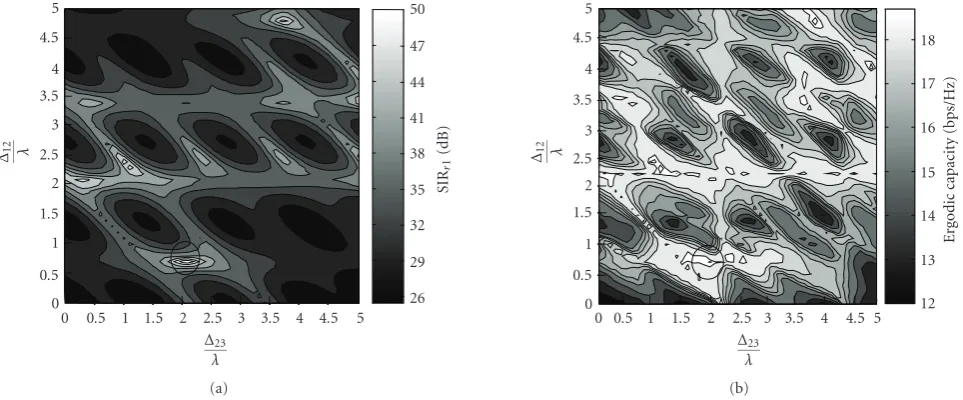
Figure4: Setting-A: rank-2 approximation of the signal-to-interference ratio SIRr2(Δ,η) (23) versusΔ12/λandΔ23/λ(a) compared with
ergodic capacityC(Δ,η) (b) (r=50 m). Circles denote optimal solutions.
the numerical optimization of (8) and (9), and the
impossi-bility to get analytical insight into the properties of the op-timal solution. When the number of antenna array is
suffi-ciently small (as inSection 5), optimization can be
reason-ably dealt with through an extensive search over the opti-mization domain and without the aid of any sophisticated numerical algorithm. On the contrary, in case of an array
with a larger number of antenna elements, more efficient
op-timization techniques (e.g., simulated annealing) may be em-ployed to reduce the number of spacings to be explored and thus simplify the optimization process. Below we will prove (by numerical simulations) that the limitations of the above
optimization (8)-(9) are mitigated by the criteria (4)-(5) still
preserving the final result.
3. SPATIAL CORRELATION MODEL
We consider a propagation scenario where each terminal, be it the user or an interferer, is locally surrounded by a large
number of scatterers. The signals radiated by different
terers add independently at the receiving antennas. The
scat-terers are distributed on a ring of radiusr0around the
ter-minal (ri, i=1,. . .,Mfor the interferers) and the resulting
angular spread of the received signal at the base station is
de-noted byφ0 r0/d0 (orφi ri/di), as inFigure 3. Because
of the finite angular spreads{φi}Mi=0, the propagation model
appears to be well suited for outdoor channels.
In [7], the spatial correlation matrix of the resulting
Rayleigh distributed fading process at the base station is com-puted by assuming a parametric distribution of the scatterers along the ring, namely, the von Mises distribution (variable 0≤ϑ <2πruns over the ring, seeFigure 3):
f(ϑ)= 1
2πI0(κ)exp
κcos(ϑ). (10)
By varying parameter κ, the distribution of the scatterers
ranges from uniform (f(ϑ)=1/(2π) forκ =0) to a Dirac
delta around the main direction of the cluster ϑ = 0 (for
κ → ∞). Therefore, by appropriately adjusting parameterκ
and the angular spreads for each user and interferers φi, a
propagation environment with a strong line-of-sight
com-ponent (φi 0 and/orκ → ∞) or richer scattering (larger
φi with κ small enough) can be modelled. The
(normal-ized) spatial correlation matrix has the general expression
for both user and interferers (for the (p,q)th element with
p,q=1,. . .,Nandi=0, 1,. . .,M) [7]:
It is worth mentioning that spatial channel models based on
different geometries such as elliptical or disk models [10,11]
may be considered as well by appropriately modifying the
spatial correlation (11). Effects of mutual coupling (not
ad-dressed in this paper) between the array elements may be
in-cluded in our framework too, see [12,13].
From (11), the spatial correlation matricesRiof the user
and interferers can be written as
Ri
whereKis an appropriate constant that accounts for
receiv-ing and transmittreceiv-ing antenna gain and the carrier frequency,
andαis the path loss exponent. The contribution of
shad-owing in (12) will be considered inSection 5.3as part of an
0
Figure5: Setting-A: rank-1 approximation (a) of the signal-to-interference ratio, SIRr1(Δ,η), versusΔ12/λandΔ23/λ. Dashed lines denote
the optimality conditions (24) obtained by the rank-1 approximation. As a reference, ergodic capacity is shown (b), for an angular spread approaching zero.
4. REDUCED-RANK APPROXIMATION FOR THE INTERFERENCE POWER
According to a reduced-rank approximation for the
spa-tial correlation matrices of user and interferers Ri fori =
0, 1,. . .,M, in this section, we derive an analytical closed
form expression for the interference power (2) to ease the
optimization of the antenna spacingsΔ. InSection 4.1, we
consider the case where the angular spread for users and
in-terferersφiis small so that a rank-1 approximation of the
spa-tial correlation matrices can be used. This first case describes line-of-sight channels. Generalization to channel with richer
scattering is given inSection 4.2.
4.1. Rank-1 approximation (line-of-sight channels)
If the angular spread is small for both user and
inter-ferers2 (i.e., φ
i 1 for i = 0, 1,. . .,M), the
asso-ciated spatial correlation matrices {Ri}Mi=0, can be
con-veniently approximated by enforcing a rank-1 constraint.
For φi 1, the following simplification holds in (11):
I0(κ2−((2π/λ)Δ
pqφicos(θi))2)/I0(κ) 1. Therefore, the
spatial correlation matrices (12) can be approximated as (we
drop the functional dependency for simplicity of notation)
Riρ·vivHi , (13)
2Rank-1 approximation for the out-of-cell interferers is quite accurate when considering large reuse factors as the angular spread experienced by the array is reduced by the increased distance of the out-of-cell inter-ferers.
From (13), the channel vectors for user and
interfer-ers can be written as hi = γ√ρivi, where γ ∼ CN(0, 1).
Therefore, within the rank-1 approximation, the interference
power reads (the additive noise contributionσ2I
N has been
dropped since it is immaterial for the optimization problem)
P1(Δ,η)=vH0
therefore, optimal spacings with respect to Problem 1 (4) can
be written as
Δ=arg min
Δ P1(Δ,η), (16)
where the subscript is a reminder of the rank-1
approxima-tion. The advantage of the rank-1 performance criterion (15)
is that it allows to derive an explicit expression as a function of the parameters of interest. In particular, after tedious but straightforward algebra, we get
0
Figure6: Setting B: rank-2 approximation of the signal-to-interference ratio, SIRr2(Δ,η), (23) versusΔ12/λandΔ23/λ(a) compared with
ergodic capacityC(Δ,η) (b) (r=50 m). Circles denote optimal solutions.
whereS(x,θn,θm)=cos[2πx(sin(θn)−sin(θm))],L=
As a remark, notice that if there exists a set of antenna
spacingΔsuch that the user vectorv0is orthogonal to theM
interference vectors{vi}Mi=1, then this nulls the interference
power,P1(Δ,η)=0, and thus implies thatΔis a solution to
(16) (and therefore to (4)).
4.2. Rank-a(a >1) approximation
In a richer scattering environment, the conditions on the
an-gular spreadφi 1 that justify the use of rank-1
approx-imation can not be considered to hold. Therefore, a rank-a
approximation witha >1 should be employed (in general)
for the spatial correlation matrix of both user and interferers:
Ri
quired to be linearly independent. In this paper, we limit the
analysis to the casea =2, which will be shown inSection 5
to account for a wide range of practical environments. The
expression of vectorsvi(k)from (11) with respect to the
an-tenna spacings is not trivial as for the rank-1 case. However,
in analogy with (14), we could set
ferers have to be determined according to different criteria.
In order to be consistent with the rank-1 case considered in
the previous section, here we minimize the Frobenius norm
of approximation error matrixRi−
a
vectors. For instance, for a uniform distribution of the
scat-terers along the ring (i.e.,κ=0), it can be easily proved that
the optimal rank-2 approximation (fori=0,. . .,M) results
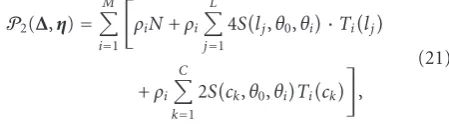
braic manipulations, the performance criterionP2(Δ,η) =
Eh0[hH0Qh0] admits an explicit expression in terms of the
pa-rameters of interest:
P2(Δ,η)=
environments, the angular spread for the in-cell user, ϕ0,
is larger than the out-of-cell interferers angular spreads,
ϕ1,. . .,ϕM(seeSection 5). Therefore, the optimization
prob-lem (4) can be stated as
Δ=arg min
Δ P2(Δ,η). (22)
5. NUMERICAL RESULTS
In this section, numerical results related to the layouts in
Figure 1(N = 4,M = 3,F = 3 for setting A andF = 7
for setting B with a cell diameter = 2 km) are presented.
0
Figure7: Setting-B: rank-1 approximation (a) of the signal-to-interference ratio SIRr1(Δ,η) versusΔ12/λandΔ23/λ. Circular marker
de-notes the optimal solution (24) obtained by the rank-1 approximation. As a reference, ergodic capacity is shown (b), for an angular spread approaching zero.
and the ergodic capacity optimization problems (8), (9) for
Problems 1 and 2, respectively, are considered and com-pared for various propagation environments. For Problem 1, user and interferers are located at the center of their
re-spective allowed sectors (η, as inFigure 1), instead, for
Prob-lem 2 average system performances are computed over the al-lowed positions (herein uniformly distributed) of users and interferers.
Exploiting the rank-a-based approximation (rank-1 and
rank-2 approximations in (17) and (21), resp.), the
inter-ference power (for fixed user and interferers position ηas
for Problem 1, or averaged over terminal positions as for Problem 2) is minimized with respect to the array spac-ings and the resulting optimal solutions are compared to those obtained through maximization of ergodic capacity. Herein, we show that the proposed approach based on in-terference power minimization is reliable in evaluating the optimal spacings that also maximize the ergodic capacity of the system. Since the number of antenna array is
lim-ited to N = 4, ergodic capacity optimization can be
car-ried out through an extensive search over the optimization domain.
The channels of user and interferers are assumed to be
characterized by the same scatterer radius ri = r (for the
rank-2 case) andr → 0 (for the rank-1 case) withκ = 0.
Furthermore, the path loss exponent isα=3.5. The
signal-to-background noise ratio (for the ergodic capacity
simu-lations) is set to Nρ0/σ2 = 20 dB. For the sake of
visual-ization, the rank-aapproximation of the interference power
is visualized (in dB scale) as the signal-to-interference ratio (SIR):
Assuming at first fixed position η for user and
interfer-ers (Problem 1),Figure 4(b)shows the exact ergodic
capac-ity C(Δ,η) forr = 50 m (and thus the angular spread is
φ0 = 5.75 deg,φ1 = φ3 = 0.87 deg,φ2 = 0.82 deg) and
Figure 4(a)shows the rank-2 SIR approximation SIRr2(Δ,η)
(23) versusΔ12andΔ23for setting A. According to both
op-timization criteria, the optimal array has external spacing
Δ121.26λand internal spacingΔ233.6λ. It is interesting
to compare this result with the case of a line-of-sight channel
that is shown inFigure 5. In this latter scenario, the optimal
spacings are easily found by solving the rank-1 approximate
problem (16) as (k=0, 1,. . .)
Conditions (24) guarantee that the channel vector of the user
is orthogonal to the channel vectors of the first and third in-terferers (the second is aligned so that mitigation of its inter-ference is not feasible). Moreover, the optimal spacings for
the line-of-sight scenario (24) form a grid (seeFigure 5(a))
that contains the optimal spacings for the previous case in
Figure 4 with larger angular spread. Notice that, for every practical purpose, the solutions to the ergodic capacity
maxi-mization (Figure 5(b)) are well approximated by SIRr1(Δ,η)
maximization in (23). As a remark, we might observe that
with line-of-sight channels, there is no advantage of
deploy-ing more than two antennas (Δ12 = 0 or Δ23 = 0 satisfy
the optimality conditions (24)) to exploit the interference
14.5
Figure8: Setting B: rank 2 approximation of the signal-to-interference ratioEη[SIRr2(Δ,η)] (a) and ergodic capacityEη[C(Δ,η)] (b) aver-aged with respect to the position of user and interferers within the corresponding sectors forΔ12=Δ23.
(i) large enough spacings have to be preferred to accommo-date diversity; (ii) contrary to the line-of-sight case, there is great advantage of deploying more than two antennas (ap-proximately 5-6 bit/s/Hz) whereas the benefits of deploying more than three antennas are not as relevant (0.6 bit/s/Hz for an optimally designed three-element array with uniform
spacing 3.6λ); (iii) compared to theλ/2-uniformly spaced
ar-ray, optimizing the antenna spacings leads to a performance gain of approximately 2.5 bit/s/Hz.
Let us now turn to the solution of Problem 2 (9). In this
case, the optimal set of spacingsΔshould guarantee the best
performance on average with respect to the positions of user and interferers within the corresponding sectors. It turns out
that the optimal spacings areΔ12=Δ231.9λfor both
op-timization criteria (not shown here), and the (average) per-formance gain with respect to the conventional adaptive
ar-rays withΔ12 = Δ23 = λ/2 has decreased to approximately
0.5 bit/s/Hz. This conclusion is substantially different for sce-nario B as discussed below.
5.2. Setting B (F=7)
For Problem 1, the exact ergodic capacityC(Δ,η) forr =
50 m (and angular spread φ0 = 5.75 deg, φ1 = 0.34 deg,
φ2 = 0.56 deg, andφ3 =0.58 deg) and the rank-2
approx-imation SIRr2(Δ,η) (23) are shown versusΔ12 andΔ23, in
Figure 6, for setting B. In this case, the optimal linear min-imum length array consists, as obtained by both
optimiza-tion criteria, by uniform 2.2λspaced antennas. Optimal
de-sign of linear minimal length array leads to a 2.5 bit/s/Hz capacity gain with respect to the capacity achieved through
an array provided with four uniformlyλ/2 spaced antennas.
Similarly as before, we compare this result with the case of a
line-of-sight channel (Figure 7(a)), where the optimal
spac-ings, solution to the rank-1 approximate problem (16), are
Δ12=Ψ(θ3)0.7λ(external spacing) andΔ23=3Ψ(θ3)
2.2λ(internal spacing)θ3 =43.5 deg. In this case, the
solu-tions (confirmed by the ergodic capacity maximization, see
Figure 7(b)) guarantee that the channel vector of the user is orthogonal to the channel vector of the third (predominant) interferer (the second is almost aligned so that mitigation of its interference is not feasible, the first one has a minor im-pact on the overall performances). As pointed out before, a larger angular spread than the line-of-sight case require-larger spacings to exploit diversity.
As for Problem 2 (9), inFigure 8, we compare the
ana-lytical rank-2 approximationEη[SIRr2(Δ,η)] averaged over
the position of users and interferers with the exact aver-aged ergodic capacity for a uniform-spaced antenna array. The minimal length optimal solutions turn out again to be
Δ12 =Δ23 2.2λ. Moreover, we can conclude that in this
interference layout the capacity gain with respect to the ca-pacity achieved through an array provided with four
uni-formlyλ/2 spaced antennas is 2.5 bit/s/Hz.
5.3. Impact of nonequal power interfering due to shadowing effects
In this section, we investigate the impact of nonequal in-terfering powers caused by shadowing on the optimal an-tenna spacings. This amounts to include in the spatial
cor-relation model (12) a log-normal variable for both user and
interferers asρi = (K/diα)·10Gi/10andGi ∼N(0,σG2i) for
i=0, 1,. . .,M. All shadowing variables{Gi}Mi=0affect
receiv-ing power levels and are assumed to be independent.Figure 9
shows the ergodic capacity averaged over the shadowing
pro-cesses for setting B andr =50 m (as inFigure 6), when the
standard deviation of the fading processes areσG0=3 dB for
the user (e.g., as for imperfect power control) andσGi =8 dB
0 0.5 1 1.5 2 2.5 3 3.5 4 4.5 5
18 17 16 15
14 13
Δ12 λ
Ergodic
capacit
y
(bps/Hz)
Δ23 λ
0 0.5 1 1.5 2 2.5 3 3.5 4 4.5 5
Figure9: Setting B: ergodic capacityC(Δ,η) averaged with respect to the distribution of shadowing (r=50 m). Circle denotes the op-timal solution.
Figure 6, we see that the overall effect of shadowing is that of
reducing the ergodic capacity but not to modify the optimal antenna spacings; similar results can be attained by analyzing the interference power (not shown here).
6. CONCLUSION
In this paper, we tackled the problem of optimal design of linear arrays in a cellular systems under the assumption of Gaussian interference. Two design problems are considered: maximization of the ergodic capacity (through numerical simulations) and minimization of the interference power at the output of the matched filter (by developing a closed form approximation of the performance criterion), for fixed and variable positions of user and interferers. The optimal ar-ray deployments obtained according to the two criteria are shown via numerical optimization to coincide for the con-sidered scenarios. The analysis has been validated by studying
two scenarios modelling cellular systems with different reuse
factors. It is concluded that the advantages of an optimized antenna array as compared to a standard design depend on both the interference layout (i.e., reuse factor) and the prop-agation environment. For instance, for an hexagonal cellular system with reuse factor 7, the gain can be on average as high as 2.5 bit/s/Hz. As a final remark, it should be highlighted that optimizing the antenna array spacings in such a way to improve the quality of communication (by minimizing the interference power) may render the antenna array unsuitable for other applications where some features of the propaga-tion are of interest, such as localizapropaga-tion of transmitters based on the estimation of direction of arrivals.
REFERENCES
[1] J. H. Winters, J. Salz, and R. D. Gitlin, “The impact of antenna diversity on the capacity of wireless communication systems,”
IEEE Transactions on Communications, vol. 42, no. 234, pp. 1740–1751, 1994.
[2] G. J. Foschini and M. J. Gans, “On limits of wireless commu-nications in a fading environment when using multiple an-tennas,”Wireless Personal Communications, vol. 6, no. 3, pp. 311–335, 1998.
[3] F. Rashid-Farrokhi, K. J. R. Liu, and L. Tassiulas, “Transmit beamforming and power control for cellular wireless systems,” IEEE Journal on Selected Areas in Communications, vol. 16, no. 8, pp. 1437–1449, 1998.
[4] J. Saholos, “A solution of the general nonuniformly spaced an-tenna array,”Proceedings of the IEEE, vol. 62, no. 9, pp. 1292– 1294, 1974.
[5] J.-W. Liang and A. J. Paulraj, “On optimizing base station an-tenna array topology for coverage extension in cellular radio networks,” inProceedings of the IEEE 45th Vehicular Technology Conference (VTC ’95), vol. 2, pp. 866–870, Chicago, Ill, USA, July 1995.
[6] R. Jana and S. Dey, “3G wireless capacity optimization for widely spaced antenna arrays,” IEEE Personal Communica-tions, vol. 7, no. 6, pp. 32–35, 2000.
[7] A. Abdi and M. Kaveh, “A space-time correlation model for multielement antenna systems in mobile fading channels,” IEEE Journal on Selected Areas in Communications, vol. 20, no. 3, pp. 550–560, 2002.
[8] P. Zetterberg, “On Base Station antenna array structures for downlink capacity enhancement in cellular mobile radio,” Tech. Rep. IR-S3-SB-9622, Department of Signals, Sensors & Systems Signal Processing, Royal Institute of Technology, Stockholm, Sweden, August 1996.
[9] H. L. Van Trees,Optimum Array Processing, Wiley-Intersci-ence, New York, NY, USA, 2002.
[10] R. B. Ertel, P. Cardieri, K. W. Sowerby, T. S. Rappaport, and J. H. Reed, “Overview of spatial channel models for antenna ar-ray communication systems,”IEEE Personal Communications, vol. 5, no. 1, pp. 10–22, 1998.
[11] T. Fulghum and K. Molnar, “The Jakes fading model incorpo-rating angular spread for a disk of scatterers,” inProceedings of the 48th IEEE Vehicular Technology Conference (VTC ’98), vol. 1, pp. 489–493, Ottawa, Ont, Canada, May 1998. [12] I. Gupta and A. Ksienski, “Effect of mutual coupling on the
performance of adaptive arrays,”IEEE Transactions on Anten-nas and Propagation, vol. 31, no. 5, pp. 785–791, 1983. [13] N. Maleki, E. Karami, and M. Shiva, “Optimization of antenna
![Figure 8: Setting B: rank 2 approximation of the signal-to-interference ratioaged with respect to the position of user and interferers within the corresponding sectors for Eη[SIRr2(Δ,η)] (a) and ergodic capacity Eη[C(Δ,η)] (b) aver- Δ12 = Δ23.](https://thumb-us.123doks.com/thumbv2/123dok_us/921036.1111582/8.600.79.524.73.288/setting-approximation-interference-ratioaged-position-interferers-corresponding-capacity.webp)