R E S E A R C H
Open Access
Class-specific Gaussian-multinomial latent
Dirichlet allocation for image annotation
Zhiming Qian
*, Ping Zhong and Runsheng Wang
Abstract
Image annotation has been a challenging problem due to the well-known semantic gap between two
heterogeneous information modalities, i.e., the visual modality referring to low-level visual features and the semantic modality referring to high-level human concepts. To bridge the semantic gap, we present an extension of latent Dirichlet allocation (LDA), denoted as class-specific Gaussian-multinomial latent Dirichlet allocation (csGM-LDA), in an effort to simulate the human’s visual perception system. An analysis of previous supervised LDA models shows that the topics discovered by generative LDA models are driven by general image regularities rather than the semantic regularities for image annotation. To address this, csGM-LDA is introduced by using class supervision at the level of visual features for multimodal topic modeling. The csGM-LDA model combines the labeling strength of topic supervision with the flexibility of topic discovery, and the modeling problem can be effectively solved by a variational expectation-maximization (EM) algorithm. Moreover, as natural images usually generate an enormous size of
high-dimensional data in annotation applications, an efficient descriptor based on Laplacian regularized uncorrelated tensor representation is proposed for explicitly exploiting the manifold structures in the high-order image space. Experimental results on two standard annotation datasets have shown the effectiveness of the proposed method by comparing with several state-of-the-art annotation methods.
Keywords: Image annotation; Latent Dirichlet allocation; Variational EM; Uncorrelated tensor representation; Laplacian regularization
1 Introduction
Automatic image annotation is a challenging work of tasks related to understanding what we see in a visual scene due to the well-known semantic gap [1]. Given an input image, the goal of image annotation is to assign meaningful tags to the image aiming at summarizing its visual contents. Such methods are becoming more and more important given the growing collections of both private and publicly available images. However, challenges for these methods often lie in three aspects: the inter-tag similarity prob-lem that different tags may have similar visual contents, the tag locality problem that most tags are only related to their corresponding semantic regions, and the intra-tag diversity problem that the relevant regions for each tag at different images can be different.
*Correspondence: [email protected]
College of Electronic Science and Engineering, National University of Defense Technology, Deya Road, 410073 Changsha, China
The inter-tag similarity problem reveals the fact that the visual similarity does not always guarantee the semantic similarity, which in general is conflicting with the inher-ent assumption of many image annotation methods, e.g., some relevant methods [2,3] that perform tag propaga-tions according to their visual similarities. To cope with this problem, it is emergent to develop more discrimina-tive visual features that can be used to separate various visual contents for different tags. However, traditional vector representations in the form of bag-of-features or bag-of-words, such as the visual descriptor that quantizes SIFT local features [3] and the colored pattern appear-ance model (CPAM) [4], are usually incompetent for the intention. The reason is that these features usually ignore the high-order characteristics of natural images and might lead to the curse of dimensionality problem when requir-ing a relatively discriminative representation for describ-ing the complex visual world. In practice, an image is intrinsically a two-dimensional or high-order tensor. To
fairly evaluate the high-order characteristics of image con-tents, tensor representations [5,6], which can explicitly describe the multiple interrelated restrictions, might allow us to avoid the problem of curse of dimensionality.
To tackle the tag locality problem, one may employ local image features instead of holistic image features to describe the visual contents of a certain tag. The work in [7] considered each image as a bag of multiple seg-mented regions and predicted the tag of each region by a multiclass bag classifier. This method, however, heav-ily depends on the segmentation performance, which is very sensitive to the image noise. Recently, implicit image representations attract much attention on describing local regions. To reveal the tag locality, Bao et al. [8] intro-duced hidden concepts for decomposing holistic image representation into tag representations. Mesnil et al. [9] learned implicit representations for both the objects and their parts. Although these representations cannot explic-itly describe the regions of a certain tag, they implicexplic-itly capture the tag’s local visual contents by learning from large amount of annotated images. Thus, implicit image representation is nontrivial for tackling the tag locality problem in large-scale datasets.
Considering the problem of intra-tag diversity, a straightforward way is to set up the class-specific tech-niques [10,11] by treating annotation tags as class labels and learning the visual contents within each class. Although capable of identifying sets of visual contents discriminative for the classes of interest, these straight-forward methods do not explicitly model the interclass and intraclass structures of visual distributions due to its lack of hierarchical content groupings. To facilitate the discovery of these structures, various hierarchical gener-ative methods have been recently ported from the text to the vision literature. Among these methods, topic models, such as latent Dirichlet allocation (LDA) [12] and proba-bilistic latent semantic analysis (pLSA) [13], that consider probabilistic latent variable models for hierarchical learn-ing have caused extensive interest. However, an analysis of previous supervised topic models [14] shows that the top-ics discovered by these models are driven by general image regularities rather than the semantic regularities for image annotation. For example, it has been noted in [14] that given a collection of movie reviews, LDA might discover topics as movie properties, such as genres, which are not central to the annotation task. Therefore, incorporating a class label variable into a generative model might tackle the intra-tag diversity problem well. Such extensions have been successfully applied into the classification task, such as class LDA (cLDA) [14], supervised LDA (sLDA) [15], class-specific-simplex LDA (css-LDA) [16], and so on.
In this paper, we develop a new extension of LDA coupled with Laplacian regularized uncorrelated tensor representation for learning semantics in the image data.
Since tensor representation can well capture the high-order statistics and structures from the training data, the proposed representation method achieves an efficient compressed image representation by imposing noncorre-lation constraints and Laplacian regularization in tensor factorization. Based on this representation, a three-level hierarchical probabilistic model, denoted as class-specific Gaussian-multinomial latent Dirichlet allocation (csGM-LDA), is developed by using class supervision at the level of visual features. In csGM-LDA, latent variables or top-ics are served as middle-level concepts for building the correspondences between visual features and annotation tags.
The core contributions of this paper are listed as follows:
• A novel hierarchical probabilistic model, namely csGM-LDA, is presented by combining the labeling strength of topic supervision with the flexibility of topic discovery, and can be effectively modeled by applying a variational EM algorithm.
• An effective image representation method, namely, Laplacian regularized uncorrelated tensor
representation, is developed to explicitly consider the manifold structures in the high-order image space. • By learning with csGM-LDA, a unified framework is
introduced to infer the hierarchies of multiple modalities and predict tags for a new image. Benefiting from the exploration of hierarchical probabilistic inferences, the unified framework can be effectively conducted.
The rest of this paper is organized as follows. We first discuss the related work in Section 2. Then, we present Laplacian regularized uncorrelated tensor representation in Section 3. After that, the proposed model is described in Section 4. Moreover, quantitative experiments vali-dating strong improvements by the proposed method are presented in Section 5. Finally, Section 6 draws the conclusion.
2 Related work
In this section, we outline research contributions which are most related to our work. We first review techniques for tensor-based image representation. Then, topic mod-els are further discussed.
2.1 Tensor-based image representation
However, approximative image representation using ten-sor subspace learning techniques in many cases can be helpful for describing various visual objects. In this paper, we discuss two main kinds of tensor subspace learning (TSL) algorithms: supervised and unsupervised TSL.
Supervised TSL algorithms use concept-driven dimen-sionality reduction to achieve discriminant tensor sub-spaces by considering the subsequent classification or recognition tasks. This line of algorithms requires that either manual class labels or object priors in the training set can be applicable to a particular image classifica-tion [5,6] or object representaclassifica-tion [17,18]. However, as image annotation system needs to handle a large num-ber of classes and most classes may require many training samples due to significant intraclass shape and appear-ance variations, it is important that the learning does not involve any human interaction. This makes unsuper-vised TSL algorithms more appealing. Unsuperunsuper-vised TSL algorithms are actively explored for data-driven dimen-sionality reduction that uses low rank tensors to approx-imate the exact represented tensors. The extensions of principal component analysis (PCA) and singular value decomposition (SVD) are most familiar methods for the research on this line. By maximizing the variance mea-sure, two-dimensional PCA (2DPCA) [19] represented an image by projecting it to principal components along the vertical direction of the image data. Then, generalized PCA (GPCA) [20] employed bilinear subspace analysis for dimensionality reduction with matrices. Later, the multilinear PCA (MPCA) [21] and uncorrelated MPCA (UMPCA) [22] were proposed for dimensionality reduc-tion with tensors of any order. By minimizing the recon-struction error, the generalized low-rank approximation of matrices (GLRAM) [23] took into account the spatial correlation of image pixels within a localized neighbor-hood and applied bilinear transforms to the input image matrices. For higher-order tensors, the work in [24] used the high-order SVD (HOSVD) to decompose an ensem-ble of images into basis images that capture the different underlying factors of variations. Furthermore, concurrent subspaces analysis (CSA) [25] was presented as a gener-alization of GLRAM for higher-order tensors. Recently, multiple tensor rank-Rdecomposition (MTRD) [26] was proposed for approximating a higher-order tensor with a series of rank-Rtensor approximations.
In this paper, we propose an unsupervised method with Laplacian regularized uncorrelated tensor representation to explicitly consider manifold structures in the high-order image space. That is, data points that are close in the intrinsic geometry of the image space shall thus be close to each other under the factorized tensor basis. By com-bining unsupervised TSL and Laplacian regularization, we can achieve a more discriminative descriptor which is much important for accurate semantic learning.
2.2 Topic models for image annotation
Topic models annotate images as the samples from a specific mixture of topics, where each topic is a dis-tribution over image observations. Three alternatives of pLSA-based models that provided in [13] were presented by using asymmetric learning for semantic indexing of large image collections. Then, a Gaussian-multinomial pLSA (GM-pLSA) model [27] was presented to learn multimodal correlations from the image data by apply-ing continuous feature vectors. Furthermore, the work in [28] extended pLSA to a higher-order formalism, so as to become applicable for more than two observable vari-ables. However, pLSA-based models are incomplete in that they provide no probabilistic restriction on how to generate the training data. In these models, each image is represented as a list of the mixing proportions for top-ics, and there is no probabilistic inference for generating these numbers of topics. This leads to two problems: first, the number of modeling parameters grows linearly with the size of the training set, which leads to serious prob-lems with overfitting; second, it is not clear how to assign probability to an image outside of the training set. To over-come these problems, it is much effective to endow the topic model with Dirichlet priors over topic parameters as they are conjugate to the multinomial distribution of the associated tags. The correspondence LDA (Corr-LDA) [29] was first presented for modeling the joint distribu-tion of images and tags. To capture more general forms of association and allow the number of topics in the two data modalities to be different, topic regression multimodal latent Dirichlet allocation (tr-mmLDA) [30] was proposed by introducing a regression module to correlate the two sets of topics. Taking advantage of limited tagged train-ing images and rich untagged images, the work in [31] proposed a regularized semi-supervised latent Dirichlet allocation (r-SSLDA) for learning visual concept classifiers in a semi-supervised way. However, several supervised methods [14-16] show that the topics discovered by LDA models are driven by general image regularities rather than the semantic regularities for image annotation. To address this, we propose a new three-level hierarchical probabilistic model by incorporating supervision into the extended LDA model, making the annotation applications be much effective than previous LDA models.
3 The proposed representation method
In this section, we first give the notations that are nec-essary in defining the multiway problem. Then, a tensor-based method is proposed for visual representation.
3.1 Notations and definitions
We follow the notation conventions in tensor algebra [32]. Vectors are usually denoted by lowercase letters, e.g.,
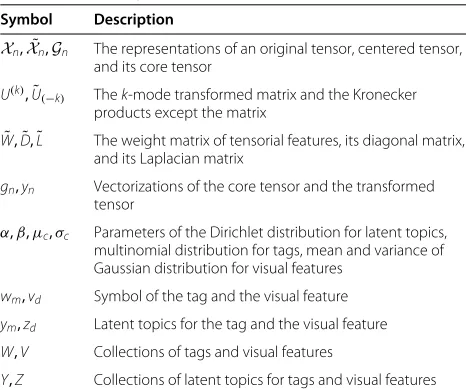
calligraphic letters, e.g., X. Their elements are denoted with indices in parentheses. Table 1 lists the key notations. The inner product of two tensors of the same size A,B ∈ RI1×I2×···×IN is defined as A,B =
i1
i2· · ·
iNA(i1,i2,· · ·iN)·B(i1,i2,· · ·iN). Thus, the Frobenius norm ofAcan be denoted byAF =√A,A. Then-mode matricization ofA ∈ RI1×I2×···×IN, denoted asA(n)∈RIn×(I1×···×In−1×In+1×···×IN), are obtained fromA by varying the indexinwhile keeping all the other indices fixed. The n-mode product of a tensor A by a matrix
U∈RJn×In, denoted byA×
nU, is a tensor with entries:
(A×nU)(i1,· · ·,in−1,jn,in+1,· · ·,iN)
=
in
A(i1,· · ·,iN)·U(jn,in) (1)
3.2 Laplacian regularized uncorrelated tensor representation
For image representation, we first represent a two-dimensional imageIwith an exact tensor representation, X ∈RI1×I2×I3, where{I
1,I2}denotes the size of the image andI3denotes the depth of image feature maps. In this representation, we consider the edge energies and the flow directions as supplementary to pixel-wise color informa-tion. At this point, we employ the Gaussian derivative (GD) and the difference of offset Gaussians (DoG), as defined in [33], for defining these features. The filter banks by convolving GD and DoG functions can be defined as:
⎧ ⎨ ⎩
Eσ(I(x,y))=I(x,y)∗GDσ,0(x,y)2+I(x,y)∗GDσ,π/2(x,y)2 Fσ(I(x,y))=I(x,y)∗DoGσ,0(x,y)2+I(x,y)∗DoGσ,π/2(x,y)2
(2)
Table 1 List of key notations
Symbol Description
Xn,X˜n,Gn The representations of an original tensor, centered tensor,
and its core tensor
U(k),U˜(−k) Thek-mode transformed matrix and the Kronecker
products except the matrix
˜
W,D˜,L˜ The weight matrix of tensorial features, its diagonal matrix, and its Laplacian matrix
gn,yn Vectorizations of the core tensor and the transformed
tensor
α,β,μc,σc Parameters of the Dirichlet distribution for latent topics,
multinomial distribution for tags, mean and variance of Gaussian distribution for visual features
wm,vd Symbol of the tag and the visual feature
ym,zd Latent topics for the tag and the visual feature
W,V Collections of tags and visual features
Y,Z Collections of latent topics for tags and visual features
where(x,y)denotes the coordinates of the image andσ is a scale parameter. Then, the image can be represented by:
X =[Y CbCrEσ/2(Y)Eσ(Y)E2σ(Y)Fσ/2(Y)Fσ(Y)F2σ(Y)] (3)
whereY,Cb,Cr are the three color channels obtained by transforming the original RGB image.
Let{Xn|Xn ∈ RI1×I2×I3,n = 1,· · ·,N}be a set of rep-resented tensors from an image dataset. To learn uncorre-lated features without loss of generality, training samples are subtracted to be zero-mean so that the constraint of uncorrelated features is the same as orthogonal projected features. Usually, the image space is always of high dimen-sionality. However, image contents are typically embedded in a lower dimensional tensor subspace, in analogy to the dimensional reduction problem that considers both fea-ture selection (i.e., give a more informative description to pixels) and spatial correlation. Thus, the task is to find a tensor subspace that captures most of the characteristics in the input space, i.e., define multilinear transformations
{U(k) ∈RIk×Jk,k = 1, 2, 3| U(k)TU(k) =I}that rewrite the original tensor as:
˜
Xn≈Gn×1U(1)×2U(2)×3U(3) (4)
where X˜n = Xn− ¯X, X¯ = (1/N)
N
n=1Xn andGn ∈ RJ1×J2×J3 is a core tensor. To capture the core tensor,
we determine the objective function with the following minimization problem:
U(k)∈RIk×Jk,G n|
U(k)TU(k)=I
=arg min U(k),Gn
+λMG
(5)
where = Nn=1X˜n−Gn×1U(1)×2U(2)×3U(3) 2
F, and MG = GTLG˜ = ijW˜(i,j) gi−gj
2 2. Here,
gn∈RD,D=3k=1Jk
is the vectorization ofGn, andG is a matrix with the column of gn. Define the diagonal matrix D˜ whose entries are column sums of the weight matrixW˜, andL˜= ˜D− ˜Wis a Laplacian matrix. The near-est neighbor graph is used to construct the weight matrix by finding the nearest neighbors for each image data. We useNN(Xn)to denote the set ofKNN nearest neighbors of Xn. The weight matrix can be simply defined as:
W(i,j)=
1 if Xi∈NN(Xj)orXj∈NN(Xi)
To solve the problem defined in Equation 5, an alternat-ing iteration scheme is applied. Given all the projection matrices {U(k) ∈ RIk×Jk,k = 1, 2, 3}, we can obtain that:
{Gn,n=1,· · ·,N} =arg min
Gn Y+λMG
(7)
where Y = Nn=1yn−gn2F, yn = vec
˜
Xn×1
U(1)T× 2 U(2)
T
×3 U(3)
T
. The above function defines a quadratic programming problem and can be solved linearly by using the Newton-Raphson method [12] with the following iteration:
gn(t+1)=gn(t)−(I+λL˜)−1 ⎛
⎝gn(t)−yn+λ j
˜
L(n,j)gj(t) ⎞ ⎠ (8)
Given the core tensorGn, we can rewrite Equation 5 as:
{U(k)∈RIk×Jk,k=1, 2, 3|U(k)TU(k)=I} =arg min U(k)
(9)
Since the projection to a high-order tensor subspace consists of several projections to the corresponding vec-tor subspaces, the optimization can be iteratively solved by finding thek-mode projection that maximizes the scat-ter in thek-mode vector subspace. To optimizeU(k), we first define two scatter matrices:
(k)
G =
N
n=1Gn(k)U˜(T−k)U˜(−k)GTn(k) (k)
X =
N
n=1X˜n(k)U˜(−k)GTn(k)
(10)
whereU˜(−k)=U(1)⊗ · · · ⊗U(k−1)⊗U(k+1)⊗ · · · ⊗U(3) and ‘⊗’ denotes theKronecker product. Then, the solution to Equation 9 can be achieved by:
U(k)=G(k)−1(Xk) (11)
The pseudo code for the proposed representation method is described in Algorithm 1. For this repre-sentation, a full solution is referring to the formal-ism in Equation 5. However, the alternating solution for this problem is quadratic with respect to the num-ber of the image dataset, which is much expensive for image representation when dealing with a large dataset. In real applications, we perform the above representa-tion method with a much smaller size by first using graph shift [34] for image clustering and then learn-ing the representation for each group. Noticeably, the image data of one group should subtract the projections of previous multilinear transformations to preserve the orthogonality.
Algorithm 1:Laplacian regularized uncorrelated tensor representation
Input: A group of image samples{Xn|Xn ∈ RI1×I2×I3, n=1,· · ·,N}
Output: Multilinear transformations {U(k) ∈ RIk×Jk,
k=1, 2, 3}and core tensors{Gn,n=1,· · ·,N}
Step 1: Center the input image samples as { ˜Xn| ˜Xn = Xn− ¯X,n=1,· · ·,N}.
Step 2: Calculate the eigen-decomposition of S(k) =
N
n=1X˜n(k)X˜nT(k), and set U(k) to consist of the least number of the eigenvectors corresponding to the largest
Jkeigenvalues.
Step 3: Iteratively compute{Gn,n=1,· · ·,N}according to Equation 8.
Step 4: Update{U(k) ∈ RIk×Jk,k = 1, 2, 3}according to Equation 11.
Step 5: Alternately perform steps 3 and 4 until convergence.
4 The proposed annotation method
In this section, we first describe the proposed method for image annotation. Then, we turn our attention to parameter estimation for the modeling problem. Finally, a unified framework is presented to infer the hierar-chies of multiple modalities and predict tags for a new image.
4.1 Class-specific Gaussian-multinomial latent Dirichlet allocation
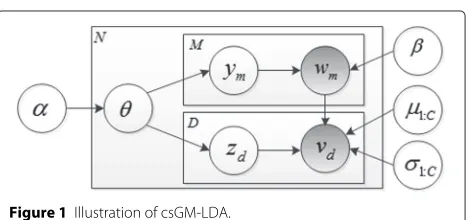
The proposed model, csGM-LDA, is a supervised proba-bilistic model for learning multiple relationships between images and tags. The basic idea is that the visual and semantic modalities of images are represented as ran-dom mixtures over multiple latent topics, where each topic is characterized by a distribution over each modal-ity. In Figure 1, the generative process of csGM-LDA for an image-tag pair with M associated tags and D visual features is given as follows:
1. Draw an image topic proportionθ ∼P(θ;α) 2. For each associated tag
wm∈W= {1,· · ·,C},m=1,· · ·,M
(a) Draw a topic assignment,
ym∼PY|(ym|θ),ym∈Ty= {1,· · ·,K} (b) Draw a tag,wm∼PW|Y(wm|ym;β),wm∈
W= {1,· · ·,C}
3. For each visual wordvd,d=1,· · ·,D
(a) Draw a topic assignment,
zd∼PZ|(zd|θ),zd∈Tz= {1,· · ·,K} (b) Draw a visual description,
vd ∼PV|Z,W(vd|zd,wm;μwm,σwm)
Similar to the earlier LDA extensions,P(·)is a Dirich-let distribution on the topic simplex θ ∈ RKwith the parameter α ∈ RK, PY|(·) and PZ|(·) are two multi-nomial distributions over the topic simplex θ, PW|Y(·) is a categorical distribution over a topic ym with the parameter β ∈ RK×C where β(k,c) = p(w
m =
c|ym = k), and PV|Z,W(·) is a Gaussian distribu-tion over a topic zd with the class-dependent param-eters μwm(zd,d),σwm(zd,d)|μwm,σwm ∈RK×D
. In this way, semantic topics generate tags or classes for images with each defining a prior distribution in visual topic space. Taking Bayesian rules, the joint distribution of
θ,ym,wm,zd,vd
for each image is given by:
P,Y,W,Z,V(θ,ym,wm,zd,vd|α,β,μwm,σwm)=
P(θ|α)PY|(ym|θ)PW|Y(wm|ym,β)PZ|(zd|θ) PV|Z,W(vd|zd,μwm,σwm)
(12)
The modeling problem is then to maximize the log likelihood of the following marginal function:
PW,V(W,V|α,β,μ1:C,σ1:C)=
θn N n=1
M m=1
D d=1
ynm
znd
P,Y,W,Z,V(θn,ynm,wnm,znd,vnd|α,β,μwnm,σwnm)dθn (13)
In csGM-LDA, the parameters {α,β,μ1:C,σ1:C} are dataset-level parameters, assumed to be sampled once in the process of generating a set of images. The variables θn is an image-level variable, sampled once per image. The variablesynm andwnm are tag-level variables, sam-pled once for each annotated tag. And the variables znd and vnd are structure-level variables, sampled once for each visual description. Structural models similar to that shown in Figure 1 are often studied in Bayesian statisti-cal modeling, where they are referred to as conditionally independent hierarchical models. Indeed, as we discuss in the following subsection, we adopt the empirical Bayes approach to estimating parameters with a variational EM algorithm.
4.2 Parameter estimation via variational inference In this section, we describe a convexity-based variational algorithm for parameter estimation. The basic idea of
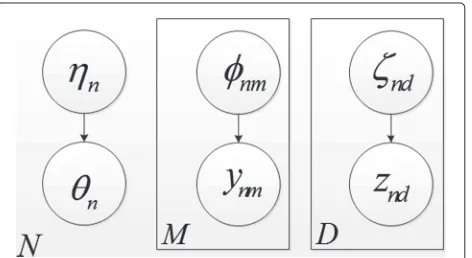
convexity-based variational inference is to make use of Jensen’s inequality to obtain an adjustable lower bound on the log likelihood [13]. Essentially, a family of lower bounds is usually indexed by a set of variational param-eters. The variational parameters are chosen by an opti-mization procedure that attempts to find the tightest possible lower bound. In particular, the objective function in Equation 13 is usually intractable due to the couplings between θn and {β,μ1:C,σ1:C} in the summation over latent topics. By dropping these edges and endowing the simplified graphical model with free variational parame-ters, we obtain a new family of distributions on the latent variables as seen in Figure 2. The variational distribution
q(θ,Y,Z|η,φ,ζ)can be characterized by:
q(θ,Y,Z|η,φ,ζ)= N
n=1 q(θn|ηn)
M
m=1
q(ynm|φnm) D
d=1
q(znd|ζnd)
(14)
where {Y,Z} are the collections of latent topics, the Dirichlet parameterηn, and the multinomial parameters {φnm,ζnd}are the free variational parameters.
Having specified a simplified family of probability distri-butions, the next step is to set up an optimization problem that determines the values of the variational parameters:
η∗,φ∗,ζ∗=arg min
{η,φ,ζ}DKL(q(θ,Y,Z|η,φ,ζ)
||P,Y,Z(θ,Y,Z|W,V,α,β,μ1:C,σ1:C) (15)
whereDKL(·)is the Kullback-Leibler (KL) divergence and {W,V} are the corresponding collections of their low-ercase variables. To achieve this minimization, we begin with the expression of the true log-likelihood for an image-tag pair{W,V}by bounding the log likelihood of
PW,V(W,V|α,β,μ1:C,σ1:C)using the Jensen’s inequality:
logPW,V(W,V|α,β,μ1:C,σ1:C) ≥
Eq[ logP,Y,W,Z,V(θ,Y,W,Z,V|α,β,μ1:C,σ1:C)] −Eq[ logq(θ,Y,Z|η,φ,ζ)]
(16)
It can be easily verified that the difference between the two sides of the above inequation is the KL divergence that provided in Equation 15. LetL(η,φ,ζ;α,β,μ1:C,σ1:C) denote the right-hand side of the inequation, we have:
logPW,V(W,V|α,β,μ1:C,σ1:C)=L(η,φ,ζ;α,β,μ1:C,σ1:C)+ DKL q(θ,Y,Z|η,φ,ζ)||P,Y,Z(θ,Y,Z|W,V,α,β,μ1:C,σ1:C)
(17)
This shows that maximizing the lower bound L(η,φ,ζ;α,β,μ1:C,σ1:C)with respect to{η,φ,ζ}is equiv-alent to minimizing the above KL divergence. As seen in the Appendix, we obtain pair of updates:
⎧
Based on the above variational inference, parameter estimation with respect to{α,β,μ1:C,σ1:C}yields the fol-lowing EM algorithm:
1. E-step: For each image, find the optimizing values of the variational parameters{η,φ,ζ}.
2. M-step: Maximize the resulting lower bound L(η,φ,ζ;α,β,μ1:C,σ1:C)on the log likelihood of PW,V(W,V|α,β,μ1:C,σ1:C)with respect to the model parameters{α,β,μ1:C,σ1:C}.
The update in the M-step corresponds to finding maximum likelihood estimates with expected sufficient statistics for each image under the approximate pos-terior which is computed by the variational parame-ters. Thus, we can also maximize the lower bound L(η,φ,ζ;α,β,μ1:C,σ1:C) with respect to the parameters {α,β,μ1:C,σ1:C}. In Appendix, we show that the update in the M-step for the Dirichlet parameterα can be imple-mented with an efficient Newton-Raphson method. The parameters{β,μ1:C,σ1:C}can be obtained as:
We summarize the parameter estimation algorithm in Algorithm 2. This is a standard EM process, and the lower boundL(η,φ,ζ;α,β,μ1:C,σ1:C) is a concave func-tion. Therefore, Algorithm 2 is convergent. From the
pseudo code, it is clear that each iteration of the E-step for csGM-LDA requiresO(NMDK)operations. Empirically, we find that the number of iterations in this step is in proportion to the number of tags and the dimensionality of visual features. Parameter estimation in M-step for
{β,μ1:C,σ1:C}requiresO(NCMDK)operations. And the number of iterations required for the Newton-Raphson method is linear to the dimensionality ofα. Therefore, each EM iteration yields a total number of operations roughly on O(NM(C+M+D)DK). The number of iterations for the EM algorithm is mainly determined by the number of involved parameters, which is in propor-tion toC(1+D)K. Thus, the complexity for building the proposed model is about O NCM(C+M+D)D2K2. When coping with large-scale data (i.e.,N K,C,D), the complexity of our modeling system is approxi-mately linear to the number of images, which is much effective by comparing with the typical quadratic anno-tation models (e.g., pLSA [13] that requires O N2KC operations, GM-pLSA [27] that yields the number of operations roughly on O N2K2C, and so on).
Algorithm 2:Parameter estimation for csGM-LDA
Input:Observations{vnd,wnm,n = 1,· · ·,N,m = 1,· · ·, M,d=1,· · ·,D}
Output:Modeling parameters{α,β,μ1:C,σ1:C}
repeat In E-step:
For each image in the image dataset, initialize
φnm(k)=ζnd(k)=1/Kby indexing allm,d, andk;
4.3 A unified framework for image annotation
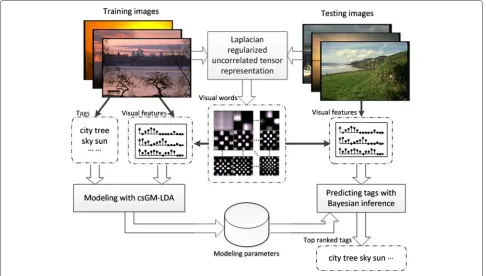
The unified framework is illustrated in Figure 3. Laplacian regularized uncorrelated tensor representation is first per-formed on the whole dataset. Then, both the semantic and the visual modalities are incorporated into building the proposed model. To annotate a new image, we first get the corresponding core tensor and then predict potential tags with Bayesian inference.
Figure 3Illustration of the proposed framework for image annotation.
annotated tags. Taking Bayesian rules, we can infer their posterior probability by:
PW|V(w|v1:D,α,β,μw,σw)=PWPV,V((vw1:,vD1:|αD,|αβ,,μβ,wμ,σww,σ)w)
=
θP(θ|α)yPY|(y|θ)PW|Y(w|y,β)zdPZ|(zd|θ)PV|Z,W(vd|zd,μw(zd,d),σw(zd,d))
dθ
θP(θ|α)zdPZ|(zd|θ)PV|Z,W(vd|zd,μw(zd,d),σw(zd,d))dθ
(20)
For simplicity, we employ Monte Carlo inference [35] to approximate the integral ofθ. To get the above proba-bility, we first generate samples{θs,s=1,· · ·,S}from the posteriorθs∼P(θ|α). Then, the tags’ probability can be rewritten by:
PW|V(w|v1:D,α,β,μw,σw)≈ S
s=1
yPY|(y|θs)P
W|Y(w|y,β)zdPZ|(zd|θs)PV|Z,W(vd|zd,μw,σw)
S s=1
zdPZ|(zd|θs)PV|Z,W(vd|zd,μw(zd,d),σw(zd,d))
(21)
5 Experiments
To evaluate the performance of our annotation frame-work, we set up several quantitative experiments. First, we investigate the effects of the setting parameters by con-ducting cross validation to select the best parameters for our proposed model. Then, we give a comparison of differ-ent image represdiffer-entations and validate the effectiveness of our representation method. Finally, we evaluate the pro-posed method on two benchmark datasets and report the results over state of the art.
5.1 Datasets and representations
We evaluate the proposed framework on two well-known benchmarks: Corel-5K [36] and ESP-Game [37]. The details of the two image datasets are shown in Table 2. The training percentage of each dataset is set as 80%, a validation set occupies 10% of the total images, and the remainder is the test set.
To get a reasonable size that keeps the images from serious deterioration for our representation method, we fix the size of images in Corel-5K and ESP-Game as 128×192and225×169, respectively. The vectorization of the core tensor constituting theD-dimensional Lapla-cian regularized uncorrelated tensorial vector (LGUTV) can be viewed as an image descriptor, with each item corresponding to an uncorrelated elementary multilin-ear projection. In our experiment, the dimensionality of LGUTV is fixed as 128 for each group in both the two datasets. We further divide the Corel-5K and ESP-Game into five and ten groups by graph shift [34], resulting in a 640-dimensional vector and a 1,280-dimensional vec-tor for these two datasets, respectively. In addition, we
Table 2 Statistics of two image datasets
Dataset Number of tags Number of images Tags per image
Corel-5K 5,000 374 3.4
compare the proposed representation method with sev-eral common representation methods, i.e., the quantified color histograms with 16 bins in each color channel for RGB, LAB, HSV representations (C-HIST), the quantified SIFT features both extracted densely on a multiscale grid (D-SIFT) or for Harris-Laplacian interest points (H-SIFT) [3], local binary patterns (LBP) [38], and CPAM [4]. To get a proper evaluation of these image descriptors, we set their dimensions equal to that of LGUTV.
5.2 Evaluation criteria and baselines
The performance of image annotation is evaluated by comparing the automatically generated tags for the test set with the human-produced ground truth. In this paper, we give the following two measures for annotation evalua-tion. Firstly,F1score is measured by computing precision (Prec) and recall (Rec) for fixed annotation length with the five most relevant tags.
F1=
2×Prec×Rec
Prec+Rec (22)
Note that each image is forced to be annotated with five tags, although the image might have fewer or more tags in the ground truth. Therefore, even if a model predicts all ground truth tags with a significantly higher probabil-ity than other tags, we will not measure perfect precision and recall. Thus, we also measure the precision at differ-ent levels of the recall for assessing the general annotation performance. The mean average precision (mAP) [13] over tags are found by computing for each tag the aver-age of precisions measured after each relevant imaver-age is retrieved.
mAP= 1 Nq
Nq
q=1
i∈rel(q)
Prec(i)!rel(q) (23)
where Prec(i) is the precision of the correctly retrieved images at rankiin the ranking results of a queryq,rel(q)
is the set of relevant images for this query, andNqis the number of all queries.
For all images in the two standard datasets, our methods are compared with several most relevant and state-of-the-art methods, including TagProp [3], pLSA [13], GM-pLSA [27], GM-LDA [29], Corr-LDA [29], topic regression mul-timodal latent Dirichlet allocation (tr-mmLDA) [30], and css-LDA [16].
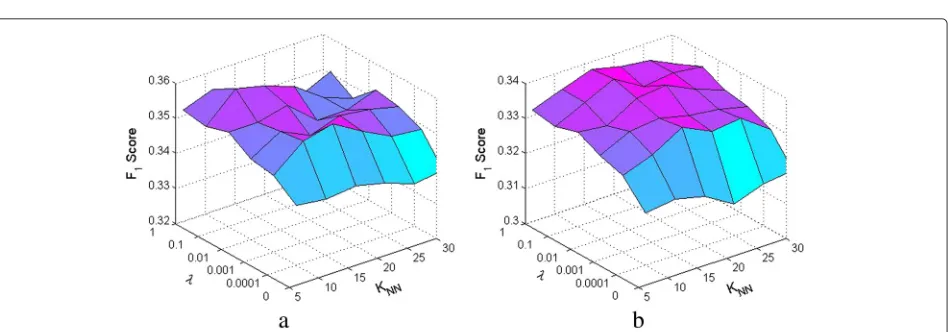
5.3 Investigate the impact of the setting parameters We first investigate the neighborhood size KNN for the graph construction and the tradeoff parameterλfor eval-uating the effectiveness of Laplacian regularization. These two parameters reflect different facets of data construc-tion; we joint discuss the sensitivity of these two param-eters. As seen in Figure 4, we measure theF1scores for different parameters by setting the number of latent top-ics equal to the number of tags. Then, we choose to set the two parameters as the most promising for the two datasets in the following experiments, which areKNN = 10,λ = 0.1for Corel-5K andKNN = 15,λ = 0.1for ESP-Game, respectively. Besides, we observe that Laplacian regular-ization can achieve a more effective representation for better semantic learning by comparing the case thatλ=0 with the case thatλ=0.
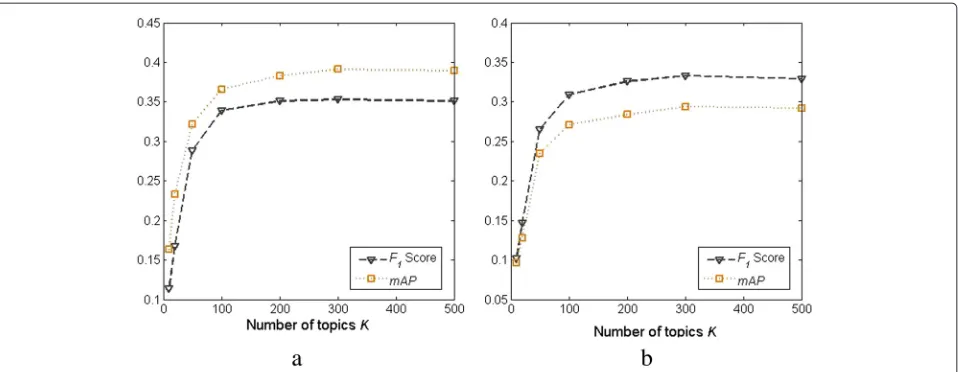
Regarding topic models, they require the number of latent topics (i.e.,K) to be estimated, as this hyper param-eter defines the capacity of the model. We analyze the parameter with a cross validation scheme. As seen in Figure 5, the improvement of annotation performance grows much slowly when the number of latent topics arrives at 100 for both the two datasets. When this num-ber increases over the total numnum-ber of tag vocabularies, csGM-LDA might suffer from the overfitting problem.
Figure 4Investigation of the neighborhood size and the tradeoff parameter.F1score is measured to evaluate the performance of csGM-LDA by
Figure 5Investigation of the number of latent topics. The performance of csGM-LDA is evaluated by taking different number of latent topics in terms ofF1score andmAPon(a)Corel-5K and(b)ESP-Game.
For example, the measures ofF1score andmAP in both Figure 5a,b decrease when the number of latent topics is larger than 300. In the following experiments, we set the parameter as K = 300, which achieves the best performance for both the two datasets.
5.4 Evaluation of different image representations In this paper, we argue that traditional vector-based image representations ignore high-order characteristics in image space, and thus, we combine unsupervised TSL and Lapla-cian regularization for achieving a more discriminative descriptor, i.e., LGUTV. To evaluate its effectiveness, we compare this descriptor with several state-of-the-art image descriptors on the two datasets by measuring F1 Scores for the results of csGM-LDA. As seen in Figure 6, the performance of modeling csGM-LDA with LGUTV achieves the best performance by comparing with oth-ers on both the two datasets, confirming that tensor
representation is most likely to provide a discriminative descriptor for recognizing the complex visual scenes.
5.5 Comparison with existing methods
In this section, we perform the annotation tasks on both the Corel-5K and ESP-Game datasets by comparing the proposed method with others. In Table 3, we report the performance by measuring bothF1score andmAPfor dif-ferent methods based on LGUTV. On both two datasets, we observe that class-specific methods (e.g., TagProp, css-LDA, and csGM-LDA) obviously perform better than oth-ers. This is consistent with the analysis in the introduction since the generative domains of the complex visual world are much hard to describe. In addition, the measures for ESP-Game are consistently lower than that for Corel-5K because the retrieval tasks on which these measures are now computed are more challenging: an average of nearly 2,000 images for testing (versus 500 images) are ranked.
Table 3 Comparison of different methods on both Corel-5K and ESP-Game
Corel-5K ESP-game
Methods F1Score mAP F1score mAP
TagProp 0.342 0.374 0.323 0.281
pLSA 0.193 0.235 0.185 0.156
GM-pLSA 0.254 0.289 0.213 0.179
GM-LDA 0.276 0.303 0.224 0.192
Corr-LDA 0.316 0.354 0.288 0.253 tr-mmLDA 0.323 0.361 0.295 0.259
css-LDA 0.350 0.391 0.325 0.282
csGM-LDA 0.353 0.394 0.334 0.290
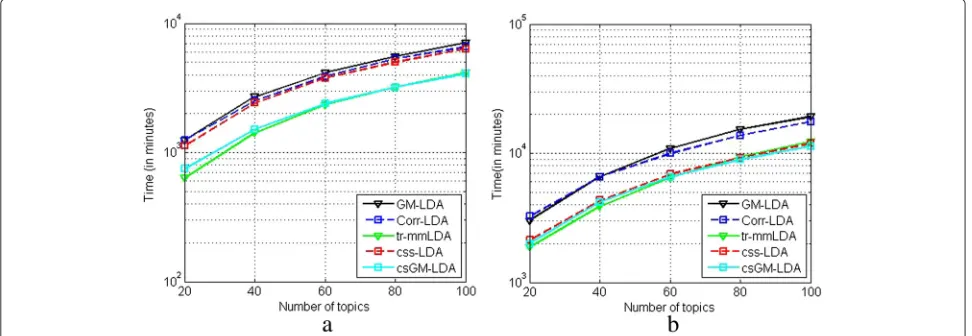
The proposed method achieves much more improve-ment on the ESP-Game dataset by comparing with a bit improvement on the Corel-5K dataset, demonstrating its effectiveness of modeling the large-scale dataset. For all the test sets, our proposed method performs best, and the instantiations of csGM-LDA and css-LDA clearly outper-form others. We further compare the time required for training of different LDA models on ESP-Game and Corel-5K on a Intel Core i5-2410M CPU 2.30 GHz processor. Figure 7 gives the results. We observe that csGM-LDA is much faster than css-LDA. The reason is probably that the number of parameters in css-LDA is much larger than that of csGM-LDA. All the above results show the efficiency of our method.
6 Conclusions
In this paper, we propose a novel model, denoted as csGM-LDA, based on Laplacian regularized uncorrelated tensor representation for image annotation. The pro-posed annotation possesses two characteristics, namely: 1) images are represented by a set of uncorrelated
tensorial descriptions and 2) class-specific information is integrated into semantic learning with the extension of the standard LDA model. The entire problem is formulated within the proposed framework, and csGM-LDA is pre-sented to bridge the semantic gap between image contents and annotated tags. The experimental results demonstrate the effectiveness of our proposed method. Following the research on this line, we will further exploit region-based tensorial features for discriminative image representation and discuss the correlation of the class-specific informa-tion in a hierarchical LDA formalism.
Appendix
To maximize the lower bound in the E-Step that described in Section 4, we begin by expanding it with the fac-torizations ofP,Y,W,Z,V(θ,Y,W,Z,V|α,β,μ1:C,σ1:C)and q(θ,Y,Z|η,φ,ζ):
L(η,φ,ζ;α,β,μ1:C,σ1:C)=Eq[ logP(θ|α)]
+Eq[ logPY|(Y|θ)]+Eq[ logPW|Y(W|Y,β)]
+Eq[ logPZ(Z|θ)]+Eq[ logPV|Z,W(V|Z,W,μ1:C,σ1:C)]
−Eq[ logq(θ|η)]−Eq[ logq(Y|φ)]−Eq[ logq(Z|ζ )] We unfold each item, and obtain:
P(θ|α)= (
kα(k))
k(α(k))
k
θ(k)α(k)−1,
PY|(ym|θ)=θ(ym)
PZ|(zd|θ)=θ(zd),PW|Y(wm|ym,β)=β(ym,wm)
PV|Z,W(vd|zd,μwm,σwm)=
1 √
2πσwm(zd,d)
×exp
−(vd−μwm(zd,d)) 2
2σ2
wm(zd,d)
To evaluate L(η,φ,ζ;α,β,μ1:C,σ1:C), we should mea-sure Eq(logθ). We find that the sufficient statistic in defining P(θ|α) islogθ(k). Since the derivative of the
log normalization factor with respect to the parameter is equal to the expectation of the sufficient statistic, we obtain:
In the E-Step, we first maximize the above function with respect to φnm(k). Observing that this is a constrained maximization sinceKk=1φnm(k) = 1, we first take the
Adding Lagrange multipliers toLand setting the deriva-tive of the summation to zero yields the maximizing value of the variational parameterφnm(k):
Similarly, we can obtain the variational parameterζnd(k) as follows:
Setting this equation to zero yields a maximum at:
ηn(k)=α(k)+
In the M-Step, we also maximize the resulting lower boundL(η,φ,ζ;α,β,μ1:C,σ1:C)with respect to the model parameters {α,β,μ1:C,σ1:C}. To estimate the Dirichlet parameterα, we first get the derivatives as:
∂L fore must use an iterative method to find the maximalα. In particular, we can invoke the Newton-Raphson method with the update: we add Lagrange multipliers and set the derivative of the summation to zero, we can obtain:
β(k,c)∝
The authors declare that they have no competing interests.
Acknowledgement
This research was conducted with the support of National Natural Science Foundation of China (Grant No. 61271439).
Received: 26 November 2014 Accepted: 7 April 2015
References
1. H Ma, J Zhu, M-T Lyu, I King, Bridging the semantic gap between image contents and tags. IEEE Trans. Multimedia.12(5), 462–473 (2010) 2. J Liu, M Li, Q Liu, H Lu, S Ma, Image annotation via graph learning. Pattern
Recognit.42, 218–228 (2009)
4. N Zhou, W Cheung, G Qiu, X Xue, A hybrid probabilistic model for unified collaborative and content-based image tagging. IEEE Trans. Pattern Anal. Mach. Intell.33(7), 1281–1294 (2011)
5. S Yan, D Xu, Q Yang, L Zhang, X Tang, H-J Zhang, inProc. IEEE Conf. Comput. Vis. Recognit. Discriminant analysis with tensor representation, (2005), pp. 526–532
6. Y Liu, Y Liu, S Zhong, K Chan, Tensor distance based multilinear globality preserving embedding: a unified tensor based dimensionality reduction framework for image and video classification. Expert Syst. Appl.39, 10500–10511 (2012)
7. Z Zhou, M Zhang, inProc. Adv. Neural Inf. Process. Syst. Multi-instance multi-label learning with application to scene classification, (2006), pp. 1609–1616
8. B-K Bao, T Li, S Yan, Hidden-concept driven multilabel image annotation and label ranking. IEEE Trans. Multimedia.14(1), 199–210 (2012) 9. G Mesnil, A Bordes, J Weston, G Chechik, Y Bengio, Learning semantic
representations of objects and their parts. Mach Learn.94(2), 281–301 (2014)
10. J Li, J Wang, Automatic linguistic indexing of pictures by a statistical modeling approach. IEEE Trans. Pattern Anal. Mach. Intell.25(9), 1075–1088 (2003)
11. Q Mao, I-H Tsang, S Gao, Objective-guided image annotation. IEEE Trans. Image Process.22(4), 1585–1597 (2013)
12. D Blei, A Ng, M Jordan, Latent dirichlet allocation. J. Mach. Learn. Res.3, 993–1022 (2003)
13. F Monay, D Gatica-Perez, Modeling semantic aspects for cross-media image indexing. IEEE Trans. Pattern Anal. Mach. Intell.29(10), 1802–1817 (2007)
14. D Blei, J McAuliffe, inProc. Adv. Neural Inf. Process. Syst. Supervised topic models, (2008), pp. 121–128
15. Q Guo, N Li, Y Yang, G Wu, inIEEE International Conference on Systems, Man, and Cybernetics. Supervised LDA for image annotation, (2011), pp. 471–476
16. N Rasiwasia, N Vasconcelos, Latent Dirichlet allocation models for image classification. IEEE Trans. Pattern Anal. Mach. Intell.35(11), 2665–2679 (2013)
17. S Yan, D Xu, Q Yang, L Zhang, X Tang, H-J Zhang, Multilinear discriminant analysis for face recognition. IEEE Trans. Image Process.16(1), 212–220 (2007)
18. D Tao, X Li, X Wu, S Maybank, General tensor discriminant analysis and gabor features for gait recognition. IEEE Trans. Pattern Anal. Mach. Intell.
29(10), 1700–1715 (2007)
19. J Yang, D Zhang, A Frangi, J Yang, Two-dimensional PCA: a new approach to appearance-based face representation and recognition. IEEE Trans. Pattern Anal. Mach. Intell.26(1), 131–137 (2004)
20. J Ye, R Janardan, Q Li, inProc. ACM SIGKDD Int’l Conf. Knowledge Discovery and Data Mining. Gpca: An efficient dimension reduction scheme for image compression and retrieval, (2004), pp. 354–363
21. H Lu, K Plataniotis, A Venetsanopoulos, MPCA: multilinear principal component analysis of tensor objects. IEEE Trans. Neural Netw.19(1), 18–39 (2008)
22. H Lu, K Plataniotis, A Venetsanopoulos, Uncorrelated multilinear principal component analysis for unsupervised multilinear subspace learning. IEEE Trans. Neural Netw.20(11), 1820–1836 (2009)
23. J Ye, Generalized low rank approximations of matrices. Mach. Learn.16(1), 167–191 (2005)
24. M Vasilescu, D Terzopoulos. Eur. Conf. Comput. Vis, (2002), pp. 447–460 25. D Xu, S Yan, L Zhang, S Lin, H-J Zhang, T Huang, Reconstruction and
recognition of tensor-based objects with concurrent subspaces analysis. IEEE Trans. Circuits Syst. Video Technol.18(1), 36–47 (2008)
26. B Zhou, F Zhang, L Peng, Compact representation for dynamic texture video coding using tensor method. IEEE Trans. Circuits Syst. Video Technol.23(2), 280–288 (2013)
27. Z Li, Z Shi, X Liu, Z Shi, Modeling continuous visual features for semantic image annotation and retrieval. Pattern Recognit. Lett.32, 516–523 (2011) 28. S Nikolopoulos, S Zafeiriou, I Patras, I Kompatsiaris, High-order pLSA for
indexing tagged images. Signal Process.93, 2212–2228 (2013) 29. D Blei, M Jordan, inProc. 26nd Ann. Int’l ACM SIGIR Conf. Research and
Development in Information Retrieval. Modeling annotated data, (2003), pp. 127–134
30. D Putthividhya, H Attias, S Nagarajan, inProc. IEEE Conf. Comput. Vis. Recognit. Topic regression multi-modal latent Dirichlet allocation for image annotation, (2010), pp. 3408–3415
31. L Zhuang, H Gao, J Luo, Z Lin, Regularized semi-supervised latent Dirichlet allocation for visual concept learning. Neurocomputing.119, 26–32 (2013)
32. H Lu, K Plataniotis, A Venetsanopoulos, A survey of multilinear subspace learning for tensor data. Pattern Recognit.44, 1540–1551 (2011) 33. W-Y Ma, B Manjunath, Edgeflow: a technique for boundary detection and
image segmentation. IEEE Trans. Image Process.9(8), 1375–1388 (2000) 34. H Liu, S Yan, inInternational Conference on Machine Learning. Robust
graph mode seeking by graph shift, (2010), pp. 671–6783
35. K Murphy,Machine Learning: A Probabilistic Perspective. (The MIT Press, 2012)
36. H Müller, S Marchand-Maillet, T Pun, inProc. ACM Int’l Conf. Image and Video Retrieval. The truth about Corel evaluation in image retrieval, (2002), pp. 38–49
37. L Ahn, L Dabbish, inProc. ACM SIGCHI Conf. on Human Factors in Computing Systems. Labeling images with a computer game, (2004), pp. 354–363 38. T Ahonen, A Hadid, M Pietikainen, Face description with local binary
patterns: application to face recognition. Mach. Learn.28(12), 2037–2041 (2006)
Submit your manuscript to a
journal and benefi t from:
7Convenient online submission
7Rigorous peer review
7Immediate publication on acceptance
7Open access: articles freely available online
7High visibility within the fi eld
7Retaining the copyright to your article