Volume 2006, Article ID 65836, Pages1–9 DOI 10.1155/WCN/2006/65836
A New MAC Protocol with Pseudo-TDMA Behavior for
Supporting Quality of Service in 802.11 Wireless LANs
Georgios S. Paschos,1Ioannis Papapanagiotou,1Stavros A. Kotsopoulos,1and George K. Karagiannidis2
1Wireless Telecommunications Laboratory, Department of Electrical and Computer Engineering, University of Patras,
Kato Kastritsi, 26500 Patras, Greece
2Department of Electrical and Computer Engineering, Aristotle University of Thessaloniki, 54124 Thessaloniki, Greece
Received 21 June 2005; Revised 12 October 2005; Accepted 28 November 2005
Recommended for Publication by Bhaskar Krishnamachari
A new medium access control (MAC) protocol is proposed for quality-of-service (QoS) support in wireless local area networks (WLAN). The protocol is an alternative to the recent enhancement 802.11e. A new priority policy provides the system with better performance by simulating time division multiple access (TDMA) functionality. Collisions are reduced and starvation of low-priority classes is prevented by a distributed admission control algorithm. The model performance is found analytically extending previous work on this matter. The results show that a better organization of resources is achieved through this scheme. Throughput analysis is verified with OPNET simulations.
Copyright © 2006 Georgios S. Paschos et al. This is an open access article distributed under the Creative Commons Attribution License, which permits unrestricted use, distribution, and reproduction in any medium, provided the original work is properly cited.
1. INTRODUCTION
As wireless connectivity rapidly becomes a necessity, new protocols arise in order to cover certain flows of the old ones. In 1997, the first IEEE protocol, 802.11, proposed among others the distributed coordination function (DCF), a means of organizing access in a common medium in a distributed manner. Eight years later, the need for quality-of-service sup-port is guiding the creation of an improved version called en-hanced distributed coordination function (EDCF) under the 802.11e protocol, which was later called EDCA (enhanced distributed channel access). In this protocol, high-priority applications access the channel with greater probability. A thorough description of how this is achieved is found in [1,2]. However, [3,4] showed that in heavy-load cases, mo-bile stations have extremely low-probability of transmiting low-priority traffic when using EDCA, an effect called starva-tion of low-priority applicastarva-tions. The quality of high-priority classes is guaranteed in exchange of total surrender of low class quality.
Knowledge of 802.11 and 802.11e is assumed in this pa-per [5, 6]. Detailed overviews of this matter are found in [1,7]. The 802.11 protocol utilizes a carrier sense multiple access with collision avoidance (CSMA/CA) technique. In the standards, two schemes are defined: point coordination
function (PCF) is controlled by a central point called access point, whereas in distributed coordination function (DCF) the management is distributed in every node of the network. PCF, despite providing better quality, can only be used in infrastructure-based networks and due to the need for syn-chronization, has proved to be unreliable in some cases [8]. On the other hand, DCF has become the preferred MAC function due to versatility. Great effort has been put into improving the performance of DCF as regards throughput [9,10], delay [11] and quality of service [12,13]. Most of the proposed schemes and algorithms are focused on two set-tings, namely, the arbitrary interframe spacing (AIFS) and the contention window (CW). These settings are used by the mobile station in order to differentiate from the rest of the contenders and access the common channel.
model is designed to create a virtual TDMA environment in a system with variable packet length. The virtual timeslots are used in order to offer guaranteed service for high-quality classes and a reserved bandwidth for low-priority classes by means of an admission algorithm. The model is designed to be backward compatible with the other 802.11 protocols.
The rest of the paper is organized as follows. In Sections
2and3the proposed model is described and evaluated, re-spectively. InSection 4, results are presented, and in the final section, the conclusion is discussed.
2. SYSTEM MODEL
The proposed model is a compatible enhancement to 802.11e protocol for quality of service using three already-defined cess classes (AC0, AC1, and AC2) and alternating-priority ac-cess class (AC3). The design goal is to offer priority acac-cess to AC3, to prevent unfairness problem from occurring, and to guarantee low delay. The model is based on the functional-ity of a local timer. A virtual frame durationFd is decided before the operation of the network.Fdcan be decided sep-arately for each physical (PHY) layer protocol, and it statis-tically defines the duration of a virtual frame that contains virtual timeslots.Fd should match the application require-ments for the delay between successive packets. Since the du-ration of a virtual timeslot is bound by the transmit oppor-tunity (TxOP) property of 802.11e, and the bandwidth and delay requirements of multimedia applications are known by the RTP protocol, the calculation ofFdis relatively easy. For a VoIP example with a codec 20 ms,Fdshould be 20 ms as well.
Using this local timer, every mobile station that trans-mits priority class information can self-organize the manner in which it transmits. Specifically, for priority classes only,
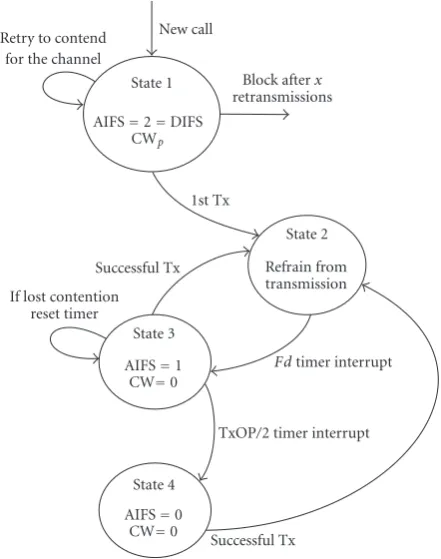
Figure 1depicts a state diagram of the MAC functionality.
Each state contains different values of AIFS and CW that the station uses to access the channel for this application. It is evident that during state 1 the application request is in ad-mission condition where it contends with all other requests. After the admission, the station occupies two basic states. In state 2, it refrains from transmission for as long as anFd counter runs. An interrupt from the timer leads to state 3 where low AIFS and CW guarantee channel access. Certain issues remain to be discussed: the possible collisions of pri-ority class, and the admission and blocking issue.
Collision between low-priority calls is normally dealt with as in DCF. Thus the point of interest is a possible col-lision of a high-priority request. Specifically, this is divided into two cases: a collision between two ongoing high-priority calls and a collision between high-and-low-priority calls.
2.1. Collision of two high-priority requests
AssumeApplication 1successfully transmits at zero time and
Application 2immediately follows after packet durationpd. When the timer ofApplication 1expires at Fd,Application 1will try to transmit the next frame. As shown inFigure 2, there is a chance that a low-priority application may have just started to transmit a full TxOP long packet transmission.
New call State 1 AIFS=2=DIFS
CWp Retry to contend
for the channel
Block afterx retransmissions
1st Tx
Successful Tx
State 2 Refrain from transmission
Fdtimer interrupt
TxOP/2 timer interrupt
Successful Tx If lost contention
reset timer
State 3 AIFS=1
CW=0
State 4 AIFS=0
CW=0
Figure1: State diagram for priority class AC3.
Collision between high-priority applications can only occur in the case of accumulation of expired timers as in this case. This happens becausepdwill probably be smaller than TxOP and bothApplication 1 andApplication 2will be ready for transmission atFd+ TxOP (seconds). To avoid such a mis-fortunate occasion, we define a fourth state (state 4) in which the priority application hops to when it has already waited in state 3 for TxOP/2 (seconds). This extra state ensures an order between high-priority applications and enables a first-in-first-out (FIFO) functionality of the high-priority con-tention queue. This ensures collision-free behavior assum-ing that all transmissions of high-priority class are longer than TxOP/2 (seconds) and no transmission is greater than TxOP (seconds).
Although collisions due to MAC protocol are avoided, there is always a chance that the packet is not accepted cor-rectly due to unpredictable behavior of wireless environ-ment. In case a packet is lost, it is not retransmitted. This UDP-like behavior is in accordance with the TDMA-like na-ture of the proposed protocol.
2.2. Collision between a high-priority class and a low-priority class
Nonpriority app
Priority app # 1
Priority app # 2
TxOP
Fd
Fd pd
pd
State 2 State 3
State 2 State 3 Collision due to
accumulation Figure2: Collision between two high-priority applications when state 4 is not used.
in a slot which follows AIFS [w] idle slots together with a high-terminal. The high-terminal transmission slots are very few in anFdframe, and in case of high-priority traffic con-ditions, there is a tendency for high-priority transmissions to appear in groups (thus there is no room for consecutive idle slots). The high bound of the probability of collision between high-priority and low-priority classes is then cal-culated by assuming three independent events: the probabil-ity of high-priorprobabil-ity transmission in a slot, the probabilprobabil-ity of AIFS [w] consecutive idle slots, and the probability of low-priority transmission in the same slot:
p3,w
c =
2
w=0
N3·Slot Time
Fd ·
Pi
AIFS [w]
·Nw·pTw, (1)
where p3,w
c is the probability of interclass collision, N3 the
number of terminals demanding high-priority applications, Slot Time the duration of a single slot,Pithe probability of
the channel to be idle in a single slot,w∈ {0, 1, 2}the num-ber of the low-priority access class (AC), AIFS [w] the respec-tive arbitrary IFS,Nw the number of terminals demanding
such traffic, andpTwthe probability that a terminal is
access-ing the channel in a specific slot for a packet of the specific AC. All these should be more clear after the following section.
The probabilityp3,w
c is shown inFigure 3for the case of
N ∈ [1, 10] simultaneously transmitting terminals with all four possible applications, AC0, AC1, and AC2 from 802.11e, and the AC3 modified according to the proposed scheme. For the case of 10 simultaneously transmitting terminals, a ratio of 1 collision per 160 seconds and 1 lost packet per 40 seconds can be estimated. These values show that the collision be-tween low-priority classes and high-priority classes is kept very small and cannot deteriorate the functionality of the proposed model.
2.3. Admission and blocking
The Fd counter implies a fixed virtual frame length. This fixed length is very important for the quality of ongoing transmissions since an increase in the frame would cause a deterministic amount of delay in the system. This also im-plies that an admission strategy is necessary for prevent-ing the system from overloadprevent-ing. Low-priority applications are somewhat led through an admission procedure when
1 2 3 4 5 6 7 8 9 10
Number of terminals 10−6
10−5 10−4
In
te
rc
lass
co
llision
p
ro
babilit
y
0 0.5 1 1.5 2 2.5
Dr
opped
pac
ke
t
ratio
due
to
int
er
class
collision
×10−3
Collision probability Dropped packet ratio
Figure3: Probability of collision between high-priority and low-priority applications.
contending for access with backoff counters. For high-priority applications, a statistical admission is used. The call to be admitted senses the channel and makesxattempts to transmit. Afterxcollisions the application becomes blocked. Blocking may also occur from the connection delay before the x retransmissions take place. AIFS setting is set equal to nonpriority case and CW p is set smaller. The result is that high-priority classes are easily admitted when the load is small. As the load increases, the blocking probability in-creases as well. If the remaining virtual slots are few, the con-nection probability will be very small due to high connec-tion delay. Blocking probability and fairness for high-priority class are governed byx,CW pof state 1, and the number of nonpriority and priority contending mobiles. Figures4and
5show some results on this matter.
2 4 6 8 10 12 14 16 18 20
Figure4: Connection delay for high-priority class,CW p=[4, 8, 16, 32] andx=[2, 4, 6, 8]. Transmission rate is 1 Mbps.
Figure5: Blocking probability for high-priority class,CW p=[4, 8, 16, 32] andx=[2, 4, 6, 8]. Transmission rate is 1 Mbps.
approach for blocking probability and connection delay is found in the next section. The valuesCW p =8 andx =4 are chosen in the rest of the analysis. SmallCW pgives
pri-ority and smaller connection delay, but results in channel monopoly by the priority class. A largexreduces blocking probability, but it also causes greater connection delay and monopolization of channel. Smaller connection delay can be achieved by using smaller AIFS values as well.
3. MATHEMATICAL ANALYSIS
3.1. Analysis for nonpriority classes
Low-priority classes (AC0, AC1, and AC2) are treated sep-arately from high-priority ones since they follow different state transitions. The analysis found in [17] is the basis of the one to be used here. In [18], Ziouva proposed a modi-fied analysis considering freezing backoffcounters, while in [19] the previous is applied on 802.11e. In our analysis we incorporate the recent findings of [20].
The Markov chain to be used can be found in [20, Fig-ure 2]. For the solution of the Markov chain we assume that priority application admission procedure has a negligible in-fluence on nonpriority access. The backoffprocedure is nor-mally analyzed and the bandwidth reduction due to priority transmissions is only taken into account in throughput and delay analysis. Ifbi,j,kis the stationary probability of backoff
statei,j,k, we can solve the system of equations forb1,0,0. The
system of equations can be found in [20], as well.
We define the probabilities of accessing the channel after a busy periodτb,wand after an idle periodτi,wand the
proba-bilities of an idle (busy) slot after a busy periodq0(p0,w) and
after an idle periodq1(p1,w). Probabilitiesτb,w,τi,w,p0,w, and
p1,ware dependent on each specific class whileq0andq1are
the same for all low-priority classes, as in [19].
The probabilities of idle channel Pi, of each class
suc-cessful transmissionPs,w, and of collisionPc are all defined
in a free-from-priority contention slot and found in [20] as well. These probabilities are valid only for the proportion of bandwidth left free from high-priority access called 1−BW p. BW pis the percentage of resources occupied by priority ap-plications. A simple approach toBW pis
BW p=Napd
Fd. (2)
Nαis the number of successfully accepted calls to the
sys-tem and pdis the total duration of a high-priority applica-tion transmitted packet. Normalized throughput for nonpri-ority applicationwwill be
Sw=Ps,wE{P}(1−BW p)/
where E{P} is the expected length of a nonpriority class packet,Tsis the average time that a successful transmission
of a packet takes, andTcis the average time that the channel
is captured due to a collision, all found in [17].
The average delay for the classwwill be
E{D}w=E{N}w
E{B}w+Tc+TT
1
Figure6: Backoffstate diagram for high-priority traffic at admission time.
where E{N}w is the average number of retransmissions,
E{B}w is the average delay between the transmissions due
to backoffand freezing,TT is the timeout duration after a
collision,E{X}wis the delay of backoffslots,E{NF}w is the
average number of backoff freezing occurrences for each transmission, and BDw is the average number of backoff
counters to be reduced until the transmission. Equation (4) can be solved using (5)-(6):
where ConIdleSlots is the number of consecutive idle slots between each two backofffreezing occurrences, defined as
ConIdleSlots= Pi(1−BW p)
the class specifications. The average durations of several cases framesTsandTcfor basic and RTS-CTS access are found in
[16,17].
3.2. Analysis for priority class
The throughput and delay analysis for priority class is much simpler than for nonpriority class as long as it is assumed that
no hidden terminal effect exists. Throughput is given by
S3=Na E
{P}p
Fd+ TxOP/R, (7)
whereE{P}p is the expected packet length in bits per frame
andRis the channel rate. The average delay will be
E{D}3=
whereFPAis the packet accumulation factor indicating how
many high-priority packets are needed to be accumulated in a large packet that is longer than TxOP/2. The first part of the expected delay is a deterministic delay imposed by the packet accumulation. The second part is the expected value of a uniform random variable of how long a priority call may wait in states 3 and 4. Expected delay is independent of the load of the system.
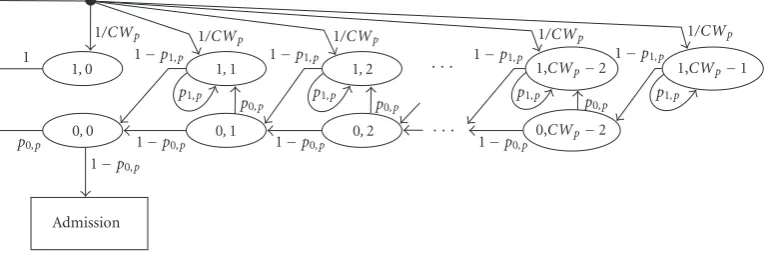
Connection delay can be found with an analysis similar to EDCA as in [19]. The Markov chain for high-priority ad-mission will be a simple chain withCW p, backoffstages with equal probability of selection and stages for freezing of back-offcounter (Figure 6). The stationary probabilities are
b0,j=(CW p−1−j)b1,0, forj∈[1,CW p−2],
stationary probabilities can be calculated:
where p indicates that AC3 class is in admission state. The probabilities of channel access for priority admission are
τi,p= b0,0
Equations (12) show that the behavior of admission is very much depended upon low-priority access conditions, which in cases of heavy loaded channels prevents the phe-nomenon of resource starvation of low-priority class.
Further, the average number of backoff slots for every connection attempt can be found:
BDp=
The average delay for every attempt to connect will be
E{CD}1=BDp·Slot Time +
The probability of successfully accessing the channel is
Pa,p=
The average connection delay, disregarding the calls that will drop due to extensive delay, is
E{CD} =Pa,pE{CD}1
Defining a threshold of acceptable connection delay ThrCD, the fact that a priority demand will be blocked due to
unacceptable delay will cause less number of retrials (x) and
Table1: Simulation values.
802.11e values
Saturation traffic
Packet length 1024 B Interarrival time 0.01 s VoIP traffic
Packet length 4×160 B Interarrival time 0.08 s
greater blocking probability. We calculate blocking probabil-ity as
In this section we calculate the behavior of the proposed model in comparison with EDCA. The performance of the MAC protocols is tested for variable number of contending stations, basic and handshaking access, and the several ac-cess classes. Every terminal is assumed to demand all four classes of access. In case of saturation analysis, it is assumed that a packet is always available for transmission. For AC3 of the proposed protocol, admission control is utilized to pre-vent the system from overloading. Since the demand is great, the throughput is found to be saturated. On the other hand, we present results where AC3 demand is not saturated. Every terminal initiates a VoIP call and saturated traffic for the rest of the classes.
Voice-over-IP (VoIP) applications use the G.711 codec [21]. Every 20 ms, 160 B of payload are transmitted . TheFd timer could be set to 20 ms for this case. However, the packet length (in bytes) needs to be greater than TxOP/2. Thus, a 4-packet accumulation is proposed before transmission, which yields a maximum of 60 ms buffer delay. This defi-ciency is necessitated by the priority class collision avoidance mechanism proposed inSection 2.1.Fdis then chosen to be 80 ms and the packet payload would be 640 B.
The analytical approach is compared with simulations with the OPNET simulator. The simulation values are de-scribed inTable 1.
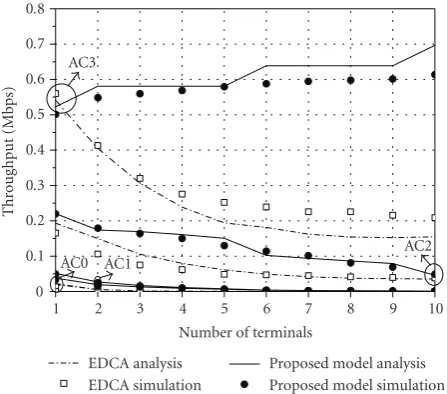
1 2 3 4 5 6 7 8 9 10 Figure7: Saturation throughput for 1 Mbps channel rate and basic access. Figure8: Saturation throughput for 1 Mbps channel rate and RTS-CTS access.
In terms of simulation and analysis comparison, the pro-posed model throughput is found to be a little worse in simulations, which is partially explained by the interclass col-lisions and the way admission control is used in analysis. In
Figure 7, an unexpected difference between analysis and
sim-ulation for AC3 is shown.
Figures9and10show throughput for the case where AC3 traffic is not saturated. Specifically, one one-way VoIP appli-cation is considered to be generated by each of the termi-nals. The rest of the traffic sources are considered saturated. These conditions showcase the performance of the two pro-tocols in realistic conditions. The proposed model is found to be superior in terms of throughput at most of the times.
1 2 3 4 5 6 7 8 9 10 Figure9: Throughput for nonsaturated AC3 traffic, 1 Mbps chan-nel rate, and basic access.
1 2 3 4 5 6 7 8 9 10 Figure10: Throughput for nonsaturated AC3 traffic, 1 Mbps chan-nel rate, and RTS-CTS access.
AC3 for EDCA is saturated earlier than expected due to the smaller packet length used. It can be seen that the proposed protocol performance for high-priority class is unaffected by the packet length as long as it remains larger than TxOP/2.
A deviation between AC2 analysis and simulation is found in this case. For better comparison, packet accumula-tion is used for EDCA and the throughput is kept high hav-ing a negative effect on delay (Figure 12). Admission control is not activated in this case.
1 2 3 4 5 6 7 8 9 10
Figure11: Average medium delay for 1 Mbps channel rate.
1 2 3 4 5 6 7 8 9 10
Figure12: Average medium delay for 1 Mbps channel rate and non-saturated AC3 traffic.
characteristic is that the proposed protocol yields very small jitter delay. This is analogous to the TDMA performance.
Low-priority delay, on the other hand, can be very high when the high-priority applications occupy the greater por-tion of the available bandwidth. If an improvement is re-quired on this matter,CW pcan be modified to perform a tighter admission control for high-priority calls, nevertheless leading to higher blocking probability.
5. CONCLUSION
A new MAC protocol is proposed to be a backward com-patible advancement to the wide-known 802.11e protocol. A timer called Fd timer is used in a distributed manner from each wireless terminal to create a virtual TDMA-like
frame. Each terminal uses another timer to prevent colli-sions with other high-priority applications. A tradeoff be-tween high-priority admission characteristics (connection delay and blocking probability) and low-priority perfor-mance can be used in quality-of-service optimization proce-dure. The results show a small improvement in throughput due to the decrease in the backoffdelay. The average delay for priority class is independent of load conditions, as expected by the TDMA nature of the proposed protocol, thus making the proposed protocol ideal for VoIP communications. Other advantages of the proposed protocol are the small jitter delay and the independence of throughput from the packet length.
REFERENCES
[1] Z. Kong, D. H. K. Tsang, B. Bensaou, and D. Gao, “Per-formance analysis of IEEE 802.11e contention-based chan-nel access,”IEEE Journal on Selected Areas in Communications, vol. 22, no. 10, pp. 2095–2106, 2004.
[2] S. Mangold, S. Choi, G. R. Hiertz, O. Klein, and B. Walke, “Analysis of IEEE 802.11e for QoS support in wireless LANs,”
IEEE Wireless Communications, vol. 10, no. 6, pp. 40–50, 2003. [3] J. W. Robinson and T. S. Randhawa, “Saturation throughput analysis of IEEE 802.11e enhanced distributed coordination function,”IEEE Journal on Selected Areas in Communications, vol. 22, no. 5, pp. 917–928, 2004.
[4] D. He and C. Q. Shen, “Simulation study of IEEE 802.11e EDCF,” inProceedings of 57th IEEE Semiannual Vehicular Tech-nology Conference (VTC ’03), vol. 1, pp. 685–689, Jeju, South Korea, April 2003.
[5] Wireless LAN Medium Access Control (MAC) and Physical Layer Specifications, IEEE Std. 802.11, 1999.
[6] Medium Access Control (MAC) Enhancements for Quality of Service (QoS), D4.4, IEEE Draft Std 802.11e, 2003.
[7] F. Cali, M. Conti, and E. Gregori, “IEEE 802.11 protocol: de-sign and performance evaluation of an adaptive backoff mech-anism,” IEEE Journal on Selected Areas in Communications, vol. 18, no. 9, pp. 1774–1786, 2000.
[8] J. N. Al-Karaki and J. M. Chang, “A simple distributed access control scheme for supporting QoS in IEEE 802.11 wireless LANs,” inProceedings of IEEE Wireless Communications and Networking Conference (WCNC ’04), vol. 1, pp. 213–218, At-lanta, Ga, USA, March 2004.
[9] W. Wang, S. C. Liew, and V. O. K. Li, “Solutions to perfor-mance problems in VoIP over a 802.11 wireless LAN,”IEEE Transactions on Vehicular Technology, vol. 54, no. 1, pp. 366– 384, 2005.
[10] Q. Pang, S. C. Liew, J. Y. B. Lee, and S.-H. G. Chan, “A TCP-like adaptive contention window for WLAN,” inProceedings of IEEE International Conference on Communications (ICC ’04), vol. 6, pp. 3723–3727, Paris, France, June 2004.
[11] S. Pollin, A. Motamedi, A. Bahai, F. Catthoor, and L. Van der Perre, “Delay improvement of IEEE 802.11 distributed coordi-nation function using size-based scheduling,” inProceedings of IEEE International Conference on Communications (ICC ’05), vol. 5, pp. 3484–3488, Seoul, Korea, May 2005.
[12] H. Zhu, M. Li, I. Chlamtac, and B. Prabhakaran, “A survey of quality of service in IEEE 802.11 networks,”IEEE Wireless Communications, vol. 11, no. 4, pp. 6–14, 2004.
[14] F. Bauchot, “MASCARA: a wireless ATM MAC protocol,” inProceedings of Wireless ATM Workshop, Helsinki, Finland, September 1996.
[15] J. Sanchez, R. Martinez, and M. W. Marcellin, “A survey of MAC protocols proposed for wireless ATM,”IEEE Network, vol. 11, no. 6, pp. 52–62, 1997.
[16] Y. Xiao and J. Rosdahl, “Throughput and delay limits of IEEE 802.11,”IEEE Communications Letters, vol. 6, no. 8, pp. 355– 357, 2002.
[17] G. Bianchi, “Performance analysis of the IEEE 802.11 dis-tributed coordination function,”IEEE Journal on Selected Ar-eas in Communications, vol. 18, no. 3, pp. 535–547, 2000. [18] E. Ziouva and T. Antonakopoulos, “CSMA/CA performance
under high traffic conditions: throughput and delay analysis,”
Computer Communications, vol. 25, no. 3, pp. 313–321, 2002. [19] Y. Xiao, “Performance analysis of IEEE 802.11e EDCF
un-der saturation condition,” inProceedings of IEEE International Conference on Communications (ICC ’04), vol. 1, pp. 170–174, Paris, France, June 2004.
[20] C. H. Foh and J. W. Tantra, “Comments on IEEE 802.11 satu-ration throughput analysis with freezing of backoffcounters,”
IEEE Communications Letters, vol. 9, no. 2, pp. 130–132, 2005. [21] S. Garg and M. Kappes, “On the throughput of 802.11b net-works for VoIP,” Tech. Rep. ALR-2002-012, Avaya Labs Re-search, Basking Ridge, NJ, USA, March 2002.
Georgios S. Paschoswas born in Athens, Greece, in 1978. He received his Diploma in electrical and computer engineering, Poly-technic School of Aristotle University of Thessaloniki (2002). He is currently in the process of defending his Ph.D. thesis in telecommunications in the School of Elec-trical Engineering and Computer Science in the University of Patras, Greece. His main interests are wireless networks, quality of service, and network management.
Ioannis Papapanagiotouhas been studying in the Electrical and Computer Engineering School of University of Patras, Greece, since 2001, and he is currently in his last year of studies. His interests include wireless local area networks (WLANs), performance eval-uation, and applications in telemedicine.
Stavros A. Kotsopouloswas born in Argos Argolidos, Greece, in the year 1952. He re-ceived his B.S. degree in physics in the year 1975 from the University of Thessaloniki, and in the year 1984 got his Diploma in electrical and computer engineering from the University of Patras. He did his post-graduate studies in the University of Brad-ford in the United Kingdom, and he is an M.Phil and Ph.D. holder since 1978 and
1985, respectively. Currently he is a Member of the academic staff of the Department of Electrical and Computer Engineering of the University of Patras and holds the position of Associate Professor. Since 2004, he has been the Director of the Wireless Telecommu-nications Laboratory and has been developing his professional life
teaching and doing research in the scientific area of telecommu-nications, with interest in mobile commutelecommu-nications, interference, satellite communications, telematics applications, communication services, and antennae design. Moreover he is the coauthor of the bookMobile Telephony. His research activity is documented by more than 160 publications in scientific journals and proceedings of international conferences. Associate Professor Kotsopoulos has been the leader of several international and many national research projects. Finally, he is a Member of the Greek Physicists Society and a Member of the Technical Chamber of Greece.
George K. Karagiannidis was born in Pi-thagorion, Samos Island, Greece. He re-ceived his university degree in 1987 and his Ph.D. degree in 1999, both in electrical en-gineering, from the University of Patras, Pa-tras, Greece. From 2000 to 2004 he was a researcher at the Institute for Space Appli-cations and Remote Sensing, National Ob-servatory of Athens, Greece. In June 2004, he joined the faculty of Aristotle University