A Survey of Application Distribution
in Wireless Sensor Networks
Mauri Kuorilehto
Institute of Digital and Computer Systems, Tampere University of Technology, P.O. Box 553, 33101 Tampere, Finland Email:[email protected]
Marko H ¨annik ¨ainen
Institute of Digital and Computer Systems, Tampere University of Technology, P.O. Box 553, 33101 Tampere, Finland Email:[email protected]
Timo D. H ¨am ¨al ¨ainen
Institute of Digital and Computer Systems, Tampere University of Technology, P.O. Box 553, 33101 Tampere, Finland Email:[email protected]
Received 14 June 2004; Revised 23 March 2005
Wireless sensor networks (WSNs) are deployed to an area of interest to sense phenomena, process sensed data, and take actions accordingly. Due to the limited WSN node resources, distributed processing is required for completing application tasks. Propos-als implementing distribution services for WSNs are evolving on different levels of generality. In this paper, these solutions are reviewed in order to determine the current status. According to the review, existing distribution technologies for computer net-works are not applicable for WSNs. Operating systems (OSs) and middleware architectures for WSNs implement separate services for distribution within the existing constraints but an approach providing a complete distributed environment for applications is absent. In order to implement an efficient and adaptive environment, a middleware should be tightly integrated in the underlying OS. We recommend a framework in which a middleware distributes the application processing to a WSN so that the application lifetime is maximized. OS implements services for application tasks and information gathering as well as control interfaces for the middleware.
Keywords and phrases:ad hoc networking, distribution, service discovery, task allocation, wireless sensor networks.
1. INTRODUCTION
Wireless sensor networks (WSNs) have gained much atten-tion in both public and research communities because they are expected to bring the interaction between humans, envi-ronment, and machines to a new paradigm. Despite being a fascinating topic with a number of visions of a more intelli-gent world, there still exists a huge gap in the realizations of WSNs. In this paper, we define WSNs as networks consist-ing of independent, collaboratconsist-ing nodes that can sense, pro-cess, and exchange data as well as act upon the data content. Compared to traditional communication networks, there is no preexisting physical infrastructure that restricts topology. WSNs are typically ad hoc networks [1] but there are ma-jor conceptual differences. First, WSNs are data-centric with
This is an open access article distributed under the Creative Commons Attribution License, which permits unrestricted use, distribution, and reproduction in any medium, provided the original work is properly cited.
an objective to deliver time sensitive data to different destina-tions. Second, a deployed WSN is application-oriented and performs a specific task. Third, messages should not be sent to individual nodes but to geographical locations or regions defined by data content [2].
In WSNs quantitative requirements in terms of latency and accuracy are strict due to the tight relation to the en-vironment. In general, the capabilities of an individual sen-sor node are limited, but the feasibility of WSN lies on the joint effort of the nodes. Thus, WSNs are distributed sys-tems and need distribution algorithms. Another motivation for distribution is the resource sharing. Further, to obtain re-sults, WSN applications typically require collaborative pro-cessing of the nodes sensing different phenomena in diverse areas [2].
context-sensitivity, and self-organization have gained more attention [11]. Surveys concerning application layer issues and prototype implementations are fairly limited [4, 12, 13]. Furthermore, proposals implementing distribution are emerging as the complexity of applications increases. These are covered in [2] but the discussion of proposals supporting application distribution is limited to few solutions for distri-bution control.
In this paper, we focus on four essential distribution as-pects in WSNs, namely,service discovery,task allocation, re-mote task communication, andtask migration. The service dis-covery comprises of identifying and locating services and re-sources required by a client. In homogeneous WSNs, the ser-vice discovery is not important but when node platforms and the composition of tasks are heterogeneous, the service dis-covery is essential. The task allocation specifies a set of sensor nodes, on which the execution of an application task is acti-vated. The remote task communication covers the means for communication between distributed tasks through a wireless communication link. The task migration means the methods for transferring a task executable from a sensor node to an-other. The algorithms defining the target nodes for migration are included in the task allocation.
Algorithms that are tightly bound to an application are not discussed. The presented distribution aspects are selected due to their generality for different types of WSNs and appli-cations. We omit, for example, data fusion and data aggrega-tion that are beneficial only for applicaaggrega-tions that gather data to a centralized storage.
In this paper we review the application distribution for WSNs focusing on distribution implemented insystems soft-ware. By systems software we mean software components providing application-independent services and managing node resources. The proposed solutions vary according to tools provided, requirements placed on the underlying plat-forms, and targeted applications and environments. How-ever, the current proposals lack an integrated solution pro-viding a distributed operating environment for WSN appli-cations. This approach would lead to a more efficient usage of resources.
This paper is organized in two main parts as follows. The first part describes the basics of objectives, challenges, and systems software solutions of WSNs. In addition, a summary of WSN application proposals is presented in order to define requirements. The second part starting inSection 3contains the survey of distribution proposals followed by their analysis inSection 4. Finally, conclusions are given inSection 5.
2. OVERVIEW OF WSNs
In order to give an overview of WSN applications, we review some examples and their characteristics. These are listed in Table 1. The selection is mainly based on prototype imple-mentations and thus all the scopes of WSNs might not be represented.
The first column inTable 1lists the applications and the second classifies them according to the main task. The third column presents the requirements set by the application. The
networking requirements in terms of data amount and fre-quency are defined in the fourth column, while the last col-umn gives the scale and density of the application.
Most of the applications gather, evaluate, or aggregate data from different types of sensors. Major differences are in networking requirements and complexity. Unfortunately, accurate values or limits to these properties are not often re-ported, which complicates a fair comparison.
The nature of applications listed inTable 1varies, but at least four main tasks can be identified [28]. Monitoring is used to continually track a parameter value in a given lo-cation, andevent detectionrecognizes occurrences of events.
Object classificationattempts to identify an object or its type andobject trackingtraces movements of an object.
For the presented applications, the “worst-case” WSN would comprise of an extensive number of nodes with vary-ing density and a network topology that constantly changes due to the errors in communication, mobility of nodes, and inactive nodes [3]. To complete complex tasks in the sce-nario, the application requires distributed processing within the network.
In our view, WSN application quality of service (QoS) is constructed from network lifetime, network load, accuracy of data, and fault tolerance. Network load in this case com-prises of the required data latency, throughput, and reliabil-ity. WSN protocols and their functions are adapted according to the QoS requirements. Currently, security is a QoS issue that is often omitted in WSNs. The natural reason is that se-curity requires too much resources [2].
For the rest of the paper we define anenvironmental mon-itoring application that is used for the analysis of the pro-posed solutions. For clarification, we refer to the application asEnvMonitor. The main task of the application is the con-stant gathering of location-dependent information within a defined area. In addition to the passive monitoring involved in the environmental monitoring applications inTable 1, En-vMonitorconsists of active monitoring tasks reacting to con-dition changes in WSN. The passive monitoring data are gathered to a central storage and aggregated during the rout-ing. Active in-network monitoring tasks execute signal pro-cessing algorithms locally in order to determine threshold values for temperature and humidity. When a threshold is reached, a set of predefined actions modifying the applica-tion QoS and the communicaapplica-tion topology taken. The mod-ifications alter the requirements for data composition, accu-racy, and latency. The priority of active monitoring tasks pre-cedes passive monitoring.
2.1. Systems software for WSNs
Table1: Examples of prototyped applications for WSNs.
Application Type Requirements Data amount and frequency Scale and density
Great Duck Island [14]
Environmental monitoring
Data archiving, Internet access, long lifetime
Minimal, every 5–10 min,
2–4 h per day 32 nodes in 1 km2
PODS in Hawaii [15] Environmentalmonitoring Digital images,energy-efficiency Large data amounts,infrequently 30–50 nodes in 5 hectares
CORIE (Columbia River) [16]
Environmental
monitoring Base stations, lifetime
Moderate data amounts, infrequently
18 nodes in Columbia River
Peek value evaluation [17]
Environmental monitoring
Collaborative processing, minimal network traffic
Moderate data amounts,
periodically Case dependent
Flood detection [18] Environmentalmonitoring Current condition
evaluation 50 bytes every 30 s
200 nodes 50 m apart
SSIM (artificial
retina) [19] Health
Image identification, realtime, complex processing
Large data amounts, frequently every 200 ms
100 sensors per retina
Human monitoring
[20] Health
Quality of data, security, alerts
Moderate data amounts, depend on the human stress level
Several nodes per human
Mountain rescue [21] Health Communication intensive
Large data amounts in high frequency
One per rescuer in mountain area
WINS for military
[22] Military
Target identification, realtime, security, quality of data
Large data amounts, infrequently
Several distant nodes
Object tracking [23] Military
Collaborative processing, realtime, location-awareness
Large data amounts with high frequency near an object
7 (prototype) nodes in proximity
Vehicle tracking [24] Military
Identification and coordination, realtime
Large data amounts every 8 s near an object
1024 nodes in 40 km2
Intelligent
input/output [25] Home entertainment
Communication intensive
Large data amounts with high frequency
One node per input device
WINS condition
monitoring [22] Machinery monitoring
Data aggregation, machinery lifetime projection
Depend on machinery complexity and its current status
Few nodes per machinery
Smart kindergarten
[26] Education
Video streaming, identification, location-awareness
Large data amounts in variable frequencies
Tens of sensors, indoor
Smart classrooms
[27] Education
Context-sensing, data exchange
Large data amounts in random frequency
Several nodes in classroom
The systems software for WSNs implementssingle node controlandnetwork-level distribution control. The single node control software implements the low-level routines in a node, whereas the network-level distribution control manages ap-plication execution within several nodes.
Single node control
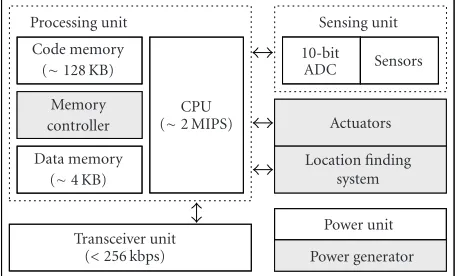
The single node control operates on a physical node depicted in Figure 1. A processing unit consists of CPU, storage
Processing unit Code memory
(∼128 KB)
Memory controller
Data memory (∼4 KB)
CPU (∼2 MIPS)
Sensing unit
10-bit
ADC Sensors
Actuators
Location finding system
Power unit
Power generator Transceiver unit
(<256 kbps)
Figure 1: Reference hardware platform architecture of a sensor node.
The reference values inFigure 1are the resources avail-able in MICA2 mote [29]. The power consumption of a node is in order of mW when active and in order ofµW when the node is in sleep. The power unit is typically an AA battery or similar energy source.
The single node control is accomplished by OS or vir-tual machine (VM). In the reference platform, OS is executed on the main CPU and it uses the same instruction and data memories as applications. Services implemented by OS in-clude scheduling of tasks, interprocess communication (IPC) between tasks, memory control, and possible power control in terms of voltage scaling and component activation and in-activation. OS provides interfaces to access and control pe-ripherals. The interfaces are typically associated with layered software components with more sophisticated functionality, for example a network protocol stack.
Network-level distribution control
Distribution control relies on networking. Figure 2depicts an example protocol stack for WSN in comparison to two widely utilized stacks, the OSI model [1] and a distributed system in a wireless local area network (WLAN). In a WLAN computer, the TCP/IP stack is used through a sockets ap-plication programming interface (API). The WLAN adapter that contains the medium access control (MAC) protocol and the WLAN radio is accessed by a device driver.
There is no unified protocol stack for WSNs and most of the proposed stacks are just collections of known pro-tocol functions. At the moment, the IEEE 1451.5 Wire-less Sensor Working Group [30] is standardizing the phys-ical layer for WSNs with an intention to adapt link layers from other wireless standards, for example, Bluetooth [31], IEEE 802.15.4 low-rate wireless personal area network (LR-WPAN) [32], or IEEE 802.11 WLAN [33]. Other types of networks posing common characteristics with WSNs are mo-bile ad hoc networks (MANETs) [34] targeted to address mo-bility.
In WSNs, the essential protocol layers are the MAC pro-tocol on the data link layer and the routing propro-tocol on the network layer. The MAC protocol creates a network topology
and shares the transmission medium among sensor nodes. The topology in WSNs is either flat, in which all sensor nodes are equal, or clustered, in which communication is controlled by cluster headnodes. The routing protocol allows commu-nication via multihop paths. A transport protocol that im-plements end-to-end flow control is rarely utilized in WSNs. The middleware layer is equivalent to the presentation layer in the OSI model [1].
For WSNs, the development of a distributed environ-ment requires the consideration of all four distribution as-pects. The control actions are taken according to the applica-tion QoS. The distribuapplica-tion aspects are typically implemented on the middleware layer on top of OS. Thus, the middle-ware component can reside in different types of platforms. In addition to OS routines, the middleware utilizes networking interface to implement communication between its own in-stances on different sensor nodes. Some distribution aspects can also be implemented directly by OS.
3. SURVEY OF DISTRIBUTION PROPOSALS
Numerous technologies for the service discovery and remote task communication are available for computer networks. The task migration is typically a transfer of a binary code im-age or a Java applet. In computer networks, the task alloca-tion is often not the main concern as resources are sufficient. Even though not directly applicable for WSNs, the computer network technologies define the basic paradigms and algo-rithms for the application distribution.
Other types of wireless ad hoc networks, like MANETs and Bluetooth, have common characteristics with WSNs. First, communication in these networks is very similar to WSNs. Second, the resource constraints must be considered, even though the limits are looser than in WSNs. For this reason we include technologies proposed for MANETs and Bluetooth in our assessment of WSN proposals.
A distinct categorization of proposed solutions for WSNs cannot be made since a proposal typically present a more complete architecture addressing several distribution as-pects. Therefore, we categorize the proposals according to their system architecture to OSs, VMs, middlewares, and stand-alone protocols.
3.1. Architectural paradigms
WSN OSI-model WLAN computer
WSN application Applicationlayer Application program
Middleware Presentationlayer Distributing middleware
Session
layer Sockets API
WSN transport protocol
Transport
layer TCP/UDP
Multi-hop routing protocol
Network
layer IP
Error control
Data link layer
WLAN adapter device driver
WSN MAC protocol WLAN MAC protocol
Transceiver unit Physicallayer WLAN radio OS
OS
Figure2: OSI model, WSN, and distributed system in WLAN protocol layers.
Client
Server
Request data
(a)
Client Mobile code
(b)
Client Tuple insert Tuple read
Tuple remove Request data Tuple distribution
(c)
Figure3: Three architectural paradigms for distribution: (a) client-server, (b) mobile code, and (c) tuple space.
Differences in programming languages and platforms must be hidden in the remote task communication. Stub pro-cedures are generated for this from interface definitions. A stub procedure at the client marshals a procedure call to an external data presentation, which is then unmarshalled back to a primitive form at the server [35].
In the mobile code paradigm, instead of moving data from a client to a server for processing, the code is moved to the data origins, and data are then processed locally. A mo-bile agentis an object that in addition to the code carries its state and data. Furthermore, mobile agents make migration decisions autonomously. They are typically implemented on top of VMs for platform independency [36].
The concept of tuple space was proposed originally in Linda [46] for the remote task communication, but it is ap-plicable also for the service discovery. Tuples are collections of passive data values. A tuple space is a pool of shared in-formation, where tuples are inserted, removed, or read. Data are global and persistent in the tuple space and remain un-til explicitly removed. In the tuple space, a task does not
need to know its peer task, tasks do not need to exist si-multaneously, and they do not need to communicate di-rectly.
3.2. Computer networks
Table2: Implemented distribution aspects in single node proposals.
Proposal Target network
Resource requirements (CPU/code memory/ data memory)
Service discovery Task allocation
Remote task communi-cation
Task migration
OS-based architectures
EYES OS [37] WSN 1 MHz / 60 KB / 2 KB Resource requests Not supported RPC Not supported
BTnodes [38] WSN 8 MHz/ 128 KB/ 64 KB Tuple space Not supported Callbacks Smoblets
TinyOS [39] WSN 8 MHz/ 128 KB/ 4 KB Not supported Not supported Active messages Not supported
BerthaOS [40] WSN 22 MHz/ 32 KB/ 2,25 KB Not supported Not supported BBS Binary code
MOS [25] WSN 8 MHz/ >64 KB/ >1 KB Not supported Not supported Not supported Binary code download QNX [41] LAN 33 MHz/ 100 KB/ N/A Network manager SMP scheduler Message passing Not supported
OSE [42] LAN N/A/ 100 KB/ N/A Hunting service Not supported Phantom process Not supported
VM-based architectures
Sensorware [17] WSN N/A/ 1 MB/ 128 KB Not supported Script population
specification Not supported
TCL script migration
MagnetOS [43] WSN N/A / N/A / N/A Not supported Automatic object
placement DVM [44]
Mobile Java objects
Mat´e [45] WSN 8 MHz/ 128 KB/KB Not supported Not supported Not supported Code capsule update
Distribution technologies designed for computer net-works are typically both computation and communication intensive and cannot be implemented on sensor nodes. They are based on the client-server architecture and use detailed specifications for services and interfaces. These technologies do not consider the possible mobility or unavailability of sen-sor nodes. While mobility is addressed in Mobile DCE, Mo-bile CORBA, or Rover toolkit, these still rely on the client-server architecture from DCE and CORBA.
3.3. Distribution proposals for WSNs
From systems software proposals for WSNs, OSs and VMs implement the single node control and middleware archi-tectures implement the network-level distribution control. These can be supported by stand-alone protocols that ad-dress only a single distribution aspect. We contribute the WSN proposals according to distribution aspects they imple-ment.
OS-based architectures
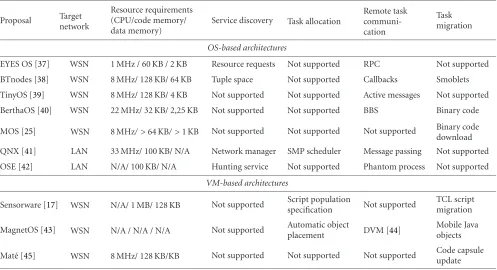
The distribution aspects implemented in OSs are listed in Table 2. In addition, the second column defines the type of a network OS is targeted for, while the third one gives OS resource requirements. In WSNs, OSs implement a very lim-ited set of services and they are fairly primitive in their na-ture. As shown inTable 2, the remote task communication is addressed typically by providing a simple method for RPC. The service discovery is rarely implemented in OS but on a higher system services layer that is associated to OS. Tasks migrate as binary code, because OSs do not support code in-terpreting.
The service discovery is implemented in EYES OS [37] on a distributed services layer above the OS by utilizing re-source requests to neighbor nodes. Also Bluetooth smart nodes (BTnodes) [38] implement distribution in system ser-vices above a lightweight OS. BTnodes use the tuple space to implement the service discovery. The task allocation is not implemented in any of the proposals.
A client-server type RPC is applied to the remote task communication in TinyOS [39], BerthaOS (for Pushpin nodes) [40], and in EYES OS. In the component-based TinyOS, the handler name of the remote component and re-quired parameters are encapsulated in a TinyOS active mes-sage. BerthaOS uses bulletin board system (BBS) for IPC and nodes can post messages also to BBS of a neighbor node. In EYES OS, the basic RPC between neighbor nodes is applied. BTnodes use the tuple space also for information sharing and for sending notifications to callbacks routines.
The task migration as binary code is possible in BetrhaOS and in MultimodAI NeTworks of In-situ Sensors (MANTIS) OS (MOS) [25]. BerthaOS allows the in-network initiation of transfers and checks the code integrity using a simple check-sum, but neither it nor MOS considers the vulnerability of the system to malicious code. In BTnodes, precompiled Java classes, smoblets, are able to migrate but they must be exe-cuted on more powerful platforms.
The local managers interact with a network manager that handles name resolution. OSE uses stub procedures, referred to as phantom processes, for the remote task communica-tion. A phantom process uses a link handler to communi-cate with the peer phantom process on the remote node. The remote node is discovered by a hunting system service that broadcasts service requests to the network.
From these proposals, QNX and OSE offer a distributed environment for applications, but they require more efficient sensor node platforms. Their resource requirements shown in Table 2 do not contain all the components required for the implementation of the distributed environment. The re-source requirements set by other OSs are in the same order of magnitude. All the proposed OS architectures implement the single node control over the application tasks ofEnvMonitor. The most applicable environment forEnvMonitoris available in BTnodes, where the tuple space implements service covery and callbacks and smoblets support in-network dis-tributed processing.
VM-based architectures
Compared to OSs, VMs offer hardware platform indepen-dency and substitute the lack of hardware protection by the protection implemented in code interpreters. The distribu-tion aspects, target network, and required resources of VM architectures are categorized inTable 2. As shown, the mobile code is a common approach to distribution, whereas service discovery is not supported.
The task allocation is supported by Sensorware [17] and MagnetOS [43]. The population of tool command language (TCL) scripts in Sensorware is specified in the scripts them-selves. MagnetOS utilizes automatic object placements algo-rithms that adaptively attempt to minimize communication by moving Java objects nearer to the data source. The remote task communication is addressed only in MagnetOS that re-lies on distributed VM (DVM) [44]. DVM abstracts network of computers to a single Java VM (JVM).
As depicted inTable 2, the mobile code is a TCL script in Sensorware, a custom bytecode capsule in Mat´e [45], and a Java object in MagnetOS. The size of the TCL scripts and especially the Mat´e code capsules is small compared to the size of Java objects. In Mat´e that operates on top of TinyOS a new code capsule is sent in TinyOS active messages to all nodes.
From the proposed solutions, Sensorware and Magne-tOS implement task migration and task allocation, whereas in Mat´e only the latest code version is updated to all nodes. Implementation of MagnetOS on sensor nodes is not pos-sible, Sensorware sets considerable requirements for under-lying platforms, and Mat´e is implemented to very resource constrained nodes.
Like OSs, these proposals implement the single node con-trol forEnvMonitor. From these proposals, Sensorware is the most suitable for EnvMonitor due to its migration, alloca-tion, and task coprocessing capabilities. However, the con-trol for these actions must be implemented by the application scripts.
Middleware architectures
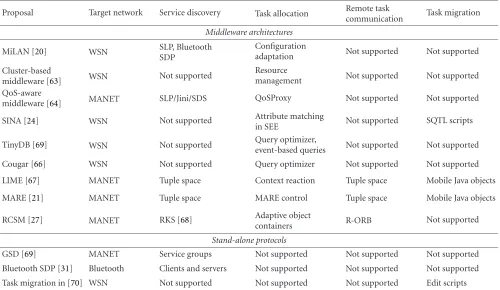
Middleware architectures implement a higher abstraction level environment for applications. Generally, three diff er-ent approaches in WSN middlewares can be ider-entified. First, a middleware coordinates the task allocation based on the application QoS. Second, WSN is abstracted to a database that supports query processing. Third, a middleware controls application processing in the network based on the current context of surrounding environment. The context depends on the location, nearby people, hosts, and devices, and the changes in these over time [62]. The target network and dis-tribution aspects for proposals are listed inTable 3.
Application QoS is applied for controlling the task alloca-tion in the configuraalloca-tion adaptaalloca-tion of the middleware link-ing applications and networks (MiLAN) [20], in the resource management of the cluster-based middleware architecture for WSNs [63], and in QoSProxies of the QoS-aware middle-ware for ubiquitous and heterogeneous environments [64]. The cluster-based middleware and MiLAN adapt also the network topology. The QoSProxy selects an application con-figuration matching available resources and makes resources reservations to guarantee the specified QoS for that configu-ration. Both MiLAN and QoS-aware middleware adopt ser-vice discovery protocols from computer network solutions. QoS-aware middleware requires a more powerful platform than the other two.
A database approach is taken in sensor information and networking architecture (SINA) [24], in TinyDB [65] on top of TinyOS, and in Cougar [66]. In SINA, database queries are injected to network as sensor querying and tasking lan-guage (SQTL) [71] scripts. These scripts migrate from node to node depending on their parameters. The task allocation in SINA is implemented by a sensor execution environment (SEE), which compares SQTL script parameters to node at-tributes and executes script only if these match. In TinyDB and Cougar, the task allocation is implemented by a query optimizer that determines energy-efficient query routes. The query plans generated by the query optimizer are parsed in the nodes and then executed accordingly. TinyDB supports also event-based queries that are initiated in-network on the occurrence of an event.
Application adaptation based on the current context is performed by Linda in a mobile environment (LIME) [67], mobile agent runtime environment (MARE) [21], and reconfigurable context-sensitive middleware (RCSM) [27]. Service discovery is implemented by the tuple space in LIME and MARE. RCSM uses a custom RKS [68] protocol that re-duces communication by advertising services only if they can be activated in the current context and potential clients are in the vicinity. LIME implements task allocation by reactions added to tuples. The MARE control manages nearby mobile agents and allocates tasks to the agents. RCSM ADaptive ob-ject containers (ADC) activate tasks in an appropriate con-text.
Table3: Implemented distribution aspects in middleware and stand-alone protocol proposals.
Proposal Target network Service discovery Task allocation Remote task
communication Task migration Middleware architectures
MiLAN [20] WSN SLP, Bluetooth
SDP
Configuration
adaptation Not supported Not supported Cluster-based
middleware [63] WSN Not supported
Resource
management Not supported Not supported QoS-aware
middleware [64] MANET SLP/Jini/SDS QoSProxy Not supported Not supported
SINA [24] WSN Not supported Attribute matching
in SEE Not supported SQTL scripts
TinyDB [69] WSN Not supported Query optimizer,
event-based queries Not supported Not supported Cougar [66] WSN Not supported Query optimizer Not supported Not supported
LIME [67] MANET Tuple space Context reaction Tuple space Mobile Java objects
MARE [21] MANET Tuple space MARE control Tuple space Mobile Java objects
RCSM [27] MANET RKS [68] Adaptive object
containers R-ORB Not supported
Stand-alone protocols
GSD [69] MANET Service groups Not supported Not supported Not supported
Bluetooth SDP [31] Bluetooth Clients and servers Not supported Not supported Not supported Task migration in [70] WSN Not supported Not supported Not supported Edit scripts
context-sensitive object request broker (R-ORB) that adapts basics from CORBA ORB. Both LIME and MARE utilize mo-bile agents implemented as Java objects for the task migra-tion.
Unlike OSs and VMs, most of the middleware architec-tures implement the network-level distribution control but do not address the single node control. Middlewares rely-ing on the application QoS specification address mainly task allocation, but leave other aspects to external components. The database abstraction is applicable to a certain type of ap-plications, likeEnvMonitor, but the expressivity of the SQTL scripts in SINA, the event-based queries in TinyDB, and es-pecially the query processing capabilities in Cougar do not support complex in-network processing. As can be seen from Table 3, context-aware proposals cover distribution aspects extensively. They implement extensive environment for En-vMonitor but their resource requirements are too high for sensor nodes.
Stand-alone protocols
The environment provided by OSs, VMs, or middleware architectures can be supported by stand-alone protocols implementing dedicated functions. We do not cover WSN MAC and routing protocols but focus on protocols that im-plement any of the four distribution aspects. The protocols and their target networks are listed inTable 3.
The group-based service discovery protocol (GSD) for MANETs [69] and the Bluetooth service discovery protocol (SDP) [31] implement the service discovery. In GSD,
termi-nals advertise their services and nearby service groups within the distance of n hops. Service requests are forwarded to-wards the service provider based on group advertisements. A Bluetooth terminal maintains information about its services in an SDP server. Searching and querying for existing services are performed by an SDP client that queries one server at a time.
An approach for minimizing the transferred binary code size on the task migration is proposed in [70]. The proposal transmits only the differences between the existing and the new code. The algorithm is adopted from thediff command of UNIX.
These protocols can be used as separate components for
EnvMonitor, but none of them provides a complete environ-ment. GSD is communication intensive due to the multi-hop advertisements. Bluetooth SDP does not support broadcast queries, which restricts its applicability in large WSNs. The task migration proposed in [70] cannot be initiated in WSNs due to the complexity of the algorithm and the lack of in-tegrity checking.
4. ANALYSIS OF PROPOSALS
Table4: System testing and validation environments for distribution proposals.
Proposal Test environment Simulation andtesting tools Prototypeplatform Result accuracy Published results
OS-based architectures
TinyOS [39] Prototype TOSSIM [72] Motes Accurate Component sizes, OS routinedelays, computation costs
BerthaOS [40] Prototype None Pushpin None Functionality mentioned
EYES OS [37] None None None None None
MOS [25] Prototype PC emulator
XMOS [25] Nymph Moderate
Memory and power consumption, test application performance results
BTnodes [38] Prototype None Micro-size
BTnodes Moderate
Component sizes, energy consumption
VM-based architectures
Sensorware [17] Prototype SensorSim [73] Linux IPAQ Accurate Framework size, execution delays,energy consumption
MagnetOS [43] Windows/Linux JVM
Custom
packet-level simulator PC None
Internal algorithm comparison in simulator
Mat´e [45] Prototype TOSSIM [72] TinyOS mote Accurate Bytecode overhead, installationcosts, code infection performance
Middleware architectures
MiLAN [20] None None None None None
Cluster-based middleware in [63]
Algorithm simulation
Custom
simulator None None
Heuristic resource allocation, algorithm performance Qos-aware
middleware in [64] None None None None None
SINA [24] Simulations GloMoSim [74] None Poor SINA networking overhead,application performance
TinyDB [65] Simulations, prototype
Custom
en-vironment TinyOS mote Accurate
Query routing performance in simulations, sample accuracy and sampling frequency in prototypes
Cougar [66] None None None None None
LIME [67] JVM None PC Poor Approximations about Java code size
MARE [21] JVM None PDA Poor Service discovery performance
RCSM [27] Prototype None PDA with custom
hardware
RCSM poor, RKS accurate
RCSM memory consumption, RKS size, communication, energy consumption
Stand-alone protocols
GSD [69] Simulations GloMoSim [74] None Poor Influence of internal parameterson service discoverability
Task migration
in [70] PC None
Tested in EYES
nodes Accurate
Algorithm performance, influence of internal parameters
4.1. Testing and validation of WSN proposals
Discussed WSN architectures vary in their complexity and requirements. In order to provide a scope for the assessment of proposals, their testing and validation environments are presented inTable 4. The test environment is presented in the second column. The simulation and testing tools and proto-type platforms identify the proposal validation tools and test platform. The published results and their accuracies are listed in the last two columns.
Generally, prototypes exist for the single node architec-tures and their results are accurate including information required for comparison. Instead, on the middleware layer, proposals are evaluated by simulations or not at all. The simulation results are inaccurate as they compare only the internal algorithms and do not give any information for a general comparison. Of course, exceptions exist in both cases.
Table5: Characteristics of technologies implementing service discovery.
Technology Communication Scalability Fault tolerance Requirements Benefits (pros) Problems (cons)
Resource
Tuple space Tuple operations Balancing between memory and scale
Not restricted Lost services can be rehunted
Peer-to-peer link Only nearby nodes one at a time
Service information only in the host
Bluetooth protocol
RKS Advertises for po-tential clients Only to nearby clients Advertisementswhen context and clients applicable
Service registration Request routing based on group
of distribution performance is not possible. The prototype platforms vary in their efficiency, the simulators in their ac-curacy, and the test applications in their requirements and functionality. As the area is evolving rapidly, generally ac-cepted benchmarks would ease the comparison of the pro-posals. However, the definition of general-enough bench-marks for WSNs is difficult due to their application-specific nature.
4.2. Comparison of technologies
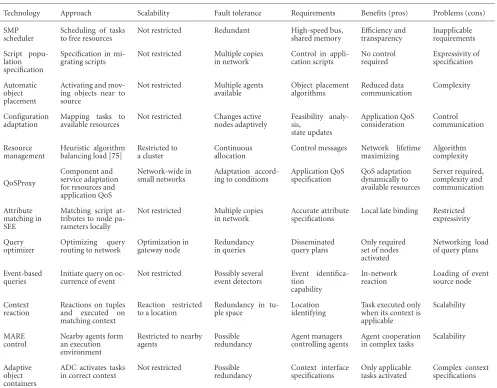
We classify the technologies for each distribution aspect sep-arately. The classification dimensions for a technology are
communication mechanism,scalability to large WSNs, fault tolerance, andrequirementsthat must be met before the tech-nology can be used. For each techtech-nology, we also assess its pros and cons in general. These dimensions offer tools for the evaluation of the robustness and applicability of a tech-nology for different kinds of WSNs and applications.
Service discovery
The classification of the service discovery technologies in the proposals according to the defined dimensions is presented in Table 5. From the presented solutions, all but the tuple space and GSD rely on client-server architecture. Still, the network manager is the only centralized server. In general, two problems can be identified from the proposals. They ei-ther have a restricted scalability or require intensive commu-nication.
The client-server technologies that are limited to nearby nodes do not scale to large WSNs. GSD and the tuple space both scale to large networks but they require more commu-nication for locating a service. However, in both technolo-gies the communication load can be decreased by increasing the number of hops, to which the service information is dis-tributed. This increases the communication during the
ini-tiation but reduces it during the discovery, with the cost of increased memory consumption.
Task allocation
The technologies that implement a mechanism for the task allocation and the characteristics of each technology are listed in Table 6. As peer-to-peer communication is not needed in all the technologies, the communication mecha-nism is replaced by a more general outlining of the taken ap-proach. As shown inTable 6, the variance of technologies is greater than in the service discovery. As most of the technolo-gies are middleware layer implementations, the main reason for the variance is the three different approaches taken at that layer.
The most promising approach is the task allocation based on application QoS. It does not restrict the implementa-tion of tasks nor rely on the surrounding context. Instead, it enables the adaptation of application operations depend-ing on the current application requirements. The application requirements can be adjusted depending on the output of the application itself, which makes the technologies adaptive to changing conditions. Generally, application-QoS-based technologies require a central control for the task allocation, but a distributed control lacks similar adaptability.
Remote task communication
From the remote task communication technologies classified inTable 7, most utilize traditional RPC or RMI that are tai-lored for resource constrained environments. The tuple space and callbacks, which also utilize tuple space, are the only ex-ceptions.
Table6: Characteristics of technologies implementing task allocation.
Technology Approach Scalability Fault tolerance Requirements Benefits (pros) Problems (cons)
SMP scheduler
Scheduling of tasks to free resources
Not restricted Redundant High-speed bus, shared memory
Not restricted Multiple copies in network ing objects near to source
Not restricted Multiple agents available
Not restricted Changes active nodes adaptively balancing load [75]
Restricted to a cluster
Continuous allocation
Control messages Network lifetime maximizing tributes to node pa-rameters locally
Not restricted Multiple copies in network
Accurate attribute specifications
Local late binding Restricted expressivity
Initiate query on oc-currence of event
Not restricted Possibly several event detectors when its context is applicable
is sent to a registered callback function whenever the value of a tuple changes. The tuple space does not support such interests on tuples. Like in the service discovery, the com-munication and memory load of the tuple space are ad-justable.
Task migration
The technologies for the task migration are summarized in Table 8. Most of the technologies rely on the mobile agents due to their fault tolerance and smaller physical size. Three technologies rely on binary code in order to lessen the com-putation load caused by the agent interpreting.
In order to use binary code in the task migration, the possible errors during transfers and malicious attacks must be managed. The edit script generation algorithm is too complex to be executed in nodes, thus making it inappli-cable for dynamic WSNs. From the VM approaches, the TCL and SQTL scripts and Mat´e bytecode capsules are more lightweight than Java objects because of the complexity and memory requirements of JVM.
4.3. Suitability assessment
Generally, the OS and VM proposals support the remote task communication and the task migration but leave the task allocation and the service discovery to an application or other external components. On the contrary, middleware approaches concentrate on implementing the task allocation, leaving other aspects for the tuple spaces or some legacy pro-tocols. MARE and LIME are the only proposals that cover all distribution aspects. However, the utilization of JVM and the distributed tuple space requires resources that are not gener-ally available in current WSN platforms.
adap-Table7: Characteristics of technologies implementing remote task communication.
Technology Communicationimplementation Scalability Fault tolerance Requirements Benefits (pros) Problems (cons)
Active messages
Remote handler, data encapsulation
Not restricted N/A Awareness of remote handler
BBS Message posting to neighbor BBS
EYES OS RPC N/A Restricted to neighbors only in one node
Shared tuple space
Not restricted Possibility for redundant messages
Name resolution Mapping to local IPC
Not restricted Possible secure channels
Not restricted N/A Compile time script modification
Tuple space Tuple operations Not restricted Redundant Shared tuple space between nodes
Context sensing Activated only in applicable context
Scalability
Table8: Characteristics of technologies implementing task migration.
Technology Communication Scalability Fault tolerance Requirements Benefits (pros) Problems (cons)
Binary code Binary code after negotiation
Only to one neigh-bor at a time
Simple checksum
Initiated by the binary code itself
Runtime initiation Scalability, bit er-rors, binary size
No protection User initiates downloads
Possibility to update OS components
Errors, binary size, user interaction
Smoblets Java applet modules Execution only in laptops/PDAs
Java interpreter protection
Efficient platforms Complex processing outsourcing
Executed only in efficient nodes
TCL script migration
TCL scripts The scale specified in scripts small size of scripts
Complex
popula-Small capsules in one active message
Script populated to all nodes in network
Mat´e interpreter protection
Injected to network by a user
Small size of scripts No controlled migration
SQTL scripts Custom query scripts The scale specified in scripts
SEE interpreter protection
Injected to network by a user
Small size of scripts Communication cost in broadcast
Edit scripts Scripts containing changes to old code
No in-network
Small size of scripts Complexity, no in-network operation
tivity of the proposals to changing conditions and the task allocation for extending network lifetime are emphasized.
For resource rich environments, MARE is the most suit-able environment. The sensing and aggregation tasks in Env-Monitorcan be allocated by the MARE control, and the active monitoring tasks can be implemented as mobile agents that are activated on demand.
4.4. Recommendations
From the systems software proposals for WSNs, OS and VM technologies implement the single node control and separate solutions for application distribution. The middleware pro-posals are applicable to the network-level distribution con-trol. However, we argue that in WSNs, OS and middleware layers must be integrated to provide sufficient services within the constraints set by applications and platform resources.
In this kind of an approach, OS and middleware are side the same framework so that information about OS in-ternals and network topology is applicable to the middle-ware layer. Thus, this approach minimizes extra computa-tion required for interfacing OS routines and communica-tion due to the control signaling. Further, the middleware layer is aware of the influences of its actions at both the single node and network level. This awareness can be beneficial in the network-level power management and in the balancing of node loading.
For a sufficient environment for EnvMonitor, OS must implement a preemptive scheduling of tasks, a memory and power management, and a local IPC. The memory control should support static and dynamic memory and maintain in-formation about available memory. We recommend the us-age of a messus-age-passing IPC because it is easily extended to the remote task communication. This kind of a general-purpose OS can be implemented on limited resources as shown in [25].
In addition to the local services, OS informs the middle-ware about the node energy and storage consumption, net-work role, associations, and nearby nodes and routes. An in-ternal interface for the middleware to control tasks, power states, and network is implemented in OS. When all distri-bution aspects are implemented on the middleware layer, the components are able to utilize the information from each other more efficiently.
For service discovery we recommend the tuple space, since the pure client-server architecture is too static for WSNs. The resource and communication load of the tuple space can be diminished by selectively distributing tuple stor-ing to nodes that use the tuple data and by dividstor-ing tuples to two-level hierarchies similar to GSD. The nodes that need a tuple for their operation can be identified with the support of task allocation. By sending only service group tuples to the distant nodes, less memory is needed but requests for tuples can still be routed accurately.
For the task allocation, the current application-QoS-based middleware proposals implement sufficient technolo-gies. However, simpler algorithms that require less control communication should be used, even with the cost of accu-racy.
For the remote task communication we recommend a simple approach that marshals the local message passing IPC to network packets. The remote nodes are identified by the service discovery. To make the delivery of a packet reliable, acknowledgements must be used. This is more lightweight than the tuple space, and the fault tolerance does not depend on the available recipients.
From our perspective, the task migration is required only in very dynamic applications, like object tracking. These applications require a VM-based environment. In OSs, the communication cost of the large binary transfers is extensive. Thus, the task migration should only be used when extremely necessary. The transfers must be protected with checksums and digital signatures, even though these are resource con-suming.
We recommend also the usage ofvirtual clusters.A vir-tual cluster may follow the physical topology or it can be a set of adjacent nodes that have elected a single control en-tity. By storing detailed tuple information and performing task allocation within the boundaries of a virtual cluster, the communication and memory load can be diminished.
5. CONCLUSIONS
Our survey of WSN applications and their distribution shows that, despite many proposals, no common bench-marks nor detailed, large-scaled experiments have been pub-lished. The research seems to focus either on node imple-mentations or theoretical work on distinct aspects, such as routing algorithms, without a realistic relation to physical platforms.
The systems software proposals are still evolving. Cur-rently, they implement technologies and algorithms for ap-plication distribution but lack an approach combining a dis-tributing middleware layer to OS providing a single node control. This kind of an approach is needed in order to im-plement a distributed operating environment, which sup-ports application QoS and extends network lifetime, for re-source scarce sensor nodes.
REFERENCES
[1] W. Stallings, Data & Computer Communications, Prentice-Hall, Englewood Cliffs, NJ, USA, 6th edition, 2001.
[2] J. A. Stankovic, T. E. Abdelzaher, C. Lu, L. Sha, and J. C. Hou, “Real-time communication and coordination in embedded sensor networks,”Proc. IEEE, vol. 91, no. 7, pp. 1002–1022, 2003.
[3] I. F. Akyildiz, W. Su, Y. Sankarasubramaniam, and E. Cayirci, “A survey on sensor networks,”IEEE Commun. Mag., vol. 40, no. 8, pp. 102–114, 2002.
[4] I. F. Akyildiz, W. Su, Y. Sankarasubramaniam, and E. Cayirci, “Wireless sensor networks: a survey,” Computer Networks, vol. 38, no. 4, pp. 393–422, 2002.
[5] K. Akkaya and M. Younis, “A survey on routing protocols for wireless sensor networks,”Elsevier Ad Hoc Network Journal, vol. 3, no. 3, pp. 325–349, 2005.
[6] H. Karl and A. Willig, “A short survey of wireless sen-sor networks,” Tech. Rep. TKN-03-018, Technical Univer-sity Berlin, Berlin, Germany, 2003, available:http://www.tkn.
tu-berlin.de/publications.
[7] D. Chen and P. K. Varshney, “QoS support in wireless sensor networks: a survey,” inProc. International Conference on Wire-less Networks (ICWN ’04), pp. 227–233, Las Vegas, Nev, USA, June 2004.
[9] V. Raghunathan, C. Schurgers, S. Park, and M. B. Srivastava, “Energy-aware wireless microsensor networks,”IEEE Signal Processing Mag., vol. 19, no. 2, pp. 40–50, 2002.
[10] A. J. Goldsmith and S. B. Wicker, “Design challenges for energy-constrained ad hoc wireless networks,”IEEE Wireless Communications, vol. 9, no. 4, pp. 8–27, 2002.
[11] D. Remondo and I. G. Niemegeers, “Ad hoc networking in future wireless communications,”Computer Communications, vol. 26, no. 1, pp. 36–40, 2003.
[12] N. Xu, “A survey of sensor network applications,” available:
http://enl.usc.edu/∼ningxu/papers/survey.pdf.
[13] C.-Y. Chong and S. P. Kumar, “Sensor networks: evolution, opportunities, and challenges,”Proc. IEEE, vol. 91, no. 8, pp. 1247–1256, 2003.
[14] A. Mainwaring, J. Polastre, R. Szewczyk, D. Culler, and J. An-derson, “Wireless sensor networks for habitat monitoring,” inProc. International Workshop on Wireless Sensor Networks and Applications (WSNA ’02), pp. 88–97, Atlanta, Ga, USA, September 2002.
[15] PODS, A Remote Ecological Micro-sensor Network Project website,http://www.pods.hawaii.edu.
[16] CORIE website,http://www.ccalmr.ogi.edu/CORIE.
[17] A. Boulis, C.-C. Han, and M. B. Srivastava, “Design and im-plementation of a framework for efficient and programmable sensor networks,” inProc. 1st International Conference on Mo-bile Systems, Applications, and Services (MobiSys ’03), San Francisco, Calif, USA, May 2003.
[18] P. Bonnet, J. Gehrke, and P. Seshadri, “Querying the physical world,”IEEE Pers. Commun., vol. 7, no. 5, pp. 10–15, 2000. [19] L. Schwiebert, S. K. S. Gupta, and J. Weinmann, “Research
challenges in wireless networks of biomedical sensors,” in Proc. 7th ACM International Conference on Mobile Comput-ing and NetworkComput-ing (MobiCom ’01), pp. 151–165, Rome, Italy, July 2001.
[20] W. B. Heinzelman, A. L. Murphy, H. S. Carvalho, and M. A. Perillo, “Middleware to support sensor network applications,” IEEE Network, vol. 18, no. 1, pp. 6–14, 2004.
[21] M. Storey, G. S. Blair, and A. Friday, “MARE: resource discov-ery and configuration in Ad hoc networks,”J. Mobile Networks and Applications, vol. 7, no. 5, pp. 377–387, 2002.
[22] H. O. Marcy, J. R. Agre, C. Chien, L. P. Clare, N. Romanov, and A. Twarowski, “Wireless sensor networks for area monitoring and integrated vehicle health management applications,” in Proc. AIAA Guidance, Navigation, and Control Conference and Exhibit, Portland, Ore, USA, 1999, Collection of Technical Pa-pers. Vol. 1 (A99-36576 09-63).
[23] K. R¨omer , “Tracking real-world phenomena with smart dust,” inProc. 1st European Workshop on Wireless Sensor Net-works (EWSN ’04), pp. 28–43, Berlin, Germany, January 2004. [24] C.-C. Shen, C. Srisathapornphat, and C. Jaikaeo, “Sensor in-formation networking architecture and applications,”IEEE Pers. Commun., vol. 8, no. 4, pp. 52–59, 2001.
[25] H. Abrach, S. Bhatti, J. Carlson, et al., “MANTIS: system sup-port for MultimodAl NeTworks of In-situ Sensors,” inProc. 2nd ACM International Workshop on Wireless Sensor Networks and Applications (WSNA ’03), pp. 50–59, San Diego, Calif, USA, September 2003.
[26] M. B. Srivastava, R. R. Muntz, and M. Potkonjak, “Smart kindergarten: sensor-based wireless networks for smart de-velopmental problem-solving enviroments,” inProc. 7th ACM International Conference on Mobile Computing and Network-ing (MobiCom ’01), pp. 132–138, Rome, Italy, July 2001. [27] S. S. Yau, F. Karim, Y. Wang, B. Wang, and S. K. S. Gupta,
“Re-configurable context-sensitive middleware for pervasive com-puting,”IEEE Pervasive Computing, vol. 1, no. 3, pp. 33–40, 2002.
[28] NIST Wireless Ad hoc Networks Project website,http://www.
antd.nist.gov/wahn ssn.shtml.
[29] MICA2 data sheet, available:http://www.xbow.com. [30] IEEE P1451.5 Wireless Sensor Working Group website,
http://grouper.ieee.org/groups/1451/5.
[31] Bluetooth Special Interest Group, “Bluetooth specification, version 1.1,” February 2001.
[32] Wireless Medium Control (MAC) and Physical Layer (PHY) Specifications for Low Rate Wireless Personal Area Networks (LR-WPAN), IEEE Standard 802.15.4, 2003.
[33] Wireless LAN Medium Control (MAC) and Physical Layer (PHY) Specifications, IEEE Standard 802.11, 1999.
[34] IETF Mobile Ad-hoc Networks Working Group website,
http://www.ietf.org/html.charters/manet-charter.html.
[35] G. Coulouris, J. Dollimore, and T. Kindberg,Distributed Sys-tems: Concepts and Design, Addison-Wesley, Boston, Mass, USA, 3rd edition, 2001.
[36] A. Fuggetta, G. P. Picco, and G. Vigna, “Understanding code mobility,”IEEE Trans. Software Eng., vol. 24, no. 5, pp. 342– 361, 1998.
[37] P. J. M. Havinga, “System architecture specification,” EYES Project Deliverable 1.1, available:http://www.eyes.eu.
org/dissem.htm.
[38] J. Beutel, O. Kasten, F. Mattern, K. Roemer, F. Siegemund, and L. Thiele, “Prototyping wireless sensor networks with BTn-odes,” inProc. 1st European Workshop on Wireless Sensor Net-works (EWSN ’04), pp. 323–338, Berlin, Germany, January 2004.
[39] J. Hill, R. Szewczyk, A. Woo, S. Hollar, D. Culler, and K. Pis-ter, “System architecture directions for networked sensors,” in Proc. 9th ACM International Conference on Architectural Sup-port for Programming Languages and Operating Systems (AS-PLOS ’00), pp. 94–103, Cambridge, Mass, USA, November 2000.
[40] J. Lifton, D. Seetharam, M. Broxton, and J. Paradiso, “Push-pin computing system overview: a platform for distributed, embedded, ubiquitous sensor networks,” inProc. 1st Interna-tional Conference on Pervasive Computing (Pervasive ’02), pp. 139–151, Zurich, Switzerland, August 2002.
[41] QNX website,http://www.qnx.com. [42] OSE website,http://www.ose.com.
[43] R. Barr, J. C. Bicket, D. S. Dantas, et al., “On the need for system-level support for ad hoc and sensor networks,” ACM SIGOPS Newsletter on Operating Systems Review, vol. 36, no. 2, pp. 1–5, 2002.
[44] E. G. Sirer, R. Grimm, A. J. Gregory, and B. N. Bershad, “De-sign and implementation of a distributed virtual machine for networked computers,” inProc. 17th ACM Symposium on Operating Systems Principles (SOSP ’99), pp. 202–216, Kiawah Island, SC, USA, December 1999.
[45] P. Levis and D. Culler, “Mat´e: a tiny virtual machine for sen-sor networks,” inProc. 10th ACM International Conference on Architectural Support for Programming Languages and Oper-ating Systems (ASPLOS ’02), pp. 85–95, San Jose, Calif, USA, October 2002.
[46] D. Gelernter, “Generative communication in linda,” ACM Trans. Programming Languages and Systems, vol. 7, no. 1, pp. 80–112, 1985.
[47] E. Guttman, C. Perkins, J. Veizades, and M. Day, “Service lo-cation protocol, version 2,” IETF, RFC 2608, June 1999. [48] Jini Architecture Specification, version 2.0, Sun Microsystems,
June 2003, available:http://www.sun.com/software/jini/specs. [49] UPnP Device Architecture, Microsoft Corporation, June 2000,
available:http://www.upnp.org/resources/documents.asp. [50] S. E. Czerwinski, B. Y. Zhao, T. D. Hodes, A. D. Joseph, and
service,” inProc. 5th International Conference on Mobile Com-puting and Networking (MobiCom ’99), pp. 24–35, Seattle, Wash, USA, August 1999.
[51] JavaSpaces Service Specification, version 2.0, Sun Microsys-tems, June 2003, available: http://www.sun.com/software/
jini/specs.
[52] T. J. Lehman, A. Cozzi, Y. Xiong, et al., “Hitting the dis-tributed computing sweet spot with TSpaces,”Computer Net-works, vol. 35, no. 4, pp. 457–472, 2001.
[53] R. Srinivasan, “RPC: remote procedure call protocol specifi-cation version 2,” IETF, RFC 1831, August 1995.
[54] The Open Group Portal to World of DCE, website,http://
www.opengroup.org/dce.
[55] Object Management Group website,http://www.omg.org. [56] Java RMI specification, Sun Microsystems, 1997–2003,
avail-able:http://java.sun.com/products/jdk/rmi/reference/docs. [57] M. Horstmann and M. Kirtland, “DCOM
architec-ture,” Microsoft Corporation, July 1997, available: http://
msdn.microsoft.com/library/default.asp?url=/library/en-us/
dnanchor/html/dcom.asp.
[58] A. Schill and S. K¨ummel, “Design and implementation of a support platform for distributed mobile computing,” Dis-tributed Systems Engineering, vol. 2, no. 3, pp. 128–141, 1995. [59] S. Adwankar, “Mobile CORBA,” in Proc. 3rd International Symposium on Distributed Objects and Applications (DOA ’01), pp. 52–63, Rome, Italy, September 2001.
[60] A. D. Joseph, J. A. Tauber, and M. F. Kaashoek, “Mobile com-puting with the rover toolkit,”IEEE Trans. Comput., vol. 46, no. 3, pp. 337–352, 1997.
[61] Supercluster.org website,http://www.supercluster.org. [62] B. Schilit, N. Adams, and R. Want, “Context-aware computing
applications,” inProc. Workshop on Mobile Computing Systems and Applications (WMCSA ’94), pp. 85–90, Santa Cruz, Calif, USA, December 1994.
[63] Y. Yu, B. Krishnamachari, and V. K. Prasanna, “Issues in de-signing middleware for wireless sensor networks,”IEEE Net-work, vol. 18, no. 1, pp. 15–21, 2004.
[64] K. Nahrstedt, X. Dongyan, D. Wichadakul, and L. Baochun, “QoS-aware middleware for ubiquitous and heterogeneous environments,”IEEE Commun. Mag., vol. 39, no. 11, pp. 140– 148, 2001.
[65] S. R. Madden, M. J. Franklin, J. M. Hellerstein, and W. Hong, “The design of an acquisitional query processor for sensor networks,” inProc. 22nd ACM SIGMOD International Con-ference on Management of Data (SIGMOD ’03), pp. 491–502, San Diego, Calif, USA, June 2003.
[66] Y. Yao and J. Gehrke, “The Cougar approach to in-network query processing in sensor networks,”ACM SIGMOD Record, vol. 31, no. 3, pp. 9–18, 2002.
[67] A. L. Murphy, G. P. Picco, and G.-C. Roman, “LIME: a middleware for physical and logical mobility,” inProc. 21st International Conference on Distributed Computing Systems (ICDCS ’01), pp. 524–533, Phoenix, Ariz, USA, April 2001. [68] S. S. Yau and F. Karim, “An energy-efficient object
discov-ery protocol for context-sensitive middleware for ubiquitous computing,”IEEE Trans. Parallel Distrib. Syst., vol. 14, no. 11, pp. 1074–1085, 2003.
[69] D. Chakraborty, A. Joshi, Y. Yesha, and T. Finin, “GSD: a novel group-based service discovery protocol for MANETS,” inProc. 4th International Workshop on Mobile and Wireless Communications Network (MWCN ’02), pp. 140–144, Stock-holm, Sweden, September 2002.
[70] N. Reijers and K. Langendoen, “Efficient code distribution in wireless sensor networks,” inProc. 2nd ACM International
Workshop on Wireless Sensor Networks and Applications, pp. 60–67, San Diego, Calif, USA, September 2003.
[71] C. Jaikaeo, C. Srisathapornphat, and C.-C. Shen, “Query-ing and task“Query-ing in sensor networks,” inProc. 14th Interna-tional Symposium on Aerospace/Defense Sensing, Simulation, and Control, vol. 4037 ofProc. SPIE’s, pp. 184–197, Orlando, Fla, USA, April 2000.
[72] P. Levis, N. Lee, M. Welsh, and D. Culler, “TOSSIM: accu-rate and scalable simulation of entire TinyOS applications,” inProc. 1st ACM Conference on Embedded Networked Sensor Systems (SenSys ’03), pp. 126–137, Los Angeles, Calif, USA, November 2003.
[73] S. Park, A. Savvides, and M. B. Srivastava, “Simulating net-works of wireless sensors,” inProc. Winter Simulation Confer-ence (WSC ’01), pp. 1330–1338, Arlington, Va, USA, Decem-ber 2001.
[74] X. Zeng, R. Bagrodia, and M. Gerla, “GloMoSim: a library for parallel simulation of large-scale wireless networks,” inProc. 12th Workshop on Parallel and Distributed Simulations (PADS ’98), pp. 154–161, Banff, Alberta, Canada, May 1998. [75] Y. Yu and V. K. Prasanna, “Energy-balanced task allocation
for collaborative processing in networked embedded systems,” inProc. ACM SIGPLAN Conference on Languages, Compilers, and Tools for Embedded Systems (LCTES ’03), pp. 265–274, San Diego, Calif, USA, June 2003.
Mauri Kuorilehto received the M.S. de-gree in 2001 from Tampere University of Technology (TUT), Finland. He is currently pursuing his Ph.D. degree and acting as a Research Scientist in the DACI Research Group, the Institute of Digital and Com-puter Systems at TUT. His research inter-ests include wireless sensor and ad hoc net-works concentrating on distributed pro-cessing, operating systems, and network simulation.
Marko H¨annik¨ainenreceived the M.S. de-gree in 1998 and the Ph.D. dede-gree in 2002 both from Tampere University of Technol-ogy (TUT). Currently he acts as a Senior Research Scientist in the Institute of Dig-ital and Computer Systems at TUT, and a Project Manager in the DACI Research Group. His research interests include wire-less local and personal area networking, wireless sensor and ad hoc networks, and novel web services.
Timo D. H¨am¨al¨ainenreceived the M.S. de-gree in 1993 and the Ph.D. dede-gree in 1997 both from Tampere University of Technol-ogy (TUT). He acted as a Senior Research Scientist and Project Manager at TUT dur-ing 1997–2001. He was nominated to be Full Professor at TUT, Institute of Dig-ital and Computer Systems in 2001. He heads the DACI Research Group that fo-cuses on three main lines: wireless local