R E S E A R C H
Open Access
A bi-population QUasi-Affine
TRansformation Evolution algorithm for
global optimization and its application to
dynamic deployment in wireless sensor
networks
Nengxian Liu
1, Jeng-Shyang Pan
1,2,3*and Trong-The Nguyen
2,4Abstract
In this paper, we propose a new Bi-Population QUasi-Affine TRansformation Evolution (BP-QUATRE) algorithm for global optimization. The proposed BP-QUATRE algorithm divides the population into two subpopulations with sort strategy, and each subpopulation adopts a different mutation strategy to keep the balance between the fast convergence and population diversity. What is more, the proposed BP-QUATRE algorithm dynamically adjusts scale factor with a linear decrease strategy to make a good balance between exploration and exploitation capability. We compare the proposed algorithm with two QUATRE variants, PSO-IW, and DE algorithms on the CEC2013 test suite. The experimental results demonstrate that the proposed BP-QUATRE algorithm outperforms the competing algorithms. We also apply the proposed algorithm to dynamic deployment in wireless sensor networks. The simulation results show that the proposed BP-QUATRE algorithm has better coverage rate than the other competing algorithms.
Keywords:Differential evolution, Particle swarm optimization, Bi-population, QUATRE algorithm, Global optimization, Dynamic deployment, Wireless sensor networks
1 Introduction
In the last few decades, there have been many optimization demands arising not only from the scientific community but also from various real-world applications. Generally, the approach to solving these optimization problems often begins with designing the objective function which can model the objectives of optimization problems [1]. Many optimization approaches have been proposed to meet these demands aiming at finding optimal solutions. Some Swarm-based intelligence optimization algorithms, such as
particle swarm optimization (PSO) [2], ant colony
optimization (ACO) [3], differential evolution (DE) [1],
artificial bee colony (ABC) optimization [4], and QUasi-Affine TRansformation Evolution (QUATRE) algorithm [5], and so on, have been developed to tackle these complex optimization problems.
QUATRE algorithm was first presented by Meng et al.
in [5] that discussed the relationship between QUATRE
algorithm and the other two swarm-based intelligence algorithms PSO and DE. In 1995, Kennedy and Eberhart
firstly introduced the PSO algorithm [2]. As PSO is
simple, powerful, and straightforward to implement, many researchers have studied this technique and
devel-oped various improved variants [6–8]. DE was
intro-duced by Storn and Price [1] in 1995, which was
arguably one of the most powerful optimization
algorithms. As well, many DE variants have been proposed to enhance the performance of DE algorithm [9–11], and QUATRE algorithm is one of them proposed to conquer representational or positional bias of DE
© The Author(s). 2019Open AccessThis article is distributed under the terms of the Creative Commons Attribution 4.0 International License (http://creativecommons.org/licenses/by/4.0/), which permits unrestricted use, distribution, and reproduction in any medium, provided you give appropriate credit to the original author(s) and the source, provide a link to the Creative Commons license, and indicate if changes were made.
* Correspondence:[email protected];[email protected]
1
College of Mathematics and Computer Science, Fuzhou University, Fuzhou 350108, China
2Fujian Provincial Key Laboratory of Big Data Mining and Applications, Fujian
University of Technology, Fuzhou 350118, China
algorithm [12]. QUATRE’s conventional notation is
“QUATRE/x/y” which denotes types of QUATRE
vari-ants. It is worth noting that the notation of QUATRE is more general than the DE’s notation“DE/x/y/z”[13].
The canonical QUATRE algorithm and its variants can be found in literatures [12–17]. The QUATRE has the ad-vantages of simplicity, few control parameters to set, and convenient to be used, but it has some weaknesses as the DE algorithm such as it will be premature convergence, and will search stagnation and may be easily trapped into local optima. Population diversity plays important role in alleviating these weaknesses. Therefore, it is important to keep the balance between diversity and convergence. In [16], S-QUATRE has been proposed which uses sort strat-egy to improve the performance of QUATRE algorithm. And S-QUATRE divides the population into the better and the worse groups and evolves the individuals in the worse group. The other algorithms which partition population into two groups or several subpopulations to maintain population diversity and to enhance the performance of al-gorithms, such as CMA-ES, PSO, DE and CSO, can be found in previous literature [18–22]. On the other hand, both mutation strategies and control parameter scale factor
Fhave significant effects on the performance of QUATRE
variants. Different mutation strategies in QUATRE algo-rithm have different performance over various optimization problems [13] because different mutation strategy has dif-ferent search ability and convergence rate. Usually, similar
to the DE algorithm, adopting larger Fvalue in QUATRE
algorithm means the algorithm is more focused on explor-ation, while a smallerFvalue means more exploitation [23]. Therefore, in this paper, in order to improve the perform-ance of QUATRE algorithm, we propose a novel Bi-Population QUATRE algorithm with a sort strategy and a linear decrease scale factorF(BP-QUATRE), and each sub-population has a different mutation strategy.
The remainder of the paper is arranged as follows. In Section 2, we briefly review the QUATRE algorithm. Our proposed Bi-Population QUasi-Affine TRansformation Evolu-tion (BP-QUATRE) algorithm is given in SecEvolu-tion 3. In SecEvolu-tion 4, we apply the proposed algorithm to dynamic deployment in wireless sensor networks. What is more, the experimental analysis of our proposed algorithm under CEC2013 test suite and simulation results in wireless sensor networks are pre-sented in Section 4. Finally, Section 6 gives the conclusion.
2 Canonical QUATRE algorithm
Meng et al. have proposed the QUATRE algorithm for solving optimization problems [5]. QUATRE is an abbre-viation of QUasi-Affine TRansformation Evolution, and the reason the authors naming the algorithm QUATRE is that individuals in QUATRE algorithm evolve by using an affine transformation-like equation. The detailed evo-lution equation of QUATRE is as follows.
X←MXþMB ð1Þ
whereMis an evolution matrix andMis a binary inverted matrix of M. The elements of them are either 0 or 1. The binary invert operation means to invert the values of the matrix. The reverse values of zero elements are ones, while the reverse values of one elements are zeros. Equa-tion2shows an example of binary inverse operation.
M¼
Mis transformed from an initial matrix Miniwhich is initialized by a lower triangular matrix with the elements
equaling to ones. Transforming fromMinitoMcontains
two consecutive steps. In the first step, every element in
each row vector of Mini is randomly permuted. In the
second step, the sequence of the row vectors is ran-domly permuted with all elements of each row vector unchanged. An example of the transformation with ps = D is given in Eq.3. Usually, the population size ps is
lar-ger than the dimension, while the matrix Mini needs to
be extended according to population size ps. Equation4
shows an example of ps = 2D + 2. Generally, when ps % D = k, the first k rows of the D × D lower triangular matrix are included inMiniand adaptively changeM ac-cording toMini[12].
problem, and D denotes the dimension number of ob-jective function, where i∈{1, 2, …, ps}. The operation
“⊗”stands for component-wise multiplication of the ele-ments in each matrix, which is the same as“.*”operation in Matlab software.B= [B1, G, B2, G,…, Bi, G,…, Bps, G]T is the donor matrix, and it has several different calcula-tion schemes (mutacalcula-tion strategies) which are listed in Eqs. (5)–(8) [7].
QUATRE=best=1:B¼Xgbest;GþF Xr1;G‐Xr2;G
ð5Þ QUATRE= rand=1:B¼Xr0;Gþ F Xr1;G‐Xr2;G
ð6Þ
QUATRE=target=1:B¼XþF Xr1;G‐Xr2;G
ð7Þ
QUATRE=target‐to‐best=1B
¼XþF Xgbest;G‐X
þF Xr1;G‐Xr2;G
ð8Þ
Xgbest, G= [Xgbest, G, Xgbest, G, …, Xgbest, G]TXgbest, G= [Xgbest, G, Xgbest, G, …, Xgbest, G]T denotes a row vector-duplicated matrix with each row vector equaling to the global best individual Xgbest, G of the Gth gener-ation. F can be considered as amplification factor, whose value region is (0, 1] for most optimization problems.Xr1,
G,Xr2, GandXr3, Gare a set of random matrices which are generated by randomly permutating the sequence of row vectors in the matrixXof theGth generation.
3 Bi-population QUATRE algorithm with sort strategy and linear decrease scale factor F (BP-QUATRE)
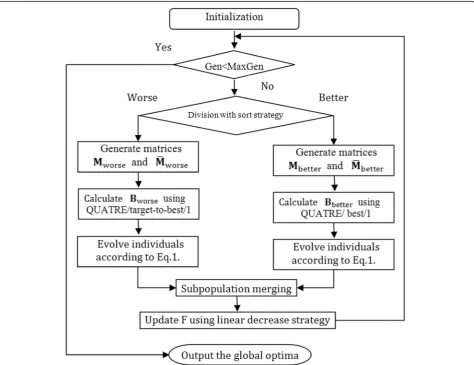
In this section, we describe the main idea of our proposed algorithm BP-QUATRE. As mentioned above, because eas-ily trapping into local optima and premature convergence is the weakness of QUATRE algorithm. In order to alleviate the above weaknesses, BP-QUATRE consisting of popula-tion initializapopula-tion, populapopula-tion division, subpopulapopula-tion evolu-tion, subpopulation merging, and an approach to update the parameter scale factorF, is proposed in this paper. The
main framework of BP-QUATRE is shown in Fig.1.
3.1 Bi-population division and mutation strategies
Usually, as conventional evolutionary algorithms, the QUA-TRE algorithm suffers from the problem of premature con-vergence, i.e., the population is too early to lose diversity and fall into local optima. Multi-population approach helps to increase population diversity and alleviate premature convergence [20]. Inspired by this, we use a Bi-population approach to enhance the diversity of the population. In our proposed algorithm, the individuals in the population are firstly sorted after initialization according to the fitness values, and then the entire population is equally divided into two subpopulations based on the sorted sequence, say
popbetter and popworse, respectively. As we know, different mutation strategy of QUATRE algorithm has different search abilities. Mutation strategy “QUATRE/best/1” uses the best individual to guide the population and has a fast convergence rate and good local search ability around the best individual. Therefore, the subpopulation popbetter evolves by adopting mutation strategy“QUATRE/best/1”to make good exploitation around the individuals with better fitness values and to have good convergence rate. On the other hand, mutation strategy “QUATRE/target-to-best/1” is a strong exploration-biased strategy, because this strategy generates donor individual using the best individual and two random selected individuals. Thus, the subpopulation
popworseevolves by using mutation strategy“ QUATRE/tar-get-to-best/1”to make a good exploration around the indi-viduals with worse fitness values and to preserve population diversity. Therefore, this bi-population division and different subpopulation having different mutation strat-egy approach can make a trade-off between the population diversity and convergence rate.
3.2 Linear decrease scale factor
Scale factor plays an essential role in balancing exploration and exploitation ability of QUATRE algorithm during the search phases. In [5], the authors illustrate the effect of differ-ent scaling factor values on the performance of the QUATRE algorithm. And there is no fixed parameter setting which can achieve the best performance for all kinds of problems. It is significant to find a good method to dynamically adjust the
scaling factor value. According to [6,24] for most population-based optimization algorithm, it is a good idea for the algo-rithm to have more exploration ability in the early stages of the search in order to sample diverse zones of the search space. In the later stages of the search, the algorithm should possess more exploitation ability to search the relatively small space where the potential global optimum lies in. Namely, at the beginning of the search, the scale factor of the algorithm should be larger. While with the increment of generations, the scale factor of algorithm should be decreased to increase the exploitation ability. Hence, we use the linear decrease strategy proposed in [6] to dynamically adjust the value of scale factor which can be described as fellow.
F¼ Fmax−ðFmax−FminÞ Gen=MaxGen ð9Þ
whereFmaxandFminare the predetermined maximum
and minimum values of scale factor F.Genis the current generation number, and MaxGen is the maximum gen-eration number.
The pseudo code of BP-QUATRE algorithm is shown in Algorithm 1.
4 Apply the proposed BP-QUATRE algorithm to dynamic deployment in wireless sensor networks In this section, we apply the proposed BP-QUATRE al-gorithm to dynamic deployment in wireless sensor net-works (WSN). The WSN becomes a popular research
applications such as environment monitoring, healthcare applications, and forest fire detection. The WSN is com-posed of a large number of battery-powered, multifunc-tional, and resources-constrained sensor nodes. The performance of the whole WSN depends on the pos-ition of the sensors which affect the coverage, con-nectivity, energy efficiency, and network lifetime. In some applications, the locations of the sensors are predetermined by static ways. However, in some cases such as battlefield, underwater, and disaster-affected regions where is difficult to predetermine the loca-tions by static ways, only dynamic deployment strat-egies can be adopted. In dynamic deployment, the sensors are first randomly placed within the area of interest and then sensors can relocate their locations by using information from other sensor nodes. But random initial deployment may not ensure effective coverage. In order to enhance the coverage rate of the whole WSN, a number of algorithms have been developed for dynamic node deployment, including
virtual force [30], Voronoi diagram [31], and swarm
intelligence algorithms [33–36]. Many swarm
intelligence algorithms are employed in sensor deploy-ment, such as the particle swarm optimization (PSO) [32, 33], artificial bee colony algorithm (ABC) [34], differential evolution (DE) [35], and so forth. In this study, the proposed QUATRE algorithm is first ap-plied to dynamic deployment in WSN with the aim of improving the coverage rate. The proposed algo-rithm is compared with PSO-based and DE-based dy-namic deployment algorithm.
4.1 Sensor detection model
Without losing generality, this paper assumes that each sensor node can move and has the same sensor radius and communication range. There are two sensor detection models in wireless sensor networks: binary detection model and probability detection model [36]. In the binary detection model, the detected possibility of the event con-cerned is 1 within the sensing radius. Otherwise, the prob-ability is 0. This model can be expressed by the Eq.9[37].
CxyðP;siÞ ¼ 10;; dotherwiseðP;siÞ<r
ð10Þ
whererrepresents sensor radius and d(P, si) denotes the
Euclidean distance between point P and the sensor node si. Although the binary sensor model is relatively simple,
the uncertainties in measurement are not taken into ac-count. Generally, sensor detections are imprecise in practical, so the detection probability Cxy(P, si) needs to
be presented in probabilistic terms. Therefore, we use the probabilistic detection model in the paper, which can be expressed by the Eq.10[38].
andβ2are detection parameters related to the characteris-tics of sensors. λ1= re−r + d(P, si) and λ2= re+ r−d(P, si)
are the input parameters. In general, the detection probabil-ity covered by sensor node may be less than 1. This means that it is necessary to overlap the sensor detection area to compensate for the potential low detection probability
[39]. And we assume that sensors observe
independ-ently. Considering a point P (x, y) in the overlap
re-gion of a set of sensors S, the joint detection
probability of point P can be calculated by the Eq. 11.
Cx;yð Þ ¼S 1−
Let Cthis the threshold of predefined effective detec-tion probability. This implies that the pointP (x, y) can be effectively covered if
min
x;y Cx;yð ÞS
≥Cth ð13Þ
4.2 Dynamic deployment based on BP-QUATRE algorithm
The purpose of sensor deployment algorithm is to deter-mine an optimal sensor distribution in the region of interest, which is similar to the swarm intelligence algorithm for solving complex optimization problems. Therefore, it is possible to apply BP-QUATRE algorithm to the dynamic deployment problem of WSN.
In the BP-QUATRE algorithm, the individual is com-posed of the coordinate representing its position in the solution space. In dynamic deployment, the individual represents the deployment of the sensors in the sensed
area. Supposing the number of sensors isN, the
dimen-sion of the individual is set to2 Nand the individual en-coding is expressed as Xi¼ ½x1i1;x2i1;x1i2;x2i2;…;x1iN; x2iN.
The elements represent the x and y coordinates of
sen-sors from 1 toNin turn.
The fitness function of the BP-QUATRE corresponds to the coverage rate of the network. Coverage rate is an
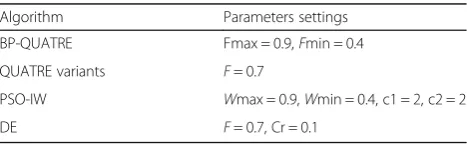
Table 1Parameters settings
Algorithm Parameters settings
BP-QUATRE Fmax = 0.9,Fmin = 0.4
QUATRE variants F= 0.7
PSO-IW Wmax = 0.9,Wmin = 0.4, c1 = 2, c2 = 2
important aspect to measure the performance of WSN. Let each sensor can cover an area Ciand A is the total size of the region of interest. Then, the coverage rate CR is calculated by the Eq.13.
CR¼ ⋃Ci
A i∈N ð14Þ
However, it is too complicated to calculate the cover-age rate of randomly deployed sensor networks by Eq. 13. Therefore, this paper uses the grid scanning method [37] to evaluate the coverage rate. According to [37], CR is evaluated as the Eq.14.
CR¼ m
n ð15Þ
5 Experimental results and discussion
A set of experiments was conducted to evaluate the per-formance of the proposed algorithm BP-QUATRE and its application to dynamic deployment in WSN.
5.1 Experimental results for BP-QUATRE
In this subsection, we evaluate the performance of the
proposed BP-QUATRE algorithm on CEC2013 [40] test
Table 2Performance for BP-QUATRE, QUATRE/target-to-best/1, and QUATRE/best/1
30D QUATRE/target-to-best/1 QUATRE/best/1 BP-QUATRE
Best Mean Std Best Mean Std Best Mean Std
1 0.0000E+ 00 4.5475E-15 3.2155E-14 0.0000E+ 00 2.2737E-14 6.8905E-14 0.0000E+ 00 5.9117E-14 1.0075E-13
2 3.4918E+ 04 2.0307E+ 05 9.1401E+ 04 6.5779E+ 04 3.2526E+ 05 1.7428E+ 05 8.0342E+ 04 3.2499E+ 05 1.8932E+ 05
3 3.3344E-08 1.2152E+ 04 4.2407E+ 04 6.4313E-02 1.1505E+ 06 3.0040E+ 06 4.0302E-05 6.8721E+ 05 2.9931E+ 06
4 1.3712E+ 00 9.6559E+ 00 7.2335E+ 00 4.1346E+ 00 2.1215E+ 01 1.5656E+ 01 6.7090E+ 00 3.8516E+ 01 2.5066E+ 01
5 0.0000E+ 00 1.0914E-13 2.2504E-14 0.0000E+ 00 1.0914E-13 2.2504E-14 0.0000E+ 00 1.1369E-13 2.2968E-14
6 2.8398E-09 1.8153E+ 00 6.2792E+ 00 2.9877E-04 7.3092E+ 00 1.0870E+ 01 4.5328E-03 1.0260E+ 01 8.0606E+ 00
7 1.9057E-01 3.8445E+ 00 4.0489E+ 00 1.1364E+ 00 2.1349E+ 01 1.7591E+ 01 7.2738E-02 4.9636E+ 00 3.9591E+ 00
8 2.0749E+ 01 2.0933E+ 01 5.1788E-02 2.0849E+ 01 2.1004E+ 01 5.8828E-02 2.0827E+ 01 2.0953E+ 01 4.7373E-02
9 1.0130E+ 01 2.6120E+ 01 6.0410E+ 00 5.8076E+ 00 1.6079E+ 01 5.5873E+ 00 9.7462E+ 00 2.2635E+ 01 5.7088E+ 00
10 5.6843E-14 2.7047E-02 1.5235E-02 0.0000E+ 00 2.3154E-02 1.5496E-02 7.3960E-03 2.0791E-02 1.1579E-02
11 2.3082E+ 01 2.7925E+ 01 2.5361E+ 00 1.3929E+ 01 2.6411E+ 01 8.3326E+ 00 1.7053E-13 4.4972E+ 00 1.8006E+ 00
12 9.0630E+ 01 1.1724E+ 02 1.3886E+ 01 3.9359E+ 01 7.5733E+ 01 1.8919E+ 01 1.9899E+ 01 5.3234E+ 01 1.5281E+ 01
13 1.0132E+ 02 1.3263E+ 02 1.5255E+ 01 5.2197E+ 01 1.1252E+ 02 3.2964E+ 01 5.8213E+ 01 1.0634E+ 02 2.4064E+ 01
14 9.9796E+ 02 1.3914E+ 03 1.9533E+ 02 1.0081E+ 02 8.1082E+ 02 2.6067E+ 02 1.0878E+ 01 1.9290E+ 02 1.2680E+ 02
15 5.3901E+ 03 6.3005E+ 03 3.4954E+ 02 3.3512E+ 03 5.1268E+ 03 7.7891E+ 02 2.7376E+ 03 4.0668E+ 03 5.3740E+ 02
16 1.8510E+ 00 2.3565E+ 00 2.4224E-01 1.3247E+ 00 2.4246E+ 00 4.5226E-01 9.4808E-01 1.8071E+ 00 4.0821E-01
17 5.5094E+ 01 6.1017E+ 01 2.5301E+ 00 2.1370E+ 01 5.5165E+ 01 1.1812E+ 01 1.7609E+ 00 3.0571E+ 01 7.3126E+ 00
18 1.6116E+ 02 1.8968E+ 02 9.6887E+ 00 1.0816E+ 02 1.6029E+ 02 2.5169E+ 01 5.2189E+ 01 1.0584E+ 02 2.3166E+ 01
19 2.7404E+ 00 4.6348E+ 00 4.7267E-01 1.6863E+ 00 3.6567E+ 00 7.7921E-01 1.0161E+ 00 1.7223E+ 00 3.4349E-01
20 1.0903E+ 01 1.1871E+ 01 3.6616E-01 1.0342E+ 01 1.2062E+ 01 6.4629E-01 1.0035E+ 01 1.1254E+ 01 4.9221E-01
21 2.0000E+ 02 3.0384E+ 02 7.7553E+ 01 2.0000E+ 02 3.1932E+ 02 8.3201E+ 01 2.0000E+ 02 3.0271E+ 02 8.2769E+ 01
22 1.0740E+ 03 1.4937E+ 03 1.9286E+ 02 4.5570E+ 02 8.3787E+ 02 2.5055E+ 02 6.2475E+ 01 2.4699E+ 02 1.0913E+ 02
23 4.5981E+ 03 6.0880E+ 03 5.3171E+ 02 3.7200E+ 03 5.3213E+ 03 8.4120E+ 02 2.6820E+ 03 4.0320E+ 03 7.2841E+ 02
24 2.0017E+ 02 2.1733E+ 02 1.4867E+ 01 2.1116E+ 02 2.3769E+ 02 1.1610E+ 01 2.0020E+ 02 2.3468E+ 02 1.6071E+ 01
25 2.3653E+ 02 2.5235E+ 02 8.2988E+ 00 2.4178E+ 02 2.5758E+ 02 8.0331E+ 00 2.4144E+ 02 2.5694E+ 02 1.2474E+ 01
26 2.0001E+ 02 2.4606E+ 02 6.6115E+ 01 2.0001E+ 02 2.4558E+ 02 6.4221E+ 01 2.0001E+ 02 2.1684E+ 02 4.6111E+ 01
27 3.2346E+ 02 6.1723E+ 02 1.7389E+ 02 5.5559E+ 02 6.9637E+ 02 9.3585E+ 01 4.1966E+ 02 7.5219E+ 02 1.5375E+ 02
28 1.0000E+ 02 3.5818E+ 02 2.5128E+ 02 1.0000E+ 02 3.7948E+ 02 2.8873E+ 02 3.0000E+ 02 3.0000E+ 02 2.9792E-13
win 9 10 14 3 1 4 12 16 9
lose 15 17 13 21 26 23 13 12 19
suite for real-parameter optimization, which includes unimodal functions (f1-f5), multimodal functions (f6-f20), and composition functions (f21-f28). The names and search ranges of this 28 benchmark functions can be found in [40], and they are shifted to the same global best location O{o1, o2, …, od}.
Firstly, we compare the BP-QUATRE with the two
QUATRE variants “QUATRE/target-to-best/1” and
“QUATRE/best/1” as BP-QUATRE employs these two
mutation strategies. Then, we compare the BP-QUATRE with inertia weight PSO and standard DE due to the
relationship among them as described in ref [5]. The
parameter settings of the algorithms are shown in
Table 1. The dimensions of all functions are set to
30. The population size ps is set to 100 for each algo-rithm, and the maximal number of function evalu-ation (NFE) is 3,000,000. We run each algorithm on each benchmark function 50 times independently. The best, mean, and standard deviation of the
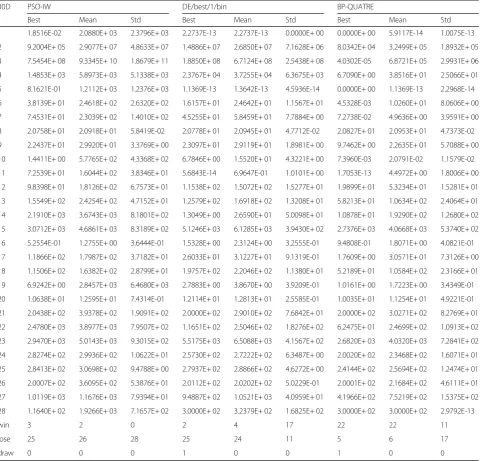
func-tion error are collected in Table 2 and Table 3. The
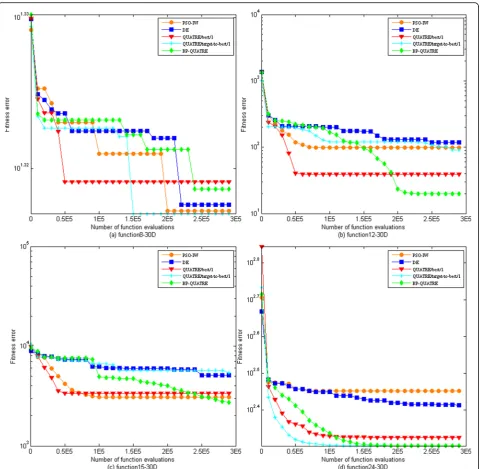
simulation results of some benchmark functions are shown in Fig. 2.
Table 3Performance for BP-QUATRE, PSO-IW, and DE algorithms
30D PSO-IW DE/best/1/bin BP-QUATRE
Best Mean Std Best Mean Std Best Mean Std
1 1.8516E-02 2.0880E+ 03 2.3796E+ 03 2.2737E-13 2.2737E-13 0.0000E+ 00 0.0000E+ 00 5.9117E-14 1.0075E-13
2 9.2004E+ 05 2.9077E+ 07 4.8633E+ 07 1.4886E+ 07 2.6850E+ 07 7.1628E+ 06 8.0342E+ 04 3.2499E+ 05 1.8932E+ 05
3 7.5454E+ 08 9.3345E+ 10 1.8679E+ 11 1.8850E+ 08 6.7124E+ 08 2.5438E+ 08 4.0302E-05 6.8721E+ 05 2.9931E+ 06
4 1.4853E+ 03 5.8973E+ 03 5.1338E+ 03 2.3767E+ 04 3.7255E+ 04 6.3675E+ 03 6.7090E+ 00 3.8516E+ 01 2.5066E+ 01
5 8.1621E-01 1.2112E+ 03 1.2376E+ 03 1.1369E-13 1.3642E-13 4.5936E-14 0.0000E+ 00 1.1369E-13 2.2968E-14
6 3.8139E+ 01 2.4618E+ 02 2.6320E+ 02 1.6157E+ 01 2.4642E+ 01 1.1567E+ 01 4.5328E-03 1.0260E+ 01 8.0606E+ 00
7 7.4531E+ 01 2.3039E+ 02 1.4010E+ 02 4.5255E+ 01 5.8459E+ 01 7.7884E+ 00 7.2738E-02 4.9636E+ 00 3.9591E+ 00
8 2.0758E+ 01 2.0918E+ 01 5.8419E-02 2.0778E+ 01 2.0945E+ 01 4.7712E-02 2.0827E+ 01 2.0953E+ 01 4.7373E-02
9 2.2437E+ 01 2.9920E+ 01 3.3769E+ 00 2.3097E+ 01 2.9119E+ 01 1.8981E+ 00 9.7462E+ 00 2.2635E+ 01 5.7088E+ 00
10 1.4411E+ 00 5.7765E+ 02 4.3368E+ 02 6.7846E+ 00 1.5520E+ 01 4.3221E+ 00 7.3960E-03 2.0791E-02 1.1579E-02
11 7.2539E+ 01 1.6044E+ 02 3.8346E+ 01 5.6843E-14 6.9647E-01 1.0101E+ 00 1.7053E-13 4.4972E+ 00 1.8006E+ 00
12 9.8398E+ 01 1.8126E+ 02 6.7573E+ 01 1.1538E+ 02 1.5072E+ 02 1.5277E+ 01 1.9899E+ 01 5.3234E+ 01 1.5281E+ 01
13 1.5549E+ 02 2.4254E+ 02 4.7152E+ 01 1.2579E+ 02 1.6918E+ 02 1.3208E+ 01 5.8213E+ 01 1.0634E+ 02 2.4064E+ 01
14 2.1910E+ 03 3.6743E+ 03 8.1801E+ 02 1.3049E+ 00 2.6590E+ 01 5.0098E+ 01 1.0878E+ 01 1.9290E+ 02 1.2680E+ 02
15 3.0712E+ 03 4.6861E+ 03 8.3189E+ 02 5.1246E+ 03 6.1285E+ 03 3.9430E+ 02 2.7376E+ 03 4.0668E+ 03 5.3740E+ 02
16 5.2554E-01 1.2755E+ 00 3.6444E-01 1.5328E+ 00 2.3124E+ 00 3.2555E-01 9.4808E-01 1.8071E+ 00 4.0821E-01
17 1.1866E+ 02 1.7987E+ 02 3.7182E+ 01 2.6033E+ 01 3.1227E+ 01 9.1319E-01 1.7609E+ 00 3.0571E+ 01 7.3126E+ 00
18 1.1506E+ 02 1.6382E+ 02 2.8799E+ 01 1.9757E+ 02 2.2046E+ 02 1.1380E+ 01 5.2189E+ 01 1.0584E+ 02 2.3166E+ 01
19 6.9242E+ 00 2.8457E+ 03 6.4680E+ 03 2.7883E+ 00 3.8670E+ 00 3.9209E-01 1.0161E+ 00 1.7223E+ 00 3.4349E-01
20 1.0638E+ 01 1.2595E+ 01 7.4314E-01 1.2114E+ 01 1.2813E+ 01 2.5585E-01 1.0035E+ 01 1.1254E+ 01 4.9221E-01
21 2.0438E+ 02 3.9378E+ 02 1.9091E+ 02 2.0000E+ 02 2.9010E+ 02 7.6842E+ 01 2.0000E+ 02 3.0271E+ 02 8.2769E+ 01
22 2.4780E+ 03 3.8977E+ 03 7.9507E+ 02 1.1651E+ 02 2.5046E+ 02 1.8276E+ 02 6.2475E+ 01 2.4699E+ 02 1.0913E+ 02
23 2.9470E+ 03 5.0143E+ 03 9.3015E+ 02 5.5175E+ 03 6.5088E+ 03 4.1567E+ 02 2.6820E+ 03 4.0320E+ 03 7.2841E+ 02
24 2.8274E+ 02 2.9936E+ 02 1.0622E+ 01 2.5730E+ 02 2.7222E+ 02 6.3487E+ 00 2.0020E+ 02 2.3468E+ 02 1.6071E+ 01
25 2.8413E+ 02 3.0698E+ 02 9.4788E+ 00 2.7937E+ 02 2.8866E+ 02 4.6272E+ 00 2.4144E+ 02 2.5694E+ 02 1.2474E+ 01
26 2.0007E+ 02 3.6095E+ 02 5.3876E+ 01 2.0112E+ 02 2.0202E+ 02 5.0229E-01 2.0001E+ 02 2.1684E+ 02 4.6111E+ 01
27 1.0119E+ 03 1.1676E+ 03 7.9394E+ 01 9.4887E+ 02 1.0521E+ 03 4.0959E+ 01 4.1966E+ 02 7.5219E+ 02 1.5375E+ 02
28 1.1640E+ 02 1.9266E+ 03 7.1657E+ 02 3.0000E+ 02 3.2379E+ 02 1.6825E+ 02 3.0000E+ 02 3.0000E+ 02 2.9792E-13
win 3 2 0 2 4 17 22 22 11
lose 25 26 28 25 24 11 5 6 17
From Table 2, we can see that BP-QUATRE has significantly better performance than the other two QUATRE variants over 28 benchmark functions. The BP-QUATRE finds 12 best values and 16 mean values of CEC2013 benchmark functions in comparison QUATRE variants. This is because the BP-QUATRE can take ad-vantage of different mutation strategies to maintain population diversity, and its linear decrease scale factor
control strategy is helpful to balance exploration and exploitation ability. For the standard deviation, the
“QUATRE/target-to-best/1” has better performance than
“QUATRE/best/1” and QUATRE algorithms, and
BP-QUATRE algorithm has better performance than“
QUA-TRE/best/1.” In addition, we can observe that QUATRE
variants with different mutation strategies have different
performance. The “QUATRE/target-to-best/1” performs
better on unimodal and composition functions than
“QUATRE/best/1,”, while the“QUATRE/best/1”performs
better on multimodal functions than“
QUATRE/target-to-best/1.”
From Table 3, we can see that, for the best value, the PSO-IW algorithm finds 3 minimum values of 28 benchmark functions. The DE algorithm finds 2 mini-mum values of 28 benchmark functions. While our pro-posed BP-QUATRE algorithm finds 22 minimum values
of 28 benchmark functions in comparison with PSO-IW and DE algorithms, and thus, it has overall better performance than the contrasted algorithms. For the mean, our proposed algorithm also has significantly better performance than the competing algorithms. For the standard deviation, the DE algorithm has better performance than PSO-IW and BP-QUATRE algo-rithms, and BP-QUATRE algorithm has better perform-ance than PSO-IW algorithm. Overall, our proposed
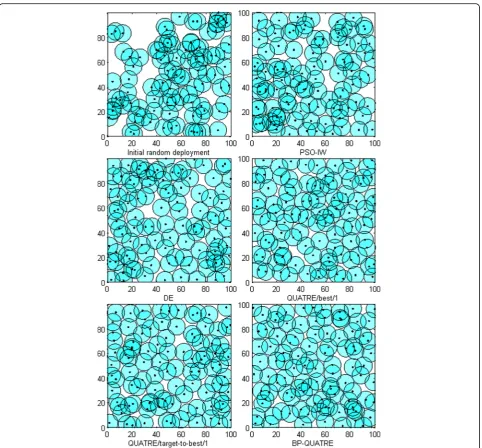
Fig. 3Initial random deployment and final sensor positions based on each algorithm. The figure presents Initial random deployment and the
BP-QUATRE algorithm has better performance than the other two competing algorithms.
5.2 Simulation results for dynamic deployment in WSN
Simulations are conducted to evaluate the performance of BP-QUATRE algorithm in the dynamic deployment of WSN. The simulation results of the proposed algorithm are compared with the results of the PSO-IW, DE, and two QUATRE variants.
To make the simulation results more reliable, the par-ameter settings such as the target area, the number of sensors, and their detection radius are according to [34]. The monitored target area is a square region with a size of 100 m × 100 m, and 100 sensor nodes are scattered randomly on this target region. The parameter settings for the probabilistic detection model are α1= 1, α2= 0, β1= 1, and β2= 1.5. And the detection radius of each sensor node is 7 m, the uncertainty parameter of meas-urementreis 3.5 m, and the communication radiusrcis 21 m. The effective detection threshold cth is 0.7. The control parameters of each algorithm are the same as in
Section 5.1 except that the acceleration coefficients c1 and c2 of the PSO are set to 1. The population size ps is set to 40, and the number of iterations is 1000. We run each algorithm 10 times independently with the same initialization.
One of initial deployments and the final best deploy-ments of WSN after executing all competing algorithms based on the probabilistic detection model are shown in
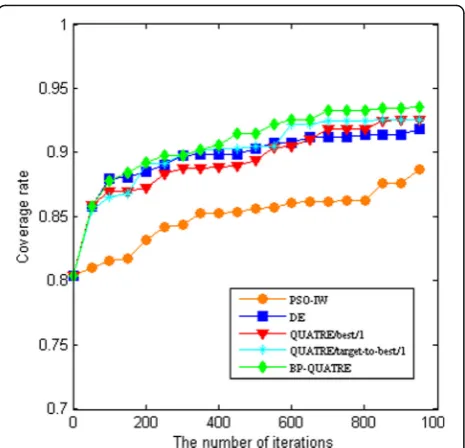
Fig. 3. The best convergences of each algorithm are
shown in Fig.4by coverage rate for the number of itera-tions. The best, mean, and standard deviation of the coverage rates for the mentioned algorithms are given in Table4. Obviously, it can be seen that our proposed BP-QUATRE has better performance than other two QUA-TRE variants and all QUAQUA-TRE algorithms have better performance than PSO-IW and DE algorithm. In other words, BP-QUATRE has better coverage rate than the other four competing algorithms in the dynamic deploy-ment of WSN. This is certainly related to the more powerful exploration and exploitation capability of the BP-QUATRE algorithm.
6 Conclusion
This paper proposes a novel BP-QUATRE algorithm for optimization problems. In BP-QUATRE, the population is divided into two subpopulations with sort strategy, and each subpopulation employs a dif-ferent mutation strategy to balance between the di-versity and convergence rate. In addition, adjusting scale factor with linear decrease strategy is adopted in BP-QUATRE algorithm to balance between ex-ploration and exploitation ability. The proposed algorithm is verified under CEC2013 test suite. The experimental results demonstrate that the proposed BP-QUATRE algorithm not only has better
perform-ance than QUATRE variants “
QUATRE/target-to-best/1” and “QUATRE/best/1,” but also has better
performance than the PSO-IW algorithm and DE algorithm. We also apply the proposed BP-QUATRE algorithm to dynamic deployment in WSN. The simulation results demonstrate that the proposed BP-QUATRE algorithm has better coverage rate than the other competing algorithms. In the future work, we will apply BL-QUATRE algorithm to classify music genre [41].
Fig. 4Comparison of coverage rates of the proposed algorithm
with the other algorithms, e.g., PSO-IW, DE, QUATRE/best/1 and QUATRE/targetto-best/1
Table 4Performance for competing algorithms in the dynamic deployment of WSN
PSO-IW DE QUATRE/best/1 QUATRE/target-to-best/1 BP-QUATRE
Best 0.8873 0.9183 0.9367 0.9305 0.9389
Mean 0.8629 0.9143 0.9212 0.9187 0.9362
Worse 0.8443 0.9084 0.9149 0.9123 0.9331
Abbreviations
BP-QUATRE:Bi-population QUATRE; DE: Differential evolution; PSO: Particle swarm optimization; PSO-IW: Inertia weight PSO; QUATRE: QUasi-Affine TRansformation Evolution algorithm; Std: Standard deviation; WSN: Wireless sensor networks
Acknowledgements
The authors would like to thank Prof. Zhenyu Meng for providing the code of QUATRE.
Authors’contributions
NL proposed the idea of the BP-QUATRE algorithm. He also carried out the simulations and drafted the paper. JP supervised the work and introduced the idea of applying the proposed BP-QUATRE algorithm into dynamic de-ployment in WSN. TN gave some suggestions for the paper and revised the manuscript. All authors read and approved the final manuscript.
Authors’information
Nengxian Liu is a Ph.D. candidate in the College of Mathematics and Computer Science, Fuzhou University. His research interest includes computing intelligence and sensor networks.
Jeng-Shyang Pan received the Ph.D. degree in Electrical Engineering from the University of Edinburgh, UK, in 1996. Now, he is the Dean in the College of Information Science and Engineering, Fujian University of Technology. His current research interests include soft computing, sensor networks and signal processing.
Trong-The Nguyen received his Ph.D. degree in Communication Engineering from the National Kaohsiung University of Applied Sciences, Taiwan, in 2016. He is currently a lecturer in the College of Information Science and Engineering, Fujian University of Technology. His current research interests include computational intelligence and sensor networks.
Funding
No funding.
Availability of data and materials
Not applicable.
Competing interests
The authors declare that there are no competing interests.
Author details
1College of Mathematics and Computer Science, Fuzhou University, Fuzhou
350108, China.2Fujian Provincial Key Laboratory of Big Data Mining and Applications, Fujian University of Technology, Fuzhou 350118, China.
3
College of Computer Science and Engineering, Shandong University of Science and Technology, Qingdao 266510, China.4Department of
Information Technology, University of Manage and Technology, Haiphong 180000, Vietnam.
Received: 18 February 2019 Accepted: 29 May 2019
References
1. R. Storn, K. Price, Differential evolution-a simple and efficient heuristic for global optimization over continuous spaces. J. Global Optim.11(4), 341–359 (1997) 2. J. Kennedy, R. Eberhart,Particle Swarm Optimization(Proceedings of IEEE
International Conference on Neural Networks, Perth, 1995) 3. M. Dorigo, V. Maniezzo, A. Colorni, Ant system: Optimization by a colony of
cooperating agents. IEEE Trans. Syst. Man Cybern. Part B Cybern.26(1), 29–41 (1996) 4. D. Karaboga, B. Basturk, A powerful and efficient algorithm for numerical
function optimization: artificial bee colony (ABC) algorithm. J. Glob. Optim. 39(3), 459–471 (2007)
5. Z.Y. Meng, J.S. Pan, X. HR, QUasi-Affine TRansformation Evolutionary (QUATRE) algorithm: A cooperative swarm based algorithm for global optimization. Knowl.-Based Syst.109, 104–121 (2016)
6. Y.H. Shi, R. Eberhart,A Modified Particle Swarm Optimizer(Proceedings of the IEEE Conference on Evolutionary Computation, Anchorage, 1998) 7. B. Liu, L. Wang, et al., Improved particle swarm optimization combined with
chaos. Chaos Solison. Fract.25(5), 1261–1271 (2005)
8. R. Cheng, Y.C. Jin, A social learning particle swarm optimization algorithm for scalable optimization. Inf. Sci.291, 43–60 (2015)
9. J.H. Liu, J. Lampinen, A fuzzy adaptive differential evolution algorithm. Soft. Comput.9(6), 448–462 (2005)
10. J. Brest, S. Greiner, et al., Self-adapting control parameters in differential evolution: A comparative study on numerical benchmark problems. IEEE Trans. Evol. Comput.10(6), 646–657 (2006)
11. S. Rahnamayan, H.R. Tizhoosh, M.M.A. Salama, Opposition-based differential evolution. IEEE Trans. Evol. Comput.12(1), 64–79 (2008)
12. Z.Y. Meng, J.S. Pan,QUasi-affine TRansformation Evolutionary (QUATRE) algorithm: A parameter-reduced differential evolution algorithm for optimization problems(IEEE Congress on Evolutionary Computation (CEC), Vancouver, 2016)
13. Z.Y. Meng, J.S. Pan,QUasi-Affine TRansformation Evolutionary (QUATRE) Algorithm: The Framework Analysis for Global Optimization and Application in Hand Gesture Segmentation(2016 IEEE 13th International Conference on Signal Processing, Chengdu, 2016)
14. Z.Y. Meng, J.S. Pan, Monkey king evolution: A new memetic evolutionary algorithm and its application in vehicle fuel consumption optimization. Knowl.-Based Syst.97, 144–157 (2016)
15. Z.Y. Meng, J.S. Pan, X.Q. Li,The QUasi-Affine TRansformation Evolution (QUATRE) Algorithm: An Overview(The Euro-China Conference on Intelligent Data Analysis and Applications, Málaga, 2017)
16. J.S. Pan, Z.Y. Meng, et al.,QUATRE algorithm with sort strategy for global optimization in comparison with DE and PSO variants(The Euro-China Conference on Intelligent Data Analysis and Applications, Málaga, 2017) 17. Z.Y. Meng, J.S. Pan, QUasi-Affine TRansformation Evolution with External ARchive (QUATRE-EAR): An enhanced structure for differential evolution. Knowl.-Based Syst.155, 35–53 (2018)
18. I. Loshchilov, M. Schoenauer, M. Sebag,Bi-Population CMA-ES Agorithms with Surrogate Models and Line Searches(Proceedings of the 15th Annual Conference Companion on Genetic and Evolutionary Computation, Amsterdam, 2013), pp. 1177–1184
19. J.F. Chang, S.C. Chu, et al., A parallel particle swarm optimization algorithm with communication strategies. J. Inf. Sci. Eng.21(4), 809–818 (2005) 20. Y. WJ, J. Zhang,Multi-population differential evolution with adaptive
parameter control for global optimization(Proceedings of the 13th Annual Genetic and Evolutionary Computation Conference, Dublin, 2011) 21. L.Z. Cui, G.H. Li, et al., Adaptive differential evolution algorithm with novel
mutation strategies in multiple sub-populations. Comput. Oper. Res.67, 155–173 (2016)
22. P.W. Tsai, J.S. Pan,Parallel Cat Swarm Optimization(Proceedings of the Seventh International Conference on Machine Learning and Cybernetics, Kunming, 2008)
23. S. Das, P.N. Suganthan, Differential evolution: A survey of the state-of-the-art. IEEE Trans.Evol. Comput.15(1), 4–31 (2011)
24. S. Das, A. Konar, et al.,Two improved differential evolution schemes for faster global search(Genetic and Evolutionary Computation Conference, Washington DC, 2005)
25. J.S. Pan, L.P. Kong, T.W. Sung, et al.,α-Fraction first strategy for hierarchical model in wireless sensor networks. J Internet Technol.19(6), 1717–1726 (2018) 26. S. Abdollahzadeh, N.J. Navimipour, Deployment strategies in the wireless sensor
network: A comprehensive review. Comput.Commun.,91, 1–16 (2016) 27. J.S. Pan, L.P. Kong, T.W. Sung, et al., A clustering scheme for wireless sensor
networks based on genetic algorithm and dominating set. J Internet Technol.19(6), 1111–1118 (2018)
28. H. YFa, C.H. Hsu, Energy efficiency of dynamically distributed clustering routing for naturally scattering wireless sensor networks. J Netw Intell3(1), 50–57 (2018) 29. X.C. Bao, C.Z. Deng, et al., Topology optimization of fault tolerant target
monitoring for energy harvesting wireless sensor network. J Netw Intell2(4), 310–321 (2017)
30. Y. Zou, K. Chakrabarty,Sensor Deployment and Target Localization Based on Virtual Forces(Proceedings of the 22nd Annual Joint Conference of the IEEE Computer and Communications Societies, San Francisco, 2003)
31. G.L. Wang, G.H. Cao, Movement-assisted sensor deployment. IEEE T Mobile Comput.5(6), 640–652 (2006)
32. X.L. Wu, L. Shu, et al.,Swarm Based Sensor Deployment Optimization In Ad-Hoc Sensor Networks(Proceedings of the 2nd International Conference on Embedded Software and Systems, Xi’an, 2005)
34. X.Y. Yu, J.X. Zhang, et al., A faster convergence artificial bee colony algorithm in sensor deployment for wireless sensor networks. Int. J. Distrib. Sens. N1-9, 2013 (2013)
35. L.Z. Jin, J. Jia, et al.,Node Distribution Optimization in Mobile Sensor Network Based on Multi-Objective Differential Evolution Algorithm(2010 Fourth International Conference on Genetic and Evolutionary Computing, Shenzhen, 2010)
36. Y. Zou, K. Chakrabarty,Sensor Deployment and Target Localization Based on Virtual Forces(IEEE INFOCOM 2003. Twenty-second Annual Joint Conference of the IEEE Computer and Communications Societies, San Francisco, 2003) 37. K. Chakrabarty, S.S. Iyengar, et al., Grid coverage for surveillance and target
location in distributed sensor networks. IEEE. T. Comput.51(12), 1448–1453 (2002) 38. S.J. Li, C.F. Xu, et al.,Sensor Deployment Optimization for Detecting
Maneuvering Targets(Proceedings of the 7th international conference on information fusion, Philadelphia, 2005)
39. S.M.A. Salehizadeh, A. Dirafzoon, et al.,Coverage in Wireless Sensor Networks Based on Individual Particle Optimization(Proceedings of the IEEE International Conference on Networking, Sensing and Control, Chicago, 2010)
40. J. Liang et al.,Problem Definitions and Evaluation Criteria for the CEC 2013 Special Session on Real-Parameter Optimization(Computational Intelligence Laboratory, Zhengzhou University, Zhengzhou, China and Nanyang Technological University, Singapore, Technical report 2012, 2013) 41. Y.T. Chen, C.H. Chen, et al., A two-step approach for classifying music genre
on the strength of AHP weighted musical features. Math7(1), 19 (2019)
Publisher’s Note